What's inside
- Key Takeaways
- Quick Picks
- How Did We Choose These Bagless Uprights?
- How Do the Five Picks and the Counterpoint Compare?
- How Should You Run a Bagless Pet Machine Day to Day?
- What Mistakes Shorten a Bagless Pet Vacuum’s Life?
- How Do You Handle Stairs and Furniture Without a Lift-Off Pod?
- How Does the Cup-Emptying Ritual Actually Work Well?
- Why Does a Spare Filter Change Bagless Ownership?
- How Should Moult Season Change a Bagless Routine?
- What Is the Two-Machine Strategy for Serious Pet Homes?
- How Do You Keep a Bagless Machine Smelling Neutral?
- How Should Renters and Students Judge These Picks?
- What About the Car, the Pram and Other Hair Colonies?
- How Do You Choose Between the Two Bissells?
- When Does It Make Sense to Switch Formats Entirely?
- How Should You Break In a New Bagless Upright?
- What Do the Numbers on the Box Not Tell You?
- How Does Noise Affect the Pet Household’s Cleaning Hours?
- How Do You Vacuum a Home Where the Dog Owns the Sofa?
- What Should a Second-Hand Buyer of These Models Check?
- How Should Guests and Visitors Change the Routine?
- How Do You Store a Bagless Upright Between Cleans?
- What Is the Honest Cost of a Year of Bagless Pet Cleaning?
- How Should a Household with Several Cleaners Keep the Rhythm?
- A Last Word on Puppies, Kittens and the First Year
- How Do You Deep-Clean with a Bagless Upright Seasonally?
- Why Does the Entrance Matter as Much as the Machine?
- How Should You Decide if One Machine Must Do Everything?
- A Note on Letting the Animals Inspect the New Machine
- One More Consideration: The Household’s Hands
- Final Recommendation
- Frequently Asked Questions
- Related Guides
As an Amazon Associate I earn from qualifying purchases. This post may contain affiliate links at no extra cost to you.
cottageverdict.com is reader-supported. When you buy through links on our site, we may earn an affiliate commission.
Where to buy: the five linked uprights below are sold on Amazon, and each linked name leads to its listing, where you can check price on Amazon and confirm the included pet tools before ordering.
Plenty of pet homes choose bagless with their eyes open, and this guide respects the choice. The best bagless upright vacuums for pet hair answer a simple household argument: no bags to buy, a clear cup that shows the harvest, and machines at tiers where a family with a dog can replace a tired vacuum without a financial summit. What they ask in return is a rhythm — the cup emptied often, the filters kept honest — and the five picks below are the uprights that repay that rhythm most faithfully, with tangle-resistant brushes, lift-off pods and pet tools designed by people who clearly own animals.
Hair remains hair, whatever the format. It wraps, it mats, it fills volume at a rate that embarrasses small cups, and it turns filter maintenance from a footnote into a headline. So this round-up scores the bagless virtues honestly: cup capacity, brushroll behaviour around hair, the quality of the pet tooling, how gracefully the machine empties, and whether its filters are washable, affordable and actually available. One prose-only section then makes the counter-argument in full — bagged pet machines as the low-dust alternative — because a reader choosing between formats deserves both cases argued by someone who respects them.
The spread here runs from Bissell’s purpose-built Pet Hair Eraser with its lift-off pod and tangle-free brushroll, through Shark’s swivelling Navigator and Bissell’s budget CleanView, to Eureka’s featherweight PowerSpeed and Dirt Devil’s reach-extended Endura. Between them they cover flats, family houses and every budget a pet can shed on. Choose by your animals and your tolerance for cup-emptying, and the right machine will announce itself.
Key Takeaways
- Bagless pet ownership is a rhythm, not a purchase: frequent cup emptying and honest filter care keep suction where the brochure promised.
- Tangle-free and anti-wrap brushrolls are the headline pet feature, cutting the weekly scissor ritual to a rare event.
- The Bissell Pet Hair Eraser Lift-Off is the specialist; the Shark NV360 is the versatile all-rounder with a sealed HEPA path.
- The CleanView, PowerSpeed and Endura Reach prove pet-capable uprights exist at genuinely accessible tiers.
- Read the prose-only section before deciding: bagged machines remain the low-dust, low-maintenance alternative for heavy shedders.
Quick Picks
| Pick | Badge | Why it earns its place |
|---|---|---|
| Bissell Pet Hair Eraser Lift-Off | Pet Specialist | Tangle-free brushroll, lift-off pod for stairs and furniture, and HEPA filtration aimed at pet households. |
| Shark Navigator Lift-Away NV360 | Best All-Rounder | Lift-away versatility, swivel steering and brushroll shutoff for the carpet-to-hard-floor pet home. |
| Bissell CleanView Swivel Pet Upright 2252 | Budget Pet Pick | Triple-action brushroll and swivel steering at the tier where pet vacuums become an easy yes. |
| Eureka PowerSpeed Bagless Upright NEU182B | Lightest Bagless Pick | A ten-pound upright with a big cup and height adjustment that small pet homes can use daily. |
| Dirt Devil Endura Reach Upright | Reach and Value Pick | Extended reach for above-floor hair patrols in a light, simple, accessible package. |
| Bagged Pet Machines as the Low-Dust Alternative | Prose-Only Counterpoint | The honest trade-off: sealed bags, steadier suction and no cup-emptying cloud, weighed against bag costs. |
How Did We Choose These Bagless Uprights?
We judged bagless machines by the burdens the format itself creates. Cup capacity came first, because pet hair fills volume faster than any other debris and a small cup turns every clean into a relay of bin trips. Brushroll behaviour came second: tangle-free and self-cleaning designs were weighted heavily, since a roller wound in hair is a roller that has stopped cleaning. Emptying grace came third — how the cup releases, how much dust escapes, whether the filter is a separate washable piece or a handful of loose media.
Pet tooling and above-floor reach decided the ties, because pet hair lives on stairs, sofas and car seats as much as on floors. Finally we checked the consumables story honestly: bagless does not mean costless, and the price and availability of replacement filters belong in any fair comparison with the bagged alternative discussed later in this guide.

Bissell Pet Hair Eraser Lift-Off — Pet Specialist
Bissell’s Pet Hair Eraser line has spent years as the bagless pet benchmark, and the Lift-Off version is its most complete argument. The tangle-free brushroll is the headline: hair feeds through instead of winding, so the roller keeps beating the carpet week after week without the scissor interventions that define lesser machines. Lift the pod off and the same suction walks the stairs and scrubs the sofa with the pet tools, which is where pet hair actually concentrates and where a floor-bound upright is merely a spectator.
Swivel steering keeps the full-size head nimble around the furniture animals colonise, the HEPA filtration gives the exhaust a discipline many bagless rivals skip, and the whole machine feels specified by a company that has interviewed a great many dog owners. For a pet household committed to bagless, this is the machine the commitment deserves.
- Format: bagless upright with lift-off pod
- Brushroll: tangle-free design
- Filtration: HEPA, with allergen-focused system design
- Tools: upholstery and crevice tools for above-floor hair
Strengths
- Tangle-free brushroll deletes the worst bagless maintenance chore.
- Lift-off pod makes stairs and furniture first-class territory.
- HEPA filtration keeps the exhaust cleaner than most bagless rivals.
Trade-offs
- Premium tier among this guide’s bagless picks.
- Cup still needs frequent emptying in heavy-shed homes.
- Heavier than the featherweight Eureka and Dirt Devil.
Best for: committed bagless pet households wanting the specialist machine. Not suited for: buyers wanting the lightest possible daily patrol.

Shark Navigator Lift-Away NV360 — Best All-Rounder
The NV360 is the bagless upright that households buy once and then recommend to relatives for a decade, and its pet case is versatility rather than specialisation. The lift-away pod detaches for stairs and above-floor work, the brushroll shuts off for hard floors where pet hair and litter grit scatter, swivel steering threads the machine between chair legs, and the HEPA-filtered sealed path is unusual discipline at this tier. It is a generalist that happens to be very good at the pet brief because the pet brief, in most homes, is mostly general housework plus hair.
Its cup is modest, which heavy shedders will notice, but everything else about the machine — parts availability, tool competence, the sheer number of households it has satisfied — argues for it as the default bagless answer. If your home mixes floors, animals and stairs in ordinary proportions, the NV360 is where this guide expects most readers to land.
- Format: bagless upright with lift-away pod
- Filtration: HEPA filter, sealed-path design
- Features: swivel steering, brushroll shutoff
- Cup: compact dust cup with upholstery and crevice tools
Strengths
- Lift-away format covers stairs and furniture without a second machine.
- Brushroll shutoff makes hard floors and litter zones manageable.
- Proven, widely stocked design with easy parts availability.
Trade-offs
- Compact cup fills quickly during moult season.
- Brushroll is not a dedicated tangle-free design.
- Filters need their washing rhythm kept honestly.
Best for: mixed-floor pet homes wanting one proven all-rounder. Not suited for: very heavy shedders wanting maximum cup capacity.
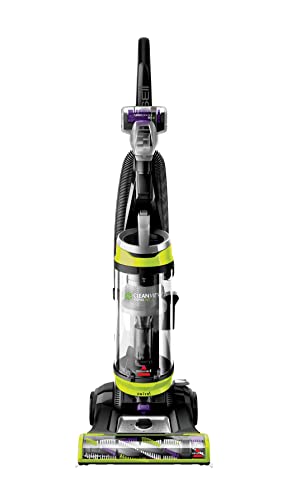
Bissell CleanView Swivel Pet Upright 2252 — Budget Pet Pick
The CleanView 2252 answers the question every budget pet household asks: how much pet vacuum does an accessible price actually buy? More than sceptics expect. Its triple-action brushroll is designed to loosen, lift and remove embedded pet hair rather than polish it, the swivel steering keeps a full-width head usable in real rooms, and the large-capacity dirt tank stretches the interval between the bin trips that define bagless life. Scatter-free technology on hard floors addresses the litter-and-kibble problem that budget rivals ignore.
It lacks the lift-off pods and tangle-free rollers of the premium picks, and its filters ask for regular attention. What it offers instead is the most pet cleaning per unit of money in this guide, from a brand whose pet commitment is structural rather than seasonal. For a first pet vacuum, a rental, or a second machine for the animals’ floor of the house, it is a thoroughly rational purchase.
- Format: bagless upright, swivel steering
- Brushroll: triple-action design for embedded pet hair
- Tank: large-capacity dirt tank
- Extras: scatter-free hard-floor behaviour, pet tools included
Strengths
- Genuine pet specification at the guide’s friendliest tier.
- Large tank reduces the bagless format’s worst chore.
- Swivel steering suits furnished, animal-occupied rooms.
Trade-offs
- No lift-off pod for stairs and upholstery depth.
- Brushroll will need periodic hair clearing.
- Filter care is entirely the owner’s responsibility.
Best for: budget-conscious pet homes and first-time pet vacuum buyers. Not suited for: households wanting lift-away versatility in the same machine.
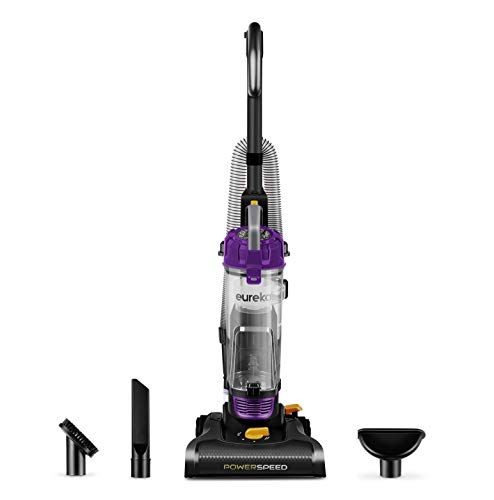
Eureka PowerSpeed Bagless Upright NEU182B — Lightest Bagless Pick
Ten pounds changes the politics of pet cleaning. The PowerSpeed is light enough that the daily patrol — the two-minute circuit of the dog’s room, the hall and the rug — happens without negotiation, and frequency, as this guide keeps arguing, is the pet household’s real weapon. Its generous dust cup swallows a patrol’s harvest without a bin trip, five height settings adapt the brush from hard floor to carpet, and the purple machine’s simplicity is a feature: nothing to configure, nothing to misunderstand, just suction where the hair is.
It is not built for the deepest pile or the heaviest moult, and its refinement is cheerful rather than luxurious. But for flats, small homes, older owners and anyone whose pet problem is daily rather than monumental, the PowerSpeed’s combination of weight, cup and price is the most persuasive in the guide.
- Format: lightweight bagless upright, around ten pounds
- Cup: large-capacity dust cup
- Adjustment: five brush height settings
- Best use: daily patrols in smaller pet homes
Strengths
- Featherweight body makes frequent cleaning genuinely happen.
- Big cup suits the daily-patrol rhythm perfectly.
- Height adjustment spans hard floors and carpet honestly.
Trade-offs
- Deep pile and heavy double coats exceed its brief.
- No lift-off pod or tangle-free brushroll.
- Light build trades away flagship solidity.
Best for: small pet homes, flats and daily-patrol households. Not suited for: large multi-dog homes with deep carpet.

Dirt Devil Endura Reach Upright — Reach and Value Pick
The Endura Reach earns its name above the floor. Its extended reach — a longer hose arrangement that lets the tools patrol stairs, upholstery and the tops of things without hauling the body — addresses the geography of pet hair, which colonises vertical and elevated territory as happily as carpet. On the floor it is a light, straightforward bagless upright with the Endura filtration system, easy to empty and easy to live with at its accessible tier.
Dirt Devil’s proposition has always been honest utility, and this machine delivers it to pet homes that need reach more than refinement. Paired with a household rhythm of frequent cups and washed filters, it covers a surprising amount of the pet brief for a machine this simple, and it makes an excellent second vacuum for the floor of the house the animals own.
- Format: lightweight bagless upright with extended reach
- Filtration: Endura filtration system
- Reach: extended hose for stairs and above-floor work
- Best use: value-focused pet homes and second-machine duty
Strengths
- Extended reach covers the vertical territory pet hair colonises.
- Light, simple and easy to empty on a frequent rhythm.
- Accessible tier suits second-machine and rental duty.
Trade-offs
- Not a deep-carpet or heavy-moult specialist.
- Brushroll needs manual hair clearing on schedule.
- Refinement sits below the premium picks.
Best for: value-focused pet homes needing above-floor reach. Not suited for: buyers wanting a single flagship for a large shedding household.
Bagged Pet Machines as the Low-Dust Alternative — Prose-Only Counterpoint
Fairness requires this section to argue against the entire guide, briefly and honestly. A bagged pet machine — the Miele Cat and Dog, the Kenmore 600 and their kin from our companion round-up — holds weeks of hair in a large sealed bag, keeps suction steadier as it fills, and empties without the cup’s characteristic puff of dust at the bin. Its filters live sheltered lives behind the bag, its brushrolls in the Kenmore’s case actively resist hair wrapping, and its owner’s chores shrink to a bag change measured in seconds per month. For heavy shedders, dust-conscious homes and anyone who hates maintenance rituals, that is not a marginal difference; it is a different ownership philosophy.
The bagless reply is equally real: no consumable bags to stock or fund, a visible cup that tells the truth about the harvest, and purchase prices that let a tired machine be replaced without grief. The trade-off, stated plainly, is money and dust against rhythm and attention. Households that will empty cups and wash filters on schedule thrive bagless, and the five machines above will serve them well. Households that know they will not should buy the bag and be done. This section is prose-only because it recommends a direction, not a product — the specific bagged picks live in the companion guide linked below.
- Bagged virtues: sealed disposal, steady suction, sheltered filters
- Bagless virtues: no bag costs, visible cup, accessible prices
- Deciding factor: the owner’s honest maintenance temperament
- Tier positioning: a format counterpoint, not a product — no purchase applies
Strengths
- Presents the format decision honestly inside a bagless guide.
- Names the maintenance temperament as the true deciding factor.
- Points heavy shedders to the format that suits their volume.
Trade-offs
- Bagged ownership carries a real, recurring consumable cost.
- Bagless machines win on purchase price at every tier.
- Neither format excuses skipping the pet tools and patrol rhythm.
Best for: readers still deciding between formats. Not suited for: readers already committed who want only model advice.
How Do the Five Picks and the Counterpoint Compare?
| Element | Type | Standout trait | Ideal home |
|---|---|---|---|
| Bissell Pet Hair Eraser Lift-Off | Linked vacuum | Tangle-free brushroll, lift-off pod | Committed bagless pet homes |
| Shark Navigator Lift-Away NV360 | Linked vacuum | Versatility, sealed HEPA path | Mixed-floor pet homes |
| Bissell CleanView Swivel Pet Upright 2252 | Linked vacuum | Pet spec at a budget tier | First pet vacuum buyers |
| Eureka PowerSpeed Bagless Upright NEU182B | Linked vacuum | Ten-pound daily patrol | Flats and small pet homes |
| Dirt Devil Endura Reach Upright | Linked vacuum | Extended above-floor reach | Value and second-machine duty |
| Bagged Pet Machines as the Low-Dust Alternative | Prose-only counterpoint | Sealed, low-maintenance ownership | Heavy shedders, dust-conscious homes |
How Should You Run a Bagless Pet Machine Day to Day?
Empty the cup before it asks. Hair compresses deceptively, and a cup that looks two-thirds full is often functionally full at the filter, so the pet household’s rule is to empty at the end of every substantial clean and during any clean where the harvest is heavy. Empty it outside or into a bag-lined bin, close the cup before carrying it back, and wipe the shroud where hair clings electrostatically — the thirty seconds that keep the next clean at full strength.
Filters run on a calendar, not a hunch. Wash washable filters on the maker’s rhythm and let them dry completely before refitting, because a damp filter in a warm machine is a smell with a motor. Keep a spare filter so the machine never waits on drying day, and replace filters that no longer rinse clean. The bagless bargain is real, but it is paid in this rhythm rather than in bags, and owners who accept the exchange rate get excellent value from every pick in this guide.
What Mistakes Shorten a Bagless Pet Vacuum’s Life?
- Running the cup past full until hair backs up into the hose and filters.
- Refitting a washed filter while it is still damp.
- Ignoring the brushroll until its hair rope stalls the motor’s belt.
- Assuming bagless means costless and never replacing exhausted filters.
- Emptying the cup indoors at face height and breathing the finest fraction.
- Using the machine on wet accidents it was never designed to touch.
How Do You Handle Stairs and Furniture Without a Lift-Off Pod?
Two of this guide’s picks detach; the others ask for technique instead. Work stairs from the bottom up with the hose and crevice or upholstery tool, the body parked safely below you, and never balance a full upright on a tread to reach one more step. On furniture, slow the tool and let suction work in overlapping passes; a handheld pass with the upholstery nozzle, done weekly, prevents the deep embedding that later demands heroics.
Households with extensive stairs and upholstered lives should weight the lift-off picks accordingly — that is precisely the need the Eraser and the Navigator were built around. Households with a short flight and two armchairs will find the hose-reach machines, the Endura above all, entirely sufficient, and the money saved can fund the spare filters the format thrives on.
How Does the Cup-Emptying Ritual Actually Work Well?
Technique civilises the bagless format’s least-loved moment. Carry the sealed cup to an outdoor bin or a bag-lined indoor one, open it at the bin’s depth rather than above its rim, and let gravity do the work before any shaking is contemplated. A liner bag inside the bin catches the inevitable escapees, and closing the cup before the walk back keeps the machine’s clean side clean. Households that empty outdoors whenever weather allows report the ritual shrinking from a grievance to a shrug.
Finish with the shroud and seal: hair clings to the cup’s upper works by static, and a quick wipe or a pass with the machine’s own suction on reassembly keeps that residue from becoming next session’s starting handicap. Thirty seconds of method at the bin buys the whole following week of full-strength cleaning, which is the best exchange rate in bagless ownership.
Why Does a Spare Filter Change Bagless Ownership?
Because drying time is downtime, and downtime is where good rhythms go to die. A washed filter needs a full day to dry honestly; without a spare, the owner faces a choice between running the machine unfiltered — unthinkable — refitting it damp, or skipping the clean. Each option corrodes the system a little, and the corrosion compounds across a year of washes. A spare filter, among the cheapest parts in the format, deletes the dilemma entirely: one in the machine, one drying or ready, swapped at every wash.
Buy the spare when you buy the machine, genuine and model-correct, and store it with the pet tools. It is the single purchase that most separates bagless households who thrive from bagless households who drift back to weak suction and strong opinions about the format.
How Should Moult Season Change a Bagless Routine?
Everything shortens. Cups that lasted a full clean in winter need emptying mid-clean when the undercoat lets go; filters that rinsed monthly want rinsing at half that interval; brushrolls that stayed clear begin collecting their first windings. The household that recognises the season doubles its rhythm for six weeks and sails; the household that runs winter’s schedule into spring concludes the machine has aged a year in a month.
Plan the season like the bagged households plan their bag stock: spare filter ready, outdoor brushing sessions for the dog at their most frequent, patrols at three a week rather than two. Moult is weather, and bagless ownership, like sailing, rewards those who reef before the gust rather than after it.
What Is the Two-Machine Strategy for Serious Pet Homes?
Many committed pet households end up owning a flagship and a featherweight, and the division of labour is worth copying deliberately. The flagship — the Eraser or the Navigator here — owns the weekly deep clean: full tool circuit, stairs, furniture, the works. The featherweight — a PowerSpeed or an Endura — owns the daily patrol, living near the animals’ territory for the two-minute interventions that keep the baseline high between flagships’ sessions.
The strategy costs less than it sounds, because the patrol machine’s tier is modest and its duties are light, and it returns the flagship to weekly rather than daily service, extending its life. Homes that adopt it stop asking one machine to be both lorry and bicycle, and each machine, specialised, outlasts the compromise it replaced.
How Do You Keep a Bagless Machine Smelling Neutral?
Pet odour in a bagless machine lives in three places: the cup’s residue film, the filter’s loaded media and the brushroll’s hair winding. The cup wants an occasional wash with ordinary household cleaning and a complete dry, not just its usual emptying; the filter wants its rhythm kept and its retirement honoured when rinsing stops restoring it; the brushroll wants clearing before its mat becomes a permanent, warm installation. Attend to the three addresses and the machine’s exhaust stays as neutral as its first month.
Storage finishes the job: a cup emptied before the machine is put away, a cupboard that is not airtight around a warm machine, and no heroic fragrances sprayed into the dust path, which perfume the problem for one session and gum the filters for twenty. Neutral is achieved by removal, not by masking, and bagless owners who learn that early keep machines their noses forgive.
How Should Renters and Students Judge These Picks?
For a rented flat with a cat, the arithmetic favours the light and the affordable: a PowerSpeed or a CleanView, a spare filter, and a patrol rhythm that keeps the landlord’s carpet innocent of matting. The end-of-tenancy clean then starts from a high baseline, which is worth real money in deposit negotiations. Students in shared houses should add durability of a different kind to the criteria — a machine whose controls survive five users’ interpretations and whose cup everyone can be taught to empty in one demonstration.
Portability seals the case for the lighter picks: they move house in a car boot, store in a metre of cupboard and ask nothing of the next address. A pet vacuum for this season of life should be bought like luggage — sized to the journey, honest about its capacity, and never so precious that a house move becomes an appliance negotiation.
What About the Car, the Pram and Other Hair Colonies?
Pet hair’s empire extends wherever the animal rides. The car that ferries the dog accumulates a seat-and-boot harvest that migrates back indoors on clothing, closing a loop the home-only cleaner never breaks. A lift-off pod or a hose-reach machine, run over the car monthly, breaks it at modest cost; the Endura’s reach and the Navigator’s pod both moonlight respectably in a driveway. Prams, pet carriers and the travel crate deserve the same pass after trips, for the same loop-closing reason.
Treat these as stations on the patrol rather than separate projects and the empire shrinks to the rooms the vacuum already owns. The households that wonder why hair regenerates despite good cleaning are usually feeding it from an uncleaned colony — most often the car — and the fix is a route extension, not a stronger machine.
How Do You Choose Between the Two Bissells?
The Eraser and the CleanView share a badge and a pet brief, and divide on depth. Choose the Eraser when the home has stairs and furniture that need powered, detached cleaning, when hair volume is high, and when the tangle-free brushroll’s labour saving will be cashed weekly for years. Choose the CleanView when the home is one level, the budget is the argument, and the pet load is moderate — its large tank and triple-action brush deliver the essentials without the pod’s price.
Neither choice embarrasses the other, which is the mark of a well-built range. The honest question is not which Bissell is better but which household you are: the one that will use a lift-off pod every week, or the one that would leave it docked while the CleanView’s simpler virtues did the same work for less.
When Does It Make Sense to Switch Formats Entirely?
When the rhythm keeps failing. A household that has owned two bagless machines and let both drift into weak, clogged resentment has received its data: the format’s price is attention, and theirs is spent elsewhere. Switching to a bagged machine is not an admission about character; it is a match between a tool and a temperament, and the companion guide exists for exactly that reader. Equally, a bagged owner who resents every bag purchase and loves a visible cup should switch the other way without nostalgia.
Formats are philosophies with plugs. The five machines in this guide will serve any household willing to run their rhythm, and the prose-only counterpoint will serve the household that is not. Knowing which household you are is worth more than any single specification in either guide.
How Should You Break In a New Bagless Upright?
Week one sets the habits the machine will live by. Fit the spare filter purchase into the same order if you can, learn the cup’s release over a bin rather than over the carpet, and run the first deep clean slowly enough to learn where the hair in your home actually concentrates — the map will differ from the brochure’s imagination. Note the cup’s fill behaviour on your heaviest room so the mid-clean emptying point becomes instinct.
By week three the rhythm should be invisible: patrol, empty, glance at the brushroll, done. Machines are usually blamed for failures that are really unlearned rhythms, and the households that invest the first fortnight in learning theirs are the ones writing the satisfied reviews a year later. The animals, meanwhile, will have decided which cupboard the machine lives in is now theirs to supervise.
What Do the Numbers on the Box Not Tell You?
They do not tell you how the cup behaves at three-quarters full of springy hair, how the brushroll looks after a month of a long-haired cat, or how the filter smells after a summer of daily patrols. Those truths live in the ownership rhythm this guide describes, and they are why two machines with near-identical specifications produce very different reputations in pet homes. Read specifications for the floor plan; read guides like this one for the life.
They also do not tell you the cost of the second year: the filters, the belt if fitted, the possible brushroll. Add that honest arithmetic to the purchase figure before comparing against a bagged machine’s bag budget, and the format decision becomes a fair fight between two transparent totals rather than a slogan contest.
How Does Noise Affect the Pet Household’s Cleaning Hours?
Uprights are not quiet, and in a pet home the audience includes the animals. Nervous dogs and most cats vote with their feet, which is manageable if cleaning is scheduled predictably and the animal has a sanctioned elsewhere to be. The composed end of this guide — the Navigator’s relatively settled note — widens the workable hours; the cheerful roar of the budget picks narrows them to when the house is awake and the dog is walking.
Never let noise push cleaning into rarity. A loud ten minutes at a predictable time beats a silent machine’s hypothetical daily use, because the animal habituates to routine and the hair does not habituate to anything. Schedule, announce by habit, and let the household’s ears — all species — adjust together.
How Do You Vacuum a Home Where the Dog Owns the Sofa?
Start by accepting the sofa’s status and cleaning it like a floor: cushions off weekly, the wells emptied, the fabric worked with the pet tool in slow overlapping passes, and the frame’s underside checked when the cushions are already off. A washable throw over the dog’s official territory concentrates the hair onto a surface the laundry can handle, and the vacuum’s furniture work halves at a stroke. This is systems thinking at sofa scale — intercept what you can, extract the rest on rhythm.
The same logic scales to the dog’s bed, the cat’s tree and the sunny window seat. Every animal station in the house gets a washable layer where possible and a tool pass where not, and the upright’s job shrinks from archaeology to maintenance. Pet homes do not need more suction nearly as often as they need fewer reservoirs.
What Should a Second-Hand Buyer of These Models Check?
Bagless pet machines circulate second-hand heavily, and their condition hides in the consumables. Inspect the cup’s seals and the shroud for the dust film that betrays a life of over-full running, rinse-test the filter if the seller allows, and spin the brushroll for bearing noise and bristle wear. Run the machine on carpet and listen for the difference between a healthy pull and a tired whine; check the hose ends for the cracks that begin at cuffs.
Price a full service — filters, belt where fitted, a brushroll if worn — into any offer, and the second-hand arithmetic usually still favours the buyer at these models’ tiers. A serviced used Navigator or CleanView will out-clean a neglected new budget machine, and the pet hair will not know the difference.
How Should Guests and Visitors Change the Routine?
They should advance it, not expand it. A bagless pet home at its rhythm needs only its ordinary deep session the day before guests — tools on the furniture, floors last, cup emptied and filter checked — to present the version of itself it maintains all month. The household that must perform a restoration for visitors is a household whose rhythm has already failed, and the fix is the rhythm, not a bigger pre-guest effort.
Keep a sticky roller by the door for the guests themselves, which is hospitality rather than cleaning, and let the animals be part of the home’s honest presentation. The goal was never a house with no evidence of a dog; it is a house where the evidence is charming rather than textile.
How Do You Store a Bagless Upright Between Cleans?
Store it serviced: cup emptied, brushroll glanced at, cord looped rather than strangled around its hooks. A machine put away full begins its next session already compromised and perfumes its cupboard in the interval, while a machine put away clean is an invitation to the next patrol. Keep the spare filter and the pet tools in the same cupboard so every service the format needs lives within one arm’s reach of the machine itself.
In small homes the upright’s parking spot is a design decision: a hallway corner it can leave in five seconds will see more use than a perfect cupboard behind three obstacles. Bagless ownership runs on frequency, and frequency runs on access, so store for the household you have rather than the showroom you imagine.
What Is the Honest Cost of a Year of Bagless Pet Cleaning?
Filters are the main line: a spare at purchase, replacements as rinsing stops restoring them, and the occasional belt or brushroll at the heavier end of pet duty. Electricity is trivial; time is the real currency, spent in the cup-and-filter rhythm this guide has priced openly. Set against a bagged machine’s bag budget, the totals usually land closer than the slogans suggest, with bagless ahead on money and bagged ahead on minutes.
That is the comparison to make before ordering, in your own household’s numbers: your animals’ output, your floors’ area, your honest minutes. The format that wins that arithmetic is the format that will still be winning in year three, long after the purchase price has faded from memory.
How Should a Household with Several Cleaners Keep the Rhythm?
Shared machines fail at the handovers: one person empties, another assumes, a third runs the cup into the red. Solve it socially and simply — the rule is that whoever finishes a clean leaves the cup empty and the machine ready, whoever notices a filter’s wash day writes it on the fridge, and the spare filter lives in the open so its absence is visible. Ten seconds of convention outperforms any amount of individual diligence in a house with rotating cleaners.
Choose the machine for the least experienced user as much as the most: controls that explain themselves, a cup that releases without a knack, a brushroll that forgives a missed week. The Eraser’s polish and the PowerSpeed’s simplicity bracket that span, and either will hold a shared household’s standard better than a temperamental specialist.
A Last Word on Puppies, Kittens and the First Year
A young animal’s first year produces the household’s steepest learning curve and some of its finest hair. Keep the machine’s work dry and debris-only, guard its cord from apprentice teeth by storing it properly, and let the patrol rhythm form while the animal is small enough to be impressed by it. The habits built in the puppy year — cup emptied, tools on the furniture, the animal settled elsewhere during cleans — become the adult dog’s ordinary world.
Buy for the animal the puppy will become, not the one asleep in the basket: the coat at six months is a rumour of the coat at two years, and the machine sized for the rumour will be replaced by the machine sized for the fact. This guide’s heavier picks exist for that future, and buying once, at the right scale, is the oldest economy in pet ownership.
How Do You Deep-Clean with a Bagless Upright Seasonally?
At each moult’s end, run the restoration: furniture moved in rotation, cushions off and wells emptied, every animal station tooled, rugs shaken outside before their indoor pass, and the machine itself serviced as the session’s final act — cup washed and dried, filter rinsed or replaced, brushroll cleared to the last winding. Half a day twice a year resets the baseline that the weekly rhythm then defends, and the machine enters each ordinary season at specification rather than in debt.
Put the dates on the calendar beside the animals’ own appointments, because the moult will not send a reminder. Seasonal depth is what separates pet homes that age gracefully from pet homes in slow retreat, and the bagless format, serviced on schedule, holds the line as honestly as any other.
Why Does the Entrance Matter as Much as the Machine?
Because the dog imports the outdoors on every return, and a vacuum that meets that import at the rug stage is fighting a battle the doormat could have won. A stiff mat, a paw towel on its hook and a thirty-second patrol of the entrance zone on walking days keep grit and leaf-mould out of the cup, the filters and the carpet’s base simultaneously. Bagless cups fill with what the house admits; admit less, and every interval in the format stretches.
Rural and garden-heavy homes should treat the entrance as a station with its own small kit, and city homes should do the same for the pavement dust that rides in on paws and wheels alike. The machine remains the last line of a defence that begins at the threshold, and the households that build the whole line rarely complain about the last one’s capacity.
How Should You Decide if One Machine Must Do Everything?
Most readers of this guide will buy exactly one vacuum, and the honest way to choose it is to rank your home’s demands in the order the hair imposes them: floor area and carpet depth first, stairs and furniture second, the animals’ number and coat third, and your own maintenance temperament as the referee over all of it. Run the five picks against that ranking and the field narrows quickly — versatility rises for mixed lists, specialisation rises for extreme ones, and the budget picks win whenever the list is short and the floors are kind.
Then check price on Amazon through the links above, add a spare filter to whichever total you are considering, and buy the machine your ranking chose rather than the one the advertisements preferred. A single well-matched upright, run on its rhythm, will out-serve a stable of compromises in any pet home in this guide’s audience.
A Note on Letting the Animals Inspect the New Machine
Every pet household knows the ceremony: the new vacuum is unboxed under supervision, sniffed at length and assigned a threat level by the resident authority. Let the inspection happen with the machine off and the cord stored, introduce the first run in a room the animal can leave, and keep the early sessions short and predictable. Within a week the machine becomes furniture with a voice, and the household’s cleaning hours stop being negotiated with its most honest critic.
It is a small ritual with a practical core — an animal calm about the vacuum is an animal that will not bolt through the room mid-clean or defend the sofa against it — and it costs nothing but patience at the start, which is the currency this entire guide has been spending wisely.
One More Consideration: The Household’s Hands
Pet cleaning is physical work distributed across whoever lives in the house, and the right upright is the one every pair of hands in it can use well. That includes the teenager on weekend duty, the grandparent who feeds the dog during holidays, and the housemate whose technique consists mainly of enthusiasm — a forgiving machine keeps all of them inside the rhythm instead of quietly opting out of it. Handles that adjust, bodies that balance, cups that release without a wrestle — these decide whether the rhythm survives the week the usual cleaner is away. Test any pick, where you can, with the household’s smallest and largest users both in mind, and let their verdicts stand alongside the specifications. A machine everyone can run is a machine that actually gets run, and in a pet home that simple fact outranks every other line in this guide.
Final Recommendation
For the committed bagless pet household, the Bissell Pet Hair Eraser Lift-Off is the specialist to beat, with the Shark Navigator NV360 a step behind as the versatile all-rounder most mixed homes should shortlist. Both reward exactly the ownership rhythm this guide has described, and both will still be earning their cupboard space long after lesser machines have been donated, demoted to the garage or quietly replaced. The CleanView 2252 owns the budget argument, the PowerSpeed owns the daily-patrol argument in small homes, and the Endura Reach owns the value-and-reach argument. Read the counterpoint once more before you order: if your honest self-assessment says the cup rhythm will slip, the bagged companion guide is not a defeat but a better match.
Whichever badge ends up in your cupboard, keep its rhythm — cups emptied early, filters washed and dried, brushrolls cleared — and a bagless upright will repay a pet household with years of strong, honest cleaning at a price that leaves room in the budget for the animals themselves — their food, their vet, their unreasonable number of toys.
Frequently Asked Questions
How often should I empty the cup with a shedding dog?
After every substantial clean, and mid-clean during moult season or whenever the hair reaches the cup’s fill line. In a multi-dog home at the moult’s peak, that can mean two or three emptyings in a single whole-house session, which is normal service rather than a defect — the cup is simply the honest measure of what your animals produced, and emptying it is the format’s rent. Hair compresses and bridges, so a cup that looks partly full may already be costing suction. Emptying early and often is the single habit that keeps bagless pet performance honest.
Do tangle-free brushrolls really work?
They work as designed: the roller’s geometry feeds hair through to the cup instead of winding it around the brush, dramatically reducing the cutting-and-pulling routine that otherwise greets the owner of a long-haired animal every single week. Owners consistently describe the first month as faintly suspicious — the chore they braced for simply does not arrive — before accepting that the design has quietly retired it. They do not abolish brushroll checks — a monthly glance remains wise — but they convert a weekly chore into an occasional one, which is why the Eraser leads this guide.
Are washable filters really free to run?
They are inexpensive, not free. Washable filters still age, still need replacing when they no longer rinse clean, and still cost the machine its performance while they dry — which is why a spare filter belongs in every bagless pet home, bought with the machine rather than after the first drying-day dilemma. Counted honestly across a year, the filter budget of a well-run bagless home is small, predictable and entirely within the owner’s control. Budget the format honestly and it remains excellent value; pretend it is costless and it will disappoint you.
Can a bagless upright handle a multi-dog home?
Yes, with the right pick and rhythm: the Eraser’s tooling and the CleanView’s large tank are built for volume, provided cups are emptied at the pace the animals dictate and filters are treated as the working parts they are. Multi-dog homes are where bagless ownership stops being casual, and the households that thrive there run their machines with the same scheduled discipline a kennel applies to everything else. Households that find the rhythm burdensome at multi-dog scale are exactly the readers the prose-only counterpoint addresses — the bagged format exists for their temperament and volume.
What should I do about hair on hard floors and litter scatter?
Slow down and, where fitted, switch the brushroll off, as the Navigator allows, so debris is drawn in rather than broadcast across the boards it just cleaned. Work the litter zone in short, deliberate strokes from its edges inward, and give the mat at the tray’s exit the same pass, since it holds the week’s largest single deposit of tracked granules. Scatter-free designs like the CleanView’s help at the margins. Work from the room’s edges towards the centre, and let the entrance and litter mats intercept what they can before the machine is asked.
When should I replace a bagless pet vacuum rather than service it?
Service first: filters, belts and a cleared brushroll revive most tired machines at small cost, and the revival is so common that a diagnosis of death should never be accepted from a machine that has not had all three within the year. Pet duty accelerates every consumable’s clock, so a bagless upright that seems finished at eighteen months is usually just a serviced one waiting to be recognised. Replace when the motor’s note has changed for good, when suction stays weak after full service, or when parts for your model vanish from the shelves. At these picks’ tiers, replacement is a legitimate strategy — but it should be a decision, not a surprise.
Related Guides
Readers comparing value should see Best Bang-for-Your-Buck Vacuums for the wider field, Best Beltless Vacuums for lower-maintenance designs, and Best Canister Vacuums for Allergies for the sealed-filtration alternative. Our earlier guide to Best Affordable Vacuums for Pet Hair gathers the budget end of this category in one place.


