What's inside
- Key Takeaways
- Quick Picks
- How Did We Choose These Picks?
- Comparison Table
- Why Does Pet Hair Behave Differently on Boards Than on Carpet?
- How Should You Clean a Hardwood Room That a Pet Lives In?
- How Do Rugs on Hardwood Change the Plan?
- What About Stairs, Thresholds and Floor Vents?
- What Are the Most Common Mistakes on Hardwood with Pets?
- Which Accessories Actually Earn Their Place?
- How Do You Verify a Floor Is Truly Clean?
- How Does the Cleaning Calendar Change with the Seasons?
- How Do You Share the Work in a Busy Household?
- What Should the Weekly Checklist Actually Say?
- How Do You Handle a Floor You Have Just Inherited?
- What Does It Cost to Neglect the Finish for a Year?
- How Should New Pet Owners Set Up Before the Animal Arrives?
- Final Recommendation
- Frequently Asked Questions
- Related Guides
As an Amazon Associate I earn from qualifying purchases. This post may contain affiliate links at no extra cost to you.
cottageverdict.com is reader-supported. When you buy through links on our site, we may earn an affiliate commission.
Where to buy: each linked canister below points to its Amazon listing, where you can check price on Amazon and confirm the floorhead supplied, because on hardwood the head is a furniture-grade decision, not an accessory detail. The final two entries are product-free lessons: how to care for a parquet brush, and the scratch-avoidance technique that protects a floor’s finish while pet hair is being evicted from it.
Finding the best canister vacuums for hardwood floors and pet hair means solving two problems that pull in opposite directions. Hardwood wants gentleness: soft bristles, felt or smooth glides, nothing with a spinning brush to fling grit across the finish or a hard wheel to track a grain of sand like a tiny plough. Pet hair wants aggression: enough airflow to lift clinging strands from boards and rug edges, tools that reach the drifts along skirting, and a body that swallows bulky hair without choking. Most vacuums are built by people who chose one of those briefs. This guide only admits machines that honoured both.
There is also the question of what the pet thinks, which is less whimsical than it sounds. A canister’s motor sits metres from the animal’s resting place rather than roaring beside it, its head approaches at floor level without a looming upright’s silhouette, and many nervous animals learn to ignore the whole arrangement within a few sessions. A machine the pet tolerates gets used in the pet’s rooms at the pet’s hours, and those are precisely the rooms and hours where the hair is.
The canister format suits the compromise beautifully. The heavy motor and bag trail behind on their own wheels while the head in your hand weighs almost nothing, so the part touching the floor can be a soft, wide parquet brush that floats on bristles rather than grinding on plastic. Add a pet that sheds across those boards and the ranking below weighs hair pickup, edge behaviour and finish safety together, then surrounds the four machines with the technique that keeps both the floor and the finish alive for decades.
Key Takeaways
- On hardwood, the floorhead decides safety while the motor decides hair pickup.
- The Miele Guard M1 Parquet XL was designed around wide, soft coverage of hard floors.
- Spinning brushes stay off bare boards in this guide; suction and soft bristles do the work.
- The Kenmore 400 Series adds pet-minded tools for the rugs and furniture between the boards.
- Parquet brush care and scratch-avoidance technique, covered prose-only, protect the finish itself.
- Grit is the floor’s real enemy, so frequent light passes beat occasional heavy ones.
Quick Picks
| Pick | Badge | Why it earns its place |
|---|---|---|
| Miele Guard M1 Parquet XL Canister | Best for Hardwood First | An extra-wide parquet head and a hard-floor brief make it the boards-first specialist with pet capacity. |
| Miele Classic C1 Pure Suction Canister | Best Simple Classic | A suction-led combination head, calm manners and bagged capture suit boards with low rugs. |
| Kenmore 400 Series Pet Friendly Lightweight Bagged Canister Vacuum | Best Pet Toolkit | Pet-friendly tools, HEPA filtration and a retractable cord cover boards, rugs and upholstery together. |
| Simplicity Scout Canister | Best Compact Control | Digital suction control and certified HEPA filtration in a compact body made for wood floors. |
| Parquet Brush Care, Explained Generically | Essential Maintenance | Clean, intact bristles are the difference between gliding protection and a scratching liability. |
| Scratch-Avoidance Technique, Explained Generically | Essential Skill | Pass direction, grit discipline and tool order keep finishes unmarked for years. |
How Did We Choose These Picks?
One more filter deserves recording: repairability of the floorhead itself. Parquet brushes are consumable interfaces, and a machine whose head can be replaced, re-bristled or sourced easily in five years protects the floor far longer than a marginally softer head from a range that vanishes. The brands in this shortlist all offer that continuity, which is part of why they are in this shortlist.
Every candidate faced the grit test first. A hardwood floor’s finish is destroyed less by vacuums than by the sand and litter those vacuums push around, so we favoured heads that draw debris inward from a soft bristle perimeter instead of bulldozing it ahead. Combination nozzles earned credit only where their wheels and soles were smooth enough for boards, and any machine whose headline act was a spinning brush on bare wood fell out of contention for this particular keyword.
Pet performance formed the second gate. Hair on boards behaves differently from hair in carpet: it drifts, clumps along skirting and under radiators, and mats on the low rugs where animals sleep. We looked for airflow strong enough to pull those drifts from edges, crevice tools that reach the skirting line, and bags that accept hair’s bulk without the airflow collapsing mid-session. Filtration mattered because hard-floor homes vacuum often and notice exhaust dust on sunlit boards immediately.
We also weighed how each machine treats the room beyond the floor. Canister bodies roll across boards all session, so wheel quality and body clearance counted: a body that drags its underside or sheds grit from its own wheels undermines the head’s good work. Hose length and wand balance counted too, because a user fighting the equipment shortens passes and skips edges, and skipped edges are where this keyword’s whole problem lives.
The four survivors divide by temperament. The Guard M1 is the boards-first flagship, the Pure Suction the uncomplicated classic, the Kenmore the pet-tool all-rounder for homes mixing boards with rugs and sofas, and the Scout the compact, finely controlled option for apartments. The prose entries then teach the brush care and technique that keep any of them safe on a finish worth protecting.

Miele Guard M1 Parquet XL Canister — Best for Hardwood First
The Guard M1 Parquet XL begins from the floor upward. Its parquet head is extra wide, so each pass covers more board, and its bristle arrangement is built to channel debris into the suction path while the head rides on softness rather than on hard plastic. On a large open-plan expanse of oak or maple, that width changes the arithmetic of cleaning day: fewer passes, fewer direction changes, and less time for a trailing canister body to wander across ground already cleaned.
Pet hair on boards tests airflow more than brushwork, and the Miele body answers with the marque’s characteristic sealed, bagged composure. Hair drifts along skirting get drawn in as the wide head passes, the bag swallows the bulky harvest without drama, and the exhaust leaves through proper filtration rather than redepositing a fine film across the sunlit floor you just finished. For homes where the boards are the expensive feature and the pet is the beloved complication, that hierarchy of priorities feels exactly right.
The compromises are the familiar flagship ones. This is a considered purchase with premium consumables, and its hard-floor specialisation means deep carpet elsewhere in the house will want a different tool or a second head. Within its brief, though, it is the most convincing machine in this guide: a canister that treats hardwood as the main event and pet hair as a problem it has fully solved along the way.
Consider a week’s real traffic across a Guard-served floor: school shoes at eight, dog paws at nine, a dragged chair at six, grit arriving on every sole. The wide head’s gift is that a full pass of a large room takes minutes rather than a quarter hour, so the floor gets its grit removed before the day’s traffic has ground it in, not after. On hardwood, timing is a protective feature, and a head that makes frequent cleaning painless is quietly the most protective tool in the building.
Owners of older, softer pine boards should pay particular attention. Pine records every insult, and a wide soft head that never concentrates weight or grit on a narrow contact patch is the kindest mechanical treatment available. The Guard’s calm, even progress across such floors, without the chatter and hop of smaller heads, is the sort of virtue that only becomes obvious after the first full clean of a floor you genuinely care about.
- Format: bagged canister with extra-wide parquet head
- Floor contact: soft bristle perimeter, no spinning brush on boards
- Filtration approach: sealed bagged system with layered stages
- Best surfaces: large hardwood areas with pet traffic
- Ownership note: premium tier; genuine bags and filters recur — check price on Amazon
Strengths
- Wide parquet head shortens sessions on big board areas.
- Soft contact protects finishes while gathering hair drifts.
- Sealed bagged body keeps exhaust off sunlit floors.
Trade-offs
- Premium pricing reflects its specialist brief.
- Deep carpet sits outside its chosen territory.
- Full-size body needs proper cupboard room.
Best for: hardwood-led homes with shedding pets and large open floor areas.
Not suited for: carpet-heavy houses needing powered pile excavation.

Miele Classic C1 Pure Suction Canister — Best Simple Classic
The Pure Suction is the guide’s argument for simplicity. Its combination floorhead flips between a smooth setting for boards and a bristle setting for low rugs with a foot pedal, no head-swapping, no electrics, no drama. On hardwood it rides flat and quiet, pulling hair and grit from board gaps and along skirting, and on the flat-weave rug by the dog’s bed it tidies respectably without pretending to be a carpet machine.
That honesty suits a great many real homes: boards everywhere, a few low rugs, one shedding animal, and an owner who wants a single well-made tool rather than a system. The bagged C1 body keeps the collected hair sealed, suction adjusts for curtains and upholstery, and the whole machine stores in the footprint of a small suitcase. It is the canister equivalent of a good plain knife, unglamorous and reached for daily.
Its limits are the mirror of its virtues. Thick carpet will defeat its passive head, large homes will cycle its modest bags briskly during moulting season, and the tool set is functional rather than lavish. Buy it for the home it describes and it will feel less like a compromise than like a decision made by someone who knows their own floors.
Guests test the Pure Suction’s philosophy in an unexpected way: it is the machine you can hand to a helpful visitor without a training session. One pedal flips the head between surfaces, the suction dial explains itself, and nobody can accidentally engage a spinning brush over your boards because no spinning brush exists. Households that share cleaning duty across generations often value that foolproofing above specifications that only the purchaser understands.
There is a longevity argument for this simplicity too. Fewer powered accessories mean fewer failure points, and the Classic line’s long production history means bags, filters and heads remain easy to source. For a second property, a rental with boards, or a first serious vacuum bought to last a decade of modest duty, that quiet durability often outranks headline capability.
- Format: bagged canister with combination floorhead
- Floor contact: switchable smooth and bristle settings
- Filtration approach: bagged capture with standard Miele stages
- Best surfaces: hardwood, tile and low-pile rugs
- Ownership note: mid tier with widely available consumables — check price on Amazon
Strengths
- One head covers boards and low rugs without swapping.
- Compact, calm and easy to store in small homes.
- Simple design promises a long, serviceable life.
Trade-offs
- No driven brush for real carpet or embedded hair.
- Smaller bags fill quickly in heavy shedding weeks.
- Accessory set is deliberately basic.
Best for: board-floored homes with low rugs and one shedding pet.
Not suited for: mixed homes where thick carpet carries equal billing.
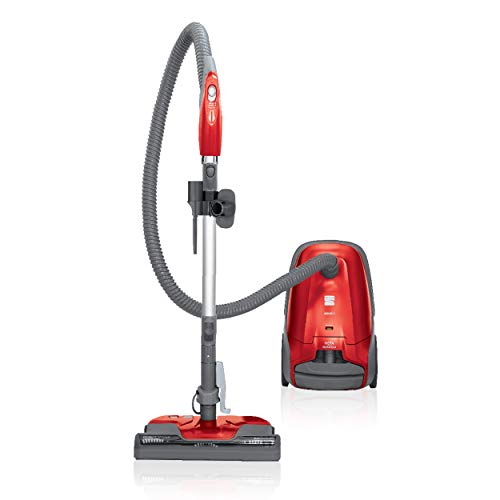
Kenmore 400 Series Pet Friendly Lightweight Bagged Canister Vacuum — Best Pet Toolkit
The Kenmore 400 Series approaches the brief from the pet’s side of the family. Its floor nozzle handles boards and low carpet in the CrossOver spirit, while the accessory kit, four cleaning tools on an extending wand, goes after the places pet hair actually accumulates on a hardwood home: the skirting drift line, the stair treads, the sofa that overlooks the boards, and the rug where the animal supervises the kitchen.
HEPA filtration and a bagged body keep the machine’s frequent sessions honest, and the retractable cord plus lightweight positioning make it the easiest full-size option here to deploy for a quick evening patrol. Pet-friendly in the name is doing real work: this is the machine for the household where the boards are only half the story and the upholstered, carpeted, creature-occupied half demands equal attention.
There is a decency to the Kenmore’s value proposition that suits family budgets under pressure from every other direction a pet creates: food, vet, fencing, the replaced sofa throw. A machine that covers floors, stairs, upholstery and the car without demanding a second purchase leaves money for the rest of the animal’s economy, and that breadth, honestly delivered, is a legitimate form of quality in a working household.
Judge its floorhead with clear eyes. It is a capable all-surface nozzle rather than a dedicated wide parquet specialist, so on vast delicate floors the Miele Guard’s softness still leads, and its brush behaviour on boards should follow the maker’s guidance for hard surfaces. What the Kenmore returns for that small concession is breadth: one machine, honestly priced in its class, covering the entire pet-haired home without a second purchase.
The 400 Series also earns marks in the holiday season, when a tree sheds needles onto boards and the pet investigates every fallen decoration. Needles are a hardwood vacuum’s awkward cargo, too stiff for weak suction and prone to clogging narrow paths, and the Kenmore’s combination of airflow, bag room and crevice tool handles the December debris field without the head jamming every metre. Machines reveal their design honesty in December more than in any showroom.
Families will appreciate how the 400 Series handles the school-run hour. Hair and grit arrive in bursts, shoes and paws crossing the boards together, and a lightweight machine that deploys in seconds and retracts its cord at a button press gets used in those bursts instead of postponed to a weekend that fills with other chores. Frequency, once again, is the specification that decides real homes.
- Format: lightweight bagged canister, extending wand
- Tools: four cleaning tools for edges, stairs and upholstery
- Filtration approach: HEPA filtration with bagged capture
- Best surfaces: boards plus rugs, stairs and furniture
- Ownership note: mid tier with a generous included kit — check price on Amazon
Strengths
- Tool kit follows pet hair into every corner it hides.
- Lightweight deployment suits frequent quick sessions.
- HEPA stage keeps repeated cleaning from redistributing dust.
Trade-offs
- All-surface head is less specialised than a wide parquet brush.
- Brush use on delicate boards needs care and correct settings.
- Accessory richness requires tidy storage habits.
Best for: pet households mixing boards with rugs, stairs and upholstered furniture.
Not suited for: purists with vast delicate floors wanting a parquet-only specialist.

Simplicity Scout Canister — Best Compact Control
The Scout’s party trick is control. Digital suction adjustment lets you feather the pull precisely, softening it for the lightweight rug that wants to climb the nozzle and for curtains near the dog’s lookout window, then restoring full draw for the skirting drift line where hair mats against the boards. In small hardwood homes, where every room mixes surfaces within a few steps, that fine control replaces a drawer of compromises.
Certified HEPA filtration in a compact body is the second attraction, giving apartment dwellers the exhaust manners usually reserved for larger machines. The extendable wand reaches under the low furniture that boards-and-pets homes accumulate, and the whole package parks in a closet corner that a full-size canister would colonise. For a one or two-bedroom flat with boards, a shedding cat or small dog, and an owner who values precision over bulk, the Scout reads like it was specified from their floor plan.
Compactness writes its own trade-offs. Bags are modest, the head is narrower than the Guard’s wide parquet tool so big rooms take more passes, and the machine’s talents concentrate on hard floors and rugs rather than deep carpet. None of that dents its case within its chosen territory, where it may be the most thoughtfully matched machine in this entire guide.
Renters in polished city flats form the Scout’s natural constituency for another reason: deposit protection. Boards in a rental are the landlord’s asset and the tenant’s liability, and a compact machine with controlled suction, proper filtration and no aggressive brush story is a deposit-saving appliance disguised as a vacuum. Document the floors at move-in, keep the Scout’s routine weekly, and the checkout inspection becomes a formality rather than a negotiation.
Studio and one-bedroom owners should note the storage choreography in particular. The Scout’s body, wand and head break down into a genuinely small parcel, freeing the same cupboard to hold the pet’s food, the mop and the winter coats without negotiation. Machines that fit the home get kept in the home, rather than exiled to a relative’s garage, and a kept machine is a used machine.
- Format: compact bagged canister, extendable wand
- Control: digital suction adjustment for mixed surfaces
- Filtration approach: certified HEPA filtration
- Best surfaces: apartment hardwood, wood floors and rugs
- Ownership note: mid tier with compact consumables — check price on Amazon
Strengths
- Fine suction control flatters mixed small-home surfaces.
- Certified HEPA stage in a genuinely compact body.
- Stores in spaces full-size canisters cannot use.
Trade-offs
- Narrower head means more passes in large rooms.
- Modest bags cycle faster during heavy shedding.
- Deep carpet lies outside its intended brief.
Best for: apartments and smaller hardwood homes wanting precise, compact control.
Not suited for: large houses with extensive thick carpet.
Parquet Brush Care, Explained Generically — Essential Maintenance
A parquet brush protects your floor only while its bristles remain clean, complete and soft. Hair wraps the bristle rows, grit lodges at their roots, and a brush neglected for a season gradually transforms from a cushion into a sander, dragging trapped particles across the finish it was bought to protect. The generic care rhythm is simple: after dusty sessions, draw a hand or a crevice tool along the bristles to lift the collected hair, and once a month inspect the rows for missing tufts, bent sections and anything hard embedded among them.
Storage habits belong in the same lesson. A parquet head stored face-down on a gritty cupboard floor loads its bristles with exactly the particles it must never carry, while a head hung or rested bristles-up stays clean between sessions. Keep the head off concrete garage floors entirely, and give it a wipe before the first pass after any building work elsewhere in the house, because renovation dust migrates through a home with unreasonable determination.
Check the head’s other contact points with the same suspicion. Wheels should spin freely and feel smooth to a fingertip, felt pads should be intact rather than peeled, and the neck joint should move without gritty resistance. A wheel with a stone embedded in its tread will sign its name across a board in a single pass, which is why this thirty-second inspection belongs before the first use on any floor you love, not after the first scratch teaches it.
Keep a note of the head’s purchase date inside the cupboard door beside the bag dates. Bristle wear is gradual enough to fool memory, and a dated note converts a vague feeling that the head seems tired into a decision with evidence behind it. Floors cannot speak for themselves until the damage is done, so the household’s paperwork has to speak earlier on their behalf.
Replacement is part of care rather than an admission of failure. Bristle heads are wearing parts with a finite life, and a fresh head costs a fraction of refinishing a room. When bristles splay, shorten unevenly or feel wiry instead of soft, retire the head without sentimentality; the floor’s finish is the asset, and the brush is its expendable bodyguard.
- After sessions: clear hair from bristle rows promptly
- Monthly: inspect bristles, wheels and felt pads closely
- Warning signs: embedded grit, splayed tufts, stiff wheels
- Replacement: treat the head as a scheduled wearing part
- Tier note: pennies of attention protecting a costly finish
Strengths
- Prevents the brush itself becoming a scratching tool.
- Keeps suction channels clear for better hair pickup.
- Costs almost nothing beyond a few minutes monthly.
Trade-offs
- Requires a routine many owners never start.
- Worn heads must be replaced rather than revived.
- Inspection is easy to skip when results look fine.
Best for: every owner of a parquet or combination head on finished wood.
Not suited for: readers hoping floor care can be entirely outsourced to machinery.
Scratch-Avoidance Technique, Explained Generically — Essential Skill
Technique decides whether a good head stays good for the floor. Begin every session at the far side of the room and work towards the door, so neither the canister body nor your shoes cross the gritty ground ahead of the head. Move in straight, overlapping lanes, lifting the head at the end of each lane rather than dragging it sideways, because a sideways drag smears trapped particles under the bristle edge like a crayon.
Work at the speed the head asks for rather than the speed your schedule prefers. A parquet brush needs a walking pace slow enough for its bristle perimeter to funnel debris inward instead of snowploughing it, and the difference between a funnelled lane and a snowploughed one is visible at the lane’s end, where the careless version leaves a crescent of grit waiting for the next shoe. Slow is not a virtue in itself here; it is simply how the tool was designed to be fed.
Sequence the tools by dirtiness. Use the crevice tool first along skirting and around chair legs, pulling the concentrated grit and hair drifts into the open where the parquet head can collect them, instead of asking the wide head to nudge that material around the room. Save the area under the pet’s bed and feeding station for a dedicated slow pass, since those zones carry the heaviest grit load per square metre in the entire home.
Watch your own footwear as part of the technique. Shoes worn outdoors carry the grit supply, so the person vacuuming in outdoor shoes re-seeds the lanes behind the head even while cleaning them. House shoes or socks turn the operator from a grit source into part of the solution, and the difference shows within a single session on a sunlit floor. It is the smallest adjustment in this entire guide and one of the most immediately visible.
Finally, respect the pause between vacuuming and mopping. A damp mop over unvacuumed boards is a grinding paste applicator, while the same mop over properly vacuumed boards is harmless gloss. The order of operations, vacuum first and always, is the cheapest floor protection ever devised, and it asks nothing but patience from the person holding the tools.
- Direction: far corner towards the door, straight lanes
- Order: crevice work first, wide head second, mop last
- Movement: lift at lane ends, never drag sideways
- Hotspots: pet bed and feeding zones get slow passes
- Tier note: a free skill that protects any finish
Strengths
- Prevents grit from being ground across the finish.
- Improves hair pickup along edges and under furniture.
- Applies to every machine and every wooden floor.
Trade-offs
- Slower than a careless once-over of the room.
- Demands attention in homes cleaned on autopilot.
- Benefits accumulate invisibly across years.
Best for: owners of finished hardwood who vacuum their own floors weekly.
Not suited for: anyone expecting technique to rescue a damaged, gritty brush.
Comparison Table
| Pick | Type | Hardwood approach | Pet angle | Watch out for |
|---|---|---|---|---|
| Miele Guard M1 Parquet XL Canister | Bagged canister, wide parquet head | Soft wide coverage, no brush on boards | Strong drift pickup, sealed bag | Premium tier, carpet limits |
| Miele Classic C1 Pure Suction Canister | Bagged canister, combination head | Switchable smooth setting | Good on low rugs and drifts | No driven brush |
| Kenmore 400 Series Pet Friendly Lightweight Bagged Canister Vacuum | Lightweight bagged canister | All-surface nozzle, careful settings | Four tools chase hair everywhere | Less specialised parquet contact |
| Simplicity Scout Canister | Compact bagged canister | Fine suction control on wood | HEPA stage, apartment scale | Narrower head, modest bags |
| Parquet Brush Care, Explained Generically | Maintenance entry | Keeps bristles protective | Prevents hair-clogged heads | Needs a monthly habit |
| Scratch-Avoidance Technique, Explained Generically | Skill entry | Lane discipline and tool order | Slow passes at pet hotspots | Takes more time |
Why Does Pet Hair Behave Differently on Boards Than on Carpet?
Carpet traps hair in a three-dimensional thicket where it stays until a brush excavates it. Boards offer hair no such anchor, so it migrates: air currents from doors and radiators push it along the grain until it banks against skirting, under radiators and beneath the sofa, forming the grey drifts every hardwood pet owner recognises. Static adds a second behaviour, gluing individual strands to the finish in a faint film that a casual pass can miss entirely.
Colour plays a cruel trick here as well. Pale hair vanishes visually on pale boards while remaining fully present to bare feet and dark socks, and dark hair hides on walnut while announcing itself on the pale rug. Owners who judge cleanliness by eye alone systematically under-clean exactly the zones their flooring disguises, which is another argument for a fixed calendar of edge work that does not ask the eye for permission.
That behaviour rewrites the cleaning priorities. Edge tools and skirting work matter more than raw centre-floor power, a head’s ability to draw from its sides matters more than its width alone, and frequency matters most of all, because a drift collected on day two is a thirty-second job while the same drift compacted for a month under a bookcase becomes an excavation. The shortlist’s machines were chosen with migration, not just pickup, in mind.
How Should You Clean a Hardwood Room That a Pet Lives In?
Timing within the day matters more than visitors would guess. Vacuum after the pet’s morning garden visit and before the household’s barefoot hours, and the boards spend their most-contacted period at their cleanest. Evening patrols suit homes whose animals import the day’s grit at dusk. Either rhythm works; the unplanned household, vacuuming whenever guilt strikes, reliably cleans after the grit has already done its grinding.
Start with the textiles, oddly enough: shake the pet’s blanket outside, vacuum its bed with the upholstery tool, and only then address the boards, because cleaning the floor beneath a hair-loaded bed merely schedules the next drift. Work the skirting line with the crevice tool, follow with the parquet head in lanes from the far corner, and finish at the feeding station with the slowest pass of the session, where grit and kibble dust concentrate.
Keep a small ritual for the end of every session: coil the hose without kinks, park the head bristles-up, and glance at the bag indicator while the machine is still in your hands. Those ten seconds are where next week’s clean is quietly prepared, and households that adopt the ritual find their equipment ageing at half the usual rate, because most vacuum damage is storage damage wearing a disguise.
Let the room rest a few minutes before anyone walks it in socks, so the fine dust the session stirred can settle onto boards that are about to be, if mopping is planned, wiped rather than walked on. Then inspect at grazing light from a doorway, the angle that betrays every missed drift and strand, and spot-clean what the inspection finds. Grazing light is the hardwood owner’s truth serum, and it costs nothing but a crouch.
How Do Rugs on Hardwood Change the Plan?
A rug over boards is a grit sandwich waiting to happen. Debris sifts through the pile and collects between rug and floor, where every footstep grinds it against the finish in darkness. Lift rugs on a monthly rhythm, vacuum the revealed boards with the parquet head, vacuum the rug’s underside as well as its face, and the sandwich never assembles. Homes that skip this ritual sometimes discover pale, scuffed rectangles when a rug finally moves, a signature of years of invisible grinding.
Rug choice itself can cooperate with the vacuum. Low, dense, washable rugs release hair to suction readily and survive the laundry that resets them, while high shag over boards traps hair beyond a hard-floor head’s talents and hides grit at industrial depth. If the pet’s favourite rug must be plush, place it where the household’s carpet-capable machine can visit, rather than asking this guide’s gentle heads to perform outside their calling.
What About Stairs, Thresholds and Floor Vents?
Hardwood stairs collect hair on their tread edges and grit in their corners, and they punish carelessness because a dragged body or a dropped tool marks the nosing where every eye lands. Work stairs with the body parked safely at the base or on a landing, the hose and crevice tool doing the travelling, and the parquet head reserved for the broad tread centres. Thresholds between rooms deserve a slow cross-pass, since the metal or timber strip there acts as a grit dam that sheds its load into both rooms.
Floor vents are the forgotten reservoir. Hair and dust settle into the grille and the first hand’s depth of ducting, then the heating system redistributes a share of it across the house for months. Lift the grille where it lifts, vacuum the cavity with the crevice tool each season, and the boards’ cleanliness stops being undermined by the building itself.
What Are the Most Common Mistakes on Hardwood with Pets?
Running a spinning brush across bare boards leads the catalogue, scattering grit, worrying delicate finishes and accomplishing less hair pickup than a proper parquet head would manage gently. Next comes the neglected brush, its bristles matted with hair and its wheels gritty, quietly converting a protective tool into the floor’s most regular assailant. Owners also mop first and vacuum second, grinding the week’s grit into the finish with enthusiastic circular motions.
Dragging the canister body carelessly deserves its own mention, because the body crosses the floor all session on wheels that collect grit as faithfully as any shoe. A body hauled sideways over a threshold or yanked around a corner can track particles across finished ground the head has already cleaned. Guide the body with the same lane discipline as the head, lift it over thresholds where the hose allows, and check its wheels during the monthly brush inspection.
Ignoring the drift lines ranks close behind: rooms vacuumed in cheerful centre spirals while the skirting banks a month of hair untouched. And many households place the pet’s bed directly on boards without a washable mat beneath, guaranteeing a grit reservoir at the exact spot where the animal’s weight grinds it into the finish nightly.
Which Accessories Actually Earn Their Place?
Beyond the headline head, three humble tools decide most hardwood outcomes. The crevice tool owns the skirting line and the radiator gap, the upholstery nozzle owns the pet’s textiles, and a soft dusting brush owns the low shelves and speaker cabinets whose dust otherwise migrates down to the boards within days. Kits that include those three, as the Kenmore’s does, cover the room’s full vertical story rather than only its floor.
Extensions and spare heads deserve a colder eye. A second parquet head kept by the door for the patrol machine can be genius in a large house, while exotic attachments bought for hypothetical messes mostly gather the dust they were meant to fight. Buy accessories against a list of your room’s actual reservoirs, skirting, vents, textiles and thresholds, and the kit stays lean, findable and used.
How Do You Verify a Floor Is Truly Clean?
Trust three witnesses. The first is grazing light: crouch at the doorway with the room’s light behind you and read the floor’s surface for drifts, strands and the dull film of missed dust. The second is the white-sock test across the traffic lane, which reports the fine grit your eyes forgive. The third is the bag itself after a month, whose contents confess what the household actually produces and whether your session frequency matches it.
Verification matters because hardwood hides its dirt politely, gleaming in the centre while the edges bank their drifts in shadow. Owners who check at grazing light monthly adjust their lanes and their calendar before the finish pays for the oversight, which is the entire philosophy of floor care compressed into one crouch at a doorway.
How Does the Cleaning Calendar Change with the Seasons?
Winter imports grit on an industrial scale: pavement salt, sand and slush residue ride every shoe and paw, dry into abrasive dust, and queue at the door for distribution. Raise the doorway and hallway frequency in those months, keep the entry mat system washed and working, and let the parquet head visit the main boards twice as often as in summer. The finish you save will be the one that would otherwise have met spring with a winter’s worth of micro-scratches.
Spring answers with hair. Coat-change season fills the drift lines faster than any machine’s schedule anticipated, so the skirting and under-furniture passes move from weekly to twice weekly while the surge lasts. Summer settles into the calm rhythm, autumn returns leaves and their gritty fragments, and the household that adjusts its calendar to the year’s debris, rather than running one fixed routine, protects the floor with the least total effort.
How Do You Share the Work in a Busy Household?
Divide the floor by temperament rather than by rota arguments. The person who notices grit owns the patrol passes, the person with patience owns the monthly rug-lifting and brush inspection, and teenagers can be trusted with the doorway lanes provided the checklist is visible and the machine is light enough to deploy without complaint. Shared machines survive shared homes when every user knows the two sacred rules: check the brush before boards, and never mop an unvacuumed floor.
Leave the machine parked ready, wand assembled and bag honest, so the next person’s session starts in seconds. A vacuum that must be assembled before use is a vacuum that gets used on weekends only, and hardwood with a shedding pet keeps a weekday schedule whether the household plans one or not.
What Should the Weekly Checklist Actually Say?
Write it down, because memory is where hardwood routines go to die. Monday’s patrol covers the doorway lanes and the feeding station. The midweek session runs the full boards with skirting work. The weekend session adds one rotating extra: rugs lifted, vents visited, stairs done properly, or the pet’s textiles excavated. Beside the list, note the bag’s date and the brush’s last inspection, and the whole system becomes visible at a glance.
Keep the list where the machine lives rather than in a phone that will be somewhere else. Paper on a cupboard door has outlasted every application ever written for this purpose, and a ticked list gives the household the quiet satisfaction that keeps routines alive long after novelty fades.
How Do You Handle a Floor You Have Just Inherited?
Moving into a home with boards and a resident pet history calls for one forensic clean before the furniture lands. Vacuum empty rooms at grazing light, work the skirting and vent reservoirs the previous household ignored, and read the bag afterwards like a report on the floor’s past. That single session establishes the baseline your own routine must merely maintain, and it frequently reveals the two or three corners where hair and grit have been banking undisturbed for years.
Photograph the floors in that empty state, especially any existing marks along the pet routes. The photographs protect a renter’s deposit, guide a buyer’s refinishing decisions, and give every household a truthful before picture against which the new routine’s value can be judged at the season’s end.
What Does It Cost to Neglect the Finish for a Year?
Refinishing a hardwood room is measured in days of disruption, sanding dust through the whole house and a bill that dwarfs any vacuum in this guide, and the damage that forces it rarely arrives as one dramatic scratch. It accumulates as a dulling of the traffic lanes, a grey tiredness along the pet’s routes, until one day the floor looks old in a way cleaning cannot reverse. Every gentle pass in this guide is, in accounting terms, an instalment against that bill, paid in minutes instead of money.
The pet sharpens the arithmetic because animals concentrate traffic. A dog’s route from bed to door to garden crosses the same boards hundreds of times a month, carrying grit on paws that press it in with real weight. Protecting those lanes, with mats at the turns and frequent light passes along the route, defends the exact square metres that would otherwise age a decade ahead of the room around them.
How Should New Pet Owners Set Up Before the Animal Arrives?
The week before a first pet comes home is the cheapest floor-protection window that will ever exist. Place the washable mat where the bed will live, decide the feeding station’s position on the most forgiving surface available, and run the new canister across every board so the household starts from a grit-free baseline. Habits installed before the animal arrives feel like the house’s nature rather than like new rules imposed on a settled pet.
Choose the machine in that same week with the animal’s adult size in mind, not its puppy or kitten dimensions. A compact canister that charms during the first month can be overwhelmed by the same animal at full coat and full mud capacity, so buy for the creature the pet will become. The shortlist above spans that growth honestly, from the Scout’s apartment scale to the Guard’s whole-house authority.
Final Recommendation
Budget honestly for the whole arrangement, not only the machine. A mid-priced canister plus a spare parquet head, a season of bags and two washable mats will outperform a flagship run with a worn brush and no mats at all, because hardwood care is a system whose weakest component sets the result. The shortlist’s prices differ, yet the philosophy governing them does not: protect the finish first, chase the hair second, and let the machine serve both masters in that order.
Hardwood-first households should buy the Miele Guard M1 Parquet XL and enjoy the rare feeling of a machine designed around their exact floor. Simpler homes will be served for years by the Classic C1 Pure Suction, pet-tool households by the Kenmore 400 Series, and apartment dwellers by the Scout’s compact precision. In every case the prose lessons carry half the value: a clean brush and a disciplined lane pattern will protect a finish longer than any single purchase. If your boards are the home’s pride and the pet is non-negotiable, the Guard M1 is the answer this guide was written to find. Bring it home, learn its lanes, and let the floor grow old at the same gentle pace as the animal padding across it.
Frequently Asked Questions
Should I ever use a rotating brush on hardwood?
As a rule, no. A spinning brush can scatter grit across the finish and, on some floors, mark softer coatings, while contributing little that suction and soft bristles cannot achieve more safely. Reserve driven brushes for carpet and rugs, and let the parquet or combination head handle the boards.
There is a narrow exception for combination heads whose brush retracts fully for hard floors, leaving a smooth sole and soft perimeter in contact with the wood. Retraction must be complete and the sole genuinely smooth; a half-retracted brush that still kisses the boards delivers the risks of both designs with the benefits of neither.
How do I stop hair drifting into corners so quickly?
You cannot stop the migration, but you can shorten its journey’s value: vacuum the skirting lines more often than the room’s centre, keep radiator gaps and under-sofa zones on the weekly list, and place washable mats at the pet’s favourite resting spots so a share of the hair lands on laundry instead of boards.
Door discipline helps more than expected. A door left open to a draughty hall acts as a hair pump, relocating the lounge’s load into the bedroom overnight, while closed doors keep each room’s drifts local and collectable. It is a zero-cost adjustment that surprises owners the first week they practise it.
Is a bagged canister worth it for a mostly hard-floor home?
Usually yes. Hard-floor homes vacuum frequently, hair fills bins in bulky low-density loads, and a bag swaps that load out cleanly while keeping airflow steadier between changes. The sealed disposal also suits homes where the collected hair carries outdoor grit and dander.
The bag also behaves like a diary. A household that dates each bag learns its true consumption across the seasons, moulting spring versus calm winter, and can stock accordingly instead of discovering an empty cupboard mid-surge. Small knowledge, steadily applied, is what separates maintained homes from rescued ones.
Which finish types need the most caution?
Softwoods like pine, older waxed finishes and any board with a worn or damaged coating deserve the gentlest heads, the cleanest brushes and the strictest grit discipline. Modern hard factory finishes tolerate more, yet even they scratch when grit is dragged, so caution scales with softness rather than switching off entirely.
When in doubt about a finish, test the routine in a hidden square beneath furniture and inspect it at grazing light after a week. Floors differ enough between houses, and between rooms in the same house after piecemeal refinishing, that local evidence beats any general rule a guide can print.
Can these canisters handle the rugs between my boards?
Yes, within their stated territories. The combination and all-surface heads tidy low rugs well, the Scout’s suction control flatters lightweight rugs, and the Kenmore’s kit covers the range most pet homes actually own. Deep-pile statement rugs remain powerhead country and sit outside this guide’s brief.
Treat each rug as a small border crossing: slow down at its edges, where grit accumulates against the thickness change, and lift the rug monthly to clear the sandwich layer beneath. A rug that is only ever cleaned on its face is a rug slowly sanding the floor it decorates.
Related Guides
Live with the chosen routine for one full season before judging it, because hardwood delivers its verdict slowly, in finishes that stay deep and clear while the pet’s routes remain as bright as the room’s quiet corners.
Your next stops might be Best 12-Volt Heated Blankets for the car that ferries the pet, Best Bagged Vacuums for Low Dust for the containment side of frequent cleaning, and Best Battery Hand Vacuums for the quick patrol machine between deep cleans. Apartment readers will also appreciate Best Air Purifiers for a 1-Bedroom Apartment.


