What's inside
- Key Takeaways
- Quick Picks
- How Did We Choose Handhelds for a Whole Home’s Small Disasters?
- Which Battery Hand Vacuums Run a Home’s Quick-Clean System Best?
- Where Should a Hand Vacuum Live in Your Home?
- How Do You Build the Ninety-Second Clean Into a Day?
- A Room-by-Room Tour: Where a Handheld Earns Its Dock
- Handheld, Stick or Robot: How Do the Satellites Divide a Home?
- What Are the Most Common Mistakes With Hand Vacuums?
- How Do You Empty a Handheld Without Undoing Its Work?
- Final Recommendation
- Frequently Asked Questions
- Related Guides
As an Amazon Associate I earn from qualifying purchases. This post may contain affiliate links at no extra cost to you.
cottageverdict.com is reader-supported. When you buy through links on our site, we may earn an affiliate commission.
Where to buy: the linked handhelds below are all sold on Amazon, the category’s natural marketplace, where it is worth checking price on Amazon on the day you shop and noting exactly which tools and charging arrangements each listing includes, because handheld bundles differ more than the machines inside them.
Every home, however grand or however modest, has a geography of small disasters that no weekly cleaning schedule ever quite reaches in time. Flour ghosts the counter beside the mixer. The cat conducts its litter a metre beyond the tray’s jurisdiction. Cereal migrates under the high chair, soil escapes the houseplant, and the sofa — the sofa is a sedimentary record of every snack ever eaten near it. The best battery hand vacuums are the machines built for that geography: not the weekly whole-house clean, which belongs to the upright in the cupboard, but the ninety-second intervention that happens between the disaster and the moment it gets trodden into the rug. Their entire value is measured in the gap between noticing a mess and the effort of doing something about it, and a good handheld shrinks that gap to the width of a thought.
That is why this guide judges hand vacuums differently from every other category on this site. Suction matters, but readiness matters more: a handheld lives or dies by where it sleeps, how it charges, how quickly it empties, and whether its tools are on its body or lost in a drawer. The picks below were chosen as a household system, not a spec contest. A Bissell with a motorised brush for the pet-haired rooms. A BLACK+DECKER furbuster that answers the same problem with its own brush and a boost of power. A Shark Cyclone built for the owner who wants the handheld to feel like a precision instrument. A dustbuster FLEX whose hose lets it reach the places rigid handhelds cannot. The standard AdvancedClean dustbuster, discussed in prose as the family’s reference shape. And a final prose entry on the unglamorous subject that decides whether any of them is still working in three years: docks, charging and battery care.
Price, in this category, buys refinement more than capability: better balance, quieter manners, tools that fit their machine instead of approximating it, batteries that hold their temper across years. The tiers below are therefore described in terms of polish and parish rather than power, because a household choosing between these picks is not choosing how clean its home can get — all of them clean admirably — but how gracefully the cleaning will fit into the day’s ordinary traffic.
A boundary, honestly drawn: a hand vacuum is a satellite, not a sun. It orbits a household that also owns, or has access to, a full-size machine for the weekly deep clean, and it does not pretend otherwise anywhere in this guide. What it offers instead is a different kind of cleanliness — the continuous kind, where messes are deleted at birth rather than accumulated for a weekend reckoning. Homes that adopt a handheld and keep it charged consistently report the same surprise: the big vacuum comes out less often, because the house never quite gets dirty enough to summon it. That is the promise these five machines are competing to keep.
Key Takeaways
- A hand vacuum’s worth is measured in seconds-to-ready: dock position, charge state and onboard tools matter more than any suction figure.
- The Bissell Pet Hair Eraser is the upholstery specialist, its motorised brush lifting hair that plain suction only rearranges.
- BLACK+DECKER’s furbuster answers with a motorised pet brush of its own and a body shaped for both house and car.
- The Shark Cyclone PET is the precision pick — light, assertive and aimed at owners who clean little and often.
- The dustbuster FLEX is the reach specialist, its integrated hose going under sofas and into car footwells where rigid bodies cannot follow.
- Docks and battery care, the final prose pick, decide whether any handheld is still a pleasure in its third year.
- Empty the cup low inside the bin and keep the filter on a monthly rhythm — the twenty-second ritual is what separates handhelds that feel immortal from handhelds that fade.
- A handheld owns everything that is not a floor: counters, sofas, stairs, shelves and cars, the vertical and furnished territory no stick or robot covers.
Quick Picks
| Pick | Badge | Why it made the list |
|---|---|---|
| Bissell Pet Hair Eraser Hand Vacuum 2390A | Upholstery hair expert | A motorised brush tool and consistent lithium power, aimed at sofas, stairs and pet beds. |
| BLACK+DECKER dustbuster furbuster Pet Vacuum | Pet brush all-rounder | Motorised pet-hair brush in the AdvancedClean family body, for home and car alike. |
| Shark Cyclone PET Handheld Vacuum CH701 | Precision quick-clean pick | HyperVelocity suction in a light body, with pet and crevice tools for the little-and-often rhythm. |
| BLACK+DECKER dustbuster FLEX Handheld | Reach specialist | An integrated flexible hose that cleans where rigid handhelds cannot bend. |
| BLACK+DECKER dustbuster AdvancedClean Handheld Vacuum | Prose-only benchmark | The standard AdvancedClean model, discussed as the shape the rest of the family is measured against. |
| Countertop Docks and Battery Care | Prose-only ownership pick | Charging docks, standby habits and battery care, the system that keeps a handheld ready for years. |
How Did We Choose Handhelds for a Whole Home’s Small Disasters?
We began where handhelds actually live: the map of messes in an ordinary week. Dry spills in the kitchen, tracked litter by the door, hair on the two chairs the pets have claimed, crumbs in the sofa seams, dust on the stairs where the big vacuum’s hose never quite reaches. Each candidate was walked through that map and judged on the match between its tools and the territory. A motorised brush earned its premium on upholstery and carpeted stairs. A hose earned its place under furniture. A crevice tool earned its keep in every room indiscriminately, because seams are where handheld debris goes to become permanent.
Second, we judged the readiness system around each machine: the dock or charger it returns to, whether its tools travel with it, how its emptying behaves over a kitchen bin at arm’s length. A handheld with excellent suction and a charger lost in a drawer is, in lived terms, a paperweight with potential. Third, we weighed hand feel — balance, weight, the grip during a stair session — because a handheld is used at arm’s length in awkward postures, and a badly balanced one is put down sooner and picked up less. Finally, we applied the household test: could this machine serve as the only satellite for a mixed home of floors, fabrics, pets and children, or is it a specialist that needs a generalist beside it? The list below contains both kinds, labelled as what they are.
Noise and manners played a quieter part in the judging than readers might expect, and a more honest one than spec sheets admit. A handheld is used in the house’s social hours — during conversations, beside sleeping children, under the television’s dialogue — and a machine whose note is harsh or whose body vibrates like a drill gets used with a reluctance that compounds. We favoured machines whose sound and balance invite the ninety-second sortie at any hour, because a guide that ignored the social cost of cleaning would be recommending machines for a house nobody lives in. The picks below are all, in this sense, good neighbours.
Which Battery Hand Vacuums Run a Home’s Quick-Clean System Best?
Two pet-brush specialists, a precision all-rounder, a reach specialist, the family’s benchmark in prose, and the charging system that keeps them all alive. Read by the mess you make most, and the right machine steps forward.

Bissell Pet Hair Eraser Hand Vacuum 2390A — Upholstery hair expert
In a pet-owning home, the handheld’s defining job is not crumbs — any machine can eat crumbs — it is the hair that weaves itself into the sofa arms, the stair carpet and the dog’s own bed. The Bissell Pet Hair Eraser was designed by a company that has built its name on exactly that material, and its motorised brush tool is the heart of the matter: bristles agitate the fabric, the hair lifts out of the weave, and the airstream — fed by a lithium-ion battery that holds its power consistently through the session — carries it away. Plain-suction handhelds polish pet hair. This one evicts it, and the difference is visible from across the room.
Its household territory extends well beyond the sofa. Carpeted stairs, the handheld’s classic parish, get the brush treatment step by step without the main vacuum’s hose ballet. The pet bed, the cat’s favourite chair, the car seat after a vet trip, the rug by the door where the lead is clipped on — the 2390A works the whole circuit with its crevice and upholstery tools covering the seams and corners the brush cannot enter. It is compact enough to live where the mess is densest, which in most pet homes means a kitchen or hallway dock, and its cup empties without the dust-cloud ceremony that discourages frequent use.
Watch the 2390A work a staircase and the design’s intelligence concentrates into one image. A full-size vacuum cleans stairs as an afterthought, from the bottom, with a hose at full stretch and its body teetering on a tread. The Bissell cleans them as a first-class job: one hand on the rail, one on the machine, each tread brushed and sucked in two passes, the risers’ edges taken with the crevice tool on the way down. Homes with carpeted stairs and a shedding dog describe this machine the way other owners describe a good mattress — as the purchase that quietly ended a daily discomfort they had stopped noticing they had.
The honest edges: the motorised brush is a fabric tool, wasted on hard floors where a plain nozzle is faster, and the machine’s talents are priced at a specialist’s tier that a pet-free home has no reason to pay. Its cup is a handheld’s cup, sized for interventions rather than expeditions. But for the household whose small disasters are predominantly furry, this is the first pick in the guide and the standard the other pet machine here must answer. Check price on Amazon when you shop; within the handheld tier it sits mid-range, and earns the position every single week.
- Format: cordless handheld with motorised brush tool
- Battery: lithium-ion, consistent power delivery
- Territory: sofas, stairs, pet beds, car seats
- Tools: motorised brush, crevice and upholstery tools
- Tier: mid — the pet specialist’s position
Strengths
- Motorised brush lifts woven hair properly
- Consistent suction across the session
- Sized and docked for daily interventions
Trade-offs
- Brush is wasted on hard-floor spills
- Handheld cup size on big sessions
- Specialist tier for pet-free homes to skip
Best for: pet-owning homes whose sofas, stairs and chairs carry the daily evidence.
Not suited for: pet-free households, which can take a simpler pick below and save the difference.
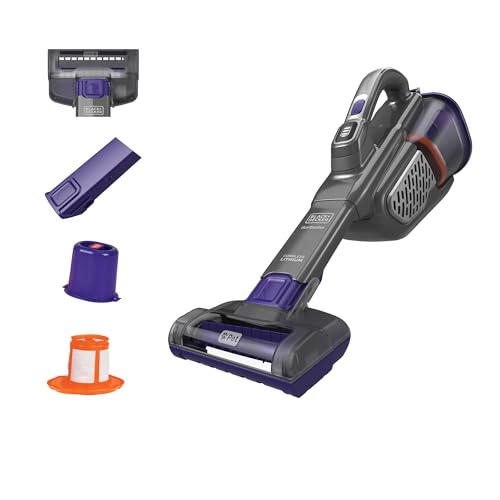
BLACK+DECKER dustbuster furbuster Pet Vacuum — Pet brush all-rounder
BLACK+DECKER’s answer to the same furry problem arrives wearing the dustbuster silhouette the world already knows, upgraded where it counts. The furbuster carries a motorised pet-hair brush at its nose, a boost of suction for the stubborn patches, and the AdvancedClean family’s general manners — a generous bowl, a washable filter, a body balanced for one-handed work — making it the pet pick for households that want one handheld to serve the house and the car without changing its tools or its temperament. Where the Bissell is a specialist that happens to travel, the furbuster is a generalist that happens to be excellent with hair.
The brush changes the machine’s whole character in the home’s worst places. The hallway runner where the dog shakes after a walk, the bottom three stairs that collect a felt of hair and grit, the car boot’s carpet after a weekend of passengers both human and canine — the furbuster works them all with the same agitation-first logic as its rival, and its power mode answers the patches where the hair has been trodden deepest. Between pet jobs it reverts gracefully to ordinary dustbuster duty: flour, crumbs, the glitter that escapes every school project, all handled with the bowl capacity to finish the job in one emptying.
The furbuster also carries a small diplomatic advantage in shared households: it looks like the dustbuster everyone already knows, so nobody needs to be taught it, lent it or forgiven for using it wrong. Visitors use it on a spill without asking where the clever machine is; teenagers use it because it is the one by the door; and its boost mode forgives the patches where a week’s hair has been compressed by feet into something approaching felt. In a category where adoption by the whole household is half the product, familiarity is not a lack of innovation. It is a feature with a long service record.
Its compromises are the family’s usual ones. It is a full-size handheld, present in the hand across a long stair session, and its talents overlap enough with the Bissell’s that owning both would be a duplication rather than a system — choose by brand loyalty, by dock position, by which shape your hand prefers, because the work they do is closer than their badges suggest. As a single purchase for a pet home that wants house-and-car coverage from one charging base, the furbuster is the most complete sentence in this guide. It sits mid-tier, and like its rival, it pays the position back in the currency of chairs you no longer apologise for.
- Format: cordless handheld, dustbuster family body
- Brush: motorised pet-hair brush fitted
- Power: boost mode for stubborn patches
- Territory: home upholstery, stairs and car interiors
- Tier: mid — one machine for both territories
Strengths
- Pet brush plus generalist manners in one body
- Generous bowl for a handheld
- Equally at home in house and car
Trade-offs
- Full-size weight across long sessions
- Overlaps the Bissell — little reason to own both
- Boost mode shortens the session’s charge
Best for: pet households wanting one handheld for the whole home and the car.
Not suited for: owners wanting the lightest possible grab-and-go machine for hard floors only.

Shark Cyclone PET Handheld Vacuum CH701 — Precision quick-clean pick
The Shark Cyclone PET is the handheld for owners who experience cleaning as a series of precise strikes. Shark rates its suction with the brand’s customary enthusiasm — HyperVelocity is the word on the box — and the lived reality underneath the adjective is a light, eager machine that pulls crumbs, litter and hair out of corners with a decisiveness the gentler handhelds do not attempt. It arrives with a crevice tool and a multi-surface pet tool, weighs little enough to live at the end of an outstretched arm, and its whole design argues that the quick clean should feel like using a good tool rather than a small appliance.
There is a temperament match here that buyers should make honestly. The CH701 rewards the owner who experiences a small mess as an itch to be scratched immediately — the cook who vacuums the flour before the sauce starts, the cat owner who patrols the litter line while the kettle boils. Owners who prefer a weekly campaign will find its small cup and eager manner beside the point, and should take the furbuster’s capacity instead. Neither temperament is better; but a handheld mismatched to its owner’s rhythm is a handheld on a dock, admired and unused, which is the saddest fate in this entire category.
Its parish is the little-and-often rhythm at its most disciplined: the kitchen counter’s flour and coffee grounds, the litter perimeter patrolled twice a day, the car footwell between proper cleans, the sofa’s seams after a film. In each place the CH701’s combination of light weight and assertive pickup shortens the job to the point where the job stops being postponed, which is the only metric that ultimately separates clean homes from intended ones. The pet tool handles the hair jobs credibly — it is a surface tool rather than a motorised brush, so woven hair takes more passes than the Bissell demands, but for the daily surface layer it is entirely in its element.
The precision comes with a smaller cup and a more focused brief than the big all-rounders: this is not the machine for a whole staircase of embedded hair or a post-party excavation, and its tier reflects Shark’s engineering polish rather than raw capacity. Buy it if your home’s disasters are frequent, small and scattered, and you want the fastest possible answer to each. It is the handheld most likely to be used twice a day, and in this category, use frequency is destiny — a truth the CH701’s designers appear to have built the entire machine around.
- Format: cordless handheld, lightweight body
- Suction: HyperVelocity class in Shark’s terms
- Tools: crevice tool and multi-surface pet tool
- Territory: counters, litter zones, seams, car footwells
- Tier: mid — polish and pace over capacity
Strengths
- Light and eager — built for twice-daily use
- Assertive pickup on crumbs, litter and grit
- Tools cover seams and surfaces precisely
Trade-offs
- Smaller cup than the all-rounders
- Pet tool is surface-class, not motorised
- Focused brief — not a deep-clean machine
Best for: tidy households with frequent small messes and a little-and-often rhythm.
Not suited for: heavy pet-hair excavation, where a motorised brush pick serves better.

BLACK+DECKER dustbuster FLEX Handheld — Reach specialist
Every other handheld in this guide is a rigid body, and rigid bodies share a blind spot: the space under the sofa, behind the toilet pedestal, beneath the car seats, inside the boot’s far corners — the places where a vacuum must bend to go. The dustbuster FLEX was designed around that blind spot. Its body carries an integrated flexible hose that extends the nozzle’s reach by a generous length, so the motor and bowl stay in your hand while the suction goes visiting. It is an old design by this guide’s standards and an enduring one, because the problem it solves has never gone away and no rigid machine has ever answered it.
At home, the hose redraws the map of what a handheld can keep clean. The dust continent under the sofa becomes a weekly thirty-second pass instead of a furniture-moving expedition. The gap between the washer and the wall, the understairs cupboard’s floor, the high shelf reached without standing the machine on its nose — the FLEX treats them as ordinary territory. In the car it is arguably even better: the hose threads under seats and into the boot’s recesses while the body waits outside, and the whole interior becomes reachable without contorting either the machine or its owner. Pet-hair capability is built into its brief, with the tools to work upholstery at the hose’s end.
Owners of the FLEX develop a particular loyalty that puzzles the spec-sheet reader, and it comes from a specific domestic moment: the first time the hose slides under a heavy sofa that has not moved in two years and emerges with a archaeological stratum of dust, hairpins and lost Lego, all without the furniture-moving expedition that the job previously demanded annually. Machines that unlock previously impossible jobs acquire a status beyond their tier. The FLEX has been unlocking that one job, in house after house, for longer than most of its rivals have existed, and its continued presence in this guide is the market’s verdict on how many homes still need it unlocked.
The hose is also the compromise, honestly stated. Suction at the end of any hose is gentler than at a rigid nozzle, so the FLEX persuades debris rather than commanding it, and its bowl and body make it a larger object to store than the wand-style picks. It is a machine bought for a map, not for a spec sheet: if your home’s problem areas are the reachable ones, the Shark above is faster; if your problem areas are the bent, hidden and recessed ones, the FLEX is not merely better — it is the only pick in this guide that goes there at all. Its tier is mid and stable, the price of a design that has found its parish and serves it faithfully.
- Format: cordless handheld with integrated flex hose
- Reach: hose extends into recesses and under furniture
- Territory: under sofas, car interiors, cupboards, gaps
- Brief: home, pet and car work in awkward spaces
- Tier: mid — the access specialist’s position
Strengths
- Reaches where no rigid handheld can follow
- Superb in cars and under furniture
- Long-proven design with a clear parish
Trade-offs
- Hose-end suction is gentler than a rigid nozzle
- Larger body to store than wand-style picks
- Slower on open, easy surfaces than rivals
Best for: homes whose dirt hides under, behind and between things.
Not suited for: owners whose cleaning is all open surfaces, who will never use the hose.
BLACK+DECKER dustbuster AdvancedClean Handheld Vacuum — Prose-only benchmark
The standard AdvancedClean dustbuster appears in this guide without a link, as the benchmark the rest of the family is measured against — the full-featured shape of the classic handheld, with its larger dust bowl, its crevice tool and rotating nozzle, and its charging station giving it a permanent powered home on a counter or wall. If the other BLACK+DECKER in this list, the furbuster, is the benchmark plus a pet brush, and the FLEX is the benchmark reimagined around a hose, then this standard model is the centre both of them orbit, and an honest guide names its centre even when it cannot sell it to you.
There is a reason this shape became the generic noun for its category, and it is worth stating for buyers choosing between the benchmark and its specialised siblings: the standard model asks nothing of its owner. No brush to unclog of hair, no hose to coil, no modes to learn — a trigger, a bowl, a nozzle, and a station to return to. Households whose messes are ordinary and whose patience for appliance personalities is limited are not settling when they choose the benchmark; they are choosing the design that several decades of households, voting with their own money, have kept in production. Longevity of that order is a review no laboratory can issue.
As a whole-home quick-cleaner, its virtues are the virtues of balance. The bowl takes a whole kitchen incident without an intermediate emptying. The rotating nozzle follows skirting boards and stair treads with a wrist-flick. The charging station means the machine is always at full readiness in its appointed place — the property this guide has argued matters more than any figure on a box. Households that find this model at a good position through their own shopping are buying the category’s reference design, refined over more years than any rival shape can claim, and they will understand within a week why the dustbuster silhouette became the generic word for the entire class of machine.
- Format: cordless handheld, standard AdvancedClean model
- Bowl: larger than the family’s entry models
- Tools: crevice tool and rotating nozzle
- Charging: station base for permanent readiness
- Tier: mid within the handheld family
Strengths
- The category’s reference balance of size and power
- Charging station keeps it permanently ready
- Generations of refinement in one design
Trade-offs
- Discussed here without a purchase link
- No motorised brush for woven pet hair
- No hose for the recessed places
Best for: buyers wanting the classic all-round handheld in its standard, fullest form.
Not suited for: pet-hair excavation or under-furniture work, where the specialists above win.
Countertop Docks and Battery Care — Prose-only ownership pick
The final pick is the system that decides whether the other five picks are pleasures or disappointments in year three: where the handheld sleeps, and how its battery is treated. Discussed generically, the principles are few and absolute. Give the machine a dock or charging station in the room where messes happen most — for most homes the kitchen or the hallway by the stairs — because a handheld stored in a distant cupboard is a handheld used monthly, and monthly is the rhythm this entire category exists to replace. Keep the tools on or beside the dock, not in a drawer in another postcode of the house. And let the machine live on its charger as its default state, so readiness is the norm.
There is a small test that reveals whether a household’s dock system works, and owners can run it tonight: is the handheld charged, tooled and within one room of the last mess you noticed? If yes, the system is functioning and the machine will serve for years. If the answer involves a search, a flat battery or a missing crevice tool, no upgrade of machine will fix what is actually a failure of address. Fix the address first — it costs a wall plug and a decision — and the machine you already own may turn out to be the pick you were shopping for.
Battery care is the second half of the system, and it is simpler than its reputation. Modern lithium batteries in these machines ask for three kindnesses: do not leave them empty for weeks, because deep idleness is their fastest ageing; do not cook them, because a dock above a radiator or in a sun-blasted conservatory shortens their life as surely as any abuse; and do exercise them in the small sorties they were built for, because a battery used gently and often outlasts one stored like a museum piece. Filters complete the liturgy — rinse or brush them on a monthly rhythm, dry them fully, and the machine’s third-year suction will resemble its first-week suction closely enough that guests will not know the difference. None of this is product. All of it is the difference between the households in this guide’s opening, whose houses stay clean, and the ones still waiting for the weekend.
- Dock: in the room where messes happen most
- Tools: stored on or beside the dock
- Battery: kept charged, kept cool, used often
- Filter: monthly rhythm, dried fully before refitting
- Rule: readiness is a system, not a feature
Strengths
- Costs nothing beyond a power socket
- Doubles the useful life of any pick here
- Turns readiness from luck into routine
Trade-offs
- Asks for a permanent counter or wall spot
- Habits must survive busy weeks
- Cannot revive a battery already ruined
Best for: every owner of every machine in this guide, from the day of purchase.
Not suited for: nobody — though it will not help a handheld stored, forgotten, in a shed.
Where Should a Hand Vacuum Live in Your Home?
The dock position is a floor-plan decision, and it repays a minute’s thought. Map your home’s messes honestly for one week — most households discover their disasters cluster in two places, usually the kitchen’s work triangle and the hall where shoes, dogs and school bags land — and put the handheld between them if one spot serves both, or accept the dock in the messier room and carry the machine for the other. Kitchens argue for a counter dock near the bin, because the emptying trip and the charging trip become the same trip. Hallways argue for a wall mount, out of the traffic line but inside the grab zone. Stairs argue for the landing, the one spot from which both flights are a sortie rather than an expedition.
Accessibility belongs in the dock conversation too, and guides mention it too rarely. A handheld is the one vacuum that an older owner, a child, or anyone with limited strength can deploy without assistance, provided its dock is at a reachable height and its weight is honest. Households planning for ageing in place, or equipping a parent’s smaller home, should weigh the Shark’s lightness and the benchmark’s balance as primary virtues rather than footnotes — a machine that can be used independently is a machine that preserves independence, which is worth more than any figure printed on its box.
Two-handheld households are more rational than they sound at this tier: a pet-brush machine docked by the living room, a light precision machine in the kitchen, each where its mess lives, each used at the frequency its position invites. The alternative — one excellent machine carried between territories — decays in practice to one excellent machine used in one territory and a second territory quietly surrendered to the weekend. Geography is destiny for handhelds. Choose the geography first, the machine second, and the system this guide describes assembles itself.
How Do You Build the Ninety-Second Clean Into a Day?
The rhythm that makes handhelds transformative is not a schedule but a trigger: the mess is the alarm. Flour down — vacuum before the kettle boils. Litter tracked — vacuum before the dog’s next pass spreads it. Guests in an hour — the sofa, the hall, the bathroom floor, in one circuit with the machine that was already charged and already in your hand’s memory. Owners who adopt the trigger find the house hovering at a baseline of clean that no weekly session achieves, because the weekly session always starts from accumulation and the trigger starts from zero. The machine’s part in this is only to be ready; the household’s part is to refuse, politely and permanently, the idea that small messes are beneath response.
The trigger habit has a compounding effect on the home’s other systems that owners rarely predict. A kitchen whose spills are deleted at birth stays cleaner at the level of its cupboards and its oven, because crumbs are the advance party of every deeper grime. A hall whose grit is lifted daily stops sanding the floor’s finish with every footstep. A sofa whose seams are excavated weekly never develops the deep, grey archaeology that requires a professional’s visit. The handheld, faithfully used, is not merely removing dirt — it is interrupting the processes by which dirt becomes damage, which is a service no amount of weekend heroism can buy back.
Children and partners can be recruited to the trigger more easily than to any cleaning rota, because the ninety-second clean is a favour-sized unit of work — small enough to grant without negotiation, satisfying enough to repeat. Households that put the handheld where a teenager passes it after breakfast acquire, within a month, a teenager who vacuums cereal without being asked, a phenomenon no upright in a cupboard has ever produced. This is the category’s secret sociology: it does not merely clean homes, it redistributes the cleaning across everyone in them, ninety seconds at a time.
A Room-by-Room Tour: Where a Handheld Earns Its Dock
Start in the kitchen, the handheld’s capital city. Flour beside the mixer, coffee grounds in a crescent around the grinder, rice that escapes every saucepan ever made, the crumb drift under the toaster and the table’s edge — the kitchen generates more ninety-second jobs than the rest of the house combined, and it offers the handheld its perfect infrastructure: a counter for the dock, a bin beneath it, hard floors that forgive everything. A handheld docked here will be used daily by whoever cooks, which is to say it will be used by the household’s most frequent witness of messes, and that pairing of witness and tool is the system’s engine.
The living room is the upholstery parish, where the pet picks earn their tiers: sofa seams excavated with the crevice tool, cushions lifted and their hidden stratum removed, the chairs the animals have claimed restored by the motorised brush to a condition guests can sit on without a preliminary apology. The hall is the transit camp — grit at the door mat, litter’s escape route, the mud that boots deposit in a language of small stones — and it rewards the fastest machine rather than the strongest, because hall messes are noticed on the way to somewhere else and cleaned only if the tool is closer than the intention to postpone. The stairs are the handheld’s oldest argument: thirteen small carpets that a full-size machine cleans with a hose, a crouch and a vocabulary, cleaned instead by a machine that climbs in your hand and treats each tread as a separate, satisfying job.
Upstairs, the bedrooms ask for gentleness — bedside dust, wardrobe-floor fluff, the debris of pockets emptied onto dressers — and the bathroom asks for the FLEX’s hose around the pedestal and the crevice tool along the bath’s edge, where hair collects in defiance of every other tool in the house. None of these rooms justifies a full-size vacuum’s deployment; all of them together are the difference between a house that is cleaned and a house that is kept. The handheld is the keeper, and the tour above is its rounds.
Handheld, Stick or Robot: How Do the Satellites Divide a Home?
Households increasingly own several small machines and wonder, reasonably, whether the handheld is redundant. The division of labour, honestly drawn, is this: the stick vacuum owns the floors’ quick pass — the kitchen after dinner, the hall after the dog — because its format walks at floor pace. The robot owns the background, patrolling on its schedule so floors never quite accumulate. The handheld owns everything that is not a floor: counters, sofas, stairs, shelves, cars, the tops of things and the insides of things. It is the only satellite whose territory is vertical and furnished, and homes that dismiss it discover the gap in the specific form of clean floors beneath dirty sofas — a house half-kept, gleaming at ankle height.
The overlap zones are where judgement earns its keep. Stairs can belong to a stick in handheld mode or to a true handheld; the true handheld wins on weight across a full flight. Car interiors can belong to any of them; the handheld wins on presence, because it can live in the garage or boot. Counters belong to the handheld alone. A household choosing one satellite should choose by its dominant un-served territory — and for most homes that territory is the furnished, vertical, crumb-collecting world above the floorboards, which is to say, this guide’s.
What Are the Most Common Mistakes With Hand Vacuums?
The first is buying a handheld as a replacement for a full-size vacuum, then reviewing it in your head as a failure when the whole house defeats it. It is a satellite; judge it by its orbit. The second is dock negligence — the machine stored wherever it was last dropped, its charger in a drawer, its readiness a rumour — which converts a good handheld into an occasional one. Third is tool separation: the crevice tool in the kitchen drawer, the brush in the garage, the machine on its dock naked, so every job is done with the wrong end or not done at all.
There is a seventh mistake, made at the till rather than at home, and it is buying the handheld with the largest numbers instead of the right tools. Runtime beyond your longest sortie, suction beyond your debris, capacity beyond your cup-emptying patience — each surplus is paid for in weight, size or tier, and each makes the machine marginally less likely to be grabbed for the ninety-second jobs that are its whole reason to exist. The spec sheet’s maximums describe a machine for a household that does not exist; the picks in this guide were sized for the one that does, messes, pets, children and all.
Fourth comes filter amnesia, the slow blinding that owners misread as battery death or motor failure. Fifth is using a motorised brush on surfaces that never asked for it — delicate upholstery, loose-weave throws — when the plain nozzle would have been kinder and quicker. And sixth is the full-cup trudge: continuing to vacuum with a loaded cup and a blinded filter, redistributing dust while believing in progress. Every mistake on this list is a systems failure rather than a machine failure, which is why this guide ends its picks with docks and care: in the handheld category, the owner is half the appliance.
How Do You Empty a Handheld Without Undoing Its Work?
It sounds beneath a buying guide’s dignity, and it decides more satisfaction than any specification in this article. A handheld emptied carelessly — shaken over an open kitchen bin in a draught — returns a visible percentage of its catch to the air and the floor it just cleaned, and owners who experience that a few times begin, unconsciously, to use the machine less. The correct ritual takes twenty seconds: carry the machine to the bin, hold the cup low inside it, open the release so the debris falls rather than launches, tap the filter against the bin’s rim to shed its dust coat, and close everything before lifting the machine clear. Outdoor bins forgive even this much technique, which is why households with a door-side bin develop the best emptying habits without ever discussing them.
Hygiene extends the same logic to the machine itself. A cup that held pet hair and litter dust for a month becomes a smell with a motor; a monthly wipe of the cup and a wash of the washable filter keep the handheld welcome in the kitchen it serves. Owners of the pet picks should add the brush roll to the ritual — hair wound around its ends is the silent tax on its agitation — and everyone should add the dock’s contacts, wiped occasionally, because a dock that charges intermittently manufactures the flat-battery mornings that owners then blame on the battery. Small machines, small rituals, large consequences: the handheld category in one sentence.
Final Recommendation
If this guide has a single sentence to leave behind, it is that a hand vacuum is not bought, it is installed — into a dock, a rhythm and a household’s habits — and the installations succeed or fail together. Choose by your dominant mess and dock the machine where that mess lives. Pet hair on fabric points to the Bissell Pet Hair Eraser for pure upholstery work, or to the BLACK+DECKER furbuster if the same machine must also serve the car and the general household. Scattered daily debris in a tidy home belongs to the Shark Cyclone PET, the fastest ninety seconds in this guide. Hidden, recessed, under-furniture dirt belongs to the dustbuster FLEX alone. And whichever machine you bring home, install its dock the same day, keep its tools upon it, rinse its filter monthly and let it live charged — because a hand vacuum’s promise is not power but presence, and presence, once it becomes a household habit shared by everyone under the roof, quietly abolishes the dirty weekend forever.
Frequently Asked Questions
Can a hand vacuum really help keep a whole home clean?
Yes — not by replacing the deep clean, but by preventing the accumulation that makes deep cleans heroic. A home whose spills, hair and litter are deleted within hours of landing needs its full-size vacuum less often and less desperately. The handheld’s contribution is frequency, and frequency, compounded daily, is the largest cleaning force available to any household.
How long do handheld batteries last before they fade?
With the care described in this guide — kept charged, kept cool, used in the short sorties they were designed for — a modern lithium handheld should give several years of service before its runtime noticeably shortens. The batteries that fade in a year are almost always the stored-empty, cooked-on-a-radiator or never-used ones. In this category, lifespan is a habit before it is a specification.
Is a motorised brush worth it if I have no pets?
Probably not. The brush exists to agitate hair and fibre out of fabric weaves; crumbs, flour and grit surrender to plain suction and a crevice tool. Pet-free households are better served by the Shark’s pace or the FLEX’s reach, and by spending the difference on the dock position and tools they will actually use. Buy the machine for the mess you have, not the mess in the advertisement.
Where is the best place to charge a hand vacuum?
Where the messes are: a kitchen counter near the bin for most homes, a hallway wall mount for hall-and-stairs households, a landing for stair-heavy ones. The wrong answers are the garage’s far corner, the utility cupboard’s depths and anywhere the machine must be fetched with intent. Readiness is geography — the best dock is the one your hand finds without your brain’s involvement.
How often should I empty and clean a handheld?
Empty the cup after any substantial sortie and before it passes half full as a habit; small cups blind fast and a loaded handheld redistributes as much as it collects. Give the filter a brush or rinse monthly, drying it fully before refitting. Two minutes of that rhythm, monthly, is the entire maintenance budget of a well-kept handheld — and the reason the good ones feel immortal.
Are hand vacuums loud enough to bother a household?
They are brief more than they are loud. A handheld’s motor is small and its note is high, but its sessions last ninety seconds rather than twenty minutes, and households acclimatise to the sound the way they acclimatise to a kettle — as a signal that something useful is happening. The honest exception is the sleeping-baby hour, during which every appliance in the house is equally exiled; schedule the sorties around it, and noise will never be the reason a handheld stays on its dock.
Can a hand vacuum handle broken glass or a big spill?
Small dry spills, yes — that is its native prey. Broken glass asks for care rather than power: sweep the large pieces with a brush and pan first, wearing shoes, then let the handheld’s crevice tool take the glittering remainder out of the seams and the rug’s pile, and empty the cup straight into an outdoor bin. Liquids are a different country entirely — no dry handheld in this guide should meet them; that is the wet-and-dry machine’s parish, and forcing a dry machine into it ends the machine.
Related Guides
The quick-clean habit has relatives across the house and beyond it, and the guides below follow the same machines and their owners into the rooms, the cars and the corners where small messes gather next. When the mess involves a bed rather than a sofa, Best Vacuums for Bed Bugs covers the careful, whole-room end of handheld thinking, while Best Canister Vacuums for Pet Hair and Messes scales the pet problem up to full-size machines. For the quietest corner of home cleaning, Best Acoustic Blankets is a change of subject entirely, and the already-published Best Car Vacuums for Pet Hair takes these same brushes and batteries out to the driveway, where the messes arrive wearing number plates and mud.



[…] comparing approaches should read Best Bagged Vacuums for Low Dust for the containment argument, Best Battery Hand Vacuums for quick spot patrols, and Best Blackhead Remover (Pore) Vacuums for a very different kind of […]