What's inside
- Key Takeaways
- Quick Picks
- How Did We Choose These Vacuums for Car Pet Hair?
- How Do the Six Picks Compare Side by Side?
- Why Does Car Upholstery Hold Hair So Stubbornly?
- Which Car Zone Should Decide Your Choice of Vacuum?
- How Long Should a Car Clean Take, and How Often?
- What Should You Do About Hair in Seat Rails, Seams and Air Vents?
- How Do You Keep a Car Vacuum Working Well?
- Can a Car Vacuum Also Handle Wet Paws and Mud?
- What Is the Sensible Routine for a Two-Dog, Two-Car Household?
- How Should You Tackle the Spring Moult in the Car?
- What About Cars That Carry Dogs Only Occasionally?
- How Do You Clean Around Child Seats and Dog Guards?
- A Note on Vacuuming Rental and Borrowed Cars
- How Do You Judge Suction Claims on a Handheld Vacuum?
- What Is the Best Order to Clean a Dog Car In?
- How Should You Store a Car Vacuum So It Actually Gets Used?
- When Is a Professional Valet Worth Paying For?
- How Do Different Coat Types Change the Cleaning Problem?
- How Do You Keep Hair Off Passengers Between Cleans?
- What Should Buyers Check on the Listing Before Ordering?
- How Does Winter Change the Dog-Car Routine?
- A Final Word on Sharing the Car with Non-Dog People
- One Last Check Before You Order a Car Vacuum
- Why the Boot Liner Deserves a Paragraph of Its Own
- Should You Vacuum the Car Before or After Washing It?
- What Mistakes Do Dog Owners Make When Vacuuming the Car?
- Final Recommendation
- Frequently Asked Questions
- Related Guides
As an Amazon Associate I earn from qualifying purchases. This post may contain affiliate links at no extra cost to you.
cottageverdict.com is reader-supported. When you buy through links on our site, we may earn an affiliate commission.
Where to buy: the five handheld vacuums reviewed in detail below are sold on Amazon, and their linked names lead to the listings where you can check price on Amazon and confirm the included tools before ordering.
Pet hair in a car behaves nothing like pet hair on a living-room rug. It weaves itself into seat fabric, mats into carpeted footwells, drifts into seat rails and door pockets, and reappears on your clothes at the exact moment you arrive somewhere that matters. The best car vacuums for pet hair are therefore not simply small vacuums; they are handheld machines with the suction to lift embedded hair, the tools to reach between seats, and a shape that works in a footwell rather than on a hallway floor. This guide judges five linked handhelds against that specific, stubborn job.
A dog car develops its own geography of dirt. The boot or cargo area collects the bulk load — shaken-off hair, dried mud, the grit of a hundred park car parks. The rear seats hold the woven-in layer that resists casual brushing. The front footwells gather the fine dust that shoes and paws grind into carpet pile. A vacuum that excels in one zone can disappoint in another, which is why the picks below are assessed zone by zone rather than by a single suction claim.
We also include one prose-only section, because every experienced dog owner eventually learns it: no vacuum alone wins against woven hair. Detailing brushes and rubber pet-hair stones loosen what suction cannot, and the honest routine pairs the two. The vacuum that follows a good loosening pass looks twice as powerful as the same machine used alone, and a guide that pretended otherwise would send you shopping for suction you may not need.
Power source divides this category cleanly. Cordless handhelds offer grab-and-go freedom for the weekly five-minute rescue, while a 12-volt corded model trades that freedom for unlimited runtime during the monthly deep clean. Neither is universally better; the right answer depends on whether your car problem is frequent light hair or occasional heavy accumulation. The picks below include both philosophies, labelled plainly.
Key Takeaways
- Embedded hair in seat fabric and footwell carpet is loosened first and vacuumed second — motorised pet brushes and crevice tools matter as much as raw suction in a car.
- Cordless handhelds suit the frequent five-minute clean; the 12-volt corded BLACK+DECKER suits long detailing sessions where a battery would give up halfway round the boot.
- Judge a car vacuum by its tools: a motorised pet brush for upholstery, a long crevice tool for seat rails, and a scrubbing brush for ground-in grit cover the three zones of a dog car.
- Dust-cup size decides how often a heavy-shedding clean stops for emptying; larger cups earn their bulk during spring moult season.
- A rubber pet-hair stone and a stiff detailing brush, discussed in prose below, are the manual partners that make every vacuum in this guide perform better.
Quick Picks
| Pick | Badge | Why it earns its place |
|---|---|---|
| Bissell Pet Hair Eraser Hand Vacuum 2390A | Best purpose-built pet handheld | A cordless hand vacuum designed specifically for pet hair at home and in the car, with a motorised brush tool that attacks hair woven into upholstery. |
| BLACK+DECKER dustbuster furbuster Pet Vacuum | Best motorised-brush all-rounder | A cordless dustbuster variant with a motorised pet hair brush, strong suction and a shape equally comfortable in the car and around the house. |
| Shark UltraCyclone Pet Pro Plus CH951 | Best suction-led handheld | A powerful cordless hand vacuum with a pet power brush, crevice tool, scrubbing brush and an XL dust cup for longer cleans between empties. |
| Shark Cyclone PET Handheld Vacuum CH701 | Best lightweight pet handheld | A lightweight cordless handheld with strong suction, a crevice tool and a multi-surface pet tool, sized for quick, frequent cleans. |
| BLACK+DECKER 12V dustbuster Car Vacuum | Best unlimited-runtime option | A corded 12-volt handheld that runs from the car’s own socket for as long as the clean takes, with rotating and extendable nozzle for awkward angles. |
| Detailing Brushes and Rubber Pet-Hair Stones | Prose-only: the manual complement | Hand tools that rake woven hair out of fabric into clumps any vacuum can lift — the cheapest performance upgrade available to every pick above. |
How Did We Choose These Vacuums for Car Pet Hair?
Eligibility required a handheld format that genuinely works inside a vehicle: light enough to use at arm’s length in a footwell, narrow enough to run along seat rails, and sold with at least one tool aimed at hair or upholstery. Full-size vacuums with car attachments were excluded, because in practice they stay in the house while the car stays hairy. Each surviving model then needed a plausible answer to the woven-hair problem, whether a motorised brush, a rubber-edged pet tool or suction strong enough to matter on fabric.
We weighted toolkits over headline power figures. In-car hair removal is a mechanical contest between bristle, airflow and fabric weave, and the machines that win it are usually the ones whose brush agitates the weave while the airflow carries the freed hair away. That is why two Shark handhelds and the motorised-brush BLACK+DECKER furbuster rank alongside the Bissell, whose whole design brief was pet hair from the start.
The final test was honesty about runtime and role. A cordless handheld that cleans brilliantly for a short session is a fine tool if the guide says plainly that it suits maintenance cleans, and a 12-volt model is a fine tool if the guide admits the cable shapes how you work. Each pick below is placed where its strengths are real, with its limits stated in the same breath.

Bissell Pet Hair Eraser Hand Vacuum 2390A — Best purpose-built pet handheld
The Bissell Pet Hair Eraser starts from the correct assumption: in a car, hair is not lying on the surface waiting to be collected, it is anchored in it. Its motorised brush tool does the anchoring-breaking work, agitating seat fabric and boot carpet so the suction behind it can actually remove what the eye sees. Used in slow, overlapping passes, it clears the rear-seat layer that defeats plain nozzles, and it is equally at home on the carpeted boot floor where dogs actually ride.
Bissell’s pet focus shows in the small decisions. The tool selection leans toward hair and upholstery rather than generic dust, the cup empties without the owner wearing the contents, and the machine’s balance suits one-handed use while the other hand tensions fabric or holds a seatbelt aside. Its lithium battery delivers consistent pull through the session rather than the fading whine older handhelds were known for, which matters when the last footwell should clean as well as the first.
- Format: cordless hand vacuum for home, auto and upholstery
- Power: lithium-ion battery for consistent suction through the session
- Key tool: motorised brush for embedded pet hair
- Filtration: cup and filter system emptied by hand
- Reach: handheld body for footwells, seat rails and boot corners
- Tier: mid-range specialist rather than a general household handheld
Strengths
- Motorised brush loosens woven hair that plain suction leaves behind
- Purpose-built pet toolkit covers seats, boot carpet and upholstery
- Steady battery power keeps the final footwell cleaning like the first
Trade-offs
- Compact cup needs emptying during whole-car cleans in shedding season
- Runtime suits maintenance and medium cleans rather than marathon detailing
- Specialist tools are less useful for household dust jobs around the home
Best for: Dog owners whose main battle is hair woven into seats and boot carpet, cleaned little and often.
Not suited for: Owners planning hour-long full detailing sessions on a single charge.
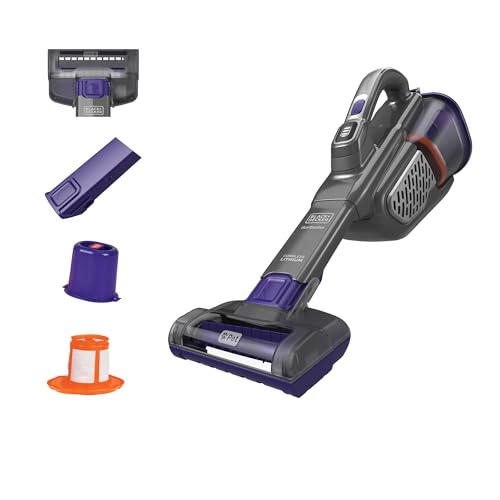
BLACK+DECKER dustbuster furbuster Pet Vacuum — Best motorised-brush all-rounder
The furbuster takes the familiar dustbuster formula and fixes its one weakness for pet owners: the plain nozzle that skates over woven hair. The motorised pet brush gives the machine an active edge on upholstery, working hair out of seat fabric and boot liners while the suction clears it. On flat carpeted areas of the car it behaves almost like a miniature upright, and that confidence changes how thoroughly owners bother to clean.
Around the rest of the vehicle it remains a well-mannered handheld. The body reaches into footwells, the cup copes with the mixed load of hair, grit and biscuit crumbs that dog transport produces, and recharging is a simple dock-or-plug habit. For households with one car and one dog, it covers the weekly routine without fuss; for multi-dog households it still performs, provided the owner empties the cup as the clean proceeds rather than compacting a whole car’s hair into it.
- Format: cordless handheld vacuum for home and car
- Key tool: motorised pet hair brush for upholstery
- Power: rechargeable battery, portable grab-and-go format
- Suction positioning: strong pull for a handheld of its class
- Filtration: washable filter components per the maker’s guidance
- Use pattern: weekly maintenance cleans and post-walk rescues
Strengths
- Motorised brush converts upholstery passes from hopeful to effective
- Familiar dustbuster handling suits drivers who dislike gadgety tools
- Works as a household spill vacuum between car duties
Trade-offs
- Very narrow gaps still need a crevice tool rather than the brush head
- Heavy whole-car cleans may need a mid-session charge or cup pauses
- Brush mechanism adds a part that needs hair cleared from it periodically
Best for: Single-dog households wanting one handheld for car seats, boot and household touch-ups.
Not suited for: Detailers who need continuous runtime for several cars in a row.

Shark UltraCyclone Pet Pro Plus CH951 — Best suction-led handheld
The UltraCyclone Pet Pro Plus approaches the car as three problems and ships a tool for each. The pet power brush handles upholstery and boot carpet, the crevice tool runs the seat rails and the gap beside the handbrake where hair and grit migrate, and the scrubbing brush works the ground-in footwell corners where paw dust becomes almost geological. Owners who rotate tools by zone will find this the most complete single purchase in the guide.
Its XL dust cup is the unglamorous advantage that shedding season reveals. A full clean of a dog car generates a surprising volume of hair, and a cup that swallows the whole job without a mid-clean empty keeps momentum and temper intact. The suction behind the tools is strong for the format, and the machine’s weight distribution suits the stooping, reaching posture car cleaning imposes. It asks for technique — slow passes, brush first on fabric — and repays it with the deepest clean here.
- Format: cordless hand vacuum for car and home
- Tools: pet power brush, crevice tool and scrubbing brush included
- Cup: XL dust cup for fewer empties during large cleans
- Power: rechargeable battery with strong handheld suction
- Filtration: cup emptied by hand; follow maker guidance on filters
- Use pattern: zone-by-zone full cleans of a dog-owning household’s car
Strengths
- Three distinct tools map exactly onto seats, rails and footwells
- Large cup survives a whole-car clean in moult season
- Strong suction rewards slow, methodical passes on fabric
Trade-offs
- Best results need tool changes, which impatient cleaners will skip
- Larger cup makes the body bulkier in the tightest footwells
- Battery still bounds the longest detailing sessions
Best for: Owners who clean zone by zone and want one kit that covers the entire car properly.
Not suited for: Drivers wanting a single no-tool grab-and-go for thirty-second tidy-ups only.

Shark Cyclone PET Handheld Vacuum CH701 — Best lightweight pet handheld
The Cyclone PET is built around a truth about car hair: frequency beats intensity. A lightweight machine that lives within reach gets used after every muddy walk, and hair removed weekly never becomes the woven mat that needs heroics. The CH701’s low weight makes the one-handed, reaching, half-kneeling work of car interiors genuinely easy, and its multi-surface pet tool handles the transition from fabric seats to carpeted boot without a tool change for most passes.
Shark’s suction tuning suits the format; the machine pulls harder than its size suggests, particularly on the short, deliberate strokes car cleaning uses. The crevice tool covers the architectural gaps — seat rails, door bins, the console’s edges — where hair collects in lines. For apartments without a garage, its size is a further virtue: it stores in a cupboard or even the boot itself, charged and ready, rather than demanding a dedicated corner of a utility room.
- Format: lightweight cordless handheld vacuum
- Tools: crevice tool and multi-surface pet tool included
- Power: rechargeable battery, grab-and-go format
- Suction positioning: strong pull for its weight class
- Filtration: hand-emptied cup with maker-guided filter care
- Use pattern: frequent short cleans that prevent hair build-up
Strengths
- Low weight makes awkward in-car postures sustainable
- Pet tool handles seats and boot carpet in one pass style
- Small storage footprint suits flats and garage-free households
Trade-offs
- Smaller cup fills during neglected-car rescue cleans
- Not the tool for a full valet of several vehicles
- Light body gives less of the planted feel some users prefer on carpet
Best for: Owners who clean little and often and want the machine stored in or near the car.
Not suited for: Anyone facing a season’s accumulated hair in one sitting.

BLACK+DECKER 12V dustbuster Car Vacuum — Best unlimited-runtime option
Every cordless pick in this guide eventually meets a clean that outlasts it: the spring deep clean, the post-holiday boot excavation, the multi-car household’s Saturday. The 12-volt dustbuster exists for that day. Plugged into the car’s own socket, it runs until the job is finished, at a steady level of power that never fades in the final footwell. Its rotating, extendable nozzle earns its keep in the angles cars specialise in — under seats, down the sides of the boot, along the tunnel beside the seats.
The trade is written into its design and should be accepted knowingly. The cable tethers you to the car, which is no hardship when the car is the workplace, but it rules out household use and shapes your route around the vehicle. Owners should also be sensible about battery draw on an ageing car battery during very long sessions. Within those honest limits, this is the detailer’s insurance policy: the machine that cannot run out of power halfway through the worst clean of the year.
- Format: corded handheld vacuum powered from a 12V car socket
- Runtime: unlimited while connected — no battery to charge or fade
- Nozzle: rotating and extendable for under-seat and boot angles
- Power: draws from the vehicle; use sensible judgement on long sessions
- Filtration: hand-emptied cup, maker-guided filter care
- Use pattern: deep cleans, multi-car households, post-holiday rescues
Strengths
- Never stops mid-clean, however thorough the session
- Steady power from first pass to last footwell
- Extendable nozzle reaches the car’s least accessible corners
Trade-offs
- Cable restricts movement and excludes household use
- Long sessions draw on the car’s battery
- No grab-and-go freedom for a thirty-second tidy
Best for: Owners who do fewer, deeper cleans and hate battery limits on principle.
Not suited for: Drivers whose routine is a quick cordless pass after every dog walk.
Detailing Brushes and Rubber Pet-Hair Stones — Prose-only: the manual complement
Ask a professional detailer how they defeat woven pet hair and the answer rarely begins with a vacuum. It begins with friction: a rubber pet-hair stone or brush drawn across the fabric in short strokes, which balls the embedded hair into loose clumps that lift away by hand or with the lightest suction. The technique transforms boot carpet and fabric seats, the two surfaces where owners otherwise conclude their vacuum is weak when the real problem is anchoring.
Stiff detailing brushes play the supporting role, flicking grit and hair out of seat seams, stitching lines and carpet edges so the vacuum’s crevice tool can collect them. Together these hand tools cost very little, never need charging, and multiply the effectiveness of every machine in this guide — which is why they are discussed here in prose, as a class, rather than linked as a pick. Buy them alongside whichever vacuum you choose, learn the short-stroke technique on the boot floor first, and the whole category will suddenly seem more powerful.
- Format: prose-only — manual hand tools, no power source
- Tools: rubber pet-hair stone or brush, stiff detailing brushes
- Action: friction loosens woven hair into liftable clumps
- Compatibility: works ahead of any vacuum in this guide
- Maintenance: rinse or pick clean; no filters or batteries
- Tier: budget addition with an outsized effect on results
Strengths
- Defeats the woven-hair problem at its mechanical root
- Costs little and lasts for years with no upkeep
- Makes modest vacuums perform like stronger ones
Trade-offs
- Adds a manual stage that takes minutes per seat
- Technique matters; long strokes achieve little
- Useless on loose surface hair where plain suction already wins
Best for: Every dog-car owner, as the partner to whichever vacuum they choose.
Not suited for: Nobody — but owners expecting them to replace a vacuum entirely will be disappointed.
How Do the Six Picks Compare Side by Side?
| Pick | Type | Standout trait | Watch out for |
|---|---|---|---|
| Bissell Pet Hair Eraser Hand Vacuum 2390A | Cordless hand vacuum | Motorised brush tool built for pet hair on fabric | Compact cup fills quickly during a full-car moult clean |
| BLACK+DECKER dustbuster furbuster Pet Vacuum | Cordless hand vacuum | Motorised pet brush on a proven dustbuster platform | Brush head width makes very tight seat-rail gaps a crevice-tool job |
| Shark UltraCyclone Pet Pro Plus CH951 | Cordless hand vacuum | XL cup plus a three-tool kit covering every car zone | Suction-led design rewards technique on woven fabric — slow passes win |
| Shark Cyclone PET Handheld Vacuum CH701 | Cordless hand vacuum | Featherweight body with a proper multi-surface pet tool | Lightweight format means a smaller cup for very heavy cleans |
| BLACK+DECKER 12V dustbuster Car Vacuum | 12V corded car vacuum | No battery at all — the car itself is the power source | The cable defines your working pattern and the engine-off draw needs respect |
| Detailing Brushes and Rubber Pet-Hair Stones | Prose-only manual tools | Loosens the hair that suction alone cannot move | They add a manual stage before vacuuming rather than replacing it |
The comparison divides along two axes: how each machine attacks woven hair, and how long it can keep working. The Bissell and furbuster lead with motorised brushes, the Sharks with suction and toolkits, the 12-volt BLACK+DECKER with endurance, and the prose-only hand tools with the loosening stage that flatters them all.
Why Does Car Upholstery Hold Hair So Stubbornly?
Seat fabrics are engineered loops and weaves, and a shed hair with its natural barbed surface works into those loops like a tiny anchor. Vacuuming pulls along the hair’s length, which often tightens the anchor instead of releasing it. That is the mechanical reason a plain nozzle can pass over visible hair repeatedly and collect almost none of it, while a brush that agitates the weave — or a rubber stone that rakes across it — frees the same hair in seconds.
Carpeted footwells add compression to the problem. Feet and paws press hair and grit into the pile daily, so the footwell layer is both woven and compacted. The scrubbing brush in a toolkit exists for exactly this zone, and owners who reserve it for footwells while using pet brushes on seats are applying the category’s tools the way detailers do.
Which Car Zone Should Decide Your Choice of Vacuum?
Start where your dog actually travels. A boot-riding dog makes the cargo area the main theatre: flat carpet, heavy load, easy access. Almost any pick here handles it, and cup size becomes the deciding factor. A rear-seat passenger dog creates the hardest problem — woven hair in shaped upholstery — and pushes the choice toward the motorised brushes of the Bissell or the furbuster, or the Shark toolkit used with patience.
Front-seat hair, usually transferred from clothing, is the lightest load and suits the grab-and-go Shark Cyclone PET. Households carrying dogs in different cars should also weigh storage: a vacuum that lives in the boot of the dog car gets used; one stored in a distant garage serves whichever car is nearest the house, which is rarely the hairy one.
How Long Should a Car Clean Take, and How Often?
A maintenance clean of a dog car — seats brushed, boot vacuumed, footwells passed — takes five to ten minutes with any cordless pick here, and that brevity is the point. Done weekly, it prevents the woven layer from ever establishing itself, and the car never reaches the state that requires a rescue. The owners with the cleanest dog cars are rarely the ones with the strongest vacuums; they are the ones whose routine is shortest and most frequent.
The deep clean is a different event: seats loosened with a rubber stone, every tool used, mats removed and beaten, boot emptied entirely. Budget the better part of an hour, choose the 12-volt machine or a fully charged Shark UltraCyclone, and treat it as a seasonal reset — spring moult, post-holiday, before selling the car. Confusing the two cleans is the commonest routine error: deep-clean effort applied weekly is unsustainable, and maintenance effort applied to a neglected car is ineffective.
What Should You Do About Hair in Seat Rails, Seams and Air Vents?
The crevice tool is the unsung hero of the dog car. Hair migrates into seat rails, the seam between seat base and back, door-bin bottoms and the edges of the centre console, where it mats with dust into grey ropes that no brush head can reach. A long crevice tool run slowly along each rail and seam collects this hidden load, and the difference shows in how clean the car smells and feels, not just how it looks.
Air vents and speaker grilles collect the finest hair and dust, and here restraint matters: a soft brush and gentle suction, never a blast that drives debris deeper. Seat stitching lines respond to the detailing brush from our prose-only pick, flicked along the seam so the crevice tool can follow. These finishing zones take minutes and separate a vacuumed car from a detailed one.
How Do You Keep a Car Vacuum Working Well?
Handhelds live hard lives — dropped on driveways, stored in cold boots, fed grit and hair in equal measure — and their upkeep is correspondingly simple and often skipped. Empty the cup after every car clean rather than letting hair compact in it, because a compacted cup strangles airflow on the next use. Wash or replace filters on the maker’s schedule, since car dust is fine enough to clog them invisibly while the machine still sounds healthy.
Motorised brushes need their own hair cleared periodically; a brush wound with hair agitates nothing. Cordless models should not live permanently flat or permanently on charge in a freezing boot if the maker advises otherwise, and the 12-volt model deserves a cable inspection now and then, because driveway abrasion is real. Five minutes of care per month is the entire contract, and it keeps suction where the listing promised it would be.
Can a Car Vacuum Also Handle Wet Paws and Mud?
Most handhelds in this guide are dry machines, and wet mud is their quiet enemy: it coats the cup, clogs the filter and turns hair into paste. The professional habit is patience — let mud dry fully, then brush and vacuum the resulting dust, which lifts cleanly. Dried mud on rubber mats can simply be removed with the mats themselves, beaten outside and vacuumed on the ground.
Wet paw prints on seats should be blotted and allowed to dry before vacuuming for the same reason. Owners in very wet climates sometimes keep a separate small wet-and-dry shop machine for the garage, but for the car itself the dry routine, applied after drying, remains the effective one. Forcing a dry handheld through wet debris is how good machines acquire a permanent smell and a short life.
What Is the Sensible Routine for a Two-Dog, Two-Car Household?
Scale changes the arithmetic. Two shedding dogs across two cars generate enough hair that a single small handheld becomes a bottleneck, and the honest solutions are a larger-cup machine like the UltraCyclone as the main tool, a lightweight Cyclone PET living in the second car, or the 12-volt model anchoring a monthly rotation where each car gets a full session in turn. Duplication is not extravagance here; it is how the routine survives contact with real schedules.
Assign the loosening tools generously too — a rubber stone in each car, so the pre-vacuum stage is never skipped for want of a thirty-second walk to the other vehicle. Multi-dog households also benefit from treating the boot as a managed zone: a washable liner, shaken out weekly, removes the bulk load before any vacuum is switched on, and turns every clean in this guide from a battle into a formality.
How Should You Tackle the Spring Moult in the Car?
Shedding season concentrates a quarter’s worth of hair into a few weeks, and the car shows it first because the dog’s loosened coat transfers on every journey. Shorten the maintenance interval rather than lengthening each clean: a five-minute pass twice a week keeps pace with the fall, while a heroic monthly session fights a woven backlog. Keep the rubber stone in the car during these weeks, because a quick rake of the seat before vacuuming doubles what each pass collects.
This is also the season when cup capacity stops being a specification and becomes the experience. Owners of compact handhelds should empty mid-clean without resentment — it is the machine working as designed at peak load — while owners planning a purchase in spring should weight the UltraCyclone’s larger cup more heavily than they would in autumn. And brush the dog before the journey when you can: hair collected on a grooming brush at home is hair that never enters the weave of your seats.
What About Cars That Carry Dogs Only Occasionally?
The occasional dog car — the borrowed lift to the vet, the friend’s spaniel on a country weekend — needs a different strategy: containment first, cleaning second. A boot liner or an old blanket under the dog captures most of the load before it reaches carpet, and a single thorough clean afterwards, loosening tools included, restores the car completely. For these owners the lightweight Cyclone PET is the proportionate purchase, stored in a cupboard and entirely adequate for a handful of cleans a year.
Resist buying the heaviest artillery for a twice-yearly problem, but do not skip the loosening stage on those rare cleans, because occasional hair weaves in just as stubbornly as daily hair. One careful session with a rubber stone and a borrowed or basic handheld will outperform a premium vacuum used carelessly, which is the recurring lesson of this entire category.
How Do You Clean Around Child Seats and Dog Guards?
Fitted child seats create the car’s most neglected territory: hair and crumbs migrate underneath and behind them, out of every tool’s reach, and stay there for years. Once a season, remove the child seat entirely, loosen the revealed upholstery with a rubber stone, and vacuum the compressed hair mat that will certainly be there. The same applies beneath dog guards and behind boot dividers, where hair drifts and settles undisturbed.
Between those removals, the crevice tool run along every edge of the fitted seat collects the migrating margin. Harnesses and straps themselves gather hair on their webbing; a stiff detailing brush flicks it free. These are unglamorous minutes, but they are where the difference between a car that carries children and dogs gracefully and one that merely endures them is decided.
A Note on Vacuuming Rental and Borrowed Cars
Returning a borrowed or hired car with a dog’s worth of hair in it is a social and sometimes financial problem, and the handhelds here solve it well because they travel. A cordless machine, the rubber stone and twenty unhurried minutes at the end of the trip will restore most interiors to a state no inspector will question. Focus on the boot floor and rear seats, then run the crevice tool along the rails, where hair hides from a glance but not from a hand.
Photograph the interior before the dog’s first journey if the arrangement is formal, so any pre-existing marks are documented, and agree expectations with the owner in advance. The cleaning itself is the easy part; the etiquette is what this small section exists to protect.
How Do You Judge Suction Claims on a Handheld Vacuum?
Handheld listings compete on power language that translates poorly to the inside of a car. What decides results on upholstery is the partnership between airflow and the tool on the end of the machine: a modest motor behind a motorised brush will out-clean a stronger motor behind a plain nozzle on woven fabric every time. Treat suction claims as a rough tier indicator, then choose by toolkit, cup size and format — the things your hands will actually judge weekly.
Battery behaviour matters more than peak figures for cordless models. A machine that holds its pull through the session cleans the last footwell as honestly as the first, while one that fades teaches its owner to rush. The lithium-powered picks in this guide were chosen partly for that steadiness, because car cleaning is sequential by nature — boot, seats, footwells — and a fading machine quietly discriminates against whichever zone comes last in your routine.
What Is the Best Order to Clean a Dog Car In?
Work top-down and inside-out. Begin with seats and headrests, where loosened hair falls onto surfaces not yet cleaned, then the seat rails and seams with the crevice tool, then footwell carpets, and finish with the boot, whose liner can be removed, shaken and vacuumed on the ground for the most thorough result of all. Mats come out early, get beaten outside the car, and go back in last, clean side up, once the footwells beneath them are done.
Keep the loosening stage immediately ahead of the vacuuming stage in each zone rather than raking the whole car first, because loosened hair resettles and re-anchors if it sits. Zone by zone — rake the seat, vacuum the seat, rake the boot, vacuum the boot — is slower to describe and faster to live, and it is the order professional detailers converge on for good reason.
How Should You Store a Car Vacuum So It Actually Gets Used?
Placement is destiny for a maintenance tool. A cordless handheld stored on its charger beside the car’s usual parking spot, or in the boot itself for the lightweight models, will be used in the small windows real life offers — while the kettle boils, while the dog drinks after a walk. The same machine stored in a loft or a distant cupboard will be used at Christmas. Choose the storage spot before the machine, if necessary, and let it veto purchases that do not fit there.
Keep the loosening tools with the vacuum, not with the household cleaning supplies, because the two-stage routine collapses the first time the rubber stone is in another building. A small caddy or even a door pocket holding stone, brush and charger cable turns the car kit into a single grab, and single grabs are what weekly routines are made of.
When Is a Professional Valet Worth Paying For?
A professional valet earns its fee at inflection points: before selling the car, after a season of neglect, when a new baby or an allergy in the family raises the standard, or when odour has soaked beyond what surface cleaning reaches. Professionals bring extraction machines, steam and time, and a thorough valet resets the car to a baseline that the handheld routine in this guide can then maintain for a year.
What a valet cannot do is stay done. Hair returns with the next journey, which is why paying for the reset without owning the maintenance tools is the expensive pattern, and owning the tools without ever resetting a truly neglected car is the frustrating one. Sequence them — professional reset first if the car needs it, handheld routine thereafter — and the combination costs less than either strategy repeated alone.
How Do Different Coat Types Change the Cleaning Problem?
A double-coated dog in moult produces volume: clouds of undercoat that fill cups, coat every surface and announce themselves from across the car park. The answer is capacity and frequency — larger cups, mid-clean empties, liners shaken often. A short-coated dog produces the opposite problem: sparse, stiff hairs that weave into fabric like needles and resist both brush and suction, making the rubber stone and motorised brush the heroes and cup size almost irrelevant.
Curly and long coats shed less into the car but carry more into it — mud, seeds, burrs and water held in the coat and deposited in the boot. For those dogs the scrubbing brush and footwell discipline matter most, and a boot liner that can be hosed down outperforms any vacuum accessory. Match your emphasis to your dog’s coat and the category’s tools sort themselves into a sensible order.
How Do You Keep Hair Off Passengers Between Cleans?
Even a well-kept dog car carries a surface layer that transfers to clothing, and managing that layer is partly textile strategy. A washable throw or seat cover where the dog rides concentrates the hair onto something that can be shaken outside and laundered, sparing the upholstery the woven layer entirely. Passengers sit on fabric that has been protected rather than merely cleaned, which feels different in a way guests notice without identifying.
A lint roller kept in the glovebox handles the final transfer before arrivals that matter, and a quick brush-down of your own clothes after loading the dog prevents you becoming the transport mechanism between car and office. None of this replaces vacuuming; it reduces the rate at which the car reloads, which is the same as making every clean last longer.
What Should Buyers Check on the Listing Before Ordering?
Confirm the tool list in the box rather than in the photographs, because accessory line-ups vary and the motorised brush or crevice tool you are buying the machine for should be named in the contents. Check whether filters are washable or replaceable and how they are obtained, since a handheld’s second year depends on them. Look at the cup’s emptying mechanism in a diagram if one is offered; you will perform that action hundreds of times, often one-handed, over a bin, in a driveway.
For cordless models, note the charging arrangement and whether a wall mount is included, because your storage plan depends on it. For the 12-volt model, confirm your car’s socket location reaches the boot with the cable provided or plan the session around the front socket. These are dull checks that take four minutes and prevent the specific disappointments that fill review sections with one-star frustration aimed at perfectly good machines.
How Does Winter Change the Dog-Car Routine?
Winter loads the car differently: road grit and salt arrive on paws and boots, daylight for cleaning shrinks, and wet coats deposit damp hair that mats faster than dry hair ever does. Rubber mats earn their place in these months because they can be lifted out and hosed while carpet is still drying from the last journey. A boot liner that contains meltwater protects the carpet beneath from the damp, sour layer that no vacuum fully cures once established.
Shorten the interval again and clean in daylight when you can, because the low sun that reveals every hair on a windscreen also reveals them on upholstery, and a clean judged in the dark is usually a clean judged generously. Keep the handheld charged indoors rather than in a freezing boot if the maker advises it, and let wet debris dry before vacuuming, as the earlier section urged, however strong the temptation to deal with it immediately.
A Final Word on Sharing the Car with Non-Dog People
The true test of a dog car is the passenger who does not own a dog. They notice the hair on a dark coat, the smell on a warm day, the grit under a shoe, with a clarity the owner lost months ago. Cleaning to that passenger’s standard — loosened seats, raked rails, washed liners, aired interior — is not vanity; it is what keeps lifts generous, car shares harmonious and the dog welcome in other people’s vehicles too.
That standard is achievable with every machine in this guide, which is the encouraging conclusion. The category does not demand the most expensive handheld; it demands the two-stage routine, the hidden zones, and a frequency matched to the dog. Get those right and the car becomes what it should be: transport that happens to carry a dog, rather than a kennel that happens to move.
One Last Check Before You Order a Car Vacuum
Picture your last three car cleans honestly: how long they took, where the hair fought hardest, and whether the machine ran out of anything — power, cup space, reach — before the car ran out of hair. Match the pick to that memory rather than to the worst clean you can imagine or the easiest one you hope for. The Bissell and the Sharks serve the frequent cleaner, the 12-volt model serves the marathon, and the loosening tools serve everyone; choosing in that order, from your own evidence, is how this category rewards its buyers.
Why the Boot Liner Deserves a Paragraph of Its Own
No accessory in this category returns more cleanliness per minute of effort than a washable boot liner, because it intercepts the load at the point of entry. Hair, mud and water land on a surface designed to be removed, shaken, hosed and dried, instead of on carpet designed to absorb and hold all three. Owners who fit one find their vacuum sessions shorten immediately, and the carpet beneath stays years younger than the dog.
Choose a liner that covers the boot floor fully and climbs the sides a little, so shaken-off debris stays contained when the dog rearranges itself mid-journey. Wash it when it begins to hold odour despite shaking, and let it dry completely before refitting, since a damp liner sealed against carpet recreates the very problem it exists to prevent.
Should You Vacuum the Car Before or After Washing It?
Interior first, almost always. Vacuuming shakes loose dust and hair that settle on sills and door shuts, and an exterior wash afterwards removes that fallout instead of sealing it onto wet paintwork. Work through the zones in the order this guide recommends, close the doors on a finished interior, and only then take the hose and bucket to the outside, where the day’s loosened debris washes away rather than being redistributed.
The exception is a car so muddy outside that opening the doors spreads grit across the seats — rinse the worst off first in that case, let the sills dry, then vacuum, then wash properly. Owners who keep that sequence find the interior stays clean longer, because the wash is no longer pushing a tide of grit and hair-laden water into every shut line the moment a door is opened.
What Mistakes Do Dog Owners Make When Vacuuming the Car?
The first mistake is vacuuming woven hair without loosening it, then concluding the machine is weak. Ten strokes of a rubber stone across a seat will teach more than any specification sheet: the vacuum was never the limiting factor. Build the loosening stage into the routine and every pick in this guide improves at once.
The second mistake is buying for the deepest clean and living with the maintenance reality. A powerful routine that takes forty minutes happens monthly at best, while hair arrives daily. Most households do better with a light machine used weekly, supported by a thorough session each season, than with a single heavyweight answer to both jobs.
The third mistake is neglecting the hidden zones. Seats and boot get cleaned because they are visible, while seat rails, seams and footwell corners accumulate the matted load that makes a car feel permanently doggy. The crevice tool exists for those lines; use it every second or third clean and the car resets properly.
Final Recommendation
For most dog owners, the Bissell Pet Hair Eraser is the pick we would hand over first, because its motorised brush attacks the woven-hair problem that defines this category, in a machine shaped for the car from the outset. The Shark UltraCyclone Pet Pro Plus is the better buy for thorough zone-by-zone cleaners, the Cyclone PET for little-and-often households, the furbuster for dustbuster loyalists, and the 12-volt BLACK+DECKER for anyone whose cleans outlast batteries. Whichever you choose, add the rubber stone and detailing brushes from our prose-only section, because they flatter every machine equally.
If your car currently smells of dog despite looking vacuumed, start with the loosening tools and the crevice work this weekend — the hidden seams are holding the evidence, and no new vacuum will find it for you until you rake it loose.
Frequently Asked Questions
Will a car vacuum damage leather seats?
Suction alone is safe on leather, but stiff brushes and scrubbing tools should be kept for fabric and carpet. On leather, use a soft nozzle or the crevice tool with care, and wipe hair away with a damp microfibre first, since leather releases hair easily and rarely needs aggressive tools.
How do I remove hair from the car’s headliner?
Gently, and with low expectations of any vacuum: the headliner’s fabric is delicate and its foam backing tears. A rubber brush used with a light touch, followed by the vacuum held just off the surface, removes most hair without stressing the material. Never scrub a headliner with a motorised brush.
Is a cordless or 12-volt vacuum better for pet hair?
Neither is better in the abstract. Cordless machines win on frequency — the weekly five-minute clean that prevents build-up — while the 12-volt model wins on endurance for deep cleans. Households that do both kinds of cleaning often end up owning one of each, and using both happily.
Why does hair remain after I vacuum the boot?
Because it is woven, not loose. Rake the boot carpet with a rubber pet-hair stone in short strokes until the hair balls into clumps, lift the clumps by hand, then vacuum the remainder. The second vacuum pass after loosening typically collects more than three passes before it.
Can I use my household vacuum in the car instead?
You can, and a full-size machine with a hose does a respectable deep clean on a driveway. The reason car handhelds exist is behavioural: the household machine stays indoors, the car stays hairy. A small vacuum stored near the car gets used weekly, which matters more than peak suction used rarely.
How do I stop the car smelling of dog after vacuuming?
Vacuuming removes hair and grit, which are the main odour carriers, especially from seams and rails. Follow with a wash of removable mats and boot liners, wipe hard surfaces, and let the car air with doors open on a dry day. Persistent odour usually traces to a liner or mat that has never been washed rather than to the vacuuming itself.
Related Guides
A car that carries dogs accumulates hair far beyond the seats, and the guides below follow that trail into the house and the wider world of pet-hair cleaning: Best Bagless Vacuums for Pet Hair Best Affordable Vacuums for Carpet Vacuum Amperage Explained: How Many Amps Do You Need? Best Car Air Purifiers


