What's inside
- Key Takeaways
- Quick Picks
- How Did We Judge Handhelds for Litter Rather Than for Everything?
- Comparison Table
- Which Litter Types Scatter Furthest, and Does the Vacuum Care?
- How Should the Daily Litter Patrol Actually Run?
- What Mistakes Do Cat Owners Make with Handheld Vacuums?
- How Do Multi-Cat Homes Change the Litter Equation?
- Where Should the Box Live for the Shortest Possible Trail?
- How Do You Handle the Litter Deep-Clean Day?
- What About Kittens, Senior Cats and Other Special Cases?
- How Long Will a Dustbuster Last in Litter Service?
- How Do You Stop Litter Dust Coating Everything near the Box?
- What Should Guests, Babysitters and Cat-Sitters Be Told?
- Why Does the Trail Always Lead to the Bedroom?
- How Do You Choose between the Three Linked Picks in One Minute?
- What Does the First Fortnight with a Litter Sentry Teach?
- How Should the Litter Kit Adapt When You Move House?
- What Is the Environmental Ledger of a Handheld Habit?
- How Do You Keep the Patrol from Becoming a Chore Everyone Avoids?
- What Does the Vet’s Waiting Room Know about Your Litter System?
- Final Recommendation
- Frequently Asked Questions
- Related Guides
As an Amazon Associate I earn from qualifying purchases. This post may contain affiliate links at no extra cost to you.
cottageverdict.com is reader-supported. When you buy through links on our site, we may earn an affiliate commission.
Where to buy: the linked dustbuster models below are sold on Amazon, and each name leads to its listing where you can check price on Amazon and confirm the current tool bundle and charging arrangement.
Cat litter respects no boundaries, and anyone searching for the best Black+Decker vacuums for cat litter has already discovered its teleportation network: the granules that leave the box on four paws, ride the hallway like a rumour, and surface days later in the bedroom carpet, the bathroom grout and — once, memorably, in every household — a shoe. Litter is a peculiar debris. It is heavier than dust, sharper than crumbs, designed by its makers to clump and track just enough to prove it works, and it concentrates in a blast radius around the box that receives more feline traffic than any other square metre of the home. It does not need a whole-house vacuum. It needs a small, willing, always-near machine that treats the scatter as a daily thirty-second event rather than a weekly campaign.
That is precisely the dustbuster’s ancestral homeland. BLACK+DECKER’s handheld line is the oldest name in grab-and-go cleaning, and three of its current models divide the litter beat between them: the compact QuickClean dustbuster for the wall by the box, the FLEX with its hose for the corners a rigid body cannot reach, and the furbuster, whose motorised pet brush handles the places where litter and hair conspire together. A fourth family member, the classic AdvancedClean handheld, is discussed in prose — it remains a perfectly sensible litter machine, and this guide explains its place honestly. Two further prose sections cover the unglamorous allies that decide whether any vacuum wins: litter mats, and the tracking-control habits that stop granules boarding the cat in the first place.
There is a dignity point worth making on the cat’s behalf: the litter area is the one part of the home where the animal is owed privacy and predictability, and every recommendation in this guide — placement, patrol timing, machine manners — was checked against that obligation. A system that keeps the floors clean by making the box a stressful place has solved the wrong problem, and no granule-free hallway is worth a cat’s confidence.
One boundary before the picks: a handheld vacuum is for dry, scattered litter on floors and hard surfaces around the box. It is not for cleaning the box itself, not for wet litter, and not a substitute for the scooping and washing rhythm that keeps the box area civilised. Used in its proper role — the daily scatter patrol — the right dustbuster converts the most resented square metre in a cat home into the most easily kept.
Key Takeaways
- Litter scatter is a frequency problem: a handheld by the box, used for thirty seconds daily, beats a weekly deep clean every time.
- The QuickClean dustbuster is the wall-mounted sentry pick; the FLEX reaches behind and beneath the box; the furbuster adds a motorised brush for litter-plus-hair zones.
- The classic AdvancedClean handheld is covered in prose as the range’s traditional option — capable for litter, judged on the same terms.
- Litter mats and tracking control, both prose topics here, remove more granules from your floors than any suction upgrade.
- Vacuum only dry scatter on surrounding floors — never the box itself, never wet or clumped litter deposits.
- Empty the little bowl after litter sessions; litter dust coats filters faster than household dust does.
Quick Picks
| Pick | Badge | Why it made the list |
|---|---|---|
| BLACK+DECKER dustbuster Cordless Handheld | Box-side sentry | The QuickClean model with a wall mount, built to live charged beside the litter box and fire in seconds. |
| BLACK+DECKER dustbuster FLEX Handheld | Reach specialist | A flexible hose stretches the clean behind the box, under its stand and along the skirting it hides behind. |
| BLACK+DECKER dustbuster furbuster Pet Vacuum | Litter-and-hair hunter | A motorised pet brush for the rug and mat zones where tracked litter tangles with shed hair. |
| BLACK+DECKER dustbuster AdvancedClean Handheld Vacuum | Prose-only classic | The range’s long-running standard handheld, discussed honestly for litter duty without a link. |
| Litter Mats, Chosen and Placed Well | Prose-only ally | The mat is the border checkpoint where most tracked granules should be confiscated. |
| Tracking Control: Habits That Stop the Spread | Prose-only system | Box placement, litter depth and paw-side routines that shrink the blast radius itself. |
How Did We Judge Handhelds for Litter Rather Than for Everything?
Litter makes its own demands, different from the crumb-and-dust diet most handhelds are marketed on. Granules are dense, so a litter vacuum needs honest suction at the nozzle rather than impressive figures at the motor; they are abrasive, so the dirt bowl and filter must tolerate a gritty load without complaint; and the work happens in a tight radius around a box, often in a bathroom or utility corner, so size, storage and charging arrangements matter more than raw runtime. We weighted the first thirty seconds of ownership most heavily: a machine that is mounted, charged and reachable in one motion will be used daily, and daily is where litter wars are won.
We also judged the tail of the job. Litter dust is fine and persistent, coating filters and settling in bowls, so easy emptying and a washable or replaceable filter path scored highly. Noise mattered in a way it rarely does elsewhere, because the litter vacuum works in the cat’s own territory, and a machine that terrifies the resident will be exiled to a cupboard by the resident’s staff. What follows is therefore a patrol ranking, not a power ranking — the best litter dustbuster is the one that is there, charged, quiet enough, and empty, every single day.

BLACK+DECKER dustbuster Cordless Handheld — Box-side sentry
The QuickClean dustbuster understands its assignment at the level of furniture: it comes with a wall mount, because a litter vacuum’s true specification is its address. Mounted beside the box, charged and waiting, it turns the post-visit scatter into a thirty-second ritual performed while the kettle boils — a pass across the mat, a sweep of the blast radius, a whisk along the skirting where granules queue. Its suction is honestly matched to the work: litter granules on hard floors and low mats surrender immediately, and the compact bowl, emptied in seconds, is sized for exactly this frequency of small cleans.
The shape suits the territory. Litter areas live in corners, alcoves and bathroom margins where a full-size machine would arrive like a parade; this little body works one-handed, at ankle height, without rearranging the room. Between litter shifts it moonlights across the home’s other small emergencies — the hall’s grit, the kitchen’s crumb line — which keeps it exercised and charged rather than forgotten, the fate of single-purpose tools.
Its compromises are scale and depth. The bowl fills fast if you neglect the patrol for a week and return to a beach; the suction that lifts granules from tile will not excavate litter ground into deep carpet pile, which is the furbuster’s parish below. And like every cordless sentry, it depends on its mount being installed where the mess actually happens — a QuickClean kept in a distant cupboard is just a vacuum, while a QuickClean by the box is a system.
- Format: compact cordless handheld, QuickClean HNVC215B10
- Storage: wall mount included for box-side stationing
- Design focus: fast, frequent passes over dry scatter
- Best matched to: hard floors and mats around the litter box
- Tier note: accessible handheld tier — check price on Amazon
Strengths
- Wall mount puts it charged and reachable at the exact scene
- One-handed size works the alcoves litter areas live in
- Quick emptying keeps the daily ritual genuinely thirty seconds
Trade-offs
- Small bowl punishes a neglected week of scatter
- Not the tool for litter ground into deep carpet
- Value depends on mounting it where the box actually is
Best for: the standard litter corner on hard flooring, patrolled daily.
Not suited for: deep-carpet litter zones or once-a-month cleaning habits.

BLACK+DECKER dustbuster FLEX Handheld — Reach specialist
Every litter station has a shadow map: the strip behind the box where granules leap and land beyond the mat’s jurisdiction, the gap beneath a raised stand, the skirting corner where the wall meets the floor at an angle no rigid nozzle has ever cleaned. The FLEX exists for that map. Its flexible hose extends the nozzle away from the body, so the machine stays in your hand or on the floor while the cleaning end explores behind, beneath and between — the three prepositions of litter.
The hose changes the ergonomics of the whole chore. Instead of kneeling and angling a rigid body into the box’s hinterland, you guide a light nozzle on a leash, reaching the wall-floor junction where tracked litter accumulates into a grey tideline over months. It is equally at home on the stairs the cat uses as a motorway and in the car footwell where litter rides out on shoes, which makes it the most versatile of the three linked picks for homes whose litter problem has satellite colonies.
Trade-offs travel with the design. A hose handheld is a fraction less instant than the wall-mounted sentry — there is a moment of uncoiling in every use — and the body’s shape is more appliance than pebble, asking a little more storage thought. Its suction at the nozzle is the honest handheld class, splendid for scatter, not intended for excavating the rug’s depths. Buy it when your litter geography includes the unreachable places, because for those places it is not the second-best tool here; it is the only one.
- Format: cordless handheld with flexible hose, BDH2020FL
- Design focus: reach behind, beneath and between furniture
- Best matched to: boxes in alcoves, on stands, or against busy walls
- Secondary parish: stairs and car footwells on the litter trail
- Tier note: mid handheld tier — check price on Amazon
Strengths
- Hose reaches the shadow zones rigid handhelds skip
- Nozzle-on-a-leash ergonomics spare the knees and back
- Versatility across stairs and car extends its value
Trade-offs
- A moment’s setup makes it slightly less instant than the sentry
- Bulkier body asks more of its storage spot
- Scatter-class suction, not deep-pile excavation
Best for: litter stations with hidden hinterlands behind and beneath the box.
Not suited for: a simple open-floor box corner where reach is never the problem.
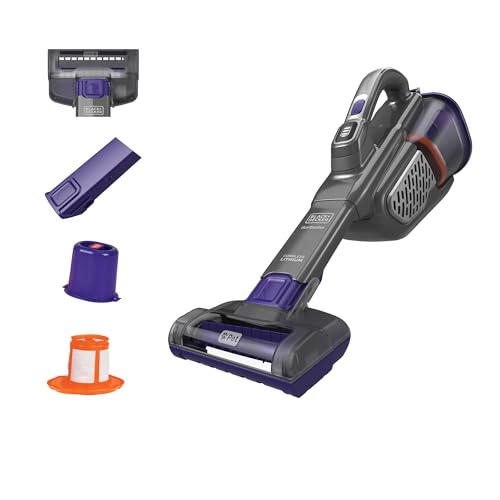
BLACK+DECKER dustbuster furbuster Pet Vacuum — Litter-and-hair hunter
Where litter meets carpet, it stops travelling alone. Granules tracked onto a rug lodge among shed hair, and the two form a composite debris that plain suction skates over — the hair shields the litter, the litter weights the hair, and together they wait out ordinary cleaning. The furbuster answers with the tool the composite fears: a motorised pet brush that agitates the surface while suction collects what the agitation frees. It belongs to BLACK+DECKER’s AdvancedClean family, and its design brief — pet hair, at handheld scale — turns out to describe the litter rug’s problem exactly.
On the mat by the box, the hallway runner the cat uses as a runway, and the bedroom carpet where the trail finally fades, the furbuster works a class above its siblings. The brush lifts the nap, the granules surface, and the hair comes with them instead of retreating deeper. It is also the pick for the litter-adjacent upholstery — the chair the cat sleeps in after visiting the box, which receives a dusting of both exports — where its brush treats fabric with the same persuasive routine.
The costs are the motorised tool’s usual ones: more weight in the hand than the pebble-simple QuickClean, a brush that itself needs an occasional hair clear, and a tier step up from the range’s simplest models. Homes with hard floors throughout the litter zone will pay for agitation they never invoke. Homes with any carpet on the trail will consider it the only serious option in the line, and on the evidence of the composite debris, they will be right.
- Format: cordless handheld with motorised pet brush, HHVK515JP07
- Family: AdvancedClean pet line
- Design focus: agitation for hair-and-litter composite debris
- Best matched to: rugs, runners and carpet on the tracking trail
- Tier note: premium handheld tier — check price on Amazon
Strengths
- Motorised brush breaks up the litter-and-hair composite
- Works upholstery where the cat naps after box visits
- Strongest surface performance of the dustbuster picks here
Trade-offs
- Heavier in hand than the simplest handhelds
- Brush needs its own occasional clearing session
- Agitation is wasted on all-hard-floor litter zones
Best for: litter trails that cross rugs, runners or any carpeted ground.
Not suited for: hard-floor-only litter corners served perfectly by the sentry pick.
BLACK+DECKER dustbuster AdvancedClean Handheld Vacuum — Prose-only classic
The AdvancedClean nameplate is the dustbuster’s classic line: the standard handheld in its long-running form, with a rotating nozzle tradition, a generous dirt bowl by handheld standards, and a charging base designed for the counter or wall of a utility space. For litter duty its virtues are the classic ones — balanced suction, a bowl that swallows a scatter session without ceremony, and a shape that generations of hands already know. Many households reading this guide own one already, in a kitchen drawer or on a garage shelf, and the first thing this section should tell them is that their litter problem may already be solved by the machine they forgot they had.
Judged against its younger siblings, the standard AdvancedClean sits between the sentry and the hunter: more substantial than the QuickClean, less specialised than the furbuster, with no motorised brush for the carpet trail and no hose for the hinterland. Its litter case rests on the same frequency logic as the whole guide — stationed near the box, charged, and used daily, it will keep a hard-floor litter corner impeccably. It is covered in prose rather than linked in this guide, so treat it as the reference point of the range: the machine the other three are variations on, and a perfectly honourable answer if it is already in your house or offered at a tier that suits you.
- Format: cordless standard handheld, AdvancedClean line
- Character: the range’s reference design, bowl-forward and balanced
- Litter verdict: fully capable on hard floors at daily frequency
- Position in this guide: prose-only discussion, no link attached
- Tier framing: the classic mid-position of the dustbuster family
Strengths
- Balanced, proven design that many homes already own
- Generous bowl by handheld standards suits scatter sessions
- Charging-base life suits a permanent litter-corner station
Trade-offs
- No motorised brush for carpeted tracking trails
- No hose for the behind-the-box shadow zones
- Less instant than a wall-mounted pebble-format sentry
Best for: households that already own one, or value the classic balanced design.
Not suited for: carpet-trail homes needing the furbuster’s agitation.
Litter Mats, Chosen and Placed Well — Prose-only ally
The mat is not an accessory to the litter system; it is the border where the system succeeds or fails. A good litter mat presents the exiting cat with a surface that traps granules from paws — a textured, mesh or deeply grooved landscape that flexes underfoot and shakes the cargo loose — and it is sized generously enough that the cat cannot simply step over the border in one stride. Placement matters as much as material: the mat belongs wall-to-wall across the box’s exit route, because a cat leaving a covered box has one door, and that door’s threshold is where the checkpoint belongs.
Maintenance decides the mat’s career. A mat that is never shaken becomes a granule reservoir that re-loads every passing paw, worse than no mat at all; shaken outdoors daily and vacuumed in the patrol, it stays a trap instead of becoming a distributor. Double-layer designs that let granules fall through to a tray empty with particular grace. Whatever the design, audit it monthly with honest eyes — mats flatten, textures polish smooth with wear, and a tired mat announces itself by the trail’s sudden extension into rooms it never reached before.
- Material logic: texture that flexes and traps granules from paws
- Sizing logic: wide enough that the exit stride cannot clear it
- Placement logic: wall-to-wall across the box’s only exit route
- Position in this guide: prose-only guidance, no product linked
- Maintenance: shaken daily, vacuumed in the patrol, audited monthly
Strengths
- Confiscates most tracked litter before it boards the cat
- Costs little and asks only a daily shake in return
- Makes the vacuum’s remaining job small enough for thirty seconds
Trade-offs
- Some cats dislike certain textures and route around them
- A neglected mat becomes a distributor instead of a trap
- Large mats need a shaking place that is not the clean floor
Best for: every litter station, without exception — the system’s foundation.
Not suited for: replacing the vacuum patrol; the two work as a pair.
Tracking Control: Habits That Stop the Spread — Prose-only system
Tracking begins inside the box, so control does too. Litter depth is the first lever: too shallow and the cat digs to the base, scattering with excavation enthusiasm; too deep and every exit carries a paw-load of surplus. The middle depth the litter’s maker suggests is a measured answer, not a guess. Box design is the second lever — higher sides and a single, mat-covered exit convert a four-directional scatter into a managed border crossing, and covered boxes concentrate the exit further still, for cats who accept them.
The third lever is the cat’s own route. A box placed in a carpeted bedroom guarantees the trail crosses the worst possible surface; the same box on hard flooring near a washable runner contains the story to surfaces that surrender granules easily. Grooming plays a quiet part for long-haired cats, whose paw furnishings are litter’s favourite transport, and a mat-side pause — many cats will accept a textured route that includes a scratching post by the exit — shakes paws at the border. None of these habits costs money worth mentioning, and together they can halve the vacuum’s workload before it is ever switched on.
- Lever one: litter depth at the maker’s middle recommendation
- Lever two: high sides and a single, mat-covered exit
- Lever three: box placement on hard floors, routes over washable runners
- Position in this guide: prose-only system, no product linked
- Combined effect: the blast radius shrinks before vacuuming begins
Strengths
- Attacks tracking at its sources rather than its symptoms
- Costs almost nothing beyond placement thought
- Benefits every vacuum the household will ever own
Trade-offs
- Some cats veto box changes with aristocratic firmness
- Placement options are limited in small homes
- Habits take a fortnight to become the household’s default
Best for: households whose trail reaches rooms far from the box.
Not suited for: excusing a skipped patrol — control shrinks the job, never erases it.
Comparison Table
| Pick | Format | Litter zone | Standout trait | Watch out for |
|---|---|---|---|---|
| BLACK+DECKER dustbuster Cordless Handheld | Compact handheld | Box-side hard floors | Wall mount, instant patrol | Small bowl, shallow-pile only |
| BLACK+DECKER dustbuster FLEX Handheld | Hose handheld | Behind and beneath the box | Flexible reach into shadow zones | Slightly slower to deploy |
| BLACK+DECKER dustbuster furbuster Pet Vacuum | Brush handheld | Rugs and runners | Motorised brush for litter-and-hair | Brush needs occasional clearing |
| BLACK+DECKER dustbuster AdvancedClean Handheld Vacuum | Standard handheld | General litter corner | Classic balanced reference design | Discussed in prose, not linked |
| Litter Mats, Chosen and Placed Well | Prose ally | The box’s exit border | Traps granules at the checkpoint | Must be shaken daily |
| Tracking Control Habits | Prose system | The whole trail | Shrinks the blast radius itself | Cats may veto box changes |
Which Litter Types Scatter Furthest, and Does the Vacuum Care?
The vacuum cares less than the mat does, but the ranking is instructive. Lightweight litters travel furthest on the paw and the draught alike; fine-grained litters embed most happily in carpet and grout; crystal litters roll like ball bearings and are found, individually, in the furthest rooms of the house, usually by a bare foot at night. Heavy clay granules stay nearest the box but grind into the hardest residue when they meet a damp floor. Your patrol frequency should follow your litter’s travel class, not a generic calendar — a crystal household patrols the trail’s far end weekly, while a clay household concentrates on the blast radius and the mat.
Switching litter to solve a vacuum problem is occasionally justified and usually disappointing, because the cat’s preference outranks the owner’s logistics and a rejected litter creates messes beside the box that no handheld was designed for. Change the system around the litter — mat, placement, patrol — before changing the litter itself, and let any litter change be the cat’s decision, negotiated slowly, in the usual diplomatic way.
How Should the Daily Litter Patrol Actually Run?
Thirty seconds, same time daily, anchored to an existing habit — the morning feed is the classic anchor, because the box receives its busiest traffic overnight and the scatter is freshest at breakfast. The route runs: mat first with a slow pass, then the blast radius in an arc, then the first metre of the trail’s main road, whether that is hallway, runner or bathroom tiles. Empty the bowl into the bin the litter waste uses, not the kitchen bin, and give the filter a tap against the bin’s rim while you are there; litter dust is the filter’s fastest enemy and the tap is a two-second vaccine.
Weekly, extend the patrol by two minutes: the FLEX’s hinterland behind the box, the skirting tideline, and the trail’s far stations where the odd granule emigrates. Monthly, wash or replace the filter per the maker’s guidance and inspect the mat with the honest audit described above. That is the entire system — under fifteen minutes a week, all-in — and households that run it describe the same surprise: litter stops being a house-wide phenomenon and becomes what it should have been all along, a small local weather event by the box, cleared before it makes the news.
What Mistakes Do Cat Owners Make with Handheld Vacuums?
The cardinal mistake is vacuuming the box area wet. A handheld drawn across damp litter or a freshly washed, still-damp floor coats its bowl and filter in a cement of dust that no tapping cures; let the zone dry, then patrol. Second comes the opposite devotion — using the litter handheld for the whole home’s emergencies until it lives wherever the last crisis was, which is never beside the box. A sentry that has wandered is a sentry lost; the litter machine’s address is its virtue, and households with busy lives do better to give the rest of the home its own small tool than to keep conscripting this one.
Third, owners neglect the filter until suction halves and blame the battery. Fourth, they patrol at the cat’s busiest moment, teaching a nervous animal that its toilet has a predator; patrol after the visit, not during the commute. Fifth, they buy reach or brush they do not need — a FLEX for an open corner, a furbuster for a tiled bathroom — and feel vaguely disappointed by excellence aimed at the wrong geography. Read your own litter map first; the picks above are a small range, and each has a parish.
How Do Multi-Cat Homes Change the Litter Equation?
Multiply the cats and the system scales by territory rather than by effort alone. Multiple boxes — the standing guidance is one per cat plus a spare — mean multiple stations, and the patrol becomes a round: mat, radius, trail, next station. A single roaming handheld can serve the round if the stations are near; spread across floors, a second inexpensive sentry at the far station outperforms one premium machine asked to commute. The furbuster’s case strengthens in multi-cat homes because hair volume joins litter volume on every shared trail, and the composite debris becomes the default rather than the exception.
Multi-cat homes also teach the deepest litter lesson fastest: the system beats the machine. Mats at every exit, boxes on hard floors, depths kept honest and a round that happens daily will keep a four-cat house tidier than a neglected flagship keeps a one-cat flat. Buy the dustbusters to serve the system, station them like fire extinguishers, and the arithmetic of many cats becomes a logistics problem with a known solution instead of a daily defeat.
Where Should the Box Live for the Shortest Possible Trail?
Placement is destiny. The ideal litter station sits on hard, washable flooring, in a corner that gives the mat a wall-to-wall run across the exit, within a few steps of the bin the waste uses, and near enough to a socket that a wall-mounted sentry can live charged at the scene. Bathrooms and utility rooms earn their popularity honestly on every count. The worst placements share a signature: carpet between the box and the household’s main routes, a doorway the cat must cross at speed, or a station so hidden for human tidiness that the patrol itself becomes an expedition nobody performs.
Small homes must compromise, and the compromise hierarchy runs: hard floor first, mat coverage second, patrol convenience third, human aesthetics last — because the trail punishes the first three compromises daily and the fourth only when guests inspect the utility corner, which they do not. A box in a carpeted spare room can still be civilised with a large mat, a washable runner laid along the exit route like a red carpet in reverse, and the furbuster stationed at the room’s door. Geography sets the difficulty; the system sets the result.
How Do You Handle the Litter Deep-Clean Day?
Beyond the patrol stands the monthly reckoning, when the box itself is emptied, washed and refilled, and the station deserves its deep pass. Move the box, and the floor beneath it — the square metre no patrol ever reaches — receives the FLEX or the sentry at full attention, because the dust that settles under a box across a month is the finest and most concentrated in the home. Wash the mat or shake and vacuum it to within an inch of its life, inspect the skirting tideline, and let every surface dry completely before the box returns, since a station reassembled damp teaches the next month’s dust to stick.
Use the same day for the machines’ own service: filters washed and set to dry with a full day allowed, bowls wiped, the furbuster’s brush cleared of its accumulated hair. Deep-clean day, kept monthly, is what allows the daily patrol to stay at thirty seconds — the two rhythms are one system, and households that skip the monthly wonder why the daily slowly stops working.
What About Kittens, Senior Cats and Other Special Cases?
Kittens scatter with the enthusiasm of apprentices and track with paws that have not yet learned economy, so the blast radius doubles and the patrol may need a second daily pass during the first months; the consolation is that kittens also teach the household the habit while everyone is motivated. Senior cats and cats with mobility limits argue for low-sided boxes and stations on one floor, and their trails are usually shorter but their boxes busier, which shifts the emphasis from reach to frequency. Long-haired breeds carry the paw-furnishing problem described earlier, and for them the mat audit and the occasional gentle paw trim, where the cat permits handling, are worth more than any machine decision in this guide.
Cats with respiratory sensitivities in the household — feline or human — argue for low-dust litter choices and against any dry sweeping that raises what the vacuum would have contained; here the handheld’s contained suction is not merely convenient but the correct tool category, used slowly, with the animal elsewhere. As ever in this guide, none of this is veterinary advice; it is housekeeping arranged kindly around the animals’ realities, and health questions belong to the vet.
How Long Will a Dustbuster Last in Litter Service?
Litter is abrasive and dusty, so the honest answer is: years, if the filter rhythm holds, and months of decline if it does not. The components under litter stress are the filter, which loads fastest; the bowl’s seals, which grit can score over time; and the battery, which ages on the same calendar as any cordless tool. The defence is entirely procedural — tap the filter at every emptying, wash it monthly, never vacuum the damp, and empty the bowl before litter dust cakes its corners. Owners who run that rhythm report dustbusters serving litter duty across several cats’ lifetimes; the machine is simple, and simple machines die of neglect rather than of work.
When decline does come, diagnose before replacing: a washed filter and a cleared intake restore most apparently tired handhelds, and a battery that has faded after years of daily service has delivered its value in full. Replace with the pick that matches your current geography, because by then the trail, the cats and the house may all have redrawn the map this guide taught you to read.
How Do You Stop Litter Dust Coating Everything near the Box?
The pale film on the shelf above the litter station is the box’s exhaust made visible: fine particles raised by digging, pouring and the cat’s own landscaping, settling on every nearby surface. Pouring technique is the first control — litter added slowly, from low, into a box whose resident is elsewhere, raises a fraction of the cloud that a cheerful high pour creates. The second control is the patrol’s order: vacuum the surrounding floor before wiping shelves, because wiping first merely relocates the film to a floor you are about to clean anyway, and the detailing logic of top-to-bottom applies in miniature here.
The third control is the machine’s own exhaust discipline: a clean filter and an intact bowl seal keep the handheld from becoming a dust distributor with a motor. Households that notice the film worsening despite faithful patrols should suspect the filter first — it is the cheapest investigation in the house — and the litter’s dust class second, since low-dust litters genuinely differ and the cat, consulted through a gradual trial, may accept the change that ends the film.
What Should Guests, Babysitters and Cat-Sitters Be Told?
The litter system survives delegation only if it is explained as a system. Leave the sitter three sentences, not thirty: where the sentry hangs, what the thirty-second patrol covers, and where the waste bin lives. Show the mat its daily shake and the filter its tap, because those two gestures are the ones a substitute will skip as unimportant, not knowing they are the load-bearing ones. If the household will be away a week, schedule the deep-clean day for your return rather than demanding it of the sitter — the patrol alone holds the line honourably for a fortnight.
Guests need less instruction and more geography: a litter station that can be closed behind a door during a dinner party is a station designed with hospitality in mind, and the patrol performed an hour before arrival — never during, for the cat’s dignity and the guests’ conversation — leaves the territory at its civilised best.
Why Does the Trail Always Lead to the Bedroom?
Because the bedroom is where the cat is going. Trails are not random scatter; they are the map of the cat’s own commute between box, food, water and the warm human hills it sleeps on, and the granules simply ride the commute until friction or a doorway’s draught shakes them loose. This is why trail control that ignores the cat’s geography fails: a mat placed where the owner wishes the cat walked is decoration, while a runner laid along the actual commute is infrastructure. Spend one evening watching the route with a strategist’s eye — where the paws land after the hallway turn, which rug edge receives the first carpet steps — and place your defences on the real roads, not the imagined ones.
It also explains the trail’s seasonal variation: winter moves the cat’s sleeping territory toward radiators and human beds, summer toward cool tiles, and the granules follow the migration faithfully. The patrol route is a living document; redraw it when the cat redraws its life, and the system this guide built will keep its promises in every season.
How Do You Choose between the Three Linked Picks in One Minute?
Stand at your litter box and look at the floor. If everything within reach is hard and open, the sentry wins: mount the QuickClean, and let frequency do what force cannot. If your gaze travels behind the box, under a stand, or along a wall the box hides against, the FLEX wins, because the clean you cannot reach is the clean that accumulates into the tideline. If your gaze crosses a rug, a runner or any carpet before it reaches open floor, the furbuster wins, because that fabric is where litter stops being a scatter and becomes a composite that only agitation breaks. Most households can make the call in that one look; households with two different stations should make it twice, and buy without guilt for both parishes.
And if the look reveals a station in genuine disorder — no mat, box on deep carpet, trail to three rooms — buy the mat and move the box before buying any machine at all. The dustbuster that arrives after the system is fixed will feel miraculously effective; the one bought instead of fixing it will be blamed, unfairly, for geography.
What Does the First Fortnight with a Litter Sentry Teach?
Day one teaches the blast radius’s true size, which is always larger than the owner’s estimate. Day three teaches the anchor habit: the patrol attached to the morning feed survives, while the patrol scheduled for whenever quietly dies. By the end of week one, the trail’s far stations have stopped restocking, because the border is finally being policed, and the bedroom granule becomes an event rather than a condition. Week two teaches the filter lesson — the first tap-out reveals how much dust the little machine has been quietly swallowing — and by the fortnight’s end, most owners report the strangest outcome of all: they stop thinking about litter entirely, which was the product they were actually buying.
How Should the Litter Kit Adapt When You Move House?
A move redraws every map in this guide at once. The new home’s box placement should be chosen before the furniture settles, while hard floors are still empty and options are open — the one moment a household can grant the litter station its ideal corner without negotiation. Walk the likely commutes as the cat will walk them, note where carpet interrupts, and station the sentry and mat as a single decision on day one, because a system installed in the first week becomes the house’s normal, while a system postponed becomes a project. The furbuster’s parish may grow or vanish with the new flooring; the FLEX may inherit a hinterland the old home never had. Re-read your picks against the new geography rather than assuming the old answers travelled with the boxes.
What Is the Environmental Ledger of a Handheld Habit?
A small cordless machine used daily for thirty seconds consumes trivial electricity and, kept for years, displaces the far larger cost of running a full-size vacuum for a square metre of scatter. The ledger’s real entries are longevity and disposal: a dustbuster maintained through its filter rhythm serves for years and its battery, when it finally fades, should travel to battery recycling rather than the bin. The mat and habits sections carry no footprint at all beyond a shake outdoors. Set against the alternative — litter tracked through a home until carpets need professional rescue or early replacement — the handheld habit is the modest option in every column, which suits a guide whose entire philosophy is small, frequent and finished.
How Do You Keep the Patrol from Becoming a Chore Everyone Avoids?
Chores die of friction, so design the friction out. The mount goes where the hand falls naturally, not where the wall looks tidiest; the waste bin stands within the same reach; the mat’s shake has an appointed outdoor spot that is not a journey. Anchor the patrol to a pleasure where possible — the kettle’s boil, the morning podcast’s first minute — and let the household’s cat person and non-cat people alike learn the thirty seconds, because a system one person owns is a system that collapses on their holiday. Children old enough to be trusted with the cat can be trusted with the sentry, and usually guard the ritual more faithfully than adults do.
Finally, notice the result out loud now and then. The trail that no longer reaches the bedroom, the bathroom floor that no longer crunches — naming the system’s victories is how a chore graduates into a household’s quiet pride, and pride is the most durable maintenance schedule ever devised.
What Does the Vet’s Waiting Room Know about Your Litter System?
Nothing directly — but the journey there is the litter system’s final examination. The carrier that leaves a clean station carries less dust into the car; the car that received the carrier benefits from the Bissell-and-boot discipline of the neighbouring guide; and the home you return to, post-appointment, with a cat who has opinions about the day, will scatter its protest across the blast radius within the hour. The patrol, performed without comment, is the household’s way of saying the matter is closed. Keep health questions for the professionals in that waiting room, and keep the floors for the system in this guide, and both sides of cat ownership stay in their proper, well-kept places.
Final Recommendation
Station the QuickClean dustbuster by the box if your litter zone is hard-floored and open, choose the FLEX if your box hides in an alcove with a shadow map behind it, and choose the furbuster if the trail crosses any carpet at all — then lay the mat, set the litter depth, and run the thirty-second patrol until it is as automatic as feeding. The granule in the bedroom slipper is not a suction failure; it is a system asking to be built, and this small black-and-orange toolkit, plus two pages of habits, is the whole blueprint, paw by paw.
Frequently Asked Questions
Can I vacuum inside the litter box itself?
No — the handhelds here are for dry scatter on the floors around the box. The box itself belongs to the scooping and washing routine, and vacuuming litter deposits or damp litter will coat the machine’s bowl and filter in a residue that ruins both the clean and the vacuum’s day.
How often should the filter be cleaned in litter duty?
More often than in any other household role, because litter dust is fine and relentless. Tap the filter clear at every emptying, and wash or replace it monthly in an average one-cat home — sooner if suction softens, since a litter-loaded filter is the usual culprit.
Will a handheld frighten my cat away from the box?
Used with ordinary sense, no: patrol after the cat’s visits rather than during them, keep sessions to their thirty seconds, and let the machine live quietly on its mount rather than appearing as an ambush. Most cats reclassify a brief, predictable vacuum as household weather within a week.
Does the furbuster’s brush scratch hard floors?
Motorised pet brushes are designed for fabric and carpet work; on hard floors the plain nozzle approach of the QuickClean is the kinder and more effective choice. Match the tool to the surface — brush for the trail’s rugs, suction for the box’s tiles — and each pick stays in its excellence.
What is the best single upgrade if litter still reaches the bedroom?
Audit the mat before the machine. A wider, fresher mat across the box’s exit, plus the box moved to hard flooring if the geography allows, stops more bedroom granules than any suction increase. The trail is a transport problem, and borders beat engines.
Can one dustbuster serve two litter stations?
If the stations are a few steps apart, comfortably. If they are on different floors, the commute will quietly kill the daily habit, and a second modest handheld at the far station will outperform the single better machine that never quite gets carried upstairs.
Is a robot vacuum a substitute for the litter sentry?
A robot patrols open floors well and will collect its share of trail litter on hard surfaces, but it cannot work the mat’s texture, the box’s hinterland or the rug’s composite layer, and its schedule rarely matches the post-visit moment when scatter is freshest. Treat it as a colleague for the hallways if one already serves the home, not as a reason to leave the box corner unstationed.
What should I do when the trail suddenly gets worse?
Read it as a bulletin, not a failure: something changed. The mat may have polished smooth with wear, the litter may be filled deeper than the cat likes, a new piece of furniture may have redrawn the commute, or the filter may be quietly loaded. Audit in that order — mat, depth, geography, filter — and the bulletin usually names its own remedy.
Should the litter vacuum be used for the kitchen too?
It can, and occasional double duty keeps it exercised — but a machine that commutes between kitchen crises and litter duty will eventually be in the wrong room at the wrong moment, and litter dust and food zones are poor companions in any case. If the kitchen wants its own small tool, the range’s simpler models serve it cheaply, and each machine keeps its parish and its hygiene.
Do covered litter boxes reduce the vacuum’s workload?
They concentrate the exit, which lets one mat guard one door — a genuine reduction for cats who accept a roof. Cats who decline the architecture will vote with their feet and create an unofficial station elsewhere, which multiplies everyone’s workload, so introduce any cover as a negotiation and let the resident’s verdict stand as final.
What if my cat digs like it is excavating a tunnel?
Enthusiastic diggers argue for higher sides, a deeper mat border and a box positioned so the excavation’s output lands on hard floor rather than carpet. The patrol absorbs the rest; some cats simply landscape with conviction, and the system’s job is to make their artistry a thirty-second matter rather than a household grievance.
Related Guides
Small-mess mastery continues across the shelf. Follow the trail to Best Blackhead Remover (Pore) Vacuums for suction at its smallest scale, Best 12-Volt Heated Blankets for the car that carries the cat to the vet, and Best Bagged Vacuums for Low Dust for the containment-first approach to fine particles. Our published Best Air Purifiers for Allergies and Pet Dander covers the airborne side of living with animals.


