What's inside
- Key Takeaways
- Quick Picks
- How Did We Judge Devices in a Category Where Restraint Is the Feature?
- Comparison Table
- What Actually Is a Blackhead, and Why Does Suction Sometimes Help?
- How Do You Run a Session, Step by Step?
- What Mistakes Do Pore Vacuum Users Make?
- Who Should Not Use a Pore Vacuum at All?
- How Do Different Skin Types Change the Settings?
- How Should the Devices and Probes Be Cleaned and Stored?
- What Occasions Actually Justify a Session?
- How Do You Read Reviews of Pore Vacuums without Being Misled?
- What Is the Difference between Blackheads, Whiteheads and Sebaceous Filaments?
- How Does Makeup Fit around a Pore Routine?
- What Should You Do If Your Skin Reacts Badly?
- How Do Pore Vacuums Compare with Strips, Cleansers and Professional Care?
- What Is a Sensible Budget Logic for This Category?
- How Should Teenagers and First-Time Users Be Introduced to the Category?
- What Does a Realistic First Month Look Like?
- Why Do the Same Pores Refill, and Is That Failure?
- How Should You Store the Kit between Occasions?
- Final Recommendation
- Frequently Asked Questions
- Related Guides
As an Amazon Associate I earn from qualifying purchases. This post may contain affiliate links at no extra cost to you.
cottageverdict.com is reader-supported. When you buy through links on our site, we may earn an affiliate commission.
Where to buy: the three linked devices below are sold on Amazon, and each name leads to its listing where you can check price on Amazon and confirm the probe set and charging details in the box.
Let us begin the way every honest guide to the best blackhead remover (pore) vacuums should begin: with the limits. A pore vacuum is a cosmetic grooming gadget. It applies gentle suction through a small probe to lift surface debris and sebum plugs from pores, most visibly on the nose, and used carefully it can leave skin looking clearer and feeling smoother for an evening out. It does not treat acne, it does not cure any skin condition, it does not replace dermatology care, and it is not suitable for inflamed, broken or sensitive skin. Suction misused — too strong, held too long in one spot — can bruise skin and leave marks that outlast the blackhead you were chasing. This guide will recommend three devices, and it will spend as much of its length on technique, restraint and aftercare as on the devices themselves, because with pore vacuums the operator matters more than the machine.
The three linked picks are variations on a shared design: a rechargeable handheld body, several suction levels, and a set of interchangeable probes for different areas of the face. The Gold model presents the formula in its most giftable form; the five-level model bundles stainless manual tools alongside the device for readers who want both approaches in one kit; and the CHIMOCEE offers the same multi-level, multi-probe arrangement as the range’s alternative badge. Around them, three prose sections cover what the devices cannot do for you: the warm-compress preparation that decides whether suction works at all, the manual extractor tools that remain the precision instrument for individual spots, and the aftercare that determines how your skin feels about the whole enterprise tomorrow.
A word about mirrors and lighting, because they are the silent co-authors of every pore routine. Bathroom light at close range is an prosecutor: it enlarges, flattens and accuses, showing filaments and plugs at a magnification no other human will ever view your face at. Judge a session’s result at arm’s length, in ordinary light, the way the world will actually see it — because grooming calibrated to a magnifying mirror is grooming calibrated to a fiction, and it is how reasonable people talk themselves into levels and durations their skin never agreed to.
Who should skip this category entirely? Anyone with inflamed or cystic breakouts, rosacea, eczema, broken skin, or a skin condition under a clinician’s care should take their questions to that clinician rather than to a gadget guide — that is not a disclaimer ritual, it is the correct routing. Everyone else should read the safety sections before the picks, buy the gentlest adequate device, and treat the lowest suction setting as home base rather than a warm-up act.
Key Takeaways
- Pore vacuums are cosmetic grooming tools only — they do not treat acne or any skin condition, and they never replace dermatology care.
- Suction can bruise: keep the probe moving, stay seconds per spot, and treat the lowest settings as your working range.
- Preparation decides the result — a warm compress or steamy shower first opens the way; suction on cold, unprepared skin mostly bruises.
- The three linked devices share one design language: rechargeable body, several suction levels, interchangeable probes; they differ in bundle and finish.
- Manual extractor tools, covered in prose, remain the precision choice for a single stubborn spot — used gently, or not at all.
- Patch-test any new device on a small, discreet area first, and stop immediately if skin protests; that is practical safety, not medical advice.
Quick Picks
| Pick | Badge | Why it made the list |
|---|---|---|
| Blackhead Remover Pore Vacuum Gold | The polished all-rounder | Five suction levels and five probes in a tidy rechargeable body with a giftable finish. |
| Blackhead Remover Vacuum with 5 Suction Levels | The complete kit | The device plus a set of stainless manual tools, for readers who want both methods in one drawer. |
| CHIMOCEE Blackhead Remover Pore Vacuum | The alternative badge | The same multi-level, multi-probe formula under a different name, worth comparing on bundle and finish. |
| Warm-Compress Preparation | Prose-only method | The step that decides whether suction lifts debris or merely marks the skin. |
| Manual Extractor Tools | Prose-only instrument | Precision for the single spot, with strict rules about pressure and when to leave a spot alone. |
| Aftercare and Skin Recovery | Prose-only routine | Cooling, gentle moisturising and sun sense — the half of the treatment nobody sells. |
How Did We Judge Devices in a Category Where Restraint Is the Feature?
Backwards, compared with most buying guides: we rewarded control before power. A pore vacuum’s useful range is its gentle end, so the quality of its lowest settings — how finely the levels step, how predictably the probe seals — mattered more than the headline count of levels. Probe variety scored next, because a wide soft probe for the cheeks’ outskirts and a small round probe for the nose’s creases are genuinely different instruments, and kits that pretend one shape serves the whole face serve it unevenly. Build honesty followed: rechargeable convenience, a body that can be cleaned, and probes that can be washed, since a grooming tool that cannot be kept hygienic has failed its only exam.
We also judged the category’s claims against the category’s truth and marked down, in our own ordering, any framing that promised transformation. These are tidying tools for a cosmetic concern, best used occasionally, gently, and with the warm-compress preparation that does half the work. The picks below are the ones we would hand to a careful friend, with the instructions in this guide attached as firmly as the charging cable.

Blackhead Remover Pore Vacuum Gold — The polished all-rounder
The Gold is the category’s standard formula finished with unusual care: five suction levels stepping from a whisper upward, five probes covering the face’s different geographies, and USB recharging that frees it from the battery drawer. For the blackhead-prone T-zone — the nose above all, where sebum plugs are most visible and most stubborn — it offers the full method in one object: the small round probe for the creases beside the nostrils, the wider probes for the flatter territories, and levels low enough to work respectably on skin that bruises at a rumour.
Its best self appears after a shower, on prepared skin, in a session measured in a few minutes rather than a campaign. Glide the probe slowly, never park it, and let the low levels do their unglamorous work; the visible reward is in the probe and on the skin’s surface smoothness, not in any dramatic extraction theatre. The gold finish, irrelevant to function, turns out to matter in one practical way: a tool that looks like an instrument of self-care gets stored like one, in the bathroom, charged — rather than exiled to a drawer of abandoned gadgets.
The cautions are the category’s cautions, and this guide will not let a pretty finish soften them. Five levels include levels most faces should never meet; treat the top of the range as existing for the toughest, least sensitive skin and briefest contact, or not at all. The device cannot distinguish a blackhead from an inflamed spot and must never be used on the latter. Buy it as the all-rounder for a careful routine, and it earns its finish.
- Format: rechargeable handheld pore vacuum
- Suction: five levels, from gentle upward
- Probes: five interchangeable heads for different areas
- Best matched to: T-zone cosmetic tidying on prepared skin
- Tier note: mid grooming tier — check price on Amazon
Strengths
- Fine level steps make the gentle working range usable
- Probe set covers nose creases and flatter zones properly
- Rechargeable body suits an occasional, unhurried routine
Trade-offs
- Upper levels exceed what most skin should ever meet
- Results are cosmetic and temporary by nature
- Discipline required: the device will not supply restraint for you
Best for: careful users wanting one complete, tidy device for T-zone grooming.
Not suited for: inflamed, broken or sensitive skin, or anyone seeking treatment rather than grooming.
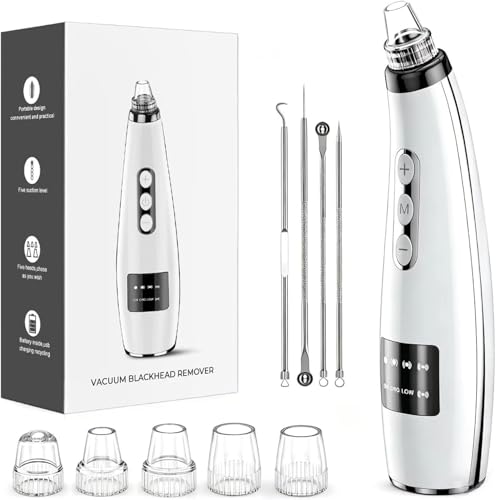
Blackhead Remover Vacuum with 5 Suction Levels — The complete kit
This model’s argument is completeness: the same rechargeable, five-level, five-probe device as its peers, bundled with a set of stainless steel manual tools for the spots that suction handles worst. That pairing reflects a truth the prose sections expand — a vacuum is an area instrument, happiest across the nose’s field of pores, while a single prominent spot sometimes answers better to a precise, gentle manual approach or, often wisest of all, to being left alone. The kit buyer gets both instruments and, with them, the obligation to learn both disciplines.
The device half performs as the category promises: leveled suction, probe variety, USB charging, and a session that belongs after warm water and before moisturiser. The manual tools raise the kit’s ceiling and its floor simultaneously — in practised, gentle hands they are the precision option; in impatient hands they are how skin gets marked, squeezed and sorry. This guide’s extractor section therefore reads as part of this pick’s manual: loop end placed around, never on top of a spot, pressure minimal and brief, and an absolute rule that anything inflamed, deep or painful is not a home-grooming matter at all.
Value framing is where the kit shines for the right reader: one purchase equips a whole drawer of occasional grooming, at a tier the separate purchases would exceed. For the reader who wants only the vacuum, the bundled steel is surplus that should stay in its case until its technique has been learned from the prose below — or indefinitely, which is also a respectable outcome.
- Format: rechargeable pore vacuum plus stainless tool set
- Suction: five levels with five probes
- Extras: four stainless steel manual tools included
- Best matched to: readers wanting both methods in one kit
- Tier note: kit value tier — check price on Amazon
Strengths
- Device and manual tools cover area and spot work together
- Five probes and levels match the category’s full method
- One purchase equips the whole grooming drawer
Trade-offs
- Manual tools demand technique the kit cannot teach by itself
- More instruments means more hygiene discipline to maintain
- Surplus steel for readers who only ever wanted the vacuum
Best for: methodical users who will learn both the device and the tools properly.
Not suited for: impatient users, or any skin with inflamed or painful spots.
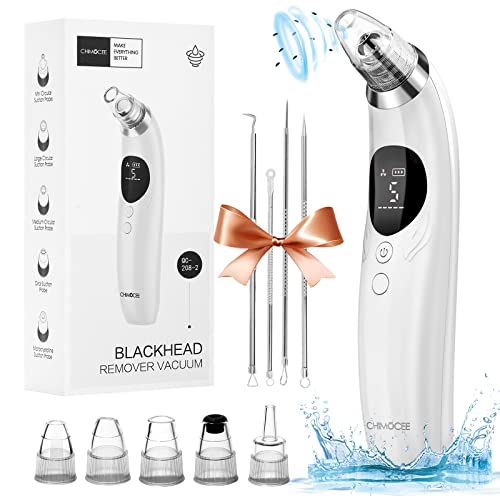
CHIMOCEE Blackhead Remover Pore Vacuum — The alternative badge
The CHIMOCEE presents the category’s shared blueprint under its own name: five suction levels, five probes, USB recharging, and a kit aimed squarely at the same T-zone routine as its two companions above. In a category where the underlying design has converged, that is not a criticism — it is the market telling you the formula is settled, and the sensible comparison between such devices runs on bundle details, finish, and which listing’s contents match the routine you actually intend to keep.
Used with this guide’s discipline — prepared skin, lowest effective level, a moving probe, minutes rather than campaigns — it performs the cosmetic task as advertised: surface debris lifted, pores looking tidier, skin smoother to the touch for the occasion that prompted the session. Its probes wash clean, its body stores small, and its levels include the gentle end where honest work happens, which is the entire technical case any pore vacuum is entitled to make.
The CHIMOCEE also inherits the category’s full list of cautions, unedited. It is a grooming gadget, not a treatment; its marketing vocabulary should be read with the same scepticism this guide applies to all three picks; and its upper levels are to be approached the way one approaches the top shelf of anything — rarely, briefly, and only with a reason. As the alternative badge in a three-device shortlist, it will suit the reader who compares bundles carefully and finds this one’s arrangement closest to their drawer.
- Format: rechargeable handheld pore vacuum
- Suction: five levels across a probe set of five
- Charging: USB rechargeable
- Best matched to: bundle-shoppers comparing the settled formula
- Tier note: accessible grooming tier — check price on Amazon
Strengths
- The full multi-level, multi-probe formula at an accessible tier
- Gentle end of the range is present and usable
- Compact, washable-probe design suits bathroom storage
Trade-offs
- Shares the category’s hard limits without exception
- Upper levels demand the same restraint as any rival
- Differentiation is bundle-deep, not capability-deep
Best for: readers comparing kits on contents and finish within a settled design.
Not suited for: anyone expecting a device in this class to treat a skin condition.
Warm-Compress Preparation — Prose-only method
Preparation is the unglamorous half of pore care that decides the visible half. Sebum plugs sit in pores like corks in bottles; warmth softens the cork and relaxes the bottle’s neck, which is why every competent routine begins with heat. The home methods are simple: a clean flannel soaked in comfortably warm water and held over the T-zone for several minutes, rewarmed as it cools, or a session timed immediately after a warm shower, when the steam has done the same work. Comfortably warm is the specification — never hot, never scalding, and never prolonged on skin that flushes easily.
What preparation buys is mercy. On warmed skin, the lowest suction levels lift what they are meant to lift, and the probe glides instead of dragging; on cold skin, the same device must work harder for less, and the difference is paid in redness and the occasional suction mark. Cleansing comes before the compress, so the warmth is not sealing the day’s surface over the pores you are about to tidy, and the whole sequence — cleanse, warm, suction gently, cool and moisturise — takes ten unhurried minutes that no device upgrade can shorten honestly.
- Method: warm flannel compress, or straight after a warm shower
- Temperature rule: comfortably warm, never hot
- Sequence: cleanse first, then warm, then gentle suction
- Position in this guide: prose-only preparation, no product linked
- Payoff: lowest levels work, skin forgives the session
Strengths
- Makes gentle suction effective instead of theatrical
- Reduces the redness and marking that ruin the exercise
- Costs nothing but ten unhurried minutes
Trade-offs
- Adds a step the impatient will try to skip exactly once
- Heat is wrong for flushed, reactive or broken skin — skip the session instead
- Requires clean flannels and the laundry honesty that implies
Best for: every pore-vacuum session, as the non-negotiable first act.
Not suited for: skin that is inflamed or reactive, which should skip the device entirely.
Manual Extractor Tools — Prose-only instrument
The stainless loop extractor is the category’s scalpel: precise, effective in skilled restraint, and entirely unforgiving of enthusiasm. Its honest use is narrow — the occasional individual spot that is superficial, ready, and asking politely — approached with the loop placed around the spot rather than pressed onto it, with the lightest pressure that persuades, after the same warm preparation the vacuum demands, on skin and tools both cleaned first. Anything deep, inflamed, painful or cystic is outside its jurisdiction completely; those belong to a clinician’s room, not a bathroom mirror, and pressing on regardless is how small concerns become marks that take weeks to fade.
Technique is mostly refusal. Refuse the second attempt when the first gentle one fails — a spot that will not yield to light pressure is telling you it is not ready or not superficial. Refuse the squeezing assist from fingernails, which adds bacteria and trauma in equal measure. Refuse to work a whole field spot by spot; that is the vacuum’s area role, and confusing the instruments’ jurisdictions is how both get blamed for the operator’s impatience. Kept in its narrow lane, cleaned and stored dry, the extractor is a lifetime tool; outside it, it is a small steel argument for the dermatologist’s number saved in your phone.
- Instrument: stainless loop extractor and companions
- Jurisdiction: the single, superficial, ready spot — nothing else
- Technique: loop around, lightest pressure, one gentle attempt
- Position in this guide: prose-only guidance, no product linked
- Absolute rule: inflamed, deep or painful spots are a clinician’s territory
Strengths
- Precision the vacuum cannot match for an individual spot
- A lifetime instrument with no charging or consumables
- Pairs with the kit pick above for a complete drawer
Trade-offs
- The easiest tool in the guide to misuse with confidence
- Strict hygiene discipline is part of the instrument
- Most spots, most days, are best served by being left alone
Best for: the methodical user facing one stubborn, superficial spot.
Not suited for: fields of spots, inflamed skin, or any squeezing campaign.
Aftercare and Skin Recovery — Prose-only routine
What happens in the twenty minutes after a session decides whether the mirror approves tomorrow. Begin with cool: a cool flannel or a gentle splash settles the skin’s protest at being suctioned, however carefully. Follow with the plainest moisturiser you own — fragrance-light, familiar, the one your skin already trusts — applied without ceremony. Then leave the area alone: no exfoliating acids that evening, no experimental products, no second session to fix what the first one started, because skin that has been groomed needs quiet, not choreography.
The following day asks for sun sense, since freshly groomed skin is temporarily more reactive; your usual sunscreen, which you were wearing anyway in any well-run routine, covers the obligation. Watch how your skin answers across the week: a routine it tolerates at the lowest levels, occasionally, is a routine you may keep; redness that lingers, marks that take days, or breakouts that follow sessions are the skin’s review of the product, and the correct response is to retire the device, not to negotiate. Aftercare’s deepest rule is that feedback loop — the mirror and the calendar, consulted honestly, outrank every claim in every listing, including the three above.
- Step one: cool the skin gently after the session
- Step two: plain, familiar moisturiser, nothing experimental
- Step three: quiet — no acids, no repeat session that evening
- Position in this guide: prose-only routine, no product linked
- Feedback rule: lingering marks mean retire the device, not retry harder
Strengths
- Converts a session’s result into next-day approval
- Builds the feedback habit that keeps grooming safe
- Uses products the reader already owns and trusts
Trade-offs
- Asks for an evening of restraint after the satisfying part
- Sun and product discipline extend beyond the session itself
- Honest feedback may retire a device you just bought
Best for: every user of every pick in this guide, without exception.
Not suited for: substituting for professional care when skin is troubled.
Comparison Table
| Pick | Format | Standout trait | Bundle note | Watch out for |
|---|---|---|---|---|
| Blackhead Remover Pore Vacuum Gold | Rechargeable device | Polished all-round formula | Five levels, five probes | Upper levels exceed most needs |
| Blackhead Remover Vacuum with 5 Suction Levels | Device plus tools | Complete grooming kit | Stainless manual tools included | Tools demand learned technique |
| CHIMOCEE Blackhead Remover Pore Vacuum | Rechargeable device | Alternative badge, same formula | Five levels, five probes | Compare bundles, not promises |
| Warm-Compress Preparation | Prose method | Decides whether suction works | Cleanse, warm, then proceed | Skip entirely on reactive skin |
| Manual Extractor Tools | Prose instrument | Precision for one spot | Loop around, lightest pressure | Never on inflamed or deep spots |
| Aftercare and Skin Recovery | Prose routine | Tomorrow’s mirror verdict | Cool, moisturise, leave alone | Lingering marks retire the device |
What Actually Is a Blackhead, and Why Does Suction Sometimes Help?
A blackhead is a pore whose plug of sebum and shed skin cells has oxidised at the surface, darkening like a cut apple’s face; it is not dirt, and no amount of scrubbing at the surface alone persuades it. Suction helps in the narrow circumstance where warmth has softened the plug and the pore’s opening is willing — the probe’s gentle pull can lift the plug’s loosened body in a way a cleanser cannot reach. Where the plug is deep, the pore unwilling or the surrounding skin inflamed, suction has nothing honest to offer, and the guide’s repeated refusals come from that simple anatomy.
Understanding this sets the device’s calendar. Blackheads form continuously as skin produces sebum, so pore care is a rhythm — an occasional gentle session, weekly at most for most users, folded into ordinary cleansing — rather than a cure administered once. Any product, routine or influencer promising permanence is selling a story skin biology declines to honour; the picks here promise only tidiness, maintained, and that promise they can keep.
How Do You Run a Session, Step by Step?
Assemble the whole cast before the curtain: cleanser, clean warm flannel, the charged device with its probes washed, a timer you will actually respect, plain moisturiser, and good light that flatters nothing. Cleanse the face thoroughly. Apply the warm compress to the T-zone for several unhurried minutes, or step straight from a warm shower. Fit the small round probe, select the lowest level, and patch-test on a discreet patch of the jawline first if the device is new to you — a few seconds, then a minute’s wait to read the skin’s answer.
Work the nose in slow glides, a few seconds per pass, lifting the probe between passes rather than dragging it under suction across the skin. Move to any other zone with the probe shape it deserves, stepping the level up only if the lowest genuinely fails on prepared skin, and never parking the probe in one spot to negotiate. Five minutes is a full session for most faces. Finish with the cool flannel, the moisturiser, and the evening of quiet described in the aftercare section — then wash the probes, dry them, and store the kit clean, because a grooming tool’s hygiene is part of its safety.
What Mistakes Do Pore Vacuum Users Make?
The signature mistake is the parked probe: suction held on one spot while the user waits for something dramatic, producing the circular bruise that becomes the session’s only souvenir. Its cousin is level ambition — starting at the middle or top of the range because the lowest feels too gentle to be working, when gentleness on prepared skin is precisely the mechanism. Third is frequency greed: daily sessions that keep skin in a permanent state of protest, blamed on the skin rather than the calendar.
Fourth, users skip the preparation and then review the device as useless, having asked suction to do anatomy’s job cold. Fifth, they aim the device at spots it must never touch — inflamed, raised, painful — converting a grooming question into a skin problem. Sixth, they share the device and its probes around a household without washing between users, an economy no skin thanks anyone for. Every mistake on this list is an operator error with a known antidote elsewhere in this guide, which is the most encouraging sentence in it.
Who Should Not Use a Pore Vacuum at All?
The list deserves its own section because it is the most important one here. Skin with active, inflamed or cystic breakouts should not meet suction; the device cannot help and can complicate. Rosacea, eczema, psoriasis patches, sunburn, broken or recently treated skin — including skin recovering from professional procedures — all belong on the skip list, with questions routed to the clinician who knows the skin in question. Anyone whose skin bruises at a whisper, or who is under dermatological care for any reason, should ask that clinician before a gadget, not after a mark.
There is also a temperament exclusion, offered kindly: the user who knows they will press harder, stay longer and escalate levels when results look slow is a user these devices will hurt, and the honest purchase for that temperament is no purchase — a good cleanser, warm water, and a professional’s number. This guide sells restraint as the category’s real feature; readers who cannot buy that feature should not buy the devices either.
How Do Different Skin Types Change the Settings?
Oily, resilient skin — the classic T-zone’s owner — tolerates the category best and still belongs at the gentle end, because tolerance is not a target. Dry skin asks for shorter sessions, longer intervals and a moisturiser it already loves waiting at the end, since suction plus dryness compounds quickly into flaking protest. Combination skin is really two skins sharing a face, and the honest method treats them so: the nose receives its brief, low-level attention while the cheeks are left to cleanser and water alone. Sensitive skin, finally, should consider this entire category optional to the point of absence; if it proceeds at all, it proceeds at the lowest level, on the smallest area, with the patch test promoted from courtesy to law.
Age redraws the map too. Teenage skin produces sebum with industrial enthusiasm and is also the skin most likely to be inflamed somewhere at any given moment, which makes the skip rules the main event for younger users and adult supervision of the discipline a genuine recommendation rather than a courtesy. Mature skin bruises more readily and forgives more slowly, arguing for the gentlest levels and the longest intervals. In every case the device’s five levels are a menu, not a ladder, and the correct level is the lowest one your skin answers with tidiness instead of commentary.
How Should the Devices and Probes Be Cleaned and Stored?
Hygiene is the category’s unglamorous foundation, because a probe that travels from pore to pore must arrive at each one clean. After every session, remove the probes and wash them in warm water with a gentle soap, rinse thoroughly, and dry them completely before they return to the case — moisture left in a stored probe is an invitation nothing on your face requested. The device’s nozzle area wipes clean with a soft, slightly damp cloth; never immerse the body, never use harsh solvents on parts that will touch skin, and let everything air before the drawer closes.
Storage discipline completes the picture: one device, one user, no exceptions that hygiene cannot survive. A shared bathroom does not make a shared pore vacuum reasonable, and households with several interested parties should treat these as personal instruments like toothbrushes — inexpensive enough to duplicate, personal enough that duplication is the point. Charge the body when it asks rather than leaving it permanently on power, keep the probe set together in its case, and the kit will be ready, clean and unembarrassing whenever the occasion calls.
What Occasions Actually Justify a Session?
The honest calendar is event-led and sparse. A session the evening before — never the morning of — a photograph, a wedding, a reunion or any occasion where the mirror’s verdict carries social weight is the category’s natural habitat: preparation done calmly, skin given the night to settle, and the morning’s face the rested beneficiary. Building the session into a weekly grooming rhythm suits some skins; building it into a daily ritual suits none, and building it into an emergency response to a newly noticed spot, an hour before leaving, is how the bruise attends the event instead of you.
There is also a seasonal note: summer’s heat and sunscreen raise sebum and surface load, making the T-zone’s tidiness a more frequent request, while winter’s dryness argues for longer intervals and richer aftercare. Let the skin’s season, not the device’s novelty, set the schedule — the gadget will be equally charged in both, which is exactly why the calendar must come from the face.
How Do You Read Reviews of Pore Vacuums without Being Misled?
Sort by the failures and read them as instructions. Complaints about marks and bruises usually describe the parked probe and the ambitious level, which tells you about the operator’s manual, not the motor; complaints about uselessness usually describe unprepared skin, which tells you the warm compress was skipped. Praise deserves the same forensic reading: the delighted reviewers almost always mention, in passing, the shower-first routine and the low settings — the technique smuggled inside the product review. Before-and-after photographs, finally, should be read as lighting’s autobiography as much as skin’s, since a sebum plug’s visibility is half illumination.
The deepest signal is temporal. Reviews written after months of occasional use, by people whose expectations were cosmetic from the start, describe a small tool doing a small job well — and that, in this category, is the only five-star sentence that means anything. Calibrate your own expectations to that sentence before purchase, and whichever of the three picks you choose will likely earn the same review from you.
What Is the Difference between Blackheads, Whiteheads and Sebaceous Filaments?
Half the disappointment in this category is a case of mistaken identity. Blackheads are open pores with oxidised plugs, dark at the surface, and they are suction’s legitimate cosmetic target. Whiteheads are closed over — the same material under a thin skin lid — and they are not a home-suction matter at all; leave them to time, gentle routine, or professional care. Sebaceous filaments are the subtlest case: natural, pale, thread-like structures that line the nose’s pores and help oil travel, visible as a field of tiny light dots that return within days no matter what removes them, because they are anatomy rather than blockage.
Filaments deserve their paragraph because they generate more gadget frustration than everything else combined. A user who empties them on Monday and finds them refilled by Thursday concludes the device failed, when in truth the device tidied a structure the body maintains on purpose. Suction can make filaments less visible briefly — an occasion-level improvement — but no routine deletes them, and chasing them daily is how gentle grooming becomes skin harassment. Learn the three identities, aim the device only at the first, and the category’s results suddenly match its promises.
How Does Makeup Fit around a Pore Routine?
Sequence is everything. A session belongs on clean, makeup-free skin, in the evening, with the night for recovery; makeup applied over freshly suctioned skin sits in pores that have just been emptied and irritates skin that has just been worked, so the calendar should never ask both of the same hour. The morning after a session is makeup’s friendlier territory — skin settled, moisturiser down, sunscreen in place, and the T-zone tidier than it has been all week, which is the entire social point of the exercise.
Cleansing honesty completes the picture: makeup removed thoroughly each night does more for pore appearance across a month than any device does in a session, because most visible pore trouble is yesterday’s residue compounding. The vacuum is the garnish on a cleansing routine, never its substitute, and users who reverse that order buy gadget after gadget to solve a washcloth’s job.
What Should You Do If Your Skin Reacts Badly?
Stop, in the full and final sense: no further sessions while any mark, lingering redness or new breakout pattern persists, and no compensating products layered over the protest. Cool compresses and your plainest moisturiser are the home response for a simple suction bruise, which fades on its own calendar of days. Anything that spreads, swells, pains, weeps or simply worries you exits this guide’s jurisdiction immediately and enters a clinician’s, because a grooming guide that pretends otherwise has stopped being honest at exactly the moment honesty matters.
Afterwards, the debrief is short. If the reaction followed a parked probe or a high level, the operator has learned the category’s central lesson at tuition prices. If it followed a gentle, prepared, textbook session, the lesson is different and simpler: this skin and this method do not suit each other, and the device should be retired without a rematch. Either way, the skin’s verdict is final and unappealable, and the guide’s last service is to insist you accept it gracefully.
How Do Pore Vacuums Compare with Strips, Cleansers and Professional Care?
Each tool owns a territory. Pore strips are the single-use ancestors: adhesive, indiscriminate, satisfying in the moment and rough on the skin’s surface, with no levels to tune and no preparation they respect. Cleansers and gentle chemical exfoliants work the slow, compounding game — nothing dramatic in a day, everything meaningful across a month — and they are the foundation every other method stands on. Professional care is the category’s ceiling and its court of appeal: trained hands, sterile instruments, and the judgement to leave a lesion alone, which no device in a drawer can replicate.
The pore vacuum’s territory is the middle: reusable, tunable, gentler than strips when used as this guide insists, and more immediate than cleansers for an occasion. It earns that territory only inside a routine where the cleanser does the daily work and the professional handles everything inflamed, deep or doubtful. Buy it as the middle instrument of three, and it will seem well-designed; buy it as a replacement for the other two, and it will seem — as so many disappointed reviews testify — like a small machine that promised to be a clinic.
What Is a Sensible Budget Logic for This Category?
The three picks live within a narrow tier of one another, and that narrowness is itself information: this is a converged, inexpensive gadget class where extra money buys bundle and finish rather than capability. Spend accordingly. The kit with the manual tools justifies its step if the tools will be learned; the polished finish justifies its step if presentation keeps the device stored, charged and used rather than abandoned; and no step within this category justifies itself by suction strength, which is the one specification your skin has voted against at every level above the second. The genuinely expensive version of pore care is the professional’s room, and the guide’s budget advice ends where it began: gadget for tidiness, clinician for trouble, and never the twain confused by a price tag.
How Should Teenagers and First-Time Users Be Introduced to the Category?
With supervision, the lowest level, and the skip rules read aloud before the box is opened. Young skin is both the most sebum-productive and the most likely to carry inflamed spots that suction must never touch, so the first session should be a demonstration of restraint as much as of technique: prepared skin, the nose only, a few glides, and the discipline to stop while everything still looks calm. The extractor tools, if the kit includes them, stay in their case until the device’s discipline is proven over several sessions — precision steel is a graduation, not a starting point.
The deeper lesson to hand over with the device is the feedback habit: skin answers every routine within days, and learning to read that answer — and to retire a method that the skin votes against — is worth more than any single gadget. A teenager taught that lesson owns something no listing sells, and will still be using it when this device is three models out of date.
What Does a Realistic First Month Look Like?
Week one is the patch test and a single, brief, lowest-level session on the nose, followed by honest observation. Week two, if the skin approved, adds the chin or forehead’s edge with the appropriate probe, still briefly, still gently. By week three the user knows their level, their probes and their interval, and the session has shrunk to its true size: ten calm minutes inside an ordinary evening routine, producing a tidier T-zone and no souvenirs. Week four is where the category either earns its shelf or loses it — and a device retired at week four for skin that disliked it is not a failed purchase but a successful experiment, concluded at gadget prices rather than clinic ones.
Why Do the Same Pores Refill, and Is That Failure?
Because skin is alive and doing its job. Sebum production is continuous, pores are its permanent plumbing, and a plug removed on Monday is a vacancy the system begins refilling by Tuesday — not sabotage, just physiology. The correct mental model is the haircut: nobody calls a haircut a failure because hair grows, and nobody sensible books one daily. Pore care on that model becomes sustainable — an occasional tidy, expectations set to maintenance, and the mirror consulted for grooming rather than transformation. Every frustrated review in this category is a haircut review written by someone promised a cure for hair.
That reframing is also the kindest thing this guide can do for its readers’ wallets. A category understood as maintenance needs one modest device, kept for years; a category misunderstood as cure invites an escalating parade of stronger gadgets, each blamed in turn. Buy the maintenance, skip the parade.
How Should You Store the Kit between Occasions?
Clean, dry, charged and together — the four-word specification that decides whether the device is a routine or an archaeology project. Probes washed and fully dried before the case closes, the body wiped and stored out of the shower’s steam path, the cable coiled with the kit rather than adopted by the household’s general cable population. A device stored this way is ready in the minute an occasion announces itself; a device stored any other way will be found, eventually, with a flat battery and a probe missing, on exactly the evening it was wanted. Small disciplines, as this entire guide has argued in three different vocabularies, are the whole technology.
Final Recommendation
Choose the Gold for the tidy all-round device, the five-level kit if you will genuinely learn the manual tools’ narrow discipline, and the CHIMOCEE if its bundle best matches your drawer — then bind whichever you buy to the preparation, the lowest levels, the moving probe and the aftercare, because those four habits are the actual product itself. A pore vacuum used that way is a pleasant cosmetic tool that earns its shelf; used any other careless way, it is a bruise with a charging cable, and no badge in this guide can save it from its operator, however polished the finish.
Frequently Asked Questions
Do pore vacuums actually work?
Within their honest limits, yes: on warmed, prepared skin, gentle suction lifts surface plugs and debris, and the T-zone looks tidier for the occasion. They do not shrink pores permanently, prevent new blackheads forming, or treat any skin condition — tidiness, maintained occasionally, is the whole truthful claim.
How often can I use one safely?
Occasionally is the operative word — weekly is a sensible ceiling for most users, with many skins preferring fortnightly. Daily use keeps skin protesting and is the commonest route to the redness users then blame on the device. Let the skin’s feedback set the calendar, and shorten the interval the moment it complains.
Why did the device leave a round mark on my skin?
That is a suction bruise, caused by a probe parked too long, a level too high, or both — the category’s signature operator error. It typically fades over days. Let it fade fully before any further session, drop to the lowest level, keep the probe gliding, and treat a repeat performance as the device’s retirement notice.
Can I use a pore vacuum on a pimple?
No. Inflamed, raised or painful spots are outside these devices’ jurisdiction entirely; suction can worsen them and spread the trouble. Leave such spots to time and ordinary gentle care, and route anything persistent, spreading or worrying to a dermatologist, whose room is where such questions belong.
Which probe should I use on my nose?
The smallest round probe suits the nose’s creases and contours, used at the lowest level that works on warmed skin, in glides of a few seconds. Wider probes belong to flatter, less sensitive territories. If a probe will not seal without pressing, it is the wrong shape for that ground — change the probe, not the pressure.
Is a patch test really necessary for a gadget?
Yes, and it takes under a minute: a few seconds at the lowest level on a discreet patch, then a pause to read the skin’s answer before the full session. Skin varies enormously in its tolerance of suction, and the patch test is how you learn your own setting before the whole T-zone is enrolled in the experiment.
Can I use a pore vacuum before applying a face mask?
A gentle session followed by a plain, soothing mask is a reasonable evening sequence for tolerant skin, provided the mask is a familiar one and the skin showed no protest during the session. Skip the pairing whenever the skin looked flushed or felt warm afterwards — recovery outranks ritual, and the mask will keep for another evening.
Do the probes wear out?
Probes are simple moulded or silicone-tipped parts that last well if washed and dried properly; replace any that crack, roughen at the rim or stop sealing evenly, because a damaged rim concentrates suction unevenly against the skin. Spares are inexpensive, and a smooth rim is a safety feature, not a cosmetic one.
Should I exfoliate on the same day as a session?
Keep them apart. Skin that has been suctioned, however gently, has had its mechanical event for the day; adding a scrub or an acid that evening stacks stresses the aftercare section exists to prevent. Alternate the days across the week if both belong in your routine, and let each method arrive on skin that has fully forgiven the last one.
Why does my nose look oilier the day after a session?
Freshly tidied pores and stimulated skin can present a temporary sheen, which settles as the skin returns to its ordinary rhythm across a day. It is not the device creating oil, and it is not a reason to schedule another session; blot, moisturise lightly, and let the calendar rather than the shine govern the next appointment.
Can men and women use the same device and settings?
The devices are unisex; the settings are personal. Skin tolerance varies by individual far more than by any category, so each user should find their own level by the patch-test route rather than borrowing a partner’s number — and, per the hygiene rules, their own device rather than borrowing the instrument itself.
Is it normal for the session to show nothing dramatic?
Entirely. A gentle session’s evidence is subtle — a tidier surface, a smoother feel — and the absence of theatre is the sign the levels were right, not wrong.
Related Guides
Suction at every scale fills this shelf. Return to household size with Best Canister Vacuums for Pet Hair and Messes, detour through Best Acoustic Blankets for a different kind of quiet, and compare the upright school in Best Bagless Upright Vacuums for Pet Hair. Our published Best Vacuum Attachments explains the nozzles and probes that make any vacuum — facial or floor-bound — more than its motor.


