What's inside
- Key Takeaways
- Quick Picks
- How did we choose the best 12-volt wet dry car vacuums?
- Comparison Table
- How do you clean a car interior properly with these tools?
- What can 12 volts actually do — and what can it never do?
- What mistakes do car vacuum buyers repeat?
- How do you win the pet hair war inside a car?
- What does winter ask of a car vacuum?
- How do you vacuum leather, fabric and screens without harming them?
- Where should the car vacuum live, and how do you keep it ready?
- Which class suits which vehicle?
- How do you detail a car like the professionals, with home equipment?
- What should you check before buying any car vacuum?
- How do road trips change the cleaning equation?
- What does each class cost to run over the years?
- How do you keep the machines themselves clean?
- Why does an honest label matter so much in this category?
- What does the weekly five minutes actually look like?
- A note for drivers who park on the street
- How do you choose between the two BLACK+DECKERs in one minute?
- Final Recommendation
- Frequently Asked Questions
- Related Guides
As an Amazon Associate I earn from qualifying purchases. This post may contain affiliate links at no extra cost to you.
cottageverdict.com is reader-supported. When you buy through links on our site, we may earn an affiliate commission.
Where to buy: each linked vacuum below points to its Amazon listing, where you can check price on Amazon and confirm the cord length, included nozzles and — critically — the power source in writing before ordering. In this category the power source is the whole story, so read that line of the listing twice.
This guide to the best 12-volt wet dry car vacuums begins with the honesty the category usually avoids. A true 12-volt car vacuum plugs into the vehicle’s own accessory socket and runs from the car’s electrical system, which makes it genuinely portable and genuinely limited: twelve volts can move crumbs, grit and pet hair, but it cannot summon the suction of a mains motor, and no honest review should pretend otherwise. Only two of the linked picks below are true 12V machines — both from BLACK+DECKER, both reviewed first — and they are recommended for what they really are: the vacuum that lives in the car and keeps it civilised between deep cleans.
The other three linked picks are labelled, here and in their reviews, as exactly what they are: small mains-powered wet dry shop vacuums, included as the garage alternative for car cleaning. They do not run from a 12V socket, they will not work in a layby, and they are not pretending to. What they offer is the other half of car care — the monthly deep clean at home, with real suction, wet capability for spills and melted snow, and hoses that reach under seats properly. A final prose-only section covers the swarm of no-name 12V car vacuums sold online, and explains why that category earns caution rather than a link.
Structured that way, the list maps onto how cars are actually kept. The daily reality of a family car — crumbs fossilising in seat rails, grit migrating from shoes to carpets, a dog’s worth of hair woven into the boot — is a frequency problem, solved by the little 12V machine that is always there. The seasonal reality — the spilled drink, the beach trip’s sand harvest, the winter slush — is a power and wet problem, solved by the garage vac. Buy for both realities and the car stays pleasant; buy either one expecting it to do the other’s job and disappointment is scheduled.
Key Takeaways
- Only two picks are true 12V socket-powered vacuums, and they are reviewed first.
- The BLACK+DECKER dustbuster suits quick, frequent in-car tidying best.
- The Flexi Auto’s hose reaches footwells and seat rails the fixed body cannot.
- Armor All, STANLEY and CRAFTSMAN are mains shop vacs — the garage alternative, clearly labelled.
- Generic no-name 12V vacuums, covered prose-only, are a cautionary category.
- Match the tool to the mess: frequency in the car, power and wet work at home.
Quick Picks
| Pick | Badge | Why it made the list |
|---|---|---|
| BLACK+DECKER 12V dustbuster Car Vacuum | Best true 12V all-rounder | Rotating, extendable nozzle and honest socket-powered suction for daily tidying. |
| BLACK+DECKER 12V Flexi Auto dustbuster | Best true 12V reach | A flexible hose that puts suction into footwells, rails and boot corners. |
| Armor All 2.5 Gallon Wet Dry Utility Vac | Garage alternative: best for cars | A mains-powered utility vac from an auto-care brand, built for wet and dry car work. |
| STANLEY 3 Gallon Wet Dry Vacuum | Garage alternative: most capacity | Three gallons and strong mains suction for detailing sessions at home. |
| CRAFTSMAN 2.5 Gallon Wet Dry Shop Vacuum | Garage alternative: best all-purpose | A compact shop vac with filter bag and attachments for car and home duty. |
| Generic no-name 12V car vacuums (category discussion) | The cautionary category | Temptingly cheap socket vacuums whose claims rarely survive the first footwell. |
How did we choose the best 12-volt wet dry car vacuums?
The first screen was truth in power sourcing. A pick could enter this guide in exactly two ways: as a genuine 12V machine that runs from the vehicle’s socket, judged on the modest physics of that supply, or as a clearly-labelled mains wet dry alternative for garage-based car cleaning, judged against other shop vacs. Anything blurring the line — battery machines marketed with car imagery, USB trinkets with vacuum ambitions — was excluded, because a buyer misled about power is a buyer whose car stays dirty.
Within the true 12V class, judging centred on the details that decide whether the tool gets used: cord length sufficient to reach the boot from the socket without acrobatics, nozzles shaped for the car’s actual geography of rails, seams and footwells, a dust cup that empties without distributing its contents back over the seats, and suction honest enough for grit and crumbs even if deep-embedded sand remains the garage vac’s department. Within the garage class, the screens were wet capability, tank size against portability, hose and attachment quality for interior work, and filter arrangements that tolerate both dust and damp.
The final test was behavioural. Car cleaning fails by postponement more than by equipment, so every pick had to lower the friction of starting: light enough to grab, quick to set up, easy to put away in the boot or the garage corner. The five linked machines are the ones that passed, each in its declared class, and the prose-only finale explains the class that reliably does not.

BLACK+DECKER 12V dustbuster Car Vacuum — Best true 12V all-rounder
Here is the genuine article: a handheld vacuum that plugs into the car’s 12V accessory socket and asks nothing else of the world — no charging, no battery anxiety, no remembering to bring it from the house. The dustbuster formula is mature for a reason, and this car edition adds the two features the habitat demands: a rotating nozzle that angles into the seams where crumbs retire, and an extendable snout that reaches the grit line along seat rails and door pockets. It lives in the boot or the footwell, deploys in seconds, and keeps a family car at the civilised end of its range indefinitely.
Its suction should be described the way physics insists: entirely adequate for the dry, loose debris that constitutes ninety percent of car dirt — crumbs, gravel dust, pet hair on surfaces, the sand of one beach trip rather than ten. Worked slowly, with the nozzle agitating as it goes, it lifts more than sceptics expect from twelve volts. What it will not do is extract grit ground into carpet pile over a winter, or touch anything wet; those jobs are the garage vacs’ sworn territory, and this review will not insult the reader by blurring the border.
The ownership details are all in its favour. The cord is long enough to tour the car from the socket, the dust bowl empties and rinses without ceremony, and there is no battery to age — the machine will work in five years exactly as it works today, which is more than most car accessories promise. For the driver who wants the car kept tidy by a tool that is simply always there, this is the guide’s first and clearest recommendation.
- Power: true 12V, runs from the vehicle accessory socket
- Nozzle: rotating and extendable for seams and rails
- Debris: dry crumbs, grit and surface pet hair
- Maintenance: rinsable dust bowl, no battery to age
- Storage: lives in the car, ready in seconds
Strengths
- Always ready — no charging routine to forget
- Nozzle design matches real car geography
- Nothing to wear out except the driver’s excuses
Trade-offs
- Dry debris only; spills belong to the wet vacs
- Cannot extract deep-ground carpet grit
- Cord management is part of the ritual
Best for: drivers who tidy little and often from the car’s own socket. Check price on Amazon.
Not suited for: wet spills, deep cleans, or valeting ambitions.

BLACK+DECKER 12V Flexi Auto dustbuster — Best true 12V reach
The Flexi Auto starts from an observation about car interiors: the dirt lives where a rigid handheld cannot go. Between the seat and the console, under the pedals, down the seat rails, in the boot’s corners — the car’s geography is a series of slots and wells, and this second true 12V pick answers it with a flexible hose between the motor body and the nozzle, so the suction arrives at the mess while the machine stays where the hand is comfortable. It is the detailer’s shape in a socket-powered tool.
The hose changes the working experience completely. Footwells can be vacuumed from outside the door without folding the operator into the car; the nozzle snakes along rails and into map pockets; and attachments at the hose’s end — crevice and brush tools in the dustbuster tradition — let the same machine groom upholstery and then excavate a seam. Power remains the honest 12V quantity, sufficient for the loose and the surface-bound, and the same dry-only boundary applies with the same firmness as its sibling’s review.
Choosing between the two BLACK+DECKERs is a question of shape rather than quality. Cars with deep footwells, third rows, or a boot that collects debris in architectural corners will feel the Flexi’s advantage weekly; simple hatchbacks tidied often may prefer the plain dustbuster’s one-piece immediacy. Either way, the pair define what true 12V cleaning can honestly be — and the rest of this guide exists for everything beyond it.
- Power: true 12V, runs from the vehicle accessory socket
- Design: flexible hose separates nozzle from motor body
- Reach: footwells, seat rails, consoles and boot corners
- Debris: dry, loose and surface material
- Tools: crevice and brush attachments for the hose end
Strengths
- Hose reach transforms awkward interior cleaning
- Same always-ready socket power, no charging
- Attachments suit both upholstery and excavation
Trade-offs
- Dry work only, like every honest 12V machine
- Hose is one more part to store neatly
- Deep carpet grit still belongs to the garage vacs
Best for: larger cars and detail-minded owners fighting awkward geometry. Check price on Amazon.
Not suited for: wet messes or anyone wanting one-piece simplicity above reach.
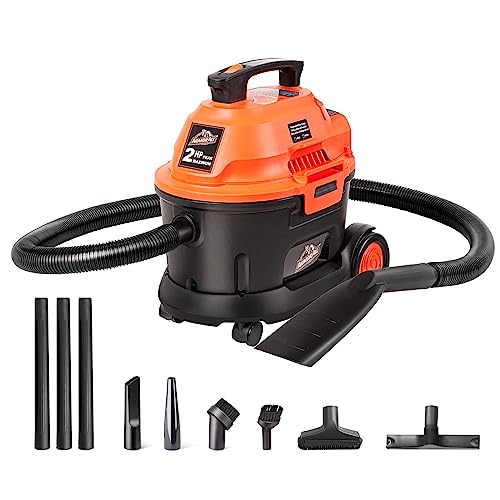
Armor All 2.5 Gallon Wet Dry Utility Vac — Garage alternative: best for cars
Label first, in the plainest terms this guide can manage: the Armor All AA255W is a mains-powered wet dry utility vacuum. It plugs into a household outlet, it does not run from a 12V socket, and it is included here as the garage alternative for car cleaning — the machine for the monthly deep clean on the driveway, not the daily tidy in the layby. With that stated, its virtues for car work are considerable, beginning with its parentage: Armor All is a car-care brand, and this little orange vac is shaped by that brief rather than adapted to it.
Two and a half gallons is the right size of serious for a car: enough tank for a full interior session and a spill, light enough to carry around the vehicle and store on a garage shelf, with a 2 peak HP motor delivering the extraction the 12V pair honestly cannot — grit out of carpet pile, sand out of boot carpet, crumbs out of the geological layer. Wet capability covers the spilled drink and the melted-snow footwell, and the auto-focused accessory thinking shows in nozzles that suit interiors rather than building sites.
The garage alternative’s terms are the mirror of the 12V pair’s: it needs an outlet and an extension lead’s worth of planning, it lives at home rather than in the car, and it is overkill for the thirty-second crumb patrol. Households with a driveway or garage and a car that earns its dirt will find it the single most satisfying car-cleaning purchase in this guide; apartment dwellers without an outlet near the car should weight the 12V pair and a friend’s driveway accordingly.
- Power: MAINS powered — not a 12V socket machine
- Capacity: 2.5-gallon tank, wet and dry capable
- Motor: rated 2 peak HP for extraction work
- Role: driveway deep cleans, spills and ground-in grit
- Design: auto-care brand, car-focused accessories
Strengths
- Real extraction power the 12V class cannot match
- Wet capability handles drinks, slush and spills
- Car-shaped thinking in size and accessories
Trade-offs
- Needs a mains outlet near the car
- Lives at home, useless for away-from-home messes
- More setup than the grab-and-go 12V pair
Best for: driveway and garage owners doing monthly car deep cleans. Check price on Amazon.
Not suited for: in-car tidying, travel, or outlet-free parking situations.

STANLEY 3 Gallon Wet Dry Vacuum — Garage alternative: most capacity
The label again, because this guide keeps its promises: the STANLEY is a mains-powered wet dry shop vacuum, included strictly as a garage alternative for car cleaning, with no 12V capability whatsoever. What it brings to that role is capacity and pull — a 3-gallon tank, the largest in this guide, over a motor rated at 3 peak HP, in a portable poly body explicitly marketed for auto detailing, tight garage spaces, vans and vehicles. For the household whose car work involves a van, a people carrier or a dog fleet, the extra half-gallon and the stronger extraction are not luxuries.
Detailing sessions are where it earns the shelf space. The suction sustains the slow, thorough passes that lift embedded grit from carpets and mats, the tank swallows a whole vehicle’s harvest without an emptying interval, and the hose-and-tool arrangement reaches under seats and into load bays with the authority the little socket vacs admire from a distance. Wet work — the winter footwell, the spilled screenwash, the cooler’s meltwater — is routine rather than remarkable.
The costs are the format’s: it is the bulkiest pick here, it wants storage and an outlet, and its power is wasted on the weekday crumb. It also serves the garage and workshop beyond the car, which for many households will justify it and for others will dilute it. As the heavy end of the garage-alternative bench, it is the right answer for big vehicles and serious sessions.
- Power: MAINS powered — not a 12V socket machine
- Capacity: 3-gallon poly tank, largest here
- Motor: rated 3 peak HP for detailing suction
- Role: vans, large cars and thorough interior sessions
- Extras: 2-in-1 shop vac positioning for garage duty
Strengths
- Biggest tank and strongest pull in the guide
- Suits vans and family-scale vehicles properly
- Doubles as the garage’s general wet dry machine
Trade-offs
- Heaviest and bulkiest option reviewed
- Outlet-dependent and home-based by nature
- Overpowered for the daily tidy it cannot do anyway
Best for: big vehicles and households wanting one serious garage vac. Check price on Amazon.
Not suited for: small-car owners seeking minimal kit, or in-car use.

CRAFTSMAN 2.5 Gallon Wet Dry Shop Vacuum — Garage alternative: best all-purpose
Third verse, same honest label: the CRAFTSMAN CMXEVBE17250 is a mains-powered shop vacuum with a 2.5-gallon tank for wet and dry jobs, present in this guide as a garage alternative for car cleaning and for nothing resembling a 12V socket. Its distinguishing pitch is completeness — a filter bag, hose and attachments in the box, a motor rated at 2.5 peak HP, and a brand whose shop vacs have been the default garage purchase for generations. Where the Armor All leans car, the CRAFTSMAN leans everywhere: car on Saturday, workshop dust on Sunday, the blocked-sink emergency whenever it chooses to occur.
For car work specifically, the filter bag deserves the headline, because interior dust is fine, allergenic and plentiful, and a bagged system keeps it contained at emptying time instead of returning it to the driveway air. The 2.5-gallon size splits the difference between the Armor All’s car focus and the STANLEY’s capacity, the attachments cover the interior’s standard geography, and the machine’s general competence means it will be the most borrowed object in the garage.
Generalists accept generalist compromises: the accessory set is capable rather than car-sculpted, and households wanting a dedicated detailing instrument may prefer the Armor All’s focus. But for the commonest real brief — one modest wet dry vac that keeps the car honest and the garage civilised — the CRAFTSMAN is the garage bench’s most balanced citizen, and its review closes the linked list on that practical note.
- Power: MAINS powered — not a 12V socket machine
- Capacity: tank holds 2.5 gallons, wet or dry
- Motor: rated 2.5 peak HP
- Included: filter bag, hose and attachments in the box
- Role: car plus workshop plus household emergencies
Strengths
- Filter bag keeps fine car dust contained
- Complete kit with nothing essential to add
- Genuine all-purpose value beyond the car
Trade-offs
- Accessories are generalist, not car-sculpted
- Home-based and outlet-dependent like its benchmates
- Filter bags are an ongoing consumable
Best for: households wanting one wet dry vac for car, garage and home. Check price on Amazon.
Not suited for: dedicated detailers, or any form of in-car socket use.
Generic no-name 12V car vacuums (category discussion) — The cautionary category
Search any marketplace for a 12V car vacuum and the results fill with machines this guide will not link: unbranded, aggressively discounted, photographed with cyclone graphics and suction claims that would embarrass a mains machine, positioned at a budget tier that seems to defy arithmetic. The category is discussed here generically and prose-only because individual products churn too fast to verify, and because the pattern across them is more instructive than any single listing: weak real suction dressed in invented numbers, dust cups that clog their own filters within a session, cords too short to reach the boot of the car in the photograph.
The disappointment they sell is specific and corrosive. A driver buys one, finds it cannot lift the grit from a footwell, and concludes that 12V vacuums are useless — when the honest machines reviewed above would have kept the car tidy for years within their declared limits. The category’s other habits include accessories that fit nothing, switches that fail by the second season, and packaging that borrows the vocabulary of brands it has no relation to. None of this makes every inexpensive 12V vacuum worthless, but it makes the unverified end of the market a lottery whose prize is a mediocre vacuum.
The practical defence is the one this whole guide models: buy the power source honestly, buy a name that will answer for the product, and let the claims be modest and checkable. A known brand’s declared 12V machine, or a labelled mains alternative, costs a little more than the lottery ticket and returns a tool instead of a lesson.
- Power: claims 12V socket operation, unverified
- Positioning: budget tier across online marketplaces
- Pattern: inflated suction claims, short cords, clogging cups
- Support: brands and parts effectively unavailable
- Verdict: the category to learn from, not to buy blind
Strengths
- Cheapest possible entry to socket-powered tidying
- Small and light almost by definition
- Abundant choice at any moment, for what it is worth
Trade-offs
- Real suction routinely betrays the printed claims
- Durability and switches are a lottery
- No parts, support or accountability behind the box
Best for: teaching buyers why the verified picks above exist.
Not suited for: anyone expecting the car to actually become clean.
Comparison Table
| Pick | Power source | Standout trait |
|---|---|---|
| BLACK+DECKER 12V dustbuster Car Vacuum | True 12V socket | Rotating extendable nozzle |
| BLACK+DECKER 12V Flexi Auto dustbuster | True 12V socket | Flexible hose reach |
| Armor All 2.5 Gallon Wet Dry Utility Vac | Mains — garage use | Car-focused wet dry cleaning |
| STANLEY 3 Gallon Wet Dry Vacuum | Mains — garage use | Largest tank, detailing pull |
| CRAFTSMAN 2.5 Gallon Wet Dry Shop Vacuum | Mains — garage use | Filter bag, all-purpose kit |
| Generic no-name 12V car vacuums (category discussion) | Claims 12V, unverified | Cautionary category |
How do you clean a car interior properly with these tools?
Sequence is the detailer’s whole secret, and it costs nothing. Work top to bottom and inside to out: seats and consoles first with the handheld or hose tools, so dislodged debris falls to floors that have not been cleaned yet; then the footwells and carpets with slow, overlapping passes; then the boot, which keeps its own geology of grit and dog hair. Mats come out and are beaten or vacuumed separately — no machine cleans a mat properly through the car — and the seat rails get the crevice tool’s full attention, because that is where the category’s missing coins and crumbs retire.
Match the machine to the stage. The 12V pair run the weekly version of this routine in five minutes, before the dirt compacts; the garage vacs run the monthly version, with the extraction and wet capability the deep session needs. Glass, screens and the final wipe belong to cloths, not vacuums, and the discipline that keeps a car pleasant is the calendar rather than the equipment: little and often in the car, deep and thorough at home, and no spill ever left to become archaeology.
What can 12 volts actually do — and what can it never do?
Twelve volts from a car socket delivers a modest, honest quantity of power, and the physics deserve respect rather than marketing. It can spin a small motor fast enough to lift loose, dry, surface debris — the crumbs, grit, hair and dust that constitute the visible life of a car interior — and it can do so anywhere the car can go, which is a superpower no mains machine shares. It cannot generate the airflow and pressure differential that extraction cleaning requires, it cannot handle liquid, and it will not improve with adjectives. Buyers who internalise that paragraph will be satisfied with the true 12V picks for a decade.
The wet half of this guide’s title lives entirely in the garage class, and that division is the honest map of the market: wet capability needs mains power at any sane price, so wet car cleaning is a driveway activity, full stop. Guides that blur the two — implying a socket trinket will handle a spilled latte — are selling the disappointment the prose-only chapter describes. Keep the classes separate in your head and in your boot, and each will delight you inside its own borders.
What mistakes do car vacuum buyers repeat?
- Believing a socket vacuum can deep-clean. Twelve volts tidies; it does not extract. Expecting valeting results from a 12V handheld guarantees the disappointment the no-name category trades in.
- Buying a shop vac and calling it a car vacuum without the label. Mains machines are superb at home and useless at the services. Know which problem you are solving before the box arrives.
- Ignoring cord length on 12V models. A socket vacuum whose lead cannot reach the boot is a footwell ornament. Measure the car’s longest run, front socket to boot corner, before choosing.
- Vacuuming wet messes with a dry machine. Liquid through a dry-only vacuum is the fastest route to a musty motor. Spills wait for the wet dry vac, or for cloths and patience.
- Cleaning the car once a season, heroically. Cars reward the opposite rhythm. Five minutes weekly with the little machine outperforms the annual archaeological expedition every time.
How do you win the pet hair war inside a car?
Dog hair in a car behaves differently from dog hair in a house: it weaves itself into carpet and upholstery fibres under the mechanical action of travel, until vacuuming alone negotiates rather than conquers. The winning sequence starts before the vacuum — a rubber-bristled brush or a dampened rubber glove drawn across the seats gathers the woven hair into liftable rolls — and only then does the machine collect what the preparation freed. The 12V pair handle the weekly maintenance of that system perfectly well, while the garage vacs, with brush tools and extraction, run the monthly reset that keeps the weave from winning.
Prevention deserves its paragraph, because it is cheaper than any vacuum in this guide. A washable boot liner and seat covers in the dog’s territory convert an upholstery problem into a laundry problem, and a thirty-second brush-down of the dog before the return journey removes the loose fraction at the source. Households that run the full system — covers, brush, weekly 12V, monthly garage — report cars that no longer announce their dog to passengers, which is the realistic definition of victory in this particular war.
What does winter ask of a car vacuum?
Winter converts the car interior into a wet, gritty building site: slush melts into footwells, grit rides in on every boot, and salt crusts the mats into grey maps. This is the garage class’s season of glory, because the wet dry machines treat meltwater as a beverage and the grit as a light snack, and a fortnightly winter session with mats removed and footwells dried properly prevents the damp, sour smell that otherwise moves in until spring. The 12V pair retire to crumb duty for the season, which is no disgrace — it is the division of labour this guide has argued from its first page.
The supporting habits are thermal and simple. Let wet mats dry outside the car rather than perfuming it, keep a cloth in the door pocket for the daily melt before it soaks, and give the garage vac’s filter a rinse and a full dry after wet sessions, because a damp filter stored in a cold garage becomes its own small climate. Cars that receive this winter respect emerge in spring without the archaeology, and their owners skip the annual deep-clean despair entirely.
How do you vacuum leather, fabric and screens without harming them?
Materials divide the interior into jurisdictions, and the tools should respect the borders. Fabric seats and carpets accept the full repertoire — crevice, brush, extraction — and reward slow passes. Leather and perforated leather want the brush tool’s gentleness, suction without scraping edges, and an absolute rule against pressing hard nozzles into the perforations where grit hides and leather tears begin. Screens, glossy trim and instrument glass want no vacuum contact at all: a soft brush at a distance for the dust, then cloths for the finish, because one dragged grit particle across a touchscreen writes a permanent review of your technique.
Vents and switchgear sit between the jurisdictions — brush tool, low fuss, patience — and the headlining should be vacuumed rarely and barely, since its foam backing ages into fragility. The garage vacs’ power is an asset everywhere except where delicacy rules, which is why the attachments, not the motor, should lead the hand around a car’s interior.
Where should the car vacuum live, and how do you keep it ready?
The 12V machine’s home is the car, and the details of that home decide its career. A boot corner or under-seat space where it neither rattles nor bakes in direct sun, its cord coiled loosely rather than kinked, its dust bowl emptied before storage rather than after discovery — these small arrangements are the difference between a tool that is grabbed and a tool that is excavated. Drivers who keep the crevice tool attached rather than boxed find the weekly five minutes happening almost by themselves, which is precisely the behavioural engine this category runs on.
The garage vacs want the mirror discipline at home: a shelf or floor corner near the car’s parking place, hose coiled, filter dry, tank emptied of the last session’s evidence. A wet dry vac stored with a damp tank announces itself to the whole garage by Friday, and a machine that must be assembled from three locations will be assembled rarely. Readiness is a storage decision made once, and it pays out at every session thereafter.
Which class suits which vehicle?
Vehicle size tilts the balance without breaking the framework. Small hatchbacks and city cars live happily on the 12V pair alone for months at a time, their footprints small enough that socket suction keeps pace, with a friend’s or a valet’s deep clean as the occasional supplement. Family estates and SUVs, with their third rows, boot acreage and passenger throughput, justify the garage machine early — the STANLEY’s tank was specified for exactly this fleet — while vans and working vehicles should treat the garage vac as essential equipment and the 12V as the cab’s daily broom.
Convertibles and cherished cars add a delicacy clause rather than a size one: brush tools, patience and the gentle end of every machine’s range, with the 12V handheld’s light touch genuinely preferable for the weekly pass. The framework survives all of it — frequency in the car, power at home — because it was built from how vehicles are actually used rather than from how vacuums are marketed.
How do you detail a car like the professionals, with home equipment?
Professional detailing is mostly sequence and patience wearing overalls, plus the discipline of finishing one zone completely before wandering to the next, and the home version with this guide’s equipment runs as follows. Strip the car first — mats out, boot emptied, door pockets evacuated — because vacuuming around clutter cleans the clutter’s outline. Brush the fabrics to lift the weave, then vacuum in the top-to-bottom order this guide described, changing tools as the jurisdictions change. Only after the dry work should any damp cloth appear, since water before vacuuming manufactures mud in the carpet’s roots. Glass comes last, mats return dry, and the whole exercise with a garage vac takes under an hour — the same hour, spent monthly, that keeps a car permanently three years younger than its registration.
The 12V pair slot into the professional rhythm as the maintenance crew between details, and that is their dignity: no home machine replaces the monthly session, and no monthly session survives without the weekly five minutes. Owners who grasp the partnership stop asking either class to be the other, which is the moment car care stops being a chore with a machine attached and becomes a system that happens to include two good ones.
What should you check before buying any car vacuum?
Run the short audit this guide has been teaching in pieces. Confirm the power source in writing — socket, battery or mains — and refuse any listing that will not state it plainly. Measure the car’s longest cleaning run and compare it with the cord or hose on offer. Inspect the dust system’s emptying story in photographs or in person, because you will perform that story two hundred times. Price the consumables — filters, bags — for the garage machines, and confirm the brand will still sell them when the model is last year’s news. Finally, decide which class you are buying and judge it only against its classmates; the 12V champion and the garage champion are both excellent, and each is a terrible version of the other.
How do road trips change the cleaning equation?
A long trip manufactures car dirt at motorway speed — service-station crumbs, beach sand with a return ticket, the snack archaeology of the rear seats — and it is where the in-car machine earns its purchase price in a single week. The 12V pair work at the destination, at the campsite, at the holiday cottage’s kerb, anywhere the car itself has gone, while the garage champions wait at home for the return deep clean that every trip deserves. Travelling households should empty the little machine’s bowl before departure, pack its crevice tool rather than its box, and run the five-minute pass at each overnight stop, because trip dirt vacuumed daily never achieves the compaction that makes the homecoming session grim.
The return session then becomes a pleasure of restoration rather than an act of archaeology: mats out, garage vac through its full repertoire, boot liner washed, and the car reset to its weekday standard in under an hour. It is the two-class system performing exactly as designed, at the moment of its maximum load, and owners who have run one summer this way rarely travel un equipped again.
What does each class cost to run over the years?
The 12V pair are close to free to own: no batteries, no bags, a filter or bowl to rinse, and a power draw the car supplies without noticing. Their cost is measured in the minutes of their modest suction, which is the trade the buyer accepted at the start. The garage machines add the consumables of their class — filter bags for the CRAFTSMAN pattern, filters to rinse and eventually replace across the bench, electricity by the penny — and repay it in extraction that postpones professional valeting indefinitely, which is where their real economy hides.
Against both, price the alternative honestly: a professional interior valet several times a year, or a car whose interior quietly depreciates the whole vehicle at resale. The two-class kit in this guide costs less than a small number of valets and then keeps working for years, which is why the recommendation is structured as a system rather than a single product — the system is where the money is saved.
How do you keep the machines themselves clean?
Vacuums that clean cars deserve the same courtesy they provide. The 12V pair want their bowls emptied after every session rather than stored full, their filters tapped or rinsed on a monthly rhythm, and their cords inspected where they flex at the plug, because a boot-stored cable lives a rougher life than a cupboard one. The garage machines want their tanks rinsed after wet work and dried with the lid ajar, their filters checked before the big session rather than during it, and their hoses hung in a coil that does not kink at the cuff. None of this exceeds five minutes a month, and all of it is the difference between equipment that is ready and equipment that is a project.
Why does an honest label matter so much in this category?
Because the car vacuum shelf is where vacuum marketing goes to exaggerate, and the exaggeration has a cost beyond money: it teaches buyers to distrust the honest products. A socket machine sold as a deep-cleaning wet dry miracle will be returned or binned within a season, and its owner will tell the story at every opportunity, while the same machine sold truthfully — a tidy-keeper for dry debris, always ready in the boot — would have been praised for a decade. This guide has therefore labelled every pick’s power source in its heading facts, its specification list and its verdict, and discussed the unlabelled end of the market as a warning rather than a bargain. Readers who adopt the same habit will never buy the wrong class again, which is worth more than any single recommendation on the page.
What does the weekly five minutes actually look like?
Concretely, so it can be copied tonight: park, engine on if your socket needs it, machine out of its boot corner. Front footwells first, thirty seconds each with the nozzle worked along the mat’s edges; seat seams and rails with the crevice end; a pass over the seats themselves for the week’s hair and dust; the rear footwells and the boot’s front corners if the week has been muddy. Bowl emptied into the nearest bin, cord coiled, machine home. The entire ceremony fits inside one song on the radio, and its compound interest — a car that never reaches the state where cleaning it feels like a punishment — is the highest return available anywhere in this guide.
A note for drivers who park on the street
Street parking rearranges the two-class system without breaking it, and in some ways it clarifies the system’s logic, since the socket machine’s independence from buildings becomes the entire point. The 12V pair become the whole weekly service, since they ask nothing of the kerb, and the garage session migrates to wherever an outlet can be borrowed — a relative’s driveway, a workplace car park with permission, a valet bay once a season. Drivers in this position should weight the Flexi Auto’s reach more heavily, keep the little machine’s routine sacred, and treat the occasional deep clean as an event worth travelling for. The framework was built on frequency first and power second precisely so that it survives the loss of the driveway, and street-parked cars kept on the 12V rhythm stay visibly tidier than driveway cars cleaned heroically twice a year.
How do you choose between the two BLACK+DECKERs in one minute?
Stand at your car’s open door and look at where the dirt lives. If it lives on the seats and the front mats of a small car that you tidy constantly, the plain dustbuster’s one-piece grab-and-go is the faster happiness. If it lives under the seats, along the rails, in the boot’s architecture and in a third row’s footwells, the Flexi’s hose will pay for its small extra fuss every single week. Both run from the same honest socket, both will outlast the car’s finance agreement, and neither will ever pretend to be a wet vac — which is why choosing between them is the pleasant kind of decision, the kind where the wrong answer is still a clean car.
Final Recommendation
For the car itself, choose between the two honest socket machines by shape: the BLACK+DECKER 12V dustbuster for simple, frequent, one-piece tidying, and the Flexi Auto where footwells, rails and third rows make reach the deciding argument. For the home base, choose among the labelled garage alternatives by appetite: the Armor All for car-focused monthly cleans, the STANLEY for big vehicles and maximum tank, the CRAFTSMAN for one all-purpose wet dry citizen of the garage. Most households that care about their cars will eventually own one from each class, and should buy them in that order — the daily tool first, the deep tool when the first spill argues for it.
And let the prose-only chapter do its work: the cheapest 12V vacuum on the internet is the most expensive way to learn what this guide has told you for free. Buy the honest wattage, keep the little machine in the car and the big machine by the driveway, and the interior will stay the kind of place that makes a long drive feel shorter. Start this week, with whichever class your parking situation allows, because the first five-minute pass is the one that converts a sceptical driver into the person who tells other drivers, at fuel stations, that the secret was never the vacuum at all — it was the rhythm the right vacuum made effortless, week after ordinary week, all year long.
Frequently Asked Questions
Will a 12V vacuum drain my car battery?
A normal tidying session of ten or fifteen minutes draws modestly, and healthy car batteries tolerate it easily, especially with the engine running during longer sessions — which is also how the socket stays live in many vehicles. The sensible habits are to avoid marathon sessions on an elderly battery with the engine off, and to treat the vacuum like any other accessory load: brief, purposeful, and finished when the job is. Drivers who clean weekly in five minutes will never meet the question in practice.
Can a 12V car vacuum pick up liquids?
The honest answer for the true 12V class is no — the linked socket machines are dry-debris tools, and liquid belongs to the mains wet dry vacuums reviewed as garage alternatives, or to cloths for small spills. Some novelty products claim wet capability at 12V, and they sit squarely in the cautionary category this guide declines to link. Keep the classes separate and each tool stays good at its job.
How often should a car be vacuumed?
Little and often beats deep and rare. A five-minute pass with the in-car machine weekly prevents the compaction that makes dirt permanent, a monthly garage-vac session handles extraction and any wet work, and mats deserve their own beating or vacuuming outside the car at the monthly session. Cars carrying dogs, children or beach habits should shorten both intervals cheerfully; the equipment in this guide is sized for exactly that rhythm.
Are cordless battery car vacuums better than 12V plug-in models?
They trade certainties. A battery handheld frees you from the cord and the socket, and the better household sticks in this site’s stick vacuum coverage do excellent car work — but the battery ages, needs charging discipline, and the machine lives in the house rather than the car. The 12V plug-in is weaker per minute and immortal per decade, always ready where the mess is. Neither dominates; they suit different households, and this guide’s class exists for drivers who value the always-there property most.
What attachments matter most for car interiors?
The crevice tool first, by a distance — rails, seams, seat junctions and console edges are where car dirt concentrates — then a small brush for upholstery and vents, then an extension or hose for footwells and boots. Wide floor nozzles, the stars of household vacuuming, matter least in a car’s geography. Judge any bundle by those three tools’ quality rather than by the count of pieces in the box.
Do I need both a 12V vacuum and a shop vac?
Eventually, most car-proud households conclude yes, and the order matters: the 12V machine first, because frequency does more for an interior than power does, and the garage machine when the first wet spill or winter argues for it in person. Drivers with tiny cars and tidy habits may run the socket machine alone for years without hardship, and households with a detailing obsession may reverse the order. The two classes are complements wearing similar names, and owning both is not duplication — it is the complete system this guide set out to describe.
What size of shop vac is right for car work?
The small end of the shop vac world is the sweet spot, as this guide’s garage bench demonstrates: two and a half to three gallons gives a full car’s worth of capacity with a machine one person carries around the vehicle and stores on a shelf. Larger shop vacs add tank you will never fill with car dirt and bulk you will resent monthly, while the smallest novelty sizes empty mid-session. Match the tank to the vehicle, not to the workshop’s ambitions, unless the machine genuinely serves both.
Should I run the engine while using a 12V vacuum?
For anything beyond a two-minute tidy, yes, as a courtesy to the battery — and in many cars the socket only wakes with the ignition anyway. Idling for a five-minute weekly pass is a trivial cost against a healthy battery and a clean car, and drivers of hybrids and EVs should simply follow their vehicle’s accessory-mode guidance, since the socket there draws from systems designed for exactly such loads. The habit to avoid is the long, engine-off deep session on an old battery, which is a jump-start looking for somewhere to happen.
Can a small shop vac damage car interiors?
Used with its interior attachments and ordinary sense, no — the garage picks here are sized and accessorised for vehicle work among their duties. The cautions are to keep hard nozzles off screens and glossy trim, to use brush tools on leather and perforated seats rather than bare suction edges, and to let the machine’s power work through the tool instead of pressing the tool into the material. Technique, as ever, is the difference between cleaning and wear.
Related Guides
The cleaning story continues indoors with Best 2-in-1 Cordless Vacuums for the house itself, while the bathroom wing of the home is covered by Best 72-Inch Bathroom Vanities and the bathing shortlist in Best Bathtubs. And for the air inside the car you have just cleaned, Best Car Air Purifiers finishes the job properly.



[…] going on the cleaning shelf: the garage and car end of the story lives in Best 12-Volt Wet Dry Car Vacuums, while corded value is covered by Best Affordable Bagless Upright Vacuums. For a change of room […]