What's inside
- Key Takeaways
- Quick Picks
- How Did We Choose These Picks?
- Comparison Table
- How Do Hotels Actually Layer a Bed?
- Why Cotton, and Why Does the Weave Matter So Much?
- How Should You Wash Hotel-Quality Blankets at Home?
- Which Mistakes Ruin the Hotel-Bed Effect Most Often?
- How Do You Choose the Right Size and Colour?
- How Does the Hotel Blanket Behave Across the Seasons?
- What Should Guest Rooms Steal From Hotels First?
- How Long Should a Cotton Hotel Blanket Last?
- How Do You Keep White Cotton White Without a Laundry Service?
- What Is the Difference Between a Hotel Blanket and a Coverlet or Throw?
- How Does a Cotton Blanket Suit Hot Sleepers and Sensitive Skin?
- How Do You Make the Bed So the System Works?
- What Should Renters and Small Homes Take From All This?
- Final Recommendation
- Frequently Asked Questions
- Related Guides
As an Amazon Associate I earn from qualifying purchases. This post may contain affiliate links at no extra cost to you.
cottageverdict.com is reader-supported. When you buy through links on our site, we may earn an affiliate commission.
Where to buy: each of the hotel-quality blankets below links to its Amazon listing, where you can check price on Amazon and confirm size, fibre and care details in the maker’s own words. The sixth entry, the classic wool hotel blanket, is discussed generically and carries no link, because its modern retail form varies too much for one listing to represent it honestly.
Everyone has a hotel bed they remember. Strip away the blackout curtains and the silence of a good corridor, and what remains is usually the layering: crisp sheet, a blanket with some texture and breathability, a duvet above — and the discovery that the middle layer, the blanket, was doing quiet structural work the whole night. The best hotel-quality blankets recreate that layer at home, and they share a recognisable profile: natural fibre, usually cotton; a weave with texture, usually waffle or thermal; a weight calibrated for layering rather than solo heroics; and a constitution that survives the industrial laundry cycle after cycle, because that is the environment these blankets evolved in.
That last trait is the one home buyers underestimate. A hotel blanket is not merely a style — white, woven, understated — it is a durability specification wearing a style’s clothing. Hotels launder blankets at temperatures and frequencies that destroy delicate home textiles in a season, and the blankets that thrive there are built with tight weaves, honest fibre and no fragile embellishment. Buying the same construction for a home bed means buying a blanket that will look correct after its fiftieth wash, which is when most home blankets have retired to the dog’s bed.
This guide therefore reads the category the way a hotel housekeeper would: fibre first, weave second, wash behaviour always. The picks below are dominated by cotton waffle and thermal weaves in white and ivory, because that is what the genuine article looks like, and the sections that follow explain how to layer them, size them, wash them without ruining the texture, and judge whether the hotel look suits your bedroom’s climate and your household’s laundry temperament.
Key Takeaways
- Hotel quality means cotton fibre, textured weave and survival through frequent hot washing.
- Waffle weave traps warmth in its pockets while staying breathable in summer.
- These blankets are layering pieces, designed to sit between sheet and duvet.
- White and ivory dominate because hotels bleach; home buyers inherit the same practicality.
- The Vellux king is explicitly positioned as hotel quality in its verified listing.
- A wool blanket remains the classic alternative layer for cold-climate beds.
Quick Picks
| Pick | Badge | Why it earns its place |
|---|---|---|
| Bedsure 100% Cotton Waffle Blanket Queen White | Best Overall | The archetypal hotel layer: all-cotton waffle weave, queen size, white, breathable in every season. |
| Utopia Bedding Cotton Thermal Blanket Twin | Best Thermal Weave | A classic thermal-weave cotton blanket in twin white, the traditional weave of institutional bedding. |
| 100% Cotton Waffle Weave Blanket 90 x 90 | Best Summer Weight | A light, breathable waffle blanket at 90 by 90 inches, woven for spring and summer layering. |
| Vellux Cotton Blanket King Ivory | Best King Size | A king in ivory with a soft knit hand, OEKO-TEX certification and explicit hotel-quality positioning. |
| Bedsure PureWoven Organic Cotton Blanket Queen | Best Organic Option | GOTS-certified organic cotton at 400 GSM with waffle and herringbone texture in tan beige. |
| Classic Wool Hotel Blankets, Discussed Generically | Knowledge Pick | The traditional wool layer of grand hotels, examined for cold rooms and natural-fibre loyalists. |
How Did We Choose These Picks?
Fibre came first, and the standard was strict: a hotel-quality claim begins with cotton, because cotton is what the professional product is made from and because its behaviour — breathable, washable hot, softening rather than degrading across cycles — defines the category. Every linked pick here is one hundred percent cotton as verified in its listing. Synthetic blankets can be excellent products, but they are a different product, and a guide about hotel quality that admitted fleece would be grading on a curve the hotels themselves do not use.
Weave formed the second gate. Waffle and thermal weaves dominate genuine hotel bedding because their textured geometry traps a layer of air for warmth while leaving channels for heat to escape, which is how one blanket can serve in January under a duvet and in July over a sheet. The picks divide between those two classic weaves and one knit, letting readers choose their texture with the trade-offs stated: waffle for structure and airflow, thermal for the traditional institutional hand, knit for softness against the skin.
Wash survival was the third filter, applied as a reading exercise: listings were checked for plain, confident care instructions rather than delicate-handling apologies. A blanket that must be babied cannot be hotel quality by definition, since the defining environment is a commercial laundry. Machine washable appears in these listings the way a load rating appears on a ladder — as the basic credential, without which nothing else in the description matters.
Colour and size realism closed the selection. White and ivory are not a failure of imagination; they are the professional palette, chosen because it tolerates bleaching and matches every room, and home buyers who adopt it inherit the same forgiveness. Sizes span twin through king so the layering system described in this guide can be built on any bed in the house, including the guest bed where the hotel effect is, frankly, most often deployed to impress.

Bedsure 100% Cotton Waffle Blanket Queen White — Best Overall
If a reader buys one blanket from this guide, the Bedsure waffle is the one the evidence points to. It is one hundred percent cotton in a waffle weave, queen-sized at ninety by ninety inches, in the category’s defining white, and its verified listing describes exactly the virtues the hotel layer exists for: breathable, soft, cosy, with the waffle texture doing the thermal work. The waffle’s grid of recessed squares creates thousands of small air pockets across the blanket’s surface, and those pockets are the whole technology — warmth held in still air, ventilation through the channels between, a blanket that adapts across seasons because its insulation is geometry rather than bulk.
On the bed it behaves the way the remembered hotel layer behaved. Under a duvet in winter it adds the missing middle warmth that lets the duvet be lighter than it otherwise must; over a sheet in summer it is the entire cover, cool enough at its edges and warm enough at its centre for the strange hours when a sleeper wants both. The texture also keeps it in place between layers better than a smooth blanket, which migrates; a waffle blanket stays where the bed-maker put it, a small discipline that tidy households notice daily.
Machine washable, all-season, giftable — the listing’s claims are the category’s standard claims, and the reason this pick leads is that it makes all of them in the classic specification without embroidery, literally or figuratively. It is the reference blanket against which the others below are variations: a different weave, a different size, an organic fibre, a warmer brief.
- Fibre: 100% cotton
- Weave: waffle texture
- Size: queen, 90 x 90 inches
- Colour: white
- Season brief: all seasons, layered or solo
- Care: machine washable
Strengths
- The classic hotel specification in its purest form here
- Waffle geometry adapts warmth across the whole year
- Texture grips between layers instead of sliding
Trade-offs
- White demands a laundry temperament to match
- Cotton’s warmth ceiling is lower than wool or plush
- Waffle texture can snag on jewellery and rough nails
Best for: any bed being rebuilt on the hotel layering system. Not suited for: sleepers wanting a single heavy blanket to replace all layers.
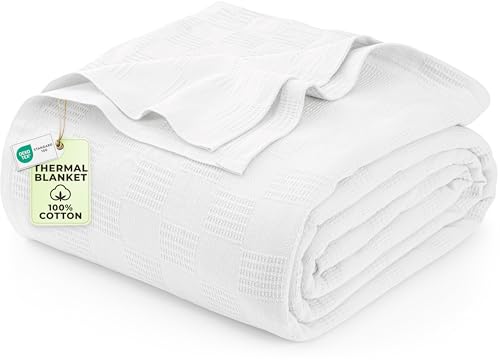
Utopia Bedding Cotton Thermal Blanket Twin — Best Thermal Weave
Before waffle became the boutique favourite, the thermal weave was the institutional standard — the blanket of hospitals, hotels and boarding schools, recognisable by its fine, net-like texture and its talent for being simultaneously present and breathable. The Utopia Bedding twin is that blanket in its honest modern form: one hundred percent cotton, thermal weave, white, ninety by seventy-two inches. Its listing calls it lightweight, breathable, soft and cosy, and positions it for bed, couch and sofa across all seasons, which is exactly the itinerant life thermal blankets have always lived.
Twin size deserves defending rather than apologising for. Twin beds fill guest rooms, children’s rooms, student halls and the spare beds of the entire hospitality world, and a twin blanket at full dimensions — not a throw pretending — layers properly, tucks properly and washes in a normal load. Households furnishing a guest bed to hotel standard will find this the correctly scaled tool, and its second life as the household’s great sofa blanket, big enough to actually cover a reclining adult, is a role throws consistently fail.
Thermal weave’s character is subtlety. It will not photograph as dramatically as waffle’s deep grid, and its warmth is the gentlest in this guide, which suits warm sleepers, warm climates and beds where the duvet does the heavy lifting and the blanket is there for texture, weight and the option of more. In the layering system, subtlety is a feature: the thermal is the layer you forget, in the way you forget everything about a well-run hotel until you come home and miss it.
- Fibre: 100% cotton
- Weave: thermal
- Size: twin, 90 x 72 inches
- Colour: white
- Character: lightweight and breathable
- Second life: full-size sofa and guest blanket
Strengths
- The traditional institutional weave, honestly executed
- Proper twin dimensions for guest and single beds
- Gentle warmth suits hot sleepers and warm rooms
Trade-offs
- Least warm option in this line-up
- Fine texture is less visually striking than waffle
- Twin-only here; bigger beds need another pick
Best for: guest beds, warm sleepers and devotees of the classic thermal hand. Not suited for: a cold bedroom needing its blanket to do serious heating work.

100% Cotton Waffle Weave Blanket 90 x 90 — Best Summer Weight
Summer is where cotton waffle stops being a layer and becomes the whole point of the bed. This blanket — one hundred percent cotton, waffle weave, ninety by ninety inches in white, described in its verified listing as lightweight and breathable and woven for spring and summer — is the cover for the nights when a duvet is unthinkable and a bare sheet feels like an unfinished bed. The waffle’s air channels, which trap warmth in winter, become ventilation in summer, and the blanket’s slight weight gives the sleeper the sense of being covered that human beings, for deep and unargued reasons, seem to require at any temperature.
Queen dimensions at summer weight is the generous choice: the blanket drapes to the bed’s edges, tucks or hangs as the maker prefers, and gives two sleepers independent territory to negotiate. In a guest room through the warm months, this single piece over a good sheet reproduces the summer hotel bed almost exactly — cool, white, textured, calm — and it washes and dries faster than any heavier blanket in this guide, which matters when guests rotate.
Its limits are the season’s limits. As the only blanket on a bed in a cold house it will not suffice, and it is not pretending otherwise; its listing says spring and summer in plain words. Buy it as the warm-weather anchor of a layered wardrobe of bedding — with the Bedsure waffle or a wool layer waiting for October — and it will be the blanket on the bed for more nights of the year than any other pick here.
- Fibre: 100% cotton
- Weave: waffle
- Size: 90 x 90 inches, queen format
- Colour: white
- Season brief: spring and summer, by design
- Character: lightweight, breathable, quick to launder
Strengths
- The summer hotel bed in a single piece
- Full queen drape rather than a skimpy seasonal size
- Fastest washing and drying cycle in this guide
Trade-offs
- Insufficient alone once nights turn cold
- White shows summer’s dust and sunscreen readily
- Light weight may feel insubstantial to weight-lovers
Best for: warm months, warm climates and summer guest rooms. Not suited for: anyone seeking one blanket for the entire year in a cold house.

Vellux Cotton Blanket King Ivory — Best King Size
The Vellux is the pick that says the quiet part in its listing: hotel quality, claimed outright, in a king at one hundred and eight by ninety inches, ivory, one hundred percent cotton with a soft breathable knit rather than a woven texture. The knit construction changes the hand completely — where waffle is architectural, knit is yielding, closer to a favourite sweater than to a waffle’s grid — and sleepers who find textured weaves busy against the skin will prefer this blanket as the layer their arms actually rest on.
King dimensions at true scale matter more in this category than in any other, because the hotel effect depends on drape: the blanket must reach both edges of a wide bed with enough fall to look and feel deliberate. The Vellux’s measurements honour that, and the ivory colour softens the professional palette by one warm degree, suiting bedrooms where pure white reads as clinical rather than serene. OEKO-TEX certification, noted in the verified listing, adds the tested-fabric credential that pairs naturally with the hotel claim.
All-season, machine washable, lightweight — the supporting claims are the category’s standard trio, and in a king they carry extra weight because a king blanket that cannot go in a home machine becomes a dry-cleaning subscription. The Vellux asks for no such thing. For the master bedroom being rebuilt on hotel lines, this is the anchor piece: the layer everything else in the system is chosen around.
- Fibre: 100% cotton
- Construction: soft breathable knit
- Size: king, 108 x 90 inches
- Colour: ivory
- Certification: OEKO-TEX noted in listing
- Positioning: hotel quality, all season, machine washable
Strengths
- True king drape for the full hotel effect
- Knit softness suits texture-sensitive sleepers
- Ivory warms the professional palette gracefully
Trade-offs
- Knit lacks waffle’s air-pocket temperature range
- King size is the largest laundry load here
- Ivory still shows marks more than mid-tones would
Best for: master bedrooms and king beds adopting the hotel system whole. Not suited for: small machines or sleepers who love a pronounced waffle texture.

Bedsure PureWoven Organic Cotton Blanket Queen — Best Organic Option
The PureWoven takes the hotel formula and changes its fibre’s biography. The cotton is one hundred percent GOTS-certified organic — a credential with an actual auditing chain behind it, covering how the cotton was grown and processed — woven at 400 GSM into a queen blanket combining waffle and herringbone textures in a tan beige the maker calls a home-decor colour rather than a laundry white. For buyers whose hotel admiration is tempered by sourcing questions, this is the pick that answers both impulses at once.
The dual texture is more than decoration. Waffle zones and herringbone zones behave slightly differently in drape and airflow, and the combination gives the blanket a visual depth the plain whites here deliberately forgo — this is the hotel blanket adapted for a home that wants the quality without the institutional cosplay. Tan beige also forgives the realities of a lived-in bed: the faint marks of ordinary weeks show less, and the blanket can stretch a little longer between washes without looking tired, though its washability is uncompromised when the day comes.
At 400 GSM the PureWoven has a substance some summer waffles lack, positioning it as a genuine all-season layer rather than a warm-weather specialist. It is the connoisseur’s pick in this guide: the one for readers who read fibre certifications the way others read thread counts, and who want their hotel bed to come with a supply chain they can describe at dinner.
- Fibre: 100% GOTS-certified organic cotton
- Fabric weight: 400 GSM
- Texture: waffle and herringbone combined
- Size: queen
- Colour: tan beige
- Season brief: all season
Strengths
- Certified organic fibre with an auditable chain
- Dual texture gives visual depth beyond plain white
- Beige forgives everyday marks between washes
Trade-offs
- Beige departs from the crisp white hotel palette
- Organic certification places it in a premium tier
- Heavier than the summer-weight waffle option
Best for: sourcing-conscious buyers wanting hotel construction with a home palette. Not suited for: purists recreating the white-on-white hotel bed exactly.
Classic Wool Hotel Blankets, Discussed Generically — Knowledge Pick
Before cotton waffle standardised the world’s hotel beds, the grand-hotel blanket was wool: a dense, plain-woven layer, often with a striped border, that warmed railway hotels and alpine lodges through winters no waffle could handle alone. Discussed generically here because modern examples vary enormously in fibre blend and finish, the classic wool blanket remains the correct answer to a specific question — what layers a bed in a genuinely cold room, under a duvet, with natural fibre throughout? Wool’s warmth per layer exceeds cotton’s, it breathes while doing it, and it asks for less washing than any fibre in this guide, since wool resists odour and releases dirt readily.
The trade-offs are equally traditional. Wool wants gentler laundering than the cotton picks above — cool, careful, infrequent — and a household committed to boiling everything weekly will ruin it. Some sleepers find even fine wool’s texture assertive against bare skin, which the layering system solves by placing the wool between sheet and duvet rather than against the sleeper. Positioned on price, honest wool sits in the mid-to-premium tiers and lasts, with moth-aware storage, for decades.
As a knowledge pick its role is calibration. A reader who tries the cotton system and still sleeps cold has not failed at hotel bedding; they have discovered they live in wool-blanket territory, as generations of cold-climate hoteliers did before them. The category’s history is a map of its climates, and wool is the northern route.
- Format: traditional wool hotel blankets, as a class
- Fibre: wool, blends vary by maker
- Signature trait: maximum natural warmth per layer
- Care: gentle, infrequent washing; moth-aware storage
- Best climate: cold rooms and northern winters
- Price positioning: mid to premium tier
Strengths
- Warmest natural-fibre layer in the hotel tradition
- Breathes while insulating, unlike heavy synthetics
- Needs the least frequent washing of any fibre here
Trade-offs
- Care is gentler than the boil-wash cotton routine
- Texture can feel assertive against sensitive skin
- Quality varies widely between modern examples
Best for: cold-climate beds and natural-fibre loyalists layering under a duvet. Not suited for: households whose laundry philosophy is hot and frequent.
Comparison Table
| Pick | Fibre & weave | Size | Standout trait |
|---|---|---|---|
| Bedsure 100% Cotton Waffle Blanket Queen White | Cotton waffle | Queen 90 x 90 | The archetypal hotel layer |
| Utopia Bedding Cotton Thermal Blanket Twin | Cotton thermal | Twin 90 x 72 | Classic institutional weave |
| 100% Cotton Waffle Weave Blanket 90 x 90 | Cotton waffle | 90 x 90 | Summer-weight specialist |
| Vellux Cotton Blanket King Ivory | Cotton knit | King 108 x 90 | Soft knit, hotel-quality claim |
| Bedsure PureWoven Organic Cotton Blanket Queen | Organic cotton, waffle/herringbone | Queen | GOTS-certified, 400 GSM |
| Classic Wool Hotel Blankets, Discussed Generically | Wool weave | Various | Cold-climate heritage layer |
How Do Hotels Actually Layer a Bed?
The professional stack, from the mattress up, runs: protector, fitted sheet, flat sheet, blanket, duvet or coverlet, and the pillows dressed last. The blanket’s position is the system’s insight — it is the adjustable layer, the one that can be folded down to the foot on a warm night, pulled to the chin in a cold one, or removed entirely in summer without remaking the bed’s architecture. Home beds that feel somehow wrong despite expensive components are usually missing exactly this middle term, running a duvet directly over a sheet and forcing one layer to do two jobs.
Texture is assigned by layer as deliberately as warmth. The sheet is smooth because skin rests on it; the blanket is textured because texture traps air and grips its neighbours; the top layer is smooth again because it faces the room. Recreating the system at home means honouring those roles rather than stacking three smooth layers that slide against each other all night. The waffle and thermal picks in this guide exist to fill the textured middle role, which is why their surfaces are features rather than decoration.
One detail separates a faithful recreation from a near miss: the blanket should be felt before it is seen. In a true hotel bed the sleeper discovers the layer by its texture and slight weight when turning, not by a decorative display across the foot. If your blanket’s main contribution to the room is visual, it has been assigned the coverlet’s job; return it to the middle of the stack, where its engineering can work unobserved through the night.
The fold at the top is the finishing grammar: sheet and blanket folded back together over the duvet’s edge, presenting a clean band and keeping the blanket’s top edge from touching faces. It takes thirty seconds and is the single most recognisable gesture of the hotel bed. Households adopting the system usually report that the fold, absurdly, is what makes the room feel finished — the bed looks kept, and a kept bed changes how the whole bedroom is treated.
Why Cotton, and Why Does the Weave Matter So Much?
Cotton’s virtues in this role are a bundle no synthetic has yet matched as a set: it breathes, it absorbs a measure of moisture and releases it to the air, it tolerates hot washing indefinitely, it softens with age instead of pilling into decline, and it carries no static. A hotel blanket lives against sleepers and inside commercial laundries; cotton is the fibre that survives both relationships gracefully. Its known weakness — modest warmth compared with wool or plush — is precisely why the weave matters, because the weave is where cotton finds its warmth.
Waffle geometry manufactures pockets of still air across the whole surface, and still air is insulation in its purest form. Thermal weave achieves a lighter version of the same trick with its fine, raised grid, trading some warmth for maximum breathability. Knit construction takes a third path, relying on the fibre’s own body and the fabric’s density, and wins on softness what it concedes in temperature range. Choosing among the picks in this guide is really choosing among those three engineering answers to one question: how should cotton hold air?
There is a sensory consequence worth stating. A woven cotton blanket feels cool to the first touch and neutral within minutes, where plush feels instantly warm and keeps building. Sleepers who overheat — a large and underserved population — often prefer the cotton’s neutrality so strongly that the hotel system converts them permanently. Warmth that can be escaped by moving a limb is a feature, and cotton’s layers are the easiest of all bedding to partially escape from.
How Should You Wash Hotel-Quality Blankets at Home?
Hotter and simpler than most home textiles: that is the professional inheritance, and cotton rewards it. Wash white cotton blankets with the white load, warm to hot as the maker’s label permits, with a thorough rinse; the fibre tolerates the regime that would destroy the plush blankets elsewhere in this collection. The one caution is load size — a king cotton blanket needs drum room to wash evenly, and an overpacked machine returns a blanket clean at the folds and doubtful at the centre.
Drying decides the texture’s fate. Waffle weave emerges from patient drying with its pockets open and springy; crushed, rushed drying flattens the geometry that does the thermal work. Tumble dry on a moderate setting or line dry with a shake halfway, and give the blanket a good snap before it goes back on the bed to wake the weave up. Cotton also forgives the occasional forgotten load better than synthetics, developing no static and no baked-in odour if rewashed promptly.
Shrinkage deserves one honest paragraph, because cotton moves. A new cotton blanket may give up a small percentage of its dimensions in its first hot washes as the weave settles into itself, and makers who know their product cut generously to allow for it. This is why the guide keeps returning to stated inches after washing rather than out of the packet, and why a blanket that arrives looking almost too large is often a blanket designed by someone who has met a laundry before. Wash a new blanket once before judging its fit on the bed; the second morning is the truthful fitting.
Frequency can follow the hotel logic at household scale: the blanket, protected by sheet below and duvet above, needs washing far less often than the sheets themselves. A rhythm of every few weeks, or at each change of season and after any illness in the house, keeps the layer fresh without wearing it in the wash. The goal is a blanket whose fiftieth wash looks like its fifth, and cotton, treated this way, reliably delivers exactly that.
Which Mistakes Ruin the Hotel-Bed Effect Most Often?
Buying the look without the system leads the list: a white waffle blanket draped over an unlayered bed is a costume, and it sleeps like one. Second comes choosing a synthetic “hotel style” blanket whose fibre cannot take the washing the style implies, so the crisp white layer greys and pills by spring. Third, buyers under-size, forgetting that the hotel drape depends on generous dimensions — a queen bed wants a queen blanket’s full fall, and a skimpy one reads as a mistake every morning.
Fourth, people over-layer in warm rooms, stacking the full winter system in July and concluding that hotel bedding is hot, when the system’s whole point is that layers come off. Fifth, they wash the blanket with the delicates’ anxiety it does not need, in cold water with whispering detergent, and wonder why it never quite smells clean. Sixth, they ignore the guest test: the hotel effect is most honestly judged by sleeping one night in your own guest bed, a diagnostic almost nobody performs and everybody should.
How Do You Choose the Right Size and Colour?
Size by the mattress plus its drape. The blanket should cover the top fully and fall down both sides far enough to tuck or to hang in the deliberate hotel manner; measure the mattress width, add the depth of both sides, and compare against the blanket’s stated width rather than trusting size names, which drift between makers. The picks here state their inches — ninety square for queens, a hundred and eight by ninety for the king — and those numbers, not the labels, are the purchase.
Colour is a laundry philosophy disguised as a decorating choice. White tolerates the hottest, simplest washing and matches every room ever painted, at the cost of displaying every mark until wash day. Ivory keeps the system’s spirit with a warmer face. Tan beige, as the organic pick demonstrates, forgives the intervals between washes and suits rooms dressed in earth tones, at the cost of the crisp professional signal. Choose by how your household actually launders, and the colour will never become a grievance.
There is a small test for colour regret that costs nothing: imagine the blanket in February, unironed, at seven in the morning, in flat winter light. White passes that test by looking clean even when it merely is clean. Strong colours and busy patterns, so charming in a catalogue’s golden hour, often fail it by looking tired. The hotel palette was selected by people whose living depended on beds photographing well in exactly that light, and home buyers inherit the research for free every time they choose the boring, correct colour.
Guest beds deserve the strictest standard, because a guest judges a household’s bedding the way a hotel guest judges a chain’s: by the worst layer. A proper cotton blanket on the guest bed, washed white and folded with the sheet, communicates a standard of care that no scented candle can imitate. Many readers of this guide are, whether they say so or not, shopping for exactly that sentence to be true of their spare room.
How Does the Hotel Blanket Behave Across the Seasons?
Spring is the layer’s showcase season. Nights swing between heating-on and windows-open, and the cotton blanket’s neutrality lets a sleeper adjust by degrees — blanket over the sheet, blanket folded to the foot, blanket kicked half off at three in the morning without waking fully. A duvet alone offers two settings, on and off; the layered bed offers a dial, and spring is when the dial earns its existence. Households that adopt the system often date their conversion to an April of unusually comfortable sleep.
Summer belongs to the summer-weight waffle and the thermal, used solo over a sheet. Cotton’s cool first touch, so unremarkable in January, becomes the point in July: the blanket feels like the cool side of the pillow, extended. Air-conditioning complicates the picture pleasantly — a room cooled for sleep makes a light cotton layer necessary rather than optional, and the hotel system, born in air-conditioned rooms, handles the combination as its native habitat.
Autumn and winter restore the blanket to its middle post, and the question becomes what stands above it. A mid-weight duvet over a waffle blanket covers most heated homes’ coldest nights; genuinely cold rooms add either a heavier duvet or the wool layer’s intervention. The blanket itself rarely changes across the year — that constancy is the system’s economy, one textile serving twelve months while its partners rotate around it — and a blanket that never leaves the bed also never gets lost in storage, which is a small, real virtue.
What Should Guest Rooms Steal From Hotels First?
Steal the layering before the luxury. A guest bed with a proper cotton blanket between sheet and cover instantly reads as considered, even on an ordinary mattress, while an expensive duvet on an unlayered bed reads as a shop display. Guests notice the adjustable middle layer at two in the morning, when they are too warm or too cold and a folded-down blanket solves it silently without a host, a thermostat negotiation or a trip to a linen cupboard in a strange house.
Steal the white palette second, for its honesty. White bedding tells a guest the bedding is washed hot and often, because white cannot pretend otherwise; coloured and patterned guest bedding asks to be trusted, and trust is exactly what a guest bed should not have to request. The hotel industry did not choose white from aesthetics but from auditability, and a spare room gains the same audit every time its bed is made in white cotton.
Steal the spare blanket third. Hotels fold one at the foot or place one in the wardrobe because guests’ thermostats are unknown variables. A home guest room with a second blanket — the thermal twin from this guide serves beautifully — within sight and reach completes the impersonation: the guest can tune the bed alone, in the dark, without apology. Hospitality is mostly the removal of small dependencies, and bedding is where a host can remove the most of them per pound spent.
How Long Should a Cotton Hotel Blanket Last?
Measured in washes rather than years, a quality cotton blanket’s life is long: the fibre does not melt, pill or delaminate, and the weave’s enemies are abrasion and chemistry rather than time. In a home washed fortnightly, a blanket from the stronger end of this guide should serve for years with its texture intact, softening gradually in the way good cotton does — a change most owners experience as improvement rather than decline, since a hotel blanket’s prime is a supple middle age rather than its crisp first week.
Retirement signs are legible when they come. Thinning at the centre where bodies turn, edges fraying beyond a tidy repair, a waffle grid that no longer springs back after drying — each announces that the weave’s structure is spent. Cotton announces honestly, unlike synthetics that can look plausible while their performance quietly leaves. A retired cotton blanket demotes gracefully to the dog’s bed, the car boot and the furniture-removal van, which is more than can be said for most textiles.
Buying with that lifespan in mind changes the value arithmetic. A blanket washed a hundred times across five years costs its owner pennies a night, and the premium for the better-constructed pick amortises into invisibility. The false economy in this category is the thin cotton that reaches retirement in eighteen months and must be bought twice inside the good blanket’s first term.
How Do You Keep White Cotton White Without a Laundry Service?
Prevention outperforms restoration. The marks that grey a white blanket are mostly cumulative — body oils at the top edge, dust settling into an unmade bed, the slow transfer of colour from a dyed throw kept folded over it. Making the bed daily, so the blanket lives under its duvet rather than exposed, and folding the top band down so faces meet sheet rather than blanket, removes most of the causes. Hotels are not cleaner than homes; they are simply more systematic about which surfaces touch what.
Washing technique carries the rest. Hot water as the label allows, a full rinse, and loads that are whites-only without exception — the single cream towel in a white load is a dye donation the whole load accepts. Sort ruthlessly and the whites stay white by arithmetic rather than chemistry. When brightness does fade, an oxygen-based soak restores cotton kindly, and sunlight on a line remains the oldest whitening technology, free and effective in any month with a dry day in it.
Accept the professional’s final secret: rotation. Hotels hold multiple sets per bed, so no single blanket takes every wash; a home that owns two blankets per main bed and alternates them doubles each one’s calendar life and always has a clean layer during laundry gaps. The second blanket feels like an extravagance at purchase and like infrastructure ever after — which is, not coincidentally, the story of the entire hotel system.
What Is the Difference Between a Hotel Blanket and a Coverlet or Throw?
Roles, again. A coverlet is the bed’s public face — decorative, smooth, sized to drape to the floor — and it is chosen by the eye. A throw is an accent with ambitions, sized for laps and chair backs, chosen by the hand and the room’s palette. A blanket is the working layer between them in function and beneath them in visibility, chosen by fibre and weave. Confusing the roles produces the familiar disappointments: the beautiful coverlet that sleeps hot and slides, the throw asked to warm a queen bed, the working blanket judged for not decorating.
The hotel system assigns each textile its post and buys accordingly, which is why this guide’s picks look plain beside the decorative blankets elsewhere in the collection. Plainness in the working layer is not a compromise but a specification: nothing to snag, nothing to fade unevenly, nothing between the sleeper and the weave’s engineering. Decoration lives one layer up, where it can be changed with the seasons while the blanket underneath serves unchanged for years.
Households furnishing a bedroom from zero should buy in the system’s order: sheets first, the cotton blanket second, the visible top layer last and with the most personality. That sequence guarantees the bed sleeps correctly before it photographs correctly, and it is the exact reverse of how most bedrooms are actually assembled — which explains a great deal about how most bedrooms sleep.
How Does a Cotton Blanket Suit Hot Sleepers and Sensitive Skin?
Hot sleepers are this category’s natural constituency. Cotton’s cool touch, breathability and freedom from static address the specific miseries of the overheating sleeper, and the layered system gives them the finest-grained control available in bedding: sheet alone, sheet plus blanket, blanket folded half down, each a distinct temperature rather than a duvet’s binary. Many hot sleepers who believed they simply slept badly discover, in a cotton-layered bed, that they slept hot — a diagnosis with a textile cure.
For skin that reacts to the world, the relevant virtues are washability and simplicity. A blanket that can be washed hot and often, in the household’s own chosen detergent, rinsed thoroughly and dried completely, is a blanket whose surface the owner controls. Certified options like the OEKO-TEX-noted Vellux and the GOTS-certified PureWoven add tested-input credentials for buyers who want them. None of this is medical advice and these are comfort textiles, not treatments; persistent skin concerns belong to clinicians. But as housekeeping, a simple cotton layer is the easiest bedding in the world to keep honest.
Texture choice personalises the answer. Waffle’s grid is palpable and some sensitive sleepers prefer the knit Vellux’s smoother face against arms and shoulders, with the waffle reserved for beds where it sits fully beneath a duvet. Trying the blanket as the top layer for a week before assigning it to the middle is a fair trial, and cotton’s forgiveness in the wash makes the experiment cheap to run.
How Do You Make the Bed So the System Works?
Technique is brief and learnable. Centre the blanket with equal fall on both sides before any folding happens, because a layer centred wrong at noon is a layer fought with at midnight. Pull it smooth without stretching — cotton weaves resent being hauled, and a snapped-taut waffle loses the loft in its pockets that the whole design exists to preserve. Let the top edge sit a hand’s width below the sheet’s top, so the folded band presents sheet against skin and blanket beneath it, in the professional arrangement.
The fold itself should be one decisive movement: duvet’s top edge folded back over the blanket and sheet together, a band of perhaps a foot, pressed flat once with a forearm. Creases beyond that are fussiness. In the morning, the same system rewards a thirty-second reset — duvet shaken, blanket smoothed, band refolded — and a bed reset daily never reaches the state where remaking it feels like a project. Hotels turn rooms in minutes because the system is simple; a home bed built on the same layers inherits the same mercy.
Pillows complete the picture and obey the same philosophy: cases washed with the sheets, protectors beneath, nothing decorative that must be removed and replaced twice a day unless the household genuinely enjoys the ritual. The hotel bed’s luxury is not abundance. It is the absence of anything that does not earn its place, and the blanket — working, washable, correctly sized — is the layer that teaches the rest of the bed that discipline.
What Should Renters and Small Homes Take From All This?
The hotel system is unusually renter-friendly because its luxury is portable and its components are standard. A cotton blanket transforms a landlord’s mattress more completely than any topper, travels in a normal box at moving time, and asks for no installation, no permission and no storage beyond a shelf. In a small home, one excellent blanket per bed outperforms a cupboard of seasonal novelties, because the layering logic lets a single textile serve the whole year while duvets rotate around it.
Laundrette households should weight washability even higher than this guide already does. Cotton that tolerates commercial machines and emerges correct is the renter’s ally; the king sizes, by contrast, should be chosen with the local machines’ drums in mind. A queen waffle washed weekly without drama serves a small home better than a king knit that needs a special trip — the recurring theme of this entire collection, that the best blanket is the one whose care fits the life around it, applies to hotel cotton with special force.
Final Recommendation
Build the system, not the souvenir. Start with the Bedsure waffle queen as the middle layer of a properly sheeted bed and you have the hotel effect in its reference form; choose the Vellux knit for a king or for skin that prefers softness to texture, the Utopia thermal for guest beds and gentle warmth, the summer waffle when the warm months are your main season, and the organic PureWoven when the fibre’s story matters as much as its performance. Keep a wool layer in mind if your rooms run genuinely cold. Wash the cotton hot, dry it with air, fold the top band down like you mean it, and the bed that results will not merely photograph like the one you remember from that good hotel — it will sleep like it, night after ordinary night, which is the only review a blanket ever really earns.
Frequently Asked Questions
What makes a blanket “hotel quality” rather than just white?
Construction, not colour: one hundred percent cotton, a textured weave such as waffle or thermal, dimensions generous enough to drape, and the ability to survive frequent hot washing without thinning or pilling. White is simply the palette that professional laundering produces; a synthetic white blanket that cannot take the wash is a costume version.
Is a waffle blanket warm enough for winter?
As the middle layer under a duvet, yes for most heated homes — that is the role it evolved for. As the only cover on the bed in a cold room, cotton waffle reaches its limit, and the honest answers are a heavier duvet above it or the wool layer discussed in this guide beneath the duvet instead.
How is a thermal blanket different from a waffle blanket?
Both are cotton weaves that trap air, at different scales. Thermal weave’s fine, net-like texture is lighter and more breathable, with gentler warmth; waffle’s deeper grid holds more still air and adapts across a wider temperature range. Thermal suits warm sleepers and guest beds; waffle suits the all-season main bed.
Can I bleach a white cotton hotel blanket?
Cotton tolerates bleaching far better than synthetics, which is one reason hotels standardised on it — but follow the individual maker’s care label, use bleach as an occasional restoration rather than a weekly habit, and rinse thoroughly. Most home whites stay bright with hot washing alone; bleach is the reserve tool.
What size blanket does a queen bed need for the hotel drape?
Look for a true ninety-by-ninety-inch queen, as the main picks here offer, and verify against your mattress: width plus both sides’ depth should not exceed the blanket’s width if you want it to hang evenly. Deep modern mattresses eat drape, so measure before ordering rather than trusting the size name.
Related Guides
The neighbouring guides below leave the hotel suite for a trailhead, a nursery and a beach — three places where blankets work for a living in entirely different ways.
Continue with Best Solar Blankets for 24-Foot Round Above-Ground Pools for the blanket that works on water, detour through Best After-Swaddle Transition Blankets for the smallest sleepers’ layers, or read Best Lightweight Receiving Blankets for cotton at its lightest and most traditional. Round out the set with Best Acoustic Blankets.



[…] with Best Hotel-Quality Blankets for the five-star version of a made bed, detour through Best Army Surplus Wool Blankets for the […]
[…] Best Battery-Operated Heated Blankets for the grown-ups’ answer to a cold house, and Best Hotel-Quality Blankets for the bed at the other end of childhood. The day’s other ritual lives in Best Baby Bathtubs […]