What's inside
- Key Takeaways
- Quick Picks
- How Did We Choose These Transition Picks?
- Comparison Table
- Which Signs Say the Swaddle Has to Go?
- How Should You Run the First Week Out of the Wrap?
- Why Does TOG Cause So Much Confusion?
- What Safety Rules Survive the Transition?
- Which Mistakes Derail Most Transitions?
- How Does Fabric Choice Change the Crossing?
- What Should Other Caregivers Be Told?
- How Do You Handle Travel in the Middle of a Transition?
- Why Are Weighted and Novelty Designs the Wrong Answer Here?
- How Much Should You Expect to Spend Across the Whole Stage?
- What Does a Realistic Night-by-Night Timeline Look Like?
- How Do Daytime Naps Fit Into the Plan?
- How Should You Wash and Store These Garments?
- Final Recommendation
- Frequently Asked Questions
- Related Guides
As an Amazon Associate I earn from qualifying purchases. This post may contain affiliate links at no extra cost to you.
cottageverdict.com is reader-supported. When you buy through links on our site, we may earn an affiliate commission.
Where to buy: the five linked products below lead to their Amazon listings, where you can check price on Amazon and confirm the size by weight, the TOG value and the fabric before ordering. The sixth entry sells nothing; it describes the plain arms-out sleep sack that waits at the end of every transition, so you can judge whether your baby even needs an in-between step.
Parents searching for the best after-swaddle blankets usually arrive here at about three in the morning, one arm of the swaddle worked loose again, a baby who five minutes ago was asleep now furious at a wrap that used to settle her. That moment, repeated over several nights, is the real subject of this guide. A transition blanket is not a warmer blanket or a cuter blanket. It is a bridge product, built to withdraw the snug containment of swaddling gradually enough that sleep survives the withdrawal.
The trigger for crossing that bridge is developmental, not calendrical. Once a baby shows signs of rolling, or starts fighting the wrap hard enough to break free nightly, the tight swaddle has done its work and needs to retire. What replaces it still has to respect the rule that governs everything in this category: a sleeping baby, unsupervised, should have nothing loose around them. Every pick in this guide is wearable, zipped or structured, precisely because a free blanket draped in a crib is not a safe substitute, however soft it photographs.
So this article judges transition products on the mechanics of letting go. How do the arms get freed, suddenly or in stages? How much of the old swaddle snugness remains around the torso? What does the fabric do about the startle reflex that the swaddle used to muffle? And when the bridge has been crossed, does the product still earn its keep as an ordinary sleep sack, or does it become a drawer relic after a fortnight?
Key Takeaways
- Rolling, not a birthday, is the signal to stop tight swaddling and start transitioning.
- Zip-off wings free one arm at a time, which suits babies who protest sudden change.
- Wide, roomy sleeves dampen the startle reflex without pinning arms to the sides.
- TOG choice follows the nursery thermometer, never the season printed on packaging.
- Every product here is wearable, because loose blankets stay out of unsupervised sleep.
- Size by weight and length together; a transition piece outgrown mid-process helps nobody.
Quick Picks
| Pick | Badge | Why it earns its place |
|---|---|---|
| HALO SleepSack Easy Transition Swaddle 1.5 TOG | Best Sleeve-Led Bridge | Roomy raglan sleeves soften startles while the body stays gently snug. |
| Baby Merlin’s Magic Sleepsuit Cotton | Best Padded Cushioning | A quilted suit that muffles twitches for babies who loved deep swaddle pressure. |
| Love To Dream Transition Bag 1.0 Tog | Best Staged Wing Removal | One wing unzips, then the other, turning change into two smaller steps. |
| HALO Easy Transition SleepSack Heather Pink | Best Second Colourway | The same sleeve-led design in a heathered pink for laundry rotation. |
| Love to Dream Swaddle Up Transition Bag 2.5 TOG | Best Cool-Room Version | A warmer weight of the wing system for nurseries that run genuinely cold. |
| Plain Arms-Out Sleep Sack, Discussed Generically | The Destination | Covered without a link as the simple endpoint every transition aims at. |
How Did We Choose These Transition Picks?
We started from the question a tired parent actually asks, which is not “what is soft?” but “what will my baby tolerate on night one?” That pushed us toward products with a genuine mechanism, something in the design that replaces part of what the swaddle did. Sleeves with volume, wings that detach, padding that adds gentle resistance: each pick below manages the startle reflex or the loss of containment in a specific, explainable way, rather than simply being a sack with hopeful marketing.
Fit information mattered just as much. Transition products are bought in a hurry and used for a short window, so a listing that sizes honestly by weight, states its TOG plainly and shows how the zip behaves at nappy-changing time earned trust over one long on adjectives and short on measurements. We also favoured designs that keep working after the transition ends, because a product useful for three weeks must justify itself differently from one useful for three months.
Finally, we held every candidate against the safe-sleep baseline that runs through this whole guide. Wearable, fitted at the chest, free of loose panels near the face, nothing that rides up. A product can be ingenious about arms and still fail that test, and several clever-looking designs were left out for exactly that reason.

HALO SleepSack Easy Transition Swaddle 1.5 TOG — Best Sleeve-Led Bridge
HALO’s answer to the end of swaddling is width where the swaddle used to be tightest. The Easy Transition keeps a recognisably snug body, then gives the arms these unexpectedly roomy, almost kimono-like sleeves. A startle still happens, because startles are neurology rather than misbehaviour, but the arm travels inside a fabric channel instead of flailing into open air and waking its owner. For babies whose problem is the flail rather than the freedom, that distinction is the whole product.
The 1.5 TOG weight sits in the sensible middle for a heated home, warm enough for a nursery that hovers around the high teens Celsius, light enough that layering a sleepsuit underneath remains an option on colder nights. The oat colourway is the quiet, unisex one, and the small size suits the younger end of the transition window, which is when most families meet this product, somewhere around the first determined rolling attempts.
What we like most is the honesty of the concept. Nothing here pretends to swaddle; the containment is reduced, visibly and deliberately, and what remains is structure. Parents report the first nights are still disrupted, and any review claiming otherwise should be distrusted, but the disruption is shallower, a stir rather than a full indignant waking.
- Form: wearable transition sack with wide sleeves
- Warmth: 1.5 TOG, midweight for heated nurseries
- Size listed: Small, in oat
- Closure: zip front for nappy access
Strengths
- Sleeve volume directly addresses startle-driven waking
- Body stays fitted, so the change feels partial, not total
- Continues as a plain sleep sack once arms settle
Trade-offs
- Babies who hate any arm fabric may still object
- Single midweight TOG means cold rooms need layering thought
- The small window of use makes sizing accuracy crucial
Best for: babies whose wake-ups are startle-led and who still like torso snugness. Not suited for: families wanting a one-arm-at-a-time staged release.

Baby Merlin’s Magic Sleepsuit Cotton — Best Padded Cushioning
The Magic Sleepsuit takes the opposite route from minimalism. It is a padded, almost marshmallow suit, and its logic is resistance: the quilting gives little limbs something to push against, so twitches lose their momentum before they become full wake-ups. Babies who were champion swaddle-wrestlers, the ones who treated a tight wrap as a challenge, often respond to this because the suit does not fight back the way a wrap does; it simply absorbs the argument.
The cotton version in cream, sized for the twelve-to-eighteen-pound range, is the breathable member of the family, and breathability deserves emphasis because padding and overheating are natural anxieties side by side. This suit is warm by construction. It belongs in a cool nursery, over light clothing, with a parent who checks the back of the neck rather than guessing from tiny hands, which are unreliable thermometers at the best of times.
It is also, frankly, a short-lived and single-purpose object, closer to a training device than to clothing. The arms and legs are open, the baby can be picked up and settled without unzipping a cocoon, and night feeds stay simple. But once rolling from back to front becomes confident and the baby needs true freedom of movement in sleep, the suit’s work is finished, and it should retire without nostalgia.
- Form: padded one-piece sleepsuit, open hands and feet
- Fabric listed: cotton outer in cream
- Size listed: Small, twelve to eighteen pounds
- Warmth: substantial by construction, for cooler rooms
Strengths
- Quilting genuinely dampens the Moro reflex’s drama
- Open extremities keep feeds and cuddles uncomplicated
- Feels like a distinct step, which some babies accept better
Trade-offs
- Too warm for mild nurseries or summer transitions
- Short usable life once rolling is established
- Bulk makes car-seat or pram transfers impractical mid-nap
Best for: strong startlers in cool rooms who loved firm swaddle pressure. Not suited for: warm homes, or babies already rolling confidently.

Love To Dream Transition Bag 1.0 Tog — Best Staged Wing Removal
Love To Dream built its reputation on a heresy: many babies prefer sleeping with arms up, near their faces, where hands can be found and sucked at three in the morning. The Transition Bag starts in that arms-up posture, wings on, then lets you unzip one wing and leave the other, so the baby spends several nights as an asymmetric creature, one hand free for self-soothing, one still cosseted. Only when that arrangement bores everyone do you remove the second wing and arrive at a straightforward sleep bag.
Staging is this product’s real intelligence. Change is the enemy of infant sleep, and the bag breaks one big change into two smaller ones, each given time to become ordinary. The 1.0 TOG weight in grey, sized for the six-to-eight-and-a-half-kilogram band, targets mild rooms, the kind sitting around twenty to twenty-four degrees, and the double zip keeps the midnight nappy change from becoming a full undressing ceremony.
The cotton is machine washable and needs to be, because a transition can coincide with the age of enthusiastic drooling and leaking. Buy the size by weight rather than by age in months, and check the fit at the neck and chest; the bag should be snug through the torso while the bell of the skirt gives hips and legs their developmental room.
- Form: arms-up bag with zip-off wings
- Warmth: 1.0 TOG for mild rooms
- Size listed: Medium, six to eight and a half kilograms
- Closure: double zip for bottom-up changes
Strengths
- One-wing stage is a genuinely gentler gradient
- Arms-up posture suits natural hand-to-face soothers
- Becomes a regular sleep bag, extending its usefulness
Trade-offs
- Arms-up devotees only; arms-down babies may not convert
- Wing zips are small parts to keep track of in laundry
- Light TOG needs a warmer sibling for cold houses
Best for: gradualists, and babies who already sleep hands-up. Not suited for: anyone wanting the transition over in a single night.

HALO Easy Transition SleepSack Heather Pink — Best Second Colourway
It would be easy to dismiss this entry as the first pick wearing a different colour, and the design is indeed the same sleeve-led idea, here in heather pink and the medium size. But rotation is a real feature in this category, not a vanity. Transition weeks are peak laundry weeks; night feeds, leaks and the occasional dramatic vomit all land on the one garment your baby has just learned to sleep in. A second, identical unit in a different shade means the learned sleep cue survives wash day.
The medium sizing also matters to the story. Babies do not read growth charts before deciding to roll, and the later transitioner, the one who swaddled happily for months, needs the bigger cut with the same familiar sleeve logic. Moving up a size mid-transition while changing nothing else about the garment is a quiet kindness to everyone’s sleep, and it is precisely what having both sizes of one design in this guide allows.
Treat the pair as a system, then. Start in whichever size the weight chart dictates, keep the other colourway clean in the drawer, and let the heathered fabric hide the faint stains that pale nursery textiles collect no matter how heroic the laundry routine. When the sleeves eventually become ordinary, both units continue as serviceable sleep sacks rather than single-purpose purchases.
- Form: wearable transition sack with wide sleeves
- Warmth: TOG 1.5, midweight
- Size listed: Medium, heather pink
- Role in a wardrobe: rotation twin of the oat version
Strengths
- Identical feel keeps the sleep cue consistent across washes
- Medium cut serves later, larger transitioners
- Heathered colour disguises everyday nursery staining
Trade-offs
- Duplicates a design rather than adding a new mechanism
- Two units of a short-stage product is a real outlay
- Pink colourway will not suit every family’s taste
Best for: households building a two-unit rotation in the medium size. Not suited for: minimalists who wash nightly and need only one.
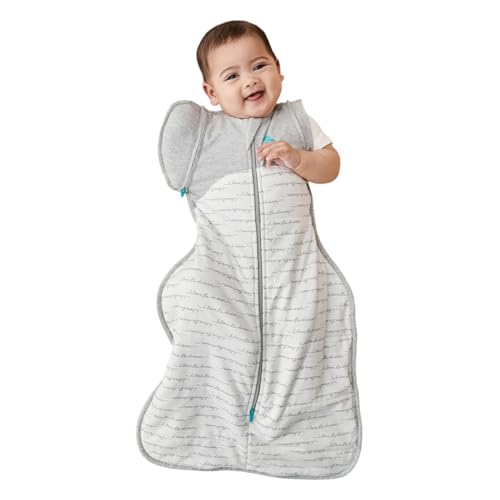
Love to Dream Swaddle Up Transition Bag 2.5 TOG — Best Cool-Room Version
Everything said about staged wings applies here, but the number that changes the conversation is 2.5. This is the warm build of the Swaddle Up transition design, aimed at rooms sitting in the low-to-mid teens Celsius, draughty older houses, winter babies, the nurseries where a parent sleeps under a duvet and still wakes chilly. In those rooms the 1.0 TOG sibling would need so much layering underneath that the layering itself becomes the complication.
The size band, thirteen to nineteen pounds, catches the classic transition age squarely, and the Dreamer white colourway is the one that will be handed down, sold on or folded into a memory box without dating itself. Zip-off wings work exactly as in the lighter bag: one first, a pause of some nights, then the second, then a warm ordinary sleep bag for the rest of the cold season.
Warmth demands one discipline in return, which is honesty about room temperature. A 2.5 TOG bag over a fleecy sleepsuit in a mild room is too much, and the correct response to a warm night is stepping down a layer, not loyalty to a purchase. Buy this version because your thermometer argues for it, and it will serve beautifully; buy it because it looks cosier in photographs, and it will spend the season in the drawer.
- Form: arms-up bag with patented zip-off wings
- Warmth: 2.5 TOG for cool rooms
- Size listed: thirteen to nineteen pounds, Dreamer white
- Extras: snug torso fit, easy nappy-change access
Strengths
- Proper warmth removes the need for fiddly under-layers
- Same proven staged release as the lighter version
- Remains useful as a winter sleep bag afterwards
Trade-offs
- Overheats quickly if the room warms up
- White shows every feed-related incident
- Weight band will be outgrown by spring for many babies
Best for: cold houses and winter transitions measured by thermometer. Not suited for: mild rooms, where the 1.0 TOG build is the honest choice.
Plain Arms-Out Sleep Sack, Discussed Generically — The Destination
Every bridge in this guide leads to the same unglamorous shore: an ordinary sleep sack, arms out, sized generously, remarkable in no way at all. We include it without a link because some babies walk straight there. The determined roller who has been escaping swaddles for weeks may accept a plain sack on the first night with an air of finally being treated like a person, and no staged product is required.
Judged generically, a good plain sack has a zip that opens from the bottom for changes, a neck opening that cannot ride toward the face, room at the hips, and a weight matched to the room. It comes in every fabric and at every tier, from budget multi-packs bought in a panic to premium natural-fibre versions bought as gifts. The tier matters less than the fit, which is true of almost nothing else in baby retail.
Think of the transition products above as insurance against a rough fortnight, and the plain sack as the default they protect. If your baby is already sleeping arms-free in supervised daytime naps, try the destination first. If nights fall apart, step back onto whichever bridge matches the failure, sleeves for startles, wings for gradualists, padding for pressure-lovers, and cross more slowly.
- Form: standard wearable sack, arms fully out
- Warmth: choose by room temperature, all weights exist
- Sizing: by weight and length, generous hip room
- Positioning: every tier from budget packs to premium fibres
Strengths
- The simplest, longest-lived option in the whole category
- No mechanism to outgrow or detach
- Works from transition night through toddlerhood sizes
Trade-offs
- Offers the startle reflex no cushioning whatsoever
- A cold-turkey switch fails loudly for some babies
- Quality varies enormously between brands and tiers
Best for: babies already napping arms-free without drama. Not suited for: strong startlers in their first week out of the wrap.
Comparison Table
| Pick | Mechanism | Warmth | Transition style |
|---|---|---|---|
| HALO SleepSack Easy Transition Swaddle 1.5 TOG | Wide sleeves | 1.5 TOG | Arms channelled, body snug |
| Baby Merlin’s Magic Sleepsuit Cotton | Quilted padding | Warm by build | Resistance absorbs twitches |
| Love To Dream Transition Bag 1.0 Tog | Zip-off wings | 1.0 TOG | One arm freed, then both |
| HALO Easy Transition SleepSack Heather Pink | Wide sleeves | TOG 1.5 | Rotation twin, medium size |
| Love to Dream Swaddle Up Transition Bag 2.5 TOG | Zip-off wings | 2.5 TOG | Staged release, cold rooms |
| Plain Arms-Out Sleep Sack, Discussed Generically | None | All weights | Straight to the destination |
Which Signs Say the Swaddle Has to Go?
Rolling attempts outrank every other signal. A baby who rocks onto their side, twists determinedly against the wrap, or has rolled even once, clumsily and perhaps accidentally, is telling you the swaddle’s safe chapter is closing. Arms pinned beside a body that can roll but cannot yet roll back is a combination nobody should gamble a night on, so the transition begins at the first credible attempt rather than at some tidier milestone.
Escape artistry is the second signal, and it usually arrives earlier. When the wrap loosens nightly and fabric migrates toward the face, the swaddle has stopped being a sleep aid and become a loose textile in the crib, which is the very thing this guide keeps warning against. Persistent, furious resistance at wrapping time, a baby who once melted into the swaddle and now arches against it, completes the picture. Development is not being difficult; it is being development.
What does not belong on the list is age alone. A contented, non-rolling baby swaddled a little longer is not a parenting failure, and a young baby rolling early is not advanced in a way that lets you delay. Watch the body in front of you, keep the crib bare either side of the decision, and remember that the transition products exist to protect sleep during a change that safety has already scheduled.
How Should You Run the First Week Out of the Wrap?
Begin with the mechanism, not the whole change. If your pick has wings, free one arm for three or four nights and resist improving the plan mid-week, because babies read inconsistency as novelty and novelty as a reason to stay awake discussing it. If your pick has sleeves or padding, the adjustment is built in, so keep everything else aggressively boring: same feed, same song, same darkness, same parent smell on the bedding.
Expect the second night to be worse than the first and plan your morale around it. Night one often runs on exhaustion and surprise. Night two is when the baby audits the new arrangement properly. This is normal enough that abandoning ship on night two is the classic error, swapping products in a spiral until the baby is transitioning from transitions. Give a mechanism a fair run of nights unless the failure is total, meaning no settling at all rather than some protest.
Daytime is your rehearsal studio. Supervised naps and floor time with arms free teach the nervous system that loose limbs are survivable, and tummy time builds the rolling and pushing strength that makes the whole developmental leap feel less alarming to its owner. A baby who spends days discovering their hands will meet those hands at night as acquaintances rather than as startling strangers attached to their shoulders.
Why Does TOG Cause So Much Confusion?
Because TOG describes the garment while parents feel the room, the clothing underneath and the baby’s own furnace-like variability all at once. The number is only the starting point of a small calculation: room temperature first, then what the baby wears beneath the sack, then the TOG on top. Change any one of the three and the others must move. A thermometer in the nursery settles arguments that guessing from the hallway never will.
The practical check is tactile and takes seconds. Slide two fingers onto the baby’s chest or the back of the neck during a night feed. Warm and dry is the goal. Hot, sweaty or flushed means a layer comes off or the lighter bag comes out, while cool hands and feet, on their own, mean almost nothing, because infant circulation keeps extremities on the chilly side as a matter of routine.
Across this guide the spread runs from 1.0 to 2.5 TOG with the padded suit as its own warm special case, and the honest advice is to own the weight your thermometer requests most often rather than a wardrobe of every weight. Most heated homes live at the lighter end through most of the year. Cold, draughty houses are the exception that justifies the heavy build, and they know who they are.
What Safety Rules Survive the Transition?
All of them, unchanged, because the transition alters the garment and nothing else. Baby sleeps on their back, on a firm flat surface, in a crib or bassinet that contains the baby and the wearable blanket and precisely nothing else. No loose blanket folded at the foot for later, no lovey promoted early out of sentiment, no hat, no padded extras. The wearable blanket is the blanket; that is the entire point of its design.
Fit checks become a nightly habit rather than a purchase-time event. The neck opening should not be able to slip over the chin, armholes should not let a small body wriggle down inside the sack, and zips should run smoothly without fabric bunching near the face. Growth spurts quietly undo a fit that was perfect a month ago, which is why sizing by current weight, rechecked occasionally, beats sizing by the age printed on a gift receipt.
One more boundary deserves plain words. Nothing in this category, no suit, sack or swaddle successor, should be described as preventing sudden infant death, and you should be suspicious of any product page that hints otherwise. These are comfort and sleep-continuity tools used inside a safe sleep environment. The environment does the safety work. The garment just helps everyone sleep inside it, and that is a respectable, sufficient job.
Which Mistakes Derail Most Transitions?
Waiting for a good week is the first. There is no week in a young baby’s life when sleep is so robust that change costs nothing, and delay while rolling advances trades a manageable protest now for a safety-driven cold stop later. Start when the signs appear, on an ordinary Tuesday, with whichever mechanism matches the baby, and let ordinary be the strategy.
Buying by age in months runs a close second. Babies of identical age can differ by a third of their body weight, and a transition garment is a fit-critical object, snug at the chest, right at the neck. The weight chart on the listing is the sizing system; the month range is decoration. Measure the actual baby, order the actual size, and accept that a fast grower may cross the whole bridge inside a single size with room to spare or outgrow the first purchase mid-crossing.
The third mistake is layering by anxiety. A parent who feels cold in a hallway adds a vest under the sack, then chooses the warmer TOG, then wonders why the baby wakes sweating and furious at midnight. Dress the baby for the nursery thermometer and the neck check, not for your own walk to the kitchen. Warm babies protest just as loudly as cold ones, and their protest is easier to misread.
How Does Fabric Choice Change the Crossing?
Cotton dominates this category for unglamorous reasons: it washes hot, tolerates the digestive enthusiasm of small babies, and breathes predictably across seasons. A cotton transition garment behaves the same in week six as in week one, which matters when the garment itself is meant to be the constant in a changing routine. Parents building a two-unit rotation will find cotton the easiest fabric to keep in genuine rotation, because both units can share one wash cycle without special handling or separate loads.
Blends enter the picture where softness or stretch is the point. A touch of elastane through the torso helps a sack keep its fitted shape over a wriggly body, and brushed synthetic panels can feel immediately cosy in a cold room. The cost is predictability. Some blends pill after repeated washing, some hold odours longer than cotton, and stretch that begins as a snug fit can relax into a loose one across a season of use. Check the fit of a stretchy garment more often than the calendar suggests, because its measurements are quietly moving.
Natural-fibre purists sometimes ask about wool for temperature regulation, and in ordinary sleep sacks wool has real merits. In transition products the mechanisms matter more than the fibre, and the leading sleeve, wing and padding designs are mostly cotton or cotton-rich for washability. Choose the mechanism first, the fabric second, and treat any product that reverses that priority, leading with a miracle textile and mumbling about how the arms work, as a product designed for a gift table rather than a nursery at three in the morning.
Whatever the fabric, buy for the wash it will actually receive. Transition garments live hard: nightly wear, frequent leaks, hurried laundering by exhausted people. Seams, zip garages and fastenings that survive that regime are worth more than a delicate hand-feel that frays by the third cycle. Read the care label as part of the product, not as fine print, and be honest about whether your household will follow anything fussier than a standard wash and dry.
What Should Other Caregivers Be Told?
A transition can be quietly sabotaged by kindness. A grandparent who re-wraps the baby in a receiving blanket for a nap because that is how babies have always slept, a babysitter who adds a folded throw for cosiness, a well-meaning partner who frees both wings on night one because the baby looked frustrated: each undoes the plan while believing they are helping. The fix is a short, written, unembarrassed set of instructions left where the garment lives.
Write down which product is in use, which stage it is at, and what stage comes next and when. One wing off until Thursday. Sleeves, not the old wrap. Nothing else in the crib, full stop. Caregivers follow written instructions far more reliably than they follow a vibe absorbed from a hurried handover conversation, and a note also protects them from the anxiety of improvising around someone else’s baby and someone else’s rules.
Daytime caregivers deserve the developmental context too. A baby mid-transition may nap differently, protest at settling, or catnap where they once slept deeply. That is the process working, not the caregiver failing. Nurseries and childminders who understand that the family is crossing from swaddle to sack will keep the daytime routine steady instead of inventing comforts, and steadiness across every pair of hands is what shortens the whole crossing.
Finally, align on the rolling rule before it is needed. Anyone who puts the baby down should know that arms stay free now, that the baby starts every sleep on their back, and that a rolled baby in a bare crib with free arms is observed rather than repeatedly flipped by an anxious adult. Shared knowledge turns a household of individuals into a team running one plan, and babies can tell the difference within days.
How Do You Handle Travel in the Middle of a Transition?
Badly, if you improvise. A strange room, a travel cot with a different mattress feel, an unfamiliar darkness: travel already taxes infant sleep before the swaddle question enters. The governing principle is to change nothing about the garment while everything about the location changes. Bring the exact unit the baby has been sleeping in, unwashed if you can bear it, because its smell is part of the sleep cue you have spent nights building.
Do not schedule a stage change for a trip. Freeing the second wing in a hotel room because the calendar said Thursday is how families end up pacing corridors at midnight. Hold the current stage steady for the whole journey, even if that means a few extra nights at one wing, and resume the plan at home where the variables are yours again. A transition delayed by a holiday is a transition that survives the holiday.
Temperature is the travel variable most likely to bite. Hotel rooms run warm, relatives’ spare rooms run cold, and the TOG calculation you perfected at home quietly expires. Pack the layer options rather than a second sack where possible: a lighter sleepsuit and a warmer one let the same garment cover both climates. Then use the neck check in the new room on the first night rather than trusting the setting that worked in your own nursery.
If the trip is long and the baby is thriving, travel can occasionally accelerate things; some babies, exhausted by happy days, sleep through a stage change that would have caused a parliamentary inquiry at home. Follow the baby rather than the itinerary, but treat that as a pleasant exception. The plan that survives most journeys is the conservative one: same sack, same stage, same rules, new wallpaper.
Why Are Weighted and Novelty Designs the Wrong Answer Here?
Every category of baby product attracts a novelty fringe, and transition sleep is no exception. Weighted sacks promise to mimic a parent’s hand. Magnetic fastenings promise silent changes. Elaborate positioners promise to hold a baby in a approved posture. In this specific category, each of those promises collides with the same wall: a baby learning to roll needs to be free, light and unencumbered in a bare sleep space, and anything that adds weight, restraint or apparatus is arguing with the developmental moment itself.
Weight deserves particular clarity. Safe-sleep guidance is consistently cautious about weighted sleep products for infants, and the logic is not subtle: pressure on a small chest is a cost, while the claimed benefit is a comfort effect that the mainstream mechanisms in this guide achieve without the cost. Sleeves cushion a startle with geometry. Padding absorbs a twitch with loft. Neither presses on the baby all night. Choose the mechanism that works by design rather than by load.
Novelty fastenings fail more quietly. A transition garment is operated one-handed, in darkness, by someone who has been awake since a previous calendar day. Zips and simple poppers survive that audit; clever closures that need aligning, threading or two-handed precision do not. When you read listings, translate every fastening into its three-in-the-morning version before admiring it, and let that translation make the decision.
The deeper principle is that this stage rewards boring excellence. The products in this guide are not thrilling, and that is their virtue. A transition is a fortnight of nights where the goal is for nothing interesting to happen at all. Buy the design that makes nothing happen reliably, wash it, rotate it, and let the baby get on with growing out of the whole question.
How Much Should You Expect to Spend Across the Whole Stage?
Budget for a stage, not for a product. The realistic shopping list for most families is one mechanism garment, a matching second unit for laundry rotation, and then the ordinary sacks that follow, which are a separate and longer-lived purchase. Families who price only the first item tend to resent the second, then improvise at bedtime with a substitute that undermines the very consistency they paid for. Count the rotation twin as part of the bridge’s cost from the beginning and the arithmetic feels honest rather than like mission creep.
Tier, in this category, buys construction more than magic. Budget transition pieces can perform the core mechanism perfectly well; what tends to suffer is zip quality, seam finishing and the accuracy of the weight chart, which is another way of saying the fit. Premium pieces earn their difference in smoother zips, better fabrics after twenty washes, and sizing information you can trust at midnight. Since the stage is short, a mid-tier garment in the correct size will outperform a luxury garment in the wrong one every single night of the crossing.
Resale and hand-me-down logic is unusually strong here because the garments are used briefly and outgrown rather than worn out. A transition sack from an older sibling, inspected for zip function and fabric integrity and checked against current weight guidance, is a sensible economy. What should never be handed down is a garment whose fit has stretched beyond its label or whose fastenings have begun to fail; in a fit-critical product, tired elastic is not thrift, it is a sizing error with a history.
Finally, hold some budget in reserve for the possibility that your first mechanism is wrong. Most babies accept the first reasonable bridge, but a minority vote decisively against sleeves or wings, and the correct response is one calm switch, not a month of nightly argument. Knowing in advance that a second mechanism might be purchased turns that moment from a crisis of sunk cost into a simple adjustment, and calm adjustments are the theme of this entire stage of babyhood.
What Does a Realistic Night-by-Night Timeline Look Like?
Night one usually runs on novelty and exhaustion. The baby notices the change, protests at settling in a way that may be theatrical or merely puzzled, and then sleeps in stretches that are shorter than swaddled stretches but longer than feared. Parents typically report the first waking arriving earlier than usual, followed by resettling that is slower but achievable. Score night one as a success if everyone is alive to describe it; the bar is genuinely that low, and setting it there protects morale.
Nights two and three are the audit. The baby has understood that the new arrangement is not a one-night experiment and presents their objections formally. Wakings may multiply, settling may require more presence, and the temptation to re-wrap just for tonight reaches its maximum strength at approximately the hour when adult judgement is at its minimum. This is the stretch where the written plan, the aligned caregivers and the decision to give a mechanism a fair run all earn their keep simultaneously.
By nights four to six the pattern usually bends. The startle that once ended sleep cycles begins landing inside sleeves or against padding and dissolving. Settling shortens first, which parents notice before stretch length improves, because a baby who goes down easily but still wakes once feels like progress you can hold. Staged-wing users often free the second arm somewhere in this window, timing it after two consecutive decent nights rather than by the calendar.
Night seven onwards is consolidation, and its main risk is parental overconfidence: a new toy in the crib as a reward, a blanket tucked in because the nights are going well, a stage skipped because the baby seems ready for anything. Resist the decorations. The bare crib and the boring routine built the improvement, and they should be left exactly as they are until the transition is a memory. Boredom, maintained for one more week, is what turns a good run of nights into the new normal.
How Do Daytime Naps Fit Into the Plan?
Naps are where transitions are rehearsed or quietly undone. A baby swaddled for daytime sleep while transitioning at night receives two contradictory lessons a few hours apart, and infant learning does not compartmentalise the way adult scheduling does. The cleaner approach is one rule around the clock: whatever stage the nights have reached, the naps match it, even when that makes the first few naps shorter and grumpier than the household would prefer.
Shorter naps during the first days are information, not failure. Day sleep is lighter, the startle reflex is closer to the surface, and the new garment has less accumulated familiarity to lean on. Parents sometimes rescue these naps with contact sleeping, which is a legitimate survival tool for the adults, provided it stays a supervised arrangement with an awake caregiver and is never mistaken for the crib standard. A baby who contact-naps by day and crib-sleeps by night is not confused; they are reading two clearly different contexts accurately.
Use the first nap of the day as your experiment slot if you want to test a stage change. Morning naps usually carry the strongest sleep pressure, which makes them the most forgiving audience for a freed second wing or a first night-equivalent in sleeves. A change that survives the morning nap has earned its promotion to the night, while a change that collapses at nine in the morning has given you the same information at a fraction of the emotional price.
Keep the nap environment as bare and consistent as the night one. The same garment, the same darkness, the same brief settling ritual in miniature. It is tempting to treat naps casually, in bright rooms with the household roaring around them, and some babies genuinely sleep through anything. But a baby mid-transition is a baby whose sleep is already negotiating one change; do not hand it a second negotiation about light and noise in the same week.
By the time nights have consolidated, naps typically follow within days, occasionally lagging in a way that tempts parents to reintroduce the wrap for daytime only. Resist that asymmetry. A baby who has crossed at night has crossed; the naps are simply the last place the old habit is being mourned. Hold the line kindly, keep the routine boring, and the daytime sleep will finish the journey the nights began.
How Should You Wash and Store These Garments?
Wash before first use, because factory finishes and transit dust have no business against newborn skin, and then wash on the rhythm the garment’s life dictates, which in transition weeks means often. Zips closed before laundering protect both the garment and everything sharing its load. A small mesh bag earns its shelf space here, corralling detached wings and keeping straps of other laundry from worrying at seams that you need intact at bedtime.
Dry with one eye on the fit. Heat can shrink cotton enough to matter in a garment whose safety depends on measurements, so the first few dries deserve a fit re-check against the baby rather than an assumption. A sack that has crept smaller is not ruined, but it has become a different size from its label, and the neck-and-chest test, not the tag, decides whether it stays in the rotation.
Keep one further habit from the very first wash: inspect the zip and the fabric around the neckline each time the garment comes out of the drawer. Transition pieces are handled nightly, twisted by strong little legs and yanked by tired adults, and small failures announce themselves in laundry light long before they matter in the dark. A sticking zip, a thinning seam, a fastening that no longer closes with conviction — each is a retirement notice, and acting on it early costs a garment while ignoring it risks a bad night at best. Retire generously; these are working clothes, not heirlooms, and their job is finished the moment their condition becomes a question.
Store retired stages flat and clean, labelled by weight band rather than by the age your baby happened to be. Six months from now, a sibling, a friend or a resale buyer will thank you for the honesty of that label, and you will thank yourself when the drawer is opened by someone running on newborn sleep.
Final Recommendation
Match the mechanism to the failure you are actually seeing at night. Startles point to HALO’s wide sleeves or Merlin’s padded resistance. A baby who needs change in instalments points to the Love To Dream wings, in 1.0 TOG for mild rooms and 2.5 when the thermometer insists. Keep a second unit for laundry, respect the weight charts, hold the safe-sleep rules exactly where they were, and give whichever bridge you choose a fair run of nights before judging it.
Cross on a Tuesday, one wing unzipped, and trust that the small person protesting tonight is the same one who will sleep straight through the new arrangement by the weekend.
Frequently Asked Questions
Can my baby sleep with a loose blanket once the swaddle ends?
No, not for unsupervised sleep. The end of swaddling is exactly when wearable blankets take over, because a free blanket in a crib can cover a face that cannot yet clear it reliably. Loose blankets belong to supervised life: feeds, cuddles, pram walks with an awake adult watching. The crib itself stays bare apart from the baby in a fitted, wearable layer.
How long does a typical transition take?
Most families see the new arrangement become ordinary within three to seven nights, with night two frequently the roughest of the run. Babies who were deeply committed swaddle enthusiasts can take longer, and staged products exist precisely for them. If a fortnight passes with no improvement at all, the mechanism is probably wrong for that baby rather than the baby being wrong for sleep.
What if my baby rolls onto their tummy inside a sleep sack?
A baby who can roll both ways and does so in a clear, bare crib is generally left to find their own position, having been placed down on their back as always. This is another reason the crib stays empty of loose items and why arms must be free once rolling is established: a roller needs their arms to adjust, push and settle. Weighted or restrictive products have no place in that picture.
Do I need two transition garments, really?
Need is a strong word, but laundry arithmetic is unforgiving. One garment in the wash is one garment unavailable at bedtime, and bedtime during a transition is not the moment to improvise with a substitute that feels different. A matching second unit, like the two HALO colourways here, keeps the sleep cue identical. If budget forces a choice, one correct garment washed diligently beats two wrong ones.
When can the transition products be retired?
The specialised ones retire when their mechanism becomes unnecessary: the padded suit once rolling is confident, the wings once both have been off for a week of settled nights. The sacks themselves continue, sized up as the baby grows, often well into toddlerhood. Retire any garment, at any stage, the moment its fit fails the neck and chest checks, regardless of what the calendar says.
Related Guides
When the bridge is crossed and ordinary baby bedding takes over, these neighbouring guides continue the story: start with Best Baby Alpaca Blankets for the natural-fibre end of the nursery shelf, then Best Muslin Swaddle Blankets if the original wrap still has supervised daytime work to do, and Best Backpacking Blankets for the family’s first nights under canvas. For the bathing half of the bedtime routine, see Best Baby Bathtubs for Infants.


