What's inside
- Key Takeaways
- Quick Picks
- How Did We Judge These Baby Alpaca Blankets?
- Comparison Table
- What Does “Baby” Actually Grade, in Fibre Terms?
- Why Does Hollow Fibre Feel Warm Yet Light?
- How Should You Care for a Throw Like This?
- Which Mistakes Do Buyers Make in This Category?
- How Does Baby Alpaca Compare With Cashmere and Merino?
- What Can You Check When the Throw Arrives?
- Which Occasions Does a Throw Like This Suit as a Gift?
- Where in the Home Does Each Style Belong?
- How Is an Alpaca Throw Actually Made?
- What Should You Budget, Tier by Tier?
- How Do You Fold, Display and Live With It Daily?
- Can a Throw Like This Be Repaired and Kept for Decades?
- What Is the Kindest Way to Give One?
- Final Recommendation
- Frequently Asked Questions
- Related Guides
As an Amazon Associate I earn from qualifying purchases. This post may contain affiliate links at no extra cost to you.
cottageverdict.com is reader-supported. When you buy through links on our site, we may earn an affiliate commission.
Where to buy: the four linked throws below lead to their Amazon listings, where you can check price on Amazon and confirm the dimensions, the fibre percentage and the care instructions before ordering. The final two entries are discussed without links, as reference points for judging the linked four, because half the skill in this category is knowing what a label is actually claiming.
Let us clear the central misunderstanding before anything is bought: the best baby alpaca blankets are not blankets for babies. “Baby alpaca” names a grade of fibre, taken from the first shearing of an alpaca, when the fleece is at its finest and softest. The animal is young in the story only as the source of that first clip. These are luxury throws for adults, for sofas and reading chairs and the foot of a bed, and any retailer happy to let you imagine otherwise is trading on a confusion this guide refuses to join.
Why does that first shearing matter enough to command premium money? Fineness. Baby alpaca fibres are thinner than the fibre from later shearings, and thin fibres bend more easily against skin, which is why a baby alpaca throw feels silky where a coarser wool feels prickly. The fibre is also hollow-cored, trapping warmth without weight, and it carries no lanolin, which is the grease that makes sheep’s wool troublesome for some sensitive noses and skin. Warmth without heft, softness without scratch, drape without stiffness: that is the honest case for the category.
It is also a category with soft edges, because “baby alpaca” has no single global police force. Percentages vary, blends hide inside fine print, and the word “alpaca” alone on a label can describe fibre of very different character from the first-shear grade. So this guide reads labels the way a sceptic reads contracts, favouring throws that state a full percentage, give real dimensions, and describe their making in Peru or Ecuador, where the fibre’s home industry actually lives.
Key Takeaways
- “Baby alpaca” is a fibre grade from a first shearing, never a baby product.
- Fineness explains the softness; hollow fibres explain the warmth-to-weight ratio.
- A stated percentage of one hundred is the claim worth paying a premium for.
- Standard throw size here runs near fifty-one by seventy-one inches.
- Care is gentle and mostly dry-clean or careful hand washing, with flat storage.
- Blends are legitimate when labelled honestly, and priced accordingly lower.
Quick Picks
| Pick | Badge | Why it earns its place |
|---|---|---|
| 100% Baby Alpaca Throw Blanket Solid | Best Straightforward Classic | A solid-colour, full-percentage throw that lets the fibre speak plainly. |
| KUNA 100% Pure Baby Alpaca Throw Blanket | Best Gift Presentation | Peruvian luxury branding and premium packaging around a full-percentage throw. |
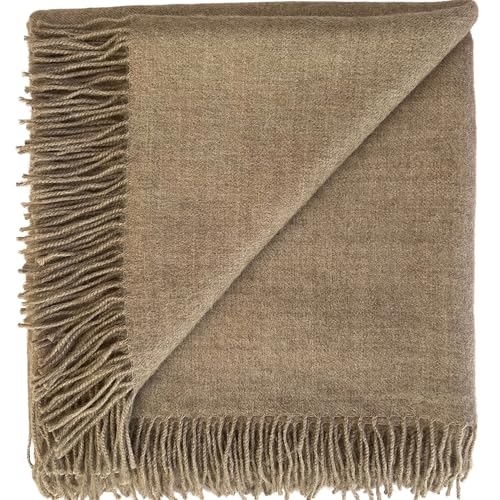
| 100% Pure Baby Alpaca Blanket Throw Peru | Best Artisan Story | Woven in Peru with the making foregrounded as part of the value. |
| ALPALOVE 100% Baby Alpaca Throw Blanket | Best Natural Neutral | An undyed-looking sand tone sized generously for sofa and bed alike. |
| Undyed Herd-Colour Alpaca Throw, Discussed Generically | The Purist Reference | Covered without a link to explain what natural colour variation signifies. |
| Alpaca-Blend Bed Blanket, Discussed Generically | The Value Reference | Covered without a link so blends can be judged on honest terms. |
How Did We Judge These Baby Alpaca Blankets?
Percentage came first, because in this category the percentage is the product. A throw woven entirely from baby alpaca delivers the full fineness and drape the premium exists for. Anything blended may still be lovely, and blends are discussed openly below, but the four linked picks here all declare themselves one hundred percent, which lets a buyer compare like with like instead of decoding four different recipes.
Dimensions came second. A throw earns its place in a home by covering a person on a sofa, knees to chest, with enough left to tuck. The cluster around fifty-one by seventy-one inches recurs through this guide because it works: generous without becoming a bed blanket, substantial without swamping a chair. Listings that hid their size or quoted it only in vague language were treated as listings with something to be vague about.
Origin and care transparency completed the judging. Alpaca is an Andean fibre with an Andean craft tradition, and the listings that named their making, Peru especially, and stated plainly how the throw should be cleaned carried more conviction than those long on adjectives like “luxury” and short on geography. A throw at this tier will be owned for decades if it is cared for, so the honesty of its care instructions is part of its quality.

100% Baby Alpaca Throw Blanket Solid — Best Straightforward Classic
Some luxury goods arrive shouting, patterned and fringed and determined to be noticed across a room. This solid-colour throw takes the other path. A single, even colour across a full-percentage baby alpaca weave puts the entire burden of impressing you on the fibre itself, and baby alpaca at its best is equal to that burden: a surface with a low, silky sheen, a hand-feel that slides rather than grips, and a drape that falls in liquid folds over an armrest.
As an afghan-style throw it suits the reading-chair life precisely. It is the blanket reached for during the long middle chapters, heavy enough to register as warmth, light enough to be forgotten between page turns. Solid colour also ages gracefully in a way patterns rarely do; it will sit comfortably in rooms redecorated twice around it, which matters for an object bought to be kept rather than rotated with trends.
Choose this one if your taste runs to understatement and your priority is the purest version of the material at a comparatively direct proposition: no gift theatre, no elaborate story, just the grade of fibre the category is named for, woven into the most versatile form a throw can take. It is the reference point against which the more decorated picks below should be measured.
- Fibre: one hundred percent baby alpaca
- Colour approach: single solid colourway
- Form: throw and afghan use
- Care posture: gentle, per label instructions
Strengths
- Full percentage with nothing diluting the hand-feel
- Solid colour integrates into almost any room scheme
- Drape and sheen show the fibre at its characteristic best
Trade-offs
- A plain surface shows pet hair and lint honestly
- No pattern means no camouflage for small marks
- Understated looks will underwhelm gift-givers wanting drama
Best for: purists buying for their own chair and their own winters. Not suited for: anyone shopping for an actual infant, which this is not.

KUNA 100% Pure Baby Alpaca Throw Blanket — Best Gift Presentation
KUNA understands something the other listings only imply: at this tier, a throw is frequently a present before it is a blanket, and presents are judged twice, once at the unwrapping and once a decade later. The brand wraps its full-percentage baby alpaca in premium gift packaging and the language of a Peruvian luxury house, and while packaging earns no warmth points, it does solve the real problem of giving a soft, flat, expensive object in a way that communicates its value before a hand ever touches it.
The throw inside the presentation is properly sized at seventy-one by fifty-one inches and described as lightweight yet warm, which is the hollow-fibre signature of the material rather than a contradiction. Hand-selected craftsmanship is the claim, and in practical terms that should mean even weaving, clean edges and consistent colour, the visible details a recipient’s fingers will audit within seconds of the box opening.
Buy the KUNA when the occasion is formal: a wedding, a milestone anniversary, a retirement, a housewarming for people whose taste you respect and whose linen cupboard you cannot inspect in advance. The neutral luxury of baby alpaca travels across households safely, and the presentation carries the message that this was chosen, not grabbed. For your own sofa, the same money in a plainer box may serve you identically, which is a compliment to the fibre rather than a criticism of the brand.
- Fibre: one hundred percent pure baby alpaca
- Size: seventy-one by fifty-one inches
- Origin story: Peruvian luxury house, hand-selected making
- Presentation: premium gift packaging included
Strengths
- Packaging solves the how-do-I-give-this problem elegantly
- Full percentage fibre at a generous, standard throw size
- Brand presentation suits formal occasions and corporate gifts
Trade-offs
- Part of the price is theatre that personal purchases may not need
- Lightweight build will surprise buyers expecting heavy winter weight
- Gift polish raises expectations the care routine must then meet
Best for: formal gifting where presentation carries half the message. Not suited for: buyers who resent paying anything for a beautiful box.
100% Pure Baby Alpaca Blanket Throw Peru — Best Artisan Story
Where KUNA sells the maison, this throw sells the workshop. Artisan woven in Peru is the headline, and for a meaningful slice of buyers that provenance is not decoration but the substance of the purchase: fibre from the Andes, worked in the Andes, by a tradition that was handling alpaca centuries before it became a luxury keyword in northern homeware catalogues. A throw like this carries slight irregularities the way handmade things do, and its owners tend to read them as signatures rather than flaws.
The dimensions match the guide’s generous standard, fifty-one by seventy-one inches, and the description leans on the material’s natural talking points: hypoallergenic character from the absence of lanolin, lightweight warmth from the hollow core. As a luxury gift it competes with KUNA, but the emotional register differs; this is the present for someone who asks who made a thing before asking what it cost.
Expect, and accept, that artisan production means the throw in your hands is one of a family rather than a clone of a photograph. Colour depth can vary subtly between pieces. That variability is precisely what industrial production irons out and precisely what this buyer is paying to keep. If uniformity matters more to you than origin, the solid classic above is your pick; if a human hand in the making matters, it is this one.
- Fibre: one hundred percent pure baby alpaca
- Making: artisan woven in Peru
- Size: fifty-one by seventy-one inches
- Character: lightweight warmth, lanolin-free fibre
Strengths
- Provenance is specific, named and central to the value
- Full percentage fibre with the material’s natural benefits
- Slight handmade variation gives each piece individuality
Trade-offs
- Variation means the delivered throw may differ subtly from photos
- Artisan supply can be less predictable than factory lines
- Buyers wanting crisp uniformity should look elsewhere
Best for: provenance-led buyers and gifts for craft-minded recipients. Not suited for: anyone who wants two throws guaranteed identical.

ALPALOVE 100% Baby Alpaca Throw Blanket — Best Natural Neutral
ALPALOVE’s contribution to this guide is a colour: sand natural, the shade of the fibre close to how it leaves the animal, sitting comfortably in the palette that undyed and lightly processed alpaca is famous for. Alpacas grow in an extraordinary natural range, whites through caramels to deep browns and blacks, and a sand-toned throw nods to that heritage. It is also, not coincidentally, the easiest colour in this guide to live with, hiding everyday dust and matching both pale Scandinavian rooms and dark leather furniture.
The throw is full-percentage baby alpaca at the familiar fifty-one by seventy-one, described with a lightweight drape for couch and bed, which positions it as the all-season member of this premium set. Draped over a bed’s foot it reads as a deliberate layer rather than spare bedding, and its weight means it can stay there through spring instead of retiring to a cupboard when the heating clicks off.
There is a quiet confidence in a brand leading with a natural shade rather than a fashion colour, because it bets the buyer will still be pleased in ten years. Of the four linked picks, this is the one we would hand to a minimalist: full fibre credentials, no pattern to tire of, no packaging theatre, a colour that asks nothing of the room around it. Its luxury is entirely in the hand, which is where baby alpaca’s luxury has always lived.
- Fibre: one hundred percent baby alpaca
- Colour: sand natural, from the fibre’s own palette
- Size: fifty-one by seventy-one inches
- Drape: lightweight, suited to couch and bed foot
Strengths
- Natural tone is the most forgiving and versatile here
- Lightweight drape extends use across more of the year
- Full percentage fibre without decorative mark-up stories
Trade-offs
- Pale sand shows dark spills more than mid-tones would
- Minimalist presentation makes it a quieter gift
- Light build may disappoint seekers of a heavy winter throw
Best for: neutral interiors and buyers planning a decade of use. Not suited for: bold-colour decorators or those wanting maximum heft.
Undyed Herd-Colour Alpaca Throw, Discussed Generically — The Purist Reference
We discuss this style without a link because it teaches the most useful lesson in the category: colour variation in alpaca can be a certificate rather than a defect. A throw woven from undyed fibre in the animals’ natural shades carries its provenance on its face. No two production runs match exactly, because no two herds do, and purists prize that unrepeatability the way wine drinkers prize vintages.
Generically, undyed throws sit at the premium end, sold by specialists rather than marketplaces, and described in the vocabulary of fibre micron counts and single-origin lots. They reward buyers who enjoy knowledge as part of ownership. They punish buyers who need a second matching throw next year, because next year’s herd clip will not be this year’s colour, and no dye bath stands ready to correct the difference.
Use this reference point when judging the linked picks: ask of each whether its colour is doing decorative work or telling you something about the fibre. Neither answer is wrong, but they are different purchases. A dyed solid buys design freedom. A natural shade buys a story about the material itself. Knowing which story you want is most of what shopping well in this category consists of.
- Fibre: typically full-percentage alpaca, undyed
- Colour: natural herd range, varying by lot
- Positioning: premium specialist tier
- Availability: specialist sellers rather than broad marketplaces
Strengths
- Colour itself evidences fibre origin and minimal processing
- Each piece is effectively unrepeatable
- Appeals to buyers who value material knowledge
Trade-offs
- Matching a second throw later is genuinely difficult
- Specialist pricing reflects scarcity as much as quality
- Limited colour choice constrains room schemes
Best for: collectors and fibre enthusiasts buying a singular piece. Not suited for: pairs, symmetry or strict colour matching.
Alpaca-Blend Bed Blanket, Discussed Generically — The Value Reference
Blends are where this category’s honesty is tested, so they earn a prose-only place as a yardstick. A blanket blending baby alpaca with sheep’s wool, cotton or a synthetic stabiliser is not a fraud; it is a different product with different virtues. Wool can add resilience and lower cost. Cotton can add washability. A small synthetic share can add durability to edges and reduce the price to a level where a blanket gets used daily instead of preserved anxiously.
The fraud risk lives in emphasis. A listing that shouts alpaca in its headline and confesses a modest percentage in its specifications is asking to be bought under a misapprehension. Read blends from the percentage outward: what share is baby alpaca, what is the remainder, and does the price reflect that recipe? A fairly priced blend with its recipe printed proudly can be a better purchase than a full-percentage throw bought resentfully and used fearfully.
For bed use specifically, blends often make practical sense. A full bed blanket takes more laundering, more friction and more life than a chair throw, and the blended constructions tolerate that regime better while still delivering some of alpaca’s softness against the skin. Keep the full-percentage pieces for the chair and the gift. Let the blend do the nightly work, and judge it by how honestly it introduces itself.
- Fibre: baby alpaca blended with wool, cotton or synthetics
- Positioning: budget-to-mid tier relative to full percentage
- Formats: bed blankets more often than chair throws
- Judging rule: percentage and price must agree with each other
Strengths
- Lower cost puts alpaca softness into daily rotation
- Blend partners can add washability and resilience
- Bed sizes are more widely available in blends
Trade-offs
- Hand-feel dilutes as the alpaca share falls
- Headline marketing often overstates the alpaca content
- Drape and sheen sit below the full-percentage standard
Best for: everyday bed use and value-led buyers reading labels carefully. Not suited for: anyone paying full-percentage money without checking the recipe.
Comparison Table
| Pick | Fibre claim | Size | Character |
|---|---|---|---|
| 100% Baby Alpaca Throw Blanket Solid | Full percentage | Throw format | Solid colour, understated |
| KUNA 100% Pure Baby Alpaca Throw Blanket | Full percentage | 71 x 51 in | Gift presentation, Peruvian house |
| 100% Pure Baby Alpaca Blanket Throw Peru | Full percentage | 51 x 71 in | Artisan woven in Peru |
| ALPALOVE 100% Baby Alpaca Throw Blanket | Full percentage | 51 x 71 in | Sand natural, lightweight drape |
| Undyed Herd-Colour Alpaca Throw, Discussed Generically | Full percentage, undyed | Varies | Natural lot variation |
| Alpaca-Blend Bed Blanket, Discussed Generically | Partial percentage | Bed sizes | Value and durability focus |
What Does “Baby” Actually Grade, in Fibre Terms?
Fibre people grade alpaca by fineness, and fineness is measured in microns, the diameter of a single hair. The finer grades come disproportionately from the first shearing of a young animal, whose fleece has not yet coarsened with age and weather. “Baby” in the trade therefore functions as shorthand for that fine grade. It describes a measurement family, not a nursery, and understanding that single fact converts a confusing shelf of products into a legible one.
Fineness is not a vanity metric. Thick fibres behave like tiny springs that resist bending and prickle skin where their ends press; fine fibres flex away, which the skin reads as softness. That is why two throws both honestly labelled alpaca can feel like different materials entirely. The coarse guard hairs of a mature fleece make a rugged blanket for a cabin. The fine first-clip fibre makes the throw in this guide, the one that can rest against a bare neck for an evening without complaint.
Later shearings are not waste, and this guide is not snobbery about them. Coarser alpaca grades weave into durable outerwear and hard-wearing blankets with their own honest uses. The point is matching grade to job. Skin-contact luxury wants fineness; a picnic blanket wants toughness. When a listing says only “alpaca” with no grade and no percentage, it has told you the species and hidden the decision that determines how the throw will actually feel.
Why Does Hollow Fibre Feel Warm Yet Light?
Alpaca fibre grows with a hollow or partially hollow core, a structure visible under magnification and consequential on a cold evening. The trapped air inside each hair insulates, so a woven throw carries warmth in its architecture rather than in its mass. Sheep’s wool insulates too, through crimp and scale, but it generally needs more weight of material to reach the same comfort, which is why wool throws announce themselves when draped over legs and alpaca throws seem to settle almost unnoticed.
The practical consequence is seasonal range. A baby alpaca throw can be the right blanket on an October evening and still be tolerable in April, because its warmth does not arrive with a heavy, smothering hand. Owners describe using theirs across more of the year than any other blanket they own, and that frequency of use is the real return on the premium: cost per evening favours the throw that is reached for in three seasons over the heavier one that wins only in January.
Hollowness also shapes care. The fibre is strong for its weight but dislikes agitation and heat in washing, the combination that convinces fine animal fibres to felt and shrink. Gentle handling, cool water when washing is permitted at all, and drying flat are not precious rituals; they are how you avoid collapsing the very structure you paid for. Treat the architecture kindly and it will insulate for decades.
How Should You Care for a Throw Like This?
Begin from an unfamiliar premise for modern textiles: this object does not want frequent washing. Alpaca resists odour and dirt better than most fibres, partly through the absence of lanolin, and an evening’s use on a sofa is not soiling in any meaningful sense. Air the throw, fold it over a chair back overnight, shake it outdoors occasionally. Reserve actual washing for actual incidents, and you will extend its life more than any product in a bottle can.
When washing is unavoidable, the label on your specific throw outranks any general advice, including this paragraph. Many full-percentage throws specify dry cleaning; others permit a cool, gentle hand wash with minimal agitation and a flat dry away from heat. What none of them permit is the standard cotton cycle, hot water and a tumble dryer, a combination that can felt a throw into a smaller, denser shadow of itself in a single afternoon of carelessness.
Storage is the other half of care, and its enemy has wings. Moths find animal fibres delicious, and a throw folded into a dark cupboard for summer is a banquet laid in private. Store it clean, since soiling attracts pests, in a breathable bag with cedar or lavender as a deterrent, and inspect it when the season turns. Fold rather than hang, because the drape that makes alpaca lovely on a chair will stretch its own weave under months of hanging weight.
Which Mistakes Do Buyers Make in This Category?
The first is the one this article opened with: shopping for a nursery with an adult luxury product, or the reverse, dismissing baby alpaca as infant merchandise and walking past one of the finest throw fibres available. The name misleads in both directions, and the correction is simply to remember that the word grades a shearing. Anyone buying for an actual baby should be in the cotton and muslin guides, where products are designed, sized and safety-framed for infants.
The second mistake is percentage blindness, paying a full-percentage price for a blend because the headline said alpaca in large type. The recipe is always printed somewhere on a legitimate listing. Find it before the price, and let the two numbers negotiate with each other in your head. A throw that is a fifth baby alpaca may be perfectly pleasant; it may not wear the price of the throws in this guide, whose claims are total.
The third mistake is care neglect after careful purchase. Buyers research fibre grades for a week, then wash the throw like a bath towel. The premium in this category is partly a promise of longevity, but the promise is conditional on gentle handling, sensible storage and moth awareness. A baby alpaca throw treated properly becomes the blanket adult children argue about inheriting. Treated casually, it becomes a felted cautionary tale within a year.
How Does Baby Alpaca Compare With Cashmere and Merino?
Shoppers at this tier usually cross-shop three famous fibres, and the honest comparison flatters each in a different column. Cashmere, from goats, matches or slightly exceeds baby alpaca in initial softness and carries unmatched name recognition, but quality cashmere at throw size is expensive, pills readily in its shorter-fibred forms, and asks for delicate handling. A cashmere throw is a jewel. It is not always the blanket you want absorbing daily sofa life, popcorn, dogs and the occasional glass of red.
Merino, the fine end of sheep’s wool, is the workhorse of the trio: elastic, resilient, widely available at every tier, and comfortable being washed in modern easy-care treatments. Its warmth is excellent and its price for a good throw is generally the friendliest of the three. What it cannot quite replicate is alpaca’s combination of silk-like surface and hollow lightness, and for the lanolin-sensitive it carries the very compound alpaca lacks. Merino wins on practicality per pound spent; it rarely wins the blind hand-test against first-shear alpaca.
Baby alpaca’s column reads: softness near cashmere, durability and pilling resistance better than cashmere, warmth-to-weight better than merino, no lanolin, and a natural colour range neither rival matches. Its weaknesses are price, care fussiness and a name that confuses half its potential buyers. If the throw will live a gentle life and softness is the priority, alpaca argues strongly. If it will be washed monthly and dragged to cabins, merino’s practicality may be the wiser luxury.
There is also a sourcing conversation that matters to many buyers at this level. Alpacas are adapted to high-altitude Andean life, are shorn without harm, and tread lightly on fragile pasture compared with some grazing animals. Cashmere’s environmental story is more contested, and merino’s varies by producer. None of this decides a purchase alone, but in a category bought partly for values and story, alpaca’s account is comparatively comfortable to tell across a dinner table.
What Can You Check When the Throw Arrives?
Unbox with your hands before your eyes. A full-percentage baby alpaca throw should feel cool at first touch, then warm quickly, with a surface that offers almost no resistance as a palm slides along the weave. Prickling at the inner wrist, where skin is thin, suggests coarser fibre has entered the recipe regardless of what the label claims. The wrist test is not laboratory science, but it catches the gap between marketing language and material fact surprisingly often.
Next, drape it over one forearm and watch it fall. Alpaca’s signature is a fluid, almost liquid hang; a stiff or boardy fall points to a tight synthetic-heavy weave or a finish doing cosmetic work. Hold a corner to the light and look for evenness: artisan pieces may show gentle variation, which is acceptable, but thin patches, snags or irregular bands across the width are workmanship issues that a premium price should not ask you to forgive.
Check the edges and the label with equal care. Edges take the strain of a throw’s life, so stitching or weaving there should be dense and tidy, and any fringe should be firmly rooted rather than decorative afterthought. The fibre-content label is the contract you actually signed; photograph it, keep it, and compare it against the listing’s claims. If the delivered percentage differs from the advertised one, that is not a nuance of natural fibre. It is a returns conversation, and it should happen within days, not after a winter of doubt.
Finally, live with it for one evening before removing every tag in triumph. Sit with it through a film. Does it warm without smothering? Does it slide off the sofa in a silky heap every time you stand, a genuine if minor alpaca trait that some households solve with a folded placement over the chair back? Small behavioural truths like these are what ownership actually consists of, and the returns window is the time to learn them.
Which Occasions Does a Throw Like This Suit as a Gift?
Weddings are the classic case, because a couple registering for their first home rarely lists an object at this level, yet a fine throw is used by two people together in a way few presents are. It photographs well in a new home, it asks nothing about the couple’s sizes or technical tastes, and it will outlast most of the registry. KUNA’s presentation exists precisely for this moment, though the artisan throw carries a different, equally wedding-appropriate message about craft and permanence.
Milestone birthdays and retirements form the second case. These are occasions where the gift is meant to mark time, and a decades-long object marks it honestly. A fiftieth birthday throw says the giver expects the recipient’s evenings to be comfortable for a long while yet. Retirement, similarly, is a transfer from office chair to reading chair, and furnishing that destination with the finest version of its central textile is a joke and a kindness in the same parcel.
Housewarmings reward the neutral picks. A sand or solid throw enters an unknown interior without arguing with it, which cannot be said of patterned ceramics or scented anything. The giver’s risk is low, the recipient’s storage problem is nil, and the object begins earning its place the first cold evening in the new home. For hosts you know well, the undyed herd-colour style discussed earlier becomes viable, because you can predict whether unrepeatable natural variation will delight or irritate them.
What this category does not suit is the obligatory present: the colleague draw, the distant relative, the thank-you that must not imply too much. A full-percentage baby alpaca throw is an intimate-scale luxury, domestic and personal, and its message is warmth in the literal home. Give it where that message is true. Where it is not, the same money in a different object will land more accurately, and the fibre deserves accurate landing.
Where in the Home Does Each Style Belong?
The reading chair is the ancestral seat of the throw, and it favours the lighter, drapier picks. ALPALOVE’s sand and the solid classic both live well folded over a chair back, available in one pull, forgiving of daily rearrangement. In this position the throw is handled constantly, so its hand-feel is audited constantly, which is another argument for full percentage in the chair role specifically: no other placement exposes fibre quality so relentlessly to its owner.
The foot of a bed asks for presence. A throw there is seen more than used, chosen by guests’ eyes in the doorway, and it should hold a fold crisply and carry its colour across a large sightline. This is where a slightly more structured weave or a bolder solid earns its keep, and where the throw doubles as the emergency extra layer on the one night a year the bedroom turns genuinely cold. It is a decorative job with a functional reserve parachute.
The sofa is the contested middle ground, shared by partners, children, visitors and animals, and it is the placement most likely to test care discipline. Households that banish fine fibre from the sofa entirely often end up never using the throw at all, which defeats the purchase. A better policy is informed use: the throw lives on the sofa, food stays at the table during its watch, and everyone understands it airs rather than washes. Baby alpaca on a family sofa, respected but not worshipped, is a defensible and pleasurable arrangement.
Travel, finally, divides owners. The throw’s warmth-to-weight ratio makes it a magnificent car companion and a civilised upgrade to any holiday rental’s thin bedding. Against that stands the risk of loss, the single most common way fine throws leave families. Our judgement: travel with it domestically, in your own car, to homes you know. Leave it behind for flights and hotels, where a lesser blanket’s disappearance would be an anecdote rather than a small grief.
How Is an Alpaca Throw Actually Made?
The journey begins at altitude. Alpacas graze the high Andean plateau, where thin air and sharp temperature swings selected for a fibre that insulates fiercely while weighing little. Shearing happens typically once a year, by hand or with shears, and the fleece comes away in one piece to be sorted by hand into grades. That sorting table is where “baby” is decided: the finest, softest portions, disproportionately from young animals’ first clips, are separated from coarser fibre destined for rugs and outer cloth.
Sorting is skilled, tactile work, done by feel as much as by sight, and it is one reason provenance matters in this category. A supply chain rooted where the fibre grows keeps that grading expertise close to the source. Fibre that travels unsorted to distant mills can still become a fine throw, but the chain of judgements grows longer and the label’s claims grow harder to audit. When a listing names its Peruvian or Ecuadorian making plainly, it is shortening that chain in a way a buyer can actually picture.
Spinning and weaving follow, by methods ranging from artisan looms to modern machinery, and neither is automatically superior. A handloom gives the slight irregularity and individual character described in the Peruvian pick above. A fine mill gives uniformity and crisp edges. What matters is the match between method and promise: a throw sold on artisan character should show a human hand, and a throw sold on luxury finish should show none. Confusion between those promises, in either direction, is where disappointment is manufactured.
Dyeing, where it happens, is the final fork. The natural palette needs no dye at all, which is why undyed throws can claim a minimal-processing story honestly. Dyed solids trade that story for design freedom, and good dye work on alpaca holds depth beautifully because the fibre takes colour with a slight lustre. When you choose between the solid classic and the sand natural in this guide, you are choosing between those two philosophies of making, and there is no wrong answer, only the one that matches your home.
What Should You Budget, Tier by Tier?
Think of the category in three honest bands. At the entry band sit the blends discussed earlier: real alpaca content, diluted, priced for daily use and frequent washing. They are the correct purchase for a bed blanket or a family sofa under heavy artillery, and the only rule is that the percentage be printed and the price agree with it. Nothing in this band should be apologised for; it should simply never be dressed in the language of the band above.
The middle band is where this guide’s linked picks live: full-percentage baby alpaca throws at the standard generous size, from brands with names and reputations attached. Prices here reflect fibre cost, Andean making and modest brand value. This is the band of best judgement for most buyers, because the material experience is complete, the softness, drape and warmth-to-weight that define the category, while the extras being sold are presentation and story rather than further fibre, there being no finer fibre left to sell.
The top band sells scarcity and singular provenance: single-lot undyed fibre, named cooperatives, limited runs, the collector’s end of the shelf. The throws are not dramatically softer than the middle band’s, because fibre fineness has a ceiling set by the animal, not the price tag. What the extra money buys is rarity, traceability and the pleasure of owning an unrepeatable object. Buyers who feel that pleasure should pay gladly; buyers who do not should know the middle band loses them almost nothing in the hand.
Across all three bands, apply the cost-per-evening test before the sticker test. A throw used two hundred evenings a year for fifteen years is one of the cheapest luxuries a home contains, even at the top band. A throw bought at any price and preserved unused in a cupboard is pure loss. The correct budget is therefore the one that buys a throw you will actually live under, at the highest fibre honesty you can reach without crossing into anxiety about using it.
How Do You Fold, Display and Live With It Daily?
Small rituals decide whether a fine throw becomes part of a home’s daily texture or an object visited on occasions. Fold it in thirds lengthwise and lay it over the chair back or sofa arm, fringe or edge aligned, in the same place every time. A fixed home means the throw is found without thought in the dark, and thoughtlessness is the hallmark of a household object that has been fully adopted. Rotating its position occasionally also evens out light exposure, protecting colour from the slow fade a sunny window administers to anything left in one pose all year.
Teach the household the two handling rules that matter and skip the rest. Hands, not teeth, clips or pet claws, are its companions; and it returns to its fold rather than the floor. Children absorb these rules quickly when they are few and consistently kept, and a throw that children are allowed to use under clear terms will be loved rather than resented as the forbidden blanket. Dogs, in most households, will negotiate their own treaty, and a folded placement above cushion height is the usual peace settlement.
When the throw is not in season, the storage discipline from the care section applies in full: clean before storing, breathable bag, cedar nearby, a note of the date. When it returns in autumn, air it outdoors for an hour before its first evening back. That small ceremony, repeated yearly, is how objects become fixtures of a family’s calendar, and fixtures are what a purchase at this level is really buying.
Can a Throw Like This Be Repaired and Kept for Decades?
Yes, and planning for repair is part of buying at this level with clear eyes. The failures a fine throw meets across decades are mundane: a pulled thread where a ring caught it, a small moth kiss discovered one autumn, an edge that thins where a thousand evenings folded it the same way. Each has a traditional remedy. Pulled threads are eased back into the weave with a blunt needle rather than cut. Small holes go to a reweaver or a skilled local tailor early, while they are still small. Edges can be bound or turned by a professional before thinning becomes tearing.
What cannot be repaired is felting from a hot wash or the overall shrinkage of a careless tumble dry, which is why this guide keeps returning to laundry as the true risk. Structure survives use; it does not survive heat and agitation. A throw that has only ever been aired, spot-cleaned and occasionally dry-cleaned can plausibly be handed down in genuinely good condition, and many families own Andean textiles with exactly that biography.
Keep the original packaging or at least the care label and purchase details in an envelope with household documents. Provenance paperwork sounds excessive for a blanket until the day it becomes the evidence that settles a family discussion about what grandmother’s throw actually is. At this tier, a blanket is a small asset. Treat its records accordingly, and its second owner will thank you in the same way its first one was thanked: by using it every cold evening.
What Is the Kindest Way to Give One?
Include the care knowledge with the gift, because the recipient’s first instinct may be to wash their beautiful new throw before use, in a machine, on a warm cycle. A short handwritten note, aired not washed, dry clean when needed, folded away from moths in summer, converts your knowledge into the throw’s lifespan. It also quietly signals that the object is the real thing, worth the three sentences of instruction that a novelty blanket would never require.
One more courtesy: tell the recipient what the name means. Half the pleasure of owning baby alpaca is explaining, the first time a guest lifts it from the chair and asks, that no infants were involved, that the softness comes from a first shearing in the high Andes, and that the throw will probably outlast the chair it is draped on. A gift that arrives with its story attached gets retold, and retelling is how a present keeps giving long after the wrapping is forgotten.
Timing matters less than context. A throw given at the start of winter is used that week and bonds to the giver immediately; the same throw in July may sit folded until October, admired but untested. When the calendar cannot be helped, a line in the card about the first cold evening coming does the bridging. Gifts of warmth are promises about a season, and naming the season makes the promise explicit.
Final Recommendation
Decide what you are really buying. For your own chair and a decade of evenings, the solid classic or ALPALOVE’s sand natural give you the full fibre with the least theatre. For a formal present, KUNA’s presentation does the communicating. For the buyer who wants the maker’s hand in the object, the artisan-woven Peruvian throw is the honest choice. Keep blends in their fairly priced place, care for whichever you choose as the architecture deserves, and remember what the name means every time you recommend it onward.
Buy the first shearing for the fineness it actually names, and the throw will still be explaining itself, softly, to whoever inherits your reading chair.
Frequently Asked Questions
Is a baby alpaca blanket safe or suitable for my baby?
It is not designed for one. These are adult luxury throws, sized and priced for sofas and beds, and the name refers to fibre from a first shearing. Infant bedding is a separate, safety-led category of fitted, purpose-made products. If you are furnishing a nursery, choose from the baby blanket guides on this site, where every pick is made for that job; keep the alpaca for the chair where you will sit during night feeds.
Why is baby alpaca softer than regular alpaca?
Fineness. Fibre from the first shearing runs thinner in diameter, and thinner fibres bend against skin instead of prickling it. Later shearings grow coarser and suit harder-wearing goods. Both are genuinely alpaca, which is why labels that give a grade and a percentage tell you far more than the species name alone, and why this guide favours listings that print both numbers plainly.
Does alpaca trigger the same reactions as sheep’s wool?
Many people who find sheep’s wool itchy or sneezy tolerate alpaca comfortably, because the fibre carries no lanolin and its surface scales lie smoother. That is an observation about common experience, not a medical guarantee, and individual sensitivities vary. If wool reactions are a serious issue in your household, test any new fibre against skin briefly before committing it to nightly use, and consult a professional for medical questions.
How long should a throw at this level last?
Decades is not an exaggeration for a full-percentage throw that is aired more than washed, stored clean against moths, and kept out of tumble dryers. Alpaca fibre is resilient and resists pilling better than many wools. The throws that die young in this category almost always die by laundry or storage rather than by use, which is why this guide spends as much space on care as on shopping.
Is a blend ever the smarter purchase?
Yes, when it is honestly labelled and honestly priced, and especially for bed blankets that will be washed and worked harder than a chair throw. A blend trades some softness and drape for durability and a lower tier. The purchase becomes a mistake only when the headline implies a full-percentage product; read the recipe, compare it with the price, and a good blend can be the most sensible money in the whole category.
Related Guides
From fibre luxury back to the nursery shelf, these guides complete the blanket picture: begin with Best Baby Blankets for Gifts for presents that are actually meant for babies, continue to Best Soft Baby Blankets for the plush end of infant bedding, and finish with Best Sand-Free Beach Blankets for the opposite extreme of blanket engineering. The bedtime routine that pairs with all of them starts at Best Baby Bathtubs for Infants.


