What's inside
- Key Takeaways
- Quick Picks
- How Did We Sort the Summer Shelf?
- Comparison Table
- Why Does Muslin Breathe Better Than Other Cottons?
- How Should a Blanket Be Used Over a Pram Safely?
- How Do You Dress a Baby for Sleep on Hot Nights?
- Which Mistakes Do Parents Make With Summer Blankets?
- How Do You Pack Summer Blankets for a Holiday?
- How Can You Tell Good Muslin From Mediocre Muslin?
- What Other Jobs Does a Summer Square Do All Year?
- How Do You Gift a Summer Baby Well?
- How Should Summer Blankets Be Washed and Stored?
- What About Babies Who Hate Being Swaddled in Summer?
- How Does Air Conditioning Change the Calculation?
- What Should You Do During a Genuine Heatwave?
- How Do You Keep Track of a Scattered Muslin Fleet?
- Final Recommendation
- Frequently Asked Questions
- Related Guides
As an Amazon Associate I earn from qualifying purchases. This post may contain affiliate links at no extra cost to you.
cottageverdict.com is reader-supported. When you buy through links on our site, we may earn an affiliate commission.
Where to buy: follow any linked blanket below to its Amazon page to check price on Amazon, and there confirm the pack count, the dimensions and whether the muslin is single or multi-layer before ordering. The sixth entry is discussed without a link, as the heavyweight contrast that explains what summer weight actually means.
Heat changes the blanket question completely. Parents hunting for the best baby blankets for summer are usually not shopping for cosiness at all; they are shopping for shade, for a breathable layer in a hot pram, for something between a baby and a car seat’s warm upholstery, for a swaddle that will not turn a July nursery into a sauna. A summer blanket succeeds by almost disappearing, and the products that understand that are overwhelmingly made of one fabric: muslin cotton, woven loosely enough that air treats it as a suggestion rather than a wall.
Muslin’s virtues compound in heat. The open weave breathes. The fabric softens with every wash instead of degrading, which matters in a season when everything is washed constantly. A large muslin square works as swaddle, pram shade, nursing cover, burp cloth, picnic seat and emergency towel across a single day out, and that versatility is why summer babies’ changing bags look like small muslin libraries. The differences between the picks below are differences of size, layer count, pack size and print, and in this category those modest-sounding variables are the whole decision.
Two disciplines govern everything that follows. First, shade is not sealing: a blanket draped over a pram must never close off airflow, and in serious heat the correct move is shade plus ventilation plus a shorter outing, not a thicker cover. Second, summer does not repeal safe sleep. These are blankets for supervised life, held babies, watched prams and floor time; the crib at night stays bare, with the baby in light clothing suited to the room’s temperature. Within those rules, here is how the summer shelf divides.
Key Takeaways
- Muslin cotton dominates summer because its open weave lets air move.
- Layer count is the warmth dial: fewer layers for heatwaves, more for air conditioning.
- Large squares around forty inches earn their keep across half a dozen daily jobs.
- Multi-packs suit a season of constant washing and constant losing.
- A pram cover must shade without sealing; airflow is non-negotiable.
- Summer blankets are supervised-life tools; night cribs stay bare and light.
Quick Picks
| Pick | Badge | Why it earns its place |
|---|---|---|
| Muslin Swaddle Blankets 3 Pack 38 x 40 | Best Everyday Trio | Three large breathable squares in bright colours for daily rotation. |
| GLLQUEN Muslin Swaddle Blankets 40 x 38 | Best for Boys’ Prints | A three-pack in boy-aimed prints with the same generous working size. |
| Konssy Cotton Muslin Baby Blanket 40 x 36 | Best Layered Single | Four layers of muslin in one blanket for air-conditioned rooms and evenings. |
| Ultra Soft Checkered Muslin Baby Blanket 2 Pack | Best Six-Layer Warmth | A two-pack of deeper-layered muslin for cooler summer nights. |
| Muslin Receiving Blankets 5 Pack | Best Big Rotation | Five neutral squares that turn laundry day from crisis into routine. |
| Heavyweight Plush Blanket, Discussed Generically | The Contrast Case | Covered without a link to mark what summer weight is not. |
How Did We Sort the Summer Shelf?
We began with the weave, because in summer the weave is the technology. Every linked pick is muslin cotton, and that uniformity is deliberate: fleece, sherpa and plush have their seasons, and this is not it. Within muslin, we separated the field by the variable that actually changes how a blanket behaves in July, which is how many layers of that open weave are stacked between the baby and the world.
Size came next. A summer muslin is a tool before it is a blanket, and tools need working area. Squares in the high-thirties to low-forties of inches can swaddle a newborn, shade a pram with margin, and still serve as a floor cloth for a sitting baby months later. Smaller receiving sizes have their uses, but for the single-blanket summer wardrobe this guide favours, the generous square is the rational default.
Pack arithmetic completed the sorting. Summer multiplies laundry and loss in equal measure; muslins are draped over prams in parks and left there, loaned, dropped and forgotten. A three-pack is the sensible household minimum, five is the relaxed optimum, and the single layered blankets below justify their solitude by doing a different job, standing in for a light blanket where plain squares would be too thin. Read the picks as a small system rather than as rivals and the guide’s logic is complete.

Muslin Swaddle Blankets 3 Pack 38 x 40 — Best Everyday Trio
This is the set we would hand a first-time parent in June without further conversation. Three muslin squares at thirty-eight by forty inches, in bright colours that cheerfully refuse to pretend a changing bag is a fashion venue, cover the summer rotation’s fundamentals: one in use, one in the wash, one in reserve for the day the first two are both casualties of the same picnic. The size sits in the sweet band, large enough to swaddle securely and to shade a pram with drape to spare.
As swaddle wraps they behave the way muslin should, with enough give to wrap snugly without the stretch that lets determined babies Houdini out by the second feed, and a weave open enough that a wrapped baby in a warm room is insulated lightly rather than cooked. As burping cloths and general infantry they are almost unfairly versatile; the listing itself lists duties the way a Swiss army knife lists blades, and for once the catalogue copy undersells the object.
Bright colours deserve a practical word. Summer muslins live outdoors, on grass, sand and café floors, and pale nursery pastels show every one of those venues permanently. A brighter square forgives the season’s evidence and is easier to spot when it slides off a pram in a park, which is the leading cause of muslin mortality. Buy this trio as the household’s summer infrastructure and let the prettier singles elsewhere in the guide be the specialists.
- Fabric: muslin cotton, breathable open weave
- Size: thirty-eight by forty inches each
- Pack: three squares, bright colours
- Roles: swaddle, receiving, burping, shading
Strengths
- Three-pack matches the real rhythm of summer laundry
- Generous size covers swaddling through floor-play months
- Bright colourways forgive outdoor use and show up when dropped
Trade-offs
- Single-layer lightness is too thin for cold air conditioning
- Bright prints will not suit every nursery’s palette
- No layered option inside the pack for cooler evenings
Best for: the default summer rotation in warm homes. Not suited for: families wanting one thick blanket instead of a system.
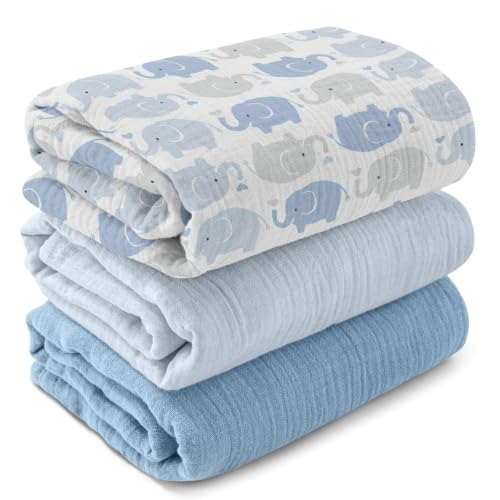
GLLQUEN Muslin Swaddle Blankets 40 x 38 — Best for Boys’ Prints
GLLQUEN’s trio is the near neighbour of the pick above, same three-pack logic, same class of generous square at forty by thirty-eight inches, differentiated by its boy-aimed prints and a listing that leans into the sensitive-skin argument for pure cotton muslin. That argument is legitimate. Newborn skin in summer, sweating under straps and into folds, is quick to complain, and a soft natural weave with no synthetic static is the gentlest common answer nurseries have.
The extra two inches of width over the first pick are not trivial in the swaddling months. Bigger babies, and babies swaddled by less practised hands, grandfathers, say, or parents at four in the morning, benefit from margin; a wrap that reaches comfortably tucks securely, and a secure tuck is the difference between a swaddle that settles and one that becomes a wrestling broadcast. If your household includes novice wrappers, width is kindness.
Choose between this and the bright trio on print and on that small size difference, because in fibre and function they are siblings. Households that prefer their nursery goods gendered will find this pack speaks their language; households indifferent to prints can toss a coin weighted by whichever colours will clash least with their pram. Either way, the muslin itself will be washed into greater softness across the summer, ending the season better than it began.
- Fabric: one hundred percent cotton muslin
- Size: forty by thirty-eight inches each
- Pack: three squares, boy-aimed prints
- Emphasis: gentleness on sensitive newborn skin
Strengths
- Widest squares here make novice swaddling easier
- Pure cotton weave suits reactive summer skin
- Three-pack rotation with prints many families prefer
Trade-offs
- Boy-aimed prints narrow its gift audience
- Same single-layer limits in cold indoor air
- Overlaps heavily with the trio above it
Best for: boy nurseries and households with beginner swaddlers. Not suited for: buyers wanting layered warmth in the same purchase.

Konssy Cotton Muslin Baby Blanket 40 x 36 — Best Layered Single
Konssy changes the architecture: instead of separate squares, one blanket of four muslin layers at forty by thirty-six inches, in a sprig floral that gives this guide its prettiest object. Four layers transform the open weave’s behaviour. Air still moves, because muslin layers trap softness rather than sealing, but the result has genuine blanket presence, enough to matter in an air-conditioned room, on an evening walk, or over a sleeping baby during supervised nap transfers in a cool café.
This is the summer blanket for the climate-controlled life. Modern summers are spent oscillating between hot streets and refrigerated interiors, and the baby who leaves home in a single square returns through a supermarket’s arctic aisle. A four-layer piece covers that oscillation in one object, which is why, despite being sold singly, it earns a full pick’s place: it replaces the light blanket category within a summer wardrobe built otherwise of squares.
The floral print commits the blanket to the girl-leaning register, and its crib, stroller and nursery listing describes supervised and decorative duty, which is how it should be read. Drape it, carry it, photograph it, use it as the layer that makes a summer baby comfortable in cooled rooms. For heatwave afternoons outdoors, step back down to a single square; the Konssy is summer’s evening weight, and knowing which hours belong to which blanket is the whole skill this guide teaches.
- Fabric: cotton muslin, four layers
- Size: forty by thirty-six inches
- Print: sprig floral
- Roles: receiving, swaddling, crib and stroller layer
Strengths
- Four layers add real warmth while keeping muslin breathability
- Single blanket format suits air-conditioned oscillation
- Floral finish is the most giftable object in this guide
Trade-offs
- Too warm as the only blanket in a true heatwave
- Sold singly, so laundry rotation needs support from squares
- Floral register will not suit every family
Best for: cooled interiors, evening walks and prettier nurseries. Not suited for: peak-heat outdoor shading, where single layers rule.

Ultra Soft Checkered Muslin Baby Blanket 2 Pack — Best Six-Layer Warmth
If Konssy’s four layers are summer’s evening, this checkered pair at six layers is summer’s cool night and its northern latitudes. Six layers of muslin build a blanket with real loft, described at forty-three inches, in blue and coffee checks that read more like a household textile than a nursery novelty. For families whose summer includes genuinely cold nights, draughty cottages, camping-adjacent pram walks and grandparents’ unheated spare rooms, this is the pick that keeps muslin’s breathability while admitting that July is not everywhere the same.
The two-pack format matters at this weight. A heavier blanket is washed less casually than a square and dries more slowly, so a pair keeps one in service while the other dries on the line. The check pattern also performs a quiet service: it hides the faint shadowing that white muslin accumulates, and it crosses the boy-girl register line without effort, suiting the unknown-baby gift and the shared sibling wardrobe alike.
Respect its limits as carefully as its virtues. Six layers in a heatwave pram would be a misuse, and this guide’s shade discipline applies with extra force: never as a sealed canopy, always with air moving. Used at its proper hours, though, it solves the complaint that ends many muslin purchases, that the squares are lovely until the temperature drops at midnight. This is the blanket for the second half of the summer night.
- Fabric: cotton muslin, six layers
- Size: forty-three inches class
- Pack: two blankets, blue and coffee checks
- Roles: crib and stroller layer for cooler hours
Strengths
- Deepest muslin warmth here for cool nights and northern summers
- Two-pack solves the slow-drying problem of heavier muslin
- Checks hide wear and suit any baby’s wardrobe
Trade-offs
- Too much blanket for heatwave afternoons
- Heavier pieces take longer to wash and dry
- Less multi-tool versatility than the big thin squares
Best for: cool-climate summers and cold-night households. Not suited for: hot regions where single layers already feel generous.
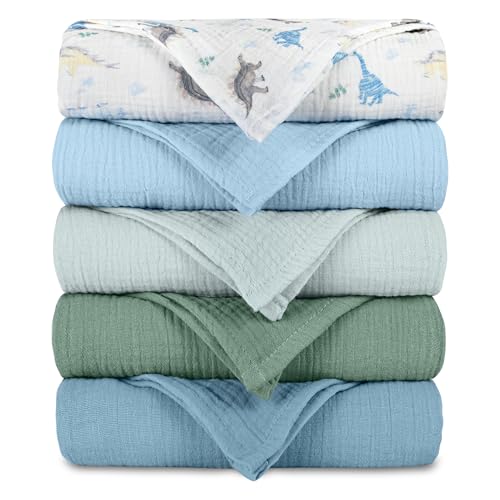
Muslin Receiving Blankets 5 Pack — Best Big Rotation
Five squares change a household’s emotional relationship with laundry. With the blue dinosaur pack in service, a muslin can live in the pram, another in the car, another at the grandparents’, and two can still be cycling through the wash without anyone performing the nightly audit that smaller packs impose. Summer is the season of being out, and being out is the season of leaving blankets in places; this pack prices that reality in from the start.
The neutral register, dinosaurs notwithstanding, aims at the broad middle of the market: boys and girls, first babies and subsequent ones, gift-givers who want quantity with a clear conscience. Muslin receiving squares are also the most forgiving textile a new parent owns, improving with washing, indifferent to being sat on, spread under a baby on questionable grass, or deployed as an emergency sunshade knotted between pram handles with full airflow beneath.
There is a strategic way to buy this pack: as the base layer of the whole summer system, underneath one layered specialist. Five squares plus the Konssy or the checkered pair covers a household from heatwave noon to cool midnight without a single fleece appearing until autumn. Viewed that way, the five-pack is not the budget option in this guide. It is the infrastructure option, and infrastructure is what experienced parents spend on first.
- Fabric: muslin cotton, breathable and skin-friendly
- Pack: five receiving squares
- Print: blue dinosaur, neutral-leaning
- Roles: swaddle wraps and all-purpose summer cloths
Strengths
- Five pieces end laundry anxiety for the whole season
- Squares can be stationed in pram, car and grandparents’ homes
- Improves with washing, tolerates rough outdoor service
Trade-offs
- Receiving size may run smaller than the big swaddle squares
- Quantity-first pack has no layered warmth inside it
- Dinosaur print, however gentle, is still a theme
Best for: multi-location households and experienced parents buying infrastructure. Not suited for: minimalists who want one beautiful blanket only.
Heavyweight Plush Blanket, Discussed Generically — The Contrast Case
Every summer guide needs its cautionary exhibit, and ours is the thick plush blanket, the winter favourite carried into July by habit. Discussed without a link and without malice, because the same blanket will be this guide’s hero in another season: plush traps heat by design, its pile is a thermal strategy, and against a baby in a hot room that strategy works entirely in the wrong direction. A baby who cannot kick free of an overheating layer is a baby relying wholly on adults to read the situation correctly.
The generic lesson is about reading your own nursery shelf seasonally. Blankets are not good or bad in themselves; they are matched or mismatched to a temperature. The plush blanket over a pram in August, the single muslin square as sole cover in a January car, are the same error in opposite directions, a failure to re-audit familiar objects when the season turns. Parents who build the habit of a seasonal blanket rotation, plush retired in June, muslin promoted, then reversed in October, avoid both versions.
Keep the plush, by all means, folded for autumn, for the first cold snap will arrive on a night when the muslins suddenly feel like handkerchiefs. Just let this prose-only entry stand as the marker between seasons in your mind: summer’s blankets are measured by how little they impede air, and the moment a blanket’s selling point becomes its thickness, it has wandered into the wrong guide.
- Fabric: plush and fleece class, generically
- Positioning: winter tier, discussed for contrast
- Summer role: none outdoors; reserve for cold snaps
- Lesson: audit the blanket shelf at every season change
Strengths
- Unbeatable warmth when its own season returns
- Softness and familiarity babies may already love
- Useful in aggressively air-conditioned spaces, cautiously
Trade-offs
- Traps heat precisely when heat is the hazard
- Heavy in prams and changing bags through summer
- Encourages the habit of using one blanket all year
Best for: autumn’s first cold night and winter generally. Not suited for: any unsupervised or hot-weather summer use.
Comparison Table
| Pick | Layers | Pack | Best hours |
|---|---|---|---|
| Muslin Swaddle Blankets 3 Pack 38 x 40 | Single | 3 squares | All summer day |
| GLLQUEN Muslin Swaddle Blankets 40 x 38 | Single | 3 squares | Swaddling months |
| Konssy Cotton Muslin Baby Blanket 40 x 36 | Four | 1 blanket | Cooled rooms, evenings |
| Ultra Soft Checkered Muslin Baby Blanket 2 Pack | Six | 2 blankets | Cool nights, north |
| Muslin Receiving Blankets 5 Pack | Single | 5 squares | Everywhere rotation |
| Heavyweight Plush Blanket, Discussed Generically | Plush pile | Singles | Winter, not summer |
Why Does Muslin Breathe Better Than Other Cottons?
The answer is geometry. A standard cotton weave packs its threads tightly, yarn against yarn, until the fabric behaves like a sheet of paper with ambitions. Muslin is woven in a plain, open structure with space between threads, and those spaces are the technology: air passes through the fabric itself rather than only around its edges. Against a baby’s skin on a hot day, that through-flow is the difference between a layer that ventilates and a layer that merely covers.
Layering muslin is therefore a dial rather than a switch. One square filters sun and gives a held baby a light sense of enclosure. Two layers soften a breeze. Four, as in the Konssy, build a blanket with evening presence. Six, in the checkered pair, approach a true cool-night cover. At every setting the fabric keeps some of its through-flow, which is why muslin layering feels gentler than swapping to a sealed synthetic of equivalent warmth. You are adjusting a lattice, not closing a door.
Muslin has one more summer virtue that listings rarely mention: it dries fast. A square rinsed at a beach café or after an ice-cream incident is serviceable again within the outing, hung over a pram handle in moving air. In a season when babies generate laundry faster than households can process it, a fabric that washes in minutes and dries in an hour is not a convenience. It is the reason the multi-packs in this guide can be as small as three and still function.
How Should a Blanket Be Used Over a Pram Safely?
The rule is shade with ventilation, always, and it deserves its own section because the pram canopy of muslin is the single most common summer blanket use and the easiest to get wrong. Drape the square so it shadows the baby while leaving generous openings for air to circulate; a pram sealed under a blanket becomes a small greenhouse within minutes on a hot day, however breathable the fabric, because still air inside warms faster than moving air outside can rescue it.
Check the baby, not the thermometer on your phone. A hand to the chest tells you the truth of that microclimate: warm and dry is right, hot or damp means the shade comes off, the walk shortens, or the route moves into real shade and moving air. Babies cannot reposition themselves away from heat, complain effectively about it in its early stages, or remove a layer, so the adult’s checking rhythm is the safety system, and it should be frequent on any hot outing.
Prefer the pram’s own sunshade and positioning where they exist, parking in shade, walking the shaded side of the street, timing outings away from the day’s peak. The muslin square is the adjustable supplement to those habits, brilliant for cutting glare across a sleeping baby’s face on a bright pavement, for privacy during a feed, for a breeze break on an exposed promenade. Used as a supplement it is one of summer’s best tools. Used as a sealed solution it betrays the trust this guide places in it.
How Do You Dress a Baby for Sleep on Hot Nights?
Summer nights ask for subtraction, and the blanket’s role in them is mostly to be absent. The crib stays bare. The baby sleeps in light cotton clothing scaled to the room: a vest alone in a genuinely hot nursery, a light sleepsuit where the night cools, with the adult checking chest temperature rather than hands and feet, which mislead. A fan moving air in the room, not aimed directly at the crib, helps the whole household and is a better investment than any textile claiming to cool.
Where do this guide’s blankets enter the night at all? Around it. A muslin square under a feeding parent absorbs the stickiness of a three-in-the-morning feed in a heatwave. A layered muslin lies ready for the pre-dawn hour when open windows finally cool the room and a supervised cuddle needs a cover. The checkered six-layer pair serves the household whose summer nights are honestly cold. The night itself, though, belongs to bare crib discipline, and any product or habit suggesting otherwise should be retired until autumn.
Expect broken sleep in heatwaves from every member of the household and budget your patience accordingly. Babies wake in heat for the same reasons adults do, and the temptation to solve those wakings with equipment, a new blanket, a different wrap, is strong at two in the morning. Most hot-night waking is weather, not wardrobe. Keep the room as cool as you reasonably can, dress the baby down, keep the crib bare, and let the season pass; it always does, usually the week after you finally buy the fan.
Which Mistakes Do Parents Make With Summer Blankets?
Overdressing from anxiety leads the list. A new parent, warned constantly about babies getting cold, meets a heatwave still dressed for the warning. The checks in this guide exist to replace that anxiety with information: chest warm and dry, room ventilated, layers minimal. A baby who is too warm will tell you eventually, but the telling is late and dramatic compared with the quiet evidence of a sweaty neck at the previous feed. Check early, dress light, adjust by evidence.
The sealed pram, covered in the pram section, is the second mistake and the one with real consequences, so it bears repetition in the mistakes list where hurried readers land. Shade plus airflow, never shade instead of airflow. The third mistake is subtler: buying summer blankets in winter sizes and winter logic, choosing the thickest, plushest object because it photographs as value. In summer, value is measured in airflow per wash cycle, and the thin squares that look like nothing in a listing outperform the impressive blanket every hot day of the season.
Finally, parents forget the car. A baby carried from a hot street into an air-conditioned car experiences the sharpest temperature swing of the day, and the layered muslins exist for exactly that transition. Keep one in the car permanently, the Konssy or a checkered blanket, so the swing is managed by equipment that lives where the swing happens. Summer blanket strategy is mostly logistics: the right weight, in the right vehicle, pram and room, before the moment arrives.
How Do You Pack Summer Blankets for a Holiday?
Muslin is the easiest textile in the nursery to travel with, because it compresses to almost nothing and forgives being washed in a hotel sink. Pack squares rolled rather than folded, two for the journey itself and two for the destination, and you have covered the plane’s air conditioning, the transfer’s heat, the apartment’s unfamiliar bedding situation and the beach in four objects that together occupy less space than a single winter blanket. Few packing decisions in family travel offer that ratio of coverage to volume.
The aeroplane deserves its own calculation. Cabins run cool at altitude while airports run hot, and a baby crosses both environments in one outfit. A single square handles the airport; the layered blanket, the Konssy class of piece, earns its hand-luggage space for the flight itself, doubling as a parent’s lap cover during feeds. On arrival, the same two pieces invert their roles in the heat. Families who pack one of each weight rarely regret it; families who pack only squares discover cabin cold at thirty thousand feet with no remedy in the bag.
At the destination, station the squares as you would at home: one with the pram, one with the day bag, one drying. Holiday laundry is improvised, and muslin’s fast drying over a balcony rail is a genuine logistical asset in a way that plush, still damp on day three, can never be. If a square is lost to a beach or a taxi, the multi-pack arithmetic absorbs the loss without a shopping expedition in an unfamiliar town, which is precisely why this guide keeps recommending packs over singles for the travelling months.
One caution completes the holiday picture: foreign sun is still sun, and the pram-shade discipline travels with you. The temptation to seal a pram against glare is strongest exactly where the sun is strongest, in the Mediterranean noon or the tropical afternoon. Shade plus airflow, chest checks, real shade at the day’s peak. The muslin in your bag is a parasol with a hundred side talents, and the holiday goes well when it is used as one.
How Can You Tell Good Muslin From Mediocre Muslin?
Hold it to the light. A good muslin shows an even, open lattice, threads consistent in thickness, no slubs or dense patches where the weave tightens into opacity. Mediocre muslin reveals itself in irregularity: bands of tightness, thin spots that will become holes, edges finished so loosely that the first wash begins unravelling the investment. Since a square’s entire function is its weave, the weave is where quality lives, and it can be assessed in ten seconds by anyone who knows to look.
Feel for the trajectory, not just the moment. New muslin can feel almost crisp, even slightly rough, and that is not a defect; the fabric is famous for softening dramatically across its first washes as the cotton relaxes. What should worry a buyer is the opposite presentation, a square that arrives suspiciously silky, which can indicate finishes that will wash away to reveal a harsher cloth, or a synthetic blend wearing cotton’s name. Read the fibre content, and trust the fabric that promises to improve over the one that peaks in the packet.
Edges and hems carry the third signal. A summer square is knotted to pram handles, trapped in car doors, dragged across floors and washed weekly; its hems absorb all of that. Double-stitched or neatly bound edges survive the season and the sibling after. Single loose hemming starts the slow fray that turns a blanket into a cloth and a cloth into a rag by August. In the multi-packs, where unit price tempts manufacturers to economise invisibly, the hems are where the economising shows.
Shrinkage, finally, should be priced into size choices. Cotton muslin commonly shrinks a little at its first wash, which is one more argument for the generous squares this guide favours: a forty-inch square that gives up an inch remains a working tool, while a small receiving blanket that shrinks becomes a large handkerchief. Wash before first use, measure your expectations accordingly, and buy at the top of the size range your budget allows. In muslin, surplus size is never wasted; it is simply future versatility stored in the drawer.
What Other Jobs Does a Summer Square Do All Year?
The muslin square’s second career begins when the baby outgrows swaddling, and it is longer than the first. As a floor cloth it defines a clean territory on any surface a sitting baby is set down upon, from relatives’ carpets to airport floors during delays. As a comfort object, a particular square, washed into softness and familiarity, is often adopted with a devotion that surprises parents who thought comfort belonged to plush. As a light towel, a shade, a makeshift bib the size of a tablecloth for the weaning months, it keeps reporting for duty.
Households without babies eventually inherit the survivors, and the squares’ third career is domestic legend: car cloths, window cloths, the wrap for a bowl of proving dough, the layer between stacked plates in a house move. This is not sentimentality about a textile; it is the arithmetic of buying a durable, multi-role object in packs. The cost per use of a muslin square across a decade undercuts nearly everything else in the nursery, including items bought explicitly for economy.
That longevity reframes the buying decision at the start. Because the squares will be used for years in evolving roles, prints chosen for a newborn’s first summer will be seen by a schoolchild wiping a bicycle. Buy the colours your household can live with at that distance. The bright trio and the checks age into utility gracefully; the most infantile novelty print is the one most likely to be retired early by a family that has outgrown its joke. Choose for the decade and the summer takes care of itself.
How Do You Gift a Summer Baby Well?
The summer baby is the easiest newborn to gift badly, because winter logic floods the shops year-round and a July baby receives fleece with touching regularity. A muslin pack, given instead, signals that the giver checked the calendar: here is the textile this baby will actually live in for the first three months, in quantities that survive the laundry reality. The five-pack in this guide is the confident version of that gift; a trio plus the Konssy is its more composed, layered alternative.
Seasonal accuracy also solves the giver’s sizing problem. Blankets do not expire the way newborn clothes do, outgrown between the shower and the birth, and a generous muslin square is as useful to a three-month-old as to a three-day-old. For the long-distance giver especially, a summer muslin set is among the safest parcels in baby gifting: light to ship, impossible to size wrong, and certain to be opened into immediate service rather than stored for a season that, for winter gifts to summer babies, is half a year away.
Add one sentence to the card and the gift is complete: an explanation, for first-time parents, that these thin squares are the point, that muslin breathes, layers and dries fast, and that the plush season will come in its own time. Many recipients of muslin confess they initially thought the giver had sent handkerchiefs. The sentence prevents the misunderstanding and converts it into gratitude by the second day of the heatwave, when the squares are in hourly use and the fleece is still in its gift bag.
How Should Summer Blankets Be Washed and Stored?
Wash them like the workhorses they are. Muslin cotton tolerates the standard family cycle, improves under it, and asks for no ceremony beyond a first wash before use and a general avoidance of heavy softeners that coat the fibres and dull absorbency. In summer’s high rotation, the washing is the storage system: squares move from line to pram to drawer too quickly to need organising, and the five-pack household will find the drawer manages itself because two squares are always somewhere else being useful.
Drying is where muslin quietly outclasses every rival in this cluster of guides. Line-dried in moving summer air, a square is ready within the hour; even indoors, draped over a chair, it beats any plush or layered textile by a day. The layered pieces dry more slowly, the six-layer checks slowest of all, which is the practical reason this guide pairs them in a two-pack: the rotation must survive the drying time of its heaviest member, and pairs are how it does.
At the season’s end, wash everything, dry it fully, and store it flat in a drawer rather than a sealed plastic box, because cotton prefers to breathe in storage as in use. Note the layer counts on a slip of paper in the drawer if your household owns the full system; next June, in the first heatwave, nobody will remember which blanket was four layers and which was six, and the note converts a rummage into a retrieval. Small administrations like this are how a blanket wardrobe stays a system instead of becoming a pile.
Retire squares by demotion rather than disposal. A square too worn for the baby becomes a car cloth, then a garage cloth, across years. The point at which a muslin truly dies is measured in decades for most households, and by then it will have been, successively, a swaddle, a shade, a floor, a comforter, a towel and a tool. Few purchases in a nursery can show a curriculum vitae like it, which is why this guide treats even its cheapest pack with a certain respect.
What About Babies Who Hate Being Swaddled in Summer?
Plenty do, and heat is often the reason misread as temperament. A baby who fights the wrap in July may simply be hot, and the first experiment is not a different wrap but less wrap: arms out, a single square across the legs during a held nap, the room cooled by moving air. Summer swaddling, where it is used at all, belongs to the coolest hours and the lightest fabric, and many families abandon it weeks earlier than their winter-born friends without any loss, because the season itself supplies the snug warmth that swaddling imitates.
For supervised daytime rest, the squares offer a graduated menu: draped over a parent’s shoulder under a sleeping baby’s cheek, spread beneath the baby on a cool floor, laid lightly across legs in a pram with airflow everywhere. Each gives some of the contact and containment babies seek without the full wrap’s thermal commitment. The baby who rejects enclosure entirely is not a problem to be solved with equipment; they are a baby whose preference the summer wardrobe can honour at almost no cost.
Night, as ever, simplifies the question. No swaddle debates survive the bare-crib rule: light clothing, cool room, nothing loose. The summer baby who hates wrapping is, from the night’s perspective, simply a baby whose preference aligns with the guidance, and their parents can retire from the swaddle argument earlier than most, with the muslin squares redeployed to the dozen daytime jobs this guide has catalogued. Few nursery disagreements resolve themselves so completely in everyone’s favour.
How Does Air Conditioning Change the Calculation?
Air conditioning has quietly rewritten the summer blanket’s job description. The classic image, a baby in heat needing less of everything, now alternates hourly with its opposite: a baby carried from a hot pavement into a café, car or home cooled to temperatures that would justify a blanket in spring. The summer wardrobe must therefore contain a genuine layer, not merely a collection of veils, and that is the structural reason the layered picks hold their places in this guide beside the squares.
The practical rhythm is a blanket staged at each threshold. The four-layer piece lives in the car or the changing bag, produced at the moment the doors close and the cold air arrives. The squares handle the street. Parents who try to make one weight serve both environments end up with a baby either sweating under a layered blanket outdoors or shivering in a square indoors, and the alternation, repeated daily, is more disruptive than either steady state would be.
Judge your own household’s ratio honestly before buying. A family in a hot climate with a cooled home and car lives mostly in the layered register indoors and the single register in transit. A family in a temperate climate with open windows lives the reverse. The packs in this guide let you weight the system either way: squares first for the outdoor life, the Konssy and the checks promoted for the refrigerated one. The season is the same; the architecture of your days decides the wardrobe.
What Should You Do During a Genuine Heatwave?
Heatwaves suspend normal blanket strategy altogether. The squares retreat to their shade and cloth duties, the layered pieces leave the bag entirely, and the household’s whole textile policy becomes subtraction: minimal clothing, maximum airflow, rooms shaded against the day’s sun and ventilated at night, outings compressed into the cooler margins. In that regime, the most useful summer blanket is the one draped wet over nothing more ambitious than a parent’s shoulder during a feed, or laid on a cool floor for a baby’s supervised sprawl.
Feeding changes in heat, for both parties, and a muslin between a hot parent and a feeding baby is a small mercy that prevents the sticky, sliding contact that makes heatwave feeds miserable. Keep a square dedicated to that duty during the hot spell and wash it daily. It is unglamorous, unphotogenic and, for the week it serves, the hardest-working object in the house.
When the heatwave breaks, resist discarding the habits it taught. The chest check, the airflow rule, the suspicion of sealed prams and overdressed babies: these were never heatwave-only disciplines, merely ones the heatwave made unforgettable. The summer system in this guide was designed around them from the start, which is why it scales from a mild June to the worst week of August without needing a different shelf of products, only a different selection from the same drawer.
How Do You Keep Track of a Scattered Muslin Fleet?
Households that adopt the multi-location strategy eventually face its bookkeeping: squares migrate. The car square drifts into the house, the grandparents’ square emigrates in a changing bag, and by August the fleet’s distribution no longer matches its plan. The low-technology fix is colour assignment. Give each location a colour family, brights for the pram, dinosaurs for the grandparents, checks for the car, and the weekly laundry sort becomes a fleet audit in which strays announce themselves by colour before anyone has to count.
Replace losses from the same logic. When a station’s colour runs down to a single square, that is the reorder signal, and it arrives weeks before the crisis of an empty pram pocket on a hot morning. Buying muslin in this managed way, little and often by colour, keeps the fleet at strength across the whole summer and into the autumn, when the squares’ duties change but their stations, by then, are habits of the house.
It sounds like a small madness until the first time a square is needed urgently and found instantly because its colour testified to its station. Systems that survive contact with a real baby are the ones maintained by glances rather than by lists, and colour-coding is a glance-system. It also helps visitors and grandparents return things to their stations without instruction, which keeps the fleet distributed across the very weeks when the parents have the least attention to spare for textile logistics.
Final Recommendation
Build the system in the order this guide presents it. Start with squares: the bright trio for most households, GLLQUEN’s wider set where novice swaddlers or boy prints argue for it, the five-pack where life is lived across several locations. Add one layered piece for your climate’s cooler register, Konssy’s four layers for cooled rooms and evenings, the six-layer checks for genuinely cold summer nights. Retire the plush to its autumn glory, keep pram shade ventilated, keep night cribs bare, and let muslin do the quiet, airy work it has done for babies for centuries.
When the heat breaks in September and the squares feel suddenly thin, you will know the season’s blankets did their job, because nobody in the house can remember a single day they were without one.
Frequently Asked Questions
Can a muslin blanket be too thin for a newborn?
For daytime supervised use, a single muslin layer suits warm rooms well; the question is always the room, not the calendar. In a cool or air-conditioned space, layer squares or step up to the four-layer blanket. At night, the crib stays bare regardless, with warmth managed through the baby’s clothing and the room itself. Thinness is a feature in heat and a variable to manage in cooled air, which is why this guide treats layer count as a dial.
How many muslin blankets does a household actually need?
Three is the functional minimum for a summer rotation, one in use, one washing, one spare. Five is the comfortable number for families out of the house daily, because squares get stationed in prams and cars and grandparents’ kitchens. Beyond the squares, one layered blanket covers the cooler register. Households that begin with a five-pack plus one layered piece rarely buy summer blankets twice, which is the cheapest outcome available.
Is draping a blanket over the pram ever acceptable?
Yes, as shade with airflow: draped to shadow the baby while leaving the pram open to moving air, checked frequently, and removed the moment the baby feels hot or damp at the chest. What is never acceptable is sealing the pram under any fabric, muslin included, in hot weather. The fabric breathes; a closed pram does not. Treat the square as a parasol, not a lid, and it remains one of summer’s most useful tools.
Do muslin blankets need special washing?
They thrive on ordinary washing and improve with it, softening across the season, which is one of their great practical virtues. Wash before first use, expect a little initial shrinkage in cotton, and dry them anywhere convenient; they are among the fastest-drying textiles in a nursery. Avoid heavy fabric softener habits if you want to preserve absorbency, but beyond that, muslin asks less of a laundry routine than almost any other baby textile.
When should summer blankets be swapped back to warmer ones?
Follow the baby’s chest and the room, not the month. The layered muslins extend the season considerably, and many households find the six-layer checks carry them deep into autumn for daytime use. The swap is complete when evenings consistently need real insulation rather than a lattice of cotton. Keep the squares in service year-round regardless; a muslin’s career as cloth, shade and comforter outlasts every season it was bought for.
Related Guides
Complete the nursery’s warm-weather picture with Best Knit Baby Blankets for the cooler months waiting at the season’s end, Best Airplane Blankets and Pillow Sets for the family holiday these squares will travel to, and Best Blankets for Rabbits and Bunnies for the smallest members of the household. Every summer day in this guide begins or ends with the routine in Best Baby Bathtubs for Infants.


