What's inside
- Where to buy these six emergency blankets
- Quick picks at a glance
- How these picks were chosen
- Side-by-side comparison
- How do you choose the right emergency blanket for your situation?
- How foil blankets actually help, and where they stop helping
- Storing and rotating emergency blankets so they work when opened
- Scenario playbook: what one blanket does in four real situations
- Pairing foil with the rest of a cold-weather plan
- Common mistakes people make with emergency blankets
- What about children, older adults, and pets?
- Final recommendation
- Frequently asked questions
As an Amazon Associate I earn from qualifying purchases. This post may contain affiliate links at no extra cost to you.
As an Amazon Associate, cottageverdict.com earns from qualifying purchases.
A mylar blanket looks almost too flimsy to matter, and that is exactly why people misunderstand it. The best mylar blankets are not bedding, not picnic throws, and not a substitute for a proper sleeping bag on a planned winter trip. They are emergency tools: feather-light sheets of reflective foil that fold down to nearly nothing, wait quietly in a glove box, a first aid kit, a marathon finish-line bag, or a shelter supply bin, and then do one urgent job when the weather, an accident, or a long wait in the cold turns a bad situation worse. Choosing well among them is mostly a question of pack size, sheet dimensions, and honesty about the scenario you are actually preparing for. A solo hiker needs something very different from a volunteer coordinator stocking a community shelter, and a driver who wants two blankets in the car trunk needs something different again from a race organizer handing out hundreds at a finish chute.
This guide works through six options that cover that whole range, from a 100-pack built for bulk relief work down to a small orange four-pack meant to be spotted easily in the woods. Along the way it explains what the listings actually tell you, what they leave unsaid, and where the limits of this category sit. One limit deserves stating before anything else: a foil emergency blanket is a short-term shield against heat loss and weather exposure, not a nightly sleeping blanket, and nobody should plan to sleep under one at home because it feels thrifty or clever. It crinkles, it traps condensation, it tears at the folds over time, and it was never designed for comfort. Treat it as insurance, and the choices below start to make sense.
Where to buy these six emergency blankets
If you are stocking a shelter program, a school emergency closet, or a relief organization’s warehouse, the 100-pack at the top of the list is the one built for that scale, with individually serious quantities meant to be handed out without rationing anxiety. The ANLOKE ten-pack takes a different angle, pairing a generous 84 by 64 inch sheet size with a heavy duty positioning that suits people who want fewer, larger blankets for camping kits. QIO CHUANG’s four-pack is the straightforward car-and-backpack option, sized at 84 by 55 inches and aimed squarely at first aid kits, hiking packs, and bug out bags. Primacare’s ten-pack comes from the emergency-services end of the market, with stated dimensions of 84 by 52 inches and a body-heat retention claim that belongs to the listing itself, which this guide will handle carefully below. The 50-pack of individually wrapped foil blankets sits between bulk and household quantities, handy for event organizers and large families alike. Finally, the Force Field four-pack in orange adds visibility and an extra thick construction claim for hunters, hikers, and anyone who might need to be seen as much as warmed.
Quick picks at a glance
| Pick | Best for | Standout detail from the listing |
|---|---|---|
| Emergency Blanket 100-Pack | Shelter and relief stockpiles | 100-pack bulk quantity framed for disaster relief and shelter care packages |
| ANLOKE Emergency Blankets 10 Pack | Campers wanting a larger sheet | 84 x 64 inch size, the widest sheet in this group |
| QIO CHUANG Mylar Blankets 4 Pack | Car kits and day packs | 84 x 55 inch sheets in a four-pack aimed at first aid and bug out bags |
| Primacare Emergency Blankets 10 Pack | First aid and EMS-style kits | Listing claims the blanket retains 90% of body heat; 84 x 52 inch silver sheet |
| Emergency Foil Blanket 50 Pack | Events and large households | Individually packaged 51 x 83 inch blankets in a 50 count |
| Force Field Emergency Blanket 4 Pack Orange | Visibility in the backcountry | Orange color with an extra thick construction claim |
How these picks were chosen
The selection started with pack count, because pack count is destiny in this category. A blanket you will hand out by the dozen should be cheap to store in volume and simple to distribute, while a blanket that lives in your own pack for years should justify its place with size or durability claims. So the list deliberately spans 4, 10, 50, and 100 counts rather than clustering around one quantity. Sheet dimensions came next: where a listing states a size, that size is quoted exactly, and the differences matter more than they appear to, because a few extra inches of width decide whether a tall person can wrap the sheet around shoulders and torso or ends up choosing which half of the body to cover.
Stated use cases were the third filter. Listings that name concrete settings — marathons, first aid, camping, hiking, shelter distribution, EMS — earned more trust in the ordering than vague survival language alone, because a named setting implies the maker thought about how the blanket gets used, carried, and opened under stress. Construction language came fourth: words like heavy duty, extra thick, and reusable appear in some titles and not others, and they are reported here as listing language, not as independently verified fact. Finally, color was treated as a genuine feature rather than a cosmetic one. Silver dominates this category, but the single orange option earns its place because signaling and visibility are real emergency functions, and a guide that ignored that would be steering backcountry readers toward a slightly worse tool for their situation.
One more note on method: nothing in this guide relies on prices, star ratings, or review counts, because those shift constantly and say little about whether a foil sheet fits your kit. Everything evaluative traces back to what each listing’s own title states — pack size, dimensions, materials language, and named uses — plus general, well-established knowledge about how emergency foil blankets behave in the field.

1. Emergency Blanket 100-Pack
Some purchases are about one person’s kit; this one is about everybody else’s. The listing frames this 100-pack around bulk homeless shelter care packages and disaster relief, and that framing should be taken seriously, because it tells you the intended rhythm of use: blankets stored by the box, handed out freely at intake desks, warming centers, and distribution events, and replaced without anyone doing painful arithmetic about cost per unit. When a cold snap hits and a shelter extends its hours, the difference between having forty blankets and having a hundred is the difference between triaging who looks coldest and simply covering everyone who walks in. That is the honest case for a pack this size, and it is a strong one.
The title describes the blankets as mylar thermal space blankets with reflective foil for cold weather emergency preparedness and first aid, and it also uses the word reusable. That word deserves a calm reading. Foil blankets can often be refolded and used again if they come back undamaged, but in a shelter or relief setting, most will be treated as single-distribution items for hygiene and practicality, and planners should budget on that assumption rather than counting on returns. The listing does not state sheet dimensions, so a coordinator who needs to confirm coverage for cots or for wrapping larger adults should check the full product page for the size before ordering cases.
- Spec snapshot: Pack count: 100 blankets
- Material language in the title: Mylar thermal foil, reflective
- Sheet dimensions: Dimensions are not given in the listing title
- Named settings: Shelter care packages, disaster relief, first aid
Strengths
- Quantity removes rationing pressure during cold-weather surges and distribution events
- Foil folds flat, so a hundred blankets store in a fraction of the space woven blankets would need
- The relief-and-shelter positioning matches how outreach teams actually deploy these blankets
Trade-offs
- Households will rarely work through a hundred blankets before storage becomes its own problem
- Sheet size is not stated in the title, which forces an extra check before a bulk commitment
- Nothing about this pack is tailored to a solo hiker who needs one proven blanket, not a case
Beyond shelters, this quantity also suits school districts stocking emergency closets, churches that run winter coat-and-blanket drives, and workplaces that keep preparedness supplies for large staff counts. The shared thread is institutional thinking: the buyer is a steward for other people’s bad days. If that is your role, the main discipline is rotation and storage — keep the boxes dry, off concrete floors, and away from heat sources, and note the purchase date so old stock can be inspected for fold damage over the years. Foil degrades quietly at creases, and a blanket that powders or tears along its folds when finally opened has failed at the only moment it was ever for.
Best for: Organizations and coordinators stocking shelters, relief supplies, or large-scale emergency closets. Not suited for: A single camper or driver who needs a handful of blankets and limited storage room. See the current listing for this 100-pack on Amazon

2. ANLOKE Emergency Blankets 10 Pack
ANLOKE’s pitch rests on two words in its title that do real work: gigantic and heavy duty. The stated sheet size is 84 by 64 inches, which makes this the widest blanket in the group by a clear margin — nine inches wider than the QIO CHUANG sheet and twelve inches wider than the Primacare. Width is not a vanity metric on a foil blanket. A standard emergency sheet wrapped around a broad-shouldered adult often leaves a gap at the chest or forces a choice between covering the legs and covering the shoulders. Sixty-four inches of width gives a person room to actually cocoon, to tuck edges underneath the body, and to sit on a margin of foil that insulates against cold ground bleeding through. For couples sharing one sheet in an unplanned bivouac, that width is the difference between a shared wrap and an argument.
The ten-pack count lands in a useful middle zone: enough to split across two cars, a home kit, and a couple of hiking packs without buying a case, few enough that none need sit in a damp garage corner for a decade. The listing names camping gear, marathons, and first aid as its settings, which tracks with the size story — this is a blanket for people who expect to use it themselves, possibly more than once in a season, rather than hand it out by the armload. The heavy duty wording is the maker’s own description, and it should be read as a claim to verify against your own handling rather than a laboratory result; foil described this way generally aims at tear resistance at the folds, which is where thin sheets usually die.
- Spec snapshot: 10 blankets per pack
- Sheet size stated: 84 x 64 inches
- Construction language: Heavy duty, in the maker’s wording
- Named settings: Camping, marathons, first aid
Strengths
- Widest sheet here, which translates directly into fuller wraps for larger adults
- Ten count splits neatly across vehicles, home kits, and packs
- Size suits ground-sheet improvisation under a sleeping pad on unexpectedly cold ground
Trade-offs
- Larger folded footprint than minimalist sheets, a real consideration in ultralight kits
- Ten blankets is more than a single occasional hiker will plausibly use
- The heavy duty claim comes from the listing, not from any independent testing cited there
There is also a quieter use for a sheet this wide that experienced campers will recognize: laid under a tent floor or over a windward shelter opening, a big foil sheet works as a reflective barrier and windbreak in camp craft, roles where the narrower sheets simply run out of material. That versatility is the real argument for ANLOKE. You are not buying the cheapest cost-per-blanket on this list; you are buying square footage and the options that come with it, in a count sized for a household that camps, drives in winter, and keeps a sensible first aid shelf.
Best for: Campers and families who want the roomiest wrap and will spread ten blankets across several kits. Not suited for: Ultralight hikers counting every gram and every cubic inch of pack space. Check the ANLOKE ten-pack on Amazon

3. QIO CHUANG Mylar Blankets 4 Pack
If the first two picks are about scale and size, this four-pack is about placement. QIO CHUANG’s title reads like a map of where emergency blankets actually live: outdoor activities, first aid, the car kit, camping, hiking, the bug out bag, marathon essentials. That list is worth lingering on, because the most common failure mode with emergency gear is not buying the wrong product — it is buying a good product and leaving it in the wrong building. A four-pack invites distribution. One blanket goes in the car, one in the hiking pack, one in the home first aid drawer, and one stays as the spare that replaces whichever gets used first. Four is the smallest count on this list, and for a single person building a sensible preparedness setup from zero, it is arguably the most rational starting point.
The stated sheet size is 84 by 55 inches, a middle dimension that covers an average adult fully when wrapped lengthwise and gives enough material for the classic emergency techniques: the wrap, the lean-to reflector beside a fire, the ground layer under a sleeping bag on a night that turned colder than the forecast promised. Nothing in the title claims unusual thickness or heavy duty construction, and that plainness cuts both ways. You are getting the standard foil format without embellishment, which is precisely what a first aid kit insert should be — predictable, light, and cheap to replace after use so nobody hesitates to open one when it is needed.
- Spec snapshot: 4 blankets per pack
- Sheet size stated: 84 x 55 inches
- Material language in the title: Mylar thermal, space blanket format
- Named settings: Car kit, first aid, hiking, camping, marathons, bug out bag
Strengths
- Small count encourages scattering blankets across car, pack, and home instead of hoarding them together
- Stated dimensions cover an average adult without the bulk of the widest sheet here
- The listing’s named uses match real-world placement habits unusually well
Trade-offs
- Four blankets disappear fast if you are outfitting a whole family or a group trip
- No thickness or durability claim appears in the title for buyers who prioritize toughness
- Marathon and event organizers will find the count far too small for finish-line distribution
The marathon mention deserves a word, because finish-line foil is where many runners first meet this product. After endurance events, organizers wrap finishers to blunt the rapid cooling that follows exertion, and a four-pack suits a support crew looking after a small team rather than a race director. For drivers, the car-kit framing matters in winter: a blanket that lives in the trunk in November is worth ten that live in a storage unit. QIO CHUANG’s set is the list’s generalist, and generalists earn their keep by being present at the moment of need.
Best for: Individuals building or refreshing a personal preparedness setup across car, pack, and home. Not suited for: Group outfitters, event organizers, or shelter stockers who need volume. Look at the QIO CHUANG four-pack on Amazon

4. Primacare Emergency Blankets 10 Pack
Primacare’s listing carries the boldest sentence in this entire category, and this guide is going to handle it the way readers deserve: the listing claims this blanket retains 90% of body heat. That figure comes from the product title itself. It is the maker’s claim, presented in the maker’s words, and it is repeated here so you know what the listing promises — not as a measurement this guide has performed or can certify. Reflective foil blankets as a class work by reflecting radiated heat back toward the body and by blocking wind and moisture that strip warmth away, and the general principle is well established. The specific number belongs to Primacare. Readers comparing listings will see similar percentages across the category, and the sensible response is to treat them as marketing shorthand for “highly reflective” rather than as audited laboratory data.
What can be assessed plainly is the rest of the title. The sheet measures 84 by 52 inches, the narrowest stated width in this group, in a silver finish described as reflective and waterproof. The named settings lean clinical and organized: survival, first aid, outdoors, camping, and EMS. That last abbreviation matters. Primacare sells into the world of responders and stocked kits, and a ten-pack sized for a first aid station, a lifeguard stand, a school nurse’s supply cabinet, or a workplace response kit makes practical sense. Ten blankets is a restock quantity for an institution that uses a few a year, not a lifetime supply and not a token gesture.
- Spec snapshot: 10 blankets per pack
- Sheet size stated: 84 x 52 inches, silver
- Maker’s claim in the title: Retains 90% of body heat, per the listing
- Named settings: Survival, first aid, camping, EMS
Strengths
- Responder-oriented framing suits stocked first aid stations and workplace kits
- Waterproof and reflective language in the title addresses the two main heat-loss routes foil can block
- Ten count matches the replacement rhythm of small institutions
Trade-offs
- At 52 inches wide, this is the tightest wrap here for broad-shouldered adults
- The headline heat-retention figure is a listing claim, not independently verified in the title itself
- Campers wanting one blanket to double as shelter material will prefer a wider sheet
A note on the waterproof wording, since it appears in this title: foil does not absorb water, and a sheet draped over a person sheds rain rather than soaking through, which is genuinely valuable in the cold-and-wet combination that drains body heat fastest. It does not mean the blanket is a rain garment or a sealed bivy; wind will still lift edges, and water will still find gaps at the neck and sides. Used with that understanding — wrap snugly, tuck edges, add whatever insulation you have underneath — a blanket like this does its real job. Primacare’s set suits buyers who think in terms of kits and stations rather than adventures, and there is no shame in that; most emergency blankets that ever get used are used by organized people in organized places.
Best for: First aid stations, workplace response kits, and organized groups that restock a few blankets at a time. Not suited for: Buyers who need maximum wrap width or who take listing percentages as certified test results. View Primacare’s ten-pack on Amazon
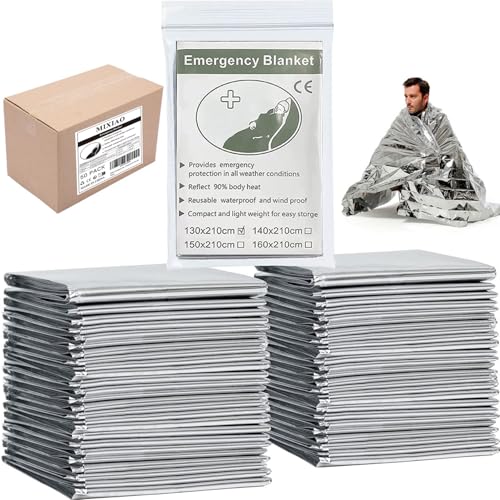
5. Emergency Foil Blanket 50 Pack
Fifty is the count for people who organize things. Race volunteers, wedding planners working outdoor venues in shoulder season, school trip chaperones, church groups running winter outreach, extended families who host holiday gatherings at rural properties — the buyer for this pack has a list of people in mind, and the list is longer than a household. The detail in the title that elevates this option above generic bulk is the individual packaging. Each blanket arrives separately wrapped, which changes the logistics completely: blankets can be dropped into welcome bags, finish-line kits, glove boxes, and classroom go-buckets one at a time, staying clean and compact until the moment each is opened, instead of being torn from a shared bundle in a parking lot.
The stated size is 51 by 83 inches, effectively the same coverage class as the Primacare sheet — a standard adult wrap, a touch narrow for the largest frames, entirely adequate for the handout scenarios this pack serves. The title positions the blankets for outdoors, camping, hiking, marathons, and first aid, with heat reflective language doing the descriptive work. Notice what the title does not do: it makes no thickness claim and no percentage claim. For an event buyer, that plainness is almost a feature. You are purchasing distribution capacity, and the evaluation that matters is whether fifty individually wrapped blankets will be where your people are when the temperature drops or the rain starts sideways.
- Spec snapshot: 50 blankets per pack
- Sheet size stated: 51 x 83 inches, silver
- Packaging detail: Individually packaged, per the title
- Named settings: Outdoors, camping, hiking, marathons, first aid
Strengths
- Individual wrapping makes one-at-a-time distribution clean and simple
- Fifty count covers events, group trips, and multi-vehicle family fleets in one purchase
- Stated dimensions are honest standard coverage for handout use
Trade-offs
- The narrower sheet is not the pick for a large adult planning to rely on a single wrap
- Fifty blankets is warehousing for a solo user with no distribution plans
- No durability or thickness claim appears in the title for rough repeated use
Event planners should think about placement the way first aid people do: blankets stored at the venue entrance do nothing for runners cooling down at a distant finish line, so split the case before the event starts — some at registration, some at the finish, some in the sweep vehicle. Families can run the same play at smaller scale, seeding cars, cabins, and relatives’ emergency drawers. That distribution instinct is what this pack rewards, and it is why the 50-count exists as its own category between the household ten-pack and the institutional hundred.
Best for: Event organizers, group leaders, and large families distributing blankets across people and places. Not suited for: A lone buyer who wants one premium blanket and has nowhere to store forty-nine spares. See the 50-pack on Amazon

6. Force Field Emergency Blanket 4 Pack Orange
Every other blanket on this list is silver, and silver has a problem nobody mentions in marketing copy: it disappears. Dropped on gray rock, draped over a person in gray drizzle, laid out on a forest floor in flat light, a silver sheet blends into exactly the environments where rescues happen. Force Field’s answer is orange — a deliberate, high-visibility color that turns the blanket into a signal panel as well as a wrap. A person waiting for help can wear it, wave it, or lay it out in a clearing, and in each configuration it does double duty that a silver blanket cannot match. For hunters, backcountry skiers, trail runners on remote routes, and boaters, that dual role is not a gimmick; it is the reason to choose this pack over a same-sized silver alternative.
The title also leans on construction language — extra thick appears twice, alongside ultralight and waterproof — and those claims sit in an interesting tension worth naming. Extra thick foil generally resists tearing at folds and punctures better than the thinnest sheets, at some cost in folded size; ultralight is the maker’s counter-assurance that the pack weight stays reasonable. Both phrases are listing claims, and the honest reading is that this four-pack aims at the durability end of the foil spectrum while trying not to become bulky. The title does not state sheet dimensions, so a buyer who needs a confirmed size for a tall user should verify on the product page. The named settings are hiking, camping, survival gear, and first aid kits — a backcountry résumé rather than an institutional one.
- Spec snapshot: 4 blankets per pack
- Color: Orange, the only non-silver option here
- Construction language: Extra thick and ultralight, both per the listing
- Sheet dimensions: Sizing is not spelled out in the listing title
Strengths
- Orange doubles as a signaling aid, a genuine safety function in open country
- Extra thick positioning targets the fold-tearing weakness of basic foil sheets
- Four count suits personal backcountry kits without surplus
Trade-offs
- High visibility is the opposite of what someone wanting a discreet, low-profile kit prefers
- Dimensions are not stated in the title, so coverage confirmation needs an extra step
- Thickness claims come from the listing and cannot be cross-checked from the title alone
There is a small, practical etiquette point for orange gear: in hunting seasons and regions, bright orange carries its own meaning, and wearing it is generally protective rather than problematic, but a blanket used as a ground signal should be weighted at the corners so wind does not carry your signal panel into the next drainage. Small fieldcraft details like that decide whether a good product performs. Force Field’s set is the specialist of this group — the one chosen for a reason beyond price per sheet — and specialists should be bought deliberately, by people who know the reason applies to them.
Best for: Backcountry users who value visibility and signaling alongside warmth retention. Not suited for: Buyers who need confirmed dimensions from the title or who prefer standard silver. Check the orange Force Field pack on Amazon
Side-by-side comparison
| Blanket | Count | Stated size | Defining trait |
|---|---|---|---|
| Emergency Blanket 100-Pack | 100 | Not stated in title | Bulk relief and shelter distribution |
| ANLOKE 10 Pack | 10 | 84 x 64 in | Widest sheet; heavy duty positioning |
| QIO CHUANG 4 Pack | 4 | 84 x 55 in | Personal kits: car, pack, first aid |
| Primacare 10 Pack | 10 | 84 x 52 in | EMS framing; maker’s 90% heat claim |
| Foil Blanket 50 Pack | 50 | 51 x 83 in | Individually packaged for handouts |
| Force Field 4 Pack | 4 | Not stated in title | Orange visibility; extra thick claim |
How do you choose the right emergency blanket for your situation?
Start with the scenario, not the product
Write down, literally, the three situations you are preparing for: a winter breakdown on a rural road, a hiker in your group going quiet and cold at altitude, a shelter shift during a cold snap. Each situation points at a different pick on this list, and the exercise takes two minutes. Buyers who skip it tend to purchase whatever count is cheapest per blanket and then discover the mismatch later — a hundred blankets in a household closet, or a single four-pack expected to cover a scout troop. The scenario list also exposes gaps a blanket cannot fill: foil is one layer in a cold-weather plan that should also include insulation from the ground, dry clothing, and a way to call for help.
Match pack count to distribution, not to anxiety
Anxiety argues for the biggest number; logistics argue for the right number. Blankets you will hand out should be bought in handout quantities — the 50 and 100 counts exist for that. Blankets you will carry should be bought in carry quantities, because surplus foil stored badly is just clutter that hides the gear you need. A useful rule: count the places a blanket should live — each car, each adult’s pack, the home kit, the workplace drawer — and buy to that number plus a small reserve. For most households that arithmetic lands between four and twenty, which is why the middle of this list is crowded.
Read dimensions before you read claims
Percentages and adjectives fill these titles, but the dimensions are the only numbers that behave predictably. An 84 by 64 inch sheet wraps a large adult with material to spare; a 51 or 52 inch width wraps an average adult adequately and a broad one snugly. If the person most likely to use the blanket is tall or broad, width should outrank nearly every other consideration. Where a title omits dimensions entirely, treat that as a prompt to check the full listing rather than as a detail to wave past, especially before ordering in bulk.
Decide whether visibility matters to you
For roadside and household emergencies, silver is fine — help is coming to a known address or a visible vehicle. For backcountry use, where being found is half the emergency, the orange option’s signaling value is a legitimate deciding factor. Some users carry one of each philosophy: silver in the car, orange in the pack. If your outdoor routes are remote, weight that choice accordingly; if your world is driveways and school gyms, it barely matters.
How foil blankets actually help, and where they stop helping
The human body loses heat several ways at once: by radiating it, by contact with cold surfaces, by moving air stripping the warm layer at the skin, and by evaporation. A reflective foil sheet addresses some of these routes well and others barely at all. Its reflective surface bounces a meaningful share of radiated heat back toward the body. Draped and tucked, it blocks wind and sheds rain, cutting the convective and evaporative losses that make cold feel violent. What it cannot do is insulate against conduction — sit on frozen ground wrapped in foil and the ground will still pull heat through the thin barrier — and it provides no loft, no trapped-air cushion of the kind a sleeping bag or a wool blanket supplies. That is why experienced guidance pairs the foil with whatever insulation is at hand: a pad, a pile of dry leaves, a car seat, even cardboard between body and ground.
Condensation is the other honest limitation. Foil does not breathe, so moisture from skin and breath collects on the inner surface during long use, and a person wrapped for many hours can end up damp — a manageable trade in a genuine emergency, and one more reason these blankets are rescue tools rather than bedding. Knowing the mechanism keeps expectations sane: the blanket buys time and blunts the worst losses while help arrives or conditions change. Within that role, it is remarkably effective for something that weighs almost nothing. Outside that role — as planned overnight insulation on a trip where a real sleeping system was an option — it is the wrong tool, and no listing claim should talk you into treating it otherwise.
Storing and rotating emergency blankets so they work when opened
An emergency blanket’s worst enemy is not the emergency; it is the decade before it. Foil stored in a hot car trunk through five summers, crushed under tools, or kept in a damp basement can degrade along its fold lines, so the sheet that finally gets opened tears into strips instead of unfolding into a wrap. Sensible storage is boring and effective: keep packs in a cool, dry place, note the purchase date on the box with a marker, and resist repacking opened blankets into kits as if they were new — a used foil sheet goes into the camping spares bin for ground duty, and a fresh one takes its place in the kit. Drivers in very hot climates should rotate car blankets more often, since trunk heat is the harshest common storage environment.
One more storage distinction is worth making between the packs on this list. Blankets intended for distribution — the fifty and hundred counts — should stay in their shipping boxes in a supply room, because the box itself is the inventory system: an opened case invites quiet shrinkage and makes head-counts unreliable before an event. Blankets intended for personal kits should come out of the box immediately and go to their assigned places, since a personal blanket still sitting in a case in the garage is functionally identical to a blanket you never bought. The two philosophies sound similar and are actually opposites, and mixing them up is how organizations end up with a tidy warehouse and empty car trunks, or a dozen loose blankets in a closet and nothing countable when the shelter calls for help.
Practice matters too, in a small way. Opening a foil blanket for the first time with cold, gloved, shaking hands, in wind, is a genuinely fiddly task, because the sheets cling and the folds confuse. Sacrificing one blanket from a multi-pack to a backyard practice session — unfold it, wrap a family member, try it as a ground layer — converts a theoretical supply into a known skill, and reveals practical details like how much the material crackles and how edges need tucking. Households that have done this once handle the real moment noticeably better. It is the cheapest training in all of preparedness.
Scenario playbook: what one blanket does in four real situations
The winter breakdown
A car that dies at night in cold weather becomes a cooling metal box within the hour, and the wait for a tow truck is exactly the interval these blankets were invented for. The play is simple but worth rehearsing mentally: stay with the vehicle, wrap each occupant separately rather than sharing one sheet — separate wraps trap each person’s own reflected heat instead of averaging everyone’s losses — and put anything available between bodies and the seats or floor. Run the engine for heat only in short intervals if fuel and ventilation allow, and never while snow blocks the exhaust. A blanket from the trunk kit turns a miserable, risky wait into a merely unpleasant one, and the difference between those two outcomes is the entire value proposition of the four and ten packs on this list.
The marathon finish line
Runners cool fast when they stop. An hour of hard effort leaves the body producing heat at an enormous rate, and within minutes of crossing the line that furnace shuts down while sweat keeps evaporating — the classic recipe for the shivering, gray-faced finisher that medical tents know well. This is why so many of the listings above name marathons explicitly. The foil wrap at the finish is not ceremonial; it is a timed intervention, applied in the first minutes, worn through the walk to gear check and the ride home. Support crews for small teams can copy the professional play with a four-pack: one blanket per runner, ready at the finish, not back at the car. Event directors operate at the other end of the scale, where the individually wrapped fifty and hundred counts exist precisely because finish-line distribution is a logistics problem measured in hundreds of shivering people per hour.
The hiker who has to stop
On the trail, the emergency is rarely dramatic cold; it is an ankle, a wrong turn, a storm arriving two hours early — any event that converts a moving, warm hiker into a stationary, cooling one. Movement is heat, and losing it is the real danger the blanket addresses. The wrap goes on early, before the person feels desperately cold, because rewarming with foil alone is far harder than slowing the loss in the first place. Add the ground layer rule — sit on a pack, a pad, folded spare clothing — and use spare material as a windbreak on the exposed side. In this scenario the orange blanket earns its premium in a second way: a stationary hiker who may need finding should look like a signal, not like a rock. Groups should carry more than one sheet, since the uninjured members will be cooling too once they stop moving to help.
The shelter cot on the coldest night
In a warming center, the blanket’s job stretches longest: not minutes of rescue but a night of sleep in a room that may be crowded, drafty, and short on real bedding. Here foil works best as one layer among whatever else exists — over a donated blanket to block drafts, under a sleeping bag as a ground barrier on a cot or mat, or wrapped around shoulders during the waking hours before lights-out. Coordinators learn quickly that distribution style matters: blankets handed out with a word of explanation about tucking edges and keeping the sheet off bare frozen floors get used well, while blankets tossed silently onto cots end up as pillows. The bulk packs on this list serve this world, and their low storage footprint means a closet of supplies can hold a whole cold snap’s worth of coverage without displacing food, cots, or clothing donations.
Pairing foil with the rest of a cold-weather plan
No single item carries a cold emergency, and the blanket’s weaknesses map neatly onto other gear’s strengths. Insulation from the ground — a foam pad, a seat cushion, even a flattened cardboard box — covers the conduction gap that foil cannot touch. Dry spare clothing, especially a hat and socks sealed in a plastic bag, attacks the problem from the other side: wet fabric drains heat so efficiently that changing out of it can matter more than the wrap itself. A light source, a whistle, and a charged phone or battery bank handle the finding-and-communicating half of the emergency, which warmth alone cannot solve. Food and water play a quieter role than people expect; a body with fuel in it produces heat better than an empty one, which is why experienced winter drivers keep calories in the same kit as the blankets.
The point of listing these companions is not to inflate a shopping list. It is to place the foil blanket honestly inside a system: it is the lightest, cheapest, most storable layer of that system, and frequently the one that gets forgotten because it looks like nothing. Kits assembled with that understanding — a blanket per person, insulation for the ground, dry spares, light, and a way to call — handle the realistic range of cold surprises. Kits built around any single miracle item, however impressive its listing claims, tend to discover the missing layer at the worst available moment.
Common mistakes people make with emergency blankets
Treating foil as a sleeping system. Planning to sleep under a mylar sheet on a trip where real bedding was possible is the category’s signature error. The blanket is a stopgap for the unplanned night, the injury wait, the breakdown — not a line item in a camping kit that replaces a sleeping bag.
Buying one blanket for a group. A single sheet cannot wrap four people, and passing it around helps no one for long. Group settings need group quantities, which is the entire reason mid and bulk packs exist on this list.
Leaving every blanket in one place. Ten blankets in a hall closet do nothing for the driver stranded twenty miles away. Distribution — car, pack, workplace, home — is what converts ownership into readiness.
Taking percentage claims as guarantees. When a listing says a blanket retains a specific share of body heat, that is the maker’s claim about its product, not a promise about your night. Wind, wet clothing, ground contact, and how well the wrap is tucked will swing real outcomes far more than any headline figure.
Never inspecting old stock. Foil that has sat for years can fail at the folds on first opening. A quick annual check of one blanket from an aging pack tells you whether the whole pack needs replacing.
Forgetting the ground. Wrapping up while sitting directly on snow, wet earth, or cold metal leaves the biggest heat drain untouched. Something — anything — between the body and the ground multiplies what the foil can do.
What about children, older adults, and pets?
Cold does not fall evenly across a household. Children lose heat faster relative to their size, get restless inside a wrap, and may find the crackling foil frightening in an already frightening moment — which is why a calm adult demonstrating the blanket at home, on an ordinary afternoon, pays off during the real event. For kids, the practical adjustments are small: wrap them with an adult’s body heat inside the same sheet only for short periods and with faces clear, keep the foil away from unsupervised play since thin plastic films of any kind do not belong around unattended small children, and prioritize dry clothes and a hat, which children accept more readily than a full cocoon. Schools and youth groups distributing blankets should build that explanation into the handout, the same way shelters do.
Older adults face a different version of the problem: many feel cold later than they should, because the body’s early warning shivers and sensations can be blunted by age or medication. In a household emergency plan, that means the blanket goes on the older person early and by someone else’s judgment, not by waiting for them to complain. Limited hand strength and dexterity also matter — foil packaging that a younger person tears open in seconds can defeat arthritic hands, so pre-opening one blanket per kit and refolding it loosely is a kind, practical touch. For pets, a foil sheet can line a carrier or cover a crate against drafts during transport, but animals chew, panic at the noise, and overheat without the ability to shed the wrap, so foil on a pet should be a supervised, short-duration measure rather than a set-and-forget layer. None of these adjustments require special products; they require remembering that the people and animals in your plan are not all the same shape of warm.
Final recommendation
For most households, the sensible center of this list is a mid-count pack with stated dimensions: the ANLOKE ten-pack if width and wrap room matter most, or the QIO CHUANG four-pack as a lean starting kit for one person. Organized buyers should follow their setting — Primacare for stocked first aid contexts, the individually wrapped 50-pack for events and groups, the 100-pack for shelter-scale stockpiles. Backcountry users with signaling on their minds should take the orange Force Field set seriously. Readers comparing blanket types beyond the emergency category can also look at Best Washable Weighted Blankets for the opposite end of the blanket world — heavy, home-use bedding rather than rescue foil.
Frequently asked questions
Can you sleep under a mylar blanket every night?
No, and you would not want to. These sheets are emergency tools: they crackle, trap condensation, and offer no cushioning or loft. They are designed to blunt heat loss during a crisis, not to serve as daily bedding at home.
Are emergency foil blankets reusable?
Sometimes, if a sheet comes back untorn and clean, it can be refolded for ground duty or a second emergency, and at least one listing here uses the word reusable. In practice, many organizations treat them as single-distribution items, and a torn or fold-damaged sheet should be replaced rather than trusted.
What size should I look for?
Long enough to cover the user head to toe — most sheets here run about 83 to 84 inches long — and as wide as your situation allows. Widths in this group run from about 51 inches up to 64, and larger adults feel that difference immediately when wrapping.
Why would anyone choose orange over silver?
Visibility. An orange sheet can be seen at distance and used as a signal panel, which matters in backcountry rescues. Roadside and home users gain little from it, which is why silver remains the default elsewhere in the category.
Where else should preparedness thinking extend?
Comfort gear at home and safety gear away from it are different budgets, but the same planning habit serves both; readers outfitting a house after sorting emergency kits may browse Best Rugs For Apartments for the indoor side of that project, while travelers building a carry kit might pair these blankets with Best Luxury Slippers for the comfort end of a long journey.
How many should a household actually own?
Start with one per person per location that matters: one for each regular driver in the car’s kit, one in each adult’s hiking pack, and a small reserve at home. For a family of four with two cars, that arithmetic usually lands between eight and twelve blankets, which is why ten-packs sell so steadily — they match the honest count for a prepared household without tipping into bulk storage. Add more only when a real distribution role appears: a team you coach, a congregation you serve, an event you staff. Blankets bought for a named purpose get stored well and found quickly; blankets bought from vague unease drift to the back of closets and age uninspected.
When the cold finally catches you somewhere you did not plan to be, the blanket folded in your kit will matter far more than the one you meant to buy.


