What's inside
- Key Takeaways
- Quick Picks
- How We Chose These Picks
- How Do the Six Stove-Room Picks Compare at a Glance?
- Where Does Stove Dust Actually Come From?
- How Should You Handle Ash So the Room Stays Clean?
- What Can a Purifier Do About the Woodsmoke Smell Itself?
- Where Should the Purifier Stand Relative to the Stove?
- How Do You Know If the Problem Is the Stove, Not the Air?
- How Does a Filter Survive a Whole Heating Season?
- What About the Rest of the House Beyond the Stove Room?
- How Does the Log Store Contribute, and How Do You Tame It?
- What Does the First Week With a Sensor Teach You?
- How Should the Machine Run Across a Burning Day?
- Can a Purifier Help in the Shoulder Seasons, When the Stove Is Cold?
- What About Houses Where the Stove Is the Only Heat?
- How Do Curtains, Rugs and Upholstery Fit Into the Picture?
- What Should You Do on the Day the Chimney Is Swept?
- Which Mistakes Do Wood Stove Households Make Most Often?
- Final Recommendation
- Frequently Asked Questions
- Related Guides
As an Amazon Associate I earn from qualifying purchases. This post may contain affiliate links at no extra cost to you.
cottageverdict.com is reader-supported. When you buy through links on our site, we may earn an affiliate commission.
Where to buy: the six best air purifiers for wood stove dust below are sold through Amazon, and their names in the Quick Picks table, the detailed reviews and the comparison table link to the matching listing, where you can check price on Amazon and confirm filter details, coverage claims and dimensions before the heating season starts. Anyone who heats with wood knows the dust intimately well. It is finer than ordinary house dust, grey rather than brown, and it gets everywhere: a film on the television, a haze on the picture glass, a gritty note on the mantelpiece that returns two days after you wipe it. It comes from ash handling, from the stove door opening, from bark and sawdust riding in on the log basket, and from the simple fact that a stove stirs the room’s air all day long.
A purifier cannot fix a stove, and this guide will not pretend otherwise. If your stove spills smoke every time the door opens, the answer is a chimney sweep, a door seal or a draught conversation with an installer — not a filter. What a well-chosen purifier does is manage the room’s background: the fine ash dust that escapes even a well-run stove, the faint woodsmoke note that settles into a room over a winter, and the general particulate load of a house where the fire burns from October to April. That is comfort work, honestly framed, and it is judged here on filter grade, washable pre-filters, sensor feedback and how each machine copes with a load that never takes a day off.
Two honesty notes before the picks. First, the figures quoted are the listings’ own: coverage areas, decibel claims and sensor types exactly as printed, with gaps marked where a listing stays silent. Second, two picks wear wood in their names and finishes — the Klarta Forste in a Wood Black finish and the ArborFlow’s wooden styling — and in both cases that is a surface finish chosen for looks, not a claim that the machine is built from solid timber. We say so in their reviews, because a stove room deserves straight talk.
Key Takeaways
- Stove dust is a pre-filter problem first: the washable pre-filters on the WESTHEY and DBFIT picks are the features that decide whether a main filter survives the whole winter intact.
- Two picks carry PM2.5 sensing — the Klarta’s laser sensor and the displays on the WESTHEY and DBFIT — which lets you watch the spike when the stove door opens and the fall as the machine works.
- The Klarta Forste states the tightest package for a stove room: H13 HEPA, a carbon filter for smoke, 20dB quiet running and coverage up to 1,237 sq ft.
- The CHIVALZ two-pack solves the two-room reality of stove houses, where the fire heats one room thoroughly and the dust visits the bedroom anyway, night after night, all season long.
- An ash vacuum is a separate tool, not a purifier; it belongs in the how-to routine beside the stove, used only on fully cold ash, and no pick here is a substitute for it or for the patience the ash routine demands.
- No purifier compensates for a smoking flue: draught and seal problems belong to a sweep or an installer, not to a filter, however strong the filter’s marketing or motor may be.
Quick Picks
| Pick | Badge | Why it earns its place |
|---|---|---|
| Klarta Forste Air Purifier | Best Stove-Room All-Rounder | H13 HEPA plus a carbon filter for smoke, a PM2.5 laser sensor and 20dB quiet running in a wood-finish body. |
| ArborFlow Wooden Air Purifier | Best Looking Beside a Stove | H13 HEPA and carbon filtration in a wooden-finish design that belongs in a room with a hearth and timber. |
| WESTHEY H13 HEPA Air Purifier | Best Washable Pre-Filter | Coverage up to 1,650 sq ft, a washable pre-filter, a PM2.5 display and a fragrance sponge for the room’s softer side. |
| GoveeLife Smart Air Purifier | Best Smart Scheduling | App and Alexa control with a PM2.5 monitor, so the machine can be run up before you open the stove door. |
| CHIVALZ 2 Pack Air Purifiers | Best Two-Room Answer | Two H13 true HEPA units in one purchase, for the stove room and the bedroom the dust migrates to. |
| DBFIT HEPA Air Purifier 2180 Sq Ft | Best Big-Room Workhorse | Coverage up to 2,180 sq ft, a washable nylon pre-filter and a PM2.5 sensor for the largest stove-heated spaces. |
How We Chose These Picks
We started from the load, not the room. Wood heat produces a particular mixture: very fine ash particles that stay airborne for hours, coarser bark and sawdust debris near the log store, and a persistent low level of smoke odour that soaks into a room across a season. A purifier for this house needs a proper HEPA-grade filter for the fine fraction — every pick here names H13 or true HEPA in its listing, or pairs HEPA with carbon — and it needs a first line of defence that can be washed, because the coarse fraction will otherwise eat the main filter alive by Christmas.
Carbon was weighted heavily, which is unusual in our guides and specific to this one. Particle filters do almost nothing for the woodsmoke smell that defines a stove room in February; carbon is the stage that softens it. The Klarta and ArborFlow both name carbon filters in their listings, and that is a large part of why they lead this page. Sensor feedback came next: in a stove house, a PM2.5 reading is not a gadget but a diagnostic, showing you what your stove habits do to the room in numbers.
Finally, we considered the house’s geography. Stoves heat one room thoroughly and the rest of the house partially, and the dust travels the same routes the heat does. A two-pack that puts a real filter in the bedroom as well as the stove room answers the actual shape of the problem, which is why the CHIVALZ pair earns its place beside larger single machines. What we excluded: any unit whose listing could not name its filter, and any suggestion that filtration substitutes for stove maintenance.

Klarta Forste Air Purifier — Best Stove-Room All-Rounder
The Forste reads like a machine specified by someone who heats with wood. Its listing states an H13 HEPA filter, a carbon filter named for smoke, a PM2.5 laser sensor, WiFi control, quiet running at 20dB, and coverage up to 1,237 sq ft — every element aimed at the stove room’s actual complaints. The carbon stage matters most: across a winter, it is the smoke note in the curtains and the faint tang when you enter from outside that wear a household down, and carbon is the only stage in any purifier that addresses smell rather than particles.
The laser sensor is the second half of the argument. Laser-based PM2.5 sensing responds quickly, and in a stove room speed is information: you see the number climb when the door opens for loading, watch how long your technique keeps it climbing, and learn within a week whether your ash routine is as gentle as you believed. Households that burn well do not guess about this; they know, and the Forste is built to tell them.
About the finish, plainly: the listing calls the colour Wood Black, and it is a finish — a surface treatment chosen so the machine sits comfortably in a room of timber and iron, not a cabinet built from solid wood. Judged as a finish, it is a good one for this setting, disappearing beside a stove in a way glossy white plastic never will. With WiFi control to run it up before you kneel at the stove door, the Forste is the most complete answer here to the room it was named for.
- Format: room purifier in a Wood Black finish (a surface finish, per the listing)
- Filtration: H13 HEPA with a carbon filter for smoke
- Coverage stated in the listing: up to 1,237 sq ft
- Noise figure stated in the listing: 20dB on its quiet side
- Sensing and control: PM2.5 laser sensor, WiFi
Strengths
- Carbon stage named for smoke, the stove room’s defining smell
- Fast laser PM2.5 sensor turns stove habits into visible numbers
- Wood-effect finish belongs in a hearth room visually
Trade-offs
- Coverage is mid-pack; the largest open-plan stove rooms may want more
- No washable pre-filter is named in the listing, so check the intake often
- WiFi features are wasted in a house that prefers manual controls
Best for: a main stove room of ordinary size, where smoke smell and fine ash are equal partners in the problem.
Not suited for: a very large open-plan heated space, or a household avoiding connected devices.

ArborFlow Wooden Air Purifier — Best Looking Beside a Stove
Most purifiers look like appliances that wandered in from a clinic. The ArborFlow is designed, per its listing, as a wooden air purifier with an eco-friendly design language, carrying an H13 HEPA and carbon filter combination for dust, smoke, pet hair and odours. The honest description of the construction is a wooden finish — the listing does not claim a solid timber cabinet, and neither do we — but as a finish it changes the machine’s fate in the room. Beside a stove, among log baskets and iron tools, a wood-toned purifier is allowed to exist in plain sight, and a purifier in plain sight is one that stays plugged in.
That visibility is not a trivial advantage. The history of home filtration is full of effective machines exiled to cupboards because someone disliked looking at them, and an exiled purifier cleans the inside of a cupboard superbly. If the ArborFlow’s looks are what keep a proper H13-and-carbon machine running in the main room all winter, its design has done more for the house’s air than a stronger specification hidden in a hallway.
The listing is quieter about the rest: no coverage figure and no decibel number are stated, so we will not supply them. Judge this pick as a mid-size room machine on its filtration, which is properly specified, and on its manners, which are the best in the group. In a cottage room where every object is wood, iron or wool, it is the only purifier here that looks like it was invited.
- Format: room purifier with a wooden finish (surface finish, not stated as solid timber)
- Filtration: H13 HEPA and carbon filter, per the listing
- Targets named in the listing: dust, smoke, pet hair and odours
- Room coverage figure: not stated in the listing
- Noise figure: not stated in the listing
Strengths
- H13 plus carbon is the right filtration pairing for stove rooms
- Wooden finish survives in a hearth room where plastic boxes get banished
- Quiet, eco-friendly design intent suits a calm, traditional interior
Trade-offs
- No stated coverage, so size it by judgement to a modest room
- No sensor display named in the listing; feedback is by dust and smell
- Finish is a surface treatment — do not buy it expecting solid wood joinery
Best for: a cottage or traditional stove room where the purifier must earn its place visually to survive.
Not suited for: a buyer who needs a published coverage figure and a PM2.5 display.
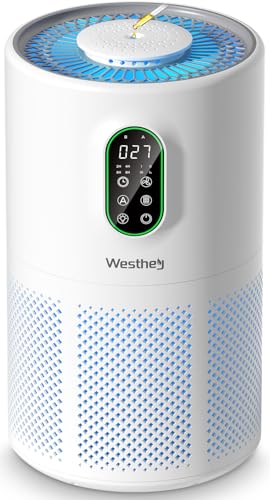
WESTHEY H13 HEPA Air Purifier — Best Washable Pre-Filter
The WESTHEY leads with the specification that decides winter survival: an H13 HEPA filter behind a washable pre-filter, in a machine claiming coverage up to 1,650 sq ft, with a PM2.5 display, auto and sleep modes, a night light and a fragrance sponge. In a stove house, that washable first stage is not a convenience — it is the economics of the whole purchase. Ash dust and log-store debris arrive daily; a pre-filter you rinse in the sink each month keeps them out of the expensive HEPA behind it, and the HEPA’s season stretches from doubtful to dependable.
The PM2.5 display gives the WESTHEY the same diagnostic value as the Klarta’s sensor, in a more conventional form: a number on the machine that climbs at loading time and falls as the room clears. Auto mode uses that reading to run the machine up and down without supervision, which suits a room whose load arrives in stove-shaped pulses rather than a steady stream. Sleep mode then keeps the overnight shift quiet while the stove ticks down to embers.
The night light and fragrance sponge are the listing’s softer features, and in a stove room they divide opinion predictably. A faint light can help a midnight stoking trip; a fragrance sponge in a room that smells of woodsmoke is, to most stove households, a solution in search of a problem — the woodsmoke is the point of the room, in moderation. Both features are optional in practice. Buy this machine for its washable armour and its display, and treat the rest as garnish.
- Format: room purifier with display, white design
- Filtration: H13 HEPA with washable pre-filter
- Coverage stated in the listing: up to 1,650 sq ft
- Display: PM2.5 display with auto and sleep modes
- Extras named in the listing: night light and fragrance sponge
Strengths
- Washable pre-filter is the single most valuable stove-room feature here
- PM2.5 display plus auto mode answers the stove’s pulsed load
- Generous stated coverage covers most single stove rooms
Trade-offs
- No carbon stage is named in the listing, so smoke smell gets less help
- Fragrance and night light will be surplus for purist stove households
- Pre-filter washing is a monthly chore that must actually happen
Best for: a busy stove room where ash and debris volume, more than smell, is the daily battle.
Not suited for: a household whose main complaint is the woodsmoke note itself.

GoveeLife Smart Air Purifier — Best Smart Scheduling
Stove work happens at predictable moments: the morning load, the evening load, the ash routine on a Saturday. The GoveeLife’s listing offers a smart purifier covering up to 1,046 ft², with a PM2.5 monitor, a 24dB sleep mode, a 3-in-1 filter and app and Alexa control — and in a stove house, that connectivity has a specific job. It lets the machine be run up from the sofa before you open the stove door, and scheduled for the half hour after the ash bucket has been out, without anyone crouching by a panel in a room full of the very dust you are trying to settle.
The PM2.5 monitor closes the loop that scheduling opens. You can watch, from the app, whether the post-loading spike is shrinking week by week as your technique improves, which turns stove craft into something measurable. The stated 24dB sleep figure sits slightly above the quietest claims in this guide, and in a living room rather than a bedroom that difference is academic; the machine will share the evening with conversation comfortably.
The honest limitation is the filter description: a 3-in-1 arrangement, per the listing, without the H13 grade named by several rivals, and no carbon stage called out separately. For dust — the title subject of this guide — the machine is properly equipped, and its smart routine may extract more real-world cleaning from a modest filter than a stronger filter left on one setting forever. For the smoke smell itself, the Klarta and ArborFlow, with carbon named in their listings, remain the more direct answers.
- Format: smart room purifier with app control
- Filtration: 3-in-1 filter, per the listing
- Coverage stated in the listing: up to 1,046 ft²
- Noise figure stated in the listing: 24dB sleep mode
- Sensing and control: PM2.5 monitor, app and Alexa
Strengths
- Scheduling matches the stove’s predictable daily rhythm perfectly
- App-side PM2.5 history turns stove technique into feedback
- Voice control suits hands covered in the evidence of log carrying
Trade-offs
- Filter grade is not named as H13 in the listing
- No carbon stage is called out for the smoke smell itself
- Needs Wi-Fi and an account to deliver its headline value
Best for: a connected household that wants the purifier choreographed around the stove’s routine.
Not suited for: a buyer who wants named H13 filtration and carbon above all else.

CHIVALZ 2 Pack Air Purifiers — Best Two-Room Answer
Every stove household knows the geography: the fire’s room is warm and dusty, and the bedroom down the hall is cooler and — somehow — dusty too, because dust rides the same warm currents that make the house comfortable. CHIVALZ answers with arithmetic instead of power: two purifiers in one purchase, each with an H13 true HEPA filter, per the listing, aimed at smoke, dust, odours, pollen and pet dander. One lives in the stove room. The other lives where you sleep, and the migration route between them stops mattering.
Two modest machines beat one strong one in this specific layout for a simple reason: filtration only works on the air in the room the machine is in. A flagship in the stove room does nothing for the bedroom’s overnight dust, which is the dust you breathe for the longest unbroken stretch of the day. The pair also degrades gracefully — if one unit is off for a filter change, the house is not unfiltered — and the listing’s note that the model is available for California signals attention to that state’s air-cleaner rules, a small mark of seriousness.
The compromises are scale and feedback. Each unit is a small-room machine; the stove room’s unit will work harder and fill its filter faster than the bedroom’s, so expect to service them on different rhythms, and do not expect displays or smart features at this positioning — the listing promises filtration, in duplicate, and the value sits in the duplication. For a whole small house heated by one stove, it is the most realistic purchase in this guide.
- Format: two compact purifiers in one purchase
- Filtration: H13 true HEPA filter in each unit, per the listing
- Targets named in the listing: smoke, dust, odours, pollen, pet dander
- Room coverage per unit: not stated in the listing
- Noise figure: not stated in the listing
Strengths
- Covers the stove room and the bedroom in a single purchase
- True HEPA grade in both units, not a diluted second machine
- Redundancy: one unit down for servicing never leaves the house bare
Trade-offs
- Each unit is small-room scale; a vast stove room may still want a flagship
- Two filters to maintain, on two different schedules
- No sensor displays or app features named in the listing
Best for: a small house or flat where one stove heats the living space and dust reaches the bedroom.
Not suited for: a single very large stove room that needs one concentrated machine.

DBFIT HEPA Air Purifier 2180 Sq Ft — Best Big-Room Workhorse
Some stove rooms are barns in disguise: a farmhouse kitchen-living space, a converted outbuilding, a long room where the stove stands at one end and life happens along the whole length. The DBFIT AP2410 is the workhorse for that architecture — its listing claims coverage up to 2,180 sq ft, pairs a HEPA filter with a washable nylon pre-filter, and adds a PM2.5 air quality sensor. The washable nylon pre-filter is the detail to underline: nylon shrugs off the coarse, abrasive fraction of stove dust — the ash grit and bark fibre — and rinses clean without disintegrating, which is exactly the temperament a pre-filter needs in this house.
The PM2.5 sensor completes the workhorse brief. In a big room, the far end from the stove can feel like a different climate, and the sensor tells you whether the machine is genuinely pulling the whole space down after a loading session or merely polishing its own corner. Paired with honest placement — mid-room, not stove-side — the DBFIT’s claim and sensor together give the largest heated spaces in this guide a credible single-machine answer.
As ever, the coverage figure is the maker’s own, with no method stated, and the listing names no carbon stage, so the woodsmoke smell gets filtration’s indirect help — less dust, fresher background — rather than carbon’s direct attention. Households whose complaint is primarily the smell should look first to the Klarta. Households whose complaint is the sheer volume of grey dust across a big room should start here.
- Format: full-size purifier for large rooms
- Filtration: HEPA with washable nylon pre-filter
- Coverage stated in the listing: up to 2,180 sq ft
- Sensing: PM2.5 air quality sensor, per the listing
- Noise figure: not stated in the listing
Strengths
- Largest stated coverage in this guide for the biggest stove rooms
- Washable nylon pre-filter suits abrasive ash and bark debris
- Sensor verifies the far end of a long room is being served
Trade-offs
- No carbon stage named in the listing for smoke odour
- Coverage method unstated, as with most rivals
- Full-size body needs a deliberate mid-room position
Best for: a large, open stove-heated space — farmhouse kitchen, barn conversion, long room — with dust volume as the main enemy.
Not suited for: a small stove room, where its scale is wasted, or a smell-first complaint.
How Do the Six Stove-Room Picks Compare at a Glance?
| Pick | Filtration (per listing) | Stated coverage | Standout trait |
|---|---|---|---|
| Klarta Forste Air Purifier | H13 HEPA plus carbon for smoke | Up to 1,237 sq ft | Laser PM2.5 sensor, 20dB, wood finish |
| ArborFlow Wooden Air Purifier | H13 HEPA and carbon | Not stated | Wooden finish that belongs by a hearth |
| WESTHEY H13 HEPA Air Purifier | H13 HEPA, washable pre-filter | Up to 1,650 sq ft | PM2.5 display, auto and sleep modes |
| GoveeLife Smart Air Purifier | 3-in-1 filter | Up to 1,046 ft² | App scheduling around stove times |
| CHIVALZ 2 Pack Air Purifiers | H13 true HEPA, two units | Not stated per unit | Two rooms covered in one purchase |
| DBFIT HEPA Air Purifier 2180 Sq Ft | HEPA, washable nylon pre-filter | Up to 2,180 sq ft | Big-room reach with PM2.5 sensor |
The pattern to carry away: carbon appears exactly where the smoke smell is taken seriously, washable pre-filters appear exactly where dust volume is taken seriously, and the wisest purchase decides which of those two enemies is really theirs before choosing which column of this table to live in.
Where Does Stove Dust Actually Come From?
Four sources, in rough order of guilt. Ash handling leads: every bucket emptied, every grate riddled, releases a puff of particles so fine they hang in the air for hours and settle as that grey film. The stove door is second — each opening for loading lets a breath of the firebox’s atmosphere into the room, however good the draught. The log store is third: bark flakes, sawdust and wood-yard grit shed from every armful carried across the room. And the stove itself is fourth, a convection engine that keeps the room’s air — and everything in it — circulating past hot surfaces all day, redistributing what the other three sources released.
A purifier addresses the airborne stage of all four, which is why it helps despite fixing none of them. The habits that shrink the sources themselves — gentle ash work, a lidded log basket, a mat under the wood store — shrink the purifier’s load in direct proportion, and a household that improves both sides of the equation ends up with a room that stays clean at a fraction of the effort of either approach alone.
How Should You Handle Ash So the Room Stays Clean?
Ash is where stove houses are won and lost, so let us be specific, and let us separate the tools honestly. An ash vacuum — a dedicated vacuum built for fine ash, with filtration of its own — is a cleaning tool for the hearth area, and it is not an air purifier; nothing in the picks above does its job, and it does none of theirs. It belongs in this routine as a separate instrument: used on a fully cold stove, it lifts ash from the firebox and hearth without the cloud that a dustpan and brush guarantee. If you take one how-to idea from this guide, take the pairing — ash vacuum for the hearth, purifier for the room.
The routine itself is patience. Let ash cool completely — a full day is not excessive, since ash insulates embers treacherously. Work slowly, keeping the vacuum nozzle or the shovel low and close to the surface, and run the room’s purifier on a higher setting during and for half an hour after the job. Empty the ash container outdoors, downwind, into a metal bucket with a lid. Every stove household develops its own version of this liturgy; the ones with clean rooms are simply the ones who never rush it.
What Can a Purifier Do About the Woodsmoke Smell Itself?
Less than it does about dust, and the difference is chemistry. Smoke smell lives in gases and in the finest particles; a particle filter catches the second and ignores the first, which is why a HEPA-only machine can leave a room visibly cleaner yet still smelling of last night’s fire. Carbon is the stage that adsorbs the gaseous fraction, and it is why the Klarta and ArborFlow — the two picks whose listings name carbon filters — lead this guide for smell-sensitive households. Even carbon has a capacity and a lifespan; in a heavy stove room it exhausts faster than the particle filter behind it.
Set the expectation correctly and the result satisfies: a carbon-equipped purifier takes the stale, slept-in edge off a stove room, so the room smells of a fire recently lit rather than of a winter accumulated. It will not, and should not, erase the character of a wood-heated house entirely. Visitors should still know there is a stove. They should not be able to date it.
Where Should the Purifier Stand Relative to the Stove?
Not beside it — that is the instinct, and it is wrong twice over. Heat rising off the stove creates a fast column of air that a nearby purifier drinks greedily, filtering the stove’s private weather while the room waits; and a purifier too close to a heat source lives a harder, shorter life than its maker intended. The productive position is across the room or along the wall the seating faces, a few metres from the hearth, where the air has mixed and the machine receives the room’s true average.
The exception proves the rule during ash work: for the half hour of the ash routine, a purifier moved nearer the hearth — still at a safe, cool distance — catches the escapees at source. Then it goes home. Households with a PM2.5 display can verify all of this empirically in a single weekend, which is the deeper reason sensor picks suit stove houses: the room teaches you its own airflow, if you give it the instruments to speak.
How Do You Know If the Problem Is the Stove, Not the Air?
By pattern. A purifier’s war is with a background: a slow, even accumulation of fine dust that returns over days. A stove fault announces itself in events — a visible puff at every door opening, a room that smells strongly within minutes of lighting, soot marks appearing above the door frame, a flue that has begun to stain the wall. Events belong to the stove and its chimney. No filter in this guide should be asked to absorb a draught problem, and money spent upsizing a purifier to fight a smoking stove is money not spent on the sweep and the seal that would actually end it.
The kindest framing is division of labour. The sweep keeps the fire’s products going up the chimney. The installer’s seals keep the firebox honest. The purifier keeps the room’s ordinary background — the ash dust of a well-run stove, the season’s faint tang — at the level of a house that happens to have a fire, rather than a fire that happens to have a house around it.
How Does a Filter Survive a Whole Heating Season?
By being defended in layers. The washable pre-filter takes the coarse assault — ash grit, bark fibre, pet hair — and wants rinsing monthly through the burning months, more often in a house that empties ash weekly. The intake grille wants a vacuum whenever you vacuum the hearth, because a caked grille starves everything behind it. And the main HEPA wants the one thing owners forget: a mid-season inspection. Take it out in January, look at its face in good light, and judge it the way you judge the stove’s rope seal — by evidence, not by the calendar’s optimism.
Households that burn all winter should also accept a shorter filter year than the packaging dreams of, and budget for it as part of the wood bill, like the sweep’s visit. A filter replaced on time is cheaper than a machine strained into noise and weakness, and far cheaper than the conclusion — wrong, but understandable — that purifiers do not work in stove houses. They do. They simply work on stove time, which is faster than suburban time.
What About the Rest of the House Beyond the Stove Room?
Dust respects the same physics as heat: it rises, drifts through doorways left ajar, and settles in the cool rooms at the ends of halls. The bedroom is the room that matters most after the stove room, because it is where the household breathes for eight unbroken hours, and it is why the CHIVALZ two-pack — a true HEPA unit for each room — earns its place in this guide beside larger machines. A single flagship, however strong, filters the room it stands in and no other.
Door discipline helps here too. A stove-room door kept mostly closed during burning hours contains both the warmth and the dust where the main purifier can process them; the bedroom door, closed at night with its own small unit running, completes the system. None of this requires a house full of machines — it requires the two rooms that matter to be treated as the system they already are.
How Does the Log Store Contribute, and How Do You Tame It?
The indoor log store is a dust factory with excellent public relations: it looks rustic, smells wonderful and sheds continuously. Every log carries bark that flakes, sawdust in its crevices and the grit of the wood yard, and every armful carried to the stove leaves a faint trail across the room. Over a winter, the floor around the basket and the air above it carry a load that has nothing to do with combustion at all.
The mitigations are carpentry, not technology. A basket or rack with a solid base catches what the logs shed where it falls; a mat beneath the store localises the rest for a weekly shake outdoors; and brushing down each armful at the outdoor stack, before it crosses the threshold, keeps the worst of the yard outside. Households that do these three things find their purifier’s pre-filter dramatically cleaner at its monthly rinse — the machine’s workload is set at the wood pile as much as at the hearth.
What Does the First Week With a Sensor Teach You?
Households that choose a sensor pick — the Klarta’s laser sensor, or the displays on the WESTHEY and DBFIT — should treat the first week as an experiment on themselves. Note the reading before the morning load, during it, and an hour after. Do the same for the ash routine. Most people discover one habit that costs the room dearly: a door opened wider and longer than the loading needs, a grate riddled with enthusiasm, an ash bucket carried uncovered through the room. Each is fixable in a day, once the number has named it.
This is the deepest argument for sensor machines in stove houses specifically. In a city flat, air quality arrives from outside and the resident is a bystander; in a stove house, the resident is the source, the operator and the audience at once. A display closes that loop. Stove craft has always been learned by eye and ear — the colour of the flame, the sound of the draw — and a PM2.5 reading simply adds a third sense to an old skill.
How Should the Machine Run Across a Burning Day?
Match the machine to the fire’s own timetable. Before the morning load, the room is at its cleanest; a low background setting holds it there. Around loading times and any ash work, a higher setting earns its noise, because that is when the room’s load arrives in pulses. Through the long evening burn, a middle setting suits a well-run stove whose door stays shut for hours at a stretch. Overnight, as the fire dies to embers, the machine can step down to its quiet gear — the Klarta states 20dB, the GoveeLife 24dB in sleep mode — and finish the day’s work in a whisper.
Auto modes automate most of this if your pick has one and its sensor is honest, and the GoveeLife’s scheduling can pre-empt the known pulses entirely. The manual rhythm costs nothing but attention for the first week, after which it becomes as automatic as the stove routine itself — because it is, by then, simply part of the stove routine.
Can a Purifier Help in the Shoulder Seasons, When the Stove Is Cold?
Yes, and the work changes character. Spring and autumn bring the stove house a different load: pollen through windows opened for the first mild days, the dust of the deep clean every stove household does when the fire goes out, and the last ash routine of the year, which is usually the biggest. A purifier earns its shelf space in those weeks by handling the cleaning dust that a summer of stillness has stored in the room’s corners, and by keeping the freshly swept room at its best.
Summer is the machine’s holiday and its maintenance window. With the stove cold, filters can be inspected honestly, the season’s spent HEPA replaced without urgency, and the pre-filter given the deep rinse it deserves. Households that use the quiet months this way start each October with a machine at full strength — which is precisely when the year’s hardest work begins.
What About Houses Where the Stove Is the Only Heat?
For the all-wood household, the purifier graduates from comfort appliance to part of the heating system’s supporting cast, and the buying logic shifts accordingly. Runtime is near-continuous for months, so filter economics dominate: washable pre-filters stop being a preference and become the price of sanity, and the cost of the main filter, and its availability mid-season, deserve checking before purchase rather than after. Redundancy also changes value — the CHIVALZ pair’s second unit, or a household’s willingness to keep a spare filter on the shelf, protects against the mid-January week when a failed filter would otherwise leave the house unfiltered at the fire’s busiest time.
These households should also size up honestly. A stove that heats a whole small house loads its room like a commercial space, and the larger claims in this guide — the DBFIT’s stated 2,180 sq ft — exist for them. The all-wood house is not an edge case in this category; it is the category’s heartland, and its owners will read every specification here with the seriousness of people choosing equipment, not gadgets.
How Do Curtains, Rugs and Upholstery Fit Into the Picture?
Soft furnishings are the stove room’s memory. Curtains and upholstery absorb the season’s smoke note and hold the fine dust that daily life re-releases with every plump of a cushion, which is why a stove room can smell of winter in May. A purifier slows the accumulation by catching particles before they lodge, but it cannot launder what is already stored. The seasonal rhythm that works is a partnership: curtains washed or vacuumed at the spring clean, cushion covers aired on a dry day, rugs beaten or vacuumed with unusual thoroughness — and the purifier running through all of it to catch what the disturbance sets free.
Rugs deserve a particular word, because a thick rug in front of a stove is both a joy and a dust reservoir of the first order. It catches the ash-side fallout of every loading, holds it against a weekly vacuum, and returns it to the air with every footstep. Households unwilling to surrender the rug — which is most households, reasonably — should vacuum it more often than the rest of the room and accept the purifier’s pre-filter will show the evidence at rinsing time. The system works; it simply asks the rug’s owners to hold up their end.
What Should You Do on the Day the Chimney Is Swept?
Sweep day is the room’s annual dust summit. However careful the sweep, however good the seals around the stove door and the sheeting across the hearth, a fine soot dust escapes into the room’s air and onto every surface — it is the nature of disturbing a winter’s accumulation. Run the purifier on its highest setting from the moment the sweep arrives, keep the room’s door closed against the rest of the house, and let the machine work for several hours after the van leaves; this is the single day of the year when heroic, noisy, maximum filtration is exactly the right setting.
Then clean in the right order. Dust surfaces with a damp cloth, working from the highest shelves down, vacuum the floor and the rug last, and rinse the purifier’s pre-filter the following day — it will have earned it. Households that treat sweep day as a coordinated operation find the house back to normal by the next morning. Households that do not find soot’s grey signature in odd corners until Christmas, and blame the purifier for a battle it was never deployed in.
Which Mistakes Do Wood Stove Households Make Most Often?
Buying a purifier to fight a smoking stove is the expensive one, and it ends with both problems unsolved. Second is parking the machine beside the hearth, where it drinks heat and plume while the room’s real air goes unfiltered. Third is neglecting the pre-filter until the main filter is matted — in a stove house, the washable stage is not an accessory but the whole economic argument, and a household unwilling to rinse one monthly should choose its machine with that honesty in mind.
The quieter errors are ash errors: emptying ash warm, or fast, or with a household vacuum never built for fine ash, each of which manufactures in one morning the dust cloud the purifier then spends a month retiring. And the final mistake is expecting the smell of a wood-heated home to vanish entirely, rather than to soften into the background where it belongs — a standard no filter can meet and no stove lover, on reflection, actually wants met.
Final Recommendation
Decide which enemy is yours. If the woodsmoke note and the fine dust arrive together, the Klarta Forste Air Purifier — H13, carbon, a fast sensor and a finish that suits the room — is the most complete single answer here. If dust volume is the war and smell a skirmish, the WESTHEY H13 HEPA Air Purifier and its washable pre-filter will outlast flashier machines, while the biggest rooms belong to the DBFIT and the two-room houses to the CHIVALZ 2 Pack Air Purifiers. Keep the ash routine slow, the chimney swept and the purifier a few honest metres from the hearth, and a wood-heated home keeps its soul while losing its grey film — which was the whole point of lighting the fire indoors in the first place.
Frequently Asked Questions
Will a purifier stop my stove from smelling?
It will soften the background smell, particularly a model with a carbon filter like the Klarta or ArborFlow, whose listings name carbon for smoke. It will not fix smoke that spills from the stove itself — that is a draught or seal problem for a sweep or installer. Expect a room that smells pleasantly of a working fire, not one that smells of an accumulated winter.
Is an ash vacuum the same as an air purifier?
No. An ash vacuum is a hearth cleaning tool that lifts cold ash without raising a cloud; an air purifier filters the room’s air continuously. They are partners, not substitutes: the vacuum handles the ash at source, the purifier handles what escapes into the room. Neither appears in the other’s job description, and a stove house benefits from both.
How often should I rinse the pre-filter in a stove house?
Monthly through the burning season is a sound rhythm, and more often if you empty ash weekly or the intake looks felted. The washable pre-filters on the WESTHEY and DBFIT picks exist for exactly this duty. A clean pre-filter is what allows the main HEPA filter behind it to survive the season. Let the pre-filter dry fully before refitting it — a damp pre-filter in a warm room quickly develops the stale smell the machine exists to remove — and use the drying hour to vacuum the intake grille and glance at the main filter’s face, so the whole inspection becomes one small ritual rather than three separate chores competing for a Saturday.
Are the Klarta and ArborFlow made of solid wood?
Their listings describe wood in the finish and styling — the Klarta’s colour is literally named Wood Black — not a cabinet built from solid timber. Treat the wood as a surface finish chosen to suit a hearth room, and judge both machines on their filtration, which is properly specified: H13 HEPA with carbon in each case.
Where is the worst place to put the purifier?
Right beside the stove. It will drink the rising heat column, work on the stove’s private plume of air instead of the room’s, and live a harder life for it. A few metres away, where the room’s air has mixed, the same machine cleans the space you actually sit in. Move it nearer only briefly, during the ash routine.
Can one purifier cover the stove room and the bedroom?
Only if the two are effectively one open space. Filtration works on the air in the room the machine occupies. Stove houses have a two-room pattern — the fire’s room and the bedroom the dust migrates to — which is precisely the problem the CHIVALZ two-pack was included to solve.
Related Guides
For the rest of the stove-heated house: Best Self-Cleaning Water Coolers for Home covers the kitchen corner that keeps a wood-heated household hydrated, Best Traditional Kitchen Faucets suits the farmhouse sink the log carrier washes at, and Best Wooden Bath Mats continues the timber theme into the bathroom.


