What's inside
- Key Takeaways
- Quick Picks
- Why Does Plastic Stay Wet When Everything Else Dries?
- Drying Methods, Honestly Labelled
- The Rival Classes: Condensation, Fan, Door-Open, and Mineral Drying
- How Much Energy Does the Heated Finish Actually Use?
- Loading for Dryness: A Short Field Manual
- Heated Dry and the Loads That Need It Most
- Small Kitchens, Hot Air: Ventilation and Heat Manners
- Slip-Ups That Make Heated Dry Look Broken
- Rinse Aid and Water: the Chemistry Under the Heat
- Shared Houses, Nurseries, and Other High-Turnover Loads
- How Dishwashers Learned to Dry: a Short, Instructive History
- When Heated Dry Is Honestly the Wrong Answer
- The Sound of a Cycle Finishing
- Deciding Between the Six Without a Showroom
- What a Decade of Heated Cycles Does to a Machine
- The First Fortnight: Testing Your New Machine Like a Reviewer
- Final Recommendation
- Frequently Asked Questions
- Related Guides
As an Amazon Associate I earn from qualifying purchases. This post may contain affiliate links at no extra cost to you.
cottageverdict.com is reader-supported. When you buy through links on our site, we may earn an affiliate commission.
All six picks below are linked to their Amazon listings so you can check price on Amazon and confirm the drying wording in the seller’s own title before you buy. That wording matters more in this guide than in most, for reasons the next two paragraphs explain.
Here is the quiet scandal of dishwasher drying: the word dry on a specification sheet can describe at least four different machines. One heats a resistive element until the crockery bakes itself dry. One rinses hot and lets a stainless tub condense the steam away. One cracks the door open and lets the room do the work. One blows air with a fan and calls the breeze a drying system. All four are legal descriptions. Only the first is heated drying, and it is the one that dries plastic — the lunch boxes, baby bottles, and storage tubs that shrug off every other method and come out beaded with water. This guide to the best dishwashers with heated drying therefore runs on a strict rule: a pick is called a heated-dry machine only when its verified listing title says so, in those words or their direct equivalent.
Six listings in the verified pool pass that test, and they are the six picks below — four full-width machines and two 18-inch models, all stating Heated Dry or Heated Drying in their titles. Around them, the article explains the rival drying classes at class level, because a buyer who understands why condensation drying leaves plastic wet will never again pay heated-dry money for a fan and a hope. If your current machine leaves everything dripping, the fault is probably not that it is broken; it is that it was never the kind of dryer you thought you bought.
Key Takeaways
- Every pick in this guide states Heated Dry or Heated Drying in its verified listing title — no drying method has been inferred from a brand’s reputation.
- Heated drying is the method that reliably dries plastic, because the tub air itself is raised in temperature rather than relying on the dishes’ stored heat.
- Condensation, fan, and auto-door-open drying all work respectably on ceramic and glass, which is why their owners often disagree about whether they work at all.
- The two 18-inch picks prove heated drying is not a large-machine luxury; both state it in their titles alongside compact dimensions.
- Heated dry costs energy at the end of every cycle, so the honest trade is drier plastics against a slightly heavier cycle — a trade most families with young children accept gladly.
Quick Picks
| Dryer | Badge | One-line case |
|---|---|---|
| Sharp SDW6504MS Dishwasher | The plain-spoken heater | Heated Dry stated in the title beside a hybrid tub, 12 place settings, and five cycles — nothing exotic, everything aimed at the drying brief. |
| Sharp SDW6757ES Dishwasher | Sensors plus a heated finish | Soil sensors and a Power Wash Zone handle the washing while the stated Heated Dry Option handles the part this guide exists for. |
| Cosmo COS-DWV24TTR Built-In Dishwasher | Three racks, heated dry | States a Heated Dry Function with a three-rack layout and sanitize technology, for households whose loads overflow two racks nightly. |
| Cosmo COS-DIS6502 Dishwasher | Tall tub, top control | A tall-tub top-control machine whose title states the Heated Dry Function and fingerprint resistance in the same breath. |
| SPT SD-9254SSB 18-Inch Dishwasher | Heated drying, slim frame | The title says Heated Drying outright, with an 18-inch width, eight place settings, and a stainless tub for small kitchens. |
| EdgeStar 18-Inch Built-In Dishwasher | Heated dry with a leakage sensor | States Heated Dry and a leakage sensor together — dry dishes and a guarded floor in one slim machine. |
Why Does Plastic Stay Wet When Everything Else Dries?
Because drying is a heat-transfer story and plastic barely participates in it. Ceramic, glass, and steel absorb the hot rinse’s energy and then spend the drying phase radiating it back, evaporating their own surface water like a road steaming after rain. Plastic stores almost no heat, so in a condensation-drying machine its surface is the coldest thing in the tub — water migrates toward it and stays. A heated-dry element changes the physics by warming the air itself, so evaporation no longer depends on the dish’s own stored heat. That single difference is why two neighbours can own equally good dishwashers and have opposite drying experiences: the one with three children and a drawer of plastic tubs lives in a different drying world from the one washing stoneware for two.
Keep that physics in mind while reading the picks, because it explains the guide’s judgements. Machines are not praised for drying generally; they are praised for stating the one mechanism that solves the plastic problem. Buyers whose loads are mostly ceramic can save money and energy with the rival classes explained later — and the next frontier of the subject, using steam itself as a washing and finishing tool, is mapped in Best Steam Dishwashers for readers whose current machine has started that curiosity itch.

Sharp SDW6504MS Dishwasher — The plain-spoken heater
The first Sharp states its case in a single tidy line: 24-inch, pocket handle, 52 dB, hybrid tub, 12 place settings, five cycles, Heated Dry. For this guide’s purposes that last pair of words is the headline, and the rest of the line describes a machine sensibly built around it. A hybrid tub — stainless where it matters, composite where it saves weight and cost — is a reasonable partner for heated drying, because the drying element does the work that a fully stainless interior does in condensation machines. Five cycles keeps the panel honest; a household buying for drying does not need nine programmes competing for attention.
The pocket handle deserves its rental of a sentence: no protruding bar to catch sleeves, hips, or a toddler’s forehead, and a cleaner line in a small kitchen. Twelve place settings is the standard family capacity, neither stretched nor stingy. The stated 52 dB is mid-pack — audible, unremarkable, fine. What this machine is really selling is the absence of the morning ritual every plastic-heavy household knows: the shake, the tea towel, the tubs left draining on the counter until lunch. If that ritual is your grievance, a stated heated-dry cycle is the direct answer, and this is its most straightforward expression in the pool.
- Width and capacity: 24-inch, 12 place settings, stated in the listing
- Drying: Heated Dry, stated in the listing title
- Tub: hybrid
- Cycles: 5
- Noise figure in the listing: 52 dB
- Handle: pocket handle
- Where to buy: the Sharp SDW6504MS listing on Amazon — check price on Amazon
Strengths
- Heated Dry stated plainly, with no decoding of marketing synonyms required.
- Hybrid tub plus a heating element is a coherent drying design rather than a feature pasted onto a condensation machine.
- Five cycles and a pocket handle make it the easiest full-width pick to live around.
Trade-offs
- A stated 52 dB will be heard in an open-plan room during evening cycles.
- Hybrid tubs divide opinion; buyers committed to full stainless should look at the 18-inch SPT below or shop the wider market.
- Five cycles means no specialist programme for the one load type your household runs weekly.
Best for: plastic-heavy family kitchens that want heated drying without paying for a flagship’s extra theatre.
Not suited for: silence hunters, for whom a stated 52 dB is the wrong starting point.

Sharp SDW6757ES Dishwasher — Sensors plus a heated finish
The second Sharp is the cleverer sibling: a top-control machine at a stated 45 dBA whose title lists soil sensors, white LED interior lighting, smooth glide rails, a Power Wash Zone, and a Heated Dry Option. That word Option is worth pausing on, because it describes how heated drying is often delivered — as a selectable boost rather than a default. For the buyer this is genuinely good news: glass-and-ceramic loads can skip the heated finish and save the energy, while plastic-heavy loads take it. The discipline is remembering to select it, which is a household habit, not a machine flaw.
Soil sensors adapt the wash to the load’s actual dirt, which pairs thoughtfully with selectable drying: light loads get a light touch at both ends of the cycle. Interior lighting sounds like garnish until you unload at midnight in a dark kitchen and discover it is the feature you mention to friends. The stated 45 dBA is the quietest figure among the full-width picks here, and glide rails matter more than they photograph — racks that move smoothly get loaded properly, and properly loaded dishes dry properly, heated element or not.
- Width and controls: 24-inch, top control with handle, per the listing
- Drying: Heated Dry Option, stated in the listing title
- Sensing: soil sensors stated
- Interior: premium white LED interior lighting, smooth glide rails, both stated
- Wash extra: Power Wash Zone stated
- Noise figure in the listing: 45 dBA
- Where to buy: the Sharp SDW6757ES listing on Amazon — check price on Amazon there
Strengths
- Selectable heated dry lets each load’s drying match its contents, saving energy on ceramic-only nights.
- The stated 45 dBA is the quietest full-width figure in this guide.
- Soil sensors and glide rails improve the washing and loading that drying depends on.
Trade-offs
- An option only works when selected; forgetful households will sometimes open the door to wet plastic anyway.
- Top controls hide the cycle status from across the room, which some families find maddening.
- More sensors and lighting mean more electronics in a hot, wet box — the classic convenience-versus-longevity trade.
Best for: mixed-load households that want heated dry on demand and quiet running as a daily default.
A poor fit for: anyone who knows they will never press an extra button and needs drying to be automatic or nothing.

Cosmo COS-DWV24TTR Built-In Dishwasher — Three racks, heated dry
Cosmo’s Vista-line machine states a Heated Dry Function and then builds the rest of the listing around capacity and calm: a three-rack design, sanitize technology, a recessed handle, a hidden touch control panel, and a promise of ultra-quiet operation. The third rack is the load-shape argument — cutlery and utensils move upstairs, the lower racks gain room for the pans and tubs that dominate family washing, and a heated finish then deals with the plastic those tubs are made of. Rack count and drying method are secretly the same feature: both decide whether the morning unload is a pleasure or a chore.
Sanitize technology, as the listing names it, is the high-heat end of the wash story, useful for chopping boards and baby gear. The hidden controls and recessed handle give the door a flat, wipe-clean face — a small mercy in kitchens where the dishwasher front collects splashes from the adjacent sink. The listing claims ultra-quiet operation without printing a decibel figure, so this guide repeats the claim as a claim and rests its judgement on the stated heated dry and the rack layout, which are the verifiable parts.
- Width: 24-inch built-in, per the listing
- Drying: Heated Dry Function, stated in the listing title
- Racks: three rack design, stated
- Wash extra: Sanitize Technology, as named in the listing
- Controls: hidden touch control panel; recessed handle
- Noise: ultra-quiet operation claimed in the listing, no figure stated
- Where to buy: the Cosmo COS-DWV24TTR listing on Amazon — check price on Amazon before you decide
Strengths
- Three racks plus stated heated dry is the family-load combination this guide would specify from scratch.
- A flat, hidden-control door front wipes clean in seconds and resists toddler button campaigns.
- Sanitize technology covers the high-heat jobs that share a household with young children.
Trade-offs
- No decibel figure is stated, so quietness is a promise rather than a measurement.
- A third rack steals a little vertical room from the rack below; very tall items need the layout checked.
- Touch panels hidden in the door edge are love-or-hate; wet hands and gloves divide households.
Best for: larger households whose loads overflow two racks and whose plastics must come out dry.
Weakest fit: buyers who shop by published decibel figures and distrust unnumbered quiet claims.
Cosmo COS-DIS6502 Dishwasher — Tall tub, top control
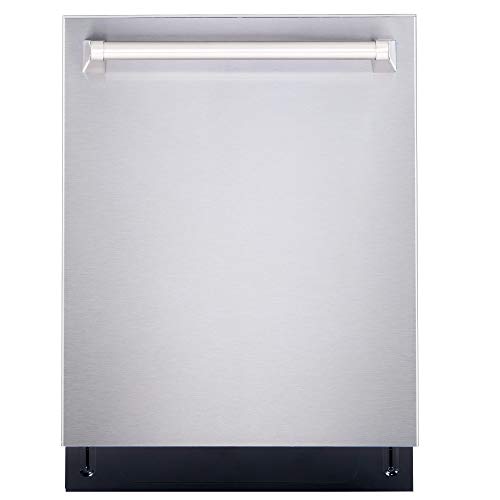
The second Cosmo is the tall-tub variant of the same idea: a top-control built-in whose title states a Heated Dry Function, advanced sanitize technology, three racks, and a fingerprint-resistant stainless finish. Tall tub is a capacity claim about vertical space — the machine’s interior reaches higher, swallowing stockpots and tall serving platters that standard tubs refuse — and in a heated-drying guide it matters because big items are the ones that pool water in their bases and rims. Heat plus headroom is a considered pairing.
Fingerprint resistance, as with the rental guide’s logic, is a maintenance feature disguised as a cosmetic one: the door stays presentable with a wipe. Top controls keep the front clean and the settings safe from casual bumps, at the usual cost of hiding the display while a cycle runs. Between the two Cosmos, the choice is really about shape: this one’s tall tub for households whose cookware runs large, the Vista model’s recessed-handle flat front for households whose kitchen runs small and splashy.
- Width and tub: 24-inch built-in, tall tub, per the listing
- Drying: Heated Dry Function, stated in the listing title
- Racks: three racks, stated
- Wash extra: Advanced Sanitize Technology, as named in the listing
- Controls: top control
- Finish: fingerprint resistant stainless steel
- Where to buy: find the Cosmo COS-DIS6502 listing on Amazon — check price on Amazon on the page
Strengths
- Tall-tub headroom plus stated heated dry handles the biggest, wettest items in a family kitchen.
- Three racks keep cutlery out of the lower rack’s valuable floor space.
- Fingerprint-resistant stainless keeps a high-traffic door looking kept rather than handled.
Trade-offs
- As with its sibling, no decibel figure is stated in the title.
- Tall tubs can make the top rack a stretch for shorter users when fully loaded.
- Top-control displays hide during the cycle, so progress checks mean opening the door a crack.
Best for: keen cooks with tall cookware who refuse to hand-dry the stockpot ever again.
Not the right match for: compact kitchens where a standard tub already swallows everything the household owns.
SPT SD-9254SSB 18-Inch Dishwasher — Heated drying, slim frame
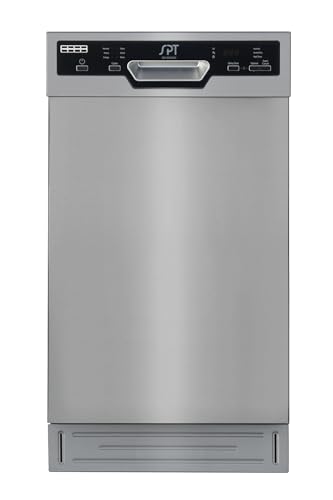
The SPT is the pick that disproves the assumption baked into most drying advice — that heated drying belongs to big machines. Its title states the words directly: an 18-inch wide built-in with Heated Drying, six wash programs, eight place settings, and a stainless steel tub, carrying an ENERGY STAR label. In a small kitchen, where the dishwasher often serves a household of one or two whose loads are disproportionately plastic — meal-prep tubs, water bottles, lunch boxes — heated drying is arguably more valuable than in a family kitchen, because there is no spare counter for a draining rack of wet containers.
The stainless tub in a slim machine is a grown-up specification; small machines are where makers usually hide plastic interiors. Six programs across eight place settings is a sensible ratio, and the width solves the cabinet problem that defines flats, cottages, and annexes. If your kitchen has the narrow gap, this is the heated-dry answer that fits it without apology or compromise on the drying mechanism itself.
- Width and capacity: 18-inch built-in, 8 place settings, stated in the listing
- Drying: Heated Drying, stated in the listing title
- Tub: stainless steel
- Programs: 6 wash programs
- Efficiency label in the listing: ENERGY STAR
- Where to buy: the SPT SD-9254SSB listing on Amazon — check price on Amazon there
Strengths
- True heated drying, stated outright, in the slim width small kitchens actually have.
- Stainless tub at 18 inches is a specification many full-size machines fail to match.
- An efficiency label stated in the title suits bills-conscious small households.
Trade-offs
- Eight place settings is a hard ceiling; dinner-party loads need a second run or a sink strategy.
- Slim machines concentrate their parts; confirm local service before buying for a remote property.
- No noise figure is stated in the title, so open-plan studio dwellers are buying quiet on faith.
Best for: small households in narrow kitchens whose plastic-heavy loads made them search for heated drying in the first place.
Poorly suited to: families of five, whose volume would turn this neat machine into a twice-nightly marathon runner.

EdgeStar 18-Inch Built-In Dishwasher — Heated dry with a leakage sensor
EdgeStar’s slim machine pairs the guide’s headline feature with the rental guide’s headline feature: the title states Heated Dry and a leakage sensor in the same specification breath, alongside eight place settings, six wash cycles, a slim design, and a digital display. That pairing is thoughtful product design for small homes, because slim dishwashers are so often installed in converted spaces — above finished rooms, over old floorboards, in annexes — where a leak’s cost is out of all proportion to the machine’s size.
The digital display is the other small-space courtesy: in a studio or a one-room annex, the machine is furniture, and a clear display that says what the cycle is doing beats a row of cryptic lights. Six cycles for eight place settings mirrors the SPT’s sensible ratio. Between the two slim picks, the decision is tub versus sensor: the SPT states a stainless tub, the EdgeStar states leak protection, and both state the heated dry that brought you to this guide. Choose by which risk your building fears more — slow interior wear or sudden water.
- Width and capacity: 18-inch built-in, 8 place settings, stated in the listing
- Drying: Heated Dry, stated in the listing title
- Protection: leakage sensor, stated in the listing
- Cycles: 6 wash cycles
- Controls: digital display
- Efficiency label in the listing: Energy Star Rated
- Finish: black
- Where to buy: the EdgeStar 18-inch listing on Amazon — check price on Amazon before ordering
Strengths
- Heated dry plus a stated leakage sensor is a pairing no other pick in this guide offers.
- A digital display suits the studio and annex installs where slim machines live.
- Efficiency is stated in the title, which helps where utilities are bundled into rent.
Trade-offs
- The listing does not state a stainless tub, so long-term interior wear is a question to put to the seller.
- Eight place settings caps the household size this machine can serve gracefully.
- Black finish in a white small kitchen can look heavier than the room wants.
Best for: annexes, conversions, and small flats where a leak would land on a finished room below.
A weak match for: buyers whose first question is tub material and who read a missing claim as a missing feature.
Drying Methods, Honestly Labelled
| Pick | Drying as stated | Size | Standout stated extra |
|---|---|---|---|
| Sharp SDW6504MS Dishwasher | Heated Dry | 24-inch, 12 place settings | Hybrid tub; pocket handle |
| Sharp SDW6757ES Dishwasher | Heated Dry Option | 24-inch | Soil sensors; Power Wash Zone; 45 dBA stated |
| Cosmo COS-DWV24TTR Built-In Dishwasher | Heated Dry Function | 24-inch | Three racks; sanitize technology |
| Cosmo COS-DIS6502 Dishwasher | Heated Dry Function | 24-inch tall tub | Three racks; fingerprint resistant |
| SPT SD-9254SSB 18-Inch Dishwasher | Heated Drying | 18-inch, 8 place settings | Stainless steel tub |
| EdgeStar 18-Inch Built-In Dishwasher | Heated Dry | 18-inch, 8 place settings | Leakage sensor; digital display |
The Rival Classes: Condensation, Fan, Door-Open, and Mineral Drying
Condensation drying is the European school: a very hot final rinse heats the dishes, a stainless tub stays cooler than the load, and moisture condenses on the tub walls and drains away. On glass and ceramic it is genuinely good and uses no extra energy, which is why its makers defend it fiercely. Its weakness is the physics from earlier in this guide — plastic never gets hot enough to dry itself — and its second weakness is time, since the process wants the door left closed while impatient households open it and release the steam onto the load instead.
Fan drying adds moving air, sometimes with a small heater in the airstream and sometimes not, which is why fan claims need the same title-level scrutiny as everything else in this guide. Auto-door-open designs pop the door at the cycle’s end and let room air finish the job; they are effective, cheap to run, and slightly unnerving the first time the door breathes open by itself at midnight. At the premium end, mineral and heat-pump systems — zeolite is the name most often attached — store and release heat with impressive efficiency, but they live in a different price conversation and, crucially, none appears in this guide’s verified pool with a heated-dry title claim, so they are context here, not picks. The maintenance-free promise of the frost-free world has an analogue in this debate, and readers comparing big kitchen appliances may enjoy how Best Frost-Free Freezers handles a similar gap between a label and the mechanism behind it.
How Much Energy Does the Heated Finish Actually Use?
Less than folklore says, and more than nothing. The drying element runs for the final portion of the cycle, and its consumption is real but bounded — the honest comparison is not against zero but against the alternatives households actually use when dishes come out wet: a second heated cycle out of frustration, a tumble of tea towels through the laundry, or a countertop drying rack occupying the workspace forever. Selectable heated dry, like the Sharp SDW6757ES states, is the thrifty expression of the feature: pay the heat only on the loads whose contents need it. Default-on heated dry, by contrast, spends the same energy drying stoneware that would have dried itself, which is where the waste stories come from.
There is also a load-shape saving available free of charge. Plastic items angled so their rims and bases cannot pool water dry dramatically better in any heated machine; a tub loaded flat-side-up is a fleet of tiny ponds that no element can fully evaporate. Teach the household the tilt habit and even a mid-range heated cycle starts performing like a premium one. Drying, more than washing, rewards the loader.
Water temperature at the tap plays a supporting role that rarely gets credited. A machine filling with properly hot water starts its wash closer to temperature, rinses hotter, and hands the drying phase a warmer load; a machine fed by a long, cold pipe run spends its first minutes warming the plumbing instead of the plates. If a new heated-dry machine disappoints in a house with a distant water heater, run the hot tap at the sink until it warms before starting the cycle for a week and compare — an old installer’s trick that still separates a machinery problem from a house problem more cheaply than any diagnostic visit.
Loading for Dryness: A Short Field Manual
Angle everything that can hold water. Bowls go in tilted, mugs lean, and plastic tubs sit at a slope with their open faces toward the tub’s centre where the heated air circulates. Keep a finger’s width between items; nested spoons and stacked tubs create private weather systems that stay wet through any cycle. Put the most plastic-heavy items where your machine’s element or vents do their work — the manual names the zone, and it is rarely the corners. Unload the bottom rack first, because tipping the top rack’s pooled water down over dry lower dishes is the classic own goal of the morning routine. And when the cycle ends, give a heated machine its few minutes: opening the door at the beep releases the very air that was finishing the job.
None of this rescues a condensation machine’s plastic problem — physics is physics — but in a heated machine it is the difference between dry and nearly dry, and nearly dry is where most complaints actually live. Households that adopt the tilt and the wait usually stop shopping for a new dishwasher within a fortnight, which is either this guide’s failure or its finest success, depending on how you count. The same load-it-properly sermon applies across the premium kitchen, incidentally — the capacity claims in Best High-End Wall Ovens reward exactly the same habit of reading what a cavity can truly hold rather than what its badge implies.
Heated Dry and the Loads That Need It Most
Some loads make the case for heated drying better than any specification sheet. Baby bottles and pump parts top the list: they are plastic, they are numerous, they are needed again within hours, and they must be properly dry before storage because a sealed bottle put away damp is a small biology experiment. A heated finish turns that turnaround from a draining-rack shift system into a single cycle. Meal-prep households run a close second — a Sunday batch of tubs and lids that must be dry before the week’s food goes in, on a deadline set by the cooking itself. Lunch-box families live the same story at smaller scale, nightly.
At the other end of the seriousness scale sit the loads that merely benefit: the plastic chopping boards that otherwise lean against the tiles all evening, the sports bottles with their narrow necks that air-drying never quite reaches, the storage canisters whose lids seal in whatever moisture the cycle left behind. None of these justify a purchase alone. Together, across a year of evenings, they are the difference between a dishwasher that finishes the job and one that hands the last ten percent back to you with a tea towel. Heated drying is best understood as buying back that ten percent, every load, for the life of the machine.
There is one more beneficiary rarely mentioned: the machine itself. A tub dried by heat between cycles smells fresher across the week than a tub left damp behind a closed door, particularly in warm climates and in machines run every other day rather than daily. Owners of condensation machines learn to leave the door ajar as a countermeasure; heated-dry owners get much of that benefit from the cycle itself, though the ajar habit harms no one and helps every design.
Small Kitchens, Hot Air: Ventilation and Heat Manners
A heated cycle ends by releasing warm, moist air somewhere, and in a small kitchen that somewhere is the room you are standing in. Machines that vent at the door add a noticeable puff of warmth at the cycle’s close; in a winter cottage that is a trivial pleasure, and in a summer studio flat it is worth knowing about before you schedule the machine to finish as you come home. Small spaces are no reason to skip heated drying — the two 18-inch picks exist precisely for those spaces — but it argues for running the cycle while a window is open or the extractor is on, habits that cost nothing and keep a compact kitchen’s air honest.
Heat manners also apply inside the tub. The racks nearest the element dry fastest and hottest, which is why glass and ceramic belong low and plastics ride high in most designs — the manual’s loading diagram is written by people who know where their machine’s heat lives. Households that load by that diagram, rather than by the archaeology of the sink, get the drying they paid for. Households that load by momentum get a randomised result and a firm opinion that heated drying is oversold, which is how good mechanisms acquire bad reputations.
One small ritual closes the subject: when the cycle ends in a small kitchen, open the door fully for the first minute of unloading rather than cracking it and wandering off. The burst of warm air escapes in one honest gust instead of condensing slowly on the nearest cold surface — which, in a compact kitchen, is often the underside of a wall cabinet that would rather stay dry. It is a two-second habit, and like most of this guide’s advice it costs nothing but attention.
Slip-Ups That Make Heated Dry Look Broken
The commonest is expectation drift: a buyer reads heated on the door of a machine whose title actually promised a fan, then concludes heated drying is a myth. Read titles the way this guide does. Second is rinse-aid neglect — heated air evaporates water, but water that sheets instead of beading dries faster and cleaner, and an empty rinse-aid reservoir quietly sabotages every method. Third is the overfilled top rack, where pooled water on tub bases rains onto the dry load below at unloading. Fourth is selecting the quick cycle for a plastic load and blaming the dryer, when quick cycles commonly shorten or skip the heated finish. Fifth is unloading top-first, the own goal described above, repeated daily in kitchens that then swear their machine cannot dry.
Rinse Aid and Water: the Chemistry Under the Heat
Heated air evaporates water; it does not negotiate with it. Water that beads into droplets on a plate presents a thousand tiny evaporation jobs and leaves a mineral freckle behind for each one. Water persuaded by rinse aid to sheet off the surface leaves in a film, taking most of its minerals with it, and the heated finish then has a fraction of the work. This is why the same machine can be praised in one street and cursed in the next: soft-water households with full rinse-aid reservoirs live in the machine’s best world, while hard-water households running the reservoir dry are asking heat to fix a chemistry problem. If your glasses dry spotty in a heated machine, refill and adjust the rinse-aid dose before you blame the element — and descale on the schedule your water hardness demands, because a scaled element heats unevenly and dries patchily.
Salt reservoirs, where a machine has one, belong to the same story: softened water rinses cleaner, sheets better, and lets the drying phase start from a better position. None of these consumables is glamorous, and all of them are cheaper than a replacement machine bought to solve a maintenance problem. The heated-dry buyer’s starter kit is therefore unglamorous too — rinse aid in the reservoir, salt if the machine takes it, a descaler on the calendar — and households that keep it rarely meet the failure modes that fill review pages.
Shared Houses, Nurseries, and Other High-Turnover Loads
Some kitchens wash for a population rather than a family, and their drying needs sharpen accordingly. A nursery or childminding kitchen cycles bottles, beakers, and snack tubs at a tempo where a draining rack becomes a bottleneck and a hygiene question; heated drying closes the loop inside the machine, which is why the sanitize-plus-heated-dry combinations among the picks — both Cosmos state sanitize technology beside their Heated Dry Function — suit those settings beyond their domestic brief. Shared student houses present the opposite discipline problem: nobody owns the load, everybody needs a dry mug, and the machine that finishes driest wins the only review that matters, which is whether the next person can use a cup without shaking it.
Guest houses and holiday lets sit between the two: turnover loads of mixed crockery, run by staff against a clock, where a heated finish removes the hand-drying line from the changeover routine entirely. In each of these settings the argument is the same one this guide has made from the first paragraph — plastic and pace are what heated drying is for — and the settings differ only in how much a wet load costs them. A family loses minutes; a nursery loses a feeding round; a let loses a review point. The mechanism does not care which currency you count in.
How Dishwashers Learned to Dry: a Short, Instructive History
The first generations of domestic dishwashers barely dried at all; they washed hot, drained, and left the rest to a tea towel, and nobody complained because the alternative was the sink. The heating element entered as the obvious fix — the same coil that heated the wash water could bake the load afterwards — and for decades heated dry was simply what dishwashers did, particularly in the American market. The European school diverged on energy principle, refining condensation drying until it was genuinely good on everything except plastic, and for a while the two schools talked past each other in exactly the way neighbours still do: one side’s owners swearing their dishes emerge dry, the other’s swearing theirs emerge wet, both telling the truth about different loads.
The modern market scrambled the schools together. Energy labels rewarded machines that skipped the element; marketing departments kept the word dry on every box; plastics flooded family kitchens and quietly changed what drying had to accomplish. The result is the vocabulary fog this guide opened with — and the reason a title-level rule, heated only where stated, cuts through thirty years of accumulated euphemism. Knowing the history will not dry a single plate, but it explains why the fog exists, and a buyer who understands the fog stops paying for it.
When Heated Dry Is Honestly the Wrong Answer
A guide that only sells its own subject cannot be trusted, so here is the case against. If your household washes stoneware, glass, and steel for two adults, eats from the same six plates in rotation, and owns four plastic tubs in total, a heated element buys you almost nothing that a hot final rinse and a cracked-open door would not deliver free. The money and the energy are better spent on the wash itself — a machine with the spray coverage and the rack sense your cooking actually needs. Likewise, if your kitchen’s loads run overnight and are unloaded at leisure in the morning, time is doing your drying for you, and every method in the rival-classes section performs better than its reputation when granted eight unhurried hours.
There is also the delicate-load argument. Heirlooms, hand-painted pieces, and anything with a gilt edge should not be in a dishwasher at all, but the marginal cases — good knives’ handles, wooden utensils someone insists on machine-washing — fare worse under a heated finish than under a gentle condensation cycle. A household full of such marginal cases may rationally choose the cooler dryer and hand-finish its few plastics. The point of this guide’s title discipline is not that heated dry wins everywhere; it is that when you decide you need it, you can identify the machines that truly have it.
The Sound of a Cycle Finishing
Drying has an acoustic signature that brochures ignore. A pure element is nearly silent — heat makes no noise worth naming — while fan-assisted systems add a soft blower note to the cycle’s final act, and door-open designs announce themselves with a mechanical sigh that startles guests and delights children. The stated figures among these picks belong to the wash rather than the dry: 52 dB for the first Sharp, 45 dBA for the second. In practice, households experience the dry phase as the quiet tail of the cycle, which is why heated drying suits overnight running in flats — the loud work is washing, and by the time the element takes over, the machine has mostly finished being heard. If your current machine seems to get louder as it dries, suspect a fan bearing or a vent, not the concept of drying itself, and let a technician confirm before the shopping begins.
Deciding Between the Six Without a Showroom
Strip the choice to four questions and the six picks sort themselves. First, width: measure the gap, because the 18-inch pair and the 24-inch four live in different kitchens and no feature crosses that line. Second, within your width, decide whether drying must be automatic or can be an option you select — that separates the two full-width Sharps more honestly than any other comparison, and it is a question about your household’s memory, not about machinery. Third, ask whether your loads are tall or wide: tall cookware points to the DIS6502’s tall tub, overflowing cutlery and utensils point to a third rack, which both Cosmos state. Fourth, name your building’s fear — a finished room below argues for the EdgeStar’s stated leakage sensor; a plastic tub interior’s slow ageing argues for the SPT’s stated stainless.
A fifth question belongs to households replacing a machine they already dislike: what, precisely, did the old one do wrong? If the answer is wet plastics, any pick here answers it. If the answer turns out to be noise, or rack layout, or a control panel nobody could read, then drying was never the real brief — and the honest move is to let that answer lead the purchase, with this guide’s stated heated dry as a requirement riding along rather than driving. Machines are replaced for the grievance, not for the brochure, and the buyers who name the grievance out loud are the ones still satisfied in year three.
Notice that price never appears in that sequence, deliberately. Within a guide built on verified titles, the differences that survive a decade are mechanisms and measurements, and those are what the four questions isolate. A buyer who answers them honestly will land on the right pick even if they never see the machines in person — which is fortunate, because slim built-ins in particular are rarely stocked on showroom floors, and most of these purchases are made, like this guide, from stated evidence.
What a Decade of Heated Cycles Does to a Machine
Honesty requires the long view. A drying element is a working component in a hostile room: it heats, cools, and gets splashed for years, and like a kettle element in hard water it can scale and eventually fail. That is not an argument against the feature — elements are among the more replaceable parts in a dishwasher, and the machines above are built by makers who expect the cycle to be used daily — but it is an argument for the descaling habit in hard-water districts and for treating a heated-dry machine’s tenth year with the same inspection rhythm you would give any hardworking appliance. The rival classes age differently rather than better: condensation machines lean on their tub seals and their owners’ patience, fan machines on a small motor, door-open designs on a latch mechanism that performs a small nightly ballet.
The correct conclusion is not that one class outlives the others. It is that drying method should be chosen for the loads you run, maintained for the water you have, and judged — as this guide has judged its picks — on what the manufacturer was willing to state in the title, in public, where it can be checked.
The First Fortnight: Testing Your New Machine Like a Reviewer
Give any new heated-dry machine a fair trial before judging it, and run the trial deliberately. In the first week, wash your worst load on purpose: the meal-prep tubs, the sports bottles, the plastic chopping board, loaded at the manual’s angles with rinse aid in the reservoir. Note what emerges dry, what emerges nearly, and where the nearly items sat — then move those items’ usual parking spots in the second week and test again. Most heated machines reveal a geography within a fortnight: a sweet zone where everything dries, corners where a stray tub keeps its puddle. Loading to that geography becomes habit faster than any resolution, and the machine’s reputation in the household is set by evidence rather than by the first morning’s luck.
Run one ceramic-only load with the heated finish off or unselected, too, if your machine allows the choice. That comparison teaches the household what the element actually contributes, which ends the abstract argument about whether it earns its energy. Households that have seen the side-by-side stop debating and start selecting intelligently — heat for plastic nights, restraint for stoneware nights — which is the entire philosophy of this guide compressed into a fortnight’s experiment in your own kitchen.
Final Recommendation
Buy the Sharp SDW6504MS if you want the feature without a fuss: stated Heated Dry, family capacity, five honest cycles. Choose the SDW6757ES if you will actually use a selectable option and value the stated 45 dBA. The Cosmos split by shape — three racks and a flat front from the Vista model, tall-tub headroom from the DIS6502 — and the slim pair split by priority, stainless tub from the SPT or a leakage sensor from the EdgeStar. Every one of them states its drying in its title, which is the discipline that matters. A heated element will not fix bad loading, but for the household drowning in wet plastic, it remains the only mechanism that answers the actual physics of the problem.
Frequently Asked Questions
Does heated drying damage plastic items?
Dishwasher-safe plastics are made for the environment a heated cycle creates, and the top rack — furthest from the element — is their home. Items not marked dishwasher-safe can warp under any hot cycle, heated dry or not, so the marking on the item, not the drying method, is the guide.
Why do some listings say dry without meaning heated?
Because dry describes a result every method claims, while heated describes a mechanism only some machines have. Condensation, fan, and door-open systems all dry ceramic well. This guide’s rule — heated only where the title states heated — exists precisely because the vocabulary is slippery.
Is a selectable heated-dry option better than always-on?
For mixed households, usually yes: ceramic loads skip the energy, plastic loads take the heat. The cost is human — someone must remember to select it — which is why the Sharp SDW6757ES suits deliberate households and the always-ready SDW6504MS suits forgetful ones.
Can heated drying be added to an existing dishwasher?
No. The element, its controls, and its safety systems are built into the machine’s design and certification. If drying is the grievance, the realistic routes are loading technique, rinse aid, and eventually a machine whose title states the mechanism you want.
Do 18-inch dishwashers really offer heated drying?
Two in this guide state it in their titles: the SPT SD-9254SSB says Heated Drying and the EdgeStar says Heated Dry. Small width limits capacity, not mechanism, and for plastic-heavy small households the combination is exactly right.
Will a heated cycle fade or stress everyday dishes?
Everyday ceramic, glass, and stainless steel are made for dishwasher heat, wash and dry alike; the items genuinely at risk are the ones that should not be machine-washed at all — gilt edges, hand-painted pieces, glued handles. Keep those at the sink, and the heated finish is safe company for everything else in a normal load.
How will I know the heated dry is actually working?
Run the plastic test from this guide’s fortnight trial: a load of tubs and bottles, loaded at an angle, with rinse aid in the reservoir. In a working heated machine they emerge dry or within a shake of it. If they emerge beaded while glass and ceramic emerge hot and dry, the drying phase — not the wash — needs a technician’s eye.
Related Guides
Drying is one front in the larger war between a kitchen and water in the wrong places; ventilation is another. Our live guide to Best Ultra-Quiet Range Hoods applies the same stated-figures discipline to the steam that leaves your hob, and it is a natural next read for anyone refitting a kitchen around honest specifications.


