What's inside
- Key Takeaways
- Quick Picks
- How did we choose hoods for a quiet list when most titles hide the noise number?
- Side-by-side: airflow, mounting, and what is actually published
- Why does the same hood sound calm in one kitchen and harsh in another?
- What should you check in your cabinets and ductwork before ordering?
- Can a quiet hood still handle a smoky sear or a big stockpot?
- How do you test a hood’s noise honestly before and after buying?
- What changes when the kitchen is open-plan?
- What maintenance keeps a quiet hood quiet year after year?
- What does a quiet hood change about how a household cooks?
- A short buyer’s checklist for the quiet-hood decision
- Which mistakes turn a quiet hood into a loud disappointment?
- Final Recommendation
- Frequently Asked Questions
- Related Guides
As an Amazon Associate I earn from qualifying purchases. This post may contain affiliate links at no extra cost to you.
cottageverdict.com is reader-supported. When you buy through links on our site, we may earn an affiliate commission.
Every hood below is sold on Amazon, and each pick links to its own listing there so you can check price on Amazon before you commit. Start with the Broan-NuTone if a published noise figure matters most to you, or the Dalxo if you need wall-mount coverage over a wider cooktop.
The best ultra-quiet range hoods solve a contradiction: a fan strong enough to pull steam and grease out of the air is, by physics, a fan that moves air fast enough to be heard. What separates a genuinely quiet hood from a loud one wearing a quiet label is not magic. It is motor placement, duct diameter, fan design, and, above all, honesty about numbers. Here is the uncomfortable truth this guide is built around: most listings that use the words ultra quiet publish no noise figure at all. Of the six hoods verified for this guide, exactly two state a measured sound level in their titles. The Broan-NuTone under-cabinet hood states 1.5 sones, and the COMFEE’ under-cabinet hood states 65 dB. The other four use words like low noise or ultra quiet without a number you can hold them to. That does not make them bad hoods. It does mean you should read their quiet claims as marketing language and their airflow, ducting options, and filter design as the verifiable part of the listing.
Sones and decibels are also not interchangeable, which trips up many buyers. Sones are a perceived-loudness scale used by the ventilation industry, where doubling the sones roughly doubles how loud a fan sounds to your ear. Decibels are a physical sound-pressure measurement. A hood rated in sones at its working speed tells you something practical about conversation in your kitchen; a decibel figure without a stated speed or distance tells you less. Throughout this guide, airflow is quoted in CFM only where the manufacturer’s title states it, and noise is quoted only for the two picks that publish it. Everything else is described in terms of design choices that genuinely affect sound: larger ducts, lower everyday speeds, dual motors that can loaf instead of strain, and baffle filters that keep airflow smooth instead of turbulent.
Key Takeaways
- Only two of the six verified picks publish a noise figure: the Broan-NuTone at 1.5 sones and the COMFEE’ at 65 dB. Every other quiet claim in this class is unnumbered.
- Airflow here runs from 350 CFM on the Broan-NuTone to 600 CFM on the dual-motor under-cabinet pick, and CFM is quoted only from manufacturer titles.
- Ducted installation is almost always quieter than ductless recirculation at the same speed, because the air leaves instead of pushing back through charcoal.
- Running a stronger hood on a low speed is usually quieter than running a weaker hood flat out, which is why the 580 and 600 CFM picks earn their place in a quiet guide.
- Under-cabinet models dominate this class; the Dalxo and VIKIO HOME are the wall-mount exceptions for kitchens without a cabinet run over the stove.
Quick Picks
| Pick | Badge | Why it earned its place |
|---|---|---|
| Dalxo Ultra Quiet 36-Inch Wall Mount Range Hood | Widest quiet coverage | A 36-inch wall-mount canopy with 580 CFM stated, aimed squarely at apartments and small condos that still cook seriously. |
| Broan-NuTone 30-Inch Under Cabinet Hood (350 CFM, 1.5 Sones) | The documented quiet pick | The only pick here with a published sones rating: 1.5 sones at a stated 350 CFM, from an established ventilation brand. |
| COMFEE’ 30-Inch Under Cabinet Range Hood | Slim fit, stated decibels | A slim convertible hood that states 65 dB in its title, with a reusable filter and a three-speed fan for tight spaces. |
| CIARRA 30-Inch Under Cabinet Range Hood | Renter-flexible convertible | A convertible ducted-or-ductless under-cabinet hood with a three-speed fan, framed by its maker for apartment cooking. |
| VIKIO HOME 30-Inch Wall Mount Range Hood (580 CFM) | Wall-mount headroom | A 30-inch wall-mount hood stating 580 CFM with touch control and LED lighting, for stoves without cabinets above. |
| 30-Inch Under Cabinet Range Hood (600 CFM, Dual Motor) | Dual-motor cruise power | The strongest under-cabinet pick here: 600 CFM stated, dual motors, baffle filters, and top or rear venting. |
How did we choose hoods for a quiet list when most titles hide the noise number?
We started from verified listings and read every title the way a skeptical engineer would. A pick could enter this guide three ways: by publishing an actual noise figure, by pairing strong stated airflow with design features that let it work at low speed, or by offering ducted and ductless flexibility so the installer can choose the quieter path. Hoods that offered nothing but the word quiet, with no airflow figure, no ducting detail, and no filter information, were left out. What survived is a spread of real kitchen situations: two slim under-cabinet hoods for apartments, a numbered-sones Broan-NuTone for buyers who want proof, two 580 CFM wall and under-cabinet options for serious cooks, and a 600 CFM dual-motor model that can idle through most meals.
We also weighed where each hood sits in a real renovation. If your project is growing toward higher-output cooking later, the step up in capture and blower design is mapped in Best Pro-Style Range Hoods With Blowers, and it is worth reading before you size your ductwork, because duct choices made now decide how quiet any hood can be later. Noise, in other words, is a system property. The hood is one part; the duct run, the number of elbows, and the makeup air in a tight modern house are the rest. A careful installer can make a mid-priced hood sound refined, and a careless one can make an expensive hood roar. The picks below were chosen to give that installer good raw material: smooth baffles, sensible speeds, and honest specifications where the manufacturer provides them.
One more filter shaped this list: every pick had to make sense at the speed of an ordinary dinner, not only at its maximum. A hood that is calm only in a laboratory sense, on a speed nobody cooks at, fails the household test. That is why the guide keeps returning to working speeds, duct condition, and filter state, the three variables that decide whether any of these six hoods sounds like the quiet appliance its name promises once it is screwed into your cabinetry and asked to clear a Tuesday. The specification gets a hood onto this list; the installation decides whether it deserves to stay there.
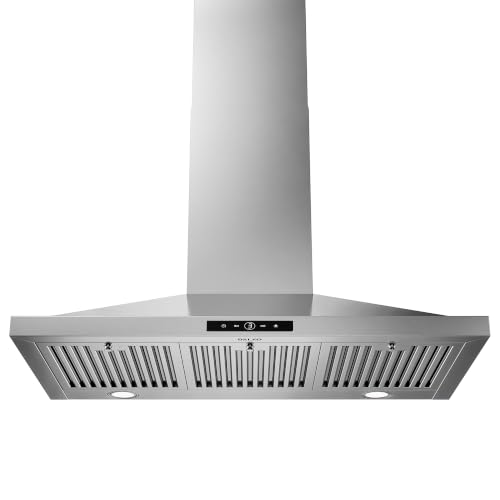
Dalxo Ultra Quiet 36-Inch Wall Mount Range Hood — Widest quiet coverage
The Dalxo is the hood in this set designed for the kitchen that has no cabinet run to hide under. Its 36-inch wall-mount canopy covers a wider cooktop than the 30-inch under-cabinet majority here, and its title states 580 CFM with both ducted and ductless installation paths. Dalxo also states that no makeup air is required, a line aimed at condo and apartment rules, and a nine-minute delay-off that lets the fan finish clearing the room after you have sat down. Touch controls keep the front face smooth and wipeable, which matters more on a wall canopy than on a hidden under-cabinet unit, because this hood is a visible piece of the kitchen.
On noise, be precise: Dalxo uses the words ultra quiet but publishes no sones or decibel figure in its title, so its quiet claim is unnumbered. What supports a calm experience is the headroom logic. A 580 CFM canopy clearing an ordinary dinner at a middle setting is working well inside its envelope, and the canopy shape itself helps, gathering the plume over front burners instead of letting it spill past a shallow cabinet-depth body. Choose it for the geometry and the flexibility, and let a careful ducted installation deliver the quiet the title promises in spirit.
Ownership details favor the Dalxo more than its headline suggests. The nine-minute delay is the feature owners end up praising, because it matches how kitchens actually clear: the pans stop steaming the moment they leave the heat, but the room holds a warm, fragrant fog for several minutes afterwards, and a fan that finishes that job alone is a fan that gets used. The two-filter arrangement keeps the grease path short and washable. In a small condo, where the kitchen opens onto the living space and a loud hood taxes every conversation in the home, a wide canopy that can work gently is worth more than its specification suggests.
- Mounting: wall mount canopy, 36 inches wide
- Airflow: 580 CFM, as stated in the manufacturer title
- Ducting: ducted or ductless convertible
- Controls: touch control panel
- Extras: 9-minute delay-off, two filters, no makeup air required per title
- Where to buy: the Dalxo Ultra Quiet 36-Inch Wall Mount Range Hood listing on Amazon — check price on Amazon
Strengths
- Widest coverage in this guide for larger cooktops
- Strong stated airflow with room to run below maximum
- Ducted or ductless installation suits condos and rentals
Trade-offs
- No published noise figure despite the ultra-quiet name
- Wall-mount chimney needs a clear wall and ceiling path
- Too wide to suit a standard 30-inch cabinet gap
Best for: apartment and condo kitchens with a 36-inch cooking span and no cabinets over the stove.
Not suited for: a 30-inch under-cabinet slot, where this canopy simply does not belong.
Where to buy: the Dalxo Ultra Quiet 36-Inch Wall Mount Range Hood listing on Amazon — check price on Amazon.

Broan-NuTone 30-Inch Under Cabinet Hood (350 CFM, 1.5 Sones) — The documented quiet pick
If this guide has a headline act, it is this Broan-NuTone, because it does the one thing the rest of the class mostly avoids: it publishes its noise. The title states 350 CFM and 1.5 sones in the same breath, which gives you a claim you can compare, verify in spirit against the brand’s documentation, and hold in mind while you shop. One and a half sones is a genuinely low working figure, in the territory where conversation continues without raised voices. The stainless under-cabinet body is a modern, plain design that disappears under a standard 30-inch cabinet run, which is exactly where most American kitchens need their ventilation to live.
The trade is output. At 350 CFM this is the gentlest mover in the guide, sized for ordinary ranges and everyday cooking rather than six-burner heroics. For the household that sautes, simmers, boils pasta, and roasts, that output paired with a short, smooth duct run is entirely sufficient, and it will be used at full willingness rather than avoided for its roar. Broan-NuTone’s long presence in ventilation also means the model sits inside a mature ecosystem of parts and documentation. Buy this hood when proof matters more than peak power, and when your cooking is honest family cooking rather than nightly high-heat searing.
Living with the Broan-NuTone is mostly a story of not noticing it. The fan goes on before the pan, the meal cooks in clear air, and nobody at the table has registered the appliance doing it. That invisibility is what the 1.5-sone figure buys in practice. It also ages gracefully: an established maker’s model tends to keep its documentation, parts, and replacement filters available for years, which matters for an appliance expected to outlive two kitchen refreshes. If your household includes a baby napping in the next room, a partner on calls in the open-plan space, or simply a cook who thinks while stirring, this documented calm is the pick that protects all three.
- Fit: mounts beneath a cabinet, 30 inches across, stainless finish
- Airflow: 350 CFM, as stated in the manufacturer’s title
- Noise: 1.5 sones, as stated in the manufacturer’s title
- Design: modern low-profile under-cabinet body
- Best use: everyday cooking on standard residential ranges
- Where to buy: the Broan-NuTone 30-Inch Under Cabinet Hood (350 CFM, 1.5 Sones) listing on Amazon — check price on Amazon
Strengths
- Published 1.5-sone rating instead of an unnumbered claim
- Trusted ventilation brand with mature documentation
- Calm output matched to ordinary family cooking
Trade-offs
- Lowest stated airflow in this guide at 350 CFM
- Under-cabinet format only, no wall-mount option
- Heavy searing will push it to its limit
Best for: buyers who want a verifiable noise figure and cook ordinary weeknight meals.
A poor fit for: a high-output range worked hard every night, where 350 CFM runs out of headroom.
Where to buy: the Broan-NuTone 30-Inch Under Cabinet Hood (350 CFM, 1.5 Sones) listing on Amazon — check price on Amazon.

COMFEE’ 30-Inch Under Cabinet Range Hood — Slim fit, stated decibels
The COMFEE’ is the second pick in this guide willing to attach a number to its noise: its title states 65 dB alongside the word quiet. Read that figure with the caution this guide applies to all decibel claims, since the measurement method is not disclosed, but credit the intent. A stated number invites comparison; an adjective does not. The hood itself is a slim stainless under-cabinet design, ducted or ductless convertible, with a three-speed exhaust fan, a reusable filter, and a bright LED light. That combination is aimed at compact kitchens, apartments, and rental-friendly upgrades where vertical space under the cabinet is scarce and installation options must stay open.
Notice what the title does not state: airflow. No CFM figure appears, so this hood should be judged as a light-to-moderate duty appliance for ordinary cooking rather than a capture powerhouse. Within that honest frame it makes sense. The reusable filter keeps running costs down, the slim body preserves headroom over the stove, and the convertible ducting lets a renter recirculate today and a future owner duct the same hood tomorrow. If your cooking is weeknight-normal and your kitchen is small, the COMFEE’ offers a stated noise figure and a forgiving shape at the accessible end of this guide.
The COMFEE’ rewards a realistic owner. Its reusable filter asks for a wash rather than a purchase, its slim body asks for very little cabinet, and its three speeds ask for no learning curve at all. In a first apartment or a rental upgrade, those are the virtues that survive contact with real life. The stated 65 dB gives shoppers a comparison point that most of this class refuses to provide, and even read cautiously it signals a maker willing to be measured. Pair it with the shortest, smoothest duct route your kitchen allows, or run it ductless with fresh charcoal, and it will do its quiet work without ever becoming a project.
- Mounting: under cabinet, 30 inches wide, slim profile
- Noise: 65 dB, as stated in the manufacturer title
- Ducting: ducted or ductless convertible
- Fan: 3-speed exhaust fan
- Filter and light: reusable filter, bright LED light
- Where to buy: the COMFEE’ 30-Inch Under Cabinet Range Hood listing on Amazon — check price on Amazon
Strengths
- States a decibel figure where most rivals state none
- Slim body suits tight under-cabinet spaces
- Reusable filter keeps upkeep cheap and simple
Trade-offs
- No airflow figure published in the title
- Decibel method undisclosed, so compare cautiously
- Light-to-moderate duty rather than heavy capture
Best for: small kitchens and apartments that want a slim hood with a stated noise number.
Not the right match for: any smoky, high-heat cooking style that needs documented airflow first.
Where to buy: the COMFEE’ 30-Inch Under Cabinet Range Hood listing on Amazon — check price on Amazon.

CIARRA 30-Inch Under Cabinet Range Hood — Renter-flexible convertible
CIARRA’s under-cabinet hood is the pragmatist of this set. Its title promises a 30-inch stainless vent hood, convertible between ducted and ductless work, with a three-speed exhaust fan, and it names apartment cooking as its home turf. No airflow figure and no noise figure are published, and this guide will not invent either. What the CIARRA offers instead is installation freedom, which in many real kitchens is the deciding feature. A renter can run it ductless without touching the building’s fabric. A homeowner mid-renovation can install it now and duct it later when the wall is open. That flexibility keeps a decent hood in kitchens that would otherwise keep a microwave’s feeble fan or nothing at all.
Judge it, then, as an honest mid-duty appliance. Three speeds cover the realistic range from simmer to saute, the stainless body wipes clean, and the under-cabinet format preserves the standard kitchen layout. Its quiet performance will be decided mostly by your installation: ducted, with a smooth run, it will sound composed; ductless, pushing through charcoal, it will work audibly harder for the same clearing. If you can duct it, do. If you cannot, it still beats recirculating nothing, and its convertibility means the better path stays open when your housing situation changes. Few picks in this guide adapt to as many kitchens as this one does.
CIARRA’s hood is the one to hand a landlord, a renovator, or a first-time buyer whose housing plans are still moving. Installed ductless in a rental, it already improves on the recirculating microwave fan it usually replaces; carried to a owned home later, the same unit can be ducted and become a permanently better appliance. That second life is rare in this category and worth money. Its three speeds cover the cooking most apartments actually see, and its stainless face wipes down in seconds after a splattering meal. It asks little, adapts much, and leaves the documented-performance question to buyers whose kitchens have stopped changing.
- Mounting: under-cabinet, 30-inch span in stainless steel
- Ducting: ducted and ductless convertible
- Fan: 3-speed exhaust fan
- Airflow: no figure stated in the manufacturer title
- Noise: no figure stated in the manufacturer title
- Where to buy: the CIARRA 30-Inch Under Cabinet Range Hood listing on Amazon — check price on Amazon
Strengths
- Convertible ducting adapts to rentals and renovations
- Simple three-speed control covers everyday cooking
- Standard 30-inch under-cabinet fit
Trade-offs
- Publishes neither an airflow nor a noise figure
- Ductless mode will sound and perform less capably
- Mid-duty capture rather than high-output headroom
Best for: renters and apartment kitchens that need ductless now with a ducted option later.
Poorly suited to: a buyer who wants documented performance figures before spending.
Where to buy: the CIARRA 30-Inch Under Cabinet Range Hood listing on Amazon — check price on Amazon.

VIKIO HOME 30-Inch Wall Mount Range Hood (580 CFM) — Wall-mount headroom
The VIKIO HOME wall mount brings the Dalxo’s canopy logic down to a 30-inch span. Its title states 580 CFM, describes the noise as low without publishing a figure, and lists touch control, a three-speed fan, LED lights, and ducted or ductless convertibility in a stainless body. Wall mounting changes the capture story in the cook’s favor: a canopy projecting over the cooking surface catches the rising plume earlier than a shallow under-cabinet panel, especially from front burners. For an open-plan kitchen where the stove sits against a wall with no cabinet run, this is the natural shape, and the chimney becomes part of the room’s design rather than an appliance hidden in joinery.
As with the Dalxo, the quiet case rests on headroom rather than a published rating. Five hundred eighty stated CFM means ordinary meals clear on the lower half of the speed range, where any fan is at its most civilized, and the top speed remains for frying and searing. The convertible ducting keeps the ductless fallback available, though the same advice applies: duct it if the wall allows, because the chimney format makes a clean vertical run to the roof straightforward in many homes. Buy the VIKIO HOME when your stove has a wall and no cabinets, and when you want canopy capture without stepping up to a 36-inch span.
The VIKIO HOME canopy changes how a kitchen feels, not only how it smells. A wall chimney gives the cooking wall a focal point, and its LED lights put the cooktop in a pool of working light that under-cabinet strips rarely match for evenness. The 580 CFM reserve means the cook can sear on the front burners, the plume’s hardest test, and still hold a conversation at the island. Touch controls keep the chimney’s face unbroken and easy to wipe after a frying session. For a kitchen being designed rather than merely equipped, this is the quiet-class pick that contributes architecture as well as air.
- Mounting: wall mount canopy, 30 inches wide
- Airflow: 580 CFM, as stated in the manufacturer title
- Ducting: ducted or ductless convertible
- Controls: touch control, 3-speed fan
- Lighting: LED lights
- Where to buy: the VIKIO HOME 30-Inch Wall Mount Range Hood (580 CFM) listing on Amazon — check price on Amazon
Strengths
- Canopy geometry captures front-burner plumes well
- Strong stated airflow allows low everyday speeds
- Suits stoves with no cabinet run above
Trade-offs
- Low-noise claim carries no published figure
- Chimney installation is a bigger job than under-cabinet
- Needs wall space and ceiling height to look right
Best for: open-plan and cabinet-free stove walls that still cook with ambition.
A weak match for: a standard cabinet run, where an under-cabinet pick fits with far less work.
Where to buy: the VIKIO HOME 30-Inch Wall Mount Range Hood (580 CFM) listing on Amazon — check price on Amazon.

30-Inch Under Cabinet Range Hood (600 CFM, Dual Motor) — Dual-motor cruise power
This unbranded-in-title under-cabinet hood states the highest airflow in the guide at 600 CFM, produced by dual motors in a stainless body with a three-speed fan, two LED lights, baffle filters, and a choice of top or rear venting in ducted or ductless configuration. The dual-motor layout is the interesting part for a quiet guide. Two motors sharing the work can move serious air without either one straining at its acoustic worst, and at the low speeds of daily cooking the pair can loaf. Baffle filters suit the output, handling grease from frying without the rapid clogging of fine mesh, and they tolerate dishwasher cleaning, which means they will actually get cleaned.
Top or rear venting is a quiet practical gift: many cabinet runs duct straight up, but older kitchens often vent through the wall behind, and a hood that offers both avoids the extra elbows that cost airflow and add noise. No noise figure is published, so the claim here is structural rather than documented, and this guide labels it as such. What is documented is output, filtration, and flexibility. If your cooking regularly involves frying, searing, or big pans on a 30-inch range, and your hood must live under cabinets, this is the pick with the headroom to stay calm about it. Install it ducted, keep the baffles clean, and it will spend its life cruising.
Under cabinets, this dual-motor hood is the one that behaves like a much larger appliance. The baffle filters are the detail cooks notice monthly: they lift out, go through the dishwasher with the roasting pans, and come back ready, so the grease path never becomes the chore that quietly ends filter maintenance in so many homes. Top or rear venting means the installer works with the house instead of against it, saving the elbows that cost both airflow and calm. Run it ducted, keep the baffles on a monthly rhythm, and its 600 stated CFM will spend years cruising at speeds where conversation never has to compete.
- Fit: mounts beneath a cabinet, 30 inches across, stainless finish
- Airflow: 600 CFM, as stated in the manufacturer title
- Motors: dual motor, 3-speed fan
- Venting: top or rear vent, ducted or ductless convertible
- Filters and lights: baffle filters, two LED lights
- Where to buy: the 30-Inch Under Cabinet Range Hood (600 CFM, Dual Motor) listing on Amazon — check price on Amazon
Strengths
- Highest stated airflow among the under-cabinet picks
- Dual motors share load for calmer high-output work
- Top or rear venting avoids noise-adding duct turns
Trade-offs
- No published noise figure in the title
- Dual-motor output is wasted on very light cooking
- Baffles need regular degreasing to stay quiet
Best for: keen cooks on a 30-inch range who fry and sear under a cabinet run.
Think twice if: a household that mostly reheats and simmers, where the Broan-NuTone’s documented quiet is the smarter spend.
Where to buy: the 30-Inch Under Cabinet Range Hood (600 CFM, Dual Motor) listing on Amazon — check price on Amazon.
Side-by-side: airflow, mounting, and what is actually published
Read the noise column carefully. Where it says no figure published, that is the manufacturer’s choice, not an omission in this table, and it is the single most useful fact in the comparison.
| Model | Mounting | Stated airflow | Noise figure in title | Ducting |
|---|---|---|---|---|
| Dalxo Ultra Quiet 36-Inch Wall Mount Range Hood | Wall mount, 36 inch | 580 CFM | No figure published | Ducted or ductless |
| Broan-NuTone 30-Inch Under Cabinet Hood (350 CFM, 1.5 Sones) | Under cabinet, 30 inch | 350 CFM | 1.5 sones | Ducted |
| COMFEE’ 30-Inch Under Cabinet Range Hood | Under cabinet, 30 inch | Not stated | 65 dB | Ducted or ductless |
| CIARRA 30-Inch Under Cabinet Range Hood | Under cabinet, 30 inch | Not stated | No figure published | Ducted or ductless |
| VIKIO HOME 30-Inch Wall Mount Range Hood (580 CFM) | Wall mount, 30 inch | 580 CFM | No figure published | Ducted or ductless |
| 30-Inch Under Cabinet Range Hood (600 CFM, Dual Motor) | Under cabinet, 30 inch | 600 CFM | No figure published | Ducted or ductless |
Why does the same hood sound calm in one kitchen and harsh in another?
Duct diameter is the first answer. A hood pushing its full output through an undersized duct creates back pressure, and back pressure becomes noise at the grille and vibration in the cabinet. When a manufacturer specifies a duct size, treat it as a minimum, not a suggestion, and resist any installer who wants to step it down to fit a joist bay without discussing the trade. The second answer is elbows. Every turn in the run adds resistance, and two tight elbows close to the hood can cost more quiet than the difference between two competing models. Keep the first section of duct straight for as long a run as the kitchen allows, use smooth rigid duct rather than flexible corrugated duct wherever you can, and make sure the roof or wall cap opens freely, because a stuck damper flutters and rattles at exactly the speeds you will use most.
The third answer is the cooking itself. A hood run at the speed the meal actually needs is a quiet hood; a hood left off until the pan is smoking, then slammed to maximum, is a loud one and a smoky kitchen besides. Turning the fan on a minute before food hits the pan establishes the airflow pattern while the fan is still on a gentle setting, and leaving it running for several minutes after cooking clears the lingering moisture that would otherwise settle on cabinets. Steam-heavy cooking rewards that patience too, and if you are planning meals around retained moisture and gentle heat, the approach in Best Home Steam Ovens pairs naturally with a hood that can clear the room afterwards without shouting over the table. Quiet, in daily use, is mostly a habit supported by a hood with enough headroom that the habit works.
What should you check in your cabinets and ductwork before ordering?
Measure the width of your cooktop first, then the space the hood must fill. Under-cabinet picks in this guide are 30-inch units that expect a standard cabinet run; the Dalxo at 36 inches wants a wider span and a wall behind it rather than cabinets above. Check the height from cooktop to cabinet underside, because slim hoods like the COMFEE’ and CIARRA exist precisely for tight vertical spaces, while a deeper hood body needs room you may not have. Then trace the duct. If your kitchen already vents through the roof or an outside wall, a ducted installation is open to you and will nearly always be the quieter and more effective choice. If you rent, or the stove sits on an interior wall with no practical route out, the convertible picks here can recirculate through charcoal filters, with the honest caveat that recirculation handles grease reasonably and moisture and odors only partially.
Electrical supply is simpler than buyers fear: these hoods are ordinary household appliances, but the outlet or junction box position still needs to land inside the cabinet or chimney space the design allows. Photograph the inside of the cabinet above your stove before ordering anything, note where the existing wiring and duct collar sit, and compare that photograph with the listing’s installation diagram. Ten minutes with a tape measure prevents the most common failure in this category, which is not a defective hood but a hood that does not fit the hole left by the old one. Finally, plan the filter routine on day one. Baffle filters that go in the dishwasher, like those on the 600 CFM dual-motor pick, stay clean in real households; filters that demand soaking and scrubbing quietly stop being cleaned, and a grease-loaded filter makes any fan work harder and sound worse.
Can a quiet hood still handle a smoky sear or a big stockpot?
Yes, if you separate capture from noise in your thinking. Capture depends on the hood’s size relative to the cooktop, how far it projects over the front burners, and whether the airflow pattern is established before the plume rises. A 580 or 600 CFM hood running at half speed moves roughly the air of a small hood at full speed, but with the fan turning slower and the sound profile lower and less strained. That headroom is the real quiet-cooking strategy, and it is why this guide includes hoods whose maximum output sounds excessive for a quiet list. You will rarely use the maximum. You will use the calm middle speeds every day, and the maximum will be there for the cast-iron sear, the wok night, and the holiday stockpot.
Front-burner cooking is the stress test. Most residential cooking happens on the front burners, farthest from the wall and closest to the edge of the hood’s capture zone. A wall-mount canopy like the Dalxo, with depth over the cooking surface, contains that plume better than a shallow under-cabinet body. If you sear often, weight that geometry as heavily as any airflow figure. And remember that a quiet hood cannot fix a missing makeup-air path in a very tight house: strong exhaust can pull against sealed construction and lose both power and composure. Most homes in this class of hood never reach that problem, but if your kitchen is part of a recent airtight renovation, raise the question with your installer before, not after, the first smoky test.
How do you test a hood’s noise honestly before and after buying?
Before buying, translate every claim into the same currency. A sones figure can be compared with other sones figures; a decibel figure only with decibels measured the same way, which you cannot verify; and an adjective with nothing. When a maker gives you a number, reward it in your shortlist, as this guide rewarded the Broan-NuTone and the COMFEE’. When a maker gives you an adjective, shift your attention to the things that predict sound in your kitchen: the duct you can provide, the speeds you will actually use, and the headroom between the hood’s maximum and your meals’ demands. Read owner discussions for the specific complaint pattern of noise at working speed, not for star summaries, and remember that a hood recorded on a phone in a tiled showroom tells you almost nothing about your own softer, furnished room.
After installation, test with a normal meal rather than a demonstration. Boil a large pot of pasta water with the lid off, which produces the pure steam load that reveals whether capture works at a gentle speed, and fry something aromatic on a front burner while someone reads aloud at the table. If the reader is comfortable and the room clears within the delay-off period, the system is right, whatever any single number said. If it is not, the fix is usually in the duct, the damper, or the mounting height rather than in the hood itself, and all three are cheaper to correct in the first month than after the kitchen is finished around them.
What changes when the kitchen is open-plan?
Open-plan living raises the stakes on every claim in this guide, because the hood’s audience is no longer just the cook. It is the homework at the island, the call in the corner, the film on the sofa, and the guests who arrived early and are standing, glasses in hand, exactly where the sound carries. In that setting the working-speed discipline matters more than any maximum figure: a hood with headroom, run early and gently, keeps the whole shared space livable, while a small hood at full tilt defends the stove and taxes the room. The wall-mount canopies in this set earn extra credit here, because they gather the plume before it enters the shared air at all.
Open plans also forgive less on the moisture side. Steam that a closed kitchen would hold until a window is opened now drifts toward bookshelves, upholstery, and artwork. A ducted route becomes close to non-negotiable for a keen cook in an open home, and the delay-off habit becomes the difference between a room that smells like dinner for an hour and one that smells like dinner until bedtime. Choose the hood for the room it will actually serve, not the room in the listing photograph, and open-plan cooking becomes the pleasure it was designed to be instead of a negotiation with everyone else in the house.
What maintenance keeps a quiet hood quiet year after year?
A hood’s sound changes across its life, and almost always for the worse, through mechanisms an owner can prevent. Grease is the first: it coats the fan wheel unevenly, and an unevenly coated wheel vibrates, and vibration is the sound owners describe as the hood getting louder with age. The defense is the filter rhythm this guide keeps prescribing, because filters are the gatekeepers that decide how much grease ever reaches the wheel. Wash baffles and mesh on schedule, replace charcoal before it saturates, and wipe the hood’s interior surfaces when the filters are out and the grease path is open in front of you. Ten minutes quarterly preserves the acoustic character you bought; neglect compounds silently until the fan itself needs professional attention.
The second mechanism is mechanical sympathy. Mounting screws relax, a damper begins to flutter, a duct joint that was taped instead of screwed starts to buzz at one particular speed. An annual five-minute inspection, running the fan through its speeds with a hand on the cabinet and an ear for new notes, catches all of these while they are still one-screw fixes. The third mechanism is the house itself changing around the hood: a kitchen sealed tighter by new windows, a more powerful range installed under an older hood, a duct cap painted shut by an overzealous exterior crew. When a quiet hood stops sounding quiet, ask what changed before blaming the motor, because the answer is usually in the system, and systems can be rebalanced.
Keep a simple record, because memory flatters appliances. Note the installation date, the filter type and size, the charcoal replacement dates if you run ductless, and the duct route’s particulars in the same kitchen drawer as the range’s manual. The next owner, the next installer, and your future self will all thank that page. Quiet, in the end, is a maintained condition rather than a purchased one, and the households that understand that are the ones still cooking in calm five years after the renovation dust settled.
What does a quiet hood change about how a household cooks?
The first change is timing. Households with loud hoods develop an avoidance pattern so gradual they never notice it: the fan goes on late, after the smoke is already visible, because turning it on means surrendering the conversation, the podcast, or the child’s story from the next room. A genuinely quiet hood breaks that pattern in the first week. The fan goes on when the pan goes on, almost as a reflex, because there is no cost to starting it, and that single habit improves capture more than any specification in this guide, since airflow established before the plume forms catches what a stronger fan started late will chase around the room. Cooks begin to sear more confidently, to fry without apologizing to the house, and to use the front burners they previously avoided because the old hood could not reach them without roaring. The kitchen’s repertoire quietly widens, which is an outcome no CFM figure ever promised and every quiet-hood owner reports.
The second change is social geography. In homes where the kitchen is the gathering place, a loud hood exiles people: guests drift to the far end of the island, homework migrates to bedrooms, and the cook works alone in a cone of noise during exactly the hours the household is together. A calm hood returns those people. The island becomes seating again during cooking, not just before and after, and the cook rejoins the conversation while still cooking, which changes the emotional texture of weeknight dinners more than any recipe. This is why this guide treated working-speed sound, documented where possible, as the class’s central specification rather than a luxury footnote: the number on the Broan-NuTone’s title and the figure on the COMFEE”s are, in lived terms, measurements of how much of your household’s evening the fan intends to tax.
The third change is the house’s background health. Moisture is the quiet enemy that a used hood defeats and an avoided hood surrenders to: pasta steam condensing in cabinet joints, frying vapor filming the ceiling paint, the slow seasoning of curtains and soft furnishings with last month’s dinners. A hood that runs at every meal, gently and without drama, exports that load before it settles, and the difference shows years later in paint, in cabinetry, and in how a home smells to a visitor at the door. None of that appears in a product title. All of it is what the six picks in this guide are actually for, and it is why the cheapest quiet hood used faithfully will outperform the finest one that a household cannot stand to switch on.
A short buyer’s checklist for the quiet-hood decision
Write five answers before you open a single listing. What width must the hood fill, measured from the cabinetry or wall it will actually meet? Which duct route can your kitchen honestly provide, and at what diameter? Which two picks in this guide match that route without conversion compromises? What will you cook on an ordinary Tuesday, and which speed will that meal use on each candidate? And finally, which candidate publishes the number you care about, or, if none does, which one’s headroom makes the missing number matter least? A buyer carrying those five answers is immune to most of this category’s marketing, because every claim a listing makes can be checked against a fact about their own kitchen rather than against a rival’s adjective.
Then make the installer part of the purchase. Send the chosen model’s duct specification to whoever will hang it before the unit arrives, confirm the route and the cap in the same conversation, and agree on the filter rhythm you will keep, in writing if the household needs the nudge. The six hoods in this guide span the quiet class’s real choices, from documented sones to dual-motor headroom, and every one of them can be the right answer in the kitchen it was chosen for deliberately. Deliberation, in this category, is not delay. It is the difference between buying a quiet hood and buying a hood with the word quiet on the box.
Keep the receipt of your reasoning, too: a note in the kitchen drawer recording which pick you chose, what number or headroom argument persuaded you, and what duct the installer actually fitted. Appliances outlive memories, and that note is how a future question about the hood gets an evidence-based answer instead of a guess.
Which mistakes turn a quiet hood into a loud disappointment?
The first mistake is buying on the word quiet alone. If a listing publishes no sones and no decibel figure, you are buying an adjective. The second is stepping the duct down or using a long run of flexible duct to make installation easier; both add turbulence and noise that no motor design can undo. The third is mounting an under-cabinet hood too high to preserve a sightline, which sacrifices capture and forces higher, louder speeds for the same result. The fourth is neglecting filters: grease-loaded baffles and saturated charcoal both raise resistance, and resistance is noise. The fifth is judging the hood in a showroom or a video. Sound perception depends on your room’s surfaces, and hard modern kitchens with stone counters and no soft furnishings make every fan sound sharper than it did in a carpeted test space.
Cold-weather cooking habits expose one more mistake: sealing the kitchen against drafts and then expecting a recirculating hood to clear steam. Recirculation returns moisture to the room, and in winter that moisture finds your windows. The insulation-minded reader will recognize the same physics discussed in Best Cold-Weather Backpacking Quilts: warm moist air and cold surfaces always negotiate, and the hood is where that negotiation starts. If your winters are long and your cooking is steamy, prioritize a ducted route even when it complicates the installation. The quiet you gain is real, and so is the dry window glass.
Final Recommendation
If you want the only fully documented quiet claim in this set, buy the Broan-NuTone and its published 1.5 sones at 350 CFM. If you want a slim apartment-friendly hood with a stated decibel figure, the COMFEE’ is the honest budget route. Cooks who need real capture headroom should look at the Dalxo for a 36-inch wall span, the VIKIO HOME for a 30-inch wall mount, and the dual-motor 600 CFM under-cabinet pick for the calmest high-output option under cabinets. The CIARRA suits renters and ductless kitchens that prize flexibility over published numbers.
A quiet kitchen is not bought in a single box; it is assembled from an honest hood, a generous duct, and the habit of starting the fan early — and the household that gets those three things right stops raising its voice over dinner.
Frequently Asked Questions
Are sones or decibels the better way to compare hood noise?
They measure different things. Sones describe perceived loudness on a linear scale your ear understands, while decibels describe sound pressure on a logarithmic scale. A sones rating at a stated speed, like the Broan-NuTone figure in this guide, is the more kitchen-useful number. A decibel figure is still useful for comparing two hoods measured the same way, but manufacturers rarely disclose their method, so treat any single decibel claim as approximate rather than exact.
Is a ductless hood louder than a ducted one?
Usually, yes, at the same airflow. In ductless mode the fan pushes air through charcoal filtration and back into the room, which adds resistance and turbulence. Ducted air leaves the house along a smooth path. If your kitchen allows a ducted route, it is the quieter and more effective choice for nearly every pick in this guide.
Why do some of these hoods publish no noise figure at all?
Because nothing requires them to, and an unnumbered claim like low noise cannot be contradicted. That is exactly why this guide flags the absence rather than filling it in. Judge those picks on airflow, ducting options, filter design, and the ability to run below maximum speed, all of which genuinely influence how loud a hood feels in use.
What speed will I actually use day to day?
For most meals, a low or middle setting. Simmering, reheating, and ordinary sauteing produce modest steam and vapor that a gentle speed clears easily. Reserve the top setting for searing, wok cooking, and frying. Choosing a hood with headroom, like the 580 and 600 CFM picks here, means those everyday speeds sit low in its range, which is where quiet actually lives.
How often should filters be cleaned to keep noise down?
Baffle and mesh filters should be degreased regularly, monthly in a busy frying household and every couple of months in a lighter one. A clogged filter raises resistance, and the fan answers resistance with effort and noise. Charcoal filters in ductless installations cannot be washed back to life and need periodic replacement instead.
Related Guides
A quiet hood earns its keep over a hardworking stove, so if you are choosing the cooking surface beneath it at the same time, Best 30 Freestanding Gas Ranges is the natural companion read. The six picks above cover the ventilation half of that pairing, from a documented 1.5-sone under-cabinet hood to a dual-motor model built to cruise.


