What's inside
- Key Takeaways
- Quick Picks
- How did we sort real copper claims from copper language?
- Copper field compared: construction as titled, mounting, and size
- Solid copper, copper shell, copper finish: what are you actually buying?
- How does copper age, and what care does a living finish need?
- What should you verify about the working parts before ordering?
- How do you design the rest of the kitchen around a copper hood?
- What should a buyer ask before handmade copper ships?
- Copper hoods and resale: what does a living-metal centerpiece do to a kitchen’s value?
- How do you photograph, light, and live with copper’s changing face?
- Before you commit to copper: a short checklist
- Which copper-hood mistakes do buyers regret most?
- Final Recommendation
- Frequently Asked Questions
- Related Guides
As an Amazon Associate I earn from qualifying purchases. This post may contain affiliate links at no extra cost to you.
cottageverdict.com is reader-supported. When you buy through links on our site, we may earn an affiliate commission.
The six copper hoods below each link to their own Amazon listing, where you can check price on Amazon and study the finish photographs closely. With copper, the photographs matter: hammering, patina, and tone vary by maker and by hand.
The best copper range hoods are bought with the eyes and justified with the engineering. Copper is the warmest metal a kitchen can wear, it changes slowly and gracefully with age, and a hammered copper canopy over a range becomes the room’s centerpiece whether you planned that or not. But this class is also a minefield of language, and this guide is built to walk you through it honestly. The verified titles divide into distinct kinds. CT Copper Tailor states handmade construction in 16-gauge copper. SINDA states hammered solid copper in its model’s name. The ZLINE KB4STX states, precisely, a copper shell over a convertible stainless steel hood. The remaining ZLINE picks are described in this guide exactly as their titles describe them, by series and model, without upgrading their wording into claims the titles do not make. A copper-colored finish, a copper shell, and a solid copper hood are three different objects at three different prices, and a buyer who knows which one is in the cart is a buyer who will still be pleased in five years.
One exclusion deserves naming, because it confuses searches in this class constantly. Listings exist for inserts and motors described with the word copper because the motor or internal components involve copper, and such a unit installed inside a wooden or stainless surround is not a copper hood in any sense a kitchen designer means. No such product appears in this guide, even in prose as a pick; the six below are hoods whose visible body is the subject. What follows weighs each on construction language, mounting, and stated performance, including the one explicit airflow figure in the set, the CT Copper Tailor’s 600 CFM, and treats finish and patina as the long-term ownership questions they are.
Key Takeaways
- Construction language differs by pick and is quoted exactly: handmade 16-gauge copper, hammered solid copper, and a stated copper shell are not the same thing.
- The CT Copper Tailor is the only pick whose title states an airflow figure: 600 CFM, with its insert included.
- Four picks are ZLINE Designer Series models, described here strictly by the series and model names in their titles.
- Mounting splits between wall and island; the island pick is the ZLINE 8GL2Hi at 36 inches.
- Copper’s patina is a living finish: expect tone to deepen and vary, which owners either prize or should avoid entirely.
Quick Picks
| Pick | Badge | Why it earned its place |
|---|---|---|
| ZLINE 36-Inch Designer Series Wall Mount Hood (KB2) | Designer Series wall presence | A 36-inch Designer Series wall-mount hood, model KB2, presented by its maker at series level. |
| ZLINE 30-Inch Hand-Hammered Wall Mount Hood (8KBH) | Hand-hammered texture | A 30-inch Designer Series wall hood whose title states the hand-hammered character of its surface. |
| CT Copper Tailor Copper Vent Hood (30.5-Inch, 600 CFM) | Handmade, fully specified | The most completely specified pick here: handmade 16-gauge copper, insert included, 600 CFM fan, medium patina. |
| SINDA Hammered Solid Copper Range Hood (30-Inch) | Solid copper, named system | Hammered solid copper in the model’s own name, with a centrifugal blower, liner, internal motor, and baffle filter stated. |
| ZLINE 36-Inch Hand Hammered Copper Island Hood (8GL2Hi) | Island centerpiece | A 36-inch island-mount hood in ZLINE’s hand-hammered copper Designer Series language, model 8GL2Hi. |
| ZLINE 30-Inch Hood With Copper Shell (KB4STX-C) | Honest copper shell | A convertible stainless hood with a stated copper shell and stainless handle: copper warmth, labeled exactly. |
How did we sort real copper claims from copper language?
We read every title as a contract. Where a title states a gauge, a construction method, or the word solid, this guide repeats it as the maker’s stated claim. Where a title states a shell, we say shell, prominently, because a shell hood can be a perfectly good purchase as long as it is bought knowingly. Where a title gives only a series and model, as with most of the ZLINE entries, we describe the hood by that series and model and by its mounting and size, and we do not decorate the description with construction claims the maker did not print. That discipline produced a list spanning the class’s real range: two overtly craft-built hoods, one honestly labeled shell design, and three Designer Series models whose appeal is their hammered and island forms.
Performance information is thin in this class and we refused to thicken it. Only one title states CFM. None state noise. So the guide judges the rest on what is verifiable: mounting geometry, width against your range, the inclusion or absence of an insert and fan, and the maker’s construction words. Readers extending a copper scheme beyond the kitchen will find the outdoor continuation in Best Outdoor Range Hoods, where one maker in this very guide builds for both rooms. Within these six, buy the construction story you can verify and the silhouette your kitchen can carry, in that order, and the copper will reward you for decades.
A note on price logic, since copper invites fantasy at both ends. This guide prints no prices, by design, but the construction ladder it teaches is also a price ladder: shell construction should cost like a stainless hood with a beautiful skin, series-level designer models like design objects, and handmade solid construction like the craft it is. When a listing’s price contradicts its construction language, believe the language and question the price, in either direction. The six picks here were chosen so that each rung of that ladder has an honest representative, and the reader who learns the ladder on these six can climb it safely anywhere else copper is sold.

ZLINE 36-Inch Designer Series Wall Mount Hood (KB2) — Designer Series wall presence
ZLINE’s KB2 is a 36-inch wall-mount hood from the maker’s Designer Series, and its title says exactly that and no more: series, mounting, size, and model. This guide honors that restraint by describing the KB2 as it is presented, a Designer Series wall hood at a generous width, without inventing construction or performance claims. In ZLINE’s Designer Series world, that presentation signals the design-led end of its range, where the hood is chosen as a kitchen feature in copper tones rather than as a utility appliance, and the 36-inch span gives it the presence to anchor a full-size range wall.
The buyer’s work with the KB2 happens on its listing: confirm the ventilation specification, finish details, and duct requirements there before ordering, because the title delegates those answers to the product page. What the title does guarantee is the format, a wide wall canopy from an established maker whose Designer Series is built around statement finishes. Choose the KB2 when the silhouette and the series are the point, your range is a full 36 inches, and you are comfortable verifying machinery details at the listing stage, as this guide recommends for every series-level pick.
The KB2’s 36-inch width deserves emphasis, because copper at standard 30-inch sizes can read as an accent, while at 36 inches it becomes the wall’s organizing feature, the object the rest of the kitchen’s metals and woods arrange themselves around. That scale suits the Designer Series intent. Pair it with a range of similar presence and warm materials nearby, and the room coheres. In a small, cool-toned kitchen the same hood could overwhelm, which is not a flaw in the hood but a fact about proportion. Copper rewards rooms that give it a stage, and the KB2 is built for the larger stage.
- Series and model: ZLINE Designer Series, KB2-HBXXX-36, per title
- Mounting: wall mount
- Width: 36 inches
- Airflow: not stated in the manufacturer title
- Construction detail: not further stated in the manufacturer’s title
- Where to buy: the ZLINE 36-Inch Designer Series Wall Mount Hood (KB2) listing on Amazon — check price on Amazon
Strengths
- Full 36-inch wall presence
- Designer Series design-led positioning
- Established maker with a broad support network
Trade-offs
- Title states no airflow or construction detail
- Specification must be verified on the listing
- Design-led pricing rather than utility pricing
Best for: 36-inch range walls where the hood is a chosen design feature.
Not suited for: a buyer who wants every specification settled by the title alone.
Where to buy: the ZLINE 36-Inch Designer Series Wall Mount Hood (KB2) listing on Amazon — check price on Amazon.

ZLINE 30-Inch Hand-Hammered Wall Mount Hood (8KBH) — Hand-hammered texture
The 8KBH’s title adds one precious word to the Designer Series formula: hand-hammered. That phrase describes a surface worked by hand, facet by facet, so the hood catches light unevenly and warmly in the way only hammered metal does. At 30 inches in a wall-mount format, it brings that texture to the standard range size, which makes it the most accessible of the overtly craft-character picks in this guide. Hammering is not merely decorative on copper; it is the traditional way the material is shaped and strengthened, and it gives the finish a depth that a smooth or printed surface cannot imitate at any distance.
As with its KB2 sibling, the title leaves airflow and further construction specifics to the listing, and this guide leaves them there too. What can be said from the title is the essential character: Designer Series, hand-hammered, wall mount, 30 inches, model 8KBH. Buyers who want the hammered look should study the listing photographs closely, since hand work varies and the pattern’s scale changes the whole effect. For a standard range in a kitchen being warmed up with natural materials, the 8KBH is the pick that puts the craft signal front and center at the commonest size.
Hand-hammered texture has a practical gift beyond beauty: it hides the small marks of kitchen life. A smooth polished hood shows every fingerprint, splash, and cleaning streak at grazing light, while a hammered surface breaks reflections into facets where minor blemishes simply join the pattern. For a working kitchen rather than a showroom, that forgiveness matters daily. The 8KBH’s patina will likewise settle into its recesses in a way that reads as depth rather than dirt, provided the cleaning stays gentle. It is the copper pick for cooks who intend to use the kitchen hard and want the centerpiece to age with the cooking instead of against it.
- Series and model: ZLINE Designer Series, 8KBH-30, per title
- Surface: hand-hammered, as stated in the manufacturer’s title
- Mounting: wall mount
- Width: 30 inches
- Airflow: not stated in the manufacturer’s title
- Where to buy: the ZLINE 30-Inch Hand-Hammered Wall Mount Hood (8KBH) listing on Amazon — check price on Amazon
Strengths
- Hand-hammered surface with real light play
- Standard 30-inch wall format
- Craft character without a custom commission
Trade-offs
- Ventilation specifics live on the listing, not the title
- Hand-worked pattern varies piece to piece
- Patina will settle unevenly across the facets, by design
Best for: standard ranges in kitchens being warmed with natural, worked materials.
A poor fit for: a buyer who wants a perfectly uniform, unchanging finish.
Where to buy: the ZLINE 30-Inch Hand-Hammered Wall Mount Hood (8KBH) listing on Amazon — check price on Amazon.
CT Copper Tailor Copper Vent Hood (30.5-Inch, 600 CFM) — Handmade, fully specified
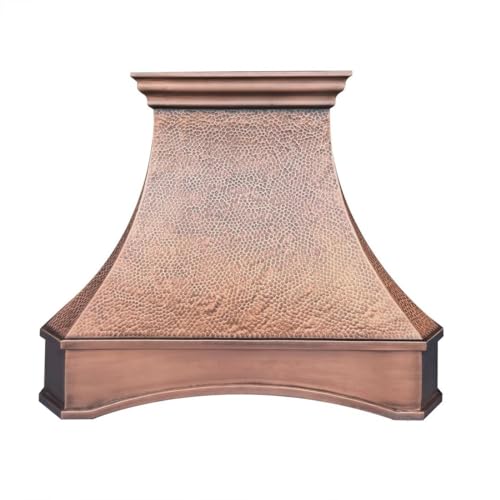
CT Copper Tailor’s vent hood, model VH263HSM, is the specification lover’s copper hood. Its title states handmade construction in 16-gauge copper, a wall-mount body 30.5 inches wide and 30 inches high, an included range hood insert with a 600 CFM fan, a medium patina finish, and an arched apron, aimed at the custom luxury kitchen. Every phrase answers a question this guide has taught you to ask. Gauge: stated, and substantial. Construction: handmade. Machinery: included and rated, the only stated airflow in the entire copper set. Finish: named, so you know the tone you are buying into rather than discovering it.
The arched apron and medium patina place this hood in the traditional, furniture-like end of the copper world, a piece designed to look inherited rather than installed. The included insert matters practically as well as rhetorically: there is no second purchase to match, no compatibility gamble between canopy and blower. For a buyer who wants copper with its paperwork in order, this is the guide’s clearest recommendation, a handmade hood whose maker was willing to print the numbers. Verify duct size and electrical needs on the listing, arrange the careful two-person installation such pieces deserve, and the VH263HSM will anchor a kitchen for a generation.
The medium patina named in the CT Copper Tailor’s title is a considered choice for buyers who love copper’s destination more than its journey. Starting at a medium tone skips the bright-penny phase that can clash with a settled kitchen, and lands the hood directly in the warm register most rooms are designed around. From there the finish deepens slowly and coherently. The arched apron reinforces that settled character, echoing traditional range alcoves and furniture lines. Combined with the stated gauge and the included 600 CFM insert, the package is the most complete single purchase in this guide: metal, machinery, and finish all decided, all stated, all in one crate.
- Construction: handmade 16-gauge copper, as stated in the manufacturer title
- Size: 30.5 inches wide, 30 inches high, wall mount
- Machinery: range hood insert included, 600 CFM fan
- Finish: medium patina, with arched apron
- Model: VH263HSM, per title
- Where to buy: the CT Copper Tailor Copper Vent Hood (30.5-Inch, 600 CFM) listing on Amazon — check price on Amazon
Strengths
- Gauge, construction, and airflow all stated plainly
- Insert included, no matching gamble
- Traditional arched-apron design with named patina
Trade-offs
- Specific traditional styling will not suit minimal kitchens
- Handmade pieces command handmade pricing
- Freight-style delivery and careful installation required
Best for: custom and traditional kitchens that want verified copper craft with rated ventilation.
Not the right match for: sleek modern kitchens, where its arched apron would argue with the room.
Where to buy: the CT Copper Tailor Copper Vent Hood (30.5-Inch, 600 CFM) listing on Amazon — check price on Amazon.

SINDA Hammered Solid Copper Range Hood (30-Inch) — Solid copper, named system
SINDA puts its construction claim in the model’s name: Classic Hammered Solid Copper. The title continues with the machinery, a high-airflow centrifugal blower, a stainless steel vent with liner and internal motor, and a baffle filter, in a wall-mount body 30 inches wide and 27 inches high, model H3 302127ST. That is a complete sentence of a title, and it lets this guide describe the hood with confidence: solid hammered copper outside, a steel ventilation system inside, professional-style baffle filtration, and an internal motor rather than a remote arrangement. No CFM figure is stated, so the airflow claim remains the maker’s qualitative high-airflow language, quoted as such.
The combination is the classic copper-hood formula executed transparently. Solid copper gives the surface its full depth and aging character; the hammering gives it light; the steel liner and internals give it a working life that soft metal alone would not. Baffle filtration suits the class, handling grease in washable steel. Choose the SINDA when the words solid copper are the point of the purchase and you want the blower system named alongside them. As with all craft copper, study the finish photographs, confirm duct details on the listing, and plan an installation worthy of the material.
SINDA’s decision to build the ventilation from stainless steel, liner and vent included, while the visible hood is solid copper, reflects how experienced metal shops actually work: each material where it performs best. Copper is a glorious surface and a soft structural metal; steel is the opposite. The hybrid is not a compromise but a division of expertise, and the title’s plain naming of both lets the buyer appreciate it. The centrifugal blower named in the title suits the design, a classic high-airflow arrangement for a hood of this style. For a traditional kitchen being built to last, the SINDA’s specification reads like a craftsman’s invoice, itemized and proud.
- Construction: hammered solid copper, as stated in the manufacturer title
- Size: 30 inches wide, 27 inches high, wall mount
- Blower: high-airflow centrifugal blower, internal motor, per title
- System: stainless steel vent with liner, baffle filter
- Model: H3 302127ST, per title
- Where to buy: the SINDA Hammered Solid Copper Range Hood (30-Inch) listing on Amazon — check price on Amazon
Strengths
- Solid copper stated in the model’s name
- Blower, liner, and filter all named in the title
- Baffle filtration matches the craft positioning
Trade-offs
- Airflow described qualitatively, no CFM figure
- Solid copper pricing and care commitment
- Traditional styling direction
Best for: buyers for whom solid copper construction is the whole point.
Poorly suited to: a shopper who needs a verified airflow figure before committing.
Where to buy: the SINDA Hammered Solid Copper Range Hood (30-Inch) listing on Amazon — check price on Amazon.

ZLINE 36-Inch Hand Hammered Copper Island Hood (8GL2Hi) — Island centerpiece
An island range already makes a declaration; a hand-hammered copper hood above it makes the kitchen unforgettable. ZLINE’s 8GL2Hi is a 36-inch island-mount model from the Designer Series, its title stating the hand-hammered copper character that defines the piece. Island mounting is the most demanding format in ventilation: no wall to help gather the plume, a chimney rising through open air to the ceiling, and a hood visible from every side, which means the finish must reward viewing from all four directions. Hammered copper is one of the few materials that genuinely does, its facets shifting as you move around the island with a pan in your hand.
The title leaves the ventilation specification to the listing, and on an island that specification deserves double scrutiny, because island hoods work harder for their capture than wall hoods of the same rating. Verify airflow, duct size, and mounting hardware carefully, and plan the ceiling route with your builder before the piece is ordered. Bought with that diligence, the 8GL2Hi is the boldest object in this guide: a working hood that doubles as the room’s chandelier-scale centerpiece, in the warmest metal a kitchen can hold. It is not a purchase for the undecided, and that is precisely its appeal.
An island hood is seen in the round and heard from everywhere, so two ownership notes follow from the 8GL2Hi’s format. First, its finish will be handled and admired up close by guests standing at the island, and hammered copper rewards that proximity like no printed finish can. Second, its ventilation should be verified with extra care on the listing, because island capture has no wall to help it and the maker’s stated details carry the whole burden of proof. Commission the ceiling work early, since the chimney’s route and support decide the kitchen’s whole ceiling plan. Done right, this is the piece visitors remember the house by.
- Series and model: ZLINE Designer Series, 8GL2Hi-36, per title
- Surface: hand-hammered copper, as stated in the manufacturer title
- Mounting: island mount
- Width: 36 inches
- Airflow: not stated in the manufacturer title
- Where to buy: the ZLINE 36-Inch Hand Hammered Copper Island Hood (8GL2Hi) listing on Amazon — check price on Amazon
Strengths
- Island format in hammered copper is a true centerpiece
- Finished presence from every viewing angle
- Full 36-inch span for island ranges
Trade-offs
- Most demanding installation in this guide
- Ventilation details must be verified on the listing
- Ceiling duct route is non-negotiable
Best for: island ranges in open kitchens ready for a defining centerpiece.
A weak match for: a wall range or a renter, for obvious structural reasons.
Where to buy: the ZLINE 36-Inch Hand Hammered Copper Island Hood (8GL2Hi) listing on Amazon — check price on Amazon.

ZLINE 30-Inch Hood With Copper Shell (KB4STX-C) — Honest copper shell
The KB4STX-C earns this guide’s respect in its title’s first line: a convertible stainless steel range hood with a copper shell and a stainless steel handle. No ambiguity, no adjective fog. The structure and interior are stainless, the visible shell is copper, and the handle stays steel, a practical touch where hands actually grip. At 30 inches in a convertible format, it is also the most installation-flexible copper-look pick here, able to serve kitchens whose ducting is still undecided. For many buyers this is the rational copper purchase: the warmth and presence of the metal where the eye lives, the durability and price logic of steel where the work happens.
Judge the shell on its own terms. A shell will age as copper ages on its surface, which is what the room sees, while the stainless body handles heat, grease, and cleaning without copper’s care requirements inside. The convertible ducting widens its audience to renters-turned-owners and phased renovations. What it is not is solid copper, and its title never pretends otherwise, which is why it belongs in a guide that prizes honest labeling. Choose the KB4STX-C when you want copper’s welcome in the kitchen, stated plainly and priced accordingly, over a standard 30-inch range.
The stainless handle on the KB4STX-C is a small tell of thoughtful design. Handles and rails are where a hood is gripped, wiped, and knocked by pan lids, and keeping that contact strip in steel while the shell wears copper puts each material where hands actually go. The convertible format extends the same practicality to the duct. Altogether this is the copper-look pick for a household that renovates in stages and lives in the kitchen throughout: warmth now, structure sorted, ducting decided when the ceiling finally opens. Honest labeling, sensible materials, flexible installation: the shell route, done properly, is a respectable route.
- Construction: stainless steel hood with copper shell, as stated in the manufacturer title
- Handle: stainless steel handle
- Mounting: wall format, convertible ducting
- Width: 30 inches
- Model: KB4STX-C-30, per title
- Where to buy: the ZLINE 30-Inch Hood With Copper Shell (KB4STX-C) listing on Amazon — check price on Amazon
Strengths
- Copper shell labeled with complete honesty
- Stainless structure simplifies interior care
- Convertible ducting suits phased renovations
Trade-offs
- A shell is not solid copper construction
- Airflow not stated in the title
- Copper surface still needs copper-appropriate care
Best for: buyers who want copper warmth with stainless practicality, knowingly chosen.
Think twice if: a purist shopping specifically for solid copper.
Where to buy: the ZLINE 30-Inch Hood With Copper Shell (KB4STX-C) listing on Amazon — check price on Amazon.
Copper field compared: construction as titled, mounting, and size
The construction column reproduces each title’s own language. Where the title is silent, the column says so rather than guessing, which is the most useful habit this comparison can teach.
| Model | Construction, as titled | Mounting | Width | Stated airflow |
|---|---|---|---|---|
| ZLINE 36-Inch Designer Series Wall Mount Hood (KB2) | Designer Series model KB2; construction not further stated | Wall mount | 36 inch | Not stated |
| ZLINE 30-Inch Hand-Hammered Wall Mount Hood (8KBH) | Designer Series, hand-hammered | Wall mount | 30 inch | Not stated |
| CT Copper Tailor Copper Vent Hood (30.5-Inch, 600 CFM) | Handmade 16-gauge copper, insert included | Wall mount | 30.5 inch | 600 CFM |
| SINDA Hammered Solid Copper Range Hood (30-Inch) | Hammered solid copper | Wall mount | 30 inch | Not stated |
| ZLINE 36-Inch Hand Hammered Copper Island Hood (8GL2Hi) | Designer Series hand-hammered copper, island model 8GL2Hi | Island mount | 36 inch | Not stated |
| ZLINE 30-Inch Hood With Copper Shell (KB4STX-C) | Copper shell over stainless steel, model KB4STX-C | Wall mount, convertible | 30 inch | Not stated |
Solid copper, copper shell, copper finish: what are you actually buying?
A solid copper hood is copper through its visible structure: the canopy you touch is the material itself, worked by hand in the craft examples here, with a gauge that gives it substance. CT Copper Tailor states 16-gauge handmade construction, and gauge matters because it decides whether the hood feels like architecture or like a skin; thicker copper holds its hammering, resists denting, and ages as one continuous surface. SINDA names its model hammered solid copper and pairs it with a stainless vent, liner, and internal motor per its title, a reminder that even solid copper hoods are systems whose working parts are usually steel. A copper shell, as the ZLINE KB4STX states with unusual honesty, is a copper exterior over a stainless hood: the visible warmth is real copper, the structure and interior are stainless, and the price reflects that division of labor.
Neither object is a fraud, but they age and cost differently, and the shell’s honesty in its title is exactly what to look for. The danger zone is the listing that says only copper in large type and nothing anywhere else; in this guide, picks whose titles stay at series level are described at series level, and you should carry that habit to any listing you meet elsewhere. Ask three questions of any copper hood: what is the gauge, what is the interior made of, and is the visible surface solid, shell, or finish. A seller who answers all three plainly is selling you a hood. A seller who answers with adjectives is selling you a photograph.
How does copper age, and what care does a living finish need?
Copper is not a static color. In a kitchen’s warm, moist, occasionally acidic air, an unlacquered copper hood deepens from bright penny tones toward richer browns, with variation where hands touch, where steam rises, and where cleaning is diligent or lazy. Hammered surfaces complicate and beautify that process, because the facets catch light differently as patina develops in the recesses. Owners who love copper usually love exactly this: a hood that records the kitchen’s life the way a wooden table does. Owners who want the showroom photograph forever should choose a lacquered finish where offered, accept that lacquer is itself a coating with a lifespan, or honestly choose a different metal.
Daily care is simpler than the romance suggests. Warm water, a soft cloth, and mild soap handle cooking film; abrasive pads and harsh chemicals are the enemies, because they strip patina unevenly and scratch the hammering’s highlights. Wax, where the maker recommends it, slows change and evens the tone. Around the hood, plan the rest of the kitchen’s metals with the patina in mind rather than the first-day color: copper warms toward tones that flatter wood, stone, and matte black, and can fight with cool stainless if the room is mostly steel. The kitchens in commercial settings, like the deck-oven bakeries surveyed in Best Commercial Deck Ovens, standardize on steel for a reason; copper is a domestic material, chosen for feeling as much as function, and it asks to be chosen knowingly.
What should you verify about the working parts before ordering?
A copper hood is two purchases in one: the visible metalwork and the ventilation machinery inside it. The CT Copper Tailor makes the machinery explicit, stating that its hood includes a range hood insert with a 600 CFM fan, so the buyer knows the working package in the box. The SINDA title names its blower type, liner, and internal motor. For the ZLINE models, whose titles stay at series level, the listing’s own specification section must answer the machinery questions before you order: airflow, fan speeds, lighting, filters, and duct size. Do not let a beautiful canopy rush you past those answers, because the hood will be judged every day by its ventilation and every year by its copper, and it should pass both judgments.
Measure as carefully as you would for any hood: width against the range, with a preference for coverage at least equal to the cooking surface; mounting height against the maker’s range; ceiling height for the island model, whose chimney must reach from a free-standing position; and the duct route, which on an island means rising through the ceiling with no wall to hide in. Island copper is the boldest object in this guide and the least forgiving of improvisation. Finally, confirm how the hood ships and who installs it. Handmade and hammered pieces are freight objects, not parcel objects, and a two-person lift with the finish protected is part of the price of admission.
How do you design the rest of the kitchen around a copper hood?
Start with temperature. Copper is the warmest object most kitchens will ever contain, and it pulls every neighboring choice toward warmth: cabinet woods read richer, stone counters want honed and veined rather than icy, and lighting should be warm enough that the metal glows instead of glaring. Cool stainless appliances can stay, but they need mediation, a wood island, black hardware, or warm textiles, so the room reads as a conversation rather than an argument. The hand-hammered picks forgive the most mixing, because their broken reflections borrow tones from everything around them; a smooth bright copper is the diva that demands the full supporting cast.
Scale is the second decision. A copper hood over a range of equal width, in a room with the ceiling height to give its chimney air, looks inevitable. The same hood squeezed over a wider range or under a low ceiling looks apologetic, and no finish quality rescues bad proportion. This is why the guide keeps widths in its comparison table’s front rank. Finally, decide the patina policy as a household, not as a surprise: agree that the metal will deepen, choose lacquer or wax regimes where the maker offers them, and photograph the hood yearly if you want to watch it happen. Kitchens that embrace the change find the hood becomes more theirs every year, which is a quality no static finish can offer at any price.
Hardware and fixtures are where the design either lands or wanders. Repeating copper in small, distant notes, a faucet, a rail, cabinet pulls in a related warm metal, ties the room together without turning it into a theme. Repeating it in large competing surfaces splits the eye. One copper hero per kitchen is the rule this guide would hand any designer, and the six picks here are all cast for that single heroic role.
What should a buyer ask before handmade copper ships?
Handmade and craft-series hoods travel differently from parcel appliances, and the questions that protect the purchase are logistical as much as technical. Confirm how the piece is crated, whether delivery is freight with a liftgate or a threshold service, and who bears the risk of a dented corner on a hammered surface that cannot be invisibly repaired. Photograph the crate before opening and the hood before installation, in daylight, because finish questions are settled by evidence. Confirm the lead time honestly; craft objects are made in queues, and a renovation scheduled around a guess will stall at the hood-shaped hole in its middle.
Ask also what arrives in the crate beyond the canopy: the CT Copper Tailor in this guide states its insert is included, which closes the question, while series-level picks delegate the machinery details to their listings, where duct size, lighting, filters, and any liner requirement must be extracted before the order, not after the delivery. Finally, agree with your installer, in advance, on who lifts, who protects the finish during the lift, and where the hood waits while the duct is finished. Copper is soft enough to record carelessness permanently. A crew that has hung one before is worth scheduling around, and the questions above are how you find out whether yours has.
Copper hoods and resale: what does a living-metal centerpiece do to a kitchen’s value?
Real-estate wisdom about kitchens is usually a counsel of neutrality: pale, stainless, inoffensive. A copper hood breaks that counsel deliberately, and the interesting question is for whom. In a home whose architecture has a point of view, a farmhouse with timber, a Mediterranean revival, a craftsman with dark wood, a well-chosen copper hood reads as the kitchen’s intention made visible, and buyers in that market segment respond to intention. It photographs memorably, anchors listings, and gives a viewing a moment that all-stainless kitchens cannot manufacture. In a home aimed at the broadest possible rental or resale pool, the same hood narrows the audience to those who share the taste, which is a real cost to weigh with clear eyes.
Construction honesty matters here too. A handmade solid copper hood is a durable asset that a knowledgeable buyer or appraiser recognizes as craft; a shell hood delivers most of the visual effect at a fraction of the commitment; a buyer who cannot tell the difference has not read anything like this guide. What consistently hurts value is not copper itself but copper done carelessly: a hood too small for its range, a finish fighting the room, machinery neglected until the centerpiece is also a grease monument. The same kitchen that gains from a considered copper installation loses from an impulsive one, which is why this guide spends so many words on proportion, patina policy, and the machinery inside the metal.
The balanced verdict is that a copper hood should be bought for the household that will live with it, with resale treated as a possible bonus rather than the motive. Kitchens are the most-lived rooms in a house, and a decade of cooking under a hood you love is worth more than a theoretical increment at a sale that may never come. Choose the construction you can describe honestly, size it to the range, keep it clean, and let the metal deepen. If a future buyer falls for it, so much the better; the hood will have already paid its real dividend, daily, in the warmest light a kitchen can hold.
How do you photograph, light, and live with copper’s changing face?
Copper is the rare appliance material that asks to be looked at properly, and lighting is where most kitchens either honor it or waste it. Under cold, blue-leaning light, copper reads orange and restless, its hammering flattened into noise. Under warm light, the same hood settles into the deep amber register that made the buyer choose it, and the facets begin their slow play as people move around the room. If a copper hood is in your future, the lighting plan is part of the purchase: warm sources, dimmable for evening, positioned so the canopy is lit as the feature it is rather than shadowed as an obstacle. The hood’s own lights handle the cooktop; the room’s lights handle the hood, and confusing those two jobs is how beautiful metal ends up looking dull in an expensive kitchen.
Living with the change is the second art. Patina does not arrive evenly or on a schedule, and the owners who thrive with copper learn to read it as a record rather than a defect: the brighter patch where a hand steadies the chimney, the deeper tone above the hardest-working burner, the recesses holding their darkness like ink in engraving. Photographing the hood once a season, from the same spot, turns that record into something a household genuinely enjoys watching, and it settles arguments about whether the metal is changing faster than it should. Where a maker offers wax or lacquer guidance, follow it as a tempo control rather than a freeze: you are choosing how fast the story goes, not whether it is told.
There is a temperament question underneath all of this, and this guide will state it plainly because it decides satisfaction more than any specification. Some households experience a changing finish as life; others experience it as entropy, a slow losing battle they will fight with polish until they resent the object. Neither temperament is wrong, but only one of them should buy unlacquered solid copper. The second household has honorable options inside this very guide: the shell construction that confines copper to a surface, the lacquered finishes where offered, or the wisdom to choose another metal entirely. The first household, the one that will run a hand over hammered copper in year ten and feel the kitchen’s whole history in it, should buy the real material without hesitation and never look back.
Before you commit to copper: a short checklist
Answer the construction question first, in the seller’s own words, before admiring a single photograph. Is the visible copper solid, a shell, or a finish, and does the title say so as plainly as the CT Copper Tailor states its gauge, the SINDA names its solid construction, or the ZLINE KB4STX declares its shell? If the answer cannot be found in the maker’s language, the purchase is not ready to happen, whatever the photographs promise. Second, extract the machinery specification, airflow, filters, lighting, and duct size, from the listing’s details, because the copper will be judged yearly while the ventilation is judged at every meal, and a hood that fails the daily judgment will not be forgiven for passing the annual one.
Third, walk the room. Measure the range’s width against the hood’s, stand where guests will stand, and decide whether the kitchen’s other materials will keep copper company or start an argument with it. Set the household’s patina policy in the same conversation, lacquer, wax, or free aging, so the metal’s future is a plan rather than a surprise. Finally, plan the delivery and the lift like the freight event it is, with photographs, protection, and a crew that has handled finished metal before. A buyer who completes those four steps owns the copper category rather than being sold by it, and the hood over their range will be the proof, deepening in tone and in the household’s affections at exactly the same pace.
One last test is worth performing before the order, and it costs nothing but honesty. Describe the hood you are about to buy to an imaginary friend, in one sentence, using only facts the maker’s title and listing actually state: the construction, the size, the mounting, and whatever machinery figures exist. If the sentence comes out complete and satisfying, as it does for the handmade CT Copper Tailor, the solid SINDA, and the plainly labeled ZLINE shell in this guide, buy with confidence. If the sentence dissolves into adjectives, the listing has not yet earned the purchase, and the correct move is to keep asking questions rather than to keep admiring photographs. Copper rewards the buyer who can describe it, because copper itself, given a decade, will describe the household right back.
Consider, finally, the craftspeople inside these listings, because copper is the one category in this batch where the maker’s hand is literally part of the product. A handmade hood carries decisions no production line makes: how deep the hammering falls, how the apron is arched, where the patina is persuaded to sit. Even the series models carry a diluted version of that authorship in their hammered surfaces. Buying copper is therefore partly patronage, and it behaves best when treated that way: ask questions, accept lead times, expect variation, and value the piece more, not less, for bearing evidence of its making. The kitchens that love their copper hoods longest are the ones that never wanted them to look machine-made in the first place.
Visit the metal in your mind’s eye at year ten before you buy it at day one. Picture the hammering holding its darker recesses, the tone settled from bright coin to deep amber, the surface carrying a faint map of where hands and steam have been. If that imagined hood pleases you more than the showroom photograph does, you are copper’s natural owner and should buy the solid, handmade end of this guide without a backward glance. If it pleases you less, the shell and lacquered routes exist precisely for your temperament, and choosing them knowingly is not a lesser decision but a more honest one. The metal will keep its side of whichever bargain you strike; the entire art of this purchase is striking the bargain your household can keep.
Which copper-hood mistakes do buyers regret most?
The costliest mistake is paying solid-copper money for shell or finish construction because the headline word copper did the selling. Read construction language the way this guide’s comparison table does, and pay for the object described, not the adjective. The second mistake is expecting the first-day color forever; unlacquered copper will change, and a buyer who has not made peace with patina will spend years polishing against the material’s nature. The third is neglecting the machinery questions, airflow, filters, lighting, and ducting, because the canopy photographs so well. The fourth is sizing by the range’s nominal width without checking the maker’s capture guidance, leaving front burners outside the copper’s beautiful, useless edge.
A subtler mistake is mixing a warm living metal into a kitchen planned entirely in cool tones and then blaming the hood for the argument. Copper wants company: wood, warm stone, matte black, or at least warm lighting. And for the household that camps and travels, the care parallel in Best Lightweight Hammock Underquilts holds: natural materials, whether down or copper, reward owners who accept their character and maintain them simply, and punish owners who expected a synthetic’s indifference. Buy copper as a material with a personality, and it becomes the kitchen’s best feature. Buy it as a color, and it becomes a chore.
Final Recommendation
For verified craft construction, the CT Copper Tailor leads with handmade 16-gauge copper and the set’s only stated airflow at 600 CFM, insert included, while the SINDA answers with hammered solid copper and a named blower system. The ZLINE KB4STX is the honest shell route into copper warmth over stainless structure. The remaining ZLINE Designer Series models, the KB2 wall hood, the hand-hammered 8KBH, and the island 8GL2Hi, are chosen by series, size, and silhouette, exactly as their titles present them.
Choose the copper you can describe accurately to a friend — gauge, construction, and all — and the hood over your stove will still be making you glad, in a deeper and richer tone, long after trendier kitchens have gone quiet.
Frequently Asked Questions
Is a copper shell hood a bad purchase?
Not at all, when it is bought knowingly. The ZLINE KB4STX states its copper shell in its title, which is honest labeling: you get real copper as the visible surface over a stainless structure, typically at a gentler price than solid construction. It becomes a bad purchase only when a buyer believes they paid for solid copper. Judge it as its own category and it is a sensible way into copper’s look.
Will my copper hood turn green?
Full verdigris is an outdoor, long-exposure development. Indoors, kitchen copper typically deepens through amber and brown tones, with variation from heat, steam, and touch. Lacquered finishes resist change longer. If the evolving tone worries you, discuss finish options with the maker before ordering rather than fighting the metal afterwards with abrasives, which only make the variation patchier.
Why do so few copper hoods state their CFM?
This class is sold primarily on craft and design, and several makers in the verified set simply do not put airflow in their titles. The CT Copper Tailor is the exception here at a stated 600 CFM. For the others, treat the listing’s specification details as required reading before purchase, and be wary of any copper hood whose ventilation details cannot be found at all.
Does hammered copper need special cleaning?
It needs gentle cleaning, not special products: warm water, mild soap, and a soft cloth, dried after washing. The hammered recesses hold patina beautifully and collect cooking film the same way, so regular light cleaning beats occasional aggressive scrubbing. Avoid abrasive pads, which scratch the high points bright and leave the surface looking worn rather than aged.
Can a copper hood work over an island?
Yes, and it is one of the great kitchen sights: the ZLINE 8GL2Hi in this guide is a 36-inch island model in the maker’s hand-hammered copper series language. Island mounting demands a ceiling duct route, structural support, and careful height planning, since there is no wall to assist capture or hide the chimney. Plan it as architecture, with your builder, from the start.
Related Guides
Copper’s warmth suits a grand cooking wall, and Best 48-Inch Dual-Fuel Ranges surveys the large-format ranges that anchor such a wall. Pair a hand-worked canopy with a range of real presence, verify the machinery inside the metal, and the kitchen gains a centerpiece that also happens to ventilate.


