What's inside
- Key Takeaways
- Quick Picks
- How did we choose inserts when the surround is half the product?
- Insert machinery compared: output, format, and ducting
- Insert, power pack, or liner: which one does your project actually need?
- How do you plan ducting and power inside a custom surround?
- Living with a hidden hood: cleaning, noise, and daily use
- How do you measure and specify an insert for cabinetry or masonry?
- What does an insert cost you in flexibility, and what does it pay back?
- Inserts in rental properties, resale kitchens, and phased renovations
- How do you choose among these six inserts for three common kitchens?
- The insert checklist in five moves
- Where do insert projects most often go wrong?
- Final Recommendation
- Frequently Asked Questions
- Related Guides
As an Amazon Associate I earn from qualifying purchases. This post may contain affiliate links at no extra cost to you.
cottageverdict.com is reader-supported. When you buy through links on our site, we may earn an affiliate commission.
The six inserts below each link to their own Amazon listing, where you can check price on Amazon and confirm cutout dimensions. One related product is intentionally unlinked: the bare liner discussed in the guide sections is a shell, explained in words only.
The best range hood inserts are the working hearts of hoods you design yourself. An insert, sometimes called a power pack, is the complete ventilation unit, blower, filters, lights, and controls, built to disappear into a custom surround: a timber mantel hood, a plaster chimney breast, a metal canopy made for the room, or the underside of a cabinet run designed to look like furniture. The verified set here is uniformly 30-inch class machinery with one deliberate exception in size, and its stated airflow spans the full residential range, from the Broan-NuTone power pack’s 300 CFM to the VIKIO HOME insert’s 980 CFM, with 900, 800, 600, and 380 CFM between. That spread is the story of the category: the same hidden format serves a quiet galley kitchen and a serious frying household, and the surround above it can look like anything at all.
Two distinctions protect buyers in this class, and this guide states both plainly. First, an insert is not a liner. A liner is a shaped metal shell, sold separately, that finishes the inside of a custom hood; alone it has no blower, no filters, and no lights, and it ventilates nothing. Some inserts need a liner or a custom structure to live in, and power packs in particular assume a surround or liner around them. Second, inserts divide by completeness: most picks here are full insert hoods with their own finished underside, while the Broan-NuTone PM300SS is a power pack, the compact machinery meant to power a custom hood built around it. Confusing those categories is how a renovation ends up with a beautiful shell and no ventilation, so the picks and the guide sections keep the vocabulary exact.
Key Takeaways
- Stated airflow spans 300 to 980 CFM across six 30-inch-class inserts, quoted only from manufacturer titles.
- A liner is a shell, not a blower; it is covered in prose only here and is never a pick.
- The Broan-NuTone PM300SS is a power pack for a custom hood, at a compact 21-inch built width per its title.
- Five picks offer ducted or ductless convertibility; the Cosmo Lumin is the ducted-only design.
- Gesture and touch controls appear on the two strongest picks; push-button simplicity anchors the rest.
Quick Picks
| Pick | Badge | Why it earned its place |
|---|---|---|
| IKTCH 30-Inch Insert Range Hood (900 CFM) | Balanced high-output insert | 900 CFM stated with four speeds, gesture sensing and touch control, and convertible ducting in a 30-inch insert. |
| Cosmo Lumin 30-Inch Insert Range Hood (380 CFM) | Gentle ducted insert | 380 CFM stated, ducted, with push-button controls, permanent dishwasher-safe baffles, and a backdraft damper. |
| FIREGAS 30-Inch Range Hood Insert (600 CFM) | Mid-output convertible value | 600 CFM stated with push-button control and both baffle and charcoal filters named for ducted or ductless work. |
| Broan-NuTone PM300SS Power Pack Insert (300 CFM) | Compact custom power pack | A power pack, not a full insert: 300 max blower CFM in a 21-inch built format for a custom hood or liner. |
| VEVOR 30-Inch Insert Range Hood (800 CFM) | Listed, push-button strong | 800 CFM stated with three speeds, baffle filters, convertible ducting, and an ETL listing named in the title. |
| VIKIO HOME 30-Inch Insert Range Hood (980 CFM) | Strongest insert here | The highest stated insert output in the set: 980 CFM with gesture and touch control and two baffle filters. |
How did we choose inserts when the surround is half the product?
We judged the machinery, since the surround is your design, not the maker’s. A pick needed a stated airflow in its title, a clear format, and controls and filtration described in the maker’s own words. That produced a ladder of power honest enough to plan a kitchen around: a compact power pack for a custom hood over a modest range, mid-output inserts for standard cooking, and two high-output models for households whose custom hood hides professional appetites. We also required the ducting story to be stated, because an insert’s duct path is designed into cabinetry or masonry and cannot be improvised after the surround is built.
The liner question shaped the exclusions. Shell-only products that surface in insert searches were kept out of the pick list entirely and are discussed in prose where the distinction is taught, because a reader who orders a liner expecting ventilation has been failed by vocabulary, not by manufacturing. Readers at the planning stage of a full custom hood will find the material end of that conversation in Best Bread Ovens, where the surround itself is the subject. Here, the machinery comes first: six verified ways to power a hood of your own design, from the gentlest power pack to an insert that out-draws most finished hoods.
A final selection habit deserves stating, because insert buyers are usually mid-renovation and tired: decide the machinery before the surround’s interior is finished, and write its dimensions on the project wall where every trade can see them. More insert projects fail on coordination than on quality, a beautiful surround built to a remembered measurement, a duct roughed in for a different vent position. The six picks here publish their formats and outputs plainly enough to be planned around from a listing page. Give your builder the chosen model’s stated dimensions and duct position in writing, and the most sophisticated category in home ventilation becomes, simply, the one that was planned first.

IKTCH 30-Inch Insert Range Hood (900 CFM) — Balanced high-output insert
The IKTCH insert states 900 CFM in a 30-inch stainless built-in body, with four speeds, gesture sensing and a touch control panel, and ducted or ductless venting. That is a complete answer to the insert brief: output with genuine reserve for a serious range, control fine enough to cruise quietly at the low end, and ducting flexibility for builds whose route is still being designed. Gesture control has a particular logic in an insert, where the control panel sits recessed in a surround and a wave reaches it more easily than a fingertip around a mantel’s edge.
IKTCH is a familiar name in this category, and the specification reads like a maker’s flagship rather than an experiment. Four speeds suit the span between a simmer and a sear, and the convertible ducting keeps the ductless fallback for the rare custom build that cannot vent. For the majority of custom-hood projects over a standard 30-inch range, this is the guide’s central recommendation: strong, flexible, and controllable machinery that will disappear into timber, plaster, or steel and simply work for years.
IKTCH’s four speeds map well onto the way a custom kitchen actually cooks through a week: a near-silent setting for the morning kettle and reheating, two working gears for dinners, and the full 900 CFM held for the Friday fry. Because the unit hides in a surround, its stainless underside is the only face the room sees, and it presents cleanly against timber or plaster alike. Owners building a hood as furniture consistently land on this class of insert for a reason: the machinery’s specification reads like a finished hood’s, while its visibility is limited to a panel of controls and a washable grease path.
- Format: built-in insert, 30 inches wide, stainless steel
- Airflow: 900 CFM, as stated in the manufacturer title
- Speeds and controls: 4 speeds, gesture sensing and touch panel
- Ducting: ducted or ductless venting
- Best use: custom surrounds over standard ranges
- Where to buy: the IKTCH 30-Inch Insert Range Hood (900 CFM) listing on Amazon — check price on Amazon
Strengths
- Strong stated output with four-speed control
- Gesture suits recessed surround mounting
- Convertible ducting fits evolving build plans
Trade-offs
- Output wasted on very gentle cooking
- Surround and duct still the owner’s project
- Gesture is a habit some cooks never adopt
Best for: custom hood builds over hardworking 30-inch ranges.
Not suited for: a finished-hood replacement, where a complete visible model belongs.
Where to buy: the IKTCH 30-Inch Insert Range Hood (900 CFM) listing on Amazon — check price on Amazon.

Cosmo Lumin 30-Inch Insert Range Hood (380 CFM) — Gentle ducted insert
Cosmo’s Lumin insert, model COS-30IRHP, states 380 CFM in a ducted 30-inch stainless body with push-button controls, three fan speeds, LED lighting, permanent dishwasher-safe baffle filters, and a backdraft damper. It is the same measured philosophy as Cosmo’s wall hood elsewhere in this batch’s research: honest mid-range output, permanent filtration, and the damper detail that keeps a ducted system sealed against drafts when idle. Push buttons suit an insert particularly well, giving tactile certainty in a recessed panel you may operate by feel while watching a pan.
Ducted-only design is a stance, not a limitation, in a custom build: if you are constructing a surround, you can almost always construct a duct, and the Lumin rewards that with permanent baffles and no charcoal routine. Its 380 CFM suits standard ranges and ordinary cooking rather than pro-style output, and within that brief it is complete and durable machinery. Choose it when the custom hood is about looks and longevity over a normal range, and the ventilation brief is competence without excess.
The Lumin’s push-button panel has an underappreciated virtue inside a deep surround: it can be operated by touch alone, knuckles or fingertip, without looking up from the pan into the lights. Three speeds are honestly matched to its 380 CFM, with no settings that exist only to lengthen a feature list. Cosmo’s inclusion of the backdraft damper again signals whole-system thinking, particularly valuable in a custom duct that the homeowner designed and therefore owns entirely. For a heritage-style kitchen where the hood is a plastered chimney and the cooking is family-normal, the Lumin is the machinery that matches the architecture’s temperament.
- Format: insert, 30 inches wide, stainless steel, Lumin Collection
- Airflow: 380 CFM, as stated in the manufacturer title
- Controls: push button, 3 fan speeds
- Filters: permanent dishwasher-safe baffle filters
- Extras: backdraft damper, LED lighting
- Where to buy: the Cosmo Lumin 30-Inch Insert Range Hood (380 CFM) listing on Amazon — check price on Amazon
Strengths
- Permanent baffles end filter purchases
- Backdraft damper seals the duct at rest
- Push buttons work by feel in a recess
Trade-offs
- Ducted only, no recirculating fallback
- Modest output for ambitious cooking
- Three speeds only
Best for: custom surrounds over standard ranges with a real duct route.
A poor fit for: a pro-style range, which will outrun its 380 CFM.
Where to buy: the Cosmo Lumin 30-Inch Insert Range Hood (380 CFM) listing on Amazon — check price on Amazon.

FIREGAS 30-Inch Range Hood Insert (600 CFM) — Mid-output convertible value
The FIREGAS insert states 600 CFM in a 30-inch built-in stainless body, convertible between ducted and ductless work, with push-button control and both baffle filters and charcoal filters named in its title. That filter pairing tells the installation story honestly: baffles for the ducted life, charcoal included for the ductless one, so the buyer is not shopping for conversion parts after the fact. Six hundred stated CFM is the sensible middle of this set, enough for a keen home cook’s frying and searing on a standard range, without the duct demands of the near-thousand-CFM picks.
Push buttons keep the interface durable and simple inside a surround. FIREGAS positions this as the accessible route into a custom hood, and the specification supports the positioning: complete machinery, both ducting paths genuinely equipped, and output matched to real cooking rather than to a headline. If your custom build is a cabinet-integrated hood over a hardworking but conventional range, and the budget should go to the visible carpentry rather than to surplus airflow, the FIREGAS is the insert that leaves money in the right place.
FIREGAS including charcoal filters in the box changes the ductless conversation from a compromise to a plan. Some custom builds genuinely cannot vent, a historic structure, a condominium’s rules, a surround built before the question was asked, and for those kitchens a convertible insert that arrives equipped for recirculation is the difference between ventilation and apology. The baffles still serve the ducted future if the route ever opens. At 600 stated CFM, the FIREGAS also holds the middle output ground that most standard ranges actually need, which makes it the easiest insert here to recommend to a renovator who has not yet met their duct.
- Format: built-in insert, 30 inches wide, stainless steel
- Airflow: 600 CFM, as stated in the manufacturer title
- Ducting: ducted or ductless convertible
- Filters: baffle filters and charcoal filters, per title
- Controls: push button
- Where to buy: the FIREGAS 30-Inch Range Hood Insert (600 CFM) listing on Amazon — check price on Amazon
Strengths
- Both filter types named for both duct paths
- Mid output matches standard ranges well
- Simple, durable push-button control
Trade-offs
- Less reserve than the 800-plus CFM picks
- No gesture or remote convenience
- Value positioning shows in plain styling
Best for: cabinet-integrated custom hoods over conventional ranges.
Not the right match for: high-output ranges that regularly overwhelm mid-tier ventilation.
Where to buy: the FIREGAS 30-Inch Range Hood Insert (600 CFM) listing on Amazon — check price on Amazon.

Broan-NuTone PM300SS Power Pack Insert (300 CFM) — Compact custom power pack
The PM300SS must be understood on its own terms: it is a custom power pack, the compact machinery that powers a hood built around it, with a two-speed exhaust fan and light, a stated 300 max blower CFM, stainless construction, and a 21-inch built width per its title. It is not a finished insert with a broad underside; it is the engine for a designed hood, often paired with a liner or a custom structure, in kitchens where space is tight and the visible design belongs to the room. Broan-NuTone’s ventilation pedigree is the reassurance here: modest output, honestly stated as a maximum, from the category’s most established name.
Three hundred CFM suits a modest range and gentle-to-ordinary cooking, and the two-speed fan keeps operation as simple as a switch. The planning burden is the highest in this set relative to output, because the surround, and any liner the design requires, are separate decisions and separate purchases. Buy the PM300SS when the project is genuinely a custom hood in a compact space, the cooking is moderate, and you want proven machinery at the heart of it. Buy a full insert instead if what you actually need is a complete unit for a standard opening.
The power pack format has one more virtue worth naming: repairability inside architecture. Because the PM300SS is compact machinery rather than a wide finished unit, a service visit inside a custom hood deals with a small, standard, well-documented unit from a maker whose parts network is measured in decades. In a surround built to outlast fashion, that serviceability is a design feature. Its light, integrated with the unit, also simplifies the custom hood’s wiring: one appliance, one connection, and the cooktop is lit and vented. For a small, beautifully built hood over a modest range, no pick in this set fits the brief as precisely.
- Format: custom power pack insert, 21-inch built width per title
- Airflow: 300 max blower CFM, as stated in the manufacturer title
- Fan: 2-speed exhaust fan, with light
- Construction: stainless steel
- Requirement: custom hood structure; liner where the design calls for one
- Where to buy: the Broan-NuTone PM300SS Power Pack Insert (300 CFM) listing on Amazon — check price on Amazon
Strengths
- Established maker’s honest maximum rating
- Compact format fits tight custom designs
- Simple two-speed operation
Trade-offs
- Lowest output in this guide
- Needs a surround, and possibly a liner, to function
- Two speeds give coarse control
Best for: compact custom hoods over modest ranges, built as designed features.
Poorly suited to: anyone expecting a complete insert in a standard opening.
Where to buy: the Broan-NuTone PM300SS Power Pack Insert (300 CFM) listing on Amazon — check price on Amazon.
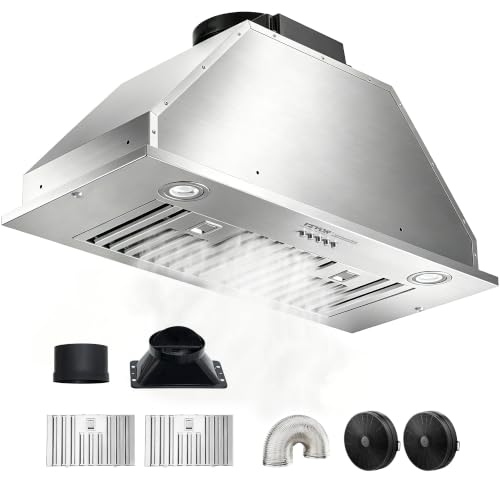
VEVOR 30-Inch Insert Range Hood (800 CFM) — Listed, push-button strong
VEVOR’s insert states 800 CFM with a three-speed fan in a 30-inch built-in stainless body, with push-button control, LED lights, baffle filters, ducted or ductless convertibility, a low-noise description, and an ETL listing stated in the title. The certification mention is worth pausing on: in a category full of unnumbered claims, a named listing signals that the unit has passed through a recognized testing process, and builders and inspectors notice such things. Eight hundred stated CFM places it firmly in the serious-cooking tier, one step below the IKTCH and VIKIO HOME, with a simpler control philosophy than either.
Push buttons and three speeds keep the ownership story plain: set it, cook, wash the baffles. The low-noise description carries no figure, so treat composure as a duct-and-speed outcome rather than a rating, as this guide consistently advises. VEVOR’s value-engineering reputation means the money here is in output and certification rather than interface luxury. For a custom build over a range that fries and sears weekly, where the surround’s budget matters and the machinery must simply be strong and listed, this is a difficult specification to argue with.
VEVOR’s ETL listing, stated in the title, also speaks to the trades who will handle the install. Electricians and inspectors meeting an unfamiliar brand inside finished cabinetry ask for exactly that credential, and having it printed in the listing shortens conversations on site. The baffle filters and three speeds keep the daily story equally plain. Where the IKTCH competes on control and the VIKIO HOME on peak output, the VEVOR competes on being the strong, listed, uncomplicated unit a builder can specify without a meeting. In renovation economics, that quality is worth real money, and experienced renovators will recognize it immediately.
- Format: built-in insert, 30 inches wide, stainless steel
- Airflow: 800 CFM, 3-speed, as stated in the manufacturer title
- Certification: ETL listed, per title
- Filters and lights: baffle filters, LED lights
- Ducting: ducted or ductless convertible
- Where to buy: the VEVOR 30-Inch Insert Range Hood (800 CFM) listing on Amazon — check price on Amazon
Strengths
- Strong stated output with ETL listing named
- Baffle filters suit serious cooking
- Convertible ducting keeps build options open
Trade-offs
- Low-noise claim has no published figure
- Three speeds and buttons only
- Less control refinement than gesture rivals
Best for: custom builds wanting listed, strong machinery without interface frills.
A weak match for: a cook who adjusts the fan constantly and wants finer control.
Where to buy: the VEVOR 30-Inch Insert Range Hood (800 CFM) listing on Amazon — check price on Amazon.

VIKIO HOME 30-Inch Insert Range Hood (980 CFM) — Strongest insert here
VIKIO HOME’s insert states 980 CFM, the highest figure among these six, in a 30-inch built-in stainless body with gesture and touch control, two baffle filters, and ducted or ductless convertible venting. In a custom surround, that output is a design gift: the visible hood can be as grand or as minimal as the room wants, while the hidden machinery out-draws most finished hoods on the market. Gesture control again suits the recessed mounting, letting the cook command a fan whose panel sits inside architecture, and the baffle pair keeps the grease path washable and simple.
Output at this level inside a surround demands the planning this guide has emphasized: a duct that can carry it, an interior shape that gathers the plume into the insert’s draw, and access for the filters and eventual service. Given those, the VIKIO HOME spends ordinary meals at its gentle end with the largest reserve in the set above it. It is the insert for the custom kitchen whose cooking is as ambitious as its carpentry, the household that fries, sears, and steams under a hood that looks like furniture and works like equipment.
Two baffle filters on the VIKIO HOME, rather than a bank of smaller panels, make the monthly wash a two-piece job, a small mercy that decides whether the rhythm survives busy seasons. The gesture control similarly earns its keep in a deep surround, where the panel can sit recessed behind a mantel line that would make buttons a stretch. With 980 stated CFM behind that convenience, this insert asks only that the surround be shaped to gather and the duct be sized to carry. Kitchens that meet those two conditions get the strongest hidden ventilation in this guide, wearing whatever face the room desires.
- Format: built-in insert, 30 inches wide, stainless steel
- Airflow: 980 CFM, as stated in the manufacturer title
- Controls: gesture and touch control
- Filters: two baffle filters
- Ducting: ducted or ductless convertible
- Where to buy: the VIKIO HOME 30-Inch Insert Range Hood (980 CFM) listing on Amazon — check price on Amazon
Strengths
- Highest stated output among these inserts
- Gesture control suits recessed panels
- Convertible ducting for build flexibility
Trade-offs
- Demands a capable duct inside the surround
- Reserve is wasted on gentle cooking
- Surround design must funnel the plume well
Best for: ambitious custom kitchens hiding serious power in furniture-grade hoods.
Think twice if: a small galley surround, where its output cannot be fed or used.
Where to buy: the VIKIO HOME 30-Inch Insert Range Hood (980 CFM) listing on Amazon — check price on Amazon.
Insert machinery compared: output, format, and ducting
All six are built-in machinery; the differences are output, control style, and whether the unit is a full insert or a power pack. Airflow is each maker’s stated figure.
| Model | Format | Stated airflow | Controls | Ducting |
|---|---|---|---|---|
| IKTCH 30-Inch Insert Range Hood (900 CFM) | Insert, 30 inch | 900 CFM | Gesture sensing and touch | Ducted or ductless |
| Cosmo Lumin 30-Inch Insert Range Hood (380 CFM) | Insert, 30 inch | 380 CFM | Push button | Ducted |
| FIREGAS 30-Inch Range Hood Insert (600 CFM) | Insert, 30 inch | 600 CFM | Push button | Ducted or ductless |
| Broan-NuTone PM300SS Power Pack Insert (300 CFM) | Power pack, 21-inch built width | 300 CFM max blower | 2-speed fan | For custom hood installation |
| VEVOR 30-Inch Insert Range Hood (800 CFM) | Insert, 30 inch | 800 CFM | Push button | Ducted or ductless |
| VIKIO HOME 30-Inch Insert Range Hood (980 CFM) | Insert, 30 inch | 980 CFM | Gesture and touch | Ducted or ductless |
Insert, power pack, or liner: which one does your project actually need?
Start with what exists in your kitchen. If you are building a custom surround from nothing, you need machinery and possibly a liner: the insert or power pack provides the blower, filters, lights, and controls, while a liner, where the design calls for one, is the shaped metal shell that lines the surround’s interior and gives the machinery a finished home. The liner alone does nothing; it is trim with a purpose, protecting the structure and easing cleaning, and it is sold separately precisely because it is a component. Any listing that seems to offer a complete custom hood at a shell’s price deserves a second read, because the blower is probably not in the box.
Between insert and power pack, the difference is completeness and size. The full inserts in this guide, from the Cosmo to the VIKIO HOME, arrive as finished units with their own underside, ready to mount into a cabinet or surround opening. The Broan-NuTone PM300SS power pack is compact machinery, its title stating a 21-inch built width, intended to be built into a custom hood or liner arrangement where space is tight and the visible design belongs entirely to the room. Choose a full insert for a defined opening and a power pack for a designed structure, and confirm cutout dimensions twice: inserts are unforgiving of openings measured from memory, and the time to discover a mismatch is before the cabinetry is finished, not during the install.
How do you plan ducting and power inside a custom surround?
The surround hides everything, which means everything must be planned. Duct first: decide whether the insert vents through the top into a rising duct or converts to ductless recirculation, a choice five of these six picks leave open and the Cosmo Lumin settles in favor of ducted work. In a custom build, a real duct is almost always achievable, since the structure is being created anyway, and it will outperform recirculation for the life of the kitchen. Route it with the fewest turns the architecture allows, at the diameter the maker specifies, and make sure the surround includes an access path: blowers need servicing, filters need removing, and a beautiful hood that must be demolished to reach its own motor is a design failure.
Power and control placement come next. The insert’s switch or touch panel lives on its underside, but a custom surround can put walls, mantels, and shelves between the cook and those controls, which is one argument for the gesture-controlled picks here: a wave works around architecture. Lighting deserves the same foresight, because the insert’s lights may be the cooktop’s only task lighting inside a deep surround. Think of the hood the way the sleep system in Best Camping Top Quilts pairs a quilt with the pad beneath it: the enclosure is the instrument, and its shape decides how the heat and air behave. A surround that funnels the plume toward the insert captures beautifully; a wide, flat, decorative box that lets the plume spread will defeat a strong blower. Design the interior shape with the same care as the exterior face.
Living with a hidden hood: cleaning, noise, and daily use
An insert’s daily life is its underside: filters to wash, lights to wipe, controls to touch. Baffle filters appear across this set, several stated as permanent and dishwasher-safe, which suits hidden machinery because a filter that is annoying to remove from a deep surround simply stops being removed. Build the cleaning reach into the design: stand at the stove, mime removing a filter, and check that the mantel’s lip or the surround’s depth does not block your hands. Noise behaves as it does in any hood, governed by duct smoothness and working speed, with one insert-specific wrinkle: a rigid surround can either deaden vibration or, if the unit is hard-mounted to resonant timber, amplify it. A competent installer isolates the unit as the maker directs.
The reward for this planning is the calmest kind of kitchen: serious ventilation with no visible appliance, in a room that may be styled anywhere from farmhouse timber to plastered minimalism. The same hidden-infrastructure thinking is quietly spreading through home comfort, from ductless systems like those in Best Air Conditioners for Bedrooms to built-in everything. An insert hood is that philosophy at the stove. Choose machinery with output in reserve, like the 900 and 980 CFM picks, and the hidden hood will spend its life at gentle speeds, which is how a custom kitchen keeps both its looks and its composure through a lifetime of frying.
How do you measure and specify an insert for cabinetry or masonry?
Measure the opening, not the appliance you are replacing, and measure it in three places, because neither cabinetry nor masonry is ever as square as it looks. The insert’s stated width names its class, 30 inches across this set with the power pack’s compact exception, but the unit’s actual body, its mounting flanges, and its duct collar each have their own dimensions on the listing’s specification drawings, and all three must agree with your structure. Write the chosen model’s cutout dimensions, duct position and diameter, and electrical location into the project documents before any finish work begins, and have the cabinetmaker or mason confirm them in writing. That single discipline prevents nearly every insert disaster story ever told.
Height deserves its own measurement ritual. The insert’s underside must land within the maker’s stated range above the cooktop, measured from the cooking surface to the filters, not to the surround’s decorative bottom edge, which may hang lower for looks. A mantel lip that dips below the machinery for style can quietly steal capture and block filter removal at once. Stand at the stove with a tape and a tall pan, check sightlines and head clearance against the planned underside, and only then release the design. Inserts reward this fussiness completely: planned once, correctly, they vanish into the architecture and ask nothing for years but a filter wash.
Specify the unglamorous parts in the same pass: the damper, the duct cap, the access panel’s location, and the service clearance the maker requires around the unit. A surround that must be cut open for a motor service was specified by someone who stopped at the pretty drawing. The guides in this batch return to that theme in every category, because it is the theme of all good installation: the object is the easy purchase; the system around it is the real one.
What does an insert cost you in flexibility, and what does it pay back?
An insert trades the appliance shopper’s freedom for the designer’s. You cannot swap it on a whim, because its opening, duct, and surround were built around its dimensions, and a future replacement must fit the same architecture or reopen it. Choose machinery with output in reserve and a maker whose support horizon is long, since the unit is a semi-permanent resident. That is the honest cost. The payback is a kitchen that looks like itself rather than like a showroom: a plastered chimney in a Mediterranean room, a timber mantel in a farmhouse, a blackened steel canopy in a loft, each ventilating as seriously as any stainless box on a retail floor.
The payback compounds in property terms as well. A well-executed custom hood is the kind of detail that makes a kitchen photograph as designed rather than assembled, and because the machinery is replaceable within the architecture, the design does not expire when a motor eventually does. Households that cook seriously and intend to stay are the natural owners of this category, and the six picks here span their appetites from the power pack’s modesty to the VIKIO HOME’s near-thousand-CFM ambition. Choose the machinery for the cooking, build the surround for the room, and the insert becomes what it was always meant to be: invisible infrastructure with a designer’s signature.
Inserts in rental properties, resale kitchens, and phased renovations
Inserts behave differently across a property’s life, and the differences are worth planning for. In a phased renovation, the insert is the patient category: the machinery can be chosen early, its dimensions written into the project, and the surround finished around it in a later phase when budget returns, provided the duct and power are roughed in during the first opening of the walls. That sequencing is the insert’s great practical gift. The FIREGAS and other convertible picks suit phasing best, because they can serve a ductless interval without pretending it is the destination. What phasing cannot forgive is a changed mind about dimensions, so the model decision must be genuinely final before the carpentry starts.
In a resale kitchen, a custom hood with a quality insert photographs as design and inspects as infrastructure, provided the machinery is a known quantity. This is where the listed and established picks earn their keep: a VEVOR with its ETL listing stated, a Broan-NuTone power pack with its maker’s decades behind it, an IKTCH with a complete specification, all reassure a buyer’s inspector in ways an anonymous unit cannot. Keep the model’s documentation with the house’s papers, note the filter size and the duct route, and the custom hood becomes a documented asset rather than a beautiful mystery the next owner must decode with a ladder.
Rental properties sit at the cautious end. A landlord’s insert lives inside architecture a tenant cannot damage easily, which protects the machinery, but filter discipline becomes a lease conversation rather than a habit, and grease neglect is the predictable failure. Simpler machinery, permanent baffles, and a cleaning line written into the tenancy agreement serve best there; the Cosmo Lumin’s permanent filters and push buttons read almost as a landlord specification. Across all three lives, the principle is constant: the insert is the permanent half of a custom hood, the surround is the expressive half, and choosing the permanent half for documentation, serviceability, and reserve output is how the expressive half stays beautiful for as long as the building stands.
How do you choose among these six inserts for three common kitchens?
Consider first the farmhouse renovation, the most common custom-hood story in this guide’s audience. The range is a hardworking 30-inch model, the surround is a timber mantel built by a local carpenter, and the cooking is serious weeknight food with a frying habit. That kitchen’s insert is the IKTCH or the FIREGAS, chosen by whether the duct route is settled: the IKTCH for a vented build that wants gesture control and 900 CFM of reserve, the FIREGAS for a phased project that may run ductless for a season and values having both filter types in the box. Either disappears into the timber, either handles the cooking with room to spare, and the choice between them is really a choice about the project’s timeline rather than its taste, which is a comfortable kind of decision to be left with.
The second kitchen is the plastered, old-world room being built around a modest range and a strong sense of atmosphere, where the hood is a chimney breast and the cooking is family-normal. Its machinery is the Cosmo Lumin or the Broan-NuTone power pack. The Lumin suits a defined 30-inch opening with a real duct, permanent baffles, and the damper’s quiet competence. The power pack suits the tighter, more sculptural chimney where space is precious and the surround’s shape is the design’s whole point, accepting 300 CFM as the honest price of that sculpture. Both choices privilege the room’s character while keeping the machinery documented and serviceable, which is exactly the balance this category exists to strike.
The third kitchen is the ambitious one: a wide or high-output range, a cook who fries and sears without restraint, and a surround designed as the room’s centerpiece. Its insert is the VIKIO HOME at 980 stated CFM, or, where the build goes truly wide, the project graduates to the dual-motor insert class discussed elsewhere in this batch’s research. That kitchen must also accept the category’s sternest planning duties: a duct sized like it means it, an interior shape that funnels rather than warehouses the plume, and service access designed in from the first sketch. Get those right and the ambitious kitchen gains the rarest prize in this entire batch of guides, a hood that guests admire for an hour before realizing it has been clearing the air the whole time they were admiring it.
The insert checklist in five moves
Name the category of your purchase out loud before ordering: a full insert for a defined opening, a power pack for a designed structure, or, if the cart contains a liner alone, a shell that will ventilate nothing until machinery joins it. That single sentence, said honestly, prevents the defining error of this entire category. Next, take the chosen model’s stated dimensions, duct position, and electrical needs from its listing and write them into the project documents where the cabinetmaker, the mason, and the electrician will each meet them, because an insert succeeds on coordination or not at all. Confirm the surround’s interior shape in the same pass: a gathering funnel toward the machinery, service access that a hand and a filter can actually use, and an underside height measured from the cooking surface rather than from the mantel’s decorative lip.
Then match the machinery to the cooking with this guide’s ladder in hand: the power pack’s documented modesty for a compact custom hood, the mid-output inserts for standard ranges and phased builds, and the high-output pair for households whose hidden machinery must out-cook most visible hoods. Decide the duct question while the structure is open, because it will never be cheaper to answer than it is today. Do those things and the insert delivers its unique promise in full: a kitchen that looks entirely like itself, ventilated like a professional’s, with the machinery’s name, numbers, and service path recorded for the decades of cooks who will stand under the surround and never need to know how thoughtfully it was chosen.
One last piece of paperwork completes the purchase properly. Record the insert’s model, its stated dimensions, the duct’s route and diameter, and the date of installation on a card fixed inside a cabinet near the hood, where the next decade’s cooks, cleaners, and service technicians will find it without detective work. Custom hoods outlive memories and sometimes outlive ownerships, and that small card converts the surround from a beautiful mystery into documented infrastructure. It is the cheapest item in this entire guide and, in the long run of a house, possibly the most valuable, because every future decision about the kitchen’s hardest-working hidden appliance will start from the facts it preserves.
Consider, finally, the insert’s invisibility as a discipline for the whole renovation. A project that can hide its hardest-working appliance successfully has usually also hidden its wiring, its plumbing, and its compromises with equal care, and the kitchens that achieve that standard feel calm in a way visitors notice without naming. The insert is where that standard is won or lost at the stove, because it forces the coordination, between machinery, structure, duct, and design, that the rest of the room merely rewards. Choose the unit early, write its facts where every trade can see them, and let the finished kitchen keep the secret. The six machines in this guide are ready to disappear; the planning is what makes the vanishing act look effortless.
Stand in the finished kitchen, finally, and judge the insert the way a guest would: not by the machinery at all, but by the room’s composure while a pan fries hard twenty feet from the conversation. The surround will take the compliments, as it should, and the hidden unit will take none, as it must. That division of credit is the insert’s whole philosophy, and it is why the category rewards the planner over the impulse buyer more completely than any other in this batch. Somewhere inside the beautiful hood, a blower chosen on stated numbers is doing unglamorous work at a gentle speed. The guest will never know its name. The cook will know it every single night, which is exactly the arrangement both of them would have chosen.
That composure has a practical shadow worth one more paragraph: a kitchen whose ventilation is invisible also ages invisibly well. Grease that never reaches the ceiling paint, moisture that never finds the cabinet joints, and a surround whose interior stays clean because its machinery was sized with reserve all compound quietly across a decade, until the custom hood’s kitchen simply looks newer than its years. Renovators chase that effect with materials and finishes, but a surprising share of it is airflow, planned early and hidden well. It is the final argument for treating the insert decision with the seriousness this guide has asked for: the machinery nobody sees is quietly deciding how the room everybody sees will look in ten years, and it deserves to be chosen like it matters, because it does.
Where do insert projects most often go wrong?
The defining mistake of this category is ordering a liner and expecting a hood. A liner is a shell; without an insert or power pack inside it, the kitchen has decoration where its ventilation should be. The second mistake is measuring the opening from the old appliance or from memory instead of from the chosen insert’s stated dimensions, then finishing cabinetry around the wrong hole. The third is sealing the unit into a surround with no service access, turning a filter change or a motor service into carpentry. The fourth is choosing output by the surround’s grandeur rather than the range’s reality, in either direction: a timid power pack under a vast mantel over a pro range, or a near-thousand-CFM insert choked by a decorative duct.
A fifth mistake is forgetting that ductless conversion inside a closed surround concentrates heat and moisture around the machinery, which is why this guide keeps steering custom builds toward real ducts while the structure is open. And a sixth is styling the surround’s interior as a flat box. The plume needs a funnel, not a warehouse. Get the vocabulary right, measure from the unit, plan the duct and the access, and shape the interior to gather, and an insert rewards you with the rarest combination in kitchen design: machinery you never see and performance you feel at every meal.
Final Recommendation
For most custom projects, the IKTCH is the balanced center: 900 stated CFM, gesture and touch control, and convertible ducting in a 30-inch insert. The VIKIO HOME raises output to 980 CFM for serious cooking, the VEVOR offers 800 CFM with push-button simplicity and an ETL listing, and the FIREGAS is the mid-output value at 600 CFM. The Cosmo Lumin serves ducted, gentle cooking at 380 CFM with permanent baffles, and the Broan-NuTone power pack powers a tight custom hood at 300 CFM where space, not appetite, is the constraint.
Design the surround you love, hide machinery you have verified inside it, and your kitchen will keep its secret through every smoky triumph — the hood nobody sees, clearing air nobody has to think about.
Frequently Asked Questions
What is the difference between an insert and a liner?
An insert is the complete ventilation unit: blower, filters, lights, and controls, built to mount inside a custom surround or cabinet. A liner is only a shaped metal shell that lines the inside of a custom hood; it has no blower and moves no air. Some projects use both, the liner finishing the structure and the insert providing the power. Never order a liner expecting ventilation.
Can an insert be used without a custom surround?
Inserts are designed to be built in, into cabinetry or a surround, and most look unfinished without one. If you want a complete visible hood, a wall-mount or under-cabinet model is the right category. The power pack in this guide, the Broan-NuTone PM300SS, is the most surround-dependent of all: it is machinery for a custom hood by design.
How much airflow does an insert need?
The same as any hood over the same range: enough for your cooking, with reserve. This set spans a stated 300 CFM for modest ranges to 980 CFM for serious ones. Because the surround’s interior shape affects capture, a well-shaped custom hood can make a mid-output insert perform beautifully, while a vast flat surround can waste a strong one. Plan machinery and shape together.
Are inserts hard to install?
They are carpentry-adjacent rather than difficult: the opening must match the unit, the duct and power must arrive at the right places, and the surround must allow service access. Most insert projects are part of a renovation with a builder or cabinetmaker involved. The mistakes are planning mistakes, not wiring mysteries, and the guide sections above are built to prevent them.
Do inserts work ductless?
Five of the six picks here state ducted or ductless convertibility, usually via charcoal filtration for recirculation. In a custom build, though, you have the rare chance to run a real duct while everything is open, and this guide recommends taking it. Ductless remains the fallback for structures where a route truly cannot be made.
Related Guides
An insert disappears into the kitchen’s architecture so the cooking can take the stage, and a wide, capable cooking surface like the one in Best 40-Inch Electric Ranges With a Double Oven gives that hidden machinery something worthy to serve. Plan the pair together and the room’s hardest-working appliance becomes its least visible one.


