What's inside
- Key Takeaways
- Quick Picks
- How We Chose These Picks
- How Do the Six Compare at a Glance?
- How Do You Plan the Duct Run So the CFM You Bought Actually Arrives?
- How Should You Clean and Maintain a Stainless Chimney Hood?
- How Loud Will a Big Hood Be, and How Do You Live With It Gracefully?
- What Should You Know About Lighting, Heat, and Cooking Under the Canopy?
- How Do Ceiling Height and Chimney Extensions Decide the Installation?
- How Do You Cook With a Hood, Rather Than Merely Under One?
- What Does the First Month With a Big Chimney Hood Teach?
- Which Mistakes Do Hood Buyers Make Most Often?
- How Should a Hood Decision Fit the Wider Kitchen Budget?
- Why Does This Guide Insist on Wall Mount, and When Is That the Wrong Answer?
- What Paperwork and Measurements Should You Gather Before Ordering?
- Final Recommendation
- Frequently Asked Questions
- Related Guides
As an Amazon Associate I earn from qualifying purchases. This post may contain affiliate links at no extra cost to you.
cottageverdict.com is reader-supported. When you buy through links on our site, we may earn an affiliate commission.
Where to buy: each hood below links to its Amazon listing, where duct size, chimney extension options, and electrical requirements can be confirmed against your ceiling height and range before ordering. The best 48 inch ventilation hoods wall mount chimney stainless models exist for one reason — a serious 48 inch range produces serious heat, steam, and grease — and a chimney hood is as much a piece of kitchen engineering as it is a stainless sculpture, so this guide judges both halves of that identity without letting the sculpture outshout the engineering.
The class divides along two honest axes. Airflow first: two models headline 1200 CFM, one headlines 1500 CFM, and the three ZLINE models carry the brand’s convertible vent reputation without a CFM figure in the material this guide works from — so we will not invent numbers for them, and buyers comparing raw airflow should confirm ZLINE’s figures on the listings themselves. Control second: gesture and touch interfaces on the newer designs versus the established push-button world of the classics. Between those axes sit the questions that actually decide satisfaction — ducting, capture, noise, and whether a chimney reaches your ceiling.
A word of proportion before the reviews. A 48 inch hood belongs over a 48 inch cooking surface, in a kitchen whose cooking justifies it: high-output burners, griddles, woks, the kind of frying that writes itself on the walls of an unvented room. Owners of gentler ranges can read this guide for its principles and size down happily. Owners of the big iron will find six stainless chimneys here, three of them siblings from one maker, and a guide that tells them apart by profile and purpose rather than by pretending they are strangers.
Key Takeaways
- Headline airflow runs to 1200 CFM on the SNDOAS and KOSTCH and 1500 CFM on the final pick; ZLINE figures should be confirmed on their listings.
- Convertible venting on the ZLINE trio and the SNDOAS lets a hood run ducted or ductless, though ducted exhaust outdoors is always the stronger arrangement.
- Gesture control, offered by two picks, answers the cook’s oldest hood problem: greasy hands meeting clean stainless at the worst moment.
- Chimney height must be matched to your ceiling before ordering; extensions and ceiling height decide whether the stainless column lands correctly.
- Capture depends on the hood’s depth and its position over the front burners, not on CFM alone, so size the canopy to the range’s full footprint.
- Three ZLINE picks are differentiated by design line — crown molding, the KE profile, and the KL3 profile — rather than by invented specification gaps.
Quick Picks
| Pick | Badge | Why it earns its place |
|---|---|---|
| SNDOAS 48 Inch Wall Mount Range Hood 1200 CFM | Gesture-Control Power | 1200 CFM with gesture, touch, and remote control plus ducted or ductless flexibility. |
| KOSTCH 48 Inch Ducted Wall Mounted Range Hood 1200 CFM | Touchscreen Ducted Pick | 1200 CFM of committed ducted exhaust behind a touchscreen panel with three speeds. |
| ZLINE 48 Inch Wall Mount Range Hood Crown Molding | Crown Molding Classic | The KBCRN-48 pairs convertible venting with a crown molding profile for traditional kitchens. |
| ZLINE 48 Inch Wall Mount Range Hood KE-48 | The Established KE | The KE-48 is ZLINE’s long-running convertible chimney in stainless, without decorative additions. |
| ZLINE 48 Inch Wall Mount Range Hood KL3-48 | Traditional Chimney Profile | The KL3-48 brings a third ZLINE silhouette to the same convertible, stainless brief. |
| 48 Inch Range Hood Wall Mount 1500 CFM Gesture Sensing | Highest Airflow Here | 1500 CFM across four speeds with gesture sensing and touch control in a ducted stainless design. |
How We Chose These Picks
Width was the gate: every pick is a 48 inch wall-mounted chimney hood in stainless steel, sized to canopy a full professional-style range. Within that gate we weighed what listings can prove — headline CFM where stated, venting configuration, control type, speed count, and the design line — and we refused to fill the silences with invention. Where a brand’s listing material available to this guide does not headline an airflow figure, the review says so and directs the reader to the listing, because a hood is a decade-long fixture and its numbers should come from its maker.
The three ZLINE models required a deliberate editorial decision, made the same way this batch handled twin freezers: siblings are presented as siblings. ZLINE’s convertible chimney platform underlies all three, and the differences a buyer is actually choosing are the crown molding treatment, the KE’s established plain profile, and the KL3’s silhouette — design and product-line distinctions, honestly labelled. A guide that fabricated technical gaps between them would be lying in the service of word count.
Finally, we weighted the unglamorous determinants of hood happiness: whether the venting can genuinely go outdoors in your house, whether the chimney telescopes or extends to your ceiling, and whether the controls suit hands that cook. CFM is the headline, but capture, ducting, and daily usability write the reviews owners leave in year three, and this guide’s structure follows that order of importance.

SNDOAS 48 Inch Wall Mount Range Hood 1200 CFM — Gesture-Control Power
SNDOAS leads the guide because it answers the widest set of real kitchen situations in one specification: 1200 CFM of headline airflow, a choice of ducted or ductless installation, and three ways to command it — gesture, touch, and remote. Gesture control sounds like theatre until the first time you wave a flour-and-oil hand past the sensor instead of smearing the stainless to raise the fan over a searing pan; cooks who fry, wok, and blacken will understand the feature in their wrists before they understand it in their heads. The remote serves the same master from across the kitchen, and the touch panel remains for everyone who prefers a button to a performance.
The ducted-or-ductless flexibility is the second half of the proposition, and it should be read with this guide’s standing honesty: ducted exhaust, carrying grease and moisture out of the house entirely, is the superior arrangement wherever the building allows it. Ductless recirculation through charcoal filtration is the fallback for apartments, awkward joist runs, and kitchens where no duct path exists — better than no hood by a wide margin, but a filter-and-return system that asks for filter discipline and accepts that heat largely stays in the room. A hood that offers both lets the buyer start ductless and convert later, which is a genuinely useful ownership path during phased renovations.
At 1200 CFM the airflow claim sits in the serious band for a 48 inch surface, sufficient muscle for high-output burners when the duct run is honest — smooth, short, and of proper diameter, because a strangled duct can tax any fan’s headline into mediocrity. Pair this SNDOAS with a well-built duct and its specification becomes experience: steam captured at the front burners, grease intercepted before it films the cabinets, and a kitchen that smells like the room it is rather than the dinner it cooked.
Choose it when control flexibility and venting flexibility both matter — the renovator unsure of the final duct path, the hands-busy cook, the household that wants one hood to survive two kitchens’ worth of plans. It is the most adaptable machine in this guide, and adaptability, in a fixture that will outlive several ranges, is a form of value all its own.
- Width: 48 inches, wall mount chimney, stainless steel
- Airflow: 1200 CFM headline
- Venting: ducted or ductless convertible
- Controls: gesture, touch, and remote
Strengths
- Three control methods suit every cooking moment and every cook.
- Ducted or ductless choice survives changing renovation plans.
- Serious airflow headline for full-width professional ranges.
Trade-offs
- Ductless mode cannot match ducted exhaust for heat removal.
- Gesture systems are wasted on cooks who never cook messily.
- Real performance depends heavily on the duct run behind it.
Best for: renovators and hands-busy cooks wanting maximum installation flexibility. Not suited for: buyers who want the simplest possible control scheme.

KOSTCH 48 Inch Ducted Wall Mounted Range Hood 1200 CFM — Touchscreen Ducted Pick
KOSTCH makes the committed choice the SNDOAS hedges: this is a ducted hood, specified for exhaust that leaves the house, at the same 1200 CFM headline, behind a touchscreen control panel with three speeds. Commitment has virtues worth naming. A ducted-only design spends its engineering on one job — moving cooking effluent outdoors through a proper duct — and the buyer who already knows their kitchen can vent externally does not pay, in money or complexity, for a ductless fallback they will never engage. Three speeds cover the honest range of cooking: a simmer’s whisper, a sauté’s working pull, a sear’s full evacuation.
The touchscreen deserves a balanced sentence. A flat glass panel wipes clean in one pass, which in the grease film environment above a range is no small mercy, and it presents the hood’s state with a clarity buttons cannot match. Against that, touch panels ask for deliberate presses with wet hands and can be less forgiving than a physical switch in the middle of a smoky moment. Households divide by temperament here, and neither temperament is wrong; the KOSTCH simply declares its side with confidence.
Duct planning is this pick’s real specification, and it is the buyer’s to supply: the shortest feasible run, the fewest elbows, smooth rigid duct of the diameter the manual requires, and a roof or wall cap that does not strangle the exit. Given that run, 1200 CFM over a 48 inch range is a formidable combination, the kind that lets a cook sear scallops at seven and host guests at eight in a kitchen that carries no evidence. Denied that run, no hood in this guide can perform its headline — a truth the KOSTCH’s ducted honesty makes refreshingly plain.
Choose the KOSTCH when the duct path is settled and the kitchen wants a clean-lined, touchscreen face over the range. It is the specialist of the guide’s opening pair: narrower in installation options, sharper in its chosen one.
- Width: 48 inches, wall mounted, stainless steel
- Airflow: 1200 CFM headline
- Venting: ducted exhaust
- Controls: touchscreen panel, three speeds
Strengths
- Committed ducted design focused on genuine outdoor exhaust.
- Touchscreen wipes clean in the grease zone above the range.
- Three speeds span simmer to full sear without excess complexity.
Trade-offs
- No ductless fallback if the building refuses a duct path.
- Touch controls can frustrate wet hands mid-service.
- Performance is hostage to duct quality, as all ducted hoods are.
Best for: kitchens with a settled duct route wanting a sleek control face. Not suited for: apartments or renovations where ducting is impossible.

ZLINE 48 Inch Wall Mount Range Hood Crown Molding — Crown Molding Classic
ZLINE has built its name on professional-style kitchen equipment for homes, and the KBCRN-48 is the decorative expression of its 48 inch convertible chimney platform: the same stainless, wall-mounted, convertible-vent foundation as its siblings below, finished with a crown molding profile at the chimney’s top. That molding is the pick. In kitchens with traditional cabinetry, ceiling trim, and a range that reads as furniture, a plain chimney can look like an appliance that wandered in from a restaurant; the crown detail marries the column to the room’s woodwork language and makes the hood look commissioned rather than installed.
Convertible venting is the platform’s practical core, shared across the ZLINE trio: duct the hood outdoors where the house allows, or run it in recirculating mode where it does not, with the same standing advice this guide gives everywhere — outdoors is better, recirculation is respectable, filters are the price of the fallback. Buyers should confirm the current listing’s full specification, including its airflow figure and duct requirements, since this guide declines to quote numbers its source material does not headline. What can be said from the platform’s long presence in the market is that ZLINE’s convertible chimneys are an established category presence, with the parts and owner experience that longevity accumulates.
The audience for the KBCRN-48 is precise: the traditional or transitional kitchen, the range wall designed as a room’s centrepiece, the homeowner who has chosen crown molding elsewhere and wants the chimney to speak the same dialect. In a stark contemporary kitchen the molding would be a costume; in its intended room it is the finishing sentence. Judge the photograph against your cabinetry rather than against the other hoods here, because that comparison — hood to room — is the one this model exists to win.
Installation thinking matches its siblings: chimney reach against ceiling height, duct path or filter plan settled in advance, and the canopy centred over the range’s full width with the mounting height the manual prescribes. Get those right and the crown molding version delivers the platform’s ventilation inside the guide’s most room-conscious design.
- Width: 48 inches, wall mount chimney, stainless steel
- Model: KBCRN-48
- Venting: convertible vent platform
- Design: crown molding chimney profile — confirm full specs on the listing
Strengths
- Crown detail integrates the chimney with traditional cabinetry.
- Convertible venting adapts to ducted or ductless houses.
- Established brand platform with a long market presence.
Trade-offs
- Decorative profile will clash with stark contemporary kitchens.
- Airflow figure must be confirmed on the listing itself.
- Molding adds a dusting ledge at the chimney’s crown.
Best for: traditional and transitional kitchens wanting a finished, furniture-like chimney. Not suited for: minimalist kitchens or buyers who need every figure before shortlisting.
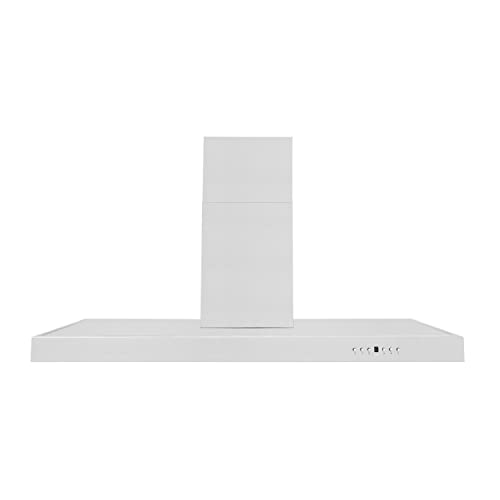
ZLINE 48 Inch Wall Mount Range Hood KE-48 — The Established KE
If the crown molding model is the platform dressed for a traditional room, the KE-48 is the platform in its working clothes: a 48 inch convertible stainless chimney without decorative additions, and the ZLINE reference design against which its siblings are variations. Longevity in a catalogue is itself a specification of sorts. A model that remains on sale across years accumulates owner reports, installer familiarity, available parts, and a second-hand understanding of its behaviour that no new launch can counterfeit, and the KE-48 carries that accumulated weight into this guide.
The plain profile is the aesthetic argument. A smooth stainless chimney over a professional range reads as competence in contemporary and industrial-leaning kitchens, where the crown molding of its sibling would be an accent too far. Nothing about the KE asks for attention; it frames the range, catches the light, and does its venting work in either ducted or recirculating configuration, per the convertible platform it shares with the rest of the trio. As with its siblings, confirm the listing’s current airflow and duct figures directly, since this guide quotes only what its source material states.
Practically, the KE-48 suits the buyer who has already decided on the ZLINE platform — for its convertible flexibility, its professional styling, its market depth — and simply wants the canonical version. That buyer exists in numbers, and serving them honestly means saying that the choice among the three ZLINEs is a design choice resting on a shared foundation, not a performance ladder with the KE on a lower rung. The rung story would be easier to write and wrong to publish.
Ceiling and duct homework applies unchanged: chimney reach measured, mounting height per the manual, filters planned if recirculating. Within that homework, the KE-48 is the guide’s recommendation for the buyer who values the proven article — the hood equivalent of ordering the dish the restaurant is named after.
- Width: 48 inches, wall mount chimney, stainless steel
- Model: KE-48
- Venting: convertible vent platform
- Design: plain chimney profile — confirm full specs on the listing
Strengths
- Long-running model with deep owner and installer familiarity.
- Clean profile suits contemporary and industrial kitchens.
- Convertible venting covers ducted and ductless homes alike.
Trade-offs
- No decorative treatment for traditional rooms wanting one.
- Key figures must be verified on the current listing.
- Shares the platform’s dependence on duct or filter discipline.
Best for: buyers wanting the canonical ZLINE chimney in a clean profile. Not suited for: traditional kitchens seeking a crown or furniture detail.

ZLINE 48 Inch Wall Mount Range Hood KL3-48 — Traditional Chimney Profile
The KL3-48 completes the ZLINE trio with a third silhouette on the shared convertible platform — a chimney profile with a more traditional cast than the KE’s plain column, standing between its siblings in spirit: designed, but without the KBCRN’s explicit crown molding gesture. Three profiles on one platform is not redundancy; it is how kitchens actually get finished, because the range wall is the most looked-at elevation in the room and small differences in a chimney’s shoulders and transitions decide whether a hood looks native or imported.
Everything this guide has said about the platform holds for the KL3 without amendment, and we repeat the essentials rather than inventing distinctions: convertible venting for ducted or recirculating installation, stainless construction at the full 48 inch width, and a specification whose airflow and duct details should be confirmed on the current listing. The KL3’s own contribution is proportion. Buyers comparing the trio should study the chimney’s shape against their ceiling height and cabinet style — a profile that flatters a nine-foot ceiling in a traditional kitchen may crowd a lower one, and the photograph, the tape measure, and the room must be consulted together.
There is a fleet logic to choosing within one brand’s platform that deserves a sentence: filters, parts, and installer knowledge overlap across the trio, so a household or a small developer fitting several kitchens can standardise on the platform and vary only the silhouette per room. The KL3 is the variation for the room that wants tradition without ornament — the shaker kitchen, the farmhouse renovation, the range wall framed in painted woodwork.
Choose it by eye and by ceiling, with the platform’s homework done once and done properly. In a guide that has separated its twins honestly elsewhere, the KL3’s identity can be stated in a line: the traditional profile of a proven convertible chimney, for the kitchen whose style sits between plain and crowned.
- Width: 48 inches, wall mount chimney, stainless steel
- Model: KL3-48
- Venting: convertible vent platform
- Design: traditional chimney profile — confirm full specs on the listing
Strengths
- Traditional silhouette suits shaker and farmhouse kitchens.
- Shared platform keeps parts and filters in the family.
- Convertible venting adapts across house types.
Trade-offs
- Distinction from its siblings is design, not specification.
- Profile proportions must be judged against your ceiling height.
- Airflow and duct figures require listing confirmation.
Best for: traditional-leaning kitchens wanting ZLINE’s platform without crown molding. Not suited for: buyers seeking a technically distinct alternative to the KE.

48 Inch Range Hood Wall Mount 1500 CFM Gesture Sensing — Highest Airflow Here
The closing pick carries the guide’s biggest number: 1500 CFM of headline airflow, across four speeds, in a ducted stainless chimney with gesture sensing and touch control. Four speeds matter at this altitude, because a fan this strong needs gradations — full power is for the wok’s breath of fire and the griddle’s Saturday smoke, while the lower settings keep a simmer’s steam managed without turning the kitchen into a wind tunnel or drowning conversation. Gesture sensing repeats the SNDOAS’s hands-dirty logic at higher power: wave, and the hood answers, with the touch panel for cooks who prefer contact.
Power this size carries responsibilities the guide will state plainly. A 1500 CFM exhaust moves enough air that larger homes and tighter modern construction should think about make-up air — the replacement air a house must admit when this much leaves — and local codes in many places require it at high extraction rates, for the sound physical reason that a starved house will pull air down flues and chimneys. Discuss the duct and make-up air plan with your installer before the hood arrives, and size the duct generously: big airflow through a small duct is noise, resistance, and disappointment in equal measure.
Who needs the guide’s maximum? The cook whose 48 inches are all working at once — griddle centre, burners high, oven doors opening into the room’s air — and the open-plan household where escaped smoke becomes everyone’s evening. For gentler cooking, this much extraction is a reserve rarely visited, and the 1200 CFM pair above will serve with less installation consequence. Matching the hood to the cooking is the guide’s refrain, and it applies at the top of the range most of all: buy the airflow your burners can justify.
Ducted commitment, four-speed control, and the class’s strongest headline make this the specialist’s pick — the hood for the range that behaves like restaurant equipment, installed with the seriousness that restaurant-grade extraction demands and rewards.
- Width: 48 inches, wall mount, stainless steel
- Airflow: 1500 CFM headline — highest in this guide
- Speeds: four, with gesture sensing and touch control
- Venting: ducted — plan duct size and make-up air with an installer
Strengths
- Strongest extraction here for fully-working professional ranges.
- Four speeds make the power usable across all cooking levels.
- Gesture control keeps greasy hands off the stainless.
Trade-offs
- May require make-up air provision under local codes.
- Oversized for households whose cooking is gentle.
- Demands a generously sized, well-built duct run.
Best for: high-output 48 inch ranges and open-plan kitchens with heavy cooking. Not suited for: mild cooking or homes unable to accommodate duct and air planning.
How Do the Six Compare at a Glance?
| Model | Airflow | Venting | Controls |
|---|---|---|---|
| SNDOAS 48 Inch Wall Mount Range Hood 1200 CFM | 1200 CFM | Ducted or ductless | Gesture, touch, remote |
| KOSTCH 48 Inch Ducted Wall Mounted Range Hood 1200 CFM | 1200 CFM | Ducted | Touchscreen, 3 speeds |
| ZLINE 48 Inch Wall Mount Range Hood Crown Molding | See listing | Convertible | Platform controls |
| ZLINE 48 Inch Wall Mount Range Hood KE-48 | See listing | Convertible | Platform controls |
| ZLINE 48 Inch Wall Mount Range Hood KL3-48 | See listing | Convertible | Platform controls |
| 48 Inch Range Hood Wall Mount 1500 CFM Gesture Sensing | 1500 CFM | Ducted | Gesture and touch, 4 speeds |
How Do You Plan the Duct Run So the CFM You Bought Actually Arrives?
A hood’s fan is rated in open air; your kitchen gives it a duct, and the duct always takes a tax. Every elbow, every metre of run, every undersized section and rough flexible bend subtracts from the headline, which is why two identical hoods in two houses perform like different machines. The planning rules are unglamorous and absolute: use the duct diameter the manufacturer specifies or larger, never smaller; choose smooth rigid duct over flex wherever the path allows; keep the run as short and straight as the house permits; and terminate through a cap that opens freely. A hood vented with that discipline delivers something close to its promise, while a hood strangled by a crushed flex duct delivers a fraction of it at a multiple of the noise.
Capture completes what airflow begins. The canopy must cover the cooking surface’s full footprint — at 48 inches over a 48 inch range, that condition is the entry ticket — and it must hang at the mounting height the manual prescribes, because a hood mounted high for headroom surrenders the front burners’ plume to the room. Cross-draughts are the invisible third factor: a door or window breeze across the range can shear a rising plume sideways faster than a marginal fan can recover it, which is why serious cooks close the kitchen door when the wok comes out. None of this appears on a listing, and all of it decides whether the listing’s number becomes your kitchen’s reality.
Where ducting is genuinely impossible and a convertible model runs recirculating, set expectations and habits accordingly: charcoal filters on their replacement schedule, the fan started a moment before the pan gets hot, and a window cracked when the cooking is at its most theatrical. Recirculation manages grease and odour respectably; it does not export heat or moisture, and a household that understands that distinction will be pleased with its ductless hood rather than betrayed by it.
How Should You Clean and Maintain a Stainless Chimney Hood?
The grease filters are the maintenance heart. Baffle or mesh, they intercept the grease the fan pulls from the air, and they want regular washing — many are dishwasher-safe per their manuals — on a rhythm set by how the household cooks: monthly for daily fryers, quarterly for gentler kitchens. A saturated filter is both a performance tax and a hygiene debt, and the five-minute wash that prevents it is the cheapest performance upgrade in this entire guide. The stainless exterior wants the opposite treatment from the one instinct suggests: wipe with the grain, with a soft cloth and a mild cleaner, never with abrasive pads that scar the finish the household paid to admire.
Ductless owners add charcoal filters to the calendar, replaced rather than washed, on the schedule the manual sets; a spent charcoal filter announces itself by returning odours the hood once caught. Lighting under the canopy, the grease rail or cup where fitted, and the fan’s accessible surfaces all benefit from the same seasonal attention. Keep the manual’s maintenance page as the authority for your model, because filter types and access differ, and treat any change in the hood’s voice — a new rattle, a strained note at a familiar speed — as the machine reporting a loose part or a laden filter while the report is still cheap to answer.
How Loud Will a Big Hood Be, and How Do You Live With It Gracefully?
Moving a thousand-plus cubic feet of air per minute is not silent work, and any guide promising otherwise is selling something. What varies between a tolerable hood and an oppressive one is less the fan than the system around it: a generously sized, smooth duct lets air leave without turbulence’s roar, while an undersized or corrugated run turns the same fan into a weather event. Speed discipline is the owner’s half of the bargain. Most cooking needs the middle settings; the top speed is an instrument for the sear, the wok, and the accident, and households that run it as a default are choosing noise they rarely need.
Conversation planning helps more than brochures admit. In open-plan homes, run the hood’s hardest work before guests sit down — the searing done, the fan stepped down to its simmer setting by the time the room fills — and the extraction will have done its job in the kitchen’s working hour rather than its social one. Remote and gesture controls, offered by two picks here, quietly assist that choreography, since adjusting the fan from the table or with a wave beats crossing the room mid-conversation. Judge a hood’s noise, finally, in your own kitchen’s terms: the household that cooks at restaurant intensity will accept a working roar as the sound of competence, while the gentle cook should buy the smaller reserve and the calmer life that comes with it.
What Should You Know About Lighting, Heat, and Cooking Under the Canopy?
A chimney hood is also the range’s ceiling light, and its quality shapes daily cooking more than owners expect. Light should fall on the front burners without glare and render food’s colour honestly — a sauce’s gloss and a steak’s crust are judged by eye, under this light, every evening. When comparing listings, note the lighting arrangement and whether its lamps can be replaced simply, because a hood outlives several generations of bulb technology and a fixture that accepts standard replacements ages more gracefully than a sealed curiosity.
Heat radiates upward into the canopy’s world as well. Grease filters, controls, and the chimney’s lower reaches all live in the plume’s path, which is why the cleaning rhythm in this guide is not cosmetic: grease allowed to accumulate on surfaces above a range is a hygiene issue and, in the extreme, a fire consideration. Keep the filters washed, the visible stainless wiped, and the area above the range free of stored items — the cookbooks and oil bottles that migrate onto nearby shelves should never colonise the hood itself. A canopy treated as equipment rather than as furniture stays safe, efficient, and handsome across the same decade it ventilates.
How Do Ceiling Height and Chimney Extensions Decide the Installation?
Measure from the cooking surface to the ceiling and hold that number against the hood’s specified mounting band and chimney range before any other decision, because the chimney is a column with a designed height, not an infinitely adjustable curtain. Standard ceilings suit most installations directly; tall ceilings may require an extension kit, which should be ordered with the hood rather than discovered after it; low ceilings may compress the mounting height below the manual’s band, which is a reason to choose a different model rather than to improvise. The time to learn which case is yours is with a tape measure, in the empty kitchen, before money moves.
Structure hides behind the plaster, too. A wall-mounted chimney anchors to studs or to properly rated fixings, and at 48 inches wide with a steel column above it, the hood is not a picture frame — the installer will want solid purchase, and older walls sometimes want reinforcement planned in advance. Electrical supply is the third quiet requirement: a dedicated, correctly placed connection per the manual, arranged before the backsplash tile sets, because retrofitting a wire behind finished tile is the kind of sentence no renovator wants to hear. Hoods reward the households that plan them as building work, and punish — politely, expensively — the ones that plan them as shopping.
How Do You Cook With a Hood, Rather Than Merely Under One?
Technique multiplies equipment. Start the fan a minute before the pan reaches full heat, so the rising current is established when the first plume arrives, and let it run on low for several minutes after cooking ends, clearing the room’s lingering share while the plates are served. Use lids as the hood’s allies: a lidded pot sends a fraction of its steam to the canopy, and the cook who reaches for a lid during the rolling boil is doing ventilation work no fan can match. Rear burners, sitting deeper under the canopy, capture more forgivingly than front ones, so the smokiest work — the hard sear, the flambé moment, the wok — belongs at the back when the pan layout allows it.
Speed selection is a skill of its own. Match the fan to the plume rather than to the recipe’s drama: steam from pasta water is light and rises eagerly, needing little; frying’s aerosol is heavy, greasy, and worth full attention; a stockpot’s all-day simmer asks only for the lowest steady draw. Households that learn their hood’s speeds the way they learn their oven’s hot spots find the machine quieter, the kitchen cleaner, and the filters slower to load — three dividends from one habit. The hood, in other words, is an instrument, and the month spent learning it is repaid at every meal afterward.
What Does the First Month With a Big Chimney Hood Teach?
Expect a period of noticing. The kitchen will smell different — which is to say, it will stop smelling of last Tuesday’s dinner by Wednesday — and the cabinets nearest the range will stay cleaner than institutional memory predicted, because grease that once settled there now leaves through the duct. Cooks notice their own behaviour changing: searing without apology, frying without opening windows in January, attempting the dishes that once banished themselves to the outdoor grill. That expansion of the kitchen’s repertoire is the hood’s real return, and it arrives within the first month.
Use that month to baseline the machine. Note which speed your ordinary cooking actually needs, how the filters look after four weeks of your real life — the truest defroster of maintenance calendars — and whether the lighting flatters the work or fights it. Adjust the cleaning rhythm to the evidence rather than to the manual’s average household, which is not yours. A hood commissioned with that attention settles into the kitchen’s background for a decade, noticed only when a guest asks why the room smells so clean an hour after a fry-up — the finest review a chimney can earn.
Which Mistakes Do Hood Buyers Make Most Often?
Chasing CFM while ignoring the duct is the flagship error, repeated in this guide because it is repeated in kitchens everywhere: the number is bought, the path is neglected, and the performance never arrives. The second mistake is mounting for looks — the chimney floated high to clear a tall cook’s head, surrendering capture at the front burners where most cooking happens. Third comes the ceiling surprise: a chimney that cannot reach, or that overwhelms a low ceiling, discovered on installation day because nobody measured the column against the room.
Fourth, buyers forget make-up air until a high-powered hood starts pulling odd draughts through the house, a problem far cheaper to plan than to retrofit. Fifth, ductless buyers skip the charcoal filter schedule and conclude recirculation does not work, when what failed was the calendar. Sixth, households buy 48 inches of extraction for a range and a cooking style that needed half of it, paying in noise and installation consequence for a reserve they never visit. Measure the room, the ceiling, the duct path, and your own cooking with equal honesty, and the hood you choose will be the hood your kitchen needed.
How Should a Hood Decision Fit the Wider Kitchen Budget?
Ventilation is the least photogenic line in a kitchen budget and the one whose absence is photographed, in grease film and lingering odour, for years. The honest allocation treats the hood, its duct, its electrical work, and any make-up air provision as one purchase, because they are one system; a premium hood on a starved duct is a smaller hood wearing a larger price. Households sequencing a renovation should therefore fix the ventilation plan while walls are open and budgets are fluid, rather than discovering the duct’s cost after the cabinets have consumed the contingency.
Within that system budget, the picks in this guide divide sensibly. The flexible SNDOAS and the committed KOSTCH spend on airflow and controls; the ZLINE trio spends on platform and design; the 1500 CFM closer spends on maximum extraction and asks the house to spend alongside it on air. None is the wrong spend for the right kitchen. The wrong spend, universally, is the one that saves on installation to afford a headline — because the headline is precisely what poor installation takes away.
Why Does This Guide Insist on Wall Mount, and When Is That the Wrong Answer?
Every pick here mounts on a wall because the assignment — and the classic 48 inch range layout — puts the cooking against a wall, where a chimney can rise straight into its duct with the fewest bends and the strongest architectural presence. The wall is the hood’s ally: structure to anchor to, a vertical path for the exhaust, and a backsplash elevation that frames the range as the room’s hearth. Kitchens that cook on an island live by different physics — no wall, cross-draughts from every side, a canopy that must hang from the ceiling and work harder for its capture — and nothing in this guide should be stretched to cover them. Island households need island hoods, honestly chosen, and the principles that do transfer are capture, duct discipline, and cooking technique rather than any model named here.
Within wall-mounted kitchens, the chimney format itself deserves its defence against the under-cabinet and insert alternatives. At 48 inches over a serious range, the chimney’s open canopy and vertical column give the plume room to gather and a straight road out, while presenting the stainless presence that this class of kitchen treats as a design feature rather than an apology. The format asks for ceiling height and wall commitment, and in the kitchens it suits, it returns both with interest — which is why the type has become the default silhouette over professional-style ranges, and why this guide’s six variations on it reward close comparison.
What Paperwork and Measurements Should You Gather Before Ordering?
Assemble the file before the cart: the range’s exact width and its distance to the nearest cabinet on each side, the cooking surface’s height, the ceiling’s height above it, the wall’s construction where the chimney will anchor, and photographs of the joists’ direction if the ceiling is open or documented. Add the electrical panel’s location and the route the duct would travel — through the roof, through an exterior wall, or upward through a soffit — sketched roughly enough that an installer can price the conversation in one visit. That file converts a vague intention into an order that fits, and it protects the household from the most common large-hood disappointment, which is a beautiful machine meeting an unmeasured room.
Keep the same file after installation, joined by the manual, the warranty record, and a note of the duct’s actual route and diameter. Future filter orders, service visits, and the eventual range replacement all become simpler when the kitchen’s ventilation facts live in one place, and a future owner inheriting the house inherits the knowledge with it. Appliances of this scale are part of the building; treat their paperwork with a building’s respect, and the chimney will be maintained like the fixture it is rather than rediscovered, expensively, at each small crisis.
Final Recommendation
Most buyers of a 48 inch range will be best served by the SNDOAS 48 Inch Wall Mount Range Hood 1200 CFM, whose combination of serious airflow, gesture and remote control, and ducted-or-ductless freedom survives more kinds of houses and renovations than any other pick here. Kitchens with a settled duct route and a taste for a clean touchscreen face should take the KOSTCH 48 Inch Ducted Wall Mounted Range Hood 1200 CFM and enjoy its committed simplicity. Brand-platform buyers should choose among the ZLINE trio by room style — crowned, plain, or traditional — beginning with the ZLINE 48 Inch Wall Mount Range Hood Crown Molding where the cabinetry is traditional.
The 1500 CFM closer is the specialist’s instrument, reserved for ranges and cooks that can justify it and houses prepared to feed it air. Whichever chimney rises over your range, build its duct like you mean it, mount it at the height the manual demands, and wash its filters like a religion — and the stainless column will repay you in the only currency that matters at dinner time, which is a kitchen that smells of nothing but the plate in front of you.
Frequently Asked Questions
How much CFM does a 48 inch range really need?
It depends on the range’s output and your cooking. High-output professional-style ranges justify the 1200 to 1500 CFM band covered here, especially with griddles and wok cooking, while gentler cooking can live lower. Whatever the fan, duct quality and capture decide how much of the rating your kitchen experiences.
Is ductless venting a real option or a compromise?
Both, honestly stated. Recirculation through charcoal filters manages grease and odour respectably and is the right answer where no duct path exists, but it returns heat and moisture to the room. Ducted exhaust outdoors remains the stronger arrangement wherever the building allows it.
Why does this guide not quote CFM for the ZLINE models?
Because the listing material this guide works from does not headline a figure for them, and inventing one would mislead. Confirm the current figure on each ZLINE listing, where the manufacturer states the full specification, before making a final comparison.
What is make-up air, and when does it matter?
Make-up air is the replacement air a house must admit when a powerful hood exhausts large volumes outdoors. At high extraction rates — the 1500 CFM end of this guide — many local codes require a make-up air provision so the house does not pull draughts down flues. Discuss it with your installer during planning.
How high above the range should the hood hang?
At the height the manufacturer specifies for your model, balancing capture against headroom. Mounting higher for looks surrenders the front burners’ plume; mounting lower than specified risks heat damage and an awkward cooking space. The manual’s figure is the answer, not a suggestion.
Can I install a 48 inch chimney hood myself?
A confident household with building skills can handle the mounting of the hood itself, but the system around it argues for professional help at key points: the duct’s exit through roof or wall, the electrical connection, and any make-up air provision are trades work with code attached. Many owners split the job — their own hands for the cabinet, licensed help for the penetrations and wiring — and that division respects both the budget and the building.
What backsplash and wall protection does a big hood need behind it?
The wall behind a 48 inch range lives in the plume’s weather, so its surface should be chosen to be cleaned rather than admired from a distance: tile, stone, metal, or a washable finish that tolerates heat and degreasing. Plan the backsplash’s height with the hood’s mounting position together, since the chimney, the splash zone, and the range form one visual and functional column. A wall treatment settled before installation — rather than patched around a mounted hood — is one more instance of this guide’s refrain that hoods are building work, and building work rewards those who sequence it.
How do I test whether my hood is capturing properly?
Use the steam test on an ordinary evening: bring a wide pot of water to a rolling boil on a front burner, set the hood to its middle speed, and watch the plume. Steam that rises straight into the canopy is capture working; steam that billows outward into the room is telling you about mounting height, cross-draughts, or a duct that is taxing the fan. A strip of tissue held near the canopy’s edge gives a second, simpler witness of the draw. Run the test after installation and after any duct work, because a hood verified in your own kitchen beats a specification believed from a page — including this one.
Should the hood match the range’s brand?
Matching badges is a styling preference, not a performance requirement; ventilation answers to width, capture, airflow, and ducting, none of which check the logo on the range below. Mixed suites are the norm in serious kitchens, where each appliance is chosen for its own job. Choose the hood your cooking and your duct justify, then let the stainless finishes — broadly consistent across the makers in this guide — carry the visual harmony.
How often should grease filters be washed?
Monthly for households that fry or sear daily, quarterly for gentler cooking, and whenever the filters look laden — a saturated filter taxes performance and hygiene alike. Follow your model’s manual for whether its filters are dishwasher-safe.
Related Guides
The ranges these hoods serve, judged by the same origin standards used elsewhere in this batch, are compared in Best American Made Gas Ranges. The craft machines that fill a renovated home’s quieter corners are rounded up in Best All Metal Sewing Machines, and the papercraft companions to a new kitchen’s first celebrations appear in Best Card Making Machines.


