What's inside
- Key Takeaways
- Quick Picks
- How We Chose These Picks
- How Do the Six Compare at a Glance?
- What Does a Range Hood Really Cost Over Ten Years?
- When Is a Convertible Hood the Smartest Spend?
- Which Features Are Worth Paying for on a Budget?
- How Do You Fit an Under-Cabinet Hood on a Budget, Safely?
- Why Do White Hoods Deserve More Respect in Value Kitchens?
- What Are the False Economies in This Category?
- How Do You Maintain an Affordable Hood Without Spending?
- What Should Renters and Landlords Each Look For?
- How Does an Affordable Hood Change a Small Kitchen’s Life?
- How Should You Time an Affordable Hood Purchase?
- What Does a Good Affordable Installation Look Like From the Street?
- How Do You Judge a Value Hood in Its First Fortnight?
- Why Does This Shelf Keep Coming Back to Filters?
- What Happens When the Affordable Hood Is the Kitchen’s First?
- How Should a Tight Budget Divide Between Hood and Duct?
- How Do You Keep a Budget Kitchen’s Air Honest in Winter?
- Which Budget Mistakes Stop Being Funny by Year Two?
- Final Recommendation
- Frequently Asked Questions
- Related Guides
As an Amazon Associate I earn from qualifying purchases. This post may contain affiliate links at no extra cost to you.
cottageverdict.com is reader-supported. When you buy through links on our site, we may earn an affiliate commission.
Where to buy: each hood below links to its own Amazon listing, where you can check price on Amazon against the running-cost notes in its review — because in this category the ticket is only the first instalment of what a hood costs. The best affordable under-cabinet range hoods are not simply the cheapest steel boxes that fit a 30-inch opening. Affordability, judged over the decade a hood should serve, is a sum: the purchase, the installation it demands, the filters it consumes, the electricity it sips or gulps, and the likelihood that it is still working — and still worth repairing — in year eight.
That arithmetic reshapes the shortlist in interesting ways. A very cheap hood that needs a duct cut through a roof may cost more installed than a convertible that fits the kitchen as it stands. A hood with washable filters quietly out-saves one with a taste for replacement pads. And a simple machine from a maker with a long parts tail can be the true bargain beside a feature-laden import whose remote, once lost, orphans its best functions.
The six below were chosen as the honest value shelf of the under-cabinet world: a convertible all-rounder from COMFEE’, Broan’s ductless specialist, two FIREGAS and SNDOAS variations in white and stainless, a slim 280 CFM entry point, and — the deliberate exception — the OSTBA, a 750 CFM machine whose specification argues that affordable can still mean powerful when the features are ones a household will use daily.
Key Takeaways
- Affordable means total cost over years: purchase, installation, filters, and repairability — not the smallest ticket alone.
- Convertible hoods save the cost of ductwork now and keep the ducted upgrade open for a later budget.
- Washable filters, as on the COMFEE’, remove a running cost that quietly exceeds many purchase differences.
- White finishes and rocker controls are value features: they match rental kitchens and never need relearning.
- The OSTBA proves the value shelf has a powerful end — 750 CFM with a timer — for cooks who will use it daily.
- A simple hood from an established maker is the safest long bet when parts and familiarity matter.
Quick Picks
| Model | Badge | Why it earns a place |
|---|---|---|
| COMFEE’ 30 Inch | Value All-Rounder | A slim convertible with three speeds, a reusable filter, bright LED light, and a listed 65dB — the running-cost champion. |
| Broan 413001 Ductless | Rental-Grade Value | A non-ducted white hood with lights from the ventilation specialist — the cheapest complete answer where no duct exists. |
| FIREGAS 300CFM White | White-Finish Saver | 300 CFM in white with two speeds, LED light, top or rear venting, and ducted or ductless conversion. |
| SNDOAS 30in Convertible | Staged-Spend Convertible | A ducted or ductless convertible in white with LED light and a two-speed fan — buy once, upgrade the venting later. |
| Under Cabinet 280CFM | Entry-Point Honesty | 280 CFM with rocker button control, two speeds, and a bright LED in a slim convertible stainless body. |
| OSTBA 750CFM | Power-End Value | 750 CFM in 430 stainless with touch, gesture, and remote control, a timer, LED lights, and top and rear venting. |
How We Chose These Picks
Value judging began with total cost rather than ticket cost. We estimated each candidate’s whole biography — installation demands, filter economics, control durability, parts prospects, and the cooking it could honestly serve — and kept only models whose lifetime sum stayed honourable. Raw cheapness was not enough: a hood that needs a roof duct cut before it works, or that consumes replacement pads forever, failed the brief however small its number looked in a search result.
Within that frame we spread the shelf deliberately: a ductless specialist for the no-duct kitchen, convertibles for the phased budget, a slim entry point for the gentle hob, and one powerful machine for the household whose value lies in buying once. Finishes in white as well as stainless were weighted as genuine features, because the affordable kitchen is usually a white kitchen, and a hood that matches it saves the cost of everything that would otherwise be replaced to agree with it.
Three purchases frame the value decision. The COMFEE’ 30 Inch is the all-round lifetime bargain for everyday cooking; the Broan 413001 Ductless is the complete answer where no duct exists; and the OSTBA 750CFM serves keen cooks who would rather buy power once than adequacy twice.

COMFEE’ 30 Inch Under Cabinet Range Hood — Value All-Rounder
The COMFEE’ makes its affordability case in the years after purchase, which is where affordability is actually decided. Its filter washes and returns instead of being replaced on a schedule, its three speeds let the motor loaf at the setting the cooking needs rather than gulping at full voice, and its convertible venting means the installation costs whatever the kitchen already allows — nothing for a ductless fit today, a duct’s price only if and when the household chooses one.
The specification is complete without being decorative: a slim stainless body that fits the standard opening, a bright LED over the hob, and a listed 65dB that suits open-plan rooms where a loud fan would simply go unused. An unused hood is the most expensive kind, whatever it cost, and the COMFEE’s civility is therefore an economic feature as much as a comfort one.
For everyday family cooking — the pasta, eggs, roasts, and occasional burgers that constitute most households’ real repertoire — it is sufficient in the way that matters: the air clears, the cabinets stay clean, the bill for filters stays at zero. Households whose cooking is gentle and whose budget is honest will find it the best-balanced purchase in this guide.
A year of COMFEE’ ownership has a recognisable texture: the filter comes out on the first weekend of the month, washes while the kettle boils, and the household’s extraction budget for the year stands at the cost of hot water. That rhythm is the machine’s whole economic argument made physical. Families who previously owned a pad-eating hood describe the saving with the particular warmth reserved for a bill that simply stopped arriving, and the kitchen’s air — cleared nightly at a volume nobody negotiates with — stays cleared because the fan is never too loud to use.
There is a further COMFEE’ economy that only appears on the household’s calendar: because the machine is quiet and sufficient, it gets used for the small jobs — the kettle’s steam, the toast’s haze, the five-minute egg — that a louder or feebler hood would be skipped for. Extraction used daily at low drama prevents the slow greasing of a kitchen far better than heroic extraction used weekly, and prevention is the cheapest form of cleaning ever sold. The ledger, as usual, rewards the appliance that fits the life rather than the brochure.
- Vent path: ducted or ductless convertible
- Fan: three speeds for daily cooking
- Filter: reusable, wash and refit
- Noise: 65dB figure in the listing
- Lighting: bright LED panel
- Profile: slim stainless under-cabinet body
Strengths
- Near-zero filter running costs
- Convertible fit avoids duct expense
- Quiet enough to be used constantly
Trade-offs
- Not built for sustained smoky cooking
- Slim canopy limits front-burner capture
- Ductless mode leaves steam indoors
Best for: family kitchens wanting low lifetime costs.
Not suited for: daily high-heat searing over a gas range.
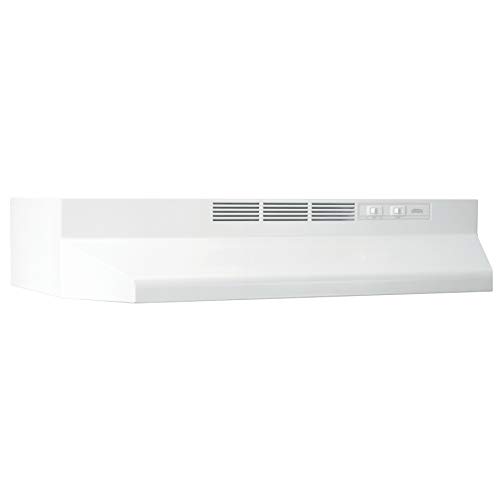
Broan-NuTone Ductless Range Hood 30in 413001 — Rental-Grade Value
The Broan’s affordability begins with what it refuses to require: no duct, no conversion kit, no electrician’s second visit, no landlord negotiation about holes in walls. For the enormous population of kitchens where extraction currently means opening a window in February, a light over the stove and a fan pulling cooking air through filtration is a complete transformation bought at the category’s entry point — and from a maker whose business is ventilation itself.
The white finish is a budget feature in disguise. It matches the white appliance suites of rentals and older kitchens, so the household is not nudged toward replacing anything else to make the room agree, and it recedes visually instead of demanding the kitchen be styled around it. Running costs are the filter’s rhythm and nothing else; the design’s longevity in Broan’s range means those filters remain obtainable, which is the unglamorous foundation of all real value.
Its limits are physics, stated plainly elsewhere in this guide: recirculation cannot export heat or steam. Within that truth, for gentle cooking in a ductless room, the Broan is not the cheap option — it is the correct one, and the distinction is why it has outlasted generations of flashier rivals at higher tickets.
Broan ownership in a rental has a social dimension the specification cannot show. The tenant gains a lit, ventilated stove — often the first in that kitchen’s life — and the landlord gains an appliance that the next four tenants will also fail to break, because there is almost nothing in it to break. When it eventually needs attention, the person who services it will have seen its pattern a hundred times. Value compounds quietly in arrangements like that, on both sides of the tenancy agreement, for as long as the building stands.
The Broan also teaches a lesson about specification restraint that expensive hoods could borrow. Nothing in it exists to be photographed; everything in it exists to be used by somebody who did not choose it, in a kitchen that was not designed, for cooking that was not planned. Designing for that reality is harder than designing for a showroom, and the decades this pattern has survived suggest the lesson was learned early and never forgotten. Value, it turns out, is what remains when every feature must justify itself to a stranger.
- Vent path: non-ducted recirculation only
- Colour: white, matches standard suites
- Role: under-cabinet fan with lighting
- Filtration: ductless grease filter path
- Brand: Broan-NuTone specialist range
- Install: screws and power, no ductwork
Strengths
- Lowest total installed cost here
- No duct means no building work
- Long-running design, findable parts
Trade-offs
- Cannot remove heat or moisture
- Suits light cooking only
- Plain specification throughout
Best for: rentals and ductless kitchens on a strict budget.
Not suited for: any kitchen that could vent outside instead.

FIREGAS Range Hood 30 inch White 300CFM — White-Finish Saver
The white FIREGAS takes the sensible 300 CFM formula — two speeds, an LED light, top or rear venting, conversion between ducted and ductless — and dresses it for the kitchens that dominate the affordable end of the market: white appliances, light cabinets, and no desire for a stainless statement above the stove. That colour match is worth money, because a hood that agrees with the room never triggers the cascade of small replacements a clashing appliance can inspire.
At 300 CFM the extraction is honestly matched to small and medium cooking, and on a short duct it genuinely exhausts, which lifts it above every recirculating-only rival at similar money. The two speeds cover the simmer and the fry; the installation, helped by the choice of vent exits, is an afternoon rather than a project; and the whole machine can be understood by every member of the household without a manual’s assistance.
As a value proposition it is the guide’s pragmatist: enough power for its brief, two venting lives in one body, a finish that fits the room it will actually serve, and nothing in the specification whose cost cannot be explained at the kitchen table. Households furnishing a first kitchen or rescuing a rental’s cooking air could do far worse with far more money.
The white FIREGAS tends to be bought by households furnishing a kitchen in a single determined weekend — the let that must be habitable by Monday, the first flat that must cook by Friday. Its virtue in that setting is completeness without homework: the finish already agrees with the room, the controls already make sense, the venting already offers two chances to fit. Months later, when the household’s cooking has found its level, the FIREGAS is usually still exactly sufficient, which is the fate value purchases are supposed to have.
FIREGAS households furnishing on a deadline discover a second saving in the months after: because the machine asked for nothing — no duct project, no learning curve, no matching purchases — the kitchen’s budget survived intact for the things that could not be compromised. That is the unrecorded function of the honest value appliance. It does its job and leaves the money, the weekends, and the household’s attention available for the rest of the home, which is precisely what affordable was always supposed to mean.
- Airflow: 300 CFM listing figure
- Finish: white under-cabinet body
- Venting: top or rear, ducted or ductless
- Fan: two-speed exhaust
- Lighting: LED over the hob
- Controls: straightforward household operation
Strengths
- White finish suits value kitchens
- Real exhaust on a short duct
- Convertible fit forgives odd houses
Trade-offs
- Modest ceiling for smoky cooking
- Two speeds limit fine control
- Basic lighting and feature set
Best for: white kitchens needing affordable real extraction.
Not suited for: keen cooks with a smoky repertoire.

SNDOAS 30in Under Cabinet Hood Convertible — Staged-Spend Convertible
The SNDOAS convertible is the value shelf’s answer to the phased budget, which is how most kitchens are actually paid for. Fitted ductless, it serves immediately — light, fan, filtration — in a white under-cabinet body that suits the standard kitchen. Later, when the renovation fund reaches the wall behind the stove, the same machine connects to a duct and becomes a genuine extractor, and not one penny of the original purchase is thrown away in the upgrade.
That two-stage life is worth more than a small purchase saving, because the alternative biography is common and wasteful: a ductless-only cheap hood bought now, discarded in two years when the duct arrives, and replaced by the machine that should have been bought first. The SNDOAS’s two speeds and LED light are unremarkable in the best sense — the specification of a hood intended to be lived with rather than reviewed — and its white finish keeps it invisible in the kitchens it will serve.
Judge it as financial planning in stainless’s stead. Households certain their duct is coming — the extension planned, the remodel sequenced — should buy this shape of machine and no other, because it is the only one whose first instalment is also its last.
SNDOAS households keep a particular date in mind: the one the duct arrives. Until then the machine serves without complaint, and its owners speak of it the way people speak of a good temporary bridge — gratefully, and with the end in sight. When conversion day comes, the transformation is disproportionate to the afternoon it takes, and the household gets to enjoy the rare renovation experience of an upgrade that required no new appliance at all. Financial planners should study this hood; it is a sinking fund made of steel.
The SNDOAS’s white body deserves a final economic note: in the staged renovation it will eventually join, white is the finish least likely to be designed out. Kitchens change their minds about steel, about colour, about everything — but a white hood under a white cabinet survives scheme after scheme without asking to be replaced for looking wrong. Longevity by invisibility is still longevity, and the staged budget that buys it has purchased years the spreadsheet never itemised.
- Vent path: ducted or ductless convertible
- Finish: white under-cabinet body
- Fan: two-speed exhaust fan
- Lighting: LED light included
- Role: staged-renovation value pick
- Fit: standard 30-inch cabinet opening
Strengths
- One purchase spans both venting stages
- White finish blends with value suites
- Simple specification, simple ownership
Trade-offs
- Modest power in either mode
- Two speeds only
- Permanent ductless use wastes its design
Best for: phased renovations with a duct in the plan.
Not suited for: households wanting strong extraction today.

Range Hood 30 inch Under Cabinet 280CFM — Entry-Point Honesty
Every value guide needs a floor, and this slim stainless hood is it: 280 CFM, rocker buttons, two speeds, a bright LED, and convertible ducting in a body that fits the standard opening without discussion. Its affordability case is the simplest in the guide — for a gentle kitchen, the difference between this and no extraction is the whole ballgame, and the difference between this and a flagship is mostly money spent on airflow that household will never summon.
Rocker controls are a lifetime-cost feature disguised as an old-fashioned one. They cannot be orphaned by a lost remote, confused by an update, or defeated by a film of grease, and they will work in year ten exactly as they worked in week one. The convertible ducting extends the same insurance to the house itself: exhaust outside where a short run exists, recirculate where none does, and convert if the house ever changes its mind.
Buy it with the clear-eyed limits this guide has stated for its class: it will not referee a wok, and an ambitious household will outgrow it. As a first hood, a rental improvement, or the extractor for a small electric hob in a small flat, it is the definition of enough — and enough, bought knowingly, is the soul of value.
The slim 280’s owners include a constituency the industry underserves: people cooking in genuinely small spaces — bedsits, annexes, granny flats, narrowboats of the kitchen world — where a full-size appliance would be an absurdity and no appliance at all was the previous arrangement. For them its modest capture is not a compromise but a category that finally fits, and its rocker switches will be operated with wet hands in cramped quarters for years without a single thought spared for them. That thoughtlessness is the product working.
Consider, too, who else the little 280 serves: the annexe built for a parent, the studio let to a student, the holiday cottage that cooks six weeks a year. In each, the correct extraction is exactly this — present, sufficient, simple, and cheap to keep — and a flagship would be a category error wearing a specification. A guide that cannot recommend the small machine for the small job has confused value with virtue, and this one declines the confusion.
- Airflow: 280 CFM listing figure
- Mounting: slim 30-inch under-cabinet
- Controls: rocker button operation
- Fan: two speeds
- Lighting: bright LED lamp
- Vent path: ducted or ductless convertible
Strengths
- Lowest commitment in the guide
- Controls that cannot be orphaned
- Convertible fit for any kitchen
Trade-offs
- Least headroom for smoky dishes
- Basic feature set by design
- Outgrown by ambitious cooking
Best for: first kitchens, rentals, and gentle electric hobs.
Not suited for: gas ranges or regular high-heat frying.
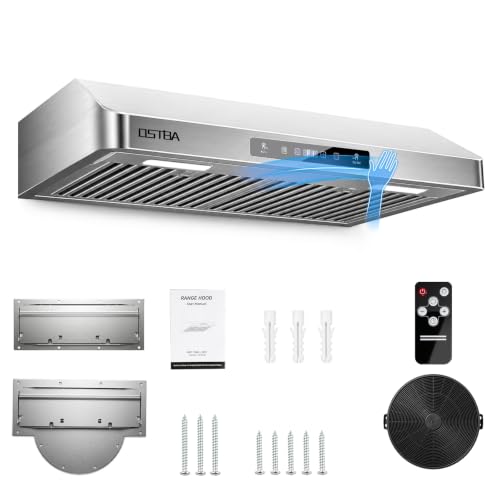
OSTBA 30in Under Cabinet Range Hood 750CFM — Power-End Value
The OSTBA closes the guide by challenging its premise in the most useful way: affordable need not mean weak. Here is 750 CFM — the output class of serious ducted cooking — in 430 stainless steel, with touch, gesture, and remote control, a one-to-fifteen-minute timer, LED lighting, stainless filters, and top or rear venting. For a household that cooks hard every day, the value arithmetic inverts: a cheap hood replaced in three years, or supplemented by open windows all winter, costs more than a capable one bought once.
The features earn their keep rather than decorating the carton. The timer lets the fan finish clearing while the household sits down; the gesture control answers the cook whose hands are the reason the fan is needed; the remote serves the far end of a busy kitchen. Stainless filters wash instead of being replaced, keeping the running-cost ledger as clean as the COMFEE’s, and three speeds let the big motor spend its life at a loaf rather than a roar.
Its condition is the duct, as with every powerful machine in these guides: feed 750 CFM a proper run and it is the value shelf’s performance bargain; starve it and the household has bought noise at any price. Keen cooks with a real duct and a long horizon should read the OSTBA as the guide’s argument that value and power reconcile — when the power will genuinely be used, nightly, for years.
OSTBA ownership rearranges a keen cook’s sense of what the value shelf means. The timer clears the air while the table is laid; the gesture control answers mid-sear; the big motor, loafing at its middle speed for most meals, wears its capacity the way a strong swimmer wears theirs — invisibly, until the moment it is the only thing that matters. Households that arrived expecting to replace a cheap hood twice in a decade instead find themselves, at the decade’s end, washing the same stainless filters and wondering what the fuss about replacement cycles was ever about.
The OSTBA’s last value argument is about attention, the household resource scarcer than money. A machine that clears the room on a timer, answers a wave, and washes its own filters in the dishwasher returns minutes and decisions to its owners every single day. Priced across a decade of dinners, those returned minutes are the largest single saving in this entire guide — larger than any filter ledger, any installation shortcut, any ticket difference the shelf contains.
- Airflow: 750 CFM listing figure
- Steel: 430 stainless construction
- Controls: touch, gesture, and remote
- Timer: one-to-fifteen-minute delay range
- Venting: top and rear options
- Filters: stainless, washable design
Strengths
- Serious power on the value shelf
- Timer and gesture serve daily cooking
- Washable filters keep costs low
Trade-offs
- Demands a properly sized duct
- Rich controls mean more to maintain
- Wasted on gentle, occasional cooking
Best for: keen cooks wanting one long-term purchase.
Not suited for: ductless kitchens or minimal cooking.
How Do the Six Compare at a Glance?
Compare these by biography, not by ticket. The snapshot names each hood’s route to value — the mechanism by which it stays cheap across a decade rather than merely looking cheap across a checkout.
| Model | Snapshot |
|---|---|
| COMFEE’ 30 Inch | Convertible, reusable filter, three speeds, 65dB listing. |
| Broan 413001 Ductless | Ductless only, white finish, light plus fan, minimal install. |
| FIREGAS 300CFM White | 300 CFM in white, two speeds, top/rear venting. |
| SNDOAS 30in Convertible | Convertible in white, two speeds, staged-spend logic. |
| Under Cabinet 280CFM | 280 CFM, rocker buttons, slim convertible body. |
| OSTBA 750CFM | 750 CFM, triple control, timer, stainless filters. |
What Does a Range Hood Really Cost Over Ten Years?
Add the instalments honestly. The purchase is the first and often the smallest of them. Installation follows: a ductless fit can be an hour of screws, while a new duct run is a building project with a building project’s invoice. Filters bill annually in one of two currencies — money for replacements, or minutes for washing — and electricity adds its quiet line, larger for a big motor run at full voice than for a modest one loafing at its middle speed.
The final instalment is replacement itself. A hood that fails in year four and cannot be repaired costs its whole ticket again; a hood that serves a decade, with parts findable throughout, amortises into genuine cheapness whatever its first number was. This is the arithmetic that puts established makers and washable filters at the top of a value guide, and it is why the cheapest listing in a search result so often finishes last in the only ranking that matters — the household’s own ledger.
When Is a Convertible Hood the Smartest Spend?
Whenever the kitchen’s future contains a duct but its present does not. The convertible’s premium over a ductless-only model is small; the saving, when the duct arrives, is the entire second purchase the ductless-only household must make. Phased renovations, rentals being bought out, extensions planned for next summer — all of these are convertible biographies, and the staged-spend logic in the SNDOAS and COMFEE’ reviews exists for them.
The convertible is also insurance against surprises. More than one household has opened a cabinet to find the assumed duct is a fiction, a capped stub, or a route blocked by a beam. A convertible fits anyway, serves immediately, and loses nothing while the real route is replanned. In a category full of rigid commitments, that flexibility has a cash value that never appears on the carton.
Which Features Are Worth Paying for on a Budget?
Spend first on the pathway: convertible venting, a washable filter, and a canopy deep enough to gather a plume. Those three determine what the hood does every day for a decade. Spend next on the interface the household will actually use — for most, honest buttons or a simple touch panel — and on lighting bright enough to cook by, because a hood’s lamp replaces the ceiling light for every meal it serves.
Spend last, if at all, on ceremony. Gesture control earns its place only in genuinely messy, daily cooking — the OSTBA’s case — while app connectivity and novelty finishes almost never repay a tight budget. The discipline is to ask of every feature a single question: will this be used weekly in year five? The features that survive that question are value; the rest is decoration wearing a specification’s clothes.
How Do You Fit an Under-Cabinet Hood on a Budget, Safely?
The affordable installation is the one done once. Measure the opening, the cabinet’s substance, and the distance to the cooking surface before ordering; confirm where power will come from; and recruit a second pair of hands for the lift, because a hood dropped onto a hob converts a saving into the most expensive line in the project. Ductless and convertible fits are mercifully brief, but the mounting screws still want solid material, not the thin floor of a cabinet alone.
Ducted fits deserve the same economy of correctness: the shortest honest run, joints sealed, the cap checked from outside. None of this requires a professional’s full invoice in many houses, but electrical work should follow local code and confidence in equal measure — a household unsure of its wiring should buy the electrician and save elsewhere, because that is the one line of the budget where cheapness is not a virtue.
Why Do White Hoods Deserve More Respect in Value Kitchens?
Because most affordable kitchens are white kitchens, and a white hood is the only finish that asks nothing of the room around it. Stainless above white appliances reads as an interruption that owners feel pressured to fix — a handle changed here, a kettle replaced there — until the hood’s true cost includes a small renovation. The white models in this guide, from Broan, FIREGAS, and SNDOAS, are not lesser versions of steel ones; they are the correct specification for the rooms they will serve.
White also ages gracefully in a working kitchen. It shows less of the fingerprint archive that stainless collects, forgives the odd splash, and suits the farmhouse and traditional styles that dominate real homes rather than showrooms. Value, in the end, is fitness for the actual room — and by that measure the white shelf of this guide is not the consolation tier but the home team’s starting lineup.
What Are the False Economies in This Category?
The classics repeat reliably. A hood so weak it is never used is a total loss at any discount. A ductless-only model bought months before a duct is cut is a purchase made twice. Filters that cannot be washed convert a small saving into a decade of small bills. A no-name machine whose parts vanish with its listing turns the first failure into a replacement. And an oversized motor on an unchanged small duct buys noise, which the household pays for in the currency of dinners talked over at raised volume.
Against each stands the same remedy: buy the biography, not the ticket. The six machines in this guide were chosen because their ten-year stories stay cheap in the ways that compound — washed filters, convertible pathways, repairable simplicity, or power sufficient to never need replacing. That is the whole secret of the affordable shelf, and it was never really about the number at the checkout.
How Do You Maintain an Affordable Hood Without Spending?
The budget hood’s maintenance is measured in minutes, and the minutes are the maintenance budget — which is why they must actually be spent. A filter washed monthly costs a sink of hot water; a filter ignored for a year costs the hood its performance and eventually its motor’s temper. The canopy’s underside wants the same weekly cloth as any premium machine’s, because grease does not check price tags before settling, and the lights want a wipe whenever the filters are out.
Once a year, look at the fixings. Under-cabinet hoods live above heat and steam, are vibrated gently by their own fans, and are occasionally knocked by tall pans; a screwdriver’s tour of the mounting points and a check that the unit still sits level costs ten minutes and prevents the rattle that households otherwise pay a call-out to diagnose. Affordable ownership is not the absence of maintenance — it is maintenance whose entire toolkit fits in a kitchen drawer.
What Should Renters and Landlords Each Look For?
The renter’s brief is permission-shaped: a hood that fits the existing opening, needs no duct and no structural change, and can be removed leaving the kitchen as it was found. The ductless Broan and the convertibles run in their ductless mode answer that brief completely, and a renter who improves a kitchen’s air at that cost has usually improved the tenancy’s goodwill by more than the ticket. Keep the receipt and the landlord’s written blessing in the same envelope.
The landlord’s brief is durability-shaped: buttons over glass, washable filters over consumables, a maker whose parts outlive tenancies. Every model in this guide was chosen with at least one eye on that brief, because the affordable shelf and the rental shelf are substantially the same shelf. A hood that survives five tenants without a repair bill is not merely cheap — it is, by the only arithmetic landlords respect, profitable.
How Does an Affordable Hood Change a Small Kitchen’s Life?
Small kitchens concentrate everything: the steam has nowhere to drift, the grease lands close, and the cook stands inside the plume’s entire territory. That is why the modest machines in this guide produce transformations out of proportion to their figures in small rooms — a few hundred CFM of honest capture, or even of filtration, changes the air of a small volume completely and quickly, where the same machine in a barn-sized kitchen would merely contribute.
The secondary effects follow within weeks. The window stops fogging at breakfast, the paint above the stove stops yellowing, the soft furnishings of an open-plan bedsit stop archiving the week’s frying. Households in small spaces should therefore resist the showroom’s pressure toward scale: in a small kitchen, the affordable shelf is not the compromise tier, it is frequently the correct engineering, bought at the correct price by people who measured their room instead of their ambitions.
How Should You Time an Affordable Hood Purchase?
The value shelf rewards the household that buys in sequence rather than in panic. The right moment is when the kitchen’s venting future is known — duct possible or impossible, renovation dated or indefinitely deferred — because that single fact selects between the ductless specialist, the convertibles, and the ducted-leaning machines more decisively than any sale event. A hood bought before that question is answered is a gamble at any discount; bought after, even the simplest model here is a plan.
The wrong moment is the week the old hood dies noisily before a houseful of guests, when any box that fits becomes the purchase and the decade inherits the emergency. Households that suspect their current hood is fading — rattling, weakening, dimming — gain real money by choosing its successor calmly, from a guide like this one, while the old machine still turns. Foresight is the deepest discount in the category, and it is available in every season.
What Does a Good Affordable Installation Look Like From the Street?
Nothing at all, ideally. The ductless and convertible fits in this guide leave no exterior trace, and even a ducted value installation should announce itself only through a neat cap, correctly placed, that a passer-by would need a reason to notice. Inside, the signs of a good job are similarly quiet: a hood level and solid, a canopy at its proper height, controls reachable, light falling on the pans rather than the cook’s eyes.
That invisibility is itself a value outcome. Work that does not need redoing, explaining, or apologising for is the cheapest work there is, and it is achieved by the unglamorous sequence this guide keeps recommending — measure twice, mount into substance, seal the joints, test with steam, and only then call the job finished. The affordable shelf does not ask for perfection; it asks for once, properly, instead of twice, cheaply.
How Do You Judge a Value Hood in Its First Fortnight?
Test the purchase against the brief it was bought for, not against a flagship’s brochure. Cook the household’s ordinary week — the pasta night, the egg morning, the Sunday roast — with the fan on the setting a real person would choose, and judge from the next room and from the cabinet doors. If the air clears, the surfaces stay clean, and nobody has raised their voice over the fan, the value brief is fulfilled completely, whatever the specification’s ceiling says.
Then perform the ownership tests: wash the filter once, purely to learn how it releases and returns; find the lamp’s replacement path in the manual; and note whether the controls stayed obvious with cooking hands. A value hood passes its fortnight by disappearing into the household’s routine, and any machine in this guide that has not disappeared by day fourteen is telling its owner something worth hearing while adjustments are still easy.
Why Does This Shelf Keep Coming Back to Filters?
Because the filter is where affordable hoods either keep their promise or quietly break it. It is the only component whose condition changes weekly, the only running cost most models have, and the part whose neglect converts a sufficient machine into an insufficient one without anything technically breaking. A value guide that did not harp on filters would be reviewing the appliances as they leave the factory rather than as they live in kitchens, and kitchens are where value is decided.
The practical consequence is a buying rule simple enough to tape inside a cabinet door: in this price territory, choose the filter you will actually maintain over the motor you will occasionally admire. Washable beats replaceable for almost every household, baffles beat mesh for the frying ones, and any filter that needs a tool and a stepladder will, in the real world, be washed less often than its owner currently intends. The honest shelf is built on that realism.
What Happens When the Affordable Hood Is the Kitchen’s First?
For many readers this shelf is not an upgrade but a beginning — the first extraction a kitchen has ever had — and beginnings deserve their own expectations. The first fortnight teaches the household its new reflexes: fan on with the burner, back burners for the smoky work, a window habit for the longest boils if the fit is ductless. None of it is instinctive on day one, and all of it is automatic by day thirty, at which point the kitchen’s air simply belongs to a different and better regime.
The discovery that follows is usually about the room rather than the machine. Cabinets stay clean for the first time in the house’s memory; the ceiling’s paint stops its slow yellowing; cooking smells become an event of the evening rather than a condition of the week. First-hood households consistently report that the modest appliance changed more of their home than purchases ten times its size, which is the affordable shelf’s founding parable and the reason this guide exists.
How Should a Tight Budget Divide Between Hood and Duct?
When money forces a choice, the duct is forever and the hood is replaceable — but a duct without a hood is a hole, and a hood without a duct still filters, lights, and serves. The staged answer this guide has recommended throughout dissolves the dilemma: a convertible now, fitted within the present budget, and the duct funded as its own later project, at which point the same machine completes itself. No other division of a tight budget buys present service and future performance in a single transaction.
If the choice is truly binary — a better hood on an old duct, or an honest hood on a new one — take the new duct with the honest hood. Plumbing outlasts appliances, a good run will serve the next two hoods as faithfully as this one, and the honest machines on this shelf are good enough that the pairing will satisfy for years. The reverse pairing, a flagship strangling on a legacy duct, satisfies nobody and educates only the installer who is eventually paid to explain it.
How Do You Keep a Budget Kitchen’s Air Honest in Winter?
Winter is the affordable kitchen’s examination: windows stay shut, the cooking turns hearty, and a ductless or modest system must earn its place against roasts and braises rather than salads. The techniques are free and they compound — lids on the long boils, the fan lit before the pan rather than after the plume, the smokiest work kept to the back burners, and a door opened for the five genuinely theatrical minutes a week instead of the whole evening.
Households that adopt those habits find their value hood’s ceiling rises to meet the season, because capture is a partnership between the machine and the cook. The ones that ask the fan alone to defeat a lidless stockpot in a sealed room are conducting an experiment whose result was never in doubt. Winter, fairly played, is winnable on this shelf — and winning it is the last proof a sceptical household usually needs that affordable was a specification, not an apology.
One more line belongs in the ledger before any purchase on this shelf: the cost of the cooking that did not happen. Kitchens without extraction ration themselves — the fish deferred, the frying avoided, the guests seated away from the stove — and that rationing is a real, if unitemised, expense of the unhooded life. Even the humblest machine in this guide refunds it in the first month, which is why the affordable shelf, properly understood, is not where households settle. It is where they start cooking everything again.
Keep the manual, the receipt, and the filter’s washing rhythm together in the drawer nearest the stove. That small archive is the affordable owner’s entire service department, and households that keep it spend the decade cooking, while households that lose it spend odd weekends searching the internet for a part number that was in their hands on the first day.
Which Budget Mistakes Stop Being Funny by Year Two?
Value shopping fails in predictable places, usually where a small saving today purchases a larger cost on an instalment plan.
- Choosing by ticket alone while ignoring installation, filters, and repairability.
- Buying a ductless-only hood shortly before a planned duct makes it redundant.
- Paying for novelty features while skimping on canopy depth and filter quality.
- Fitting a stainless hood into a white kitchen and funding the matching cascade.
- Saving on the duct run, then blaming an adequate hood for the resulting noise.
- Skipping the second pair of hands and dropping the unit onto the hob.
Every item is avoidable with the ledger habit: price the decade, not the day, and the affordable shelf becomes genuinely affordable.
Final Recommendation
The value crown divides by biography. For the ordinary family kitchen, the COMFEE’ is the complete answer — convertible, washable, quiet, and sufficient for the cooking that actually happens. The Broan owns the ductless rental, the FIREGAS and SNDOAS serve white kitchens and phased budgets with equal good sense, the slim 280 CFM model is the honest floor for gentle hobs, and the OSTBA stands at the shelf’s powerful end for cooks whose daily output justifies buying extraction once and properly.
Price the decade before you price the day — count the duct, the filters, the parts, and the cooking — and the affordable hood you bring home will still be earning its place when flashier purchases are asking to be replaced.
Frequently Asked Questions
Is a cheap range hood a false economy?
Only when its biography is expensive: costly installation, consumable filters, unrepairable parts, or weakness that means it goes unused. A simple hood with washable filters and an honest specification is a true economy, and several in this guide qualify.
Should I buy ductless now and ducted later?
Buy a convertible now and the same machine becomes the ducted one later. That single decision is the most reliable saving in this category, because it removes an entire second purchase from the renovation’s future.
Do washable filters really save much?
Across a decade, yes — replacement pads are a small bill repeated until it is not small, while a washable filter costs minutes. The saving regularly exceeds the purchase difference between neighbouring models on this shelf.
Is stainless steel worth paying extra for?
Only if the kitchen is a stainless kitchen. In a white suite, a white hood is the better specification at any price, because it asks nothing else in the room to change. Finish should follow the room, not the showroom.
Can an affordable hood handle a gas range?
The stronger end of this shelf can, within reason — the OSTBA’s class of output serves ordinary gas cooking well on a proper duct. Pro-style ranges at full stretch belong to the heavier guides, and no budget is well served by pretending otherwise.
What is the cheapest complete upgrade from no hood at all?
A ductless or convertible under-cabinet model fitted where the stove already sits: light, fan, and filtration with no building work. The Broan is the purest form of that upgrade, and its effect on a previously unventilated kitchen is out of all proportion to its ticket.
Related Guides
With the kitchen’s air budgeted and handled, the rest of the home list awaits. Readers often continue with Best 24-Inch Compact Ventless Dryers, Best Affordable Hair Dryers with Stylist-Level Features, Best Blow Dryers for Dogs.



[…] arithmetic is settled, the remaining projects queue up politely. Readers often continue with Best Affordable Under-Cabinet Range Hoods, Best Black Friday Deals on Stackable Washer Dryers, Best Blow Dryers for […]