What's inside
- Key Takeaways
- Quick Picks
- How We Chose These Picks
- How Do the Six Island Hoods Compare?
- How High Should an Island Hood Hang?
- What Does Installation Actually Involve?
- How Do Cross-Draughts Change the Specification?
- How Should You Clean a Canopy at Height?
- What Mistakes Do Island Buyers Make?
- How Loud Is Life Under an Island Hood?
- How Does an Island Hood Change the Whole Room’s Design?
- What About Resale and the Next Owner?
- How Should You Live With It for the First Fortnight?
- How Do You Cook a Feast Under an Island Hood?
- What Should the Budget Include Beyond the Hood?
- How Does the Choice Age With the Kitchen?
- What If the Island Has a Downdraft Instead?
- How Do You Keep the Chimney Looking Like Architecture?
- What Does a Quiet Evening Under One Feel Like?
- How Do Seasons Test an Island Installation?
- What Should Tall and Short Cooks Each Check?
- How Does an Island Hood Serve a Keen Home Baker?
- What Is the Sensible Order of Decisions?
- How Do You Choose Between Glass and Steel at the Same Power?
- What Happens When the Whole Family Cooks at Once?
- How Should You Think About Energy?
- What Does a Second Year of Ownership Reveal?
- What Questions Should You Ask the Installer at the Quote Stage?
- How Do You Protect the Cooktop and Counters During Installation?
- What Is the Island Hood’s Relationship With the Rest of the Ventilation?
- What Is the Final Walk-Around Before You Pay?
- What Is the Hood’s Job at a Dinner Party?
- Final Recommendation
- Frequently Asked Questions
- Related Guides
As an Amazon Associate I earn from qualifying purchases. This post may contain affiliate links at no extra cost to you.
cottageverdict.com is reader-supported. When you buy through links on our site, we may earn an affiliate commission.
Where to buy: the best kitchen island range hoods in this guide are sold on Amazon, and their names link to the matching listing in the Quick Picks table, the detailed reviews and the comparison table, where you can check price on Amazon and confirm ceiling-height range, chimney extension options and duct diameter before ordering. An island hood has the hardest job in domestic ventilation. It hangs from the ceiling over a cooktop with no wall behind it, exposed to cross-draughts from every door and window, and it must capture a rising plume that has nothing to lean on — while looking like a piece of sculpture the whole kitchen will be judged by.
That double life, appliance and centrepiece, shapes every decision in this category. Airflow needs to be generous because capture is inefficient on four open sides. The chimney must telescope or extend to meet your ceiling, which makes ceiling height a specification rather than a detail. And the finish will be seen from the dining table, the sofa and the doorway, in daylight, for a decade. A wall hood can be merely competent; an island hood must also be beautiful, or at least serene.
The six picks divide along three lines: glass-canopy designs that keep sightlines open, all-steel chimneys that read as professional equipment, and the choice between thirty inches of width matched to a standard island range or thirty-six inches of capture margin. All are ceiling-mount machines, most are ducted designs with convertible options on some models, and all assume the installation seriousness that hanging a heavy appliance over a cooking surface deserves.
Key Takeaways
- Island hoods fight cross-draughts on four open sides, so they need more airflow than a wall hood over the same cooktop.
- Ceiling height decides the chimney length: measure floor to ceiling and cooktop to hood before falling for a design.
- Glass canopies preserve sightlines across open-plan rooms; steel chimneys read as professional and hide ductwork completely.
- Thirty-six inches of hood over a thirty-inch range buys capture margin that island cooking genuinely uses.
- Installation is structural — joists, duct route and electrical supply — so plan it like a building project, not a purchase.
- Controls reachable from the cooktop, or by gesture and remote, matter when the hood hangs above hot pans.
Quick Picks
| Pick | Badge | Why it earns its place |
|---|---|---|
| JOEAONZ 30 Inch Island Range Hood 700 CFM | Best Steel Workhorse | 700 CFM, push-button control and five-layer mesh filters in a stainless ceiling-mount chimney. |
| Tieasy Island Range Hood 30 Inch Glass 700 CFM | Best Glass Canopy | 700 CFM under a tempered-glass canopy with gesture sensing, touch control and four LED lights. |
| Cosmo Lumin 30 Inch Island Range Hood 380 CFM | Best Refined 30 Inch | 380 CFM ducted, soft-touch controls, dishwasher-safe baffle filters, timer and clock. |
| Cosmo Lumin 36 Inch Island Range Hood 380 CFM | Best Wide Capture | The Lumin formula at thirty-six inches with a glass visor, for broader capture over island ranges. |
| Tieasy 30 Inch Island Range Hood Gesture Touch 700 CFM | Best Black Gesture Model | 700 CFM in black, gesture and touch control, baffle filters and a time setting. |
| FIREGAS Black Island Range Hood 30 Inch | Best Black Push-Button | 700 CFM, three speeds, push-button control and four lights in a black convertible design. |
How We Chose These Picks
Capture geometry led. An island plume rises into a room’s air currents, so width, canopy shape and airflow were weighed together: the 700 CFM group answers draughty open-plan spaces, the Cosmo pair answers calmer rooms with refinement and quieter manners, and the thirty-six-inch Lumin answers the cook who wants the hood wider than the range. Glass earned its places honestly — in a through-view kitchen, a transparent canopy keeps the room’s sightlines and daylight intact in a way no steel box can.
Controls were judged from the cook’s position, reaching up past steam. Push buttons, soft-touch pads, gesture sensors and timers each appear because island cooks divide into people who want to touch, wave or schedule. Filter strategy mattered too: mesh stacks, permanent filters and dishwasher-safe baffles imply different maintenance lives at the top of a ladder, which is where island filters get changed.
Finally, every pick had to be a genuine ceiling-mount design with a chimney system intended for island work — not a wall hood adapted with optimism. Ducted performance is the grading basis; where a model also offers a ductless conversion, that is treated as a fallback for difficult ceilings, not the main event.
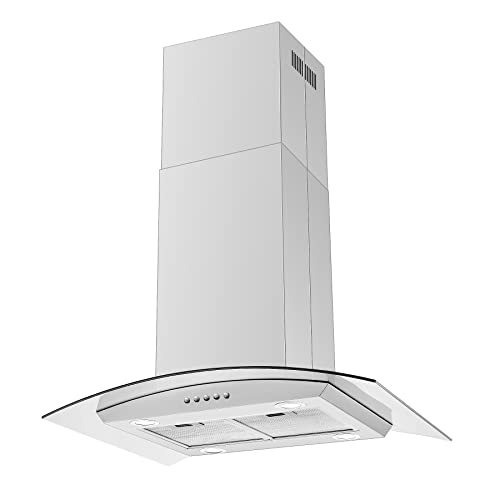
JOEAONZ 30 Inch Island Range Hood 700 CFM — Best Steel Workhorse
The JOEAONZ is the island hood as honest machinery: a stainless chimney, 700 CFM of rated airflow, push-button controls that work with a knuckle, and five-layer mesh filters doing the grease work. In an open-plan kitchen where the island range earns its living — family cooking three times a day, pans on every burner — that specification is the sensible centre of the category.
Mesh filters in five layers trap grease effectively and wash in a sink of hot degreasing solution; they ask for that soak more often than baffles would, which is the running cost of this design’s straightforwardness. Push buttons, meanwhile, are the island control that never misunderstands a gesture or loses a remote down the sofa. The JOEAONZ keeps its styling industrial-calm, a brushed chimney that suits kitchens built around steel and stone.
Give it a duct run worthy of its fan — the island position often means a longer path to an outside wall or a straight shot through the roof, and the roof route flatters any hood. Mounted at the maker’s recommended height over the cooktop, with the room’s worst draughts considered, this is the workhorse pick for households that cook hard and maintain simply.
- Airflow: 700 CFM
- Controls: Push button
- Filters: 5-layer mesh
- Mounting: Ceiling mount, 30 inch
- Body: Stainless steel
Strengths
- Strong rated airflow for draughty open-plan islands.
- Push-button controls are unambiguous with greasy hands.
- Steel chimney suits professional-look kitchens.
Trade-offs
- Mesh filters need regular soaking rather than a dishwasher ride.
- All-steel canopy blocks sightlines a glass design would keep.
- Full speed will be audible across an open-plan room.
Best for: busy family islands in steel-and-stone kitchens. Not suited for: rooms where the view across the island must stay open.
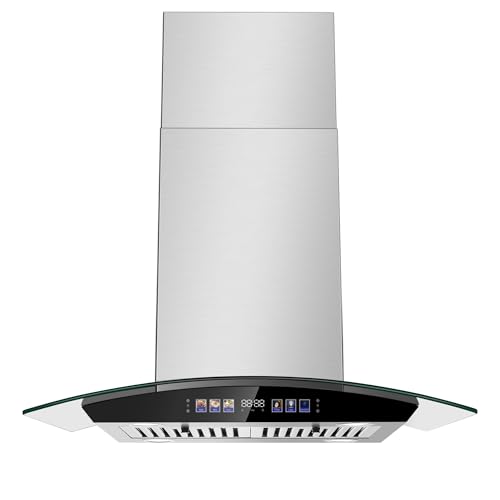
Tieasy Island Range Hood 30 Inch Glass 700 CFM — Best Glass Canopy
Glass changes what an island hood does to a room. The Tieasy’s tempered-glass canopy floats over the cooktop, catching the plume while the eye passes through it to the garden, the dining table, the person cooking opposite. For open-plan homes where the island is a social surface as much as a stove, that transparency is not decoration; it is the difference between a kitchen that feels divided and one that feels whole.
The specification underneath the elegance is serious: 700 CFM, a three-speed fan, four LED lights, permanent filters, and a control scheme pairing touch with colour gesture sensing — wave, and the hood responds, a trick that stops being a trick the first time both hands are full of pan and spatula. The Tieasy glass model asks for one discipline in return: glass shows grease film sooner than steel, so its canopy wants a wipe as part of the weekly clean, not as an annual event.
Choose this hood where the island faces a view or a room worth seeing, and where the cook will enjoy a machine that performs its work visibly and lightly. In a white, bright, modern kitchen it can be the single most complimented object in the house.
- Airflow: 700 CFM
- Canopy: Tempered glass
- Controls: Gesture sensing and touch
- Speeds: 3, with 4 LED lights
- Filters: Permanent
Strengths
- Glass canopy preserves sightlines and daylight across the island.
- Gesture control suits hands-full cooking moments.
- Four LEDs light the cooktop generously from above.
Trade-offs
- Glass announces grease film and needs frequent wiping.
- Gesture sensors have a learning curve for the whole household.
- Canopy style will not suit traditional, country kitchens.
Best for: bright open-plan islands facing a view or dining space. Not suited for: anyone who hates wiping glass.
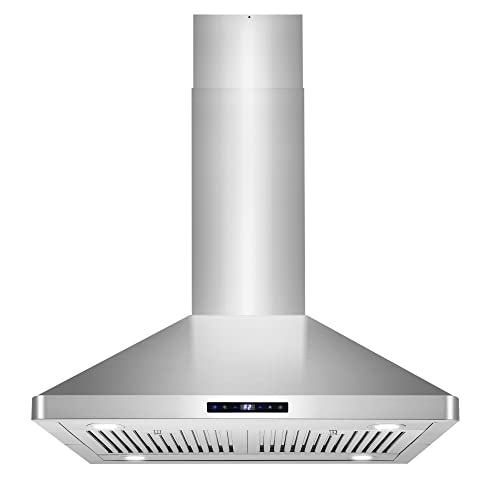
Cosmo Lumin 30 Inch Island Range Hood 380 CFM — Best Refined 30 Inch
Cosmo’s Lumin line is the tailored suit of this guide: 380 CFM of ducted airflow, soft-touch controls, three fan speeds, permanent baffle filters the listing confirms as dishwasher-safe, plus a timer and a clock set into a stainless island chimney with LED lighting. The airflow figure looks modest beside the 700 CFM group until you remember what it pairs with — baffles that keep their performance between cleans, and a fan voiced for rooms where people also live.
In a calmer kitchen — an island used for ordinary family cooking rather than wok theatre, in a space without savage cross-draughts — 380 CFM on a good duct clears the plume completely, and does it without turning the dining area into a wind tunnel’s waiting room. The timer earns quiet praise: set the clearing tail, sit down to eat, and the hood switches itself off after the air is clean. The Lumin 30 inch is the pick for cooks who measure a hood by how the room feels at dinner, not by the brochure’s biggest number.
Fit and finish complete the case. Cosmo sells coordinated kitchen suites, and the Lumin’s steel, seams and lighting sit at that level. If your island anchors a designed kitchen rather than a workshop of cooking, this is its natural crown.
- Airflow: 380 CFM, ducted
- Controls: Soft touch, with timer and clock
- Speeds: 3 fan speeds
- Filters: Permanent baffle, dishwasher-safe per listing
- Model: COS-63ISS75, Lumin collection
Strengths
- Refined build and finish for design-led kitchens.
- Baffle filters clean in the dishwasher and hold performance.
- Timer runs the clearing tail without supervision.
Trade-offs
- 380 CFM is the group’s lowest ceiling for smoky cooking.
- Draughty, door-heavy rooms may overwhelm its capture.
- Premium positioning within the island category.
Best for: calm, designed kitchens with ordinary-to-keen cooking. Not suited for: wok stations in draughty barn conversions.

Cosmo Lumin 36 Inch Island Range Hood 380 CFM — Best Wide Capture
Width is capture insurance, and the thirty-six-inch Lumin is the insurance policy. Hung over a thirty-inch island range, its canopy overhangs the cooktop on every side, claiming the plume’s edge cases — the front-left burner in a cross-draught, the tall stockpot leaning its steam sideways. The listing adds a glass visor to the steel chimney, a detail that widens the capture face while keeping the upper room visually light.
The running gear matches its thirty-inch sibling: 380 CFM, three speeds, soft-touch controls, permanent dishwasher-safe baffle filters and LED light, in the larger COS-668ICS900 format. On an island with a five- or six-burner top, the extra width is not vanity; island plumes spread as they rise, and a canopy that meets them at their spread width captures what a narrower hood waves at.
Check two things before choosing it: the island’s own width, since a thirty-six-inch hood over a narrow island can crowd the room’s proportions, and the ceiling structure, since a bigger canopy wants confident fixing. Where both answers are comfortable, this is the connoisseur’s solution to island capture physics.
- Airflow: 380 CFM, ducted
- Width: 36 inch canopy with glass visor
- Controls: Soft touch
- Speeds: 3 fan speeds
- Filters: Permanent baffle, dishwasher-safe per listing
Strengths
- Overhang captures plumes that escape narrower hoods.
- Glass visor widens capture without visual heaviness.
- Same refined Cosmo running gear as the 30-inch Lumin.
Trade-offs
- Can overwhelm a small island’s proportions.
- Same 380 CFM ceiling as its smaller sibling.
- Larger canopy needs especially confident ceiling fixing.
Best for: wide islands and multi-burner cooktops in open rooms. Not suited for: compact islands in low-ceilinged kitchens.

Tieasy 30 Inch Island Range Hood Gesture Touch 700 CFM — Best Black Gesture Model
Black island hoods make a room’s architecture explicit, and this Tieasy leans in: a black thirty-inch ceiling-mount chimney, 700 CFM, gesture and touch control, a three-speed fan, four LED lights and stainless baffle filters, with a time setting for the clearing tail. In kitchens built around black cabinetry, dark stone and drama, a steel hood is the compromise; this is the intention.
The baffle filters distinguish it from its glass-canopied sibling — metal baffles shrug off the dishwasher and keep their airflow character between cleans, suiting households that cook greasier and clean in batches. The listing notes ductless or ducted flexibility, and this guide grades it as a ducted machine while acknowledging the fallback exists for ceilings where a duct truly cannot go. The Tieasy in black also carries the time setting its sibling lacks, for cooks who like the fan to finish the job after they have left the room.
Black finishes ask for the right light: the four LEDs matter here, pooling brightness on the cooktop so the dark canopy does not drink the room’s cheer. In the right kitchen — moody, modern, deliberate — this hood is the ceiling’s exclamation point.
- Airflow: 700 CFM
- Finish: Black
- Controls: Gesture and touch, time setting
- Speeds: 3, with 4 LED lights
- Filters: Stainless baffle
Strengths
- Black finish completes dark, dramatic kitchen schemes.
- Baffle filters suit greasier cooking and dishwasher cleaning.
- Time setting automates the post-cooking clear.
Trade-offs
- Dark canopy absorbs light; not for dim kitchens.
- Gesture control needs household-wide learning.
- Black shows dust pale and obvious between cleans.
Best for: black-scheme kitchens wanting strong, hands-free venting. Not suited for: bright traditional rooms or dust-averse owners.

FIREGAS Black Island Range Hood 30 Inch — Best Black Push-Button
FIREGAS offers the black island statement with the controls of an earlier, simpler school: push buttons, three speeds, four lights, 700 CFM and permanent filters in a stainless-based black hood that the listing describes as ducted or ductless convertible. For cooks who love the black look and distrust gesture sensors on principle, this is the group’s meeting point.
Push buttons on an island hood have a particular virtue: they can be found and operated by touch alone, eyes on the pan, and they give the same answer every time. The four lights spread a working pool across a thirty-inch cooktop, and the convertible design gives the installer options where the ceiling’s duct route turns awkward — though, as everywhere in this guide, the ducted route is the one being graded and recommended.
Set beside its Tieasy rival, the FIREGAS trades gesture theatre for mechanical certainty and keeps the same headline airflow. Kitchens with teenagers, grandparents and visiting cooks — households where the hood must explain itself instantly — often end up happier with buttons than with waves.
- Airflow: 700 CFM
- Finish: Black stainless
- Controls: Push button, 3 speeds
- Lights: 4
- Filters: Permanent; ducted/ductless convertible per listing
Strengths
- Black drama with foolproof push-button operation.
- Strong rated airflow for open island cooking.
- Four lights give an even working pool.
Trade-offs
- No gesture or remote refinements for hands-full moments.
- Black finish shows dust and fingerprints readily.
- Convertible’s ductless mode is a fallback, not a strength.
Best for: black kitchens shared by cooks of all ages. Not suited for: buyers wanting the newest control technology.
How Do the Six Island Hoods Compare?
| Pick | Airflow | Canopy | Signature point |
|---|---|---|---|
| JOEAONZ 700 CFM | 700 CFM | Steel, 30 in | Push buttons, mesh filters |
| Tieasy Glass | 700 CFM | Glass, 30 in | Gesture sensing, sightlines |
| Cosmo Lumin 30 | 380 CFM | Steel, 30 in | Baffles, timer, refinement |
| Cosmo Lumin 36 | 380 CFM | Steel + visor, 36 in | Wide capture margin |
| Tieasy Black | 700 CFM | Black, 30 in | Gesture, baffles, timer |
| FIREGAS Black | 700 CFM | Black, 30 in | Push buttons, 4 lights |
Two philosophies divide the table. The 700 CFM group buys capture with power, for draughty rooms and smoky cooking. The Cosmo pair buys it with width, baffles and calm. Finish and controls then choose within each camp: glass for sightlines, black for drama, steel for the professional register, buttons for certainty, gestures for theatre that turns out to be practical.
How High Should an Island Hood Hang?
Higher than a wall hood, lower than your instincts. The plume needs to reach the canopy before room currents tear it apart, yet the cook needs headroom and a view across the island. Makers state a recommended band measured from cooktop to canopy, and island designs sit toward the taller end of domestic practice because the chimney must clear sightlines. Treat the manual’s band as the answer and your ceiling as the constraint: floor-to-ceiling height minus cooktop height minus the hood’s band tells you the chimney length you need, and whether an extension kit joins the order.
Tall ceilings are the island category’s tax. A nine- or ten-foot ceiling can demand extension chimneys, longer ducts and a more serious conversation with the joists. Measure before the design seduces you, and confirm the chosen model’s chimney range in writing on the listing — returns of ceiling-mount hoods are nobody’s idea of a light parcel.
What Does Installation Actually Involve?
Structure first: the hood hangs from ceiling joists or from blocking fitted between them, never from plasterboard’s optimism. Then the duct: straight up through the roof is the elegant route where the building allows; across the ceiling void to a wall cap is the common alternative, with elbows counted and mourned. Electrical supply arrives through the same ceiling. Finally the chimney telescopes to meet the ceiling line, hiding the whole apparatus inside the design’s silhouette.
This is professional work for most households — two people, scaffolding or a platform, and comfort with roof flashing. Budget it as a project with a date, a skip for the old kitchen’s sins and a plan for cooking simply while the ceiling is open. The households that enjoy installation day are the ones who treated it as building work from the first phone call.
How Do Cross-Draughts Change the Specification?
Walk your kitchen’s air before choosing. Doors to gardens, opening windows, a staircase’s chimney effect and the air-conditioning’s favourite vent all draw currents across an island, and each current is a thief pulling at the plume. A draughty room argues for the 700 CFM camp or the thirty-six-inch canopy’s margin; a sealed, calm room lets the Cosmo pair’s refinement shine. Cook with the worst door closed during searing, establish the fan’s column before the pan smokes, and position — as far as an island allows — the wildest burner away from the draught’s main road.
Season matters too: summer’s open everything is the island hood’s hardest shift. If your household cooks with the garden doors wide from May to September, specify for that kitchen, not for the sealed one in the brochure photograph.
How Should You Clean a Canopy at Height?
With a platform, never a wobbling chair, and on a rhythm that keeps each session short. Glass canopies wipe with a microfibre and a degreasing spray; steel takes the same with attention to its grain; black finishes show every missed streak, so work in daylight. Filters come down for their wash — baffles to the dishwasher, mesh to its soak — at intervals set by your cooking’s grease output, and the ladder work is easier if both jobs share one scheduled morning each month.
Safety deserves the plain sentence: switch the power off before hands go near the fan housing, let everything cool, and never lean a ladder against the island’s edge. Island maintenance is household mountaineering at modest altitude; treat it with the same unhurried respect.
What Mistakes Do Island Buyers Make?
Choosing by photograph without measuring the ceiling is the classic. Second is undersizing width to match the range exactly, leaving no capture margin in a format that needs it most. Third is forgetting the room’s draughts until the first smoky evening demonstrates them. Fourth is specifying a whisper-quiet life and a wok habit in the same machine.
A subtler error is lighting the island twice: pendants and a hood competing for the same ceiling territory. Decide which object owns the space above the cooktop — in a working kitchen it should be the hood — and let any decorative pendants live over the island’s non-cooking end, where they will not collect grease or duel with the chimney.
How Loud Is Life Under an Island Hood?
The fan hangs in open air with no cabinet to muffle it, so island hoods speak plainly. Working speeds on the stronger models will carry across an open-plan room; the answer is the same choreography taught elsewhere — power for the smoky minutes, gentleness for the long tail — plus the timer habit, so the clearing cycle finishes the conversation after the meal rather than during it. Solid ducting and firm mounting keep the voice mechanical rather than rattling, which the ear forgives far more easily.
If the island is also the home office, the homework table and the party’s centre, weigh the Cosmo pair’s calmer specification seriously. A hood whose working volume suits the room gets used at full commitment; a louder one gets negotiated down to uselessness.
How Does an Island Hood Change the Whole Room’s Design?
It becomes the ceiling’s protagonist whether you planned that or not. Sightlines from the sofa end at the canopy; photographs of the kitchen include it; guests ask about it. That prominence argues for choosing the finish as carefully as the sofa’s fabric — steel for the professional register, glass for lightness, black for architecture — and for keeping the chimney’s lines clean of the magnets, notes and hanging gadgets that wall hoods accumulate. An island hood is furniture that ventilates, and treating it as furniture from the start produces kitchens that look composed rather than equipped.
Lighting design bows to it as well. The hood’s LEDs are the cooktop’s sun; pendants, if any survive the planning, move to the island’s dining end and dim for the evening. Rooms that accept the hood’s primacy look intentional. Rooms that fight it look like two kitchens arguing.
What About Resale and the Next Owner?
A properly ducted island hood is a selling point with paperwork: estate agents photograph it, buyers ask whether it vents outside, and the honest yes carries weight. Keep the installation invoice, the duct diagram and the manual in the house file. A convertible run ductless by a previous owner, by contrast, invites the buyer’s surveyor to write paragraphs. If you are renovating to sell within a few years, the ducted route and the documented trail are worth more than a fancier canopy.
For your own tenure the calculus is simpler: you will look at this object daily and cook under it nightly. Resale merely confirms what daily life already knows — infrastructure done properly is never wasted money.
How Should You Live With It for the First Fortnight?
Cook the repertoire, deliberately. Sear something and watch the plume from the dining side, where its escape routes are visible. Boil the biggest pot and note where the steam condenses. Run each speed during a conversation and learn which one the room tolerates. Check the filters after the first greasy week to calibrate their washing interval against your cooking rather than the manual’s average household.
Adjust one variable at a time — the door you now close, the burner you now favour — and the system tunes itself to your house. By the end of the fortnight the hood stops being the new object in the kitchen and becomes the reason the kitchen feels finished.
How Do You Cook a Feast Under an Island Hood?
Big occasions test the system in relays: the oven cycling all afternoon, burners rotating through sauces, a last-minute sear while guests are arriving through the very doors that feed the draughts. The winning pattern is a steady medium speed from the first hour, the steamiest pots at the back of the cooktop, and the smoky work finished before the doorbell starts its shift. Then let the timer’s tail run while everyone sits down, so the dining air clears itself without a machine interrupting the toasts.
Hosts also learn to brief the room: garden doors closed during the sear, open again for the salad course. Guests comply happily when the reason is a visible plume and a cook who clearly knows the choreography. The hood, handled this way, becomes part of the theatre rather than an apology within it.
What Should the Budget Include Beyond the Hood?
The chimney extension if your ceiling is tall, the duct and its roof or wall cap, structural blocking, electrical work, scaffolding or platform hire, and the installer’s day — in many projects those lines together rival the hood’s own price. Spend in the right order: structure and duct first, canopy second. A modest hood on an excellent duct and a confident fixing will out-cook and out-last a flagship hung on compromises, and the JOEAONZ-versus-Cosmo debate only begins once the invisible work is properly funded.
Running costs afterwards are the familiar small change of ventilation — filter washing, lamp life, electricity — with one island-specific addition: the occasional professional clean of a long duct run in grease-heavy households, budgeted every few years rather than feared.
How Does the Choice Age With the Kitchen?
Cabinets get repainted, worktops get replaced, appliances cycle through fashions in a decade. The island hood, hung from the structure and married to a duct, tends to survive two rounds of those changes, which argues for the most timeless silhouette your taste allows. Glass ages gracefully in modern rooms, steel in almost any room, black where the architecture is confident. Trend-led shapes date like hairstyles in photographs.
Controls age differently from canopies. A push-button hood will be operable by everyone forever; gesture systems are delightful now and a question mark in fifteen years. Households planning a forever kitchen sometimes choose buttons for the same reason they choose a tap with a lever — the interface is the part you touch ten thousand times.
What If the Island Has a Downdraft Instead?
Some islands arrive with a downdraft vent that rises from the worktop, and their owners ask whether a canopy is still worth adding. Downdrafts fight physics — hot air rises, and a vent at counter level must pull it sideways and down — so they manage steam politely and smoke reluctantly. A canopy above does the job in the direction nature intended. Where a downdraft exists and performs adequately for a gentle cook, keep it; where the household sears and stir-fries, the ceiling hood is the upgrade that ends the argument, and the downdraft can retire to warming duty or be removed in the next worktop change.
How Do You Keep the Chimney Looking Like Architecture?
Dust settles on its shoulders and grease mist films its faces, in quantities that depend on the cooking below. A monthly wipe from a platform, working top-down with a degreasing cloth, keeps the surface in the register of furniture rather than equipment. Black chimneys want the wipe in daylight; glass wants it before guests, not after they have admired the view through a smeared canopy.
Resist decorating it. No magnets, no hanging herbs, no fairy lights in December — or rather, know that every addition converts architecture back into appliance. The island hood’s beauty is its clean geometry doing honest work; let it.
What Does a Quiet Evening Under One Feel Like?
Picture the machine at its best work: a stew murmuring on a back burner, the fan on its lowest gear adding a breath of movement to the room, the LEDs pooling warm light on the cooktop while the rest of the open-plan space dims toward evening. This is the island hood’s domestic register, far from the showroom’s full-speed roar. Most of its life is spent exactly here, which is why low-speed manners deserve as much research as headline airflow.
Ask, when comparing finalists, not only how loudly each can shout but how quietly each can whisper. The household that cooks gently five nights and dramatically on two should weight the whisper heavily, because five nights is most of a life.
How Do Seasons Test an Island Installation?
Summer opens every door and window, feeding the draughts that steal plumes; winter seals the house and gives the hood still air to work with, while condensation gathers on the chimney’s cool steel after a steamy session. Spring storms test the roof cap’s flashing; autumn’s first cold snap reveals whether the damper seals against the weather it now keeps out. None of these are faults — they are the seasons auditing a hole you deliberately made in the house’s envelope, and a sound installation passes each audit without comment.
Wipe the winter condensation, check the cap after storms, and let the machine’s calendar follow the house’s own maintenance rhythm. Infrastructure that is inspected seasonally rarely surprises anyone.
What Should Tall and Short Cooks Each Check?
The canopy’s lower edge is a fixed fact in a room where people move with pans. Tall cooks should stand at the island in the showroom photograph in their mind: is the sightline under the canopy clear to the back burners, and does the head-clearance survive a reach across the cooktop? Short cooks should check the controls’ reach without stretching over a front burner, and the wisdom of gesture or timer models rises accordingly. Households with both should set the mounting height by the manual’s band and the taller cook’s skull, then let the shorter cook own the remote or the wave.
These ergonomic minutes, spent before ordering, prevent the decade-long annoyance of a beautiful object placed exactly where a forehead wants to be.
How Does an Island Hood Serve a Keen Home Baker?
Ovens in islands exhale through their doors, and a canopy above catches the rolling steam of a bread bake, the sugar smoke of a spilled crumble, the butter haze of a croissant morning. Bakers value the light as much as the airflow: colour judgment on a crust is a visual skill, and four good LEDs over the cooktop double as the oven door’s inspection lamp. The fan’s low gear clears a bake’s humidity without blasting a cooling draught across proofing dough set nearby — provided the dough is not parked directly in the capture column, a geography lesson learned once.
Flour, as in every kitchen, is the filter’s quiet enemy. Brush surfaces down before the fan runs on bake days, and the partnership between canopy and sourdough stays cordial for years.
What Is the Sensible Order of Decisions?
Ceiling first, because its height and joists veto more designs than any taste can. Duct route second, because it decides which airflow figures are real. Width third, matching canopy to cooktop with margin. Power fourth, chosen for the room’s draughts and the menu’s smoke. Finish fifth, controls sixth, and only then the small print of timers and clocks. Buyers who follow that order rarely return anything; buyers who start at finish and work backwards populate the resale listings.
Write the six answers on one page before ordering and keep it with the house papers. The next owner will think you were an engineer; you will know you were merely methodical for one evening.
How Do You Choose Between Glass and Steel at the Same Power?
Stand where your guests will stand. If the island faces a garden, a view or a dining table full of faces, glass keeps all of it in the room and steel edits it out. Then stand where the cook stands at noon in summer: glass admits the daylight to the cooktop, steel shades it and substitutes its own LEDs. Neither answer is wrong; they are different rooms wearing the same kitchen’s floor plan. The tie-breaker is maintenance temperament — glass shows its film and forgives a wipe, steel hides its film and demands the wipe anyway on schedule.
Households that entertain across the island, cook and converse in one motion, tend to choose glass and never reconsider. Households that cook in focused solitude tend to choose steel and enjoy its professional calm. Know which household yours is before the specification seduces you.
What Happens When the Whole Family Cooks at Once?
Holiday kitchens put four cooks around one island: someone at every burner, a body crossing the capture zone every minute, doors opening behind them. The plume gets interrupted, bumped and draught-pushed in ways no test kitchen simulates. The defences are choreography again — one person owns the searing, traffic flows behind the cook rather than between cook and hood, and the fan goes a gear higher than the food alone would ask, to insure against the room’s chaos.
After such a session, run the tail long and wipe the canopy while the ladder is a thought rather than a project. Big cooking days are when the island hood earns its price in public; treat them as its showcase and it will not disappoint the audience.
How Should You Think About Energy?
A ducted island hood exports conditioned air, and in a heated or cooled house that air was paid for. The honest accounting runs both ways: the export is brief and purposeful, removing moisture and pollutants whose alternative cost is mould, redecorating and a house that smells of its own history. Efficient households simply refuse to waste the exchange — fan matched to the moment, tail timed rather than forgotten, doors managed during the smoky minutes. The machine’s own electricity is small change beside the air it moves, so behaviour, not motor efficiency, writes the energy story of an island kitchen.
What Does a Second Year of Ownership Reveal?
That the installation was the product. By year two the filters have a rhythm, the household has a speed for every dish, and the canopy has survived its first deep clean and its first dinner-party interrogation. Owners discover whether they bought correctly in the negative evidence: no grease on the ceiling rose, no smell in the curtains, no regrets at the sightline. If any of those fail, the diagnosis is almost never the badge — it is height, duct or habit, in that order, and each has a remedy short of replacement.
That is the mature way to read this whole category: the hood is a system installed once and tuned by living. Buy the system, tune it kindly, and it disappears into the architecture of good meals.
What Questions Should You Ask the Installer at the Quote Stage?
Where exactly will the fixings land, and what will they bite into? Which way will the duct run, how wide is every section, and what cap finishes it? Who opens and who makes good the ceiling, and is the electrical supply already where the chimney needs it? What happens if the joists run the awkward way — because in half the houses they do — and what is the plan B that does not involve a smaller duct? An installer who answers with measurements and alternatives is selling a system; one who answers with reassurance is selling a surprise.
Get the chimney extension question settled in the same conversation, with your ceiling height measured in front of both of you. More island projects stall on a missing extension than on any other single part.
How Do You Protect the Cooktop and Counters During Installation?
Cover the island like a building site, because for two days it is one: hardboard over the worktop, the cooktop masked, the floor’s route from the door protected against boot-borne grit. Chimneys travel in sections that swing; give them a clear arc. Photograph the ceiling before it closes if you ever want to find a joist again without a stud finder’s guesswork, and keep pets and small children entirely out of the room while anything hangs half-fixed above head height.
When the tools leave, run the commissioning tests from the ducted guide’s discipline — kettle steam at every burner, a tissue at the canopy’s edge, a walk outside to watch the cap — before the installer’s van is out of the street. That is the cheapest moment in the hood’s whole life to correct anything.
What Is the Island Hood’s Relationship With the Rest of the Ventilation?
A modern house breathes as a system: bathroom fans, a tumble dryer’s exhaust, the hood’s own draw. In a tight home the island hood is the largest single exhaust, and on its highest gear it can tug at other flues and doors. The practical signs are small — a door that suddenly closes itself, a wood stove that puffs when the fan starts — and the practical answers are a cracked window during the biggest runs and, in sealed high-performance homes, a make-up air conversation with the builder. Most houses, most of the time, simply get on with it; the hood is one lung among several, and a healthy house tolerates a deep breath.
What Is the Final Walk-Around Before You Pay?
Stand at the island with the fan on its working speed and a pan of water at a rolling boil. Watch the plume from three sides of the room, not from the cook’s flattering position. Run a hand along the chimney’s seams for leaks of air that should be travelling upward. Switch every light, wave at every sensor, press every button with a wet knuckle. Open the cabinet of your patience and check the filters seat as the manual promises, because you will be reseating them monthly for years.
Then cook dinner — a real one, with a sear in it — before the installation is a memory. Appliances reveal themselves under food, not under inspection lamps, and the first meal is the honest acceptance test of the whole project: capture, noise, light and the room’s feeling at the table. If that meal ends with clear air and an unhurried cook, the island has its crown and the kitchen has its heart.
What Is the Hood’s Job at a Dinner Party?
To be forgotten by dessert. The cooking smells should read as appetite before the meal and as memory after it, never as atmosphere during it. That vanishing act is choreography the host controls: the sear finished before the doorbell, the fan’s tail timed under the first course, the canopy wiped while the kitchen still belonged to the cook. Guests will praise the food, the room, the evening — and never once the ventilation, which is the ventilation’s finest compliment.
If your island regularly hosts that theatre, choose for the working speeds’ manners as much as for the headline power, because the machine’s audience is seated eight feet away with a glass in hand.
Final Recommendation
For power with simplicity, the JOEAONZ; for power with light and sightlines, the glass Tieasy; for power in black with baffles and a timer, its Tieasy sibling; for black with buttons, the FIREGAS. For calm rooms and designed kitchens, the Cosmo Lumin pair — thirty inches for standard islands, thirty-six where capture margin matters more than airflow. Every one of them transforms an island from a smoke source with a view into a kitchen’s working heart.
Measure your ceiling tonight, stand at the island and look at what the hood will block or bless, and choose the canopy you want to see at breakfast for the next ten years — because an island hood is the one appliance in the house you will literally look at every single day. Look at it in the morning light if you can, and again under the kitchen’s evening lamps, because steel, glass and black each keep two faces and you are marrying both of them.
Frequently Asked Questions
How much CFM does an island hood really need?
More than the same cooktop against a wall, because capture leaks on four sides. The 700 CFM models here suit draughty rooms and smoky cooking; 380 CFM with a wide canopy suits calmer kitchens. Duct quality and mounting height move the real answer as much as the fan does.
Can an island hood be installed ductless?
Some models here offer a convertible ductless mode, but this guide recommends and grades the ducted installation. Recirculating an island hood gives up the format’s main advantage, since steam and heat have nowhere to go in the middle of a room.
How often do island hood filters need cleaning?
Monthly is the working rhythm for regular cooks: baffles through a dishwasher cycle, mesh into a hot degreasing soak, and the canopy wiped while the platform is out. Greasier cooking shortens the interval; the filters themselves will tell you, because a loaded filter’s hood starts leaving the room’s air half-finished no matter the speed.
What ceiling height works for these hoods?
Each model states a chimney range on its listing; standard ceilings are the design centre, and taller ceilings may need an extension kit. Measure floor to ceiling and cooktop height, then confirm the arithmetic against the listing before ordering.
Do island hoods need a professional installer?
Most households should hire one: the work combines structural fixing, ducting through a roof or ceiling void, and electrical supply above a cooking surface. A confident DIYer with building experience and a second pair of hands can manage a straightforward roof route, but the flashing and the fixings are unforgiving of improvisation.
Is a 36-inch hood worth it over a 30-inch range?
Often, yes. The overhang captures plume edges that cross-draughts push sideways, which is the island format’s characteristic failure. Choose it where the island’s proportions and ceiling fixing can carry the larger canopy gracefully.
Can I add an island hood to an existing kitchen without a full remodel?
Yes, provided the ceiling can take the fixing and the duct a route — through the roof or across the ceiling void. It is a contained project of days rather than a remodel of months, though the ceiling will be opened and made good, and the cooktop may need its electrical arrangements reviewed at the same time. Many households use the occasion to fix the lighting plan as well, since the ceiling is open anyway.
How do I reach the controls above a hot cooktop?
Models here use push buttons, soft-touch pads or gesture sensing placed at the canopy’s edge, designed to be reached or waved at without leaning over burners. Set the speed before pans get violent, and use timers for the tail. Gesture models reward a clean, deliberate wave rather than a flourish, so teach the household the exact motion during the first calm cook rather than during the first smoky emergency.
Related Guides
The connected decisions continue with heat sensing for the cooktop’s finest work in Best Smart Meat Thermometers, the sink that island life revolves around in Best Kitchen Sinks Undermount 60 40, and morning-after recovery in Best Coffee Makers With Grinder and Easy to Clean.


