What's inside
- Key Takeaways
- Quick Picks
- How We Chose These Picks
- How Do the Six Ranges Compare Side by Side?
- What Does American Made Actually Mean on a Range Label?
- How Should You Judge a Gas Cooktop Beyond Its Biggest Burner?
- Which Oven Style Fits the Way You Really Bake?
- What Should You Measure and Check Before the Range Arrives?
- How Do You Keep a Gas Range Cooking Evenly for Years?
- How Does Living With Gas Differ From Cooking on Electric or Induction?
- What Happens on Installation Day, and What Should the First Week Look Like?
- Which Accessories Earn Their Space Beside a Gas Range?
- Which Mistakes Do Range Shoppers Regret Most Often?
- Why Does Burner Layout Matter More Than Burner Count?
- How Do You Read a Range Listing Like an Inspector?
- What Should Landlords and Second-Kitchen Buyers Do Differently?
- What Other Costs Belong in a Range Budget?
- Final Recommendation
- Frequently Asked Questions
- Related Guides
As an Amazon Associate I earn from qualifying purchases. This post may contain affiliate links at no extra cost to you.
cottageverdict.com is reader-supported. When you buy through links on our site, we may earn an affiliate commission.
Where to buy: all six ranges below are sold through Amazon, and every linked model name in the Quick Picks table, the review headings, and the comparison chart opens that range’s own listing, where you can check price on Amazon and read the country-of-origin line for the exact model before ordering. Shoppers hunting for the best american made gas ranges usually want two things at once — a burner set that behaves properly on a Tuesday night and a supply chain that starts closer to home — and this guide keeps those two questions separate, because they have different answers.
Origin claims deserve plain language, so here is ours. GE Appliances builds its cooking products in Louisville, Kentucky, at Appliance Park, and we can say that about the two GE ranges below without hedging. Kenmore, Maytag, Whirlpool, and Frigidaire are American brands with long domestic manufacturing histories, yet their assembly locations shift from model to model and from year to year, so for those four we describe the brand honestly and tell you to confirm the specific unit’s origin on its listing and rating plate. A guide that printed one blanket claim for all six would be tidier and less true.
What unites the six is the format American kitchens actually buy: a 30-inch gas range, four or five sealed burners up top, an oven between roughly 4.6 and 5.0 cubic feet below, and controls placed either on a backguard, across the front, or along a slide-in’s front edge. Within that shared footprint the personalities diverge quickly. One GE keeps the traditional freestanding silhouette and a white finish that suits farmhouse and rental kitchens alike, while its sibling slides in with convection and a steam-cleaning oven. Kenmore’s PRO entry reaches for a restaurant look, Frigidaire’s Gallery model leans on convection and accessibility, Maytag adds air fry to a sturdy 5.0-cubic-foot cavity, and Whirlpool closes the set with a storage drawer and an unfussy brief.
Gas cooking rewards attention to details that spec sheets bury. Burner output spread matters more than the single biggest number, because a range that cannot hold a gentle simmer will scorch a sauce while its power burner sits idle. Grate material decides whether heavy cast iron skillets slide or skate. Oven cleaning method shapes your Saturdays for a decade. We weighted those lived details alongside origin, and the reviews below explain, range by range, where each model spends its engineering effort and where it plainly saves.
Key Takeaways
- GE Appliances manufactures in Louisville, Kentucky, so the two GE picks carry the firmest American-made claim in this set.
- Kenmore, Maytag, Whirlpool, and Frigidaire are American brands whose assembly varies by model; verify origin on the individual listing.
- Every pick here is a 30-inch range, so all six drop into the standard American range opening without cabinet work.
- Convection appears on the GE slide-in, the Kenmore PRO, and the Frigidaire Gallery; the remaining three use conventional ovens.
- Simmer control and grate stability predict daily satisfaction better than headline burner output alone.
- Front controls keep burners reachable without leaning across lit flames, a layout worth preferring for shorter cooks.
Quick Picks
| Pick | Badge | Why it earns its place |
|---|---|---|
| GE 30 Inch Free-Standing Gas Range 4.8 Cu Ft White | Best Classic Freestanding | A Louisville-built GE in the traditional layout, with sealed burners and a 4.8-cubic-foot oven in clean white. |
| GE GGS600AVFS 30 Inch Slide-In Gas Convection Range | Best Slide-In Convection | Front controls, convection baking, steam cleaning, and an EasyWash tray from GE’s Kentucky cooking lines. |
| Kenmore PRO 30 Inch Front Control Gas Range | Best Pro-Style Front Control | Five burners, true convection, and an air fry mode behind a professional front-control face. |
| Frigidaire Gallery 30 Inch Gas Range | Best Accessible Convection | A five-burner Gallery cooktop with convection and ADA-compliant design in a fingerprint-friendly finish. |
| Maytag 30 Inch Gas Range with Air Fry | Best Air Fry Range | A 5.0-cubic-foot Maytag oven pairing everyday gas baking with a dedicated air fry setting. |
| Whirlpool WFGS5030RS 30 Inch Freestanding Gas Range | Best Storage-Drawer Simplicity | Five cubic feet, a full-width storage drawer, and Whirlpool’s straightforward control layout in stainless. |
How We Chose These Picks
Origin came first, and it was graded rather than binary. A model earned an unqualified American-made statement only where the manufacturer’s domestic production is documented and current, which is why the GE pair anchors this guide. The other four brands qualified through their American heritage and United States assembly programs, with the model-by-model caveat printed wherever their names appear. Any range whose listing hid its basic specifications was cut, however famous the badge on its door.
Cooking hardware came second. We required sealed burners across the set, because open burners spill boil-overs into places no sponge reaches. We favoured cooktops offering a genuine spread of output — a high burner for a rolling boil, mid burners for ordinary pans, and at least one low burner capable of holding a sauce at a bare murmur. Oven volume had to suit a holiday turkey or a half sheet pan, and cleaning method had to be stated plainly, whether steam, manual, or self-cleaning.
Finally, we checked that each range answers a distinct household. Remodelers chasing a built-in look, landlords furnishing a durable rental, large families roasting nightly, and cooks who air fry three times a week should each find one model described in terms of their actual week. Six ranges that all courted the same buyer would have made a shorter guide and a worse one.
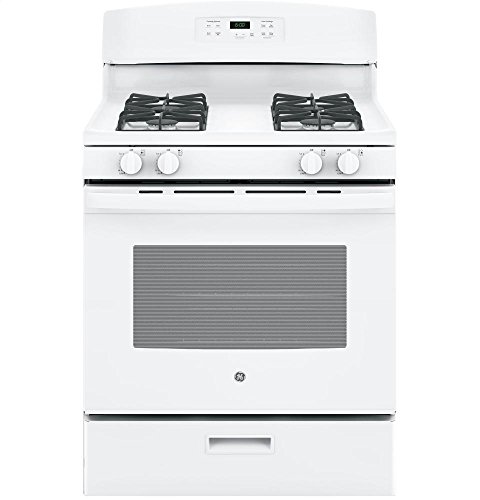
GE 30 Inch Free-Standing Gas Range 4.8 Cu Ft White — Best Classic Freestanding
This white GE is the range many American kitchens grew up around, updated where it counts. Sealed burners replaced the old open design, so a pot of pasta water that foams over stays on the cooktop surface instead of migrating into the burner box. The 4.8-cubic-foot oven swallows a large roasting pan or two casserole dishes side by side, and the backguard-mounted controls keep small children from experimenting with the knobs while dinner simmers.
Because GE Appliances manufactures its cooking line in Louisville, Kentucky, this model carries the guide’s firmest origin story, and that matters beyond sentiment. Domestic production shortens the parts pipeline for the components owners actually replace over a long service life — igniters, knobs, grates, and control boards — and GE’s service network remains the deepest of any brand in this roundup. A range bought for a farmhouse, a rental, or a first home benefits from that infrastructure every time a minor repair beats a full replacement.
Daily cooking is deliberately uncomplicated. Four burners cover the standard repertoire, the oven lights reliably, and the white finish forgives the flour dust and tomato splatter of real use while brightening smaller kitchens that stainless can make feel clinical. There is no convection fan and no air fry program, and cooks who bake layered cakes weekly will notice the difference in browning evenness. Everyone else gets a straightforward appliance that does the fundamentals without demanding study.
Consider also who else cooks on it. In households where grandparents visit and teenagers experiment, a backguard layout with familiar knob behaviour removes the small frictions that make people avoid an appliance. Nobody needs a tutorial to light this range, nobody wonders which display mode they have entered, and that absence of friction is itself a feature family kitchens feel daily even if they never name it.
- Format: 30-inch freestanding range with backguard controls
- Oven volume: 4.8 cubic feet, conventional gas baking
- Cooktop: four sealed burners under removable grates
- Finish: white, suited to bright and traditional kitchens
- Origin note: GE Appliances production in Louisville, Kentucky
Strengths
- Documented Kentucky manufacturing behind the GE badge.
- Sealed burners contain spills on the cooktop surface.
- Backguard controls sit beyond a child’s easy reach.
Trade-offs
- Conventional oven browns less evenly than convection rivals.
- Four burners leave less room for a griddle plus two pots.
- White finish shows scorch marks near burner caps sooner.
Best for: traditional kitchens, rentals, and buyers prioritising verified domestic production. Not suited for: bakers wanting convection evenness or hosts needing five burners.

GE GGS600AVFS 30 Inch Slide-In Gas Convection Range — Best Slide-In Convection
Slide-in design changes a kitchen’s whole sightline, and the GGS600AVFS is GE’s argument for making the change. With controls moved to the front edge and no backguard rising behind the cooktop, tile and countertop run uninterrupted to the wall, and the range reads as furniture rather than appliance. Under that styling sits a convection oven that circulates heated air for more even roasting, plus a steam-cleaning cycle for routine spills.
The EasyWash tray is the detail owners mention after the first messy month. It lifts out of the oven floor, goes to the sink, and returns — a humble feature that converts the worst part of oven ownership into a two-minute chore. Steam cleaning handles the light soil between deeper cleans, so the tray and the steam cycle together cover most of what a home oven actually endures, short of a sugary pie boiling over onto a hot floor.
Like its freestanding sibling, this range comes out of GE’s Louisville production, giving remodelers a verified domestic option in the slide-in category where imported models crowd the shelves. The front-control layout also suits cooks who dislike reaching across lit burners to adjust an oven, and the stainless finish pairs with the appliance suites most renovations already specify. Measure your cutout carefully, since slide-ins overlap the countertop edges and reward precise openings.
- Format: 30-inch slide-in with front controls, no backguard
- Oven: gas convection with steam cleaning cycle
- Detail: removable EasyWash tray in the oven floor
- Finish: stainless steel for a built-in appearance
- Origin note: GE Appliances production in Louisville, Kentucky
Strengths
- Slide-in profile gives counters a continuous, custom look.
- Convection evens out multi-rack baking and roasting.
- EasyWash tray turns oven-floor cleaning into sink work.
Trade-offs
- Front knobs invite accidental bumps in narrow galley kitchens.
- Steam cleaning loosens light soil only, not baked-on sugar.
- Slide-in fit demands a precise, level countertop opening.
Best for: remodelers wanting a built-in look with verified Kentucky production. Not suited for: kitchens with an irregular cutout or cooks preferring backguard controls.

Kenmore PRO 30 Inch Front Control Gas Range — Best Pro-Style Front Control
Kenmore dresses this range like the professional models that cost several times more: front controls across a wide face, five burners under heavy grates, and a 5.0-cubic-foot oven running true convection with an air fry mode inside. The effect in a kitchen is immediate — it becomes the wall everything else defers to — yet the footprint stays a standard 30 inches, so the drama arrives without a contractor.
True convection distinguishes itself from fan-assisted baking by adding a heating element around the fan, which steadies temperatures when the door opens and closes during a long roast. Air fry mode uses that same circulation at higher intensity, crisping wings and potatoes on a sheet pan without a countertop appliance competing for outlet space. Five burners let a stockpot, a skillet, and a simmering sauce coexist, which is the ordinary Tuesday test most four-burner ranges quietly fail.
On origin, we write about Kenmore the careful way. Kenmore is an American brand, and its appliance lines have long involved United States assembly, but the plant responsible changes across models and production runs. Treat the PRO as a US-brand range with domestic assembly claimed by the maker, then confirm the country of origin printed for this exact listing before you buy. That two-minute check protects the very thing you came to this guide to secure.
- Format: 30-inch freestanding range, front-control pro styling
- Oven volume: 5.0 cubic feet with true convection
- Cooktop: five burners beneath continuous-style grates
- Modes: convection baking plus dedicated air fry setting
- Origin note: American brand; confirm this model’s origin on its listing
Strengths
- Professional appearance without a professional-range footprint.
- True convection steadies heat through door openings.
- Five burners handle a pot, pan, and sauce simultaneously.
Trade-offs
- Origin varies by production run, so verification is required.
- Pro styling dominates small kitchens visually.
- Air fry results still trail a dedicated countertop fryer slightly.
Best for: serious home cooks wanting a pro look and five-burner capacity. Not suited for: buyers who need an origin guarantee without checking the listing.

Frigidaire Gallery 30 Inch Gas Range — Best Accessible Convection
Frigidaire’s Gallery line aims at cooks who want convection results without a learning curve, and this 30-inch model wraps that oven in an ADA-compliant design. Controls and reach distances follow accessibility guidelines, which quietly benefits everyone: shorter cooks, seated cooks, and anyone who has ever stretched across a hot cooktop to reach a back knob and regretted the route.
The five-burner cooktop spreads work across the surface, and the 4.6-cubic-foot oven — the smallest cavity in this set — heats quickly and suits households cooking for two to four more often than for a crowd. Convection circulation evens the browning on sheet-pan dinners and cookie batches, and the fingerprint-resistant finish answers the stainless era’s most tedious chore, the daily polishing of handprints off the door.
Frigidaire’s parentage is American and its ranges have deep roots in United States production, yet, following the rule we set at the top of this guide, we will not stamp a specific plant on this specific model. Assembly for Gallery ranges can differ by configuration, so read the origin statement attached to this listing and the label inside the door frame when the range arrives. The brand’s long American history is genuine; the model-level fact is yours to confirm in under a minute.
- Format: 30-inch range with accessibility-minded layout
- Oven volume: 4.6 cubic feet with convection circulation
- Cooktop: five burners for multi-pan weeknight cooking
- Design: ADA compliant, fingerprint-resistant finish
- Origin note: American brand; model-level origin needs listing confirmation
Strengths
- Accessible control placement helps cooks of every height.
- Convection performance in a quick-heating, smaller cavity.
- Fingerprint-resistant finish cuts daily wipe-down effort.
Trade-offs
- Smallest oven here; a huge turkey becomes a negotiation.
- Assembly origin is not fixed to one published plant.
- Five burners crowd when every pot is oversized.
Best for: smaller households valuing accessibility and convection in daily cooking. Not suited for: holiday hosts who routinely roast oversized birds.

Maytag 30 Inch Gas Range with Air Fry — Best Air Fry Range
Maytag built its reputation on appliances that outlast their kitchens, and this 5.0-cubic-foot gas range applies that temperament to a modern brief. The headline addition is air fry, which turns the full oven cavity into a crisping chamber for family-sized batches — a tray of wings for a game night rather than the two servings a countertop basket manages — while the gas oven underneath handles ordinary baking and roasting without ceremony.
Five cubic feet is the joint-largest cavity in this guide, and it changes what a weeknight can hold: a roasting chicken beside a pan of vegetables, or two dishes at different heights without a shuffle halfway through. Maytag’s design language stays plainspoken, with sturdy grates and controls that read at a glance from across the room, a small mercy when your hands are floured and the timer is your only free attention.
Maytag is a Whirlpool Corporation brand with Iowa roots stretching back more than a century, and its ranges participate in the company’s United States manufacturing footprint. Following our batch-wide rule, though, the honest sentence is the narrower one: assembly location for a given Maytag range depends on the model and run, so verify the origin printed for this unit. Buyers who do that checking once get both the brand’s durability culture and a documented answer.
- Format: 30-inch freestanding gas range, stainless finish
- Oven volume: 5.0 cubic feet, among the largest here
- Signature mode: air fry sized for family batches
- Controls: plainly labelled, readable from a distance
- Origin note: American brand under Whirlpool; confirm model origin
Strengths
- Air fry capacity dwarfs any countertop basket appliance.
- Generous oven fits a main dish and sides together.
- Straightforward controls suit shared and rental kitchens.
Trade-offs
- No true convection element behind the fan.
- Large cavity preheats slower for a single small dish.
- Origin confirmation falls to the buyer, model by model.
Best for: families air frying in quantity and roasting big weeknight dinners. Not suited for: solo cooks who mostly reheat single portions.

Whirlpool WFGS5030RS 30 Inch Freestanding Gas Range — Best Storage-Drawer Simplicity
Whirlpool closes the set by remembering what freestanding ranges quietly gave up as broilers moved into ovens: a full-width storage drawer that actually holds sheet pans, cooling racks, and the cast iron skillet with no other home. The WFGS5030RS pairs that drawer with a 5.0-cubic-foot oven in stainless, and the combination reads as a deliberate brief — capacity and storage first, fashionable extras later.
Renters inherit ranges; owners choose them, and this Whirlpool is pitched at owners who plan to stay. Its specification avoids fashionable fragility — no glass touch panel to spiderweb, no motorised anything — in favour of mechanical honesty that a local technician can service with parts from a regional warehouse. That serviceability compounds over a long ownership into the cheapest range in this guide to keep alive, whatever the listings say on the day of purchase.
On the cooktop, the sealed burners and edge-to-edge style grates make sliding a heavy pot between burners a one-handed move rather than a lift-and-pray manoeuvre. The oven’s conventional layout will suit cooks who learned on gas and trust its behaviour: strong bottom heat for pizza stones and bread, honest roasting for meats, and no fan-driven surprises for delicate custards that prefer still air.
Whirlpool’s headquarters and much of its manufacturing history sit in Michigan and Ohio, and the corporation remains the largest American appliance maker. Even so, our rule holds for this badge too — production assignments rotate across its plants and partner facilities, so the origin of the WFGS5030RS specifically should be read off its listing rather than assumed from the corporation’s biography. Two minutes of reading converts a brand story into a verified fact about your range.
- Format: 30-inch freestanding range with storage drawer
- Oven volume: 5.0 cubic feet, conventional gas heat
- Cooktop: sealed burners under edge-to-edge grates
- Storage: full-width drawer for pans, racks, and skillets
- Origin note: American maker; verify this model’s stated origin
Strengths
- Real storage drawer rescues sheet pans from oven storage.
- Wide grates let heavy pots slide instead of lift.
- Conventional oven behaviour suits traditional baking habits.
Trade-offs
- No convection or air fry programs at all.
- Storage drawer means no separate broiler compartment below.
- Stainless finish needs regular wiping to stay bright.
Best for: cooks short on cabinet space who value capacity and storage. Not suited for: bakers who specifically want fan-driven convection.
How Do the Six Ranges Compare Side by Side?
| Range | Oven | Burners | Defining trait |
|---|---|---|---|
| GE 30 Inch Free-Standing Gas Range 4.8 Cu Ft White | 4.8 cu ft, conventional | 4 sealed | Louisville-built classic in white |
| GE GGS600AVFS 30 Inch Slide-In Gas Convection Range | Convection, steam clean | Sealed cooktop | Slide-in profile, EasyWash tray |
| Kenmore PRO 30 Inch Front Control Gas Range | 5.0 cu ft, true convection | 5 | Pro styling plus air fry |
| Frigidaire Gallery 30 Inch Gas Range | 4.6 cu ft, convection | 5 | ADA-compliant layout |
| Maytag 30 Inch Gas Range with Air Fry | 5.0 cu ft, air fry | Sealed cooktop | Family-size air fry capacity |
| Whirlpool WFGS5030RS 30 Inch Freestanding Gas Range | 5.0 cu ft, conventional | Sealed cooktop | Full-width storage drawer |
What Does American Made Actually Mean on a Range Label?
The phrase carries legal weight, and understanding it will make you a sharper shopper than any badge. United States regulators distinguish between products made domestically with negligible foreign content, products assembled domestically from a mix of domestic and imported components, and products merely designed by an American company. Appliance listings use all three situations, sometimes under similar-looking language, which is precisely why this guide grades its claims instead of repeating marketing copy.
A practical reading method takes under two minutes. Open the listing for the exact model, find the country-of-origin field, and read it literally rather than hopefully. Then check the manufacturer’s own product page for the same model number, since a marketplace field can lag a production change. When the range arrives, the rating label inside the door frame or behind the storage drawer states the assembly country for your individual unit. Three consistent answers mean you know what you bought.
There is also a difference between supporting domestic manufacturing as a value and treating origin as the only specification that matters. A range assembled in Kentucky with a burner layout that fights your cookware will annoy you daily, while a range whose listing confirms domestic assembly and whose cooktop suits your pans will quietly satisfy for years. Origin should open the shortlist, as it does in this guide, and cooking behaviour should close the sale. Holding both ideas at once is the entire discipline of shopping this category well, and it is why our reviews spend as many words on simmer burners and grate geometry as on factory geography.
None of this diminishes the brands whose assembly rotates. Whirlpool Corporation, GE Appliances, and Frigidaire’s parent all operate substantial United States plants and employ American workers at scale; a model assembled in one of those plants in a given year may be assembled elsewhere in another. The honest position is not suspicion but specificity. You are buying one range with one serial number, and its origin is a checkable fact rather than a vibe.
How Should You Judge a Gas Cooktop Beyond Its Biggest Burner?
Manufacturers advertise the power burner’s peak because it is the easiest number to print, yet daily cooking lives at the other end of the dial. A low burner that holds a true simmer — a lazy bubble breaking the surface of a sauce every few seconds — prevents more ruined dinners than any high-output hero. When you read a listing, look for the smallest burner’s output and any mention of simmer settings, then imagine your most delicate regular dish sitting on it for forty minutes.
Grate design is the second under-read specification. Continuous grates let you slide a full Dutch oven from a hot burner to a cool corner without lifting its weight at arm’s length, which is both safer and kinder to your wrists. Cast iron grates retain heat and stabilise wobbly pans; lighter coated grates are easier to carry to the sink. Neither is universally better, but the choice should be conscious, matched to the cookware you actually own.
Finally, consider ignition and cleanup together. Electronic ignition is universal in this set, so the differentiators are sealed burners, removable caps, and surfaces that release burnt sugar without a chisel. A cooktop that cleans in five minutes gets cleaned after every session, and a clean cooktop ignites evenly, simmers honestly, and ages gracefully — a chain of small virtues that outlasts any single specification.
Which Oven Style Fits the Way You Really Bake?
Conventional gas ovens heat from below, and generations of bakers have built technique around that fact: bread loves the strong floor heat, roasts baste in their own juices undisturbed, and custards set without a fan stirring the air. If your repertoire leans traditional, the conventional ovens on the GE freestanding, the Maytag, and the Whirlpool will feel like old friends rather than compromises.
Convection adds a fan, and true convection adds a heating element around that fan. The payoff appears with multiple racks — cookies browning at the same rate top and bottom — and with roasted vegetables that crisp instead of steaming in their own moisture. The GE slide-in, Kenmore PRO, and Frigidaire Gallery cover this territory at three different sizes and layouts, so the convection decision can be made independently of the capacity decision.
Air fry deserves a deflating footnote. It is convection at aggressive temperature with a perforated pan, not a separate technology, and its results scale beautifully in a full oven while trailing a small countertop fryer for tiny batches. Buy it as a bonus on a range you already like, as with the Kenmore and the Maytag here, rather than as the reason for the purchase.
What Should You Measure and Check Before the Range Arrives?
Start with the opening. A nominal 30-inch range space usually measures a hair under or over, and slide-in models overlap the countertop, so record the exact width at counter height and at the floor, where baseboards steal space. Confirm the gas line’s position against the range’s rear cavity diagram in the installation manual; a stub-out in the wrong corner turns delivery day into a plumber’s emergency visit.
Electrical needs surprise gas shoppers. Modern ranges still require a standard outlet for ignition, clocks, and convection fans, and that outlet’s location matters as much as the gas line’s. Walk the delivery path with a tape measure as well — doorways, stair turns, and the kitchen entry itself — because a range that cannot reach the kitchen is a warehouse problem wearing your name.
Ventilation completes the checklist. Gas burners produce moisture and combustion byproducts, so a hood that vents outdoors earns its keep; recirculating hoods help with grease but not with humidity. None of this requires professional help to assess, only an honest half hour with a tape, a flashlight, and the installation PDFs the manufacturers publish for every model in this guide.
How Do You Keep a Gas Range Cooking Evenly for Years?
Burner performance degrades quietly through clogged ports. A spill that carbonises across a few port holes bends the flame sideways, creating a hot crescent and a cool patch in every pan. The fix is unglamorous: lift the caps monthly, soak them, clear each port with a soft brush or wooden pick, and never enlarge a hole with metal. Ten minutes of this restores the flame geometry the range left the factory with.
Oven accuracy drifts too, usually announcing itself as recipes that suddenly need extra time. An inexpensive oven thermometer, left inside for a week of ordinary cooking, tells you the truth about your cavity’s offset, and most modern ranges allow a calibration adjustment in their settings. Recheck after any igniter replacement, since a weakening igniter delays gas valve opening and quietly lowers average temperature long before it fails outright.
Keep a short log during the first year, even if it lives on a sticky note inside a cabinet door: the date of each deep clean, any burner that misbehaved, the igniter’s behaviour on cold mornings. Patterns invisible week to week become obvious across seasons, and a range whose quirks are documented gets diagnosed in one service visit instead of three. Owners of older houses swear by this habit, because it turns appliance care from folklore into evidence.
Gaskets, knobs, and grates reward the same modest attention. A door gasket that no longer seals leaks heat into your kitchen and money into the air; test it by closing the door on a strip of paper at several points and feeling for a firm drag. Grates washed and dried promptly resist rust at their feet. None of these tasks needs a technician, and together they explain why some twenty-year-old ranges cook like new while some five-year-old ones feel tired.
How Does Living With Gas Differ From Cooking on Electric or Induction?
Gas gives feedback no dial can imitate: you see the flame shrink as you turn the knob, and the pan responds within seconds rather than coasting on stored heat. That immediacy is why generations of cooks defend it, and why the adjustment from electric to gas usually takes one meal rather than one month. The trade is attentiveness — a gas burner left low under an empty pan is quietly heating air, and a boil-over can snuff a flame while gas continues flowing on older designs, though modern ranges in this class include flame-safety behaviour worth confirming on the listing.
Heat character differs too. A gas flame wraps slightly around a pan’s base, warming the sidewalls and suiting woks, rounded skillets, and stovetop roasting techniques like charring peppers directly over the burner — a trick no smooth electric surface will ever permit. Oven moisture is the subtler distinction: gas combustion releases water vapour, so a gas oven’s air is more humid than an electric oven’s, which many bakers credit for softer crumb in everyday loaves and which pastry specialists sometimes work around for crisp shells.
Running costs and infrastructure vary by region, so the sensible comparison is local rather than ideological. Homes already plumbed for gas gain little from switching; homes facing a new gas line should price that installation honestly against the range itself. Every model in this guide assumes an existing, correctly sized gas supply, and the installation manual’s stated requirements — line size, shutoff placement, clearances — are the authority, not a salesperson’s reassurance.
What Happens on Installation Day, and What Should the First Week Look Like?
A good delivery begins before the truck arrives: the old range’s gas shutoff located and tested, the path cleared to full width, and a clear patch of floor waiting, because installers work faster and more carefully in a room that respects their task. The crew should level the new range, check every burner for a clean blue flame ring, and light the oven to confirm ignition — observations you are entitled to watch and question while they are still in your kitchen.
Keep the paperwork ritual short and complete. Photograph the rating label with its model and serial numbers, register the warranty the same evening, and file the origin documentation you verified at purchase alongside the receipt. That small folder becomes gold years later when a service technician asks questions you would otherwise answer by crawling behind a hot appliance with a phone torch.
Cook deliberately during the first week. Run the oven empty once at moderate heat to burn off manufacturing residues with windows open, then test the extremes you actually use: your gentlest sauce on the smallest burner, your largest sheet pan in the oven, a full cooktop on a busy evening. Ranges reveal their personalities quickly under honest work, and any genuine defect announces itself inside the return window rather than after it, provided the first week involves real cooking instead of admiration.
Which Accessories Earn Their Space Beside a Gas Range?
Very few, chosen well, beat a drawer of hopeful gadgets. A flat cast iron griddle that spans two burners converts any of these ranges into a breakfast station for pancakes and smash burgers, and it stores in the Whirlpool’s drawer or upright beside the GE freestanding. Choose one sized to your burner spacing rather than the largest available, because an oversized griddle heats unevenly at its corners and warps under protest.
An oven thermometer, already praised in the maintenance section, deserves its permanent hook inside the door of whichever range you buy; it costs little, asks nothing, and settles every argument between a recipe’s timing and your oven’s mood. Beside it, a splatter screen for the cooktop’s busiest burner and a set of long tongs rated for open flame cover most of what gas cooking specifically demands.
A sturdy trivet for resting hot lids earns a mention too, because gas cooking produces a steady parade of saucepan lids with nowhere dignified to land. Park them on a trivet rather than the cooktop’s cool corner and the grates stay clear for the next pan, a tiny choreography improvement that busy cooks feel three times a night.
Resist the rest until a real recipe asks twice. Wok rings, specialty simmer plates, and conversion gadgets each solve a narrow problem, and buying them speculatively fills drawers that the storage-minded Whirlpool buyer was trying to empty. Gas ranges reward restraint in their accessories just as they reward restraint at the dial — small, deliberate, and exactly sufficient.
Which Mistakes Do Range Shoppers Regret Most Often?
The costliest error is buying the headline instead of the label: assuming a brand’s heritage settles a specific model’s origin, then discovering the distinction after delivery. Read the origin field for the exact unit, as this guide repeats deliberately, because the discovery is free before purchase and awkward after. The second error is measuring only the opening’s width while ignoring the gas stub-out and the delivery path, a pairing that strands more new ranges in garages than any defect ever has.
Cooktop mistakes follow. Shoppers dazzled by a maximum output figure sometimes bring home a range whose lowest burner still boils a delicate sauce, and they spend years hovering over pots that a gentler burner would have minded alone. Others choose front controls for their looks, then learn that a toddler or a large dog can reach them — a layout decision that should involve the whole household’s heights and habits.
The quietest regret is skipping the cleaning question. An oven without any assisted cleaning, in a household that roasts weekly, becomes a monthly afternoon of fumes and scraping, and owners start avoiding the roasts they bought the range to make. Match the cleaning system — steam, manual, or the tray-assisted approach on the GE slide-in — to your real habits, not your aspirational ones.
Why Does Burner Layout Matter More Than Burner Count?
Five burners crowded onto a 30-inch surface can hold fewer real pans than four burners spaced with generosity, because cookware diameters, not burner tallies, govern a working cooktop. Two twelve-inch skillets side by side will evict a centre burner from usefulness no matter what the brochure promises, and a stockpot’s wide base can starve its neighbours of elbow room. Judge a layout by imagining your three largest vessels cooking simultaneously, since that is the honest stress test of a holiday evening.
Offset placement is the quiet solution better ranges employ. When the largest burner sits front and a simmer burner hides at the rear, a sauce can murmur behind the action while a sear commands attention in front, and the cook’s body stays clear of rising steam. The sets in this guide arrange their burners along those lines to varying degrees, and cooks with a signature multi-pot dish should trace that dish across each cooktop diagram before deciding.
Knob placement completes the geometry. Front controls shorten the reach to every burner but place temptation at toddler height; backguard controls demand a reach across the cooktop yet keep ignition out of small hands. There is no universal winner, only a household-specific answer, and the six ranges here deliberately span both philosophies so the choice remains yours rather than the market’s.
How Do You Read a Range Listing Like an Inspector?
Begin at the specification table rather than the photographs, because photography flatters every finish equally. Confirm the fuel type first — a surprising number of handsome ranges are dual-fuel or electric in disguise — then the oven volume in cubic feet, the burner count, and the cleaning method, in that order. Each of those four facts eliminates wrong purchases faster than any aesthetic judgment, and each appears in the structured data of the listings for all six models here.
Next, hunt the quiet fields: country of origin, warranty length for parts and labour, and the dimensions including depth with the handle. Depth ambushes buyers whose counters run shallow or whose kitchen door sits close to the range wall. Warranty terms reveal how a manufacturer prices its own confidence, and the difference between one year and a longer sealed-system promise tells you something marketing copy never will.
Finish with the installation manual, which every brand in this guide publishes as a free PDF. It states clearances to combustible surfaces, the gas supply requirements, and the anti-tip bracket procedure in unhedged engineering language. A buyer who has read the manual cannot be upsold on imaginary requirements, and a buyer who finds a requirement their kitchen cannot meet has saved a delivery fee and a difficult phone call.
What Should Landlords and Second-Kitchen Buyers Do Differently?
Rental kitchens reward boring virtues: sealed burners that forgive tenant spills, controls a stranger can decode without a manual, and a brand whose parts a local technician stocks on the van. The white GE freestanding and the Whirlpool both fit that brief, and their domestic service networks matter more in a rental than any feature list, because a range repaired in two days keeps tenants that a range awaiting parts for three weeks quietly loses.
Second kitchens — basement suites, in-law units, garage workshops with ambitions — impose different constraints. Gas service may not extend there at all, which ends the conversation before it starts, and local codes often govern basement cooking appliances strictly. Where gas is present and permitted, the compact end of this set, particularly the Frigidaire Gallery with its accessible layout, suits a secondary space better than the pro-styled Kenmore, whose presence would upstage the main kitchen it was meant to support.
In both cases the origin question changes shape rather than disappearing. A landlord verifying domestic production is partly buying the parts pipeline that keeps the unit serviceable across a decade of tenants. That is the pragmatic core underneath this whole category: American manufacturing, where it is documented, is a serviceability argument wearing a patriotic hat, and it deserves to be evaluated as both.
What Other Costs Belong in a Range Budget?
The appliance itself is only the largest line in a longer ledger. Delivery and installation commonly add their own charges, a gas line extension or shutoff replacement adds more, and hauling away the old range is rarely free. None of these figures appears in the product listing’s headline, so a household comparing two ranges should compare the full installed totals, gathered from the retailer and a local installer before commitment, rather than discovering them sequentially at the door.
Small fittings surprise the unprepared. A new flexible gas connector is standard practice at installation and should never be the reused veteran from the old range, anti-tip brackets must suit the floor beneath, and a slide-in conversion sometimes asks for a filler strip behind the cooktop where the countertop stops short. Each item is minor alone; together they explain why experienced remodelers hold a contingency cushion beside any appliance budget.
Operating costs run the other direction, quietly and for years. Gas ranges sip energy compared with their purchase drama, and the differences among these six in daily running expense are small enough that burner behaviour and oven fit should outrank them. Spend your attention where the decade is actually lived — at the dial, in the oven, and over the sink with a burner cap soaking — and let the budget’s tail stop wagging the purchase.
Final Recommendation
For a buyer whose first requirement is a range with a firmly documented American factory behind it, the GE 30 Inch Free-Standing Gas Range 4.8 Cu Ft White and its slide-in sibling the GE GGS600AVFS 30 Inch Slide-In Gas Convection Range stand apart, because Louisville production can be stated about them without a caveat. Between the two, choose by silhouette: backguard tradition or front-control modernity. Shoppers wanting five burners and pro theatre should take the Kenmore PRO 30 Inch Front Control Gas Range after confirming its listing’s origin line, while the Frigidaire serves smaller accessible kitchens, the Maytag feeds air-fry families, and the Whirlpool stores the pans nobody else could house.
Whichever name lands in your kitchen, spend the two verification minutes this guide keeps recommending, measure the opening and the doorway twice, and choose the burner spread your sauces need rather than the number a headline shouts. Do that, and the range you light on the first night will still be flattered by your cooking a decade later — its flame steady, its oven honest, and its papers in order from the day it arrived.
Frequently Asked Questions
Are all six ranges in this guide built in the United States?
No, and the guide is written the way it is because of that answer. The two GE models come from documented production in Louisville, Kentucky. Kenmore, Frigidaire, Maytag, and Whirlpool are American brands whose assembly varies by model and production run, so their listings must be checked individually. Anyone promising one blanket answer for all six is selling you a slogan instead of information.
Does a slide-in range need different cabinetry than a freestanding one?
Usually not new cabinetry, but it does need an accurate opening. Slide-in models overlap the countertop edges slightly and lack a backguard, so the wall behind them should be finished and heat-tolerant, and the countertop cut must match the range’s width closely. Freestanding models forgive sloppier openings because their sides are finished and their backguard covers the gap behind.
Is true convection worth choosing over a conventional gas oven?
It earns its place when you bake on multiple racks, roast vegetables often, or hate rotating pans halfway through. Single-dish bakers and traditional bread makers may never miss it. In this set, the Kenmore PRO carries true convection with an element around the fan, while the GE slide-in and Frigidaire Gallery offer fan convection, and the other three ovens are conventional.
Can these ranges run on propane instead of natural gas?
Most American gas ranges ship configured for natural gas and include or offer a conversion kit for liquid propane, performed by a qualified installer who changes orifices and adjusts the regulator. Confirm the kit’s availability for your exact model on its listing before ordering, and never treat conversion as a casual do-it-yourself task, since gas work carries real risk.
What is the first thing to check when a burner flame looks uneven?
Look at the burner cap’s seating and its ports. A cap knocked slightly crooked during cleaning distorts the flame ring immediately, and carbonised spills blocking a few ports bend the flame to one side. Reseat the cap, clear the ports gently with a wooden pick after the burner cools, and the flame usually returns to an even circle.
How long should a well-kept gas range last?
Ranges are among the longest-lived kitchen appliances, and a well-kept example commonly serves well beyond a decade of daily use. Longevity hinges on igniters, gaskets, and burner cleanliness rather than on the cabinet itself, which is why the maintenance habits described above matter more than the purchase tier. Domestic parts availability, strongest for the GE pair here, stretches that lifespan further.
Do I need a special pan for gas burners?
No specialty cookware is required, though flat, heavy bases reward you with steadier contact and fewer hot spots. Thin, warped pans rock on grates and cook unevenly on any fuel. Cast iron and clad stainless both thrive over gas, and the only real caution is keeping handles turned inward so a passing hip does not send a skillet travelling.
Related Guides
A range anchors one wall of a working kitchen, and the projects around it deserve the same care. When the cooking wall is settled, many readers move outdoors with Best 3000 Psi Pressure Washers for the patio the dinners spill onto, lighten the house’s mood with Best Affordable Karaoke Machines for after-dinner entertainment, and round out the appliance survey at the counter with Best Juice Maker Machines.


