What's inside
- Key Takeaways
- Quick Picks
- How We Chose These Picks
- How Do the Six Juicers Compare at a Glance?
- Why Does Centrifugal Juice Oxidise Faster Than Cold Press Juice?
- Which Juicer Handles Leafy Greens and Wheatgrass Properly?
- How Should You Prep Produce for Each Type of Machine?
- What Does a Realistic Cleaning Routine Look Like?
- How Much Juice Should You Make in One Session?
- How Loud Are These Machines in a Real Morning Kitchen?
- Why Does Pulp Dryness Tell You More Than Wattage?
- How Should You Store a Juicer So It Actually Gets Used?
- Which Juicer Suits a Household With Children?
- How Does the Produce Calendar Change What You Juice?
- What Should You Check on the Listing Before Ordering a Juicer?
- How Do You Rescue a Juicing Habit That Has Faded?
- Can You Juice Frozen or Very Soft Fruit Successfully?
- How Do You Build Juice Recipes That Actually Balance?
- What Running Costs Should You Expect Over the Years?
- How Should Beginners Run Their Very First Session?
- How Do You Juice for Guests Without Spending the Party in the Kitchen?
- What Is the Sensible Way to Upgrade From a First Juicer?
- How Does Juicing Fit Alongside Blending and Eating Whole Fruit?
- How Should You Handle Citrus, Ginger and Other Strong Ingredients?
- What Mistakes Do New Juicer Owners Make Most Often?
- Final Recommendation
- Frequently Asked Questions
- Related Guides
As an Amazon Associate I earn from qualifying purchases. This post may contain affiliate links at no extra cost to you.
cottageverdict.com is reader-supported. When you buy through links on our site, we may earn an affiliate commission.
Where to buy: all six juicers below are sold through Amazon, and their names in the Quick Picks table, the detailed reviews and the comparison table link to the matching listing so you can check price on Amazon and verify jug sizes, pulp containers and included parts before ordering. The best juice maker machines divide into two technologies that produce genuinely different drinks. Centrifugal juicers — the two Brevilles and the Juilist here — spin produce against a fast mesh basket, flinging juice out in seconds. Cold press juicers — the Ninja and both Omegas — turn an auger slowly, crushing and squeezing produce so the juice emerges with less foam and less air beaten into it.
That mechanical difference flows straight into the glass. A centrifugal machine finishes a litre of juice before a cold press has warmed up, but the high-speed spinning whips in oxygen, builds a foamy head and starts oxidation immediately, so the juice tastes best within the hour. A cold press works at a walking pace, yet its juice pours denser, separates more slowly and keeps its flavour far better in the fridge, because far less air was folded in during extraction. Neither is simply better; they serve different mornings.
Produce choice sharpens the split further. Hard fruit and vegetables — apples, carrots, beetroot, ginger — fly through a centrifugal chute whole or nearly whole. Leafy greens, herbs and wheatgrass disappoint in a spinning basket, where leaves can pass through barely touched, while an auger’s slow squeeze extracts them properly. Soft fruit sits between the camps: centrifugal machines can turn berries into expensive foam, whereas cold presses handle them steadily but slowly.
Noise, cleaning and counter space complete the picture, and the reviews below treat them as first-class criteria rather than footnotes. A juicer that takes twelve minutes to wash is a juicer that gets used on Sundays only, whatever its extraction numbers promise. Read with your actual routine in mind: the weekday glass before work, or the slow weekend batch for the fridge. One promise governs everything below: where a listing gives a figure, we quote it as the maker’s figure, and where the two technologies genuinely differ — foam, oxidation, greens, pace — we say so plainly rather than hiding behind a single score, because a juicer chosen against your habits is a juicer donated within the year.
Key Takeaways
- Centrifugal picks juice in seconds but whip in air and foam, so their juice oxidises faster and drinks best immediately.
- Cold press picks squeeze slowly with an auger, giving denser juice, less foam and better fridge life.
- Hard produce suits centrifugal chutes; leafy greens and herbs belong to the cold press family.
- The Breville JE98XL is the centrifugal benchmark, while the Omega VSJ843QR anchors the vertical cold press side.
- Ninja’s NeverClog design answers the cold press family’s most annoying habit: pulp jams mid-session.
- Cleaning time, not motor power, is what decides whether any juicer survives its first month in a real kitchen.
Quick Picks
| Pick | Badge | Why it earns its place |
|---|---|---|
| Breville Juice Fountain Plus JE98XL | Best Centrifugal Benchmark | The long-running dual-speed centrifugal reference point, built to juice whole fruit fast. |
| Breville Juice Fountain Cold BJE430SIL | Best Centrifugal for Batches | A centrifugal machine shaped around bigger batches and juice you pour for the whole table. |
| Juilist Juicer Machine 3 Inch Wide Mouth 800W | Best Budget Centrifugal | Wide-mouth centrifugal juicing with three speeds at the leanest commitment in this guide. |
| Ninja NeverClog Cold Press Juicer JC151 | Best Compact Cold Press | A 150W auger juicer engineered against clogging, with a modest footprint and pulp control. |
| Omega Pure Press Cold Press Juicer VSJ843QR | Best Vertical Cold Press | A low-speed vertical auger design in red, squeezing with the patience cold press fans expect. |
| Omega Cold Press Juicer All-in-One Nutrition System | Best Versatile Cold Press | A horizontal cold press system that also turns out nut butters and baby food. |
How We Chose These Picks
We refused to rank these six on a single scale, because the category’s central argument — speed against extraction style — is a genuine fork, not a quality ladder. Instead, each machine is judged first inside its own technology: how well does this centrifugal model juice, pour and clean up, and how completely does this cold press squeeze, handle greens and avoid jams? Only after that do we ask the shared question of which mornings each machine improves.
For the centrifugal trio, the criteria were chute width, speed control and how the design handles the foam and heat that high-speed spinning creates. Dual speeds matter because soft fruit shredded at full tilt becomes foam and waste, while hard roots at low speed bog down. For the cold press trio, we weighted auger behaviour with fibrous produce, anti-clog thinking, and how much prep the feed chute demands, since slow juicers that require everything diced to sugar-cube size test their owners’ patience in a different way.
Across all six we counted the parts that meet the sink. Every juicer here disassembles into a small crowd of components, and the honest differences lie in mesh baskets that trap fibre, pulp bins that empty cleanly, and jugs that pour without dripping down the fridge shelf. Manufacturer figures for wattage are quoted as the listings state them; what we would not do is invent yield percentages or nutrient claims no listing supports. The six that survived those filters divide evenly, three per technology, because the honest answer to “which juicer is best” in 2026 is still “which kind of juicer are you” — and a guide that pretends otherwise would fail the reader before the first glass.
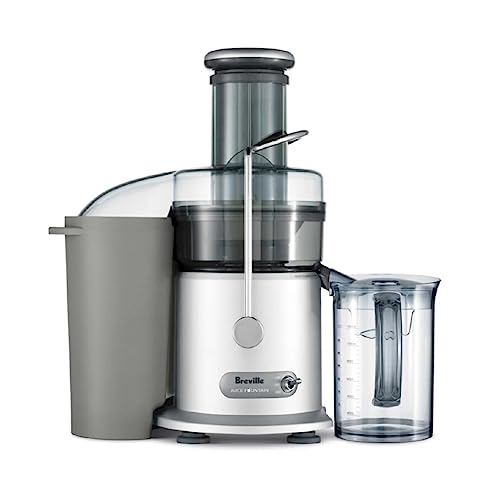
Breville Juice Fountain Plus JE98XL — Best Centrifugal Benchmark
The JE98XL is the centrifugal idea executed by the brand that defined it for home kitchens. Drop produce down the wide chute and a spinning mesh basket shreds it against thousands of tiny teeth, throwing juice through the mesh while pulp collects separately. The listing describes it plainly: whole fruits and vegetables, dual-speed centrifugal extraction. Two speeds are the detail that matters — a lower setting for softer produce that would otherwise explode into foam, and full speed for carrots, apples and beetroot that need violence to give up their juice.
Speed is this machine’s personality. A morning glass exists roughly a minute after the fruit bowl is raided, and a kilo of produce becomes juice in a single unhurried session. The trade is written into the physics: the basket beats air into the juice, a foamy cap forms, and oxidation begins at once, so JE98XL juice is a drink-now proposition rather than a batch-for-Thursday one. The sound matches the speed — a brief, purposeful roar that nobody sleeps through, though it is over quickly enough that neighbours forgive it.
Cleaning is the centrifugal toll, and this Breville pays it as gracefully as the design allows. The mesh basket is the part that decides your mood: rinse it immediately and fibre lifts away with a brush; leave it until lunch and you will be picking dried pulp from the mesh with your fingernails while reconsidering your life choices. Owners who build the rinse into the ritual — juice, pour, rinse, drink — keep this machine for years. Owners who treat washing as a later problem quietly stop juicing.
- Type: centrifugal, dual-speed extraction
- Feed style: wide chute for whole or large pieces
- Juice style: fast, foamy, best consumed immediately
- Strength with: apples, carrots, beetroot, citrus, ginger
- Weak with: leafy greens and wheatgrass
Strengths
- Juices a full glass in about the time toast takes
- Dual speeds protect soft fruit from foaming waste
- Wide chute keeps prep to rough chunks or nothing
Trade-offs
- Foam and oxidation shorten the juice’s best life
- Loud while running, even if only briefly
- Mesh basket demands immediate rinsing
Best for: weekday juicers who drink immediately and value speed above all. Not suited for: batch makers storing juice for several days.

Breville Juice Fountain Cold BJE430SIL — Best Centrifugal for Batches
Breville’s Juice Fountain Cold stays in the centrifugal family — a spinning basket still does the extraction — but it is arranged around a different habit: making more juice, for more people, in one session. The “Cold” in the name reflects the design’s aim of limiting the temperature rise that fast extraction can cause, keeping the juice closer to how it left the fruit. A generous jug under the spout means a full round for the table happens without stopping to empty a glass at a time.
That batch orientation changes who should buy it. The JE98XL above serves a person; this machine serves a household’s Sunday, a brunch table, or the cook who juices the week’s carrots and apples in one deliberate sitting. The centrifugal truths still apply and we will not pretend otherwise: foam forms, air is incorporated, and the juice remains at its best fresh, even if a sealed jug in the fridge carries it respectably to the next day. What the design buys is scale and a cooler pour, not cold press chemistry.
In the kitchen it behaves like its sibling where it counts. Produce prep is minimal thanks to the wide chute, the pulp bin swallows a long session before it needs emptying, and the same mesh-basket rule governs happiness — rinse promptly or scrub later. Its footprint is the consideration the smaller machine avoids: a batch juicer earns a permanent counter position rather than a cupboard, so measure the space under your wall cabinets before falling for the jug capacity.
- Type: centrifugal with cold-focused design
- Session style: large batches into a family-size jug
- Juice style: fresh-first, fridge-tolerant overnight
- Strength with: big hard-produce sessions for groups
- Counter need: permanent spot, taller under cabinets
Strengths
- Batch sizing suits families and entertaining
- Cold-focused design tempers extraction heat
- Same low-prep wide-chute convenience as the JE98XL
Trade-offs
- Still produces centrifugal foam and oxidation
- Larger body claims real counter territory
- Oversized for a solo daily glass
Best for: households juicing for several people in one session. Not suited for: single-glass juicers in small kitchens.

Juilist Juicer Machine 3 Inch Wide Mouth 800W — Best Budget Centrifugal
Juilist’s proposition is the centrifugal essentials without ceremony: a three-inch wide mouth that takes produce in large pieces, three speeds, and a motor the listing rates at 800W maximum with a 400W working figure. Read those numbers the way engineers write them — the higher figure is a peak, the lower one is the sustained rating — and the machine underneath is an honest, ordinary centrifugal juicer for households testing whether juicing fits their life at all.
Three speeds give it a touch more produce manners than single-speed budget rivals. Soft peaches and tomatoes get a gentler pass instead of being blasted into the pulp bin half-juiced, while the top setting handles the carrot-and-apple work that makes up most home juicing. The wide mouth keeps the knife work minimal, which at this end of the market is the feature owners actually feel every day; a cheap juicer that demands dicing is a cheap juicer returned.
Expectations should be set by the family it belongs to. This is a spinning-basket machine, so the juice arrives fast, foamy and ready to drink now, and leafy greens will underperform the way they do in every centrifugal design. The easy-clean claim in its listing is best honoured by the same immediate-rinse habit the Brevilles demand. What Juilist genuinely offers is a low-stakes doorway: find out whether your household juices weekly or monthly before anyone commits to augers and premium baskets.
- Type: centrifugal, three speeds
- Motor: 800W max, 400W rated per the listing
- Feed mouth: 3 inches for large pieces
- Juice style: quick and foamy, drink promptly
- Role: first juicer or occasional-use machine
Strengths
- Three speeds cover soft and hard produce decently
- Wide mouth keeps preparation minimal
- Lowest-commitment way into centrifugal juicing
Trade-offs
- Peak wattage headline flatters the real rating
- Leafy greens extract poorly, as with all centrifugals
- Build and support trail the Breville pair
Best for: juicing beginners and occasional users testing the habit. Not suited for: daily heavy juicers or green-juice devotees.

Ninja NeverClog Cold Press Juicer JC151 — Best Compact Cold Press
Cross into the cold press family and everything slows down on purpose. The JC151 drives a high-torque auger with a 150W motor — a figure that looks weak beside centrifugal wattage and means almost the opposite, because squeezing needs torque at low speed rather than frantic revolutions. Produce is crushed and pressed, juice trickling out dense and dark while pulp emerges from a separate path. Ninja builds the model around two promises: it is engineered not to clog on fibrous loads, and its pulp control lets you choose how much body stays in the glass.
The sizes tell you the intended kitchen. A 24-ounce juice jug and a 36-ounce pulp container make this a one-or-two-person machine, compact on the counter and unbothered by weekday duty. Celery, ginger and leafy handfuls — the produce that defeats centrifugal baskets and jams lesser augers — are exactly its home ground, handled steadily as long as pieces are fed at the pace the auger asks for. Rushing a cold press by ramming the pusher is how clogs are born; this design forgives more than most, but the rhythm is still crush, wait, feed.
The juice itself justifies the patience for the right drinker. It pours with a thin foam line instead of a head, tastes closer to the produce, and a sealed jug keeps its character in the fridge into the next day because so little air was beaten in. Cleaning swaps the centrifugal’s mesh battle for auger parts that mostly rinse, though fibrous residue in the screen still rewards an immediate soak. For small households whose juice leans green, this is the cold press with the fewest excuses attached.
- Type: cold press, high-torque auger
- Motor: 150W, tuned for torque over speed
- Containers: 24oz juice jug, 36oz pulp bin
- Juice style: dense, low-foam, fridge-friendly
- Strength with: greens, celery, ginger, fibrous produce
Strengths
- Anti-clog design tackles fibrous loads calmly
- Pulp control adjusts the juice’s body
- Compact footprint suits smaller counters
Trade-offs
- Slow by design compared with any centrifugal
- Jug size caps batch sessions quickly
- Produce needs cutting to chute-friendly pieces
Best for: green-juice drinkers in one-or-two-person households. Not suited for: big family batches or anyone in a morning rush.

Omega Pure Press Cold Press Juicer VSJ843QR — Best Vertical Cold Press
Omega’s VSJ843QR stands upright, and that posture shapes the whole experience. In a vertical cold press, produce drops into the top of the auger chamber and gravity assists the slow squeeze as juice drains down and pulp is expelled. The listing calls it a vertical low-speed juicer, and low speed is the creed: the auger turns gently, pressing rather than shredding, so oxidation stays minimal and the juice that collects is the calm, saturated kind cold press devotees describe as tasting like the ingredient itself.
Vertical designs earn their following on self-feeding convenience. Once pieces are in the chute, the auger’s pull draws them down with less pusher work than horizontal machines demand, and the tall, narrow body claims a modest square of counter while looking — in this red finish — like it belongs there. Greens, wheatgrass-style ingredients, soft fruit and the standard hard roots all pass through the same unhurried process, with pulp that comes out noticeably dry when the produce is fresh and fed steadily.
The disciplines are real. Everything must be cut to fit the chute, stringy celery benefits from short lengths so fibres do not wrap the auger, and the session moves at the machine’s pace or not at all. Cleaning involves the auger, screen and chamber, a few minutes of rinsing that stays easy only if it happens before pulp dries into the mesh. Buyers who accept those terms get the archetypal vertical masticating experience from the category’s most established cold press name.
- Type: cold press, vertical low-speed auger
- Feed style: top chute, gravity-assisted
- Finish: red, counter-presentable design
- Juice style: low-foam, slow-oxidising, rich colour
- Strength with: greens, soft fruit, mixed daily juicing
Strengths
- Vertical layout self-feeds with little pusher effort
- Gentle squeeze keeps foam and oxidation low
- Established cold press brand behind the design
Trade-offs
- Prep cutting is part of every session
- Stringy produce needs short pieces to behave
- Slower than the centrifugal trio by a wide margin
Best for: committed cold press households juicing daily. Not suited for: whole-fruit, no-prep speed seekers.
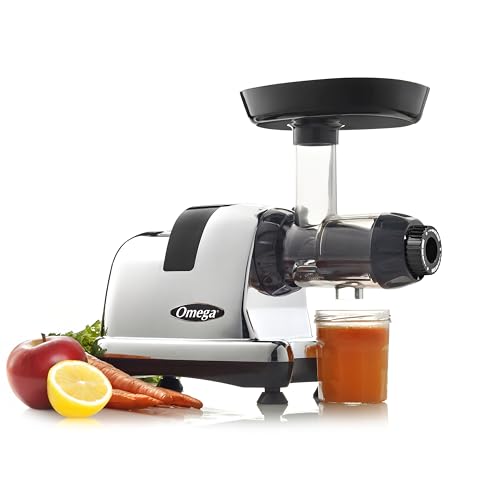
Omega Cold Press Juicer All-in-One Nutrition System — Best Versatile Cold Press
The second Omega lies down where its sibling stands up. A horizontal cold press pushes produce along a horizontal auger toward an end cap, and that architecture is what lets this machine moonlight: the listing presents it as an all-in-one nutrition system covering vegetable and fruit juice, nut butter and baby food among its roles. Attachments and adjustable end pressure turn the same slow squeeze that makes juice into a tool that grinds, homogenises and extrudes.
As a juicer it behaves with horizontal manners. Feeding is more deliberate than the vertical model — the pusher is a genuine participant — and in exchange the design handles leafy and fibrous loads with the grinding patience horizontal augers are known for. Juice quality sits squarely in the cold press pattern: minimal foam, slow oxidation, good fridge manners. Where it pulls ahead is the afternoon after juicing, when soaked almonds become nut butter and steamed vegetables become baby food in the same machine that made breakfast.
Versatility has a storage cost: more attachments mean more parts to wash, dry and keep together, and owners who only ever juice will carry that complexity for nothing. The machine also shares the family pace, so a household in a hurry will resent it by Wednesday. But for the cook who genuinely rotates through its roles — juice on Monday, nut butter on Friday, purées when the baby or the soup demands — one horizontal system replaces a small crowd of single-purpose gadgets.
- Type: cold press, horizontal auger system
- Roles beyond juice: nut butter, baby food and more
- Feed style: horizontal chute, active pusher use
- Juice style: dense, low-foam, slow to oxidise
- Strength with: greens, fibrous produce, multi-task kitchens
Strengths
- Several kitchen jobs handled by one machine
- Horizontal squeeze excels with leafy loads
- Cold press juice quality for fridge batches
Trade-offs
- Attachments multiply washing and storage
- Feeding takes more attention than vertical designs
- Juice-only buyers pay for unused talents
Best for: whole-food kitchens that will use every attachment. Not suited for: juice-only households wanting the simplest cleanup.
How Do the Six Juicers Compare at a Glance?
| Pick | Badge | Distinguishing detail |
|---|---|---|
| Breville Juice Fountain Plus JE98XL | Best Centrifugal Benchmark | Centrifugal, dual speed, whole-fruit chute |
| Breville Juice Fountain Cold BJE430SIL | Best Centrifugal for Batches | Centrifugal batch design with a family-size jug |
| Juilist Juicer Machine 3 Inch Wide Mouth 800W | Best Budget Centrifugal | Centrifugal, 3-inch mouth, three speeds |
| Ninja NeverClog Cold Press Juicer JC151 | Best Compact Cold Press | Cold press, anti-clog auger, 24oz jug |
| Omega Pure Press Cold Press Juicer VSJ843QR | Best Vertical Cold Press | Cold press, vertical low-speed auger |
| Omega Cold Press Juicer All-in-One Nutrition System | Best Versatile Cold Press | Cold press, horizontal, multi-role system |
Why Does Centrifugal Juice Oxidise Faster Than Cold Press Juice?
Oxidation is chemistry doing what chemistry does when juice meets air, and the two technologies invite very different amounts of air to the meeting. A centrifugal basket spins at high speed, shredding produce into a mist of droplets with enormous surface area while the basket itself fans air through the mixture. Enzymes and oxygen get thoroughly introduced, foam forms from the turbulence, and the clock on flavour, colour and nutrient loss starts ticking loudly from the first glass.
A cold press crushes produce in a slow, mostly enclosed squeeze. Juice leaves the pulp as a stream rather than a spray, carrying little incorporated air, and the foam line on top is thin enough to read through. The result is not immortality — fresh juice always declines — but a sealed jug of cold press juice tomorrow resembles today’s glass far more closely than centrifugal juice does. If your habit is batching on Sunday for weekday mornings, this single difference may outweigh every other row in the comparison table.
Which Juicer Handles Leafy Greens and Wheatgrass Properly?
Greens expose the centrifugal family’s blind spot. A spinach leaf in a spinning basket meets the mesh briefly and lightly; much of it sails into the pulp bin still holding its juice, and what does extract arrives with effort out of proportion to the handful you fed. Rolling leaves into tight bundles or sandwiching them between apple chunks improves the yield, but it remains a workaround on a machine designed for hard produce.
Augers treat leaves as a normal ingredient. The slow crush folds, tears and presses greens against the screen until their juice genuinely leaves, and wheatgrass — hopeless in a centrifugal basket — is a standard cold press job. The Ninja’s anti-clog auger and both Omegas all belong to this world. If green juice is the point of the purchase rather than an occasional variation, shop only within the cold press half of this guide and let the centrifugal trio go without regret.
How Should You Prep Produce for Each Type of Machine?
Centrifugal prep is mostly about the chute. Wash everything, remove stones and thick rhubarb leaves, and cut only what the mouth cannot swallow — which, on the wide-chute Brevilles and the three-inch Juilist, is surprisingly little. Alternate hard and soft pieces during a mixed session so the basket clears itself, and keep the pusher gentle: forcing produce against a spinning basket sprays juice sideways into the pulp instead of through the mesh.
Cold press prep is knife work with a purpose. Pieces must fit the chute and, just as importantly, suit the auger’s bite: short lengths for celery and other stringy produce so fibres cannot wrap and stall the screw, modest chunks for hard roots, leaves rolled or bunched so the auger catches them. Feed at the pace the machine sets, letting each piece clear before adding the next. Five calm minutes of prep buys an unjammed session and noticeably drier pulp.
What Does a Realistic Cleaning Routine Look Like?
Forget the stopwatch claims and think in parts. A centrifugal session leaves a mesh basket coated in fibre, a pulp bin, a lid, a jug and a pusher. Rinsed under a running tap within minutes, the whole set takes a short, meditative spell with the little brush every owner should keep by the sink. Left until evening, the same basket becomes an archaeological dig, and that difference — not extraction quality — is what kills most juicing habits by February.
Cold press parts rinse more forgivingly because nothing was flung at speed into fine mesh, but screens still trap pulp and augers carry residue into their grooves. A soak in warm water while you drink the juice softens everything for a quick wipe. Whichever family you choose, dry parts fully before reassembly, store the machine ready to run rather than buried, and count a dishwasher-safe part list on the listing as a genuine quality-of-life feature.
How Much Juice Should You Make in One Session?
Match the batch to the technology’s clock. Centrifugal juice peaks immediately, so make what the next hour drinks: a glass each for whoever is in the kitchen, poured while the foam still stands. Making a litre to refrigerate wastes the very freshness you bought the speed to capture, unless it will be gone by tomorrow morning and stored sealed and full to the brim to limit the air inside.
Cold press juice tolerates planning. A session producing two or three days of sealed, refrigerated bottles is a rational Sunday ritual, especially in the Omega and Ninja machines whose jugs and pulp bins are sized for steady batches. Freeze surplus in small portions for smoothies rather than letting it fade in the fridge. In both families, juice what ripe produce you actually have; a juicer is a rescue for the crisper drawer’s good intentions, not a reason to buy vegetables by the crate.
How Loud Are These Machines in a Real Morning Kitchen?
Noise follows mechanism. A centrifugal basket spinning under load produces a high, urgent roar — the sound of a blender’s angrier cousin — but only for the seconds each batch takes. Early risers juicing for a sleeping household learn to close the kitchen door and keep sessions short, which the machine’s speed happily allows. There is no quiet mode; there is only brevity.
Cold press machines hum rather than roar. An auger crushing carrots makes a low, rhythmic working sound that a conversation can continue over, and a podcast survives it easily. The trade is duration: the gentle noise lasts for the whole session rather than a few bursts. Households sensitive to sound should weigh total exposure, not peak volume — five calm minutes often disturb a home less than ninety seconds of full-throated spinning at dawn.
Why Does Pulp Dryness Tell You More Than Wattage?
Squeeze a handful of spent pulp and you learn what the specification sheet hides. Pulp that drips when pressed means juice you paid for is leaving in the bin, whatever the motor’s headline figure claimed. Pulp that holds together dryly means the extraction — basket or auger — actually finished the job. Checking pulp across your first sessions is the fastest home diagnostic a juicer owner has.
Dryness also exposes technique. Wet pulp from a centrifugal machine usually means the pusher was forced or the basket was overloaded with soft produce; wet pulp from a cold press usually means feeding outpaced the auger. Freshness matters too: tired, limp produce gives up its juice reluctantly in any machine. Before blaming hardware, run the same load again slowly with fresh ingredients — the pulp will deliver the verdict without sentimentality.
How Should You Store a Juicer So It Actually Gets Used?
The most-used juicer is the one already assembled. Cold press owners with counter room should leave the machine built and plugged in, jug rinsed and resting beside it, because a juicer stored in five pieces inside a high cupboard might as well be stored at a relative’s house. Centrifugal owners face the bulkier basket and bin; a low cupboard at waist height, parts nested in their working order, is the difference between a daily habit and a monthly event.
Wherever it lives, store the small parts together — pusher, brush, any locking pieces — in one labelled container near the machine. A missing pusher discovered mid-session, with chopped produce already waiting, is the sort of small frustration that quietly retires appliances. Keep the brush with the machine too, not under the sink in general population; the basket’s mesh does not care that the brush was meant for bottles.
Which Juicer Suits a Household With Children?
Children change the juicing equation twice: they drink enthusiastically and they recruit the machine into family rituals. Sweet, fast centrifugal juice — apple, carrot, orange — wins young palates, and the Breville pair’s speed keeps a Saturday session from becoming a queue of impatient small people. Safety habits are straightforward: the chute is not a toy, the pusher is the only thing that follows produce down, and spinning baskets are opened only when fully stopped.
Cold press machines suit families whose children are old enough to enjoy the process itself. Feeding pieces into an auger at its unhurried pace is a genuinely satisfying job for a supervised eight-year-old, and the quieter running keeps the kitchen sociable. Green juice acceptance improves when children choose the ingredients and operate the machine — ownership of the recipe beats parental persuasion every time, in juice as in everything else.
How Does the Produce Calendar Change What You Juice?
A juicer bought in strawberry season meets a different year than its owner expects. Spring brings greens and herbs at their best, flattering cold press machines; summer floods both families with soft fruit that needs gentle handling and quick drinking; autumn’s apples, pears and roots are centrifugal home turf, cheap and abundant; winter leans on citrus, carrots, beetroot and ginger, the sturdy cast that juices well in anything.
Planning loosely around that calendar keeps costs sane and flavours bright, because juicing concentrates produce — a glass holds several pieces — and out-of-season ingredients punish the shopping bill accordingly. It also rotates nutrients and taste without any deliberate system: the machine simply follows the market. Owners who juice with the seasons rarely suffer the week-three boredom that ends habits, because the menu keeps changing underneath them.
What Should You Check on the Listing Before Ordering a Juicer?
Start with the parts diagram and count what meets the sink. Confirm which components are dishwasher safe if that matters to you, whether the juice jug and pulp bin sizes suit your household’s sessions, and whether replacement screens, baskets or auger parts are sold openly rather than by special request. For centrifugal models, check the chute width in the text rather than the photograph; for cold press models, check jug and bin capacities, because a compact machine’s small containers govern batch work more than its motor does.
Then read the wattage the way this guide has taught you: a peak figure describes a moment, a rated figure describes the work. Check the machine’s height against your wall cabinets with the lid open, its weight against the cupboard you plan to lift it from, and the seller’s returns route while the decision is still theoretical. A juicer is a decade-long kitchen relationship when it fits; the listing’s small print is where fit is decided.
How Do You Rescue a Juicing Habit That Has Faded?
Most faded habits died of friction, not dislike. The cure is to remove one obstacle at a time: move the machine to the counter for a fortnight, buy produce already washed and ready, and shrink the ambition from daily litre batches to a single glass with breakfast. A centrifugal owner can lean on speed — the glass genuinely takes minutes — while a cold press owner should prep the night before so the morning session is only feeding and pouring.
Novelty helps more than discipline. One new ingredient a week — a thumb of turmeric, a pear variety, mint from the garden — refreshes the ritual without a new machine. So does a destination for the juice: a bottle that travels to work, a jug that anchors Sunday brunch. Habits survive when they are attached to pleasures, and a rescued juicer that produces one beloved glass reliably has beaten the pristine machine in the cupboard on every measure that matters.
Can You Juice Frozen or Very Soft Fruit Successfully?
Frozen produce defeats both families in different ways. In a centrifugal basket, rock-hard frozen chunks bounce, stress the mesh and extract unevenly; in a cold press, they can stall an auger built for crushing, not quarrying. Thaw fruit until it yields to a thumb and both machines cope happily, though the juice will carry more water and a softer flavour than the same fruit fresh. Keep frozen stock for smoothies, where a blender’s violence is an asset, and let the juicer work on fresh or thawed ingredients.
Very soft fruit — ripe bananas, avocados, mangoes at full perfume — is purée food rather than juice food. Bananas in particular emerge from any juicer as a token smear and a bin of disappointment, because their flesh holds almost no free liquid. Blend them into finished juice afterwards for body, the way cafés do, instead of asking the juicer to perform a blender’s job. Knowing which ingredients belong to which machine is the quiet skill underneath every good juice habit.
How Do You Build Juice Recipes That Actually Balance?
Reliable juice follows a simple architecture: a sweet, high-yield base such as apple, carrot, orange or pear; a green or earthy middle of cucumber, celery, spinach or beetroot; and a small, loud accent — ginger, lemon, mint, turmeric — that makes the glass taste deliberate. Bases forgive, middles nourish, accents define. A recipe missing its accent tastes like liquid salad; a recipe missing its base tastes like medicine, and neither gets made twice.
Work in ratios rather than shopping lists. Roughly two parts base, one part middle and a thumb-sized accent handles most produce a crisper drawer offers, in either machine family. Taste before pouring the full batch and adjust with citrus, which brightens greens and tames beetroot’s earthiness alike. Write down the combinations your household repeats — on the fridge, not in an app you will never open — because a juicer’s real recipe book is the five glasses a family actually loves.
What Running Costs Should You Expect Over the Years?
Juicers are unusually honest appliances: the machine is nearly the whole cost. Centrifugal owners eventually face a tired mesh basket, cold press owners an auger or screen after years of service, and both families consume produce at a rate that dwarfs any parts budget. There are no filters to subscribe to, no pods, no proprietary cartridges. The electricity for a session is trivial in either technology.
The real budget line is ingredients, and it rewards the same seasonal shopping described earlier. Juice what is cheap and abundant, rescue the drawer’s wilting residents before they cross the line, and treat exotic out-of-season produce as an occasional accent rather than a base. Owners who shop this way find juicing costs less than the café habit it replaces by a wide margin; owners who juice imported berries in January have chosen a luxury and should enjoy it as one.
How Should Beginners Run Their Very First Session?
Choose forgiving produce: apples, carrots and an orange forgive almost everything. Wash, assemble the machine slowly while reading its manual once — actually once, not zero times — and juice the hard pieces first, watching how your machine sounds when it is happy. That sound is your baseline; every future strain or rattle will announce itself against it.
Pour, taste, and then clean immediately while the lesson is fresh, noting which part trapped the most fibre and how the pulp felt in your hand. Write nothing down except the one thing you would change. A first session judged this way teaches more than a weekend of videos, and ending with the machine clean, dry and reassembled means the second session — the one that starts the habit — has no obstacles left in it.
How Do You Juice for Guests Without Spending the Party in the Kitchen?
Entertaining exposes each family’s temperament. The cold press owner can work ahead: juice in the afternoon, seal bottles completely full, refrigerate, and serve in the evening with the machine already washed and forgotten. Citrus-heavy blends hold up best, and a fresh herb sprig in the glass restores the just-made impression honestly, because the flavour genuinely survived the wait.
The centrifugal owner juices to order, which becomes theatre rather than labour if the produce is washed, cut and chilled in advance and the machine stands ready. Guests enjoy watching a glass appear from whole fruit in under a minute; the host’s only discipline is rinsing the basket between large rounds so flavours stay clean. Trying to batch centrifugal juice hours ahead, by contrast, serves your friends a lesson in oxidation — plan around each machine’s nature instead of against it.
What Is the Sensible Way to Upgrade From a First Juicer?
Upgrade toward your evidence, not toward a catalogue. A year with a budget centrifugal machine teaches you exactly what a premium one must fix: perhaps nothing, if the morning glass still delights, or perhaps greens, if the pulp bin keeps confessing how much spinach it stole. A year with a compact cold press teaches its own lessons — usually about jug size and session pace rather than extraction quality.
Keep the old machine through the transition if space allows. Households often discover the two technologies settle into different jobs — centrifugal for weekend crowds and carrot-apple staples, cold press for weekday greens and fridge batches — and the supposed upgrade becomes a partnership. Selling the first machine before the second has survived a month of Tuesdays is how kitchens end up juiceless and poorer at the same time.
How Does Juicing Fit Alongside Blending and Eating Whole Fruit?
Juicing removes most fibre to concentrate flavour and volume of produce into a glass; blending keeps everything, fibre included, at the cost of a thicker, more filling drink; eating the fruit whole remains the slowest and most complete option of all. These are complements, not contestants. A household can juice greens it would never eat in quantity, blend the soft fruit juicers handle badly, and still crunch an apple on the way out the door.
The practical wisdom is to let each tool do its best work and to be honest about why the juicer is on the counter: for the pleasure of fresh juice and for produce variety that chewing alone was not delivering. Framed that way, a juicer does not need to justify itself against the fruit bowl — it simply needs to be used, cleaned and enjoyed often enough to earn its square of counter.
How Should You Handle Citrus, Ginger and Other Strong Ingredients?
Citrus is the diplomat of the juice world, brightening greens and softening earthy roots, but it asks for small courtesies. Peel oranges and grapefruit before juicing in either family, because the rind’s oils turn bitter under pressure and the pith adds a chalky edge no sweetness fully hides; lemons and limes can go in halved with thinner skins, in modest amounts. Feed citrus between harder pieces in a centrifugal machine so the basket clears the soft flesh instead of smearing it across the mesh.
Ginger needs no peeling, only respect. A thumb-sized piece flavours a full batch, and fresh ginger in a cold press releases its heat slowly through the whole session, so add it early if you want it integrated and late if you want it pronounced. Turmeric follows the same logic with the added theatre of staining everything it touches — augers, baskets, hands and worktops — a cosmetic tax worth knowing about before a white-shirted morning. Strong ingredients reward restraint: the goal is a glass that tastes composed, not challenged.
What Mistakes Do New Juicer Owners Make Most Often?
Buying against their produce is the classic error: a greens devotee with a centrifugal machine, or a carrot-and-apple household waiting on a slow auger every morning while the school run honks outside. The second mistake is feeding technique — ramming the pusher on a centrifugal until juice sprays into the pulp bin, or overloading a cold press chute until the auger stalls and the session becomes a disassembly exercise.
Storage mistakes quietly undo good juice. Leaving centrifugal juice in a half-empty jug gives oxygen a large headspace to work in, and keeping any fresh juice past its few good days while calling it a health drink is optimism, not nutrition. Finally, owners under-buy produce variety: the same apple-carrot glass daily becomes a chore by week three, while a rotating cast — citrus and ginger one day, cucumber and greens the next — keeps the machine in the routine it was bought for.
Final Recommendation
Decide by the glass you actually drink. For speed, whole fruit and a juice that goes from counter to hand in minutes, the centrifugal trio leads with the Breville Juice Fountain Plus JE98XL as its benchmark and the batch-sized Juice Fountain Cold behind it. For greens, fridge batches and juice that keeps its composure, the cold press trio answers, from the compact Ninja NeverClog JC151 to the two Omega designs, vertical for daily rhythm and horizontal for the multi-role kitchen.
One honest test settles most remaining doubt: picture next Tuesday, not Christmas morning. The machine that fits that Tuesday — its noise, its washing-up, its pace — is the machine still juicing next year, and a year of ordinary Tuesdays filled with fresh juice is worth more than any specification either family can print.
Frequently Asked Questions
Does cold press juice really keep better in the fridge?
Yes, within the modest limits of fresh juice. Because the auger incorporates far less air during extraction, oxidation proceeds more slowly and flavour and colour hold up better across a couple of days in a sealed, full container. Centrifugal juice is best the day it is made.
Can a centrifugal juicer make green juice at all?
It can, with modest expectations and technique: roll leaves tightly, sandwich them between hard pieces, and accept that yields trail a cold press by a wide margin. Households whose juice is mostly greens should buy an auger machine instead of fighting a basket.
Why do cold press juicers have such low wattage numbers?
Wattage measures consumption, not squeezing ability. A cold press motor is geared for torque at low revolutions, so a modest wattage figure can still crush hard roots steadily. Centrifugal machines need high wattage to sustain basket speed under load.
What should I do with all the pulp?
Vegetable pulp folds into soups, stocks, muffins and compost; fruit pulp suits baking and freezing into smoothie portions. Very dry pulp is also a good sign — it means the machine extracted thoroughly rather than sending juice to the bin.
Is juicing a good way to use up soft or bruised fruit?
It is one of the best uses, provided anything mouldy is discarded rather than trimmed hopefully. Slightly soft fruit juices readily in both families, though soft loads in a centrifugal machine do best alternated with firm pieces to keep the basket clearing.
Should I juice every day, or is a few times a week enough?
Frequency follows appetite rather than doctrine. A daily small glass suits households that have built the ritual into breakfast; a few generous sessions a week suit everyone else and match how produce actually arrives in a shopping cycle. The machine does not grade you. What matters is that the rhythm you choose is one the cleaning routine can survive, because a juicer used happily three times a week for five years has beaten a daily juicer abandoned in March on every measure except calendar arithmetic.
How long does a juicer realistically last?
Years of regular service are normal for both families when the consumable parts are treated as consumables: baskets and screens eventually tire, seals age, and motors in well-kept machines generally outlast the accessories around them. The lifespan killers are neglect — pulp dried into mesh, augers forced on frozen loads — rather than honest mileage, so the cleaning habits in this guide are also the longevity plan.
Related Guides
Juicing usually arrives alongside a wider kitchen rethink, and the neighbouring guides cover its natural companions. Cold storage for batch juice and produce lives in our Best 30 Wide French Door Refrigerators roundup, laundry-day households may appreciate the research behind Best American Made Dryers, and the outdoor half of a healthy-home project is handled by the Best Car Pressure Washers for Home Use guide.



[…] cover the projects that grow out of it. When refreshments join the craft table, our roundup of the Best Juice Maker Machines keeps long sessions pleasant, while kitchen planners may prefer the appliance research in Best […]