What's inside
- Key Takeaways
- Quick Picks
- How We Chose These Picks
- How Do the Six Presses Compare at a Glance?
- What Makes a Citrus Press Professional Rather Than Domestic?
- Lever, Motor or Muscle: Which Pressing Method Suits You?
- How Much Juice Does an Orange Actually Give?
- How Do You Juice Citrus Well, Step by Step?
- Pulp: How Do You Get the Texture You Actually Want?
- Which Citrus Beyond Oranges Should You Plan For?
- How Should You Clean a Citrus Press So It Lasts?
- Counter Space, Storage and the Socket Question
- What Should a Small Café or Juice Stall Consider?
- How Do You Choose Between a Citrus Press and a Masticating Juicer?
- What About Noise, Heat and Long Sessions?
- How Should You Store and Serve Fresh Citrus Juice?
- What Does Good Value Look Like in This Category?
- How Do You Juice for a Crowd Without Losing the Morning?
- Which Oranges Juice Best, and Does Variety Matter?
- How Do You Handle Lemons and Limes Differently?
- What Safety and Sense Apply Around a Press?
- How Do You Get Children Involved in Juicing?
- What Should You Do With the Rinds and Pulp Afterwards?
- How Does a Press Change a Kitchen’s Habits?
- What Mistakes Do Orange Juicer Buyers Make Most Often?
- Final Recommendation
- Frequently Asked Questions
- Related Guides
As an Amazon Associate I earn from qualifying purchases. This post may contain affiliate links at no extra cost to you.
cottageverdict.com is reader-supported. When you buy through links on our site, we may earn an affiliate commission.
Where to buy: the six best professional orange juicer squeezer machines in this guide are sold through Amazon, and each name in the Quick Picks table, the detailed reviews and the comparison table links to its own listing, where you can check price on Amazon and confirm the cone sizes, jug capacity and cleaning routine before you commit counter space to it.
Professional is a slippery word in the citrus world, so let us pin it down before a single orange gets halved. A professional orange juicer, for the purposes of this guide, is a machine built for repetition: it squeezes citrus all morning without the motor heating up, the cone wobbling or the operator’s wrist filing a complaint. That definition lets in two very different families. Five of these picks are electric citrus presses, which use a cone and a motor or a lever-assisted press to do the squeezing. One is not electric at all, and it earns its place precisely because a heavy manual press never overheats, never trips a breaker and never asks for a socket.
What none of these machines does is juice in the cold-press sense. They will not handle kale, ginger or a crate of carrots, and they are not trying to. A citrus press does one job — halving the distance between a whole orange and a glass — and does it with less waste, less pulp chaos and less cleanup than a general juicer that treats an orange as an afterthought. If your household drinks grapefruit juice at weekends, runs a small café counter, or works through a winter crate of oranges before they soften, this narrower tool is the honest one to buy.
Key Takeaways
- A citrus press beats a general juicer for oranges: the cone works on a halved fruit, so peel and pith stay out of the glass.
- Lever-assisted pressing, as on the Breville Pro, removes wrist effort almost entirely and suits long daily sessions.
- Motorised cone models trade a little drama for speed and small footprints, which matters on a narrow counter.
- Pulp control is the feature you will touch daily; adjustable strainers matter more than headline motor claims.
- The Zulay pick is a manual cast iron press with no motor at all — heavy, silent and immune to overheating.
- Judge capacity by your real session: a family breakfast and a market stall are different purchases wearing similar clothes.
Quick Picks
| Pick | Badge | Why it earns its place |
|---|---|---|
| Breville Citrus Press Pro | Best Lever Press | A die-cast lever arm does the squeezing for you, so a crate of oranges becomes a jug of juice without a tired wrist. |
| Breville Citrus Press | Best Motorised Cone | An automatic motor and a one-size-fits-all cone keep the ritual to three moves: halve, hold, pour. |
| Eurolux Citrus Juicer | Best for Effortless Daily Use | A powerful motor, a soft grip handle and dishwasher-safe parts make the daily glass the path of least resistance. |
| Vinci Electric Citrus Juicer | Best Hands-Free Compact | A fully enclosed, splash-free design juices hands-free into a 12 oz bowl — the tidy answer for small counters. |
| BLACK+DECKER Citrus Juicer | Best Simple Workhorse | Pressure-activated, 32 ounces of capacity and almost nothing to learn — the honest appliance version of a citrus press. |
| Zulay Cast Iron Citrus Press | Best Manual Press | Cast iron, a lever and no motor whatsoever — the press that cannot overheat, stall or need a socket. |
How We Chose These Picks
We started from the way oranges are actually juiced in busy kitchens: halved, pressed, discarded, repeated. Any machine that made that rhythm awkward — fiddly cones, jugs that dribble down their own sides, strainers that clog by the fourth fruit — was marked down regardless of how handsome it looked in photographs. Citrus work is sticky work, so parts that rinse clean under a tap scored heavily, and dishwasher-safe components scored heavier still.
We also insisted on range. A guide with six near-identical motorised cones would help nobody, so the final six span lever pressing, automatic motorised cones, an enclosed hands-free design, a simple pressure-activated workhorse and one fully manual cast iron press. Between them they cover the home enthusiast who juices daily, the small business squeezing to order, and the traditionalist who trusts iron and leverage over circuitry.
- Pressing method first: lever, motorised cone, enclosed automatic or manual iron — the method decides effort and pace.
- Cone fit across citrus sizes, from small limes to grapefruits that dwarf the average orange.
- Pulp management: adjustable strainers or swappable filters rather than a single fixed outcome.
- Cleaning reality: how many parts meet the juice, and whether those parts tolerate a dishwasher.
- Stability under load, because a press that walks across the counter mid-squeeze fails its only job.
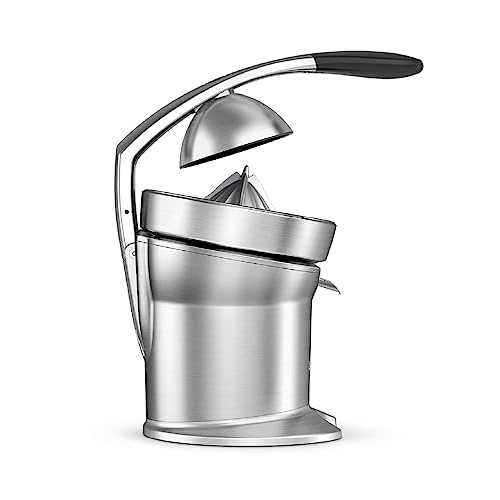
Breville Citrus Press Pro — Best Lever Press
The Breville Citrus Press Pro approaches an orange the way a good workshop tool approaches a bolt: with leverage. You halve the fruit, set it on the cone, and pull the die-cast lever arm down; the press head meets the fruit with a force your hand alone could never sustain evenly, and the juice runs while the pith stays politely behind. After a dozen oranges your shoulder still feels like your shoulder, which is the entire professional argument in one sentence.
The brushed stainless steel body is not decoration. Citrus acid is quietly corrosive, worktops get wet, and a machine that lives beside a sink earns its keep by shrugging off both. The cone is sized as a one-size answer for citrus generally, so lemons, limes and grapefruits all sit on the same geometry the oranges use, and the adjustable pulp control lets a household negotiate its own peace treaty between the pulp lovers and the smooth-juice faction.
Its honest limitations are footprint and ceremony. This is a tall, deliberate appliance that wants a permanent home rather than a cupboard commute, and the lever ritual, while easy, is one fruit at a time by design. For a café counter, a serious breakfast household or anyone juicing through citrus season in bulk, those are fair trades. The Breville Citrus Press Pro is the machine in this guide that most plainly deserves the word professional.
Ownership, over months, is where the Pro separates itself from lighter machines. The lever’s pivot stays tight, the cone keeps its edge geometry, and the whole apparatus develops the settled, oiled feel of equipment rather than the loosening feel of gadgets. Owners tend to reorganise the counter around it — fruit bowl within reach, glasses on the shelf above — and that small domestic redesign is the surest sign a machine has become infrastructure rather than purchase.
- Press type: lever-assisted electric citrus press
- Body: brushed stainless steel with die-cast arm
- Fruit range: oranges, lemons, limes and grapefruits
- Pulp: adjustable control at the strainer
- Role: high-volume daily pressing
Strengths
- Lever arm removes nearly all hand and wrist effort
- Stainless build shrugs off acid, water and daily wiping
- One cone geometry handles the whole citrus family
Trade-offs
- Tall footprint wants a permanent counter position
- One-at-a-time pressing sets a deliberate pace
- Heavier to move than the motorised cone models
Best for: daily bulk juicers, small cafés and anyone whose wrists object to hand squeezing. Not suited for: tiny kitchens where every appliance must vanish into a cupboard.
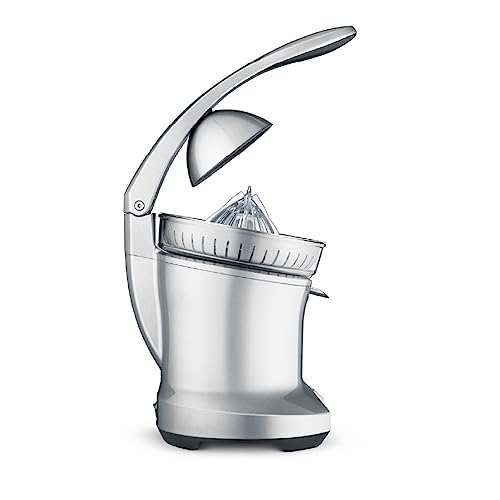
Breville Citrus Press — Best Motorised Cone
Where its bigger sibling uses leverage, the Breville Citrus Press uses a motor and a simpler bargain: you hold the halved fruit on the cone, the machine does the rotating, and juice appears. The automatic start keeps the interaction almost thoughtless, which is a genuine virtue at seven in the morning when the person operating the juicer has not yet become a person.
The one-size-fits-all cone is the design decision that defines it. Oranges sit naturally, lemons behave, and grapefruits — within reason — are accommodated without a drawer of alternative cones to wash, lose and argue about. The silver body keeps the same wipe-clean logic as the Pro while taking up less visual and physical room, so this is the Breville for a kitchen that juices often but not industrially.
What you give up is the lever’s sheer extraction force and the sense of machinery that will outlive the house. A motorised cone asks a little downward pressure from your hand, and very large sessions will feel longer than they do on the Pro. For households juicing a jug at breakfast and lemons through the week’s cooking, the Breville Citrus Press hits the balance point between effort, size and seriousness.
There is also a social ease to this model worth naming. A guest can operate it without instruction, a teenager can be trusted with it, and nobody has to be taught a lever’s technique or warned about an enclosed cycle. Machines that visitors can use get used more, and a juicer that the whole household operates casually will quietly out-produce a more capable machine that only one enthusiast understands.
- Press type: motorised cone, automatic start
- Cone: one size for oranges, lemons and grapefruits
- Finish: silver
- Role: frequent home juicing without bulk ceremony
- Cleaning: cone and juicing parts separate for rinsing
Strengths
- Almost no technique to learn — hold and it juices
- Single cone means fewer parts to wash or lose
- Smaller presence than the lever press
Trade-offs
- Your hand still supplies steady downward pressure
- Less extraction force than the lever-assisted Pro
- Jug sessions for a crowd take patience
Best for: households juicing several times a week in ordinary quantities. Not suited for: market-stall volumes or grapefruit specialists with oversized fruit.

Eurolux Citrus Juicer — Best for Effortless Daily Use
The Eurolux Citrus Juicer is built around a single observation: the juicer that gets used is the one that asks least of you before coffee. Its motor is described by the listing as ultra-powerful, and in practice what that means at the counter is that the cone does not sulk when a thick-skinned orange arrives. You press, it turns, and the soft grip handle gives your hand somewhere comfortable to be while physics happens.
Stainless steel carries the body, which keeps the machine looking like kitchen equipment rather than a toy, and the auto shutoff is a small mercy for households where the juicer gets abandoned mid-breakfast by someone who heard the toast land. Pulp control is present and adjustable, so the same machine can serve a strained glass for a child and a chewier one for the adult who insists pulp is the point.
Cleanup is where this pick quietly wins its badge. The parts that meet the juice are dishwasher-safe per the listing, and in citrus work that is not a luxury — dried orange pulp sets like varnish, and a machine that can go straight into the rack gets cleaned properly instead of eventually. The Eurolux Citrus Juicer is the low-friction choice: not the most theatrical press here, but possibly the one still in daily use in March.
Think of this pick as the commuter bicycle of the group: not the fastest object here, not the most beautiful, but the one whose daily friction is lowest. The auto shutoff, the dishwasher-safe parts and the comfortable handle are all small mercies that compound. In a household where juicing competes with school runs and work calls, compounding small mercies is exactly how a habit survives February.
- Press type: electric cone squeezer
- Body: stainless steel with soft grip handle
- Safety: auto shutoff per the listing
- Pulp: adjustable control
- Cleaning: dishwasher-safe juicing parts
Strengths
- Strong motor keeps pace with thick-skinned fruit
- Dishwasher-safe parts remove the cleanup excuse
- Comfortable grip suits arthritic or smaller hands
Trade-offs
- Less mechanical drama than a lever press for purists
- Counter presence is still that of a full appliance
- Pulp settings need a trial glass to dial in
Best for: daily juicers who value easy cleaning over ceremony. Not suited for: buyers wanting a manual machine with no motor at all.

Vinci Electric Citrus Juicer — Best Hands-Free Compact
Every other electric pick in this guide asks you to hold the fruit. The Vinci Electric Citrus Juicer declines to. Its fully enclosed design takes the halved citrus, closes over it and juices hands-free, which changes the emotional texture of the job entirely: you can be buttering toast, supervising a pan or simply standing back while the machine minds its own sticky business.
Enclosure also means containment. Citrus juice is an enthusiastic traveller, and the splash-free claim in the listing addresses the fine mist that open cones spray across worktops, walls and the cook. Juice collects in a 12 oz bowl behind a locking spout, and the choice of fine or coarse pulp filters lets you pick your texture with hardware rather than hope. The size range is generous on paper, running from limes up to grapefruits of 4.5 inches.
The trade is volume and theatre. Twelve ounces is a household glass or two, not a brunch production, and the enclosed cycle is a set rhythm you wait on rather than conduct. But for a compact kitchen, a tidy cook, or anyone who has cleaned orange mist off a tiled wall one time too many, the Vinci Electric Citrus Juicer solves the actual problem, which was never the juice — it was everything around the juice.
The enclosed design has one more advantage nobody puts on the box: it contains the sound and the smell of the work as well as the spray. Early-morning juicing in a flat with thin walls is a more considerate act when the machine minds its business behind a lid. And because the bowl is modest, the Vinci nudges its owners toward juicing little and often — which, for freshness, is precisely the right habit.
- Press type: enclosed automatic, hands-free
- Bowl: 12 oz with locking spout
- Filters: fine and coarse pulp options included
- Fruit range: limes to 4.5-inch grapefruits per listing
- Role: compact, low-mess household juicing
Strengths
- Hands-free cycle frees you for the rest of breakfast
- Enclosed body keeps spray off walls and worktops
- Two filters give real pulp choice in a small machine
Trade-offs
- 12 oz bowl caps session size
- Enclosed parts need a rinse routine of their own
- No lever or cone ritual for those who enjoy it
Best for: small kitchens and tidy cooks juicing a glass or two at a time. Not suited for: hosts producing juice for a table of eight.

BLACK+DECKER Citrus Juicer — Best Simple Workhorse
The BLACK+DECKER Citrus Juicer has been the default answer to a simple question for years: what do I buy if I just want orange juice without studying orange juice? Its cone is pressure activated, so the machine starts when the fruit lands and stops when you lift away, and that is very nearly the whole manual. In a category that loves to invent features, this one’s restraint is its character.
Capacity is its quiet strength. The 32 oz container swallows a family breakfast’s worth of squeezing before anyone has to stop and pour, which keeps the rhythm of halving and pressing unbroken. Adjustable pulp control is fitted, because even the simplest machine must mediate the pulp argument, and the juicing parts are dishwasher-safe per the listing, because even the simplest machine must survive its own cleanup.
Nobody will mistake it for café equipment, and it does not ask to be mistaken. The materials and presence are domestic, the sessions it suits are domestic, and a household that outgrows it will know exactly why and exactly what to buy next — probably something further up this page. Until then, the BLACK+DECKER Citrus Juicer remains the pick that respects a modest brief and a modest counter equally.
Its longevity in catalogues tells its own story. Designs survive this long in the small-appliance world only when returns are low and breakfasts are uneventful, and uneventful is high praise for a machine asked to work before coffee. Keep the cone rinsed, treat the jug kindly, and this is the sort of appliance that gets handed to a student flat a decade later still entirely itself.
- Press type: pressure-activated electric cone
- Capacity: 32 oz container
- Pulp: adjustable control
- Cleaning: dishwasher-safe parts per the listing
- Role: family breakfasts and everyday lemons
Strengths
- Nothing to learn — pressure starts the cone
- Generous jug keeps long sessions flowing
- Compact, light and easy to store
Trade-offs
- Domestic build rather than café-grade hardware
- Hand pressure still part of every squeeze
- Plain looks next to the stainless picks
Best for: families and first-time buyers who want juice, not a hobby. Not suited for: commercial counters or design-led kitchens.

Zulay Cast Iron Citrus Press — Best Manual Press
Let the record be plain before anything else: the Zulay Cast Iron Citrus Press is not an electric juicer. There is no motor, no cone that spins and no cord. It is a heavy cast iron hand press — you set the halved fruit in its stainless steel cup and pull the lever, and iron, leverage and gravity extract the juice. Including it in a guide of machines is deliberate, because for a certain kind of professional use it outlasts every motor on this page.
Consider the lemonade stand, the market stall, the off-grid cabin and the café that loses power on the hottest day of the year. The Zulay works in all of them, at the same pace, with the same result, forever. Cast iron’s weight is the mechanism’s foundation: the press stays planted while you pull, and the extraction from a firm lever press is thorough, leaving rinds that look genuinely finished rather than merely squeezed.
The costs are yours to supply: effort, one fruit at a time, and a respect for the press’s heft when moving it. It also asks for a jug beneath and a moment’s aim. But as the listing’s own phrase has it, this thing is lemonade-stand ready, and there is a whole tradition of professional citrus work that never plugged anything in. The Zulay Cast Iron Citrus Press is that tradition, in black iron, still entirely competitive.
Storage deserves a word, because iron this honest is not light. Give it a low shelf or a permanent corner rather than a high cupboard, and lift it with two hands and respect. In return it asks for no cord management, no descaling and no firmware of any kind. There are households for whom that exchange — weight for permanence — is not a compromise at all but the entire point of the purchase.
- Press type: manual lever press — no motor, no cord
- Body: cast iron with stainless steel fruit cup
- Fruit: oranges, lemons and citrus generally
- Power: none required, works anywhere
- Role: stalls, stands, cabins and motor-free kitchens
Strengths
- Cannot overheat, stall or trip a breaker
- Leverage gives thorough extraction from each half
- Iron build is effectively a lifetime purchase
Trade-offs
- Your arm is the motor, every single time
- Heavy to move and store
- One fruit at a time, at human pace
Best for: stalls, stands, cabins and buyers who distrust motors on principle. Not suited for: anyone with limited hand or arm strength.
How Do the Six Presses Compare at a Glance?
Read the table by pressing method rather than by brand. Lever and manual iron presses extract hardest and ask most of the room or the arm; motorised cones ask least per fruit; the enclosed Vinci asks nothing at all but works in small batches. Your session size, repeated daily, is the number that should choose between them.
One pattern in the table deserves a second look: the two machines with the least machinery — the simple pressure-activated cone and the iron press with no motor at all — are also the two with the fewest possible failure modes, while the most capable machines earn their complexity honestly. There is no wrong end of that spectrum, only the wrong match between a spectrum position and a household’s patience.
| Pick | Badge | Distinguishing detail |
|---|---|---|
| Breville Citrus Press Pro | Best Lever Press | Die-cast lever arm, brushed stainless body, adjustable pulp control |
| Breville Citrus Press | Best Motorised Cone | Automatic motor, one-size-fits-all cone, silver finish |
| Eurolux Citrus Juicer | Best for Effortless Daily Use | Stainless body, soft grip handle, auto shutoff, dishwasher-safe parts |
| Vinci Electric Citrus Juicer | Best Hands-Free Compact | Enclosed hands-free juicing, fine and coarse filters, 12 oz bowl |
| BLACK+DECKER Citrus Juicer | Best Simple Workhorse | 32 oz capacity, pressure activated, adjustable pulp control |
| Zulay Cast Iron Citrus Press | Best Manual Press | Manual cast iron press, stainless fruit cup, no electricity |
What Makes a Citrus Press Professional Rather Than Domestic?
The honest dividing line is repetition under load. A domestic juicer survives Sunday; a professional one survives the season. That shows up in materials first — stainless and die-cast where acid, water and knocks are daily events — and in mechanisms second. A lever arm or a serious motor keeps extraction consistent on the fortieth orange, when a light machine and a tired hand both start leaving juice in the rind.
It also shows up in what the machine does not do. Professional citrus presses rarely chase extra functions, because every added gadget is another part to clog with pulp at the worst moment. The six here share that discipline: cones, strainers, jugs and levers, arranged well. If your juicing is occasional, domestic is genuinely fine and the BLACK+DECKER proves it; if citrus is a daily production, buy up the scale once rather than twice.
Lever, Motor or Muscle: Which Pressing Method Suits You?
Lever pressing, as the Breville Pro practices it, converts a downward pull into even, heavy pressure across the whole fruit. Extraction is excellent, effort is low, and the pace is set by you. It is the method of cafés and serious households, and its only real demands are counter height and room for the arm’s travel.
Motorised cones reverse the effort: the machine spins, you merely hold and guide. It is faster to start, lighter to live with and kinder to small kitchens, at the cost of some downward pressure from your hand and a ceiling on brute force. Muscle alone — the Zulay’s way — removes every electrical failure mode and replaces them with your own stamina, which for a stallholder pressing to order is often the most reliable motor available.
How Much Juice Does an Orange Actually Give?
A medium orange typically yields somewhere around a third to a half of a cup of juice, varying with variety, ripeness and how recently it was picked. Four to six oranges per generous glass is a fair planning figure, which is why session size matters so much in this category: a household of four at breakfast is a twenty-orange problem, and twenty oranges is precisely where light machines and tired wrists begin to negotiate.
Extraction efficiency is the other half of the arithmetic. A firm press that flattens the rind’s inner wall takes meaningfully more from each fruit than a gentle one, and across a crate that difference is whole glasses. It is also why warming fruit to room temperature and rolling it firmly on the counter before halving genuinely helps: the juice vesicles loosen, and whatever press you own gets an easier, more generous fruit to work on.
How Do You Juice Citrus Well, Step by Step?
Start with fruit at room temperature, rolled firmly under your palm until it feels slightly yielding. Halve across the equator rather than pole to pole, so the cone meets the maximum number of juice segments. Press or hold with steady pressure rather than jabbing — citrus gives up its juice to persistence, not violence — and give the half a quarter turn and a second press if your machine allows it.
Strain according to the drinker, not the machine’s default. Strain fully for a child’s glass or a cocktail, leave the pulp for the breakfast traditionalist, and always juice lemons for cooking last if you are sharing a session, so the orange juice does not pick up a lemon accent. Rinse the cone and strainer the moment you finish; citrus pulp that dries for an hour becomes a scrubbing project, while pulp rinsed in the minute is nothing at all.
Pulp: How Do You Get the Texture You Actually Want?
Pulp is not a flaw to be eliminated but a texture to be chosen, and the adjustable controls on the Breville Pro, Eurolux and BLACK+DECKER exist because households contain both factions. Mechanically, the adjustment changes how much of the fruit’s fibrous material passes the strainer with the juice. Wide open, you get body and bite; closed down, you get the smooth glass that photographs well and pleases children.
The Vinci takes the other route, with separate fine and coarse filters you swap physically. Hardware filters are slower to change than a dial but more definite in result. Whichever system you own, decide per serving rather than per machine: juice the smooth glasses first, then open the control for the pulp drinkers, so one session satisfies the whole table without a second wash of the strainer between factions.
Which Citrus Beyond Oranges Should You Plan For?
Grapefruit is the size test. Its diameter defeats small cones and small enclosed chambers alike, so grapefruit households should read the fruit ranges carefully — the Vinci’s stated span up to 4.5-inch fruit and the Breville cones’ one-size geometry are the relevant claims here. Lemons and limes are the opposite test: small fruit on a big cone can slip and spin rather than press, and a cone with a well-shaped centre spike handles them far better than diameter alone suggests.
Blood oranges, mandarins and pomelos each bring quirks — softer flesh, looser segments, thicker rind — but the deeper point is seasonal. Citrus arrives in waves, and a press bought for January oranges will meet May lemons for lemonade and December limes for cooking. Buying for the family of fruit, not the single fruit, is what separates a considered purchase from a January impulse.
How Should You Clean a Citrus Press So It Lasts?
Citrus is acidic, sugary and pigmented, which makes it a triple threat to any machine left dirty. The routine that works is boring and short: parts off, rinse under hot water immediately, a soft brush on the strainer holes where pulp lodges, and everything dried before reassembly so no damp corner ferments quietly. Dishwasher-safe parts, as on the Eurolux and BLACK+DECKER, convert that routine into a single loading action on busy mornings.
The Zulay’s iron needs the cookware respect iron always needs: wash, dry thoroughly, and never leave it sitting in a wet sink where rust can start its slow argument. Stainless bodies wipe down with anything; what they dislike is abrasive scouring that clouds the finish. Five minutes of routine per session is the whole secret, and it is why well-kept presses measure their lives in decades.
Counter Space, Storage and the Socket Question
A citrus press earns counter space only if it is used weekly; below that rhythm, a storable machine beats a monumental one. Measure honestly: lever presses are tall, enclosed machines are deep, and the Zulay is simply heavy in a way that discourages cupboard commutes. The socket question eliminates itself in one case only — the manual press works on a stall, a boat or a balcony with equal indifference to infrastructure.
Cord length and jug placement sound trivial until the first session. A jug that pours from a spout at the front behaves differently from one you lift and tip, and a machine whose juice outlet drips after the pour will decorate the counter daily. These small ergonomics, repeated hundreds of times a year, are what owners actually live with; the specification list is merely the machine’s first impression.
What Should a Small Café or Juice Stall Consider?
Throughput, extraction and failure modes, in that order. Throughput is fruits per minute sustained, not the sprint of the first six; extraction is margin, because juice left in rinds is stock thrown away; failure modes are what happens at the Saturday rush. A lever press and a manual iron press both degrade gracefully — they slow down only as fast as the operator does — while motorised cones should be assessed for heat over a long session.
Hygiene workflow matters as much commercially as at home, with the addition of visibility: customers watch a press work, and a machine that looks clean, simple and deliberate sells the juice before the glass is poured. Keep a second strainer, rinse between flavour changes, and let the machine’s theatre work for you. The stallholder tradition behind the Zulay exists because the ritual itself is good business.
How Do You Choose Between a Citrus Press and a Masticating Juicer?
The two machines answer different questions. A masticating juicer processes whole produce slowly and broadly — greens, roots, soft fruit — and treats citrus as one ingredient among many, peel negotiated by the recipe. A citrus press does citrus only, but does it with the peel excluded by design, which is why its orange juice tastes like the fruit rather than the tree.
Households that juice everything should own the broad machine and accept its citrus compromise. Households whose juicing is eighty percent oranges, lemons and grapefruit should own the press and let a blender handle the rest. The mistake is buying breadth for a narrow habit: the press’s simplicity, speed and cleanup will be used daily, while the broad machine’s versatility gets used monthly and resented weekly.
What About Noise, Heat and Long Sessions?
Motorised cones are not silent, but their noise is brief and honest — seconds per fruit rather than minutes per jug. Heat is the subtler limit: a small motor working through a crate of oranges on a hot morning will warm, and sensible owners pace long sessions, juicing in waves while breakfast cooks. Lever and manual presses simply do not have this paragraph in their lives, which is one more reason high-volume settings gravitate toward them.
Your own heat matters too. A long session at a badly placed machine — too low, too far from the fruit, jug behind the machine — tires the cook more than the motor. Set the press at comfortable elbow height, fruit on the dominant-hand side, glasses and jug in front, rinds bowl behind. Ergonomics sounds grand for orange juice until the morning you juice forty oranges for a party and discover it was the whole subject.
How Should You Store and Serve Fresh Citrus Juice?
Fresh citrus juice is at its best in the first hour, bright and aromatic, and it declines gracefully rather than suddenly. If you must hold it, chill it in a covered jug and treat the same day as the limit; the flavour flattens and the vitamin content fades with air and time. A quick stir before pouring redistributes the fine pulp that settles, and serving over ice forgives a multitude of small delays.
Freezing is the underrated option for glut management. Juice from a windfall crate freezes well in ice-cube trays or small jars with headspace left for expansion, and a frozen cube of lemon juice dropped into cooking is a small winter luxury. Label by fruit and month, rotate honestly, and the press you bought for fresh juice quietly becomes a preserving tool as well.
What Does Good Value Look Like in This Category?
Value in citrus pressing is cost per year, not cost per purchase. A machine used daily for a decade is cheap at almost any ticket; a machine used twice is expensive at any discount. Judge by the sturdiness of the pressing mechanism, the availability of a simple cleaning routine you will actually perform, and the absence of novelty features whose parts you will lose.
The range in this guide is deliberately wide because households are wide. The BLACK+DECKER’s value is that it removes every excuse not to start; the Breville Pro’s value is that it removes every reason to upgrade. The Zulay’s value is measured in decades and inherited kitchens. Pick the horizon that matches your household’s honest intentions, and the money tends to take care of itself.
How Do You Juice for a Crowd Without Losing the Morning?
Juicing for guests is a logistics problem wearing an apron. Juice in two waves: a first jug before guests arrive, held chilled and covered, and a second, smaller wave made to order so the theatre and the freshness both survive. Set the machine where guests can watch without crowding the work triangle, and put a pulp-positive friend in charge of the strainer settings to end all negotiation.
Fruit arithmetic keeps the peace: six oranges per guest is generous, four is adequate, and a lemon for every six oranges brightens a big jug noticeably. Keep a second jug cold and empty for the moment the first empties, because the gap between jugs is where hosts disappear into the kitchen and parties cool. The press, run calmly in waves, never has to be the bottleneck of a good morning.
Which Oranges Juice Best, and Does Variety Matter?
Variety matters more than most buyers expect. Thin-skinned, heavy-for-their-size fruit gives the most juice; a light orange with thick pith is mostly packaging. Valencia and navel oranges are the reliable juicing standbys, blood oranges bring colour and a berry edge for winter glasses, and mandarins juice sweetly but softly, rewarding a gentler press. The hand test beats the label: choose fruit that feels dense and slightly yielding.
Seasonality is the deeper truth. Citrus bought in its season juices generously and tastes like itself; citrus bought against the calendar can be dry, woody and disappointing through no fault of any machine. A press reveals fruit quality rather than creating it, which is why the same machine can seem brilliant in January and ordinary in August. Buy fruit like a juicer owner — by weight in the hand, not by shine under the lights.
How Do You Handle Lemons and Limes Differently?
Small citrus concentrates everything: less juice per fruit, more intensity per drop, and a greater tendency to slip on a large cone. Work in batches, keep steady centred pressure, and expect to halve more fruit than instinct suggests — a recipe’s casual ‘juice of a lemon’ is a real lemon, fully pressed, not a squeeze from a wedge kept in the fridge door.
Limes reward warmth even more than oranges do. Ten seconds of firm rolling, or a brief rest in warm water, loosens a lime dramatically, and the difference shows in the jug. For cooking, juice lemons and limes straight into a small bowl rather than the breakfast jug, so seeds and pulp can be managed at recipe scale. The press does not care which citrus it meets; the cook’s organisation is what changes.
What Safety and Sense Apply Around a Press?
Citrus pressing is among the gentlest kitchen work, and its few rules are mostly about respect for moving parts and leverage. Keep fingers on the fruit’s peel side, never under a descending press head; let a motorised cone stop before lifting the fruit away; and treat a lever’s travel as a path that hands and curious children should stay out of. None of this is alarming — it is the ordinary choreography of any tool that applies force for you.
Electrical common sense covers the rest: dry hands near sockets, cords kept out of the juice’s splash zone, and machines unplugged before deep cleaning. The manual press replaces electrical sense with lifting sense — bend, grip, two hands — and with one culinary warning: juice on a stone worktop should be wiped promptly, because citrus acid left sitting can mark delicate surfaces over time.
How Do You Get Children Involved in Juicing?
A citrus press is one of the kindest introductions to kitchen work: the transformation is visible, the result is drinkable, and the skills — halving with help, pressing steadily, pouring carefully — are real ones. Motorised cones suit supervised small hands because the machine does the turning; a lever press suits older children who can be trusted with its travel path and enjoy the machinery of it.
Give the job edges: one child halves with a grown-up, one presses, one pours, and everyone tastes the difference between the first glass and the pulp-heavy last one. Juice made by children gets drunk by children, which settles many breakfast negotiations. The manual iron press, beautiful as it is, belongs to adult arms — let it be the machine they graduate to, not the one they start on.
What Should You Do With the Rinds and Pulp Afterwards?
A juicing household generates a quiet mountain of rinds, and treating them as an ingredient rather than rubbish changes the economics of the whole habit. Zest taken before halving freezes brilliantly for baking; spent halves simmered with water make a fragrant household cleaner base; and pulp from the strainer folds into marinades, dressings and baking where its bitterness is balanced by fat and sugar.
What does not get used should leave promptly. Citrus waste sours fast in a warm kitchen, attracts fruit flies with real dedication, and is better composted the same day than admired in a bowl. Gardeners value the acidity in moderation; everyone else values the clear counter. A press session that ends with rinds dealt with, parts rinsed and juice chilled is a small complete system, and systems are what habits are made of.
How Does a Press Change a Kitchen’s Habits?
Something subtle happens in the weeks after a good press arrives: citrus stops being an ingredient bought for a recipe and becomes a standing resource. Lemons get juiced because the machine is there, and the cooking improves in small ways — dressings sharpen, marinades brighten, a plain glass of water gains a reason to exist. Oranges bought hopefully actually get used, because the distance between fruit bowl and glass has shrunk to a minute.
That habit shift is the real return on the purchase, and it is why this guide weights ease and cleanup so heavily against raw specification. A press that lives out, rinses fast and works without ceremony rewires a kitchen’s defaults. A press that lives in a cupboard behind the slow cooker changes nothing at all. Buy the machine your household will walk past and use, and the fruit bowl will start emptying itself.
What Mistakes Do Orange Juicer Buyers Make Most Often?
Most disappointments in this category are mismatches, not defects: the right machine bought for the wrong session, the wrong fruit or the wrong cook. These are the mismatches that recur.
- Buying a general cold-press juicer for a citrus habit, then fighting peel, pith and bitterness in every glass.
- Choosing by motor claims alone and ignoring cone fit, which decides how fruit of different sizes actually behaves.
- Underestimating session size — a glass a day and a family brunch are different machines wearing similar prices.
- Leaving pulp to dry on the strainer, converting a thirty-second rinse into a weekly excavation.
- Expecting a manual press to suit someone with weak hands, or a motorised cone to suit a market stall.
- Juicing fridge-cold fruit straight from the crate and blaming the machine for a modest yield.
Notice that none of these is about brand. They are about fit between a household’s real rhythm and a machine’s real method, which is why this guide spends as much time on how you juice as on what you juice with.
Final Recommendation
One more consideration deserves space before the verdict: support and spares. Cones, strainers and jugs are the parts that live hardest, and a brand whose replacements are easy to find turns a worn strainer from a funeral into a errand. Breville’s long presence in this category counts here, as does the Zulay’s near-total absence of anything to replace. Whichever route you take, register the purchase, keep the manual’s cleaning page, and treat the machine as the decade-long appliance it is meant to be.
If one recommendation must stand for the most people, it is the Breville Citrus Press Pro: the lever removes the effort, the stainless build removes the worry, and the pulp control removes the household argument. Households juicing in smaller, tidier rhythms should take the Vinci for its enclosed calm or the Eurolux for its dishwasher-friendly ease, and the BLACK+DECKER remains the right first machine for almost anyone. The Zulay stands apart as the motor-free answer, and it may outwork them all.
Buy for the session you actually run, at the size your counter actually has, and the best professional orange juicer squeezer machines stop being a category you researched and become the reason fresh juice simply happens in your kitchen — the first glass of the crate, cold and bright, is the only verdict that ever really mattered.
Frequently Asked Questions
Is a citrus press better than a normal juicer for oranges?
For citrus specifically, yes. A press works on a halved fruit with the peel held outside the juice path, so the result is sweeter and cleaner, with none of the bitter pith notes a general juicer can introduce by processing peel. A general juicer wins only when you also need vegetables and greens.
Can these machines juice grapefruit and lemons too?
Yes — citrus is a family, and every pick here is shaped for it. Lemons and limes sit on the same cones as oranges, while grapefruit depends on size: check the stated fruit range, notably the Vinci’s span up to 4.5-inch fruit, if grapefruit is a weekly habit.
How many oranges make one glass of juice?
Plan on four to six medium oranges for a generous glass. Variety and ripeness move the figure, and room-temperature fruit rolled before halving gives noticeably more than cold fruit squeezed straight from the fridge.
Is the manual Zulay press really professional?
By the only definition that matters — sustained, repeatable work — yes. It cannot overheat or stall, its extraction is thorough, and stallholders have used iron presses commercially for generations. Its limit is the operator’s arm, not the machine.
How do I stop juice tasting bitter?
Keep peel and pith out of the juice path, avoid over-pressing a spent half until the rind complains, and juice at room temperature. Bitterness in citrus almost always traces to pith or to fruit processed whole rather than halved and pressed.
What is the fastest way to clean up after juicing?
Rinse cone, strainer and jug under hot water the moment the session ends, before pulp dries. Dishwasher-safe parts on the Eurolux and BLACK+DECKER make that a loading task; the Zulay’s iron should be washed and dried thoroughly by hand.
Related Guides
Citrus season fills a kitchen with good problems, and the rest of the house has its own lists: the nursery is sorted in Best Crib Sheet Sets, the bathroom shelf improves with Best Waffle Bath Towels, and the soak that follows a long juicing morning begins with Best Faucets for Freestanding Tubs.



[…] for honest materials and real dimensions, beginning with Best Powered Leather Theater Chairs, Best Professional Orange Juicers and Best Steam Cleaners for Tile Floors and Area […]