What's inside
- Key Takeaways
- Quick Picks
- How Did We Choose Kettles for Life Over a Flame?
- How Do the Six Kettles Compare Side by Side?
- How Do You Match a Flame to a Kettle Base?
- Why Do Gas Kettles Gather Soot, and Should You Worry?
- What Mistakes Do Gas Kettle Owners Make Most Often?
- How Should You Keep Water Hot Without Wasting the Ring?
- What Does Warp Resistance Actually Protect Against?
- How Do You Brew Tea Well Over a Gas Ring?
- When Is a Small Kettle the Smartest Buy on a Big Range?
- How Should You Clean a Gas Kettle Without Ruining Its Finish?
- What Safety Habits Belong Around a Kettle on Gas?
- What Changes When You Cook at Altitude or With Bottled Gas?
- How Do You Judge a Whistle Before You Can Hear It?
- What Is the Right Kettle for a Bed-and-Breakfast or a Busy Guest House?
- How Should a Kettle Share a Hob With Real Cooking?
- What Should You Do in the First Week With a New Gas Kettle?
- How Does a Kettle Fit a Kitchen That Also Bakes, Roasts and Preserves?
- What Running Costs and Lifespan Should a Gas Kettle Owner Expect?
- Final Recommendation
- Frequently Asked Questions
- Related Guides
As an Amazon Associate I earn from qualifying purchases. This post may contain affiliate links at no extra cost to you.
cottageverdict.com is reader-supported. When you buy through links on our site, we may earn an affiliate commission.
Where to buy: the six kettles below are sold through Amazon, and the names in the Quick Picks table, the review headings and the comparison table link to their own listings, so you can check price on Amazon and confirm the capacity, steel grade and handle design before ordering. Shoppers after the best tea kettle for gas ranges are usually replacing a kettle that failed in a flame-specific way: a scorched handle, a soot-blackened base, or a whistle nobody could hear over the extractor.
A gas flame is an honest but wasteful heat source. It heats the kettle base and then keeps going, up the sides, into the handle zone and out into the kitchen, which is why gas kettle craft begins with matching the flame to the base diameter. A ring wider than the kettle is a room heater wearing a kettle as a hat; a ring too small concentrates its fire in a hot coin at the centre and leaves the outer water to catch up by conduction.
Steel dominates this guide because steel forgives flame. All six picks are stainless bodies of one grade or another, from the 304 steel of the foedo to the 18/8 steel of the MAXCOOK, in capacities from a modest 1.5 quarts to a family-scale 4.2 quarts. Handles, the component gas heat attacks first, divide the field: cool-touch folding designs, ergonomic grips kept clear of the flame path, and one listing that sensibly includes an anti-scald towel for the journey from hob to pot.
The whistle remains the kettle conscience on gas, arguably more than on any other hob, because a gas ring left burning under a dry kettle does its damage quickly and quietly. Every pick here whistles. The reviews note how each design handles the flame realities, soot, heat tinting, grate stability and the simmer end of the scale, where a kettle is sometimes asked to keep water hot rather than merely boil it.
One pick will be familiar from the induction guide: the WALDWERK, whose listing covers gas as well as induction. It is reviewed here from the flame side, with different emphases and different working details, because a dual-duty kettle earns its place in each kitchen for different reasons. The rest of the six are gas-first propositions, sized and finished for life over a ring of blue fire.
Read the reviews with your own range in mind: its ring sizes, its grate pattern, the hand you pour with and the hour your first round happens. A kettle is used more often than any pan in most kitchens and forgiven less, because it is handled half asleep, in a hurry, by everyone in the house including the guests. The right one disappears into that routine so completely that the household only notices it on the rare morning it is away being descaled, which is the highest praise this category offers.
Key Takeaways
- All six picks are stainless steel bodies, the material that forgives direct flame best.
- Capacities span 1.5 to 4.2 quarts, from the folding-handle Primula to the family MAXCOOK.
- Match the flame diameter to the kettle base or pay to heat the kitchen instead of the water.
- Handle design is the gas-specific battleground: cool-touch, folding and ergonomic grips lead this guide.
- The foedo listing includes an anti-scald towel, a small inclusion every gas cook will understand.
- A working whistle is a safety device on gas, where a dry boil damages fast and quietly.
Quick Picks
| Pick | Badge | Why it earns its place |
|---|---|---|
| WALDWERK Tea Kettle | Best Dual-Duty Kettle for Gas | A 2.4 quart stainless kettle whose listing names gas stoves alongside induction, whistling and family-sized. |
| foedo Whistling Tea Kettle | Best Protected-Pour Design | Three litres of food-grade 304 stainless steel with an ergonomic handle and an included anti-scald towel. |
| Mr. Coffee Flintshire Tea Kettle | Best Compact Brushed Classic | A 1.75-quart stainless whistling kettle in a brushed satin finish from a household-name maker. |
| Primula Stewart Tea Kettle | Best Folding-Handle Small Kettle | A 1.5-quart stainless kettle with a fast-boil whistling spout and a cool-touch folding handle, in brushed silver. |
| Large Stainless Whistling Tea Kettle | Best Warp-Resistant Family Body | A 3.1 quart stainless kettle with a wood-pattern ergonomic handle and a warp-resistant build for stove tops. |
| MAXCOOK Whistling Tea Kettle | Best Extra-Large Kettle | The largest kettle here at 4.2 quarts, in 18/8 stainless steel with a brushed satin finish. |
How Did We Choose Kettles for Life Over a Flame?
Flame tolerance came first. Each pick had to be a metal stovetop kettle whose listing places it on a gas hob without apology, and stainless steel swept the field because it shrugs off soot, heat tint and the occasional lick of flame around the base that would ruin lesser finishes. Grades named in the listings, 304 and 18/8 among them, are reported as stated.
Handles were interrogated as gas equipment, not as styling. Where does the grip sit relative to the flame path? Does it fold, stay cool, or ship with protection? A kettle handle over a gas ring lives a harder life than the same handle over induction glass, and the reviews score that honestly, because the pour at the end of the boil is where kettles earn or lose their keep.
Capacity spread was chosen to mirror gas households, which range from the single camper-style mug to the farmhouse family whose kettle serves tea, bottles and cooking water in one fill. The six span 1.5 to 4.2 quarts so that both ends of that life are served by a considered pick rather than a compromise.
Finally, the whistle and the base were weighed together. A wide, flat base sits stable on grates and catches the flame efficiently, and a clear whistle closes the safety loop. Kettles that treated either as an afterthought did not survive the shortlist, however handsome their silhouette.

WALDWERK Tea Kettle — Best Dual-Duty Kettle for Gas
Over a flame, the WALDWERK shows its second character. The stainless body that the induction guide praised for its flat contact here earns its keep differently: it takes the soot and the heat bloom of a gas ring without complaint, wipes back to a working shine, and its 2.4 quart volume sits in the stable middle of a grate, neither teetering on a small ring nor sprawling across two.
The whistle is the gas-relevant virtue to underline in this review. On a hob where the heat continues whether or not anyone is listening, a prompt, clear whistle is the difference between a kettle and an incident, and the WALDWERK reports its boil in the confident tone a busy kitchen needs. Position the handle away from the flame path as a matter of habit and the pour that follows is calm, one-handed and controlled.
Dual duty remains the strategic reason to choose it. A household with a gas range today and an induction renovation in its future, or a gas main hob and an induction side plate today, buys this kettle once. Its gas review deliberately differs from its induction review because the questions differ: here it is judged on flame manners, grate stability and soot tolerance, and on those questions it answers as well as it did on the magnetic ones.
- Body: stainless steel, stovetop teapot form
- Capacity: 2.4 quarts
- Hob fit: gas stoves named in the listing, induction also covered
- Whistle: yes, stovetop whistling kettle
- Pouring: one-handed family pour
Strengths
- Equally at home over flame or field
- Stable mid-size footprint on grates
- Clear whistle for a busy gas kitchen
Trade-offs
- No colour finish offered in the listing
- Handle placement still needs flame awareness
- Fundamental design, few novelty features
Best for: households whose hob is gas now and may change later. Not suited for: buyers wanting a kettle styled only for the flame.

foedo Whistling Tea Kettle — Best Protected-Pour Design
The foedo listing shows a maker who has watched people use kettles on gas. The body is food-grade 304 stainless steel at a 3 litre capacity, all metal in construction, rust resistant in the listing words, and the handle is ergonomic; then, the telling detail, the box includes an anti-scald towel. That towel acknowledges the gas truth that handles and lids can arrive at pouring time hotter than the hand expects, and it solves the problem for the price of a cloth.
Three litres is the family-with-guests size, enough for a big pot and a cafetière in one boil, and the all-metal build suits a range where plastic trim near a flame is a liability. Quick boiling is claimed in the listing, and over a correctly sized ring a steel body of this shape makes good on it, provided the flame is kept to the base and not allowed to waste itself up the sides.
The silver finish will gather the working patina of gas life, heat tint at the base and the odd soot shadow, and owners should decide in advance to call that character rather than damage. A periodic polish restores the showroom if wanted. For households that pour often, pour big and pour over flame, the foedo combination of capacity, steel grade and scald sense is hard to argue with.
- Body: food-grade 304 stainless steel, all metal
- Capacity: 3 litres
- Handle: ergonomic, with anti-scald towel included
- Build notes: rust resistant and durable per the listing
- Boil: hot water quick boil per the listing
Strengths
- Anti-scald towel shows real gas-kitchen thinking
- 304 steel body with no plastic near the flame
- Three litres covers pot plus cafetière rounds
Trade-offs
- Silver finish gathers heat tint and soot shadows
- Large body is a firm lift when full
- Towel is one more item to keep near the hob
Best for: busy family ranges with big, frequent tea rounds. Not suited for: solo drinkers boiling a single mug at dawn.
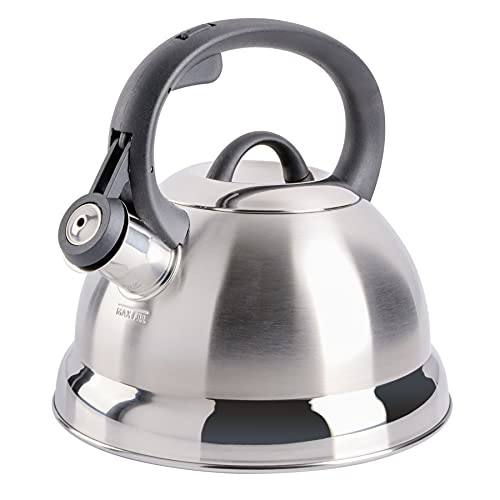
Mr. Coffee Flintshire Tea Kettle — Best Compact Brushed Classic
Mr. Coffee takes the modest end of the capacity table and dresses it properly: 1.75 quarts of stainless steel in a brushed satin finish, whistling, and shaped for the stovetop rounds of a smaller household. Brushed satin is the diplomat finish over gas, because the fine texture dissolves the soot shadows and heat marks that a mirror polish would frame and exhibit.
The size is the strategy. On a gas ring, a smaller kettle filled for two mugs boils quickly on a modest flame, wastes little and lifts lightly, which is the correct daily experience for a couple or a single tea drinker. The Flintshire name promises nothing exotic, and that is its charm: a kettle from a maker whose appliances live in ordinary kitchens, doing the ordinary miracle of boiling water without fuss or ceremony.
Its limits are the honest limits of its class. A family pot means a second boil, and the brushed finish, while forgiving, will never give the showroom gleam of polished steel. Households whose tea life is measured in mugs rather than pots will find those limits theoretical and the daily manners of this kettle exactly fitted to their ring.
- Body: stainless steel
- Capacity: 1.75 quarts
- Finish: brushed satin
- Type: whistling stovetop kettle
- Role: small-household daily kettle
Strengths
- Brushed satin hides gas working marks
- Quick, light boils for one or two mugs
- Household-name maker, classic design
Trade-offs
- Second boil needed for a family teapot
- No statement finish or colour
- Compact size will not serve gatherings
Best for: couples and solo drinkers with a mug-based tea life. Not suited for: homes boiling for a table of guests regularly.
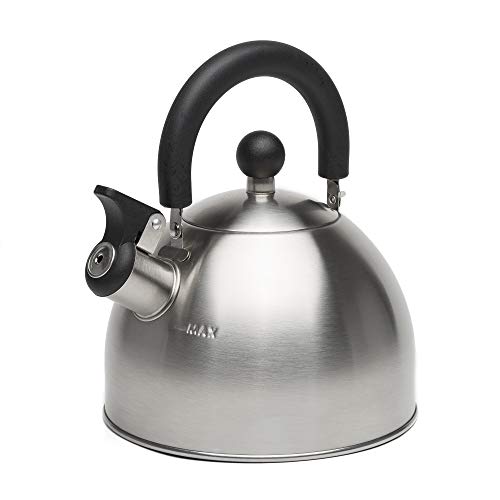
Primula Stewart Tea Kettle — Best Folding-Handle Small Kettle
The Primula Stewart solves the small-kitchen gas problem with a folding handle. At 1.5 quarts it is the smallest kettle in this guide, and its cool-touch handle folds for storage, which in a flat or a caravan kitchen is the difference between a kettle that lives by the hob and a kettle that lives in the way. Brushed silver with a black handle keeps the look calm while the fold does the clever work.
Cool-touch matters doubly over gas. The flame path on a small ring under a small kettle can reach parts of the handle zone that a larger setup spares, and a handle designed to stay graspable protects the pour that follows the whistle. The fast-boil whistling spout named in the listing suits the small-volume life: little water, little wait, clear signal.
Small kettles ask their owners to accept the refill rhythm, and the Stewart household will boil twice for a family pot without resentment because the rest of the day the kettle is perfectly sized. For a single drinker, a student kitchen, a camper conversion or an office kitchenette with a gas ring, this is the most considered small answer in the guide.
- Body: stainless steel, brushed silver
- Capacity: 1.5 quarts
- Handle: cool-touch, folding for storage
- Spout: fast-boil whistling spout per the listing
- Accent: black handle
Strengths
- Folding handle saves real cupboard space
- Cool-touch grip suits small-ring flame paths
- Fast small boils for single servings
Trade-offs
- Smallest capacity in the guide
- Two boils for any family occasion
- Folding mechanism is one more moving part
Best for: small kitchens, caravans and single-cup households. Not suited for: family teapots and gathering-scale rounds.

Large Stainless Whistling Tea Kettle — Best Warp-Resistant Family Body
This unbranded 3.1 quart kettle leads its listing with the two gas anxieties it answers: warping and handles. Warp resistance is named outright, and over a flame the claim matters, because repeated fierce heating and casual cooling is exactly the regime that slowly dishes a thin base until the kettle rocks on its grate and heats in patches. A base built to resist that fate is a base built for gas as it is actually used.
The wood-pattern ergonomic handle is the second answer. It reads as a grip designed to look like timber while behaving like a modern heat-aware handle, shaped for the two-handed confidence a full 3.1 quarts sometimes wants. The kettle declares itself for stove tops broadly, gas among them, and its size serves the family pot, the bottles and the cooking-water assist in one fill.
Unbranded ownership asks the usual faith in return: the listing claims are the specification, and long-term support runs through the seller rather than a maker catalogue. Households comfortable with that exchange gain a big, flame-sensible kettle whose two headline features aim precisely at the way gas kettles actually die.
- Body: stainless steel
- Capacity: 3.1 quarts
- Base: warp resistant per the listing
- Handle: wood-pattern ergonomic design
- Hob fit: stove top use including gas per the listing
Strengths
- Warp-resistant base targets the classic gas failure
- Handle design suits a heavy full kettle
- Family capacity in one fill
Trade-offs
- Unbranded support runs through the seller
- Wood-pattern look will divide tastes
- Big body tempts overfilling for small rounds
Best for: families wanting a large kettle built against warping. Not suited for: buyers who only purchase established brands.
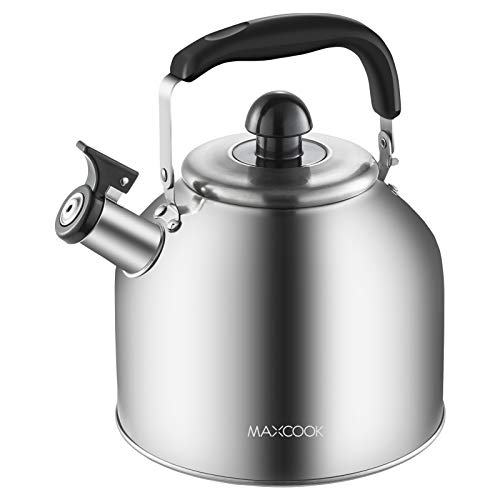
MAXCOOK Whistling Tea Kettle — Best Extra-Large Kettle
MAXCOOK builds the reservoir of the guide: 4.2 quarts, a full 4 litres, in 18/8 stainless steel with a brushed satin finish. This is the kettle for the house where hot water is a utility, the farmhouse table, the bed-and-breakfast kitchen, the family that fills a large pot for tea and a second vessel for the washing-up assist without thinking of the kettle as a tea accessory at all.
Eighteen-eight steel, the chromium-nickel grade behind much good cutlery, brings corrosion resistance that suits a kettle living permanently by a hob, and the brushed satin finish manages the soot and tint of gas service with the same discretion as the smaller Flintshire. At this size the base spans a large ring handsomely, catching a flame that would be wasted on a small kettle and converting it into volume.
The cautions are pure physics. Four litres of boiling water is a serious lift and a serious pour, best done two-handed by most wrists, and a household that fills it for two mugs is heating a swimming pool to make a cup of tea. Buy the MAXCOOK when the volume is genuinely used, and it is the most capable kettle in this guide; buy it for insurance against guests, and it will tax every ordinary day.
- Body: 18/8 stainless steel
- Capacity: 4.2 quarts, 4 litres
- Finish: brushed satin
- Type: whistling tea kettle for stove top
- Hob note: suitable for gas stove top per the listing
Strengths
- Largest capacity for utility-scale hot water
- 18/8 steel resists corrosion by the hob
- Wide base uses a large ring efficiently
Trade-offs
- Very heavy when filled to capacity
- Wasteful for one or two mug rounds
- Needs a large ring to heat evenly
Best for: big households and hospitality-scale hot water duty. Not suited for: small kitchens and modest daily tea rounds.
How Do the Six Kettles Compare Side by Side?
| Pick | Capacity | Steel or body note | Standout trait |
|---|---|---|---|
| WALDWERK Tea Kettle | 2.4 quarts | Stainless steel | Dual-duty gas and induction listing |
| foedo Whistling Tea Kettle | 3 litres | 304 stainless, all metal | Anti-scald towel included |
| Mr. Coffee Flintshire Tea Kettle | 1.75 quarts | Stainless, brushed satin | Compact household classic |
| Primula Stewart Tea Kettle | 1.5 quarts | Stainless, brushed silver | Cool-touch folding handle |
| Large Stainless Whistling Tea Kettle | 3.1 quarts | Stainless steel | Warp-resistant base claim |
| MAXCOOK Whistling Tea Kettle | 4.2 quarts | 18/8 stainless, brushed satin | Largest utility capacity |
Over gas, the table reads differently from an induction comparison. Capacity matters more, because a wide base on a large ring converts flame to volume efficiently, and handle design matters more, because the flame path reaches where induction never does. The steel notes are a durability story: grades and warp resistance are promises about the hundredth boil, not the first.
The small end of the table deserves its dignity. The Primula and the Flintshire will outsell the giants in real kitchens because most tea rounds are one or two mugs, and a small kettle on a small ring is the fastest, cheapest boil in this entire guide. Buy the row that matches your ordinary Tuesday, and borrow a saucepan for the extraordinary Saturday.
How Do You Match a Flame to a Kettle Base?
Look down at the ring with the kettle off and the gas lit, and the rule draws itself: the flame tips should kiss the base and stop there. Flames licking up the sides are heating the kitchen, scorching the handle zone and painting soot up the body, while contributing nothing to the water. Turn the ring down, or move the kettle to the smaller ring, until the blue crown sits inside the base diameter.
The opposite error is subtler. A fierce small ring under a wide kettle concentrates heat in a coin at the centre, which can stress the base over time and leaves the outer water to warm by conduction alone. Large kettles like the MAXCOOK belong on large rings at moderate flame, where the heat spreads across the floor of the pot and the whole volume climbs together.
Make the check a habit whenever the kettle changes rings. Different burners serve different meals, and the kettle often migrates around the hob across a day. A two-second glance at the flame crown before walking away saves the soot, the handle and a measurable slice of the gas bill, every single boil.
Why Do Gas Kettles Gather Soot, and Should You Worry?
Soot is unburned carbon, and a healthy blue flame produces very little of it. A kettle base that blackens quickly is often reporting a flame problem: a ring burning yellow at the tips, a burner cap seated crookedly, or a flame simply too large for the base and curling around it starved of air. Read the soot as a diagnostic before you read it as dirt.
A light, even darkening at the base is normal working patina and harms nothing; it can even be left alone on the underside where nobody sees it. Heavy, flaky soot deserves a response: check the burner, clean the base with a paste of bicarbonate and water, and resize the flame. Yellow flames also waste gas and, in enclosed kitchens, deserve a service visit rather than a shrug.
Finishes decide how the story shows. Brushed satin, worn by the Flintshire and the MAXCOOK, folds soot shadows into its texture, while a polished body would exhibit them. This is one of the quiet reasons brushed finishes dominate the gas end of the kettle market: the flame writes on every kettle, and brushed steel is the paper that hides the handwriting.
What Mistakes Do Gas Kettle Owners Make Most Often?
The first mistake is the full-power habit: the largest ring at maximum flame for every boil, regardless of kettle size. It saves seconds, wastes gas up the sides, overheats handles and, repeated daily, is the fastest route to a warped base. The kettle that boils a minute slower on the right ring at the right flame will outlive the scorched sprinter by years.
The second mistake is leaving the kettle sitting on a hot grate after the ring is off, or worse, returning an empty kettle to a still-burning ring while the tea steeps. An empty kettle over flame is a dry boil in slow motion, and the base pays for every minute. Move the kettle to a cold ring or a trivet as part of the pouring ritual, until the habit is automatic.
The third mistake is ignoring a fading whistle. Scale narrows the whistle passage on gas kettles exactly as on any other, and a muted whistle removes the only alarm a gas hob respects. Descale the cap when the note changes, and treat a kettle that has stopped whistling as a kettle asking for attention, not as a kettle growing mellow.
How Should You Keep Water Hot Without Wasting the Ring?
Gas cooks often want the kettle to hold heat between rounds: a second pot of tea, a top-up for the cafetière, a bottle at bedtime. The wasteful method is a perpetual low flame, which leaks heat and money for hours. The better method is thermal: boil once, pour what is needed, and let the remaining water stand in the kettle off the ring, where a steel body and a closed lid keep it usefully hot for the next round within the half hour.
A kettle cosy, unfashionable and effective, extends that window considerably for households with a long tea morning. Where a simmer is truly needed, the smallest ring at its lowest stable flame under the kettle base is the honest minimum, and the kettle should be at least half full so the water, not the steel, receives the heat.
Plan the rounds and the problem mostly dissolves. A family that drinks two pots an hour apart is better served by two fresh boils in a mid-size kettle than by one giant boil kept simmering, because fresh water makes better tea and a smaller flame bill. The MAXCOOK volume is for simultaneous demand, not for storage.
What Does Warp Resistance Actually Protect Against?
A kettle base warps when its metal expands unevenly, fierce heat in one zone, cooler metal around it, repeated until the floor of the pot dishes or domes. Gas is the usual author, because a flame delivers its energy in a ring or a coin rather than across the whole base. The symptoms arrive slowly: a kettle that once sat flat begins to rock on its grate, heats in patches and takes longer to boil as contact and conduction suffer.
A warp-resistant build, claimed by the 3.1 quart pick in this guide, answers with a base engineered to hold its shape through that punishment: thicker or layered construction that spreads the thermal stress instead of concentrating it. It is not invulnerability, and the same listing logic applies to every kettle here: correct flame sizing is the owner half of the warp bargain.
Cooling habits complete the defence. Never plunge a hot kettle base under cold water to speed a refill; the thermal shock of that quench is a warp in a single act. Let the kettle stand a minute, fill from the warm tap if your system allows, and the base will keep the flat, stable shape it arrived with.
How Do You Brew Tea Well Over a Gas Ring?
Gas gives the tea maker one gift induction cannot: infinite, instant analogue control. Bring the water up on a working flame, then, for green and white teas, cut the ring and let the kettle stand off the heat while the fiercest heat leaves the water, listening for the murmur to soften before you pour. For black tea, pour at the full boil straight off the whistle, as the leaf demands.
Fresh water matters over gas exactly as over any heat: yesterday reboiled kettle water makes flat tea and films the cup. The gas-specific craft is the flame-off moment; water taken off a still-burning ring keeps climbing for a few seconds from the heat stored in the base, so lift the kettle decisively and pour without hovering it over the flame out of habit.
Warm the pot while the kettle climbs. A gas hob usually has a spare small ring or the residual warmth of the grate, and a teapot warmed through steeps evenly and holds its temperature to the last cup. The ritual costs nothing and separates a good pot from a lucky one more reliably than any leaf upgrade.
Coffee deserves a sentence in a tea kettle guide, because the cafetière and the pour-over cone drink from the same kettle in most homes. Pour-over brewing rewards the slow, controlled stream and the just-off-boil rest even more strictly than tea, and a kettle whose spout can pour a thin, steady thread without glugging will serve the coffee ritual as faithfully as the tea round. Judge the spout at the sink with that thread in mind if your mornings run on both leaves and grounds.
When Is a Small Kettle the Smartest Buy on a Big Range?
Ranges are sold by their largest ring, but tea is made by the round, and most rounds are small. A 1.5 or 1.75 quart kettle on the small ring is the fastest honest boil in a gas kitchen, because every flame tip works on water the household will actually drink. The Primula Stewart and the Mr. Coffee Flintshire exist for this arithmetic, and their owners typically report the large kettle, if one survives in the cupboard, emerging only for parties.
Small kettles also travel well through a household life: the student flat, the caravan, the office kitchenette, the spare kettle that serves when the main one is descaling. A folding handle, as the Primula offers, turns that portability into cupboard geometry, which is why small kettles with storage tricks punch above their capacity in real homes.
The honest limit is hospitality. If your kitchen regularly boils for six, a small kettle makes you a kettle-watcher through two boils while the conversation starts without you. Buy small for the daily truth, and let the gathering days borrow a saucepan, which every gas range handles beautifully.
How Should You Clean a Gas Kettle Without Ruining Its Finish?
Inside, the routine is the universal one: a vinegar or citric acid descale on a rhythm set by your water hardness, the whistle cap soaked alongside, and two plain-water boils rinsed away before tea duty resumes. Gas adds nothing to the interior story except, perhaps, a faster scale cycle in homes where the kettle is boiled more often for cooking water.
Outside is where gas ownership differs. Soot and heat tint call for a bicarbonate paste and a soft cloth, worked in the direction of the brushing on satin finishes, never a scouring pad that will carve bright scratches into the texture. The base can take a firmer hand than the body, and a periodic base clean also restores efficient contact with the grate and the flame.
Handles and knobs want a damp cloth and nothing more aggressive, because their materials, however heat-aware, age under solvents. Dry the kettle after washing rather than leaving it to spot, and store it with the lid ajar if it will sit for days, so the interior dries fully and no stale smell moves into the next fill.
What Safety Habits Belong Around a Kettle on Gas?
The flame is the obvious hazard and the kettle adds two of its own: steam and weight. Keep the spout turned away from the walkway and from the hand that reaches for the ring control, because the steam plume at the boil is invisible at its hottest point. The anti-scald towel in the foedo box and the cool-touch handle on the Primula are design answers to the same truth: test the handle temperature with a knuckle before committing a grip.
Never leave a lit ring under a kettle as a room habit, and never let a child be the person who discovers the kettle has boiled. Gas kitchens run on a culture of checking: ring off, kettle moved, whistle cap seated for the next boil. Those three checks take four seconds and they are the entire safety system of a stovetop kettle, which has no electronics to forgive a lapse.
Finally, respect the full kettle as the heaviest pour in the kitchen. Two hands for the big bodies, a clear path to the pot, and no pouring over a floor where a pet or a toddler can arrive unannounced. Most kettle scalds happen in transit, not at the hob, and the transit is entirely within the pourer control.
What Changes When You Cook at Altitude or With Bottled Gas?
Mountain kitchens boil cooler water, and gas kettles feel it as a shorter whistle wait and a gentler boil. Black tea at altitude may need a longer steep to reach lowland strength, while delicate teas become almost impossible to scald, which high kitchens quietly count as compensation. The kettle itself needs no adjustment; the cook calendar does, adding a minute to the pot rather than chasing a temperature the air will not allow.
Bottled gas and camper rings burn with a smaller, less stable flame than a mains range, and they reward the small end of this guide. The Primula Stewart, with its folding handle and 1.5 quart body, is the natural travelling kettle, while a 4.2 quart MAXCOOK on a camping ring is a mismatch of ambitions that will soot the body and test everyone patience. Match the kettle to the flame you actually have, at home and away.
Wind is the third variable outdoors and in draughty farmhouse kitchens alike. A flame blown sideways heats one wall of the kettle and leaves the rest, lengthening the boil and painting a soot crescent that tells the story. A windshield, a calmer ring position or simply the lee side of the hob restores the honest vertical flame the kettle was designed around.
How Do You Judge a Whistle Before You Can Hear It?
Online, a whistle must be judged by its design description, because no listing can play you the note. Look for a proper two-part whistle cap with a defined air passage, the construction behind the classic clear tone, and be wary of listings where the whistle is a decorative slit in the spout. The picks here all present themselves as whistling kettles in their titles, which is the claim to hold them to on the first boil.
Test the whistle during the first week, deliberately, with the kitchen door closed and the television on, because that is the acoustic reality it must survive. A whistle that cannot summon you from the next room fails its only job, and a kettle within its return window can be exchanged for that reason alone, however handsome it looks on the ring.
Remember that whistle volume is partly water level. A kettle filled near its line whistles later and sometimes softer than a half fill, because the steam space is smaller and the boil must work harder to speak. If your kettle seems shy, descale the cap and test at a moderate fill before condemning the design.
What Is the Right Kettle for a Bed-and-Breakfast or a Busy Guest House?
Hospitality hot water is a volume business with a service rhythm: early risers, a breakfast rush, afternoon teas and bottles at night. The MAXCOOK 4.2 quart body is built for that arithmetic, and its brushed satin discretion suits a kitchen guests may glimpse. Pair it with a smaller kettle for the quiet hours and the system covers the whole day without boiling a reservoir for one guest mug at midnight.
Durability outranks beauty in this setting, because the kettle will be used by staff hands and guest hands, filled by the distracted and poured by the hurried. All-metal construction like the foedo, a warp-resistant base like the 3.1 quart pick, and handles that forgive a fast grip are the features that survive a season of hospitality. Keep a descale date in the kitchen diary, because guest-house water works a kettle harder than any family.
Presentation still counts at the table. Many hosts boil in a workhorse and serve from a smaller, prettier pot, which frees the kettle choice from appearance entirely. That division of labour is the professional secret this guide happily passes on: the kettle is infrastructure, and infrastructure should be chosen for stamina, not for photographs.
How Should a Kettle Share a Hob With Real Cooking?
On a working range the kettle competes for rings with saucepans, and the etiquette is thermal. The kettle takes the ring that matches its base while it boils, then yields to a trivet or a cold corner of the hob, because a kettle parked on a prime ring through a meal service is a kettle in everyone way. Gas cooks develop the shuffle unconsciously; naming it helps a new cook learn it in a week instead of a year.
Steam management is the second negotiation. A kettle at a rolling boil beside a frying pan donates moisture to a process that may not want it, and its plume can condense on the extractor and drip with comic timing. Angle the spout away from the pans, and time the boil to finish before the frying begins, which the whistle makes easy to arrange.
The reward for this choreography is a hob that behaves like a team. Water ready when the pasta needs topping up, tea ready when the cook sits down, and no ring wasted heating an empty kettle out of habit. The six kettles here are all shaped for that working life; none of them asks to be the only object the range ever heats.
What Should You Do in the First Week With a New Gas Kettle?
Wash it, boil it twice and discard the water, then make the first real round at a moderate fill on the ring you expect to use daily. Watch the flame against the base with your own eyes and adjust the ring choice there and then, because that pairing, kettle and ring, is the relationship the next decade of boils will live inside.
Practise the pour at the sink, full, with both hands if the body is large, and note where the drip falls when you right the kettle. Learn whether the lid stays seated during a confident pour and whether the handle temperature climbs on your ring at your flame. Every kettle has these small signatures, and a week of attention teaches them while an exchange is still a simple thing.
End the week by timing your standard boil and writing the number on the inside of a cupboard door. It sounds eccentric until the month the boil takes half as long again, when that number tells you the base has furred, the flame has drifted or the burner needs cleaning, and turns a vague suspicion into a diagnosis.
How Does a Kettle Fit a Kitchen That Also Bakes, Roasts and Preserves?
In a preserving kitchen the kettle graduates from tea duty to process water: topping up the jam pan, sterilising a funnel, keeping a bain-marie honest. Those jobs reward the large bodies in this guide, the foedo and the MAXCOOK, whose volumes match the preserving session scale, and they reward a spout that pours slowly without glugging, because a jam funnel forgives nothing.
Baking days ask the opposite: small, precise amounts of hot water for yeast, for soaking fruit, for the water bath under a custard. A small kettle that boils a cup quickly, the Primula or the Flintshire, serves a baker better than a reservoir, and its speed encourages the fresh-fill habit that good dough quietly depends on.
The lesson generalises beyond any single cuisine. Kettles are sized by their household dominant job, and households contain multitudes across a week. The comparison table in this guide is best read as a cast of characters, and the right purchase is the character your kitchen calls on stage most often, not the one with the grandest single scene.
What Running Costs and Lifespan Should a Gas Kettle Owner Expect?
A stovetop kettle is among the cheapest appliances to own: no filters, no elements, no electronics, and a fuel cost per boil measured in pennies when the flame is sized honestly. The descale solution is the only consumable, and a bottle of vinegar serves a year of maintenance. Against an electric kettle element or a pod machine, the gas kettle is a model of fiscal calm.
Lifespan follows the care sections above. A steel kettle protected from dry boils, quenched bases and abandoned flames will commonly serve a decade or more, outliving the range it was bought for and following its owners to the next kitchen, as the dual-duty WALDWERK expects to do. The parts that age, whistle caps and handle grips, are the parts to inspect annually.
Budget one honest line for replacement: when the base finally rocks beyond redemption or the whistle cap cracks, the kettle has earned its successor. Owners who track such things often find the cost per boil across a kettle life rounds to zero, which is why this category rewards buying well once rather than cheaply twice.
Final Recommendation
For the gas household that wants one kettle to answer nearly everything, the foedo Whistling Tea Kettle pairs 304 steel and family capacity with the anti-scald towel that proves its maker understands flame. The WALDWERK Tea Kettle remains the strategist choice for homes whose next hob might not burn gas, and the MAXCOOK Whistling Tea Kettle serves genuine utility volume.
At the small end, the Primula folding handle and the brushed Flintshire make the daily mug round fast and light, while the warp-resistant 3.1 quart body answers the classic gas failure by name. Match your flame to your base, size the kettle to your Tuesday, and keep the whistle loud and honest.
A kettle on gas is the oldest partnership in the kitchen, flame under steel, and when the sizes are right and the whistle is clear it still feels less like operating an appliance and more like keeping a small, useful fire exactly where you want it.
Frequently Asked Questions
What size flame should I use under a kettle?
A flame whose tips stay within the diameter of the kettle base. Flames licking up the sides waste gas, scorch handles and paint soot up the body. If the ring is too large even at its lowest stable setting, move the kettle to a smaller ring rather than accepting the waste. Recheck the pairing whenever the kettle changes, because the ring that suited the family body will bully a small kettle, and the ring that suited the small kettle will take all morning under the family one.
Why has my kettle base gone black?
Light darkening is normal working patina from the flame. Heavy, flaky soot suggests a flame burning yellow, a mis-seated burner cap or a ring too large for the base. Clean the base with bicarbonate paste, check the burner, and resize the flame; a persistently yellow flame deserves a service visit. Note where the blackening sits, because a crescent on one side points to a draught or a tilted grate, while an even ring of soot points to flame size, and the two diagnoses lead to different cures.
Can I use these kettles on induction as well?
Some can. The WALDWERK listing covers induction alongside gas, and several of the steel bodies here declare broad stovetop suitability. Check the individual listing for the claim before assuming, because induction needs a magnetic base that gas never asks about. A kettle that serves both hobs is also the natural spare for a household with a portable induction plate for summer cooking, when the gas range turns the kitchen into a sauna by ten in the morning.
Is a bigger kettle more economical on gas?
Only when the volume is used. A large kettle on a large ring converts flame efficiently for family rounds, but boiling four litres for two mugs wastes most of the heat. Economy lives in matching kettle, ring and fill to the round in hand. The same logic explains why two kettles, a small daily and a large social, appear in so many experienced gas kitchens: each boil then happens in the vessel sized for it, and neither kettle spends its life working at the wrong scale.
How do I stop my kettle warping?
Size the flame to the base, avoid fierce small rings under wide kettles, never quench a hot base under cold water, and move the empty kettle off a lit or hot ring. A warp-resistant base, as the 3.1 quart pick claims, adds engineering to those habits but does not replace them. If a base has already dished slightly, a kettle can often still serve on a grate, which forgives what flat glass would not, but treat the rock as a warning and correct the flame habits that caused it before the damage completes itself.
Why does the handle of my gas kettle get hot?
The flame path and rising hot air pass close to the handle zone, especially on small rings under small kettles. Cool-touch designs like the Primula folding handle and ergonomic grips mitigate it, and an anti-scald towel, included with the foedo, is the classic backup. Test with a knuckle before gripping. Handle heat that suddenly worsens on a familiar ring is information: the flame has grown, the burner cap has shifted, or the kettle has migrated off centre, and each of those is worth correcting before the next boil rather than tolerating with a thicker towel.
Related Guides
When the tea is poured, the rest of the morning routine still waits, so continue with Best Juicer Machines, Best Upholstery Steam Cleaners for Sofas and Best Nonstick Skillets for Gas Ranges.



[…] with the same respect for fit and function, beginning with Best Kitchen Faucets for Hard Water, Best Tea Kettles for Gas Ranges and Best Duvet Covers for Weighted […]