What's inside
- Key Takeaways
- Quick Picks
- How Did We Choose These Nonstick Skillets for Gas Ranges?
- How Do the Six Nonstick Skillets Compare Side by Side?
- Why Does Gas Heat Punish Thin Skillets?
- Granite-Style or Ceramic — Which Coating Suits Your Cooking?
- How Do You Keep Flames Off the Handle and the Coating?
- Which Skillet Shape Fits Which Weeknight Job?
- How Should You Wash and Store Nonstick Over the Long Term?
- What Size Burner Should a 12-Inch Skillet Sit On?
- How Do You Fry an Egg on Gas Without Sticking or Scorching?
- What Should You Cook in a Deep Skillet That a Shallow One Cannot?
- How Do You Tell When a Nonstick Pan Is Truly Finished?
- How Do You Sear Meat in a Nonstick Skillet Without Wrecking It?
- One Great Skillet or a Stable of Three?
- How Do You Break In a New Nonstick Skillet Over Gas?
- What Mistakes Do Nonstick Skillet Buyers Make Most Often?
- Final Recommendation
- Frequently Asked Questions
- Related Guides
As an Amazon Associate I earn from qualifying purchases. This post may contain affiliate links at no extra cost to you.
cottageverdict.com is reader-supported. When you buy through links on our site, we may earn an affiliate commission.
Where to buy: all six skillets below are sold through Amazon, and their names in the Quick Picks table, the detailed sections and the comparison table link to their listings so you can check price on Amazon and confirm diameter, coating type and handle design before ordering. Anyone sorting through the best non stick skillets for gas ranges quickly discovers that gas is the demanding partner in this relationship — open flame heats unevenly, licks up the sides, and punishes coatings and handles that electric cooking treats gently.
Three of the six picks share a brand, and this guide refuses to blur them. SENSARTE appears as a deep 12-inch sauté pan with a lid and a five-quart capacity, as a 12-inch omelette pan in Swiss granite coating, and as a wider 12.5-inch skillet — three genuinely different tools for three different jobs, distinguished below strictly by what their listings state, never by invented differences.
The other three picks widen the field by surface and style: a ceramic-coated aluminium pan from IMUSA in speckled grey, a family-size MICHELANGELO skillet built for batch cooking, and a cream-white granite CAROTE whose light finish shows browning beautifully. All six sit in the 12-inch class, because that is the diameter a family gas range feeds best — large enough for four chicken thighs, small enough to heat evenly over one strong burner.
Gas ranges reward skillets with substantial, flat bases. A thin pan over a flame develops a scorching centre and cool edges, warps over time, and turns eggs into a geography lesson. The picks here carry the base weight to spread flame heat, while their coatings — granite-style and ceramic — are asked to survive the one environment where nonstick goes to be tested.
Handle discipline matters over gas in a way it never does on induction. Flames that climb past the base reach handles, so handle material, length and angle enter the buying decision alongside coating chemistry. The sections below weigh those gas-specific realities pick by pick, because a skillet that is merely good on electric can be quietly miserable over an open flame.
Spend one week cooking three meals a day over an open flame and a kitchen develops opinions about pans that no showroom can teach: which base stays flat, which handle stays holdable, which coating still releases an egg on day seven. This guide is written from that week’s perspective. The six pans below are the ones whose designs answer gas’s specific interrogations — heat pattern, flame reach, grate stability — rather than merely surviving them.
A note on what this guide does not do: it does not rank these six by a single score, because a skillet’s excellence is inseparable from the hand and the menu it serves. The deep pan that wins a braising household’s heart would frustrate an omelette purist by Tuesday. Read the badges as job descriptions rather than medals, and the right shortlist for your stove will assemble itself from the sections below.
Everything in the sections that follow was filtered through one question a gas cook asks nightly: will this pan still be flat, calm and slick after a year of open flame? Keep that question in hand as you read, and the badges will sort themselves.
Key Takeaways
- Three SENSARTE picks, three different tools: a deep lidded 5-quart sauté pan, a 12-inch omelette pan, and a 12.5-inch skillet.
- Gas flames demand substantial flat bases — thin pans scorch in the centre and warp over time.
- All six picks sit in the family 12-inch class that one strong burner heats evenly.
- Granite-style and ceramic coatings divide the field by feel, care and utensil tolerance.
- Handles over gas need length and heat sense, because flame climbs past the base.
- A lid turns the deep pick into a braising and steaming vessel, not just a fryer.
Quick Picks
| Pick | Badge | Why it earns its place |
|---|---|---|
| SENSARTE Deep Frying Pan | Best Deep Sauté Pan | SENSARTE’s deep 12-inch pan with lid and 5-quart capacity — the sauté and braise specialist. |
| SENSARTE Omelette Pan | Best Omelette Pan | SENSARTE’s 12-inch omelette pan in Swiss granite, shaped for eggs and sliding food. |
| SENSARTE 12.5 Inch Frying Pan | Best Extra-Wide Skillet | SENSARTE at 12.5 inches — the widest floor here for uncrowded searing. |
| IMUSA Ceramic Fry Pan | Best Ceramic Surface | IMUSA’s ceramic aluminium pan in speckled grey for easy-release pan frying. |
| MICHELANGELO Nonstick Frying Pan | Best Family Workhorse | MICHELANGELO’s family-size 12-inch skillet for larger portions and batch cooking. |
| CAROTE Nonstick Frying Pan | Best Light-Finish Skillet | CAROTE’s cream-white granite skillet with a heat-resistant handle and easy-clean finish. |
How Did We Choose These Nonstick Skillets for Gas Ranges?
Gas suitability came first, judged by base substance and footprint. Each pick is a 12-inch-class skillet with a base broad and heavy enough to sit stable on grates and spread a flame’s heat, rather than a featherweight pan that would scorch centrally and skate around the burner. Diameter claims were taken from the listings and are stated exactly in every section.
The three SENSARTE listings were separated by their titles, not by imagination: the deep pan is identified by its lid, its 5-quart capacity and its helper handle; the omelette pan by its name and Swiss granite coating; the 12.5-inch by its extra half inch and stone cookware positioning. Where the listings overlap, the sections say so instead of manufacturing distinctions.
Coating variety completed the shortlist deliberately. Granite-style coatings, a ceramic surface and the deep pan’s healthy non-toxic positioning give households with different care habits and utensil drawers a genuine choice, and every pick’s listing states PFOA-free or equivalent positioning where it applies — recorded below as the listings present it.
We also read the listings for what they omit. A skillet silent about its base construction, its handle material or its coating family is asking the buyer to gamble, and over gas the gamble is settled by flame within a month. Every pick here declares the facts a gas cook needs — diameter, coating, capacity or handle design — in its own title, which is why the sections can argue from evidence instead of from hope.

SENSARTE Deep Frying Pan — Best Deep Sauté Pan
This is the SENSARTE that is not really a skillet in the shallow sense: a 12-inch deep frying pan with a lid, five quarts of capacity, a helper handle opposite the main one, and a listing that calls it a sauté pan with a cover. The depth changes the menu — curries, braises, one-pan pasta, a whole spatchcocked chicken under its lid — while the nonstick interior keeps the cleanup closer to a frying pan’s than a Dutch oven’s.
Over gas, the helper handle earns its place every time the pan is full. Five quarts of stew is a two-handed lift, and the second grip turns a risky waddle to the trivet into a controlled move. The lid traps steam for rice-finishing and vegetable-softening, then lifts to let the same pan reduce a sauce hard over the flame — a range of behaviour no shallow skillet in this guide can imitate.
Its listing positions the pan as healthy and non-toxic, PFOA and PFOS free, and induction-capable as well as gas-friendly. Buy it as the deep anchor of a small pan collection: the piece that fries in the morning, braises in the evening, and justifies its cupboard space in both shifts, provided your storage accepts a lidded pan of real presence.
One more role suits this deep pan: the stovetop-to-table vessel. Its proportions present well, the lid keeps a braise warm through the walk to the table, and the helper handle makes that walk safe with a full load. Households short on serving dishes will find it doing double duty at Sunday lunches — a skillet that plates up as a serving piece earns a permanence in the kitchen that purely functional pans rarely achieve. Renters of pan collections — the cooks who keep three pans total — should weigh this one’s arithmetic: it replaces a sauté pan, a lidded casserole for stovetop work and the big skillet, three hooks becoming one. Minimalist kitchens are not built from specialised tools but from a few deep generalists, and no pick in this guide generalises further without losing its frying soul entirely.
- Size: 12 inch, deep format per the listing
- Capacity: 5 Qt per the listing
- Lid: included, with cover per the listing
- Handles: main handle plus helper handle
- Coating position: PFOA PFOS free per the listing
Strengths
- Depth and lid unlock braising, steaming and one-pan meals
- Helper handle makes full-pan lifts safe and controlled
- Nonstick cleanup after long, saucy cooking sessions
Trade-offs
- Deep walls make flipping eggs and pancakes awkward
- Heaviest and bulkiest storage footprint here
- Lid needs its own home in the cupboard
Best for: one-pan cooks who braise, steam and sauté in a single vessel.
Not suited for: egg specialists wanting a shallow, sloped skillet.
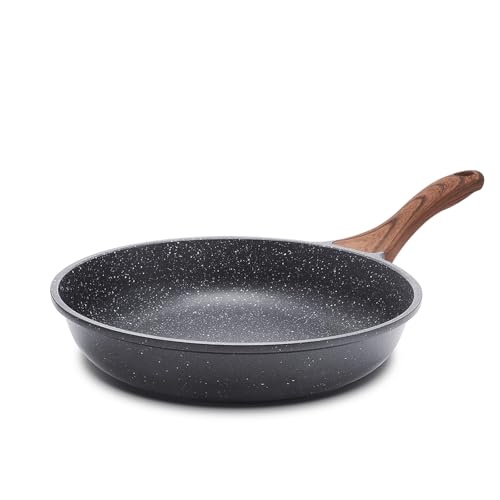
SENSARTE Omelette Pan — Best Omelette Pan
The second SENSARTE is the omelette pan proper: 12 inches, Swiss granite coating, and a listing that names it a chef’s pan for omelettes. The distinction from its deep sibling is shape and purpose — this is the shallow, egg-first tool, the one whose surface is tuned for sliding a folded omelette onto a warm plate without a tear or a spatula wrestling match.
Swiss granite coatings earn their following on release and resilience: eggs, fish skin-side down, cheese-edged frittatas and delicate pancakes all leave the surface cleanly, and the speckled granite face hides the minor marks of daily service that show brutally on plain dark coatings. Over a gas flame the pan’s base spreads heat evenly enough that an omelette sets as a sheet rather than a bullseye.
At 12 inches it also moonlights as the household’s general egg-and-more station — French toast for four in rotation, quesadillas, reheated pizza slices crisping underneath. It will not braise, and it does not pretend to; within its shallow brief it is the most specialised and, for breakfast households, possibly the most-used pan in this guide.
Egg technique on this pan rewards one habit: warm it a breath longer than instinct suggests, because an omelette pan’s thinner profile responds quickly, and a fully settled surface is what lets the eggs set in a sheet before the fold. Cooks upgrading from a warped old pan often blame their hands for years of torn omelettes that were actually the pan’s domed floor at work — a flat granite surface is the quiet correction. French-style omelette purists will note this pan’s 12-inch span is generous for a two-egg omelette, which wants a smaller field — but for the three-egg family omelette, the Spanish tortilla and the frittata that feeds four, the size is exactly right, and its granite floor releases the egg sheet whole. Pans, like knives, are bought for the meals a household actually repeats.
- Size: 12 inch per the listing
- Role: omelette pan per the listing
- Coating: Swiss granite coating per the listing
- Positioning: healthy induction cookware, chef’s pan
- Coating position: PFOA free per the listing
Strengths
- Egg release is the best-matched brief in this guide
- Granite face hides daily marks gracefully
- Even base heat sets omelettes as a sheet, not a ring
Trade-offs
- Shallow walls exclude saucy and braised dishes
- No lid included for steaming finishes
- Specialist shape overlaps a general skillet’s duties
Best for: breakfast households where eggs appear daily.
Not suited for: cooks needing depth, lids or large-batch capacity.
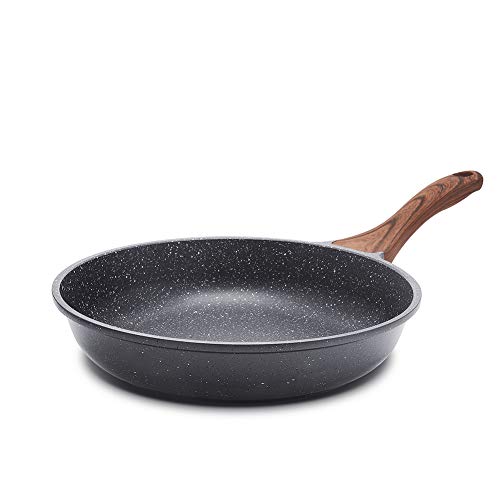
SENSARTE 12.5 Inch Frying Pan — Best Extra-Wide Skillet
The third SENSARTE stretches the format: 12.5 inches of Swiss granite-coated skillet, positioned by its listing as healthy stone cookware and an omelette pan at the larger size. That extra half inch sounds trivial until four chicken thighs or a double row of potato slices need floor space — crowding is the enemy of browning, and this pan’s floor is where uncrowded cooking happens in the SENSARTE line.
Distinguish it from the 12-inch omelette pan by dimension and by listing: this is the wider skillet, the one whose diameter is the headline. In use it behaves like the family’s general searing station — burgers with elbow room, a full pan of fajita vegetables, pancakes in a grid that does not force mergers at the edges.
Over gas, the wider base asks for a burner that can feed it; a small flame under a 12.5-inch floor leaves the rim lazy. On a strong burner it is superb, and households whose range has one genuinely powerful ring will find this the most versatile of the three SENSARTE picks — width being the quiet specification that decides more dinners than coating chemistry does.
The wide floor changes sauce work too: a pan sauce built in the drippings of four uncrowded chicken thighs has the volume and the evaporation geometry to reduce properly, where a crowded smaller pan merely steeps. Deglaze this skillet and there is room to swirl, scrape and finish with butter in the same vessel — the restaurant sequence, available at home because a half inch of diameter said so. Consider the wide pan for flatbreads: quesadillas for two at once, pancakes without border disputes, a whole pizza’s worth of reheated slices crisping in one pass. Foods that arrive flat and numerous are this skillet’s native population, and households whose weeknights run on wraps, melts and flatbreads will find the extra half inch quietly restructuring their cooking for the better.
- Size: 12.5 inch per the listing
- Coating: Swiss granite coating per the listing
- Role: frying pan skillet, omelette pan per listing
- Positioning: healthy stone cookware per the listing
- Coating position: PFOA free per the listing
Strengths
- Widest floor here — food browns uncrowded
- Granite coating releases and hides wear well
- Generalist size covers most family frying
Trade-offs
- Needs a strong burner to heat the full width
- No lid included for covered finishes
- Larger diameter needs storage width to match
Best for: families searing for four on a powerful gas burner.
Not suited for: small burners or cooks who need a lidded pan.

IMUSA Ceramic Fry Pan — Best Ceramic Surface
IMUSA’s entry changes the coating conversation: a 12-inch aluminium fry pan with a ceramic surface — its Premier Cera line — in speckled grey, positioned by its listing plainly as ideal for pan frying. Ceramic coatings bring a distinctive slickness that feels almost glassy when new, and the speckled finish gives the pan a lighter, friendlier presence than the granite brigade.
Ceramic asks for a slightly different contract than granite-style coatings. It rewards moderate heat — which gas cooks must manage actively, since a flame’s first instinct is maximum — and gentle utensils, and in exchange it delivers easy release for eggs, fish and pancakes plus a surface that wipes clean with unusual completeness. The aluminium body keeps the pan light enough for one-handed tossing of vegetables.
Pan frying is the right brief to judge it by: cutlets, plantains, quesadillas, reheated leftovers crisping at the edges. Households that cook those foods weekly, treat coatings kindly and prefer a lighter pan will find the IMUSA the most cheerful tool here; households that blast every pan on full flame should choose granite and be honest about why.
The IMUSA has a traveller’s virtue: it is light and inexpensive enough in spirit to be the pan that goes to the holiday rental, the camper stove and the student kitchen without anxiety. Ceramic pans at the premium end inspire a protectiveness that can ruin a holiday breakfast; this one invites use. Keep its moderate-heat contract and it will repay the casualness with seasons of easy-release service in kitchens that are not even yours. The speckled finish has a photographer’s benefit similar to the cream CAROTE’s: a mid-tone grey that neither swallows browning nor shouts over the food, so pan-fried items show their colour honestly while cooking. Cooks who judge by eye — which is to say, cooks — get better information from this surface than from a black one, and information is what stands between golden and gone-too-far.
- Size: 12 inch per the listing
- Material: aluminium per the listing
- Surface: ceramic, Premier Cera per the listing
- Colour: speckled gray per the listing
- Role: ideal for pan frying per the listing
Strengths
- Ceramic slickness releases delicate foods cleanly
- Light aluminium body suits one-handed cooking
- Speckled grey finish looks fresh in open kitchens
Trade-offs
- Ceramic prefers moderate heat — gas needs restraint
- Gentle utensils required to protect the surface
- Ceramic longevity trails granite under rough use
Best for: gentle cooks who pan fry often and value easy release.
Not suited for: full-flame households that abuse coatings.

MICHELANGELO Nonstick Frying Pan — Best Family Workhorse
MICHELANGELO’s 12-inch skillet is the family workhorse brief stated without decoration: a family-size nonstick pan for larger portions and batch cooking, with easy food release and cleanup, and induction among its compatibilities alongside the gas ranges this guide cares about. The listing’s language is about feeding people at volume, and the pan is built to that sentence.
Batch cooking is a specific discipline: double quantities of scrambled eggs that must not weld to the pan at minute nine, a full pack of sausages, stir-fried vegetables in one pass instead of two. A skillet that releases reliably at volume and wipes clean between batches is the difference between batch cooking as a system and batch cooking as a punishment, and that is the ground this pan claims.
It is the least specialised pick here, and for many households that is the recommendation: one honest 12-inch nonstick that fries, sears, reheats and batches without a personality to manage. Pair it with the deep SENSARTE if braising enters your week, or let it stand alone as the pan that simply gets used every day.
Batch households should note the cleanup rhythm this pan enables: because food releases so completely, the between-batch wipe takes seconds, and a Sunday meal-prep session — eggs, then chicken, then vegetables — can run in one pan with three wipes instead of three washes. That is the unlisted specification that decides whether batch cooking survives contact with a real family’s patience, and it is where this workhorse quietly outclasses prettier pans. Meal-prep households measure pans in a private unit: portions per session before the cook’s patience ends. By that unit this MICHELANGELO is the richest pan here — a full batch of chicken, a double recipe of fried rice, a week’s breakfast burrito filling in one uninterrupted run. When a pan removes the second batch, it removes the moment most home batch-cooking resolutions die.
- Size: 12 inch per the listing
- Role: family-size skillet per the listing
- Use: larger portions and batch cooking per listing
- Release: easy food release and cleanup per listing
- Compatibility: induction listed alongside stovetops
Strengths
- Batch portions release cleanly batch after batch
- Unfussy generalist that suits daily family cooking
- Easy cleanup keeps high-volume cooking sustainable
Trade-offs
- No lid or helper handle for heavy, saucy loads
- Less specialised for eggs than the omelette pan
- Family size may overshoot solo cooking needs
Best for: families batch cooking on a daily rhythm.
Not suited for: solo cooks or egg perfectionists.

CAROTE Nonstick Frying Pan — Best Light-Finish Skillet
CAROTE closes the six with colour: a 12-inch granite skillet in cream white, with a heat-resistant handle, all-stovetop compatibility per its listing, and a healthy non-toxic granite positioning. The cream interior is not mere styling — pale surfaces show browning honestly, so onions, butter and pancake batter report their true colour instead of hiding against a dark floor until they scorch.
The heat-resistant handle deserves its mention over gas specifically. Flames lick wider than the pan’s base on high settings, and a handle designed to tolerate heat — kept angled away from the flame’s climb — is the difference between a grip you trust and one you approach with a cloth and suspicion. CAROTE’s handle design is a recurring reason owners cite this line, and gas cooks feel the benefit first.
Granite-style coating gives the pan the family’s expected release and wipe-clean manners, while the cream finish asks one discipline: staining foods like turmeric and tomato will tint a pale surface over time if left sitting. Wash promptly and the pan keeps its showroom calm; let it soak in curry overnight and it will carry the memory, beautifully seasoned but visibly lived-in.
Cream finishes have a second audience: cooks who photograph their food. A pale granite surface makes a skillet a serving backdrop — frittatas, shakshuka and pancake stacks all present against cream the way they do in the cookbooks — and the pan goes from flame to table without a transfer. If your kitchen runs on that kind of pleasure, the CAROTE is not the vain choice; it is the honest one. A final word for the cream finish’s critics, who call it precious: every pan in this guide asks a discipline — granite asks for heat sense, ceramic for gentleness, the deep pan for storage. The CAROTE merely makes its discipline visible, in tint and prompt washing, rather than hiding it in a warped base or a tired coating discovered too late. Visible disciplines are the ones households actually keep.
- Size: 12 inch per the listing
- Finish: cream white granite per the listing
- Handle: heat-resistant handle per the listing
- Compatibility: all stovetops compatible per listing
- Positioning: healthy non toxic granite cookware
Strengths
- Pale floor shows browning honestly — fewer scorched surprises
- Heat-resistant handle suits open-flame cooking
- Granite release with wipe-clean cleanup
Trade-offs
- Cream surface can tint from staining foods
- Prompt washing needed to keep the finish bright
- No lid included for covered cooking
Best for: cooks who judge browning by eye and cook over open flame.
Not suited for: households that leave pans soaking in sauces overnight.
How Do the Six Nonstick Skillets Compare Side by Side?
Depth, diameter and coating separate these six 12-inch-class pans — and the three same-brand picks are distinguished by their listings, not by lore.
| Pick | Badge | Standout trait | Watch out for |
|---|---|---|---|
| SENSARTE Deep Frying Pan | Best Deep Sauté Pan | Deep 5-quart lidded sauté capacity with helper handle | Too deep for easy egg flipping |
| SENSARTE Omelette Pan | Best Omelette Pan | Shallow Swiss granite omelette specialist | No lid, no braising depth |
| SENSARTE 12.5 Inch Frying Pan | Best Extra-Wide Skillet | Widest 12.5-inch granite floor for uncrowded searing | Demands a strong burner |
| IMUSA Ceramic Fry Pan | Best Ceramic Surface | Ceramic aluminium lightness for pan frying | Moderate heat and gentle utensils only |
| MICHELANGELO Nonstick Frying Pan | Best Family Workhorse | Family batch-cooking workhorse, easy release | Plain feature set — no lid or helper grip |
| CAROTE Nonstick Frying Pan | Best Light-Finish Skillet | Cream granite with heat-resistant handle | Pale finish tints if left soaking |
Why Does Gas Heat Punish Thin Skillets?
A gas flame delivers its energy in a ring, hottest where the flamelets touch and cooler between them, and a thin base simply forwards that pattern to the food: a scorching annulus, a raw centre, eggs that set in rings. A substantial base acts as a translator, absorbing the ring’s energy and re-radiating it as an even field — the single most important skillet quality over gas, ahead of any coating.
Warping is the slow punishment. Repeated cycles of fierce local heat and cooling walk thin aluminium into a dome, and a domed skillet on grates rocks, spins and pools oil at its edges. The bases across this guide — from the SENSARTE 12.5 Inch Frying Pan at 12.5 inches down — are chosen thick enough to stay flat through years of that cycling.
Preheating discipline completes the defence: a minute or two on medium lets the base equalise before food lands, while blasting on high then adding eggs is how even good pans get blamed for sticking. Gas gives instant control; the skillet needs a moment to turn that control into evenness.
Granite-Style or Ceramic — Which Coating Suits Your Cooking?
Granite-style coatings — the speckled surfaces on the SENSARTE trio, the MICHELANGELO and the CAROTE — are the forgiving school: strong release, good tolerance of everyday utensils and heat habits, and a face that hides the evidence of both. For households that cook fast and wash faster, granite is the coating that survives the lifestyle.
Ceramic, represented here by the IMUSA, is the purist: a glassy slickness that releases delicately and wipes spotless, in exchange for moderate heat and kind utensils. Its performance peak is arguably higher and its tolerance narrower, which makes the choice a personality test as much as a specification comparison.
Longevity honesty belongs in this section: every nonstick surface is a consumable with a lifespan measured in years, not decades. Coatings kept off maximum heat, washed without scouring and used with suitable utensils last longest whichever family you choose — and a pan bought at skillet prices and retired gracefully beats a heirloom-priced pan mourned annually.
How Do You Keep Flames Off the Handle and the Coating?
Centre the pan on the burner and match flame to base: the flame ring should kiss the underside, not climb the walls. Flames up the sides waste gas, soot the exterior, overheat the coating’s edges where it is thinnest, and reach for the handle with intent. A smaller burner under a 12-inch pan often cooks better than the biggest ring turned theatrical.
Angle the handle away from neighbouring burners and from the oven door’s swing, and prefer handles with heat-resistant design like the CAROTE’s when the range layout forces handles over warm territory. A handle that stays grippable keeps the cook calm, and calm cooks do not drop pans.
Restraint with maximum heat protects the coating’s chemistry. Nonstick surfaces degrade fastest at sustained high temperatures, and gas reaches those temperatures effortlessly — so sear briefly when you must, then settle to medium, where these pans do their best work anyway. The flame is a servant with a loud voice; keep it at conversational volume.
Which Skillet Shape Fits Which Weeknight Job?
Shallow and sloped is the egg shape: the SENSARTE Omelette Pan exists because omelettes, crepes and fried eggs want a surface they can slide across and a wall they can climb out of. Depth is the braise shape: the deep SENSARTE with its lid owns curries, one-pan pastas and anything that begins as a fry and ends as a simmer.
Width is the crowd shape. The 12.5-inch pan and the family MICHELANGELO serve the nights when four portions must sear together or not at all, because a second batch always eats later and worse. Match the pan to the meal’s geometry and the cooking feels easy; mismatch them and even good technique spends the evening compensating.
Most households resolve this with two pans, not six: a shallow egg skillet and one deep or wide workhorse cover the week between them. This guide’s six are a menu for building that pair — or trio, if batch cooking is a religion — rather than a suggestion that anyone needs all six hanging in a row.
How Should You Wash and Store Nonstick Over the Long Term?
Warm water, a soft sponge, ordinary detergent: that is the whole liturgy. Nonstick that needs more than this was either overheated during cooking or left to carbonise afterwards, and both are habits, not fates. Let the pan cool before washing — cold water on a hot coating stresses the bond between surface and body — then dry it rather than leaving it to drip.
Storage is where coatings quietly die. Stacked pans grind their surfaces against each other’s bases and rims, so hang the skillets or nest them with cloth or felt between the layers. A deep SENSARTE with its lid inverted stores neatly; the shallow pans hang happily from a rail and stay ready for the morning shift.
Utensils complete the care triangle: wood, silicone and nylon at the surface, metal reserved for the cast iron drawer. One disciplined utensil crock extends a coating’s prime by years, which is the cheapest performance upgrade available anywhere in this guide.
What Size Burner Should a 12-Inch Skillet Sit On?
The medium-large burner is the 12-inch pan’s natural home on most gas ranges: broad enough to feed the base evenly, tame enough not to send flames up the walls. The power burner earns its name for the wide deep SENSARTE and for searing, used briefly and deliberately; the simmer burner suits keeping a finished sauce warm in the deep pan, under its lid, without scorching the bottom.
Watch the flame’s footprint rather than the knob’s label. Blue cones should spread across the underside and stop at its edge; a ring of flame visible from the side is heat leaving the pan and entering the kitchen, the handle’s neighbourhood and your gas bill simultaneously.
Grate stability matters at this size too. A 12-inch pan full of food is heavy, and grates that let it rock when stirred are a hazard no coating can offset. Test a candidate’s sit on your own grates when it arrives — flat, steady, handle clear of the flame’s climb — and return any pan that fails the physical exam, however pretty its listing.
How Do You Fry an Egg on Gas Without Sticking or Scorching?
The sequence is short and unforgiving of shortcuts: pan on a medium flame for a minute until its base is evenly warm, a small knob of butter or film of oil across the surface, then the egg, then stillness. The white sets from the edges inward; the yolk stays glossy; the whole thing releases with a nudge because the coating met an egg at the right temperature instead of a cold one or a scalding one.
Scorching almost always traces to the power burner used out of habit. Eggs belong on the medium ring, where the flame’s footprint matches the pan’s floor, and they take perhaps thirty seconds longer — thirty seconds that buy the difference between a diner egg and a lace-edged, rubberised apology. Gas control is instant; the discipline is remembering to use less of it.
What Should You Cook in a Deep Skillet That a Shallow One Cannot?
Anything with a second act. A shallow skillet fries; a deep one fries and then simmers — chicken thighs crisped skin-down, then braised in stock under the lid in the same pan, carrying their fond into the sauce. One-pan pasta, shakshuka, curries, sausage and peppers drowning happily in tomato: the deep format’s menu is the shallow one’s menu plus every dish that ever asked for a lid and a little volume.
The deep pan also civilises frying itself for the nervous cook: higher walls mean less spatter on the range, fewer burns on the forearm, and room to turn food without launching it. Households with children near the stove or white shirts near the cook will feel that wall height as a safety feature disguised as a specification.
How Do You Tell When a Nonstick Pan Is Truly Finished?
The honest signals arrive in order: eggs that once slid now hesitate, then cling at the centre where heat concentrates; the surface shows pale wear arcs where the spatula travels; washing stops restoring the slickness it restored a year ago. At that point the coating has given its service, and persisting with it teaches a household to hate fried eggs rather than to replace a pan.
Retirement need not mean the bin immediately — a tired nonstick still reheats pizza, toasts sandwiches and warms tortillas honourably, duties where release hardly matters. But let it stop being the egg pan the day the eggs say so. Coatings are consumables with dignity; replacing them on evidence rather than on a calendar is the grown-up arrangement.
How Do You Sear Meat in a Nonstick Skillet Without Wrecking It?
Respect the format’s limits and it sears respectably: dry the meat’s surface thoroughly, preheat the pan to a confident medium-high — never a screaming maximum — and lay the pieces down uncrowded, then leave them alone until the crust releases them. The fond will not rival cast iron’s, because nonstick is designed to let go of exactly what iron keeps, but a golden, honest sear is well within these pans’ manners.
Restraint afterwards matters as much: deglaze gently, keep the sauce’s simmer civilised, and never take the pan from flame to cold tap in one motion. Households that want iron’s violent crust regularly should own iron for that job and let the nonstick do the ninety percent of cooking it does better. Right tool, right violence level — the whole of pan wisdom in one sentence.
One Great Skillet or a Stable of Three?
The stable wins on evidence: a shallow egg pan, a deep lidded pan and one wide generalist cover a household’s entire stovetop repertoire with each tool in its prime, and the combined cost often undercuts a single prestige pan asked to compromise at everything. This guide’s six picks are best read as the candidate pool for those three hooks on the rail.
The exception proves the rule: genuinely tiny kitchens, boats, caravans and first flats may have room for exactly one pan, and then the deep lidded SENSARTE is the correct monogamy — the only pick here that fries, braises, steams and serves. Choose it, commit to it, and let the one-pan life be a discipline rather than a deprivation.
How Do You Break In a New Nonstick Skillet Over Gas?
Wash it warm and soapy, dry it fully, and give the coating a light seasoning of its own: a film of oil warmed gently on the flame for a minute, then cooled and wiped, settles a new surface the way a first fatty cook settles cast iron. Cook eggs and pancakes in the first week rather than a violent sear, letting the pan and your burner habits learn each other at forgiving temperatures.
That gentle first week also calibrates the cook: every gas range has a burner whose medium is another range’s high, and the new pan is the instrument that reveals yours. By the time the skillet is asked to sear, the partnership — hand, flame, base, coating — has a shared language, and the pan’s prime years are spent cooking instead of recovering from its introduction.
What Mistakes Do Nonstick Skillet Buyers Make Most Often?
Treating the three SENSARTE listings as interchangeable is this category’s home-grown confusion. They share a brand and a coating family, but the deep lidded pan, the 12-inch omelette pan and the 12.5-inch skillet are different tools bought for different jobs. Read the title of the one you are ordering — depth, lid and diameter are all printed there — and the pan that arrives will be the pan you meant to buy.
Cooking everything on maximum flame shortens every coating’s life and warps thin bases into spinners. Gas makes high heat effortless, which is exactly why discipline matters: medium for most work, high briefly for searing, and never an empty nonstick pan left over a roaring burner while the cook answers the door.
Metal utensils and stacked storage destroy more nonstick than cooking does. A fork’s tines, a pan nested rim-to-coating, a scouring pad after a late night — each takes a little of the surface with it. Soft utensils, separated storage and a warm soapy sponge keep the release that made you buy the pan in the first place.
Finally, buying one skillet to do every job guarantees mediocrity at all of them. Eggs want shallow, braises want deep, crowds want wide. Two pans chosen by shape outperform one expensive compromise, and this guide’s six exist so the pair you build matches the meals your household actually cooks.
Aerosol cooking sprays deserve the fifth warning, because they are marketed precisely at nonstick owners and quietly harm the pans they court. Their propellants and additives bake into a gummy film at gas temperatures that scrubbing then attacks — and the scrubbing, not the cooking, finishes the coating. A brush or cloth of ordinary oil takes five seconds longer and leaves the surface exactly as the maker intended.
Preheating an empty nonstick pan and then wandering off is the sixth and most dangerous habit on this list: coatings degrade at temperatures an unattended gas burner reaches quickly, and the safety question outruns the cookware question entirely. Food ready, cook present, then flame — in that order, every time, and a nonstick pan will never be asked to survive a temperature it was never built to meet.
Storing a skillet with its lid’s knob resting inside another pan’s coating — the deep pan’s household will recognise this Tetris — scars two surfaces at once. Lids live on a rack, a hook or inverted on their own pan, never as a weight inside a coated neighbour. Cupboard geometry is a coating’s silent bodyguard.
Final Recommendation
Build the pair this way: the 12.5-inch pan if eggs rule your mornings, the deep lidded omelette pan if one-pan dinners rule your evenings — and many households will correctly take both SENSARTE bookends and skip the middle. Width seekers on strong burners should take the 12.5-inch instead, and batch-cooking families the MICHELANGELO, whose whole personality is feeding people without fuss.
The remaining two are temperament picks: the IMUSA Ceramic Fry Pan for gentle cooks who pan fry delicately and will honour ceramic’s contract, and the CAROTE for cooks who read browning by eye over open flame and want a handle built for that environment. Every one of the six will serve a gas range well if its shape matches your meals and its coating matches your habits.
So stand at your own stove tonight, watch where the flame actually touches the pan you own, and choose the skillet whose base, walls and handle answer that flame — because over gas, the right pan is not the slickest one, it is the one still flat, calm and releasing eggs like a promise kept, years after the box is forgotten.
Frequently Asked Questions
Are the three SENSARTE pans in this guide actually different?
Yes, by their listings. The deep pan is 12 inches with a lid, a 5-quart capacity and a helper handle, positioned as a sauté pan. The omelette pan is a shallow 12-inch Swiss granite skillet named for eggs. The third is a wider 12.5-inch Swiss granite skillet. Same brand and coating family; different shapes for different jobs.
Can nonstick skillets go over a high gas flame?
Briefly, for searing, but sustained maximum heat is the fastest way to age any nonstick coating and can warp lighter bases. Medium heat preheats these pans evenly and cooks most food better; reserve high flame for short, deliberate moments and never leave an empty nonstick pan over a full burner.
Do these skillets work on induction as well as gas?
Several listings say so — the deep SENSARTE, the MICHELANGELO and the CAROTE all claim broad or induction compatibility — which is useful for households with mixed cooktops or future range changes. This guide chose them for gas performance; treat the induction compatibility as a stated bonus from the listings.
How long should a nonstick skillet last?
With moderate heat, soft utensils and gentle washing, a quality granite-style coating serves for years of regular use; ceramic typically asks for kindlier treatment to reach a similar span. Every nonstick surface is eventually a consumable — when eggs begin sticking despite good habits, the pan has given its service and replacement is maintenance, not failure.
Is a 12-inch skillet too big for a small gas range?
It depends on the burner and grates more than the width of the range. A 12-inch pan needs a burner whose flame spreads across most of its base and grates that hold it steady; on a compact range with small burners, the 12-inch omelette pan on the strongest ring usually works, while the 12.5-inch may heat lazily at its rim.
Can I put these pans in the oven?
Oven tolerance varies by handle material and coating, and the listings differ — check the specific listing for your pick before it ever meets oven heat. As a rule, handles and coatings set the ceiling, and stovetop-to-oven recipes are best served by the deep pan only where its listing supports it. When in doubt, finish the dish on the flame.
Why does my skillet spin on the gas grates?
A spinning pan has usually warped into a slight dome, or its base is smaller than the grate span it sits on. Test the base on a flat worktop: if it rocks, heat cycling has bowed it and replacement is the honest fix. If it sits flat at home but spins on the range, the grates are the mismatch — choose the burner whose grate pattern grips the base best.
Can I use these skillets under a grill or broiler?
Treat the answer as listing-specific: handles and coatings set strict ceilings, and many nonstick pans are not broiler-rated at all. Unless your pick’s listing states oven and broiler tolerance plainly, keep it on the flame it was chosen for and finish dishes with a lid instead — the deep SENSARTE’s covered finish imitates a broiler’s gentler effects safely.
Are granite-style coatings metal-utensil safe?
Listings for granite-style pans often describe strong utensil tolerance, and the surfaces do resist scratching better than classic nonstick. The prudent habit remains wood or silicone at the surface, because a coating’s prime is measured in years of small kindnesses. A metal spatula used occasionally and gently will not ruin these pans; a drawer of metal used daily and roughly will shorten any coating’s best years.
Should I buy a skillet with a lid or buy the lid separately?
A lid matched to the pan — as with the deep SENSARTE here — seals better, stores with its partner and is priced into the purchase. Universal lids serve several pans adequately and suit households short on cupboard space. Judge by how often covered cooking appears in your week: daily braises and steaming argue for the matched lid, occasional melting argues for the universal one.
Is it normal for a new skillet to smoke slightly on first use?
A faint wisp during the very first heating is common as manufacturing residues burn away, and it should vanish after the first wash and gentle break-in described in this guide. Persistent smoking at ordinary cooking temperatures is not normal — it signals oil burning on an overheated surface or a coating in distress, and the correct response is lower heat, not greater tolerance.
What is the best first meal to cook in a new skillet?
Something fatty, flat and forgiving — bacon, a grilled cheese, or pancakes — because the first cook teaches you the pan’s heat map at low stakes while laying down the earliest seasoning of goodwill on the coating. Save the delicate fish and the violent sear for the second week, when pan, burner and cook have learned each other’s habits.
Related Guides
Finish the kitchen shortlist with our guides to Best Faucets for Undermount Bathroom Sinks Best Powered Leather Theater Chairs Best Professional Orange Juicers



[…] gas is your other kitchen, continue with our guides to Best Nonstick Skillets for Gas Ranges Best Movie Theater Chairs for Home Best Juicer […]