What's inside
- Key Takeaways
- Quick Picks
- How Did We Choose the Best Carbonator Machines?
- How Do the Six Carbonator Machines Compare?
- Which Drinks Can Each Machine Actually Carbonate?
- How Does CO2 Cylinder Compatibility Work in Practice?
- What Does Home Carbonation Cost Across a Year?
- How Do You Get the Fizz Level Right Every Time?
- How Do You Troubleshoot a Flat or Weak Result?
- How Should Bottles Be Cared For and Replaced?
- How Does a Carbonator Change Entertaining at Home?
- What Is the Environmental Case, Stated Plainly?
- How Do You Choose Within the SodaStream Family Itself?
- How Do You Build a Home Soda Ritual the Family Keeps?
- What Should Renters and Small Kitchens Consider?
- How Do the Premium and Budget Ends Justify Themselves?
- How Do You Run a Tasting Evening Around a Carbonator?
- What Happens to a Carbonator Habit Across a Year?
- What Mistakes Do Carbonator Buyers Make Most Often?
- Final Recommendation
- Frequently Asked Questions
- Related Guides
As an Amazon Associate I earn from qualifying purchases. This post may contain affiliate links at no extra cost to you.
cottageverdict.com is reader-supported. When you buy through links on our site, we may earn an affiliate commission.
Where to buy: the six machines below are all listed on Amazon, and their names in the Quick Picks table, the detailed reviews and the comparison table link to the listings so you can check price on Amazon and confirm exactly which cylinders and bottles each bundle includes before ordering. The best carbonator machines divide along one bright line, and understanding it will save you from the category’s only real disappointment. SodaStream machines are built to carbonate water — you fizz first, then add flavour. Drinkmate’s design carbonates the drink itself: juice, iced tea, wine, flat soda being revived. Which side of that line your kitchen lives on decides this guide more than any other specification.
Everything else is refinement. The SodaStream family spans three entries here — the Terra with its Quick Connect cylinder system in a generous bundle, a classic screw-in kit in black, and a fountain-style starter kit — differing in cylinder fitting, bundle contents and countertop presence. Aarke’s Carbonator 3 appears in stainless steel and matte black as the premium-materials statement: the same sparkling-water job, executed in metal with the gravity of a designed object. None of these machines needs electricity, which surprises people; the gas does the work, and the machine is a beautifully controlled valve.
Cylinder compatibility is the ownership detail that outlives the unboxing, so this guide treats it carefully and at the level of principle. SodaStream’s newer machines use the Quick Connect cylinder; older designs use the screw-in standard; Aarke and Drinkmate follow the classic screw-in tradition — but listings and regional variants change, so the standing advice is to verify the exact cylinder type on the listing of the specific bundle you buy. A carbonator is a ten-year appliance fed by a consumable, and the consumable’s fitting is the marriage you are actually entering.
Cost per litre, counter footprint, bottle handling and the ritual pleasure of the lever all get their sections after the reviews. But return to the bright line when deciding: households that drink sparkling water and squash will be delighted by any pick here, while households dreaming of fizzy orange juice at breakfast have exactly one correct answer — and it is not the famous name.
Key Takeaways
- Drinkmate carbonates any drink — juice, tea, wine, flat soda — while SodaStream machines are designed for water only, flavoured afterwards.
- Aarke’s Carbonator 3 is the premium-materials option: stainless construction, cordless operation, designed to live on display.
- SodaStream’s newer Quick Connect cylinders and older screw-in cylinders are different fittings — confirm the type on your exact bundle’s listing.
- Bundle contents vary more than machines do; count the cylinders and bottles included before comparing prices across listings.
- No pick here needs a power socket — the CO2 does the work, so placement is anywhere on the counter.
- Judge cost per litre across a year of cylinders, not the machine’s shelf price alone.
Quick Picks
| Pick | Badge | Why it earns its place |
|---|---|---|
| SodaStream TERRA Sparkling Water Maker CO2 Bundle | Best Complete Starter Bundle | The Terra with its Quick Connect system and three 60L cylinders — months of fizz before the first exchange. |
| SodaStream Classic Soda Machine Kit Black 60L | Best Classic Kit | The familiar black SodaStream kit with a 60L canister and carbonating bottle for water-first households. |
| SodaStream Fountain Soda Machine Starter Kit | Best Fountain-Style Starter | A silver-and-black starter kit with 60L canister for households building a drinks station. |
| Drinkmate OmniFizz Sparkling Water Maker | Best for Carbonating Any Drink | The OmniFizz bundle that fizzes juice, tea, wine and more — the category’s one true all-drink machine here. |
| Aarke Carbonator 3 Sparkling Water Maker Stainless Steel | Best Premium Design | Stainless steel construction and a lever ritual that turns sparkling water into a countertop ceremony. |
| Aarke Carbonator 3 Sparkling Water Maker Matte Black | Best Premium in Black | The Carbonator 3 in matte black for kitchens where the stainless finish would strike the wrong note. |
How Did We Choose the Best Carbonator Machines?
The water-only versus any-drink divide structured the shortlist before any brand loyalty could. A guide that mixed the two without flagging the difference would set juice drinkers up for a foamy kitchen lesson, so Drinkmate’s OmniFizz was included deliberately as the all-drink representative, and every SodaStream and Aarke section states its water-first design plainly. Within the water-first majority, the criteria became bundle value, cylinder system and the quality of the daily ritual.
Bundle arithmetic received unusual attention, because in this category the box contents are half the product. A machine bundled with three Quick Connect cylinders is a different purchase from the same machine with one, and starter kits differ in bottles as well as gas. The reviews compare bundles as bundles, while reminding readers — here and in the mistakes section — that listings change and the contents of the specific offer in front of them are the only contents that count.
Materials and permanence closed the assessment. A carbonator lives on the counter in full view for years, used daily, never stored; plastic machines earn their place through value, while Aarke’s metal construction earns its premium through exactly that visibility and through a mechanism built to be serviced rather than replaced. Each pick was finally matched to a kitchen personality — the family drinks station, the juice experimenter, the design-led minimalist — and the verdicts name those matches without hedging.

SodaStream TERRA Sparkling Water Maker CO2 Bundle — Best Complete Starter Bundle
The Terra is SodaStream’s modern mainstream machine, and this bundle is the way to buy it: the maker itself, the Quick Connect cylinder system that swaps gas with a lever motion rather than a screwing ritual, and three 60L Quick Connect cylinders in the box. That cylinder count is the headline a first-time buyer should actually read. One cylinder teaches you the habit; three cylinders carry a household through its first seasons of sparkling water without an exchange errand interrupting the honeymoon.
Daily life with the Terra is deliberately unremarkable, which is the compliment this category runs on. Fill the bottle to its line, seat it, press for fizz in short bursts until the water bites the way your household likes it, flavour afterwards if flavour is wanted. The water-only rule applies as it does to every SodaStream: juices and cordials go in after carbonation, never before, because sugared liquids foam enthusiastically and the machine is neither designed nor warrantied for that experiment.
As the guide’s default recommendation, the Terra bundle suits the household converting from bought bottles — the family tired of hauling sparkling water home and returning empties. Its Quick Connect system is also the future-facing choice within SodaStream’s range, so exchanges and spares align with where the brand’s ecosystem is heading. Check the listing’s cylinder count once more before ordering, since bundles are the most edited objects in retail, and then enjoy the particular smugness of fizz on demand.
- TERRA sparkling water maker
- Quick Connect CO2 system
- 3 Quick Connect 60L cylinders included
- Water carbonation, flavour afterwards
- Cordless, counter-top operation
Strengths
- Three cylinders postpone the first exchange for months
- Quick Connect swaps are fast and tool-free
- Modern SodaStream platform with the widest support
Trade-offs
- Water only — juice drinkers need the Drinkmate instead
- Quick Connect cylinders differ from older screw-in spares
- Bundle contents should be rechecked on the live listing
Best for: households switching from bought sparkling water who want a complete, modern starter set.
Not suited for: anyone planning to carbonate juice, wine or other drinks directly.
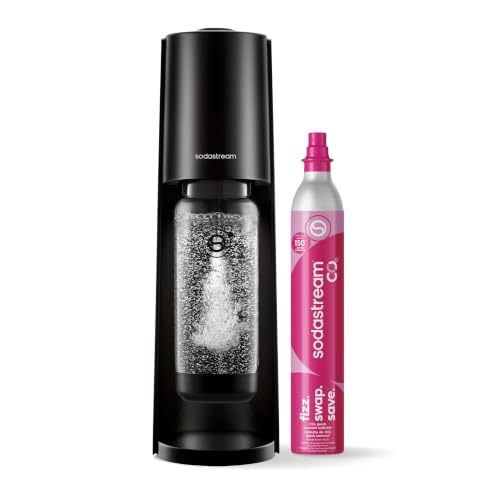
SodaStream Classic Soda Machine Kit Black 60L — Best Classic Kit
Before the Terra’s quick-connect convenience, this was simply what a SodaStream was: a black countertop machine, a 60L CO2 canister, a carbonating bottle, and water transformed in seconds. The Classic kit keeps that proven arrangement available for households who prefer the established screw-in cylinder world — the world of existing spare cylinders in the cupboard, of exchanges stocked everywhere, of a mechanism a generation of users already understands with their eyes closed.
There is a genuine ownership argument for the classic fitting. Screw-in cylinders have been the standard for years, which means households upgrading from an older machine may already own compatible spares, and the exchange network for them is as mature as the category gets. The kit format also keeps the entry simple: one canister, one bottle, no bundle arithmetic to perform. For a single person or a couple testing whether home carbonation suits their habits, that simplicity is the correct size of commitment.
Water-first rules apply unchanged — fizz the water, flavour the glass — and the ritual is identical in pleasure to its newer sibling’s. Choose the Classic when your kitchen already speaks screw-in, or when you want the category’s most familiar machine at a kit’s straightforward scope. Choose the Terra when you are starting from nothing and value the three-cylinder head start and the newer connection. Either way, the water sparkles the same; only the plumbing of ownership differs.
- Classic black SodaStream design
- 60L CO2 canister included
- Carbonating bottle in kit
- Screw-in cylinder tradition
- Water carbonation, flavour afterwards
Strengths
- Proven design with the mature screw-in exchange network
- Simple kit scope suits first-time, smaller households
- Compatible with many households’ existing spare cylinders
Trade-offs
- Single included cylinder means an earlier first exchange
- Screw-in swaps are slower than Quick Connect
- Water only, like every SodaStream in this guide
Best for: smaller households and upgraders already invested in screw-in cylinders.
Not suited for: buyers wanting the newest connection system or a multi-cylinder bundle.
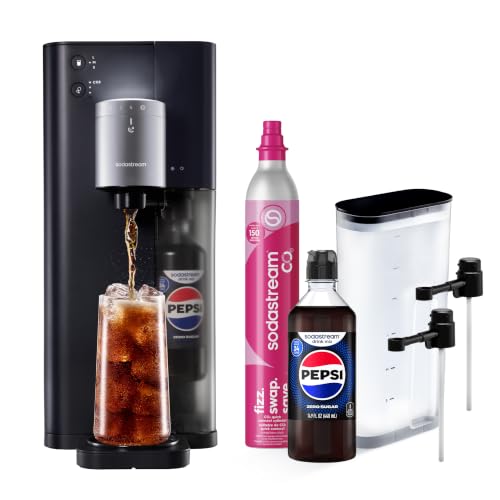
SodaStream Fountain Soda Machine Starter Kit — Best Fountain-Style Starter
The Fountain starter kit dresses the SodaStream idea in silver and black and aims it at a particular room: the kitchen or den where drinks are a small ceremony. “Fountain” is the operative word — this is the pick for households building a drinks station, where the machine stands beside glasses and syrups and the making of a soda becomes part of the hospitality rather than a utility performed at the sink. The kit includes the 60L canister and bottle a starter needs, in the classic SodaStream manner.
Functionally, its loyalties are SodaStream’s: water is carbonated in the bottle, and everything flavoured — syrups, cordials, a squeeze of citrus — joins afterwards in the glass. Hosts who understand that sequence discover it is a feature at a drinks station, not a limitation: one bottle of fiercely fizzy water becomes six different drinks at the table, each guest’s glass flavoured to order. The fountain framing, in other words, suits the water-first workflow better than any other setting in the home.
Compare it honestly with its siblings before choosing. The Terra bundle beats it on cylinder count and connection modernity; the Classic kit matches its scope in plainer dress. The Fountain earns its premium in presence — it is the SodaStream you leave out when guests are expected and the counter is part of the entertaining. Kitchens that hide appliances will not need it; kitchens that perform a little will love it.
- Fountain-style starter kit
- Silver and black finish
- 60L CO2 canister included
- Carbonating bottle included
- Water carbonation, flavour afterwards
Strengths
- Presentation suits a permanent drinks station
- Complete starter scope in one box
- Water-first workflow flavours each glass individually
Trade-offs
- Fewer included cylinders than the Terra bundle
- Styling premium over the Classic kit’s plain scope
- Direct carbonation of juice or wine is not its design
Best for: hosts building a visible drinks station for family and guests.
Not suited for: minimalist kitchens that store every appliance out of sight.

Drinkmate OmniFizz Sparkling Water Maker — Best for Carbonating Any Drink
Here is the machine that breaks the category’s rule, deliberately and by design. The Drinkmate OmniFizz carbonates any drink — the manufacturer’s own promise, and the reason it exists. Juice goes in juice and comes out sparkling; iced tea gains a lift; a glass of wine becomes a spritzer with actual pressure behind it; yesterday’s flat soda returns from the dead. Its slow-release system exists precisely to manage the foaming that makes other machines water-only, letting pressure escape gradually instead of redecorating the counter.
The bundle framing matters with Drinkmate, since the “ultimate bundle” packaging aims to start a household completely. But the deeper value is creative range. A SodaStream household flavours water; a Drinkmate household experiments — sparkling lemonade from actual lemonade, fizzy cold brew experiments, children’s party drinks made from the juice already in the fridge rather than syrups bought for the purpose. If your imagination is already listing drinks, that reaction is the buying signal, and no other pick in this guide can honour it.
Discipline still applies. Sugary and pulpy drinks foam more and ask for the slow release to be used patiently, bottles must be the machine’s own, and carbonating anything alcoholic belongs to adult hands and adult judgement. The OmniFizz also lives in the classic cylinder world, so confirm cylinder details on the listing as with every pick here. Given those ordinary cares, this is the guide’s most liberating machine — the one that treats carbonation as an ingredient, not a beverage category.
- Carbonates any drink, by design
- Slow-release pressure system
- Ultimate bundle packaging
- Works with water, juice, tea and wine
- Cordless counter-top operation
Strengths
- Only pick here that fizzes drinks directly, not just water
- Revives flat soda and sparkling wine leftovers
- Slow release tames the foaming other machines forbid
Trade-offs
- Sugary drinks need patient, gradual pressure release
- More technique to learn than a water-only machine
- Water-only households pay for range they will never use
Best for: experimenters who want sparkling juice, tea, wine and revived soda at home.
Not suited for: sparkling-water purists who will only ever fizz water.

Aarke Carbonator 3 Sparkling Water Maker Stainless Steel — Best Premium Design
The Aarke Carbonator 3 is what happens when an industrial designer is given the sparkling-water brief and a metal budget. The body is stainless steel, the action is a lever with the weighted certainty of good machinery, and the whole object is cordless and compact enough to live permanently on the counter as a piece of the kitchen’s architecture. It carbonates water — only water, like its SodaStream cousins — but it does so with a ceremony that turns a daily glass into a small, satisfying ritual.
Premium here is not a scent or a logo; it is materials and mechanism. Steel where others use plastic, a lever where others use a button, and a design language that assumes the machine will be seen ten thousand times and should reward the seeing. Owners of design-led kitchens understand the proposition instantly: appliances that cannot be hidden must be beautiful, and the Carbonator 3 is the only machine in this guide that a kitchen designer would specify on looks alone.
The honest costs are money and scope. It asks a premium for its execution while performing the same water-only job as the SodaStreams, and its bottles and cylinders follow Aarke’s ecosystem — the classic screw-in tradition — which should be confirmed on the listing like every fitting in this guide. Buy it when the counter is a designed space and the ritual will be savoured daily. Households chasing the lowest cost per litre should let the Terra bundle’s three cylinders make their very different, equally rational case.
- Stainless steel construction
- Lever-controlled carbonation
- Cordless, no power needed
- Premium countertop design
- Water carbonation, flavour afterwards
Strengths
- Metal build quality a class above plastic rivals
- Lever ritual makes daily use genuinely pleasurable
- Designed to be displayed, not stored
Trade-offs
- Premium price for the same water-only job
- No multi-cylinder bundle advantage at this level
- Direct juice carbonation remains Drinkmate territory
Best for: design-led kitchens wanting a permanent, beautiful sparkling-water ritual.
Not suited for: households optimising purely for cost per litre.
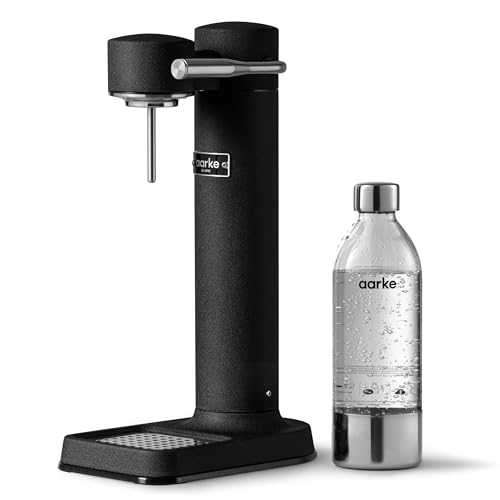
Aarke Carbonator 3 Sparkling Water Maker Matte Black — Best Premium in Black
Everything said about the Carbonator 3 above applies here with one variable changed — and in a designed kitchen, that variable is not small. The matte black finish recasts the same stainless-bodied, lever-operated machine for the kitchens that dominate current design: black taps, black handles, dark worktops, appliances that disappear into the scheme rather than gleaming against it. Aarke sells the two finishes as equals, and this guide treats the choice as interior design rather than specification.
Matte finishes have their own practical personality worth a sentence. They hide the water spots and fingerprints that polished steel advertises, at the cost of showing dust and flour more readily in a working kitchen — a trade most home bakers will accept without blinking. The mechanism beneath is unchanged: cordless lever carbonation of plain water, flavour added in the glass, and a presence on the counter that reads as intentional from every angle.
So the decision procedure is refreshingly short. If you have read the stainless review and felt the pull of the object, walk to your kitchen and look at the counter it will live on. Steel kitchens take the steel machine; black-schemed kitchens take this one; and households indifferent to the question should save the deliberation and buy on bundle value elsewhere in the guide. What neither Aarke offers is Drinkmate’s any-drink freedom — that bright line from the introduction survives even the prettiest finish in the category.
- Matte black finish
- Stainless-bodied Carbonator 3 design
- Lever-controlled carbonation
- Cordless, no power needed
- Water carbonation, flavour afterwards
Strengths
- Finish integrates with black-schemed modern kitchens
- Matte surface hides fingerprints and water spots
- Same premium mechanism as the stainless model
Trade-offs
- Shows dust and flour more than polished steel
- Premium pricing for a water-only machine
- Finish choice is aesthetic, with no functional gain
Best for: black-schemed kitchens wanting the premium carbonator without the gleam.
Not suited for: buyers indifferent to design who would rather optimise bundle value.
How Do the Six Carbonator Machines Compare?
| Pick | Carbonates | Cylinder world | Character |
|---|---|---|---|
| SodaStream TERRA Sparkling Water Maker CO2 Bundle | Water only | Quick Connect | Three-cylinder starter bundle |
| SodaStream Classic Soda Machine Kit Black 60L | Water only | Classic screw-in tradition | Proven simple kit |
| SodaStream Fountain Soda Machine Starter Kit | Water only | Classic SodaStream kit | Drinks-station presentation |
| Drinkmate OmniFizz Sparkling Water Maker | Any drink | Classic cylinder tradition | All-drink experimenter |
| Aarke Carbonator 3 Sparkling Water Maker Stainless Steel | Water only | Classic screw-in tradition | Premium steel design |
| Aarke Carbonator 3 Sparkling Water Maker Matte Black | Water only | Classic screw-in tradition | Premium black design |
Which Drinks Can Each Machine Actually Carbonate?
Water, in five cases out of six — and the discipline is about foam and design, not snobbery. Still water accepts gas calmly; drinks containing sugar, pulp or alcohol foam as pressure releases, and machines built only for water have no mechanism to manage that surge. Their manufacturers state the water-only rule plainly, and following it protects both the drink and the machine’s seals and valves from a sticky education.
Drinkmate’s OmniFizz is the engineered exception, with a slow-release valve designed to let foaming drinks depressurise gradually. That single mechanism redraws the menu: juices, teas, wines and flat soft drinks all become candidates. The practical technique is patience — smaller fills, slower release, a pause before opening — and the reward is a category of homemade drinks no water-only machine can produce at any price. Decide which menu your household will actually drink from, and the guide’s central choice makes itself.
How Does CO2 Cylinder Compatibility Work in Practice?
Two fittings divide the current market. SodaStream’s newer machines, the Terra among them, use Quick Connect cylinders that click into place; the brand’s older machines and the wider classic standard — followed by Aarke and Drinkmate designs — use screw-in cylinders that thread on. The cylinders are not interchangeable between the two systems, and no adapter improvisation belongs anywhere near a pressurised gas bottle in a family kitchen.
Because bundles, regions and model years vary, treat this as a principle to verify rather than a label to memorise: before ordering any machine here, find the cylinder type stated on that specific listing, and before ordering spare cylinders, match them to the machine you own rather than to the brand’s other machines. Exchanges follow the same split — hand back an empty of your type, receive a full one of your type — and a household that keeps one spare of the correct fitting never faces a fizzless weekend.
What Does Home Carbonation Cost Across a Year?
The machine’s price is the smallest honest number in the calculation. The running cost is cylinders: each 60L canister carbonates roughly its stated volume of water at moderate fizz, less for households that like their water aggressive, and exchanges cost a fraction of a new cylinder. Set against that, the displaced spending — bottled sparkling water bought weekly, with its deposits, hauling and fridge space — is the figure that usually settles the argument at the kitchen table within a month.
Bundle choice bends the first year’s curve. The Terra’s three included cylinders delay exchange spending the longest; single-cylinder kits start the exchange rhythm sooner but ask less upfront. Aarke ownership prices like a durable appliance rather than a consumable bundle, which suits households counting in decades. None of these maths problems has a universal winner — but every household should run its own version with its real weekly water habit, rather than buying on the shelf price of the machine alone.
How Do You Get the Fizz Level Right Every Time?
Start with cold water, because cold liquid holds gas far more willingly than room-temperature liquid does — the single most effective technique in this entire category, and it costs nothing but fridge space for the bottle. Fill to the bottle’s marked line rather than above it, carbonate in short presses with a pause between them, and taste after the second press rather than committing to a number copied from anyone else’s palate.
Then write your household’s answer down. Every family has one — the number of presses that makes the water taste like theirs — and new users who find it in the first week stop over-carbonating, which wastes gas, or under-carbonating, which wastes enthusiasm. Flavours go in after, in the glass, for every water-only machine; Drinkmate owners fizz the finished drink instead and release the pressure slowly. Serve promptly, recap the bottle firmly, and the last glass keeps most of the first glass’s bite.
How Do You Troubleshoot a Flat or Weak Result?
Work the short list in order, because home carbonation fails for few reasons and all of them are humble. First, temperature: warm water sheds gas as fast as the machine can add it, so chill the bottle properly and try again before suspecting anything mechanical. Second, the fill line: an overfilled bottle leaves no headspace for gas to gather, and an underfilled one wastes pressure on air. Third, the seal: a bottle not fully seated, or a cylinder not fully engaged, leaks the fizz you paid for into the kitchen’s general atmosphere.
If those pass, look at the cylinder itself. A canister near empty carbonates politely rather than fiercely, and the fade is gradual enough that households blame their technique for weeks. Swap in the spare — this is the moment the spare earns its cupboard space — and the comparison settles the question in one bottle. Press technique completes the list: short, patient presses with pauses let gas dissolve, while one long heroic press mostly entertains the room with noise and vents the excess at the release.
Drinkmate owners add one variable: the drink itself. Pulpy, sugary or warm drinks resist and foam, and the answer is the slow release used as designed, with smaller fills for ambitious liquids. A result that still disappoints after the list has been worked is a listing or support question, not a personal failure — these are simple machines, and their few failure modes are known, fixable and almost never the owner’s fault beyond the first three humble items.
How Should Bottles Be Cared For and Replaced?
The carbonating bottle is the machine’s pressure vessel, and it deserves the respect that phrase implies. Use only the bottles made for your machine — they are rated for its pressure and shaped for its seal — and retire any bottle that is scratched deeply, clouded by damage or past the date marked on it by the maker. Hand-washing suits most carbonating bottles better than a dishwasher’s heat unless the listing states otherwise, and a bottle brush reaches the base where yesterday’s squash likes to linger.
Keep at least two bottles in rotation. One lives in the fridge, full of cold water, permanently ready — the single habit that most improves a household’s carbonation life, since cold water is the technique that matters most. The second covers the first’s washing and the evening when two drinks are wanted at once. Bottles are the cheapest component in the system and the one that touches every glass, so this is not the place for false economy.
Storage between uses is simple: bottles rinsed, dried and stored with caps loose enough not to trap yesterday’s moisture, cylinders upright and secured where they cannot be knocked from a height by an enthusiastic cupboard raid. None of the six machines asks for more ceremony than that. The category’s durability stories — machines fizzing daily for a decade — belong to households whose bottle and cylinder habits were this boring, this consistently.
How Does a Carbonator Change Entertaining at Home?
It moves the drinks station from purchase to production. A host with a carbonator offers sparkling water as a default rather than a favour, flavours it per glass — a cordial for one guest, citrus for another, nothing at all for the purist — and never again performs the returning-from-the-shop ritual with clinking bags. The machine’s presence also quietly upgrades everything beside it: juices become spritzers, leftover wine becomes a second evening’s aperitif under Drinkmate’s hand, and children at the table get the ceremony of a fizzy drink made in front of them.
The fountain-style SodaStream and the Aarkes understand this theatre best, which is why their sections speak of drinks stations rather than appliances. But any pick here performs the essential trick: turning a stored commodity into a made thing, in seconds, while the guest watches. Hosts consistently report that the making is the entertainment — the lever, the hiss, the first aggressive sip — and that the machine pays its social rent long before its financial one is settled.
Plan the station like a stage, in miniature. Machine at the counter’s end where a small queue cannot block the cooking, glasses within reach, flavourings in a row, a towel beneath for the drips that ceremony always produces. Keep the spare cylinder out of sight and the current bottle in the fridge until the moment arrives. Guests remember rituals that look effortless, and effortlessness in a drinks station is ninety per cent arrangement — the carbonator merely supplies the hiss.
What Is the Environmental Case, Stated Plainly?
It rests on subtraction rather than virtue signalling. Every litre carbonated at home is a litre not bought in a single-use bottle, not transported by lorry and chilled in a shop — and for a household drinking sparkling water daily, those litres accumulate into a genuinely large absence over a year. The exchange cylinder system closes the loop on the gas side: empties return, are refilled and return again, so the canister in your cupboard is a traveller, not a disposable.
Honesty requires the other half of the ledger. The machine itself is a manufactured object, the cylinders travel to be refilled, and a carbonator bought for a habit that never forms is pure addition to the world’s clutter. The environmental case is therefore a usage case: it strengthens with every week the machine is used and evaporates for the appliance abandoned by spring. Buyers who have read this far — who know their water habit, their drink line, their cylinder fitting — are precisely the buyers whose machines will be used enough to make the arithmetic true.
That is also why this guide keeps returning to fit. A Drinkmate in a juice-drinking house displaces more bought drinks than a SodaStream in the same house; an Aarke used daily for a decade out-earns three cheap machines landfilled in sequence. The greenest carbonator is the one still fizzing in ten years, and durability, correct choice and a spare cylinder in the cupboard are environmental features as surely as any material claim on a box.
How Do You Choose Within the SodaStream Family Itself?
By connection and by bundle, in that order. The connection question is generational: Quick Connect on the Terra represents where the brand’s ecosystem is heading, while the classic kits speak the screw-in language of the installed base. A household starting fresh should generally face forward with the Terra; a household holding screw-in spares, or replacing a beloved older machine, loses nothing by staying with the fitting its cupboard already speaks. The water that emerges cannot tell the two apart.
The bundle question is arithmetic wearing a costume. Count cylinders first — the Terra’s three against the kits’ one apiece — then bottles, then any extras, and divide by your household’s expected weekly litres to find how many months each offer carries before the exchange rhythm begins. Starter kits that look cheaper can simply be shorter, and offers that look extravagant can be the patient money. Listings change their bundles more often than their machines, so perform the count on the day, on the page in front of you.
Presence breaks any remaining tie. The Fountain kit is styled for a drinks station on display; the Classic kit is the plain black workhorse; the Terra splits the difference in contemporary dress. None of these choices is a trap — the family is one family, the water sparkles identically, and the worst outcome available is owning a good machine in a finish you merely like. Save your agonising for the guide’s real fork: water only, or anything at all.
How Do You Build a Home Soda Ritual the Family Keeps?
Rituals survive on readiness. The household that keeps a bottle of water chilling at all times, a spare cylinder in the cupboard and the machine wiped and waiting will carbonate daily without deciding to; the household that must chill, hunt and assemble will carbonate on Sundays for a month and then remember the machine at parties. Every technique section in this guide is secretly about this: cold water, correct fills and matched cylinders are not fussiness, they are the removal of friction from a habit the family wants.
Give the ritual a place in the day. Breakfast spritzers for the Drinkmate household, the first still-to-sparkling glass when work ends, the children’s weekend ceremony of making the drinks for a family film — a carbonator woven into a named moment stops being an appliance and becomes part of how the house runs. Hosts will recognise the pattern from the entertaining section: production beats purchase, and a small daily production beats a grand occasional one for justifying the counter space.
Let the repertoire grow by accretion. One syrup the family loves, one juice experiment a month, a house rule that any flat soft drink gets one revival attempt before the bin — the menu of a carbonator household is written by its own history, and after a year it will contain combinations no manufacturer ever printed. That menu, more than the machine’s finish or fitting, is what guests remember and what the household would actually miss if the machine vanished tomorrow.
What Should Renters and Small Kitchens Consider?
Everything about this category flatters a small kitchen except the counter it stands on. No pick here needs plumbing, power or installation — a renter can unbox at noon and fizz by lunch, then take the machine to the next home without leaving a mark or a hole. The footprint question is therefore the only real one: measure the intended corner, remember the bottle needs vertical room to seat and lift, and let compact designs like the Terra and the Aarkes argue their case on the tape measure’s evidence.
Cylinder logistics suit renters better than most appliance consumables. Exchanges happen at ordinary shops, spares store in any cupboard, and nothing about the system touches the property. A household that moves often might favour whichever fitting its new town stocks most visibly — a principle worth one drive past the local shops before ordering — because the best cylinder system is the one whose refills are on your existing routes through the week.
Small kitchens also benefit from the category’s quiet. A carbonator makes its brief hiss and then falls silent, asks for no venting, heats nothing and smells of nothing. In a studio or a shared house, that discretion is a feature with real value, and it pairs with the drinks-station idea at miniature scale: machine, two glasses, one syrup, a corner that punches absurdly above its square footage every time a guest is offered something sparkling and homemade.
How Do the Premium and Budget Ends Justify Themselves?
The budget end justifies itself in litres. A classic kit, exchanged faithfully, produces sparkling water at a running cost that bottled water cannot approach, and asks nothing about design in return — the correct purchase for a household whose kitchen is a workplace and whose fizz is a utility. Its compromises are ceremony and speed of cylinder swaps, and households that feel neither compromise have no business paying to remove them.
The premium end justifies itself in years and in sightlines. An Aarke is bought the way a good knife is bought: once, for a decade, to be used daily and seen constantly, with a mechanism whose pleasure is part of the product. That arithmetic fails completely for a machine used monthly, which is why this guide refuses to rank the premium picks above the bundles in any universal sense — they answer a different question, about what a kitchen is for, and only the household living in that kitchen can mark it.
Between the poles, the Terra bundle occupies the rational centre most first-time buyers should start from, and the Drinkmate stands outside the axis entirely, selling range instead of refinement. A guide can map that terrain honestly, but the final weighting — litres, years, range, ceremony — belongs to the buyer. Choose the justification that matches your actual life, and the machine will keep justifying itself every day it is used.
How Do You Run a Tasting Evening Around a Carbonator?
Treat fizz as an ingredient with dosage, because that is what a carbonator actually sells. Pour one base drink three ways — lightly pressed, fully carbonated, and rested five minutes after opening — and let the table discover that carbonation level is a flavour decision, not a quality dial. Juices sharpen as gas rises; delicate drinks can be bullied by it; water, the honest control, teaches the scale. A Drinkmate household can run this experiment across its whole repertoire in one evening and emerge with house settings for everything it serves.
Structure the evening like any tasting: small glasses, plain water and an unsalted bite between rounds, notes if the household enjoys that sort of theatre. Compare the machines’ philosophies through the glass — a flavoured-after SodaStream water against the same drink carbonated directly in the Drinkmate is the guide’s central argument, drinkable. Guests who perform that comparison once understand the category better than any review can teach them, including this one.
End with the practical harvest. Write the household’s press counts and favourite combinations where the machine lives, because a tasting that produces no record was merely a party — a fine thing, but a lesser yield. The carbonator’s long value is a repertoire, accumulated drink by drink, and an evening spent mapping it deliberately is the fastest route from owning the machine to being the household other households consult about fizz.
What Happens to a Carbonator Habit Across a Year?
It seasons. Spring brings the first spritzers and the discovery that last summer’s favourite syrup survived the winter; summer is the machine’s high season, when cold water vanishes from the fridge at a rate that justifies the spare-cylinder doctrine entirely; autumn experiments with teas and orchard juices, especially in Drinkmate households; winter, surprisingly, keeps the habit alive through parties, mixers and the simple fact that a house full of guests drinks sparkling water like a hotel.
The year’s rhythm teaches the household its true consumption, which retrospectively grades the original purchase. The bundle that looked extravagant in January reads as foresight by August if the cylinders lasted as planned; the single-cylinder kit’s exchange rhythm becomes a familiar errand, or the evidence that a bigger bundle should have been bought. Either way, the second year’s buying — spares, bottles, perhaps a second machine for a holiday home — is done by experts, and experts in this category are made by nothing more exotic than twelve months of paying attention.
Households should also expect the habit to recruit. Guests who fizz at your counter buy machines for theirs; children raised on homemade sparkling water regard shop bottles as the eccentric option; the machine becomes part of the house’s identity in the small way durable pleasures do. That is the destination every section of this guide has been steering toward — not a purchase completed, but a household that carbonates the way it brews tea: unthinkingly, daily, and exactly to its own taste.
A carbonator also asks one small courtesy of its household: tell the truth about the drinks nobody finished. Every repertoire accumulates a syrup bought in enthusiasm and abandoned by consensus, a flavour experiment the table voted down, a bottle size that never suited the fridge. Clearing those honestly each season keeps the drinks station a living menu rather than a museum, and the space they free is where next season’s favourite will stand. The machines in this guide are patient objects; the ritual around them should be as honest as the guide has tried to be about fittings, foams and finishes — because a carbonator, in the end, is a promise a kitchen makes to itself about how it will drink, and promises are kept in the small print of ordinary days.
Notice, finally, how little this category asks compared with its return. Cold water, a cylinder exchanged a few times a year, a bottle rinsed and refilled — and in exchange, a household stops buying, hauling and storing cases of sparkling water, and gains a small daily ceremony at the counter. The machines are durable, repairable in spirit and passed between households like good kitchen furniture; the drinks they manufacture are disproportionate to everything they consume. A family choosing among these six is not really shopping for valves and bottles — it is deciding how its kitchen will drink for the next decade, and the correct answer, as this guide has argued from six directions, is the one that matches the glasses actually raised at its table.
Keep the first bottle simple, too: still water from the fridge, three patient presses, one honest taste. That plain beginning teaches the hands everything the rest of the repertoire requires, and it gives the household its baseline — the glass against which every later experiment, from cordial spritzers to Drinkmate’s sparkling juices, will be judged. Mastery in this category is a short road; it begins, fittingly, with water.
What Mistakes Do Carbonator Buyers Make Most Often?
- Carbonating juice in a water-only machine and meeting the foam the manual warned about.
- Buying spare cylinders of the wrong fitting — Quick Connect and screw-in do not mix.
- Comparing machine prices while ignoring how many cylinders each bundle includes.
- Fizzing warm water, then blaming the machine for a flat result.
- Overfilling the bottle past its line and compressing the space the gas needs.
- Storing no spare cylinder, so the first empty ends the habit for a fortnight.
Final Recommendation
Most households should take the SodaStream TERRA Sparkling Water Maker CO2 Bundle: the modern Quick Connect machine with three cylinders is the most complete start in the category, and its water will carry every flavour a family adds afterwards. Choose the Classic kit if your kitchen already runs on screw-in spares, the Fountain kit if the drinks station is a stage, and the Drinkmate OmniFizz Sparkling Water Maker the moment your ambitions include fizzy juice or wine — no other pick can follow you there. The Aarke pair, led by the Aarke Carbonator 3 Sparkling Water Maker Stainless Steel, are for households buying a decade of daily ritual and a designed object in the same box.
Whichever machine earns the counter space, chill the water, learn your household’s number of presses, and keep a spare cylinder of the right fitting in the cupboard — sparkling water on demand is a small luxury that compounds daily, and the first time a guest asks for fizzy water and you simply reach for the lever, the machine has already justified itself.
Frequently Asked Questions
Can I really carbonate juice in the Drinkmate?
Yes — that is the manufacturer’s stated design purpose for the OmniFizz, which carbonates any drink rather than water alone. Use its slow-release mechanism patiently with sugary drinks, fill sensibly, and expect juice, tea, wine and flat soda all to take fizz successfully.
Why do SodaStream machines say water only?
Because their valves and pressure release are designed for water’s calm behaviour; sugared liquids foam on depressurising in ways the design does not manage. The household workflow is to carbonate water first and add syrups, cordials or juice in the glass afterwards.
Are Quick Connect and screw-in cylinders interchangeable?
No. They are different fittings used by different machine generations, and spares must match the machine you own. Treat the fitting named on your specific bundle’s listing as the authority, since bundles and model years vary across the range.
Do these machines need electricity?
None of the six picks here requires a power socket; the compressed CO2 supplies all the energy, and the machine meters it. That cordlessness is why a carbonator can live anywhere on the counter, including spots far from an outlet.
How long does a 60L cylinder last?
Roughly its stated volume at moderate fizz — less for households that carbonate aggressively, more for gentle sparkling. In practice, a water-drinking family measures a cylinder in weeks to months, which is why keeping one correct spare removes all urgency from exchanges.
Is the Aarke worth its premium over SodaStream?
For households that will use it daily for years in a kitchen where it is always visible, the steel construction and lever ritual justify the difference as a durable-goods purchase. For cost-per-litre optimisation, the Terra bundle’s included cylinders make the stronger financial case.
Related Guides
A well-run drinks corner touches several of this site’s other guides, and these are the nearest neighbours: Best Card Making Machines Best 24 Inch Dishwashers Best American Made Gas Ranges



[…] draw on the same cupboards as the grown-ups’ ones, and these guides sit closest on the shelf: Best Carbonator Machines Best Undercounter Ice Makers Best 48 Inch Ventilation Hoods Wall Mount Chimney […]