What's inside
- Key Takeaways
- Quick Picks
- What earned a hood a place on a pro-style list?
- Pro-style field at a glance: output, speeds, and mounting
- Internal, inline, or remote: where should the blower live?
- How much airflow does a pro-style home range actually need?
- What does daily life with baffle filters and six speeds look like?
- How do you size a duct for a high-output hood without wasting the power?
- What separates a pro-style kitchen that works from one that only photographs well?
- How do pro-style hoods behave in small kitchens and apartments?
- How do you maintain a pro-style hood like a professional would?
- Five checks before a pro-style hood earns its place
- Where do pro-style hood projects usually go wrong?
- Final Recommendation
- Frequently Asked Questions
- Related Guides
As an Amazon Associate I earn from qualifying purchases. This post may contain affiliate links at no extra cost to you.
cottageverdict.com is reader-supported. When you buy through links on our site, we may earn an affiliate commission.
All six hoods below are sold on Amazon with their own listings, so you can check price on Amazon for each before deciding. One related product is deliberately not linked: the remote blower unit discussed in the buying sections is a component, explained in words only.
The best pro-style range hoods with blowers borrow their manners from restaurant kitchens: deep capture over the burners, baffle filters that shrug off grease, stainless bodies built to be scrubbed, and blowers strong enough to clear a room where six burners may run at once. Pro-style at home is not really about looks, though the squared stainless silhouette is half the appeal. It is about what happens when you sear on a high-output burner while a stockpot steams behind it. A domestic hood sized for gentle cooking loses that fight in the first minute, and the whole house smells of dinner until morning. The picks in this guide state airflow as high as 950 CFM at the top of a range, 750 CFM, and 700 CFM, and they pair that output with the filtration and venting choices that make power usable rather than merely loud.
One clarification before the picks, because the phrase with blower invites confusion. Every hood here contains a blower; that is what a hood is. Separately, the market sells standalone inline and remote blower units, such as the Awoco units that surface in searches for this class. A remote blower is a component, not a hood: it is a motor housing installed in the duct run, in an attic or on a roof, so the noise of moving air happens away from the cook. That route is real and worth considering on a major renovation, and this guide discusses it in prose. It is not given a pick slot or a link here, because buying a component as if it were a complete hood leaves a kitchen with a motor and no capture surface, no filters, and no lights. The six picks below are complete hoods, ready to mount and vent.
Key Takeaways
- Stated airflow in this set runs from 380 CFM to a 525–950 CFM range on the Hauslane UC-PS38; figures come only from manufacturer titles.
- Baffle filters, not mesh, are the pro-style standard here, and the linked picks that state them describe them as dishwasher-safe.
- A standalone remote blower is a component for a duct run, not a hood; it is covered in prose only and never linked as a pick.
- Six-speed fans on the two Hauslane picks give finer control between a simmer and a full sear than the usual three speeds.
- Under-cabinet pro hoods dominate this set; the Cosmo, Arspura, and Tieasy are the wall-mount routes.
Quick Picks
| Pick | Badge | Why it earned its place |
|---|---|---|
| Hauslane UC-PS18 Under Cabinet Range Hood | Pro build, calmer brief | Six speeds, auto shut-off, three-way venting, and heavy-duty pro stainless in a 30-inch under-cabinet body. |
| Hauslane UC-PS38 Under Cabinet Range Hood | Top stated output | The strongest stated performance here: 525–950 CFM, six speeds, and an auto-clean function in pro stainless. |
| Cosmo Vista 30-Inch Wall Mount Range Hood (380 CFM) | Measured wall-mount pro | A ducted wall-mount hood stating 380 CFM with permanent dishwasher-safe baffle filters and a backdraft damper. |
| Arspura P1 Pro Smart Range Hood (36 Inch) | Smart source capture | A 36-inch smart wall hood claiming high-velocity source capture, filter-free design, and app plus gesture control. |
| Tieasy 30-Inch Wall Mount Range Hood (700 CFM) | Plain-spoken 700 CFM wall power | A wall-mount hood stating a clear 700 CFM, permanent filters, and ducted or ductless convertibility. |
| AMZCHEF 30-Inch Under Cabinet Range Hood (750 CFM) | 750 CFM, three control styles | The highest single stated figure under cabinets here, with touch, remote, and gesture control plus baffle filters. |
What earned a hood a place on a pro-style list?
Three tests decided this list. First, stated output: a pro-style hood must publish airflow or an equivalent capture claim in its title, because professional equipment is specified, not implied. Second, filtration and build: baffle filters, stainless construction, and controls that survive greasy fingers are the working uniform of the class. Third, control depth: more speeds mean the hood can match the meal instead of offering a choice between off and overwhelming. The two Hauslane models anchor the under-cabinet side with six speeds each, the AMZCHEF brings the highest single stated figure among the 30-inch under-cabinet picks at 750 CFM, and the wall-mount trio covers kitchens where the range stands free of cabinets.
We also kept the blower question honest. If your renovation can place the motor remotely, the component route discussed later in this guide can quiet a powerful system dramatically, and readers comparing motor layouts will find the twin-motor residential approach mapped in Best Range Hoods With Dual Fans. What we would not do is hand a component a pick slot and let a reader order it expecting a finished hood. A range-plus-hood bundle listing that appeared in research was excluded for the mirror-image reason: this guide rates hoods, and a bundle hides the hood’s own specification inside the range’s. Every pick below stands on its own title, its own stated figures, and its own listing.
A final word on what pro-style means in this guide, because the term is abused by marketing. We treated it as a working description: output that answers a high-output range, filtration built for grease volume, construction that tolerates scrubbing, and controls that function with cooking hands. A hood that merely wears a squared stainless silhouette over a domestic fan did not qualify, and a hood with the working traits qualified even when its styling was quiet. That is why this list mixes under-cabinet workhorses with wall canopies and one smart outlier: the style in pro-style should be the consequence of the engineering, never a substitute for it.

Hauslane UC-PS18 Under Cabinet Range Hood — Pro build, calmer brief
The UC-PS18 is Hauslane’s pro-style argument made for ordinary kitchens. The title stacks the working features: six speeds, auto shut-off, three-way venting, LED lighting, a touch panel, and a dishwasher-safe filter, all in heavy-duty pro stainless steel under a 30-inch cabinet. Six speeds matter more than buyers expect, because pro-style cooking is not one task; the fan that clears a sear should also be able to murmur over a sauce. Three-way venting is the installer’s friend, letting the duct leave vertically or horizontally to suit the house rather than forcing the house to suit the hood.
Hauslane describes the model as low noise without publishing a figure, so judge its composure by its control depth: with six settings, the right speed for the meal is usually one of the gentle ones. This is the pick for a serious home cook whose range is residential rather than truly professional, and who wants the build quality, filtration, and venting flexibility of the class without chasing the highest output in the guide. It is also the natural step up for anyone replacing a flimsy builder hood in the same cabinet opening.
Ownership of the UC-PS18 settles into a rhythm quickly. The auto shut-off becomes the household’s habit, a last run that finishes the clearing while the table is being set, and the six speeds stop being a specification and become a vocabulary: one for reheating, three for a saute, five for the sear. The three-way venting pays off silently in homes whose duct had to turn a corner no catalog anticipated. Hauslane’s pro framing shows in the details that survive greasy years, a touch panel with no knobs to trap film and a filter that goes through the dishwasher without complaint. It is the pro-style pick most likely to be recommended by its installer.
- Mounting: under cabinet, 30 inches wide
- Venting: 3-way venting, ducted
- Speeds: 6 speeds with auto shut-off
- Controls and light: touch panel, LED lighting
- Filter: dishwasher-safe filter
- Where to buy: the Hauslane UC-PS18 Under Cabinet Range Hood listing on Amazon — check price on Amazon
Strengths
- Six speeds give unusually fine control
- Three-way venting eases difficult duct routes
- Heavy-duty stainless build with washable filtration
Trade-offs
- No single CFM figure stated in the title
- Low-noise claim is unnumbered
- Under-cabinet only, no canopy option
Best for: serious home cooks under cabinets who value control and build over peak output.
Not suited for: a true high-output pro range run at full tilt nightly.
Where to buy: the Hauslane UC-PS18 Under Cabinet Range Hood listing on Amazon — check price on Amazon.

Hauslane UC-PS38 Under Cabinet Range Hood — Top stated output
The UC-PS38 is the heavyweight of this guide, and its title reads like a specification sheet: ducted output stated as a 525–950 CFM range, auto clean, six speeds, auto shut-off, a touch panel, GU10 LED lighting, and a dishwasher-safe filter in pro stainless steel. A stated range rather than one number is honest engineering language, reflecting output across speeds and installation conditions, and its top end is the highest figure anywhere in this set. This is the hood for a genuine pro-style range worked hard: multiple burners, high-heat searing, and frying that would defeat a domestic vent in minutes.
Auto clean is the feature that separates ownership from specification. Powerful blowers ingest greasy vapor for years, and a function aimed at keeping the interior clean protects the performance you paid for. The demands are real, though: this output needs a duct that can carry it, and a kitchen that cooks enough to justify it. Installed on a proper run, the UC-PS38 spends ordinary meals at its lower speeds with enormous reserve above. Installed on a choked duct, it will be loud and wasted. Give it the ductwork and it is the most complete pro-style under-cabinet pick here.
The UC-PS38’s auto-clean function deserves a longer defense, because blower interiors are where powerful hoods go to decline. Grease vapor that passes the filters coats the fan and housing over years, unbalancing the wheel and roughening the sound, and almost no owner ever cleans inside a hood. A system designed to address that accumulation protects the 525–950 CFM promise deep into the appliance’s life. Paired with six speeds that keep daily running gentle, the PS38 is engineered around a truth its rivals ignore: a pro hood’s tenth year matters as much as its first, and the kitchens that buy this class intend to keep it that long.
- Mounting: under cabinet, 30 inches wide, ducted
- Airflow: 525–950 CFM, as stated in the manufacturer title
- Speeds: 6 speeds with auto shut-off
- Cleaning: auto-clean function, dishwasher-safe filter
- Controls and light: touch panel, GU10 LED lighting
- Where to buy: the Hauslane UC-PS38 Under Cabinet Range Hood listing on Amazon — check price on Amazon
Strengths
- Highest stated output in this guide
- Auto-clean protects long-term performance
- Six speeds tame the power for daily meals
Trade-offs
- Needs a generous duct run to deliver its figures
- Overkill for gentle cooking styles
- Top speeds are purposeful, not quiet
Best for: pro-style ranges and committed high-heat cooks with proper ductwork.
A poor fit for: a small apartment range, where its capacity and installation demands never pay off.
Where to buy: the Hauslane UC-PS38 Under Cabinet Range Hood listing on Amazon — check price on Amazon.

Cosmo Vista 30-Inch Wall Mount Range Hood (380 CFM) — Measured wall-mount pro
The Cosmo Vista, model COS-63175S in its title, is the restrained professional of the wall-mount group. It states 380 CFM, three fan speeds, soft-touch controls, LED lighting, permanent dishwasher-safe baffle filters, and a backdraft damper in a stainless wall-mount body. Three hundred eighty CFM will not win a numbers contest against this guide’s heavyweights, and that is not its purpose. Its purpose is correct, durable ventilation for a standard range on a wall, with the filtration that defines the pro style and a damper that keeps outside air and weather from wandering back down the duct between meals.
Permanent baffles are the ownership story: no replacement filter schedule, just panels that come out, wash, and go back, for the life of the hood. The backdraft damper is the detail experienced installers nod at, because a flapping or missing damper is a common source of drafts, rattles, and lost efficiency in wall venting. Choose the Vista when your cooking is solid family fare on a wall-mounted range position, and you want pro filtration and build without paying for output you will never call on. It is the grown-up pick of the trio on the wall.
The Vista’s backdraft damper sounds like a footnote until the first cold night, when a duct without one breathes winter air onto the cook’s neck and rattles in the wind. Cosmo including it in the title signals a maker thinking about the whole duct system rather than the photogenic front panel. Permanent baffles complete that philosophy: the total cost of ownership is the purchase and the washing, forever, with no filter subscription quietly taxing the household. In a rental property or a family kitchen watching its running costs, the Vista’s restraint is a financial feature as much as an engineering one, and its 380 CFM is honestly matched to the standard ranges most homes actually own.
- Mounting: wall mount, 30 inches wide, stainless steel
- Airflow: 380 CFM, as stated in the manufacturer title
- Speeds: 3 fan speeds, soft-touch controls
- Filters: permanent dishwasher-safe baffle filters
- Extras: backdraft damper, LED lighting
- Where to buy: the Cosmo Vista 30-Inch Wall Mount Range Hood (380 CFM) listing on Amazon — check price on Amazon
Strengths
- Permanent baffles end filter replacement costs
- Backdraft damper included for cleaner wall venting
- Honest output matched to standard ranges
Trade-offs
- Lowest stated airflow among the wall picks here
- Three speeds only
- Ducted design assumes a real vent route
Best for: wall-position standard ranges that want pro filtration without oversizing.
Not the right match for: any six-burner pro range, which will out-cook its 380 CFM quickly.
Where to buy: the Cosmo Vista 30-Inch Wall Mount Range Hood (380 CFM) listing on Amazon — check price on Amazon.

Arspura P1 Pro Smart Range Hood (36 Inch) — Smart source capture
The Arspura P1 Pro argues that capture should happen at the source. Its title leads with a 36-inch wall-mount body for open kitchens and an IQV system claiming 17 metres per second of high-velocity source capture with 1200Pa of pressure, no makeup air needed, a full-length LED, a filter-free design, and app and gesture control. Notably, it states no CFM figure, choosing velocity at the capture zone as its language instead. That is a genuinely different philosophy: rather than moving a huge volume of room air, pull the plume in fast, close to where it is born, before it can spread into an open-plan space.
The filter-free design will divide readers. Baffle devotees trust washable steel; Arspura’s approach removes the filter routine from ownership entirely, which suits cooks who know they will never soak a panel. Gesture and app control suit the same hands-busy reality as any pro kitchen. The cautions are equally clear: its claims are stated in units you cannot cross-check against the CFM figures elsewhere in this guide, and a smart hood asks you to accept an app ecosystem in an appliance category that usually outlives several phones. Choose it as the forward-looking pick for an open kitchen where containing the plume early matters more than traditional specification.
The P1 Pro’s filter-free design asks its owner to trade one chore for a question. The chore is real: filters are the most neglected maintenance in the kitchen, and removing them removes a failure mode. The question is how the internals handle grease over years without them, and the honest answer is that the design’s youth means the long record its baffle rivals can point to does not yet exist. Early adopters in open kitchens, where its source capture directly addresses the room’s problem, are the natural buyers. Everyone else should read its velocity claims as a promising philosophy, watch the model mature, and let the baffled establishment carry the family range in the meantime.
- Mounting: wall mount, 36 inches wide, for open kitchens
- Capture claim: 17 m/s high-velocity source capture, 1200Pa pressure, per title
- Airflow: no CFM figure stated in the manufacturer title
- Design: filter-free, full-length LED lighting
- Controls: app and gesture control
- Where to buy: the Arspura P1 Pro Smart Range Hood (36 Inch) listing on Amazon — check price on Amazon
Strengths
- Source-capture concept suits open-plan kitchens
- No filters to wash or replace
- Gesture control works with messy hands
Trade-offs
- No CFM figure for comparison with rivals
- Smart features add an app dependency
- Velocity claims cannot be cross-checked at home
Best for: open-plan kitchens that want plume control at the source and minimal upkeep.
Poorly suited to: a traditionalist who wants baffles, a CFM figure, and buttons.
Where to buy: the Arspura P1 Pro Smart Range Hood (36 Inch) listing on Amazon — check price on Amazon.
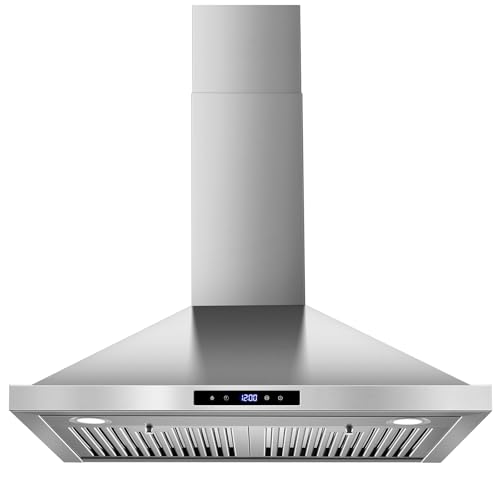
Tieasy 30-Inch Wall Mount Range Hood (700 CFM) — Plain-spoken 700 CFM wall power
The Tieasy makes the simplest powerful promise on the wall: 700 CFM, stated plainly, in a 30-inch stainless wall-mount hood with touch control, permanent filters, a three-speed exhaust fan, LED light, and a duct that converts between ducted and ductless work. Seven hundred stated CFM is serious output for a 30-inch span, in the territory where a pro-style range’s worst minutes are handled rather than endured. Permanent filters keep the ownership simple, and the convertible duct gives constrained kitchens a fallback while rewarding a proper ducted run with the full performance.
Three speeds for this much output means each step is a meaningful jump, so expect the top setting to be a tool for searing and frying rather than a background hum. That is the correct bargain at this level: power in reserve, used deliberately. The Tieasy suits the cook whose range lives on a wall, whose cooking is ambitious, and who wants the specification stated in one honest number rather than a range or a velocity claim. Among the wall picks, it is the straightforward powerhouse, and its convertibility makes it the easiest of the strong hoods to place in a complicated building.
The Tieasy’s convertibility is easy to underrate until a project changes mid-stream. Kitchens stall: a duct route turns out to be blocked by a beam, a permit conversation goes sideways, a wall that was supposed to open stays shut. A hood that can start ductless and convert later keeps the renovation moving and the cooking civilized in the interval, then delivers its full 700 CFM when the route is finally cut. Permanent filters suit that same project reality, asking for washing rather than a parts order. For a phased remodel over a serious range, the Tieasy may be the most project-proof pick in this guide.
- Mounting: wall mount, 30 inches wide, stainless steel
- Airflow: 700 CFM, as stated in the manufacturer title
- Ducting: ducted or ductless convertible
- Fan: 3-speed exhaust fan, touch control
- Filters and light: permanent filters, LED light
- Where to buy: the Tieasy 30-Inch Wall Mount Range Hood (700 CFM) listing on Amazon — check price on Amazon
Strengths
- Strong single stated figure of 700 CFM
- Permanent filters simplify ownership
- Convertible ducting widens installation options
Trade-offs
- Only three speeds for a wide output range
- Top speed will be assertive in a small kitchen
- Ductless mode undersells its real capability
Best for: wall-mounted pro-style ranges that cook hard and want stated power.
A weak match for: a quiet-first household, which should look at documented low-noise designs instead.
Where to buy: the Tieasy 30-Inch Wall Mount Range Hood (700 CFM) listing on Amazon — check price on Amazon.

AMZCHEF 30-Inch Under Cabinet Range Hood (750 CFM) — 750 CFM, three control styles
AMZCHEF’s under-cabinet hood states 750 CFM, the largest single figure among this guide’s 30-inch cabinet picks, and surrounds it with the controls of a modern appliance: touch, remote, and gesture operation, a timer, LED lights, dishwasher-safe baffle filters, and three duct outlets for installation flexibility. The control trio is more than a novelty list. Touch serves clean hands, the remote serves the cook who has stepped away to the table, and gesture serves the moment your hands are coated in marinade and the pan starts smoking early. In a working kitchen, the control you can reach is the control that gets used.
Baffle filters and three outlets show the same practical streak underneath: grease handling that washes in the dishwasher, and venting options that adapt to the duct your house actually has. The number to respect is the output. Seven hundred fifty stated CFM under a cabinet is pro-style territory, and it asks for a duct run that can carry it and cooking that occasionally needs it. For the under-cabinet kitchen with a powerful range, this is the pick that answers the AMZCHEF way: maximum stated power, minimum friction in using it, and filtration built for the grease that power implies.
The remote control on the AMZCHEF sounds like a gimmick until the first dinner party, when the cook is plating at the island, the pan is still breathing on the stove, and the fan needs to drop a level without a trip back across the kitchen. Gesture covers the opposite moment, hands deep in butchery or batter. Between them, the hood stays adjusted in real time, which is when adjustment matters. Three duct outlets complete a design that keeps saying the same thing: the manufacturer expected this hood to be installed in real houses and used by real cooks, and removed every small excuse not to run it.
- Mounting: fits under a cabinet; thirty-inch span; stainless steel construction
- Airflow: 750 CFM, as stated in the manufacturer title
- Controls: touch, remote, and gesture, with timer
- Filters: dishwasher-safe baffle filters
- Venting: three duct outlets
- Where to buy: the AMZCHEF 30-Inch Under Cabinet Range Hood (750 CFM) listing on Amazon — check price on Amazon
Strengths
- Highest single stated CFM under cabinets here
- Three control methods cover messy-hands cooking
- Baffle filters match the output’s grease load
Trade-offs
- Output demands a capable duct run
- Gesture control is a habit not everyone adopts
- Serious power for kitchens that may cook gently
Best for: powerful ranges under cabinets, cooked by people who hate touching controls mid-sear.
Think twice if: a light-duty kitchen, where this much blower is never exercised.
Where to buy: the AMZCHEF 30-Inch Under Cabinet Range Hood (750 CFM) listing on Amazon — check price on Amazon.
Pro-style field at a glance: output, speeds, and mounting
Output figures are reproduced exactly as titles state them, including the Hauslane UC-PS38’s range rather than a single number. Where a title gives no CFM, the table says so.
| Model | Mounting | Stated airflow | Speeds | Filtration noted in title |
|---|---|---|---|---|
| Hauslane UC-PS18 Under Cabinet Range Hood | Under cabinet, 30 inch | Not stated as a single figure | 6 speeds | Dishwasher-safe filter |
| Hauslane UC-PS38 Under Cabinet Range Hood | Under cabinet, 30 inch | 525–950 CFM | 6 speeds | Dishwasher-safe filter, auto clean |
| Cosmo Vista 30-Inch Wall Mount Range Hood (380 CFM) | Wall mount, 30 inch | 380 CFM | 3 speeds | Permanent baffle filters, dishwasher-safe |
| Arspura P1 Pro Smart Range Hood (36 Inch) | Wall mount, 36 inch | No CFM stated; velocity capture claim | App and gesture control | Filter-free design |
| Tieasy 30-Inch Wall Mount Range Hood (700 CFM) | Wall mount, 30 inch | 700 CFM | 3 speeds | Permanent filters |
| AMZCHEF 30-Inch Under Cabinet Range Hood (750 CFM) | Under cabinet, 30 inch | 750 CFM | Touch, remote, and gesture control | Dishwasher-safe baffle filters |
Internal, inline, or remote: where should the blower live?
An internal blower sits inside the hood body, which makes installation simple and keeps the whole system in one purchase. Its cost is proximity: the motor is a few feet from your ears, so at high speed you hear it honestly. An inline blower moves the motor into the duct run, often in a joist space or attic, which softens the sound at the stove while keeping duct sizes conventional. A remote blower goes further, mounting at the roof or exterior wall termination, and pulls air through the whole run; kitchens fitted this way can run serious airflow with a hushed cooking zone, at the price of a more involved installation, weatherproofing, and a component that must be matched to the hood and duct by someone who understands static pressure.
The standalone blower units sold under names like Awoco belong to that second and third world. They are legitimate components with their own ratings, and in a planned system they are excellent. They are not, on their own, ventilation for a kitchen, because capture happens at the hood: the canopy or under-cabinet body, its depth over the burners, and its filters do the gathering, while the blower merely does the moving. Buyers seduced by a powerful component listing sometimes discover they still need the hood, the duct, the damper, and the cap. Plan the system whole, or buy one of the complete hoods in this guide and let its internal blower do the work it was matched for. The same whole-system thinking applies at the cooking surface, where fast, fierce heat sources like those in Best Halogen Ovens reward ventilation that was planned alongside them rather than after them.
How much airflow does a pro-style home range actually need?
Work from the range outward. A standard four-burner residential range cooking a family dinner asks for competent, not heroic, ventilation, and several picks here would serve it at half speed. A pro-style range changes the arithmetic because its burners are built to pour heat into pans, and heat is what lifts the plume of steam, smoke, and grease that the hood must intercept. High stated figures like 750 CFM, 700 CFM, and the UC-PS38’s range up to 950 CFM exist for the worst five minutes of your cooking week: the hard sear, the flaming pan, the full-house fry. Size for those minutes and the hood spends the rest of its life loafing at quiet middle settings, which is the pro-style ownership experience people actually praise.
Duct capacity must match ambition. A high-output hood choked by a small or tortured duct run delivers noise instead of airflow, and can even perform worse than a modest hood on a clean run. Before ordering the strongest pick your budget allows, confirm the duct diameter the manufacturer specifies and that your kitchen can provide it, ideally rising straight through the roof with minimal turns. Check ceiling height for wall-mount chimneys, cabinet depth for under-cabinet bodies, and the electrical supply position. Pro-style equipment assumes a kitchen planned around cooking; giving it that planning is most of the installation job.
What does daily life with baffle filters and six speeds look like?
Baffle filters earn their professional reputation in the dishwasher. Instead of a fine mesh that clogs and mats, baffles force greasy air around sharp turns; droplets fall out of the airstream into channels, and the stainless panels themselves come out and wash. In a home that fries weekly, that difference decides whether filters get cleaned monthly or abandoned. Several picks here state dishwasher-safe baffles or filters in their titles, and the Hauslane UC-PS38 adds an auto-clean function aimed at the blower interior. Treat those features as core, not garnish: a pro-style hood with neglected filters loses capture and gains noise exactly like a cheap one.
Speed count shapes daily manners just as much. Three speeds are enough for most cooks, but six speeds, as on both Hauslane picks, let you trim the fan to the meal: a whisper for reheating soup, a purposeful middle for a saute, and full power held in reserve. Auto shut-off timers, also on the Hauslane pair, finish the clearing after you leave the stove, which is when most households actually remember the lingering steam exists. The Arspura pushes control furthest with app and gesture operation for hands covered in flour or oil. None of this is luxury for its own sake; in a working kitchen, controls you can operate with messy hands are controls that get used, and a used hood is a clean kitchen.
How do you size a duct for a high-output hood without wasting the power?
Begin with the manufacturer’s specified duct diameter and treat every deviation as a purchase of noise at the price of airflow. A high-output hood on an undersized duct is the most expensive way to ventilate badly: you pay for 750 or 950 CFM, receive a fraction of it at the grille, and get a roar as a receipt. Keep the run as short as the house allows, rise vertically where possible, and count your elbows before you order, because two unnecessary turns can cost more performance than the price difference between two models in this guide. Smooth rigid duct, sealed joints, and a termination cap that opens freely complete the system; flexible duct, crushed in a joist bay, undoes all of it in a single careless afternoon.
Then think about the air’s other end. A powerful hood removes air that must come from somewhere, and in a tight modern house the somewhere can be a fireplace flue, a water heater vent, or simply resistance that starves the fan. Most homes in this class never need dedicated makeup air, but a sealed new build with a top-output pick should have the conversation with the installer before the first smoky test, not after. The pro kitchens these hoods imitate treat supply and exhaust as one system. Copy that thinking at domestic scale and the hood will deliver its title figures in your kitchen rather than only in the maker’s test rig, which is the entire point of buying specification instead of silhouette.
Finally, commission the installation like you mean it. Stand in the kitchen during the first full-power run, listen for rattles at the damper and vibration at the cabinet, and have the installer correct them while the ladders are still out. Check that the baffles seat without gaps, that the lights and every speed respond, and that the auto shut-off completes a cycle. A pro-style hood is a small piece of commercial equipment, and commercial equipment is commissioned, not merely plugged in. That half hour of diligence is worth more than any extended warranty sold at a checkout.
What separates a pro-style kitchen that works from one that only photographs well?
The working pro-style kitchen is a chain of matched decisions. The range’s output set the hood’s size; the hood’s size set the duct; the duct’s route set the cabinet and ceiling plan; and the filtration matches the cooking that actually happens at the burners. Break any link and the chain complains: a mighty range under a decorative hood smokes, a mighty hood on a toy duct roars, baffles over a gentle cooktop are jewelry. The photographs, by contrast, only require the silhouette. This guide exists for the chain. Every pick here publishes enough of its working specification to be matched into a system, and every guide section returns to the same advice: decide the cooking first, then let the equipment follow in order.
There is also a human link in the chain, and it is the cleaning rhythm. Pro-style equipment assumes a household that treats degreasing as part of cooking, the way a line cook wipes a station. Baffles through the dishwasher monthly, surfaces wiped while they are still warm and willing, the blower’s auto-clean allowed to run its course where fitted: these small rituals keep a pro hood performing like the commercial original instead of declining into a loud, greasy monument. The kitchens that love these hoods are not the ones with the most expensive ranges. They are the ones whose owners cook often, clean briefly and regularly, and chose every link of the chain on purpose.
How do pro-style hoods behave in small kitchens and apartments?
Pro-style equipment in a small kitchen is a study in proportion. The output that serves a sprawling range wall can overwhelm a galley, not because power is bad but because capture geometry shrinks: in a small room, a strong hood at full speed clears the air so fast it pulls cooking heat, conversation, and the cook’s comfort with it, and the noise of that power reflects off nearer walls. The answer is not to abandon the class but to use its control depth. The six-speed Hauslane picks exist for exactly this: run at their gentle end, they behave like refined domestic hoods with professional filtration, and the reserve stays holstered for the one pan that needs it. A three-speed pro hood in a small kitchen is a blunter instrument, and its lowest setting should be auditioned honestly against your tolerance.
Apartments add building rules to the physics. Duct routes may be fixed by the structure, penetrations may be forbidden, and the convertible picks in this guide, the Tieasy most plainly, become the pragmatic route: ductless now with disciplined charcoal changes, ducted later if the building ever allows. Neighbors are the other apartment variable, because a powerful blower’s vibration travels through shared structure in ways a detached house forgives. Solid mounting, isolated fixings, and civilized working speeds are courtesies as much as engineering. A pro-style hood in an apartment is entirely viable, and deeply satisfying to the serious cook trapped in a small footprint, provided it is chosen for its low-end manners as much as its headline output.
The final small-kitchen truth is visual. A pro-style hood is a large stainless object, and in a compact room it becomes the design, which can be glorious or exhausting depending on the household’s taste. Under-cabinet models tuck their mass into the cabinet line and suit small rooms better than chimneys that demand vertical theater. Choose the format your room can carry, size the output to the range you own rather than the range in the catalog, and a small kitchen with pro-style ventilation becomes the best kind of cooking room: tight, hot, efficient, and clear-aired, with every piece of equipment earning its cubic inches.
How do you maintain a pro-style hood like a professional would?
Professional kitchens treat exhaust maintenance as part of cooking rather than as housekeeping, and the rhythm transfers home intact. Baffles come out on a schedule tied to cooking volume, not to visible filth, because by the time a baffle looks dirty its channels have been narrowing for weeks and the fan has been working against the restriction audibly. In a frying household that rhythm is monthly; in a gentler one it stretches, but it never becomes annual. The dishwasher does the work, which is precisely why this guide weighted dishwasher-safe filtration so heavily in its picks: a maintenance step that costs four minutes of loading happens, and one that costs an afternoon of soaking does not, and the hood’s tenth-year performance is decided by that difference repeated a hundred times.
The surfaces tell the same story. Stainless steel wiped while it is still warm from cooking releases its film with a damp cloth; the same film left through a cold night and a busy week needs chemicals and effort, and the hood’s finish pays for both. Line cooks wipe their stations between orders for exactly this reason, and the home version is a cloth kept within reach of the range and used in the two minutes while a sauce rests. The blower’s interior, the part owners never see, is where the UC-PS38’s auto-clean earns its place in this guide’s esteem, because it addresses the one zone the cloth cannot reach. For hoods without it, an annual professional degreasing is not an indulgence but the maintenance the design assumes, and budgeting for it at purchase is the professional habit applied to a domestic budget.
Finally, professionals inspect by sound. A hood’s note changes before its performance visibly fails: a new rattle at one speed, a flutter at startup, a hum that was not there in spring. Caught early, each is a damper, a screw, or a filter seat; caught late, each becomes a motor conversation. Run the fan through its speeds monthly with the kitchen quiet, the way you would listen to a car you intend to keep, and act on what you hear while it is still cheap. That is the whole of the professional method: clean on schedule, wipe while warm, listen with intent. A pro-style hood maintained that way will still be earning its name when the kitchen around it is renovated for the second time.
Five checks before a pro-style hood earns its place
Begin at the range, not at the hood. Write down its width, its burner character, and the hardest five minutes of your cooking week in plain words: a wok at full blast, four pans at once, a frying session that fills the house. That sentence is your specification, and every pick in this guide can be tested against it honestly. Next, walk the duct route with a tape and a flashlight, counting turns and measuring what diameter the house can actually give, because that route will either cash the hood’s stated figures or quietly void them. Third, decide the blower’s home: inside one of these complete hoods for the overwhelming majority of homes, or, on a designed renovation, in a remote component arrangement planned with a professional, never as an accidental purchase mistaken for a hood itself.
Then choose by the ownership details you will touch daily. Baffles you will wash, speeds you will actually use, controls your hands can work mid-sear, and a shut-off that finishes the job when you leave the stove. The UC-PS38’s auto-clean, the AMZCHEF’s three control styles, the Cosmo’s permanent filters, the Arspura’s gesture interface: each is a bet about which daily friction matters most in your kitchen, and only you know the answer. Make that bet deliberately, commission the installation like commercial equipment, and the pro-style hood stops being a style at all. It becomes what the name should always have meant: the hardest-working appliance in the room, bought on evidence.
One last consideration belongs to the household rather than the kitchen: who will actually clean this hood, and how honestly? Pro-style machinery assumes a degreasing rhythm, and the gap between the rhythm a household imagines during a renovation and the one it keeps in February is where these hoods go to decline. If the truthful answer is that nobody will soak anything, ever, weight the picks with dishwasher-safe baffles and auto-clean functions accordingly, and say so out loud during the purchase rather than discovering it in year two. Equipment chosen for the household that exists, rather than the household in the brochure, is the through-line of every guide in this batch, and nowhere does it matter more than under a hood built for grease.
Budget, finally, like a professional kitchen would: the hood, the duct it deserves, the electrical it needs, and the commissioning half hour, as one indivisible purchase. The commonest false economy in this category is a flagship hood starved by a bargain installation, and the second commonest is the reverse, gold-plated ductwork serving a fan that cannot use it. Matched spending is the whole secret. When the four line items are planned together, the system’s performance stops depending on luck, and the first full-power sear becomes a demonstration rather than an experiment. That is the moment a pro-style purchase justifies itself, and it is available to any household willing to plan the chain instead of admiring the silhouette.
And when the first big cook is done and the room is clear, resist the urge to declare victory on the strength of one evening. Run the hood through a month of ordinary meals, note which speed your hand reaches for, and let that observation, not the specification, have the final word on whether the chain was matched correctly.
Where do pro-style hood projects usually go wrong?
The classic error is buying output the duct cannot feed, then blaming the hood for noise that the installation created. The second is ordering a standalone blower component as though it were a complete hood, a confusion this guide has flagged deliberately: components move air, hoods capture it, and a kitchen needs both functions. The third is mounting a wall canopy too high for a tall cook’s sightline and losing the front burners’ plume entirely. The fourth is treating baffle filters as maintenance-free because they are professional; they are washable, not self-cleaning, the UC-PS38’s auto-clean notwithstanding. The fifth is forgetting makeup air in a tight new kitchen, where a powerful hood can struggle against the house itself.
A quieter mistake is oversizing for a gentle cook. If your repertoire is weeknight pasta and roast vegetables, the strongest picks here will spend their lives at their lowest settings, and a calmer hood would have served as well for less money and less installation. Match the machine to the cooking you actually do, the way a traveler matches insulation weight to the trips actually taken in Best Lightweight Camping Quilts: the impressive specification is only valuable on the days it is used. Pro-style is a tool category, not a costume, and the kitchens that love these hoods are the ones that cook like they mean it.
Final Recommendation
For most pro-style home ranges under cabinets, the Hauslane UC-PS38 is the center of this guide: a stated 525–950 CFM range, six speeds, and auto-clean in a heavy stainless body. The UC-PS18 is its calmer sibling for cooks who want the build without the top-end output. On a wall, the Tieasy states a plain 700 CFM, the Arspura offers the most advanced capture-and-control concept, and the Cosmo Vista is the measured, permanent-filter choice. The AMZCHEF answers with 750 CFM and three ways to control it.
Buy the hood your range would choose for itself — baffles down, duct straight, power in reserve — and every hard sear afterwards will end with clear air instead of a house that smells like the attempt.
Frequently Asked Questions
Is a remote blower better than the blower inside these hoods?
It can be quieter at the stove, because the motor sits in the duct run or at the roof instead of over your head. It is also a bigger project: the blower is a separate component that must be matched to a hood, duct size, and termination. For most homes, a complete hood with a strong internal blower, like the picks here, delivers the performance without the system-building. Choose the remote route on a major renovation with professional design help.
Why do pro-style hoods use baffle filters instead of mesh?
Baffles separate grease by changing the airstream’s direction, so droplets collect in channels rather than clogging a fine screen. They tolerate high heat, handle heavy frying, and wash clean, usually in a dishwasher. Mesh filters are cheaper and fine for light cooking, but they load up quickly under pro-style output and strangle airflow as they clog.
Do I need the highest CFM pick for a standard range?
No. A standard residential range is well served by the middle of this guide, run at sensible speeds. The highest stated outputs, 750 CFM and the UC-PS38’s range to 950 CFM, are for pro-style ranges with high-output burners, wok cooking, and frequent searing. Oversizing a gentle kitchen buys installation demands you will never repay in use.
What does auto shut-off actually do on the Hauslane picks?
It lets the fan keep running for a set period after you finish cooking, then switch itself off. The minutes after a meal are when steam and fine grease are still drifting out of pans and oven vents, so a timed run clears air you would otherwise leave behind, without you standing by the controls.
Can these hoods be installed ductless?
Some can: the Tieasy title states ducted or ductless convertibility. Be aware that pro-style cooking produces more grease and moisture than recirculation handles gracefully, and charcoal capacity becomes a recurring chore. If your range justifies a pro-style hood, it almost always justifies a real duct. Treat ductless as a compromise for constrained buildings, not the default.
Related Guides
A pro-style hood belongs over a range with the output to justify it, and Best 36-Inch Dual-Fuel Ranges walks through exactly that class of cooking surface. Pair the two thoughtfully, size the duct once, and the kitchen will handle everything from a quiet simmer to a full-throttle sear.


