What's inside
- Key Takeaways
- Quick Picks
- How Did We Judge a Class With So Few Published Numbers?
- Six Light Pieces, Side by Side
- What Does Lightweight Actually Buy You?
- How Do You Use a Flat Blanket as a Sleeping Layer?
- Which Lightweight Mistakes Cost Campers Most?
- How Do You Choose Between Down and Down-Alternative in Practice?
- What Makes a Blanket Genuinely Packable?
- How Do These Blankets Earn Their Keep at Home?
- How Do You Pack a Light Blanket So It Survives the Trip?
- When Is a Light Blanket Not Enough?
- How Do You Wash a Lightweight Camping Blanket Without Ruining It?
- What Should You Look for on the Listing Before You Order?
- Final Recommendation
- Frequently Asked Questions
- Related Guides
As an Amazon Associate I earn from qualifying purchases. This post may contain affiliate links at no extra cost to you.
cottageverdict.com is reader-supported. When you buy through links on our site, we may earn an affiliate commission.
Where to buy: All six picks below are sold on Amazon. Use any linked name to open its listing: check price on Amazon, confirm the colour and size in stock, and check the maker’s own packed dimensions before you order.
The best lightweight camping quilts turn out, on honest inspection, to be mostly blankets — and this guide is happier for admitting it. The lightweight end of the camping-insulation shelf is dominated by blanket-form pieces: flat, packable covers with down or down-alternative fill, sold as quilts, blankets, and sleeping-bag blankets interchangeably. Rather than pretend these are shaped backpacking quilts with footboxes and pad straps, we review them as what they are — light covers whose virtues are packability, versatility, and the sheer number of jobs one flat warm rectangle can do across a year of trips.
A second honesty note: weights are rarely stated in these listings’ titles, so we do not invent them. Where a title gives a size — and several do, down to the inch — we quote it and use it. Where a title gives a fill, like the 650 fill power down in our first pick, we quote that too. Everything else is judged on form: how the piece packs, whether it snaps or wears as a poncho, whether it resists water, and which trips it honestly suits. Lightweight, in this guide, means light enough to forget in the pack until the moment it saves an evening — judged by behaviour, not by a number nobody published.
That framing also decides what this guide is not. It is not a contest for the coldest night, and none of these pieces should be graded against winter. It is a guide to the warm layer that actually gets carried — to trailheads, festivals, cabins, stadiums, and spare rooms — by people whose trips are mostly mild and occasionally, unpredictably, not. If your camping includes genuinely cold nights, treat everything here as the layering piece it is and pair it with a rated system; if your camping is the three-season majority, one of these six may be the only insulation you need to own.
Key Takeaways
- This class is blanket country: five of the six picks are blanket-form pieces by their own titles, and they are reviewed as blankets — flat, packable, versatile — not as shaped quilts with hardware they do not have.
- Stated sizes are quoted exactly where titles give them, including 55-by-79-inch and 57-by-78-inch blankets; weights are almost never stated in this class, so none are claimed anywhere in this guide.
- Snaps, clasps, and poncho cuts are the real technology here — the features that turn a flat blanket into wearable warmth around a camp, and they appear only where a title actually describes them.
- Down and down-alternative divide the shelf cleanly: down packs smaller and warmer per ounce, while the down-alternative COVACURE shrugs at damp grass and wet evenings that make down owners nervous.
- The right question is not which piece is warmest but which packs smallest for the trips you take — a stadium blanket, a travel blanket, and a backpacking layer are three different answers wearing similar shapes, and the honest buyer chooses by itinerary before choosing by fill.
Quick Picks
| Pick | Badge | Why it earns its place |
|---|---|---|
| Get Out Gear Down Camping Blanket | Best Stated Fill in the Class | 650 fill power down in a waterproof, packable blanket — the clearest specification on this shelf. |
| ROSE FEATHER Down Camping Blanket | Best Travel-Size Down Blanket | A stated 55-by-79-inch down blanket pitched at travel and airplanes as much as trails. |
| COVACURE Down-Alternative Camping Blanket | Best Snap-On Wearable Blanket | Down-alternative fill, snap buttons, wearable cut, and a stated 57-by-78-inch span. |
| Wise Owl Outfitters Camping Blanket | Best Poncho-Style Woobie | A woobie-style poncho blanket with snap clasps and tie-down loops, unfolding to 6.5 by 4.5 feet. |
| MOOX Down Camping Blanket | Best Stadium-to-Trail Down Blanket | Down fill at a stated 55-by-79 inches, waterproof, aimed at stadiums and trails alike. |
| KODIAK CANVAS Camping Quilt | Canvas-Brand Durability Pick | The one true quilt naming here, from a canvas-gear brand known for building heavy and lasting. |
How Did We Judge a Class With So Few Published Numbers?
By refusing to reward vagueness and refusing to punish it, either. A pick earned credit for every fact its title actually states — a fill power, a dimension, a named feature like snap buttons or tie-down loops — because stated facts are the only ones a buyer can hold a maker to. Picks whose titles state almost nothing, like the KODIAK CANVAS quilt, are reviewed on the strength of the maker’s identity and the form itself, with the absence of specification named plainly rather than papered over with invented detail.
We also sorted by carry context, because “lightweight” means different things to a backpacker, a festival camper, and a parent packing for a cold football match. The same blanket can be brilliantly light for a car boot and pointlessly heavy for a rucksack, so each review names the carry it suits. Readers whose lightweight ambitions run to suspended sleep will find the hammock-specific end of this thinking in our guide to Best Hammock Top Quilts, where packability is judged against a hammock’s stricter geometry.
Finally, we checked feature honesty. Wearable claims, waterproof claims, and poncho claims appear in these reviews only where the listing title itself makes them — a discipline that sounds obvious until you have read a shelf of listings where the photograph promises what the text never says.
We also considered the second owner — the friend, child, or guest who will inevitably use the blanket — because light blankets are the most borrowed objects in any camp kit. A pick that only works for its purchaser’s exact habits is a fragile pick; the six below were chosen partly for how gracefully they lend, layer, and survive being used by somebody who never read a word of this guide.

Get Out Gear Down Camping Blanket — Best Stated Fill in the Class
In a class where numbers are scarce, the Get Out Gear blanket states the one that matters most: 650 fill power down. That figure tells a buyer real things — the down lofts respectably, the blanket will pack smaller than a synthetic of similar warmth, and the maker is confident enough to print the specification where rivals print adjectives. The title adds waterproof and packable, and pitches the blanket across camping, hiking, travel, and hammock use, which for once reads as accurate breadth rather than marketing sprawl: a flat down blanket genuinely does serve all four.
As a sleeping layer, grade it as a mild-to-cool-night blanket that layers beautifully — over a sleeping bag whose rating the night is testing, or under a quilt as a loft-adding base. Down’s rules apply in full: keep it dry, store it lofted, and do not ask it to be a rain layer. Within those rules, this is the specification-led choice of the six, the blanket for buyers who want at least one hard number to plan around in a soft-spoken category.
It also packs the way travel gear should — small enough to justify its place on trips where warmth is a contingency rather than the plan, which is most trips, and exactly the trips where a blanket earns its keep by being there at all.
One more use deserves naming, because it recurs in owner reports of every good down blanket: the hammock top layer. A flat down blanket drapes into a hammock’s curve more obediently than any shaped quilt, settling along the diagonal without bridging or bunching, and for hammock campers who already own an underquilt it can be the simplest top insulation of all. The title names hammocks among its uses, and for once the breadth is earned — this blanket’s flatness, its waterproof shell, and its pack size all point the same way.
- Fill: 650 fill power down, per the listing title
- Shell behaviour: waterproof, per the listing title
- Form: flat blanket — packable, per the listing title
- Uses named in title: camping, hiking, travel, hammock
- Where to buy: the Get Out Gear Down Camping Blanket listing on Amazon — check price on Amazon
Strengths
- Only pick here stating a down fill power.
- Packs small enough for genuine backpacking contingencies.
- Waterproof shell shrugs off tent condensation and dew.
Trade-offs
- Down still loses its argument when soaked through.
- Flat form needs tucking to stay put overnight.
- No stated dimensions in the title to plan coverage.
Best for: specification-minded campers wanting a packable down layer with one honest number attached. Not suited for: wet-climate campers who cannot keep down dry across a whole trip.

ROSE FEATHER Down Camping Blanket — Best Travel-Size Down Blanket
The ROSE FEATHER blanket leads with its dimensions — 55 by 79 inches, stated in the title — and that single fact organises its whole review. Seventy-nine inches is a tall sleeper’s length; fifty-five is a one-person width with a little generosity. This is a blanket shaped for a single body rather than a shared sofa, and its title’s itinerary agrees: camping, travel, airplane, hiking, picnic. It is the personal blanket of the guide, the one that lives in a carry-on or a daypack rather than in the family camping box.
Down fill, a waterproof and packable build, and a sleeping-bag-blanket description complete the picture: a light layer for the traveller whose nights happen in draughty cabins, overnight trains, airport delays, and tents in roughly equal measure. The Blue colourway named in the title is a practical travel colour — dark enough to forgive the floors it will meet. Buy it for one person’s warmth across many kinds of journey, and its stated size stops being a specification and becomes the reason it is always the one packed.
Solo travellers should note what the dimensions politely exclude: this is not the blanket to volunteer for sharing. Couples and parents should look at the wider pieces in this guide and leave the ROSE FEATHER to its intended owner, alone and adequately covered.
There is a discipline the travel brief teaches its owner, too: a personal blanket sized to one body forces honest packing. It cannot double as the family picnic ground, the dog’s bed, and the guest layer, so it stays in the travel kit where it belongs, aired and ready, instead of migrating through the household and vanishing before the trip that needed it. Gear with a single clear job tends to be present for that job — and presence, again, is this whole class’s philosophy.
- Size: 55 by 79 inches, per the listing title
- Fill: down, per the listing title
- Shell behaviour: waterproof and packable, per the title
- Colourway named in title: Blue
- Where to buy: the ROSE FEATHER Down Camping Blanket listing on Amazon — check price on Amazon
Strengths
- Stated dimensions make coverage plannable.
- Full length suits tall solo sleepers properly.
- Travel brief suits cabins, trains, and tents alike.
Trade-offs
- One-person width excludes sharing by design.
- Down demands dry handling on wet trips.
- No fill power figure is stated in the title.
Best for: solo travellers wanting one personal blanket for every kind of journey. A poor fit for: couples or families shopping for a shared camp blanket.

COVACURE Down-Alternative Camping Blanket — Best Snap-On Wearable Blanket
The COVACURE makes the synthetic case in this class, and makes it well: down-alternative fill, a stated 57-by-78-inch span, waterproofing, and snap buttons that turn the flat blanket into a wearable wrap. The snaps are the feature to linger on. A blanket that fastens around the shoulders stays where it is put — through a cold evening on a campsite, a windy stadium row, a night walk to the facilities block — and that staying-put quality is worth more, in real camps, than a small difference in fill. Wearable warmth is warmth that gets used at the hours when campers are actually coldest and least likely to fetch a jacket.
Down-alternative fill brings the synthetic virtues in full: it tolerates damp grass, wet evenings, and imperfect drying with a shrug, it washes without ceremony, and it suits households where down’s care rules would last exactly one trip. The title’s claim that it blocks the wet is the right ambition for a synthetic piece — this is the blanket to spread on dewy ground, wrap around wet shoulders after a swim, and generally treat as equipment rather than as bedding. The Green colourway named in the title agrees with that outdoor brief.
For families, this is the lendable blanket of the guide — the one handed to the child, the guest, the friend who packed optimistically — because nothing about its care or construction requires a briefing before it is borrowed.
The snaps deserve one practical warning: fasten them before washing, so the blanket does not snag itself or its companions in the machine, and check them after muddy trips, because a snap full of grit is a snap on its way to failing at the coldest moment. Thirty seconds of that attention per trip is the entire maintenance contract of this pick, which is precisely the point of choosing synthetic, snap-fastened simplicity in the first place.
- Fill: down alternative, per the listing title
- Size: 57 by 78 inches, per the listing title
- Fastening: snap buttons, wearable, per the listing title
- Shell behaviour: waterproof, per the listing title
- Where to buy: the COVACURE Down-Alternative Camping Blanket listing on Amazon — check price on Amazon
Strengths
- Snap buttons make it genuinely wearable warmth.
- Synthetic fill forgives damp, dirt, and borrowers.
- Stated size is generous for one or cosy for two.
Trade-offs
- Packs larger than down for similar warmth.
- Snaps are one more thing to check before trips.
- Synthetic loft flattens gradually across seasons.
Best for: families and damp-climate campers wanting wearable, washable, lendable warmth. Not the right match for: ultralight backpackers counting every packed litre.
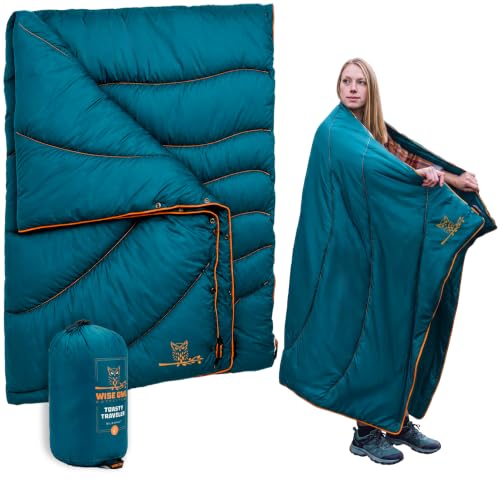
Wise Owl Outfitters Camping Blanket — Best Poncho-Style Woobie
Wise Owl’s blanket arrives wearing its heritage in its title: a woobie-style poncho. The woobie — the military poncho liner — is the most beloved blanket in soldiering history, and this civilian descendant keeps the formula: a packable puffy quilt that converts to a poncho, with quick-snap clasps and tie-down loops, unfolding to 6.5 by 4.5 feet per the title. The tie-down loops are the detail veterans will nod at: they let the blanket fasten to a poncho, a hammock, a tarp line, or a chair, turning a loose cover into placed insulation that stays where the evening needs it.
Water resistance and compact travel are also claimed in the title, and both suit the woobie brief — this is a blanket designed to be carried on the off chance and used in a dozen improvised ways when the chance arrives. As a sleeping layer it is a mild-night piece; as a poncho it is the warmest thing at a cold camp that nobody has to hold onto; as a ground cloth, picnic layer, or dog’s bed it is unbothered. Wise Owl built its name on hammock camping gear, and the blanket’s loops and snaps show that systems thinking throughout.
If your camping style is improvisational — tarps, hammocks, borrowed sites, weather that changes its mind — this is the blanket that improvises back, and the one most likely to be doing something useful in every photograph of the trip.
It is also the pick most likely to be understood by anyone who has served, camped with soldiers, or borrowed a genuine poncho liner and reluctantly returned it. That borrowed-woobie experience is the strongest testimony in this category — people remember a blanket decades later — and a civilian version with modern clasps and water resistance is selling that memory in a legitimate form. Buy it for the versatility, keep it for the feeling of being prepared for weather that has not happened yet.
- Style: woobie-style poncho, per the listing title
- Unfolded size: 6.5 by 4.5 feet, per the listing title
- Hardware: quick-snap clasps and tie-down loops, per the title
- Shell behaviour: water resistant, per the listing title
- Where to buy: the Wise Owl Outfitters Camping Blanket listing on Amazon — check price on Amazon
Strengths
- Poncho conversion makes warmth wearable hands-free.
- Tie-down loops anchor it to tarps and hammocks.
- Improvises across ground, chair, and camp duties.
Trade-offs
- Poncho cut is a compromise as a pure sleeping cover.
- Narrower unfolded width than the big rectangles here.
- No fill type or figure is stated in the title.
Best for: improvisational campers, hammock campers, and festival weekends. Poorly suited to: sleepers wanting a simple, wide, bed-like blanket and nothing else.

MOOX Down Camping Blanket — Best Stadium-to-Trail Down Blanket
The MOOX blanket shares its stated dimensions with the ROSE FEATHER — 55 by 79 inches — but aims them at a different life: its title names the stadium first among equals, alongside hiking and travel, and describes a waterproof, water-resistant down blanket in a Blue Gray colourway. That stadium brief is worth taking seriously rather than smiling at. The hours Americans spend cold on bleachers — autumn football, spring baseball, band competitions — vastly outnumber their nights in tents, and a packable down blanket is the correct equipment for both, which makes this the hardest-working recreational purchase in the guide for many households.
On the trail it behaves as the ROSE FEATHER does: a one-person down layer, packable and light in spirit, layering over bags and under quilts as needed. The double waterproof language in the title suggests a shell built for damp benches and dewy grass, the two surfaces this blanket will actually meet most. Judge it as the generalist’s down blanket — the one bought for the stadium, borrowed for the campsite, and eventually claimed by whichever family member gets coldest, most often, in public.
Households choosing between this and the ROSE FEATHER should decide by itinerary: travel-heavy lives point one way, event-heavy lives the other, and the blankets themselves are close enough that the calendar is the honest tiebreaker.
Stadium use imposes one demand the trail does not: the blanket must be pleasant in public — quick to shake out, unbothered by spilled drinks, and presentable over ordinary clothes. A waterproof shell earns its keep on bleachers exactly as it does on wet grass, and the Blue Gray colourway will hide the evidence of both venues. It is a small thing, but the blanket that looks respectable at the match is the blanket that gets brought to the match, and warmth left at home warms nobody.
- Size: 55 by 79 inches, per the listing title
- Fill: down, per the listing title
- Shell behaviour: waterproof and water resistant, per the title
- Colourway named in title: Blue Gray
- Where to buy: the MOOX Down Camping Blanket listing on Amazon — check price on Amazon
Strengths
- Stadium brief means year-round weekly usefulness.
- Stated size matches tall solo sleepers well.
- Down fill packs small for the car and the pack.
Trade-offs
- One-person width, like its ROSE FEATHER rival.
- Down care rules apply despite the casual brief.
- No fill power figure is stated in the title.
Best for: sports parents and event-goers who also camp. A weak match for: campers wanting maximum shared coverage from one blanket.

KODIAK CANVAS Camping Quilt — Canvas-Brand Durability Pick
The KODIAK CANVAS listing title is the shortest in this guide — a brand and the words Camping Quilt, nothing more — and the review must therefore be the most careful one here. What can honestly be said: this is the one pick actually named a quilt, and it comes from Kodiak Canvas, a maker whose reputation rests on heavy canvas tents and gear built to be used hard for years. Buyers who know the brand know what that implies about construction philosophy; buyers who do not should understand that the purchase case here is the maker’s identity and the quilt form, not a specification sheet, because the title offers none.
We include it deliberately, as the durability-first counterweight to a shelf of featherweight blankets. Canvas-culture gear trades packability for lifespan, and there are campers — base campers, hunting camps, canvas-tent traditionalists — for whom that trade is not a compromise but the entire point. A quilt that will be dragged, folded over tailgates, and slept under for a decade answers a different question than a blanket that packs to a loaf of bread, and this guide serves both readers better by naming the difference than by pretending one scale fits all.
Because no size, fill, or weight is stated in the title, we claim none. Check the listing itself for those particulars before ordering, and weigh what you find against the brand’s track record — which is, in the end, the product being sold here.
That is not a dismissal — it is a description of a legitimate gear philosophy with a long pedigree. The campers who buy canvas-tradition equipment are buying out of the replacement cycle entirely, accepting weight and bulk in exchange for never shopping this category again. If that sentence sounds like you, the absence of a specification sheet matters less than the presence of the maker’s name, and this quilt is the only pick in the guide addressed to you.
- Maker: KODIAK CANVAS, per the listing title
- Form: camping quilt — the only pick titled as one
- Stated specifications: none in the title — check the listing
- Brand character: heavy-duty canvas gear tradition
- Where to buy: the KODIAK CANVAS Camping Quilt listing on Amazon — check price on Amazon
Strengths
- A maker known for building gear to last years.
- True quilt naming in a blanket-dominated class.
- Suits base camps where durability outranks weight.
Trade-offs
- No published figures in the title to plan around.
- Canvas-culture gear rarely wins on packability.
- Specification-led buyers will find nothing to compare.
Best for: traditionalists and base campers buying a quilt for the decade. Not suited for: backpackers, for whom every unstated gram is a gram too many.
Six Light Pieces, Side by Side
| Piece | Fill from its title | Stated size | Signature feature |
|---|---|---|---|
| Get Out Gear Down Camping Blanket | 650 fill power down | Not stated | Waterproof packable all-rounder |
| ROSE FEATHER Down Camping Blanket | Down | 55 by 79 inches | Travel and airplane brief |
| COVACURE Down-Alternative Camping Blanket | Down alternative | 57 by 78 inches | Snap buttons, wearable wrap |
| Wise Owl Outfitters Camping Blanket | Not stated | 6.5 by 4.5 feet unfolded | Woobie poncho with tie-down loops |
| MOOX Down Camping Blanket | Down | 55 by 79 inches | Stadium-first down blanket |
| KODIAK CANVAS Camping Quilt | Not stated | Not stated | Canvas-brand quilt form |
What Does Lightweight Actually Buy You?
Options. A light blanket is the piece of insulation that gets taken on the trips where warmth is uncertain rather than guaranteed — the September weekend that might turn, the festival that might rain, the cabin whose heating might be optimistic. Heavy insulation stays home on those trips because its cost in space is certain and its benefit is not; light insulation comes along because the equation reverses. That is the whole philosophy of this class, and it explains why these pieces are blankets: a flat rectangle is the most option-dense shape in outdoor gear, equally ready to be a bed layer, a poncho, a picnic ground, or a dog’s nest, at a packed size that never argues with the rest of the luggage.
The same logic scales up to the whole house, incidentally. Comfort gear earns its keep by being present at the moment of need, which is why our guide to Best Air Conditioners for Large Rooms judges machines by the rooms they will actually cool rather than the showroom figures they can quote — presence and fit beat specification, in a bedroom as surely as on a trail.
How Do You Use a Flat Blanket as a Sleeping Layer?
Tuck it like you mean it. The flat blanket’s one structural weakness is migration — it slides, bunches, and escapes — and the countermeasures are all technique: edges under the hips before sleep, feet wrapped in the bottom fold like the end of a bed, and a sleeping pad’s texture working in your favour rather than a slippery groundsheet. Snap-equipped blankets like the COVACURE can be fastened into a loose tube, which solves migration at a stroke, and poncho-style pieces can be worn into the sleeping bag so the blanket and the sleeper turn as one.
Layering multiplies a light blanket’s range. Over a sleeping bag it adds a shell of still air and takes the condensation that would otherwise damp the bag; under a bag it adds a vapour-resistant base layer on cold ground. Two light blankets layered sleep warmer than either alone and pack to different corners of two people’s luggage — a trick couples use to share warmth without sharing a single point of failure.
Hammock sleepers should think of the flat blanket as the top half of a two-part answer: something beneath the hammock carries the underside, and the blanket drapes the top, where its flatness is an advantage rather than a compromise. Ground sleepers on pads get a different benefit — the blanket’s edges can be tucked under the pad itself on cold nights, borrowing the pad’s stability to solve the migration problem in one move. Either way, technique is the multiplier: the same blanket sleeps noticeably warmer in practised hands, which is why this guide spends as many words on tucking, snapping, and layering as on the products themselves.
Which Lightweight Mistakes Cost Campers Most?
Believing the word lightweight in a title without checking what is actually stated is the first. This guide quotes sizes and fills only from titles for a reason: in this class, unstated numbers are unkept promises, and the camper who plans coverage around an assumed dimension discovers the truth at bedtime. The second mistake is asking a light blanket to do a cold night’s whole job — these are mild-night and layering pieces, and the camper who respects that boundary stays warm, while the one who tests it becomes a cautionary tale with a headlamp.
Third, storing down blankets compressed between trips quietly flattens them across a single winter. Fourth, washing synthetic blankets with fabric softener coats the fibres and dulls their loft. And fifth — the household mistake — buying one light blanket when the honest need was two different ones: a personal travel blanket and a shared camp blanket are different tools, and the guides in our wider library, from quilts to the heritage pieces in Best Copper Range Hoods, keep teaching the same lesson, that buying the right form once beats buying the wrong form twice.
How Do You Choose Between Down and Down-Alternative in Practice?
Start with your weather, not your aspirations. Down’s advantage — warmth per ounce and per packed litre — is real but conditional on dryness, and a camper whose trips run through coastal rain, river valleys, and condensation-heavy tents will spend those trips managing the condition instead of enjoying the advantage. Down-alternative fill gives up the spreadsheet and wins the calendar: it is warm enough on the mild nights this class serves, it tolerates the damp those nights come with, and it forgives the storage habits of real households. On a three-season blanket, the honest performance gap between the two fills is smaller than the honesty gap between their owners’ drying discipline.
Then consider who else will use it. A personal blanket, owned and cared for by one careful person, can be down with a clear conscience. A household blanket — borrowed by teenagers, spread under toddlers, wrapped around wet dogs — should be synthetic, because its life will include events no care routine survives, and a synthetic blanket emerges from those events merely washed, while a down one emerges diminished. The COVACURE’s snap-fastened, washable brief is written for exactly that household, and the down picks are written for the careful soloist; the guide respects both by refusing to rank one life above the other.
Allergy and ethics preferences settle some choices outright, and they need no apology in either direction. What deserves a second thought is buying down for a blanket that will live in a car boot — heat and compression are down’s two slow enemies, and a car boot supplies both, all summer, at no extra charge.
What Makes a Blanket Genuinely Packable?
Packability is three properties wearing one word. The first is compressed size — how small the blanket becomes under pressure — where down’s loft paradoxically wins, because high loft crushes to little. The second is recovery: a packable blanket must re-loft when released, night after night, which is where fill quality and storage habits meet. The third is the sack itself — a blanket whose stuff sack is lost, torn, or sized by an optimist is a blanket that travels badly regardless of its fill, and the snap-and-loop hardware on pieces like the Wise Owl woobie quietly substitutes for a sack by letting the blanket fasten to the outside of a pack.
Test packability at home the way you test warmth: pack the blanket for a week, in the sack and conditions it will actually travel in, then release it and watch the loft return. A blanket that sulks flat after a week of compression will not forgive a month of it between trips, and the time to learn that is in the living room, not at a trailhead with the light going.
Finally, weigh packed shape against the rest of your luggage. A blanket that packs to a smooth cylinder rides in a rucksack’s corners and a carry-on’s gaps; one that packs to an awkward brick fights every other object it travels with. The travel-briefed picks in this guide — the ROSE FEATHER above all — earn their place as much by the shape they disappear into as by the warmth they provide when they reappear.
How Do These Blankets Earn Their Keep at Home?
Count the nights honestly and the home wins by a landslide: guest beds in cold snaps, sofa duty through winter, the sick-day nest, the extra layer when the heating fails or the teenager’s room runs cold. A packable camp blanket is the household’s reserve warmth — stored small, deployed instantly, and indifferent to whether the emergency is a broken boiler or an unexpected guest. That reserve role rewards the versatile pieces most: the COVACURE snaps around a convalescent’s shoulders, the MOOX covers the sofa’s cold end, and the Get Out Gear blanket turns a daybed into a bed.
There is a seasonal rhythm to it. Spring and autumn belong to the campsite; deep winter belongs to the house; summer belongs to the stadium, the picnic, and the beach evening that outlasts the sun. A blanket bought for one of those theatres and sized honestly will serve in all four, which is why this guide keeps asking about your calendar rather than your ambitions — the calendar is where the blanket will actually live.
Care at home is the same discipline as care in the field, minus the weather: aired after use, stored lofted if down, washed gently and dried completely, and kept where it can be found in the dark by a cold person at 2 a.m. The blanket that can be found is the blanket that gets used, and used blankets are the only kind worth buying.
How Do You Pack a Light Blanket So It Survives the Trip?
Stuff, do not fold — folding creases the same lines trip after trip and wears the fill along them, while stuffing distributes the stress randomly and keeps any one crease from becoming a cold line across the blanket. Keep the blanket in its own dry bag inside the pack rather than loose, because a light blanket’s worst enemy on the trail is not cold but the damp that migrates from wet boots, a leaking bottle, or a rain-soaked pack liner. At camp, give it air before you need it: ten minutes shaken out and draped while the tent goes up restores loft that a day of compression flattened, and that small ritual is worth more warmth than the difference between most fills in this class.
On the journey home, reverse the priorities. A blanket that comes home damp — from dew, from a wet tent packed around it, from the simple humidity of a car boot in summer — must come out of its sack the same day, not the same week. More light blankets die of one forgotten damp weekend in a stuff sack than of a decade of honest use, and the mildew that results is nearly impossible to wash out of down. The packable blanket’s whole bargain is that it is easy to carry; the owner’s side of the bargain is that it is unpacked, aired, and stored loose with the same reliability.
Travellers by air should treat the blanket as cabin equipment rather than luggage: worn or carried through security, it is warmth during the flight, a pillow at the gate, and insurance against the destination’s first cold room — three jobs no checked bag can perform, and the reason the travel-briefed picks in this guide are sized to a single body.
When Is a Light Blanket Not Enough?
When the night has a plan of its own: a forecast near freezing, wind that finds the tent, altitude that rewrites the temperature after dark. A light blanket’s honesty is that it serves the mild majority superbly and the cold minority not at all, and the skill this category teaches is recognising which minority a given night belongs to before you are lying in it. The signals are learnable — elevation, season, the behaviour of dew and frost on previous nights, the simple testimony of your own hands at dusk — and campers who learn them carry a light blanket with total confidence, because they know the nights it owns and they respect the ones it does not.
For those colder nights, the blanket does not retire; it layers. Over a bag, under a quilt, inside a hammock system — the flat rectangle’s lack of shape becomes its passport into every other system you own. That is the final answer to the sceptic who asks why a serious camper owns a blanket with no rating at all: because warmth is assembled, not purchased, and the light blanket is the most cooperative building block in the assembly.
How Do You Wash a Lightweight Camping Blanket Without Ruining It?
Gently, rarely, and completely dry before storage — those three adverbs are the whole manual. Down pieces want a front-loading machine, a down-specific wash, and a long, patient tumble dry on low heat with dryer balls breaking the clumps, continuing until the fill feels dry past the point of doubt, because damp down stored away is down being quietly destroyed. Synthetic pieces forgive a warmer, faster cycle, which is part of their family appeal, but they share the last rule absolutely: nothing in this guide should be put away holding moisture, whatever its fill.
Between washes, spot-clean and air. Most camp dirt is surface dirt, and a blanket draped over a line in moving air sheds smells and light soil without a full wash’s wear on its fill. Washing is cumulative damage as well as cleaning — every cycle costs a little loft — so the blanket that is aired weekly and washed seasonally will out-loft the blanket washed after every trip, and the difference shows up on the coldest night of the year, which is the only audit that matters.
Check the hardware while you wash: snaps fastened, loops untangled, zips on storage sacks working. A light blanket’s features are its value, and the wash is the natural moment to audit them — thirty seconds with your hands now against a failed snap discovered at a cold campsite later is the best trade in all of gear maintenance.
What Should You Look for on the Listing Before You Order?
Read the title the way this guide did, because the title is the contract. Confirm whether a size is stated and whether it suits your body and your sharing plans; confirm the fill is named, and if it is down, whether any fill power is printed; confirm that features you are counting on — snaps, loops, a poncho cut, waterproofing — appear in the maker’s own words rather than only in a photograph. Then read the care description with the same care, because a blanket whose washing rules your household cannot follow is a blanket with a shortened life, whatever its fill.
Check the variant, too. Several picks here are sold in multiple colours and sometimes sizes under one listing, and the colourway named in a title — a particular blue, a particular green — may be one option among several, with dimensions that can differ between them. Thirty seconds confirming the variant in the basket is cheaper than a return, and in a class with this few published numbers, the variant check is where most buying mistakes in this guide’s category are actually made or avoided.
Finally, sanity-check the blanket against your calendar one last time: the trips, the events, the guests, the journeys. A light blanket is a small purchase with an unusually long shadow — it will be borrowed, packed, spread, and slept under for years — and the minute spent matching it to your real life is the highest-value minute in the whole transaction.
Final Recommendation
Start with the Get Out Gear blanket if you want the class’s one stated fill power and a waterproof, packable all-rounder. Choose the COVACURE if your camps are damp, your borrowers are many, and wearable snaps sound like the warmth you will actually use. The Wise Owl woobie suits improvisers; the ROSE FEATHER and MOOX divide the solo travellers from the stadium regulars; and the KODIAK CANVAS quilt serves the buyer who wants a maker’s reputation and a decade of service instead of a specification. Lightweight gear is a promise about presence — the warm layer that is actually there — and the best pick in this guide is simply the one whose shape matches the trips already written in your calendar, the blanket you will still be packing, without thinking, five summers from now.
If you are buying exactly one and your life mixes all of it — trails, travel, events, guests — let the tiebreak be care: choose the piece whose washing and storage rules your household will actually keep, because a blanket’s second year depends on its first year’s handling more than on its fill. The warmest blanket in this guide, five summers from now, will be the one that was aired, stored loose, and brought along often enough to be loved rather than merely owned.
Bring it on the next trip even if the forecast looks kind. That is the entire spirit of this category in one sentence, and the campers who live by it are, disproportionately, the warm ones in every story their friends tell afterwards, on every trail, at every festival, in every cold spare room from here to the coast, in every season of the long camping year ahead of us all, wherever the road and the weather happen to lead next, in the months and the miles still to come for all of us who camp and travel.
Frequently Asked Questions
Can a camping blanket replace a sleeping bag?
On mild nights and for warm sleepers, yes — especially snapped or tucked with care. On cold nights, treat these blankets as layers over or under a bag rather than replacements, because none of the six here publishes a temperature rating to plan a cold night around.
Why do so few of these listings state a weight?
Because this class sells on versatility rather than ultralight credentials, and makers quote the numbers that flatter their brief — sizes, fills, features. Our advice is to judge by stated facts and packed behaviour, and to treat any weight you need for a serious backpacking decision as a question to ask on the listing itself.
Down or down-alternative for a light camp blanket?
Down for pack size and warmth per ounce, with dry handling. Down-alternative for damp camps, frequent washing, lending, and any household where careful gear storage is a fantasy. Both appear in this guide because both answers are right for somebody.
What size blanket suits two people?
Look for the widest stated spans — the COVACURE’s 57 by 78 inches is the most generous rectangle here for sharing, while the 55-by-79-inch pieces are honestly one-person blankets with excellent length. When in doubt, two personal blankets beat one shared one for actual sleep.
Can I take a camping blanket on a plane as hand luggage?
Yes, and the travel-briefed picks here are effectively designed for it: a packable blanket worn through the terminal or folded into a personal item doubles as cabin warmth and a makeshift pillow, and it insures the whole trip against cold rooms at the far end. Keep it in its own small sack inside your bag so it stays clean through security trays and overhead bins, and shake it out at the destination before its first night — loft lost to a day of compression returns within the hour.
How should I store a packable down blanket?
Loose and lofted, in a large breathable sack or draped in a wardrobe — never in its compression sack between trips. Loft is the product you bought; storing it crushed is paying for warmth and then keeping it in a flattened state until the one night you need it.
Are these blankets suitable for children?
As supervised camp and household layers, yes — the synthetic COVACURE especially, since it washes easily and its snaps keep it in place around small shoulders. Size the blanket to the child where you can, keep drawcords and loops out of reach of toddlers as you would with any corded item, and remember that children chill faster than adults: a blanket that is a comfort layer for you may be the main event for them, so plan their pad and clothing accordingly.
Related Guides
For the wider blanket shelf these pieces were drawn from, our guide to Best Backpacking Blankets follows the same stated-facts discipline across the packs-and-trails end of the category, including several heavier options for campers who carry by car and judge a blanket by the decade rather than by the gram.



[…] neighbours. When your trips run milder and weight matters more than survival margins, our guide to Best Lightweight Camping Quilts covers the other end of this same shelf, where blankets and quilts trade raw warmth for […]