What's inside
- Key Takeaways
- Quick Picks
- How Did We Judge Underquilts Built to Travel Light?
- Undersides, Compared
- How Does an Underquilt Actually Seal?
- How Do You Vent an Underquilt on Warm Nights?
- Which Underquilt Mistakes Cost the Most Warmth?
- How Do You Match an Underquilt to a Top Quilt?
- What Does Suspension Hardware Do to Warmth?
- How Do You Sleep in a Hammock in the Rain Without Soaking the Underquilt?
- How Long Should an Underquilt Last?
- How Do You Test an Underquilt Before a Trip Depends on It?
- What Should You Pack Around the Underquilt?
- How Do You Choose Between Two Underquilts With No Stated Range?
- Why Do Hangers Convert From Pads and Never Go Back?
- Final Recommendation
- Frequently Asked Questions
- Related Guides
As an Amazon Associate I earn from qualifying purchases. This post may contain affiliate links at no extra cost to you.
cottageverdict.com is reader-supported. When you buy through links on our site, we may earn an affiliate commission.
Where to buy: All six underquilts below are sold on Amazon. Open a linked name to reach its listing, check price on Amazon, and confirm the size variant against your hammock, and check the suspension hardware included before you order.
The best lightweight hammock under quilts fix the coldest problem in hammock camping: the air moving beneath you. An underquilt hangs under the hammock’s fabric, loft uncompressed, warming the underside that your body weight would otherwise flatten into uselessness. It is the half of the hammock sleep system that newcomers skip and veterans buy first, and this guide’s six picks were chosen for the quality that defines the category — warmth that travels light. Temperature figures appear only where a title states them: the CROSSHIP prints a 41-to-68-degree range and the Onewind prints 35 to 50 degrees, and every other pick is judged on length, weight where stated, materials, and maker, with no rating invented on its behalf.
Lightweight matters doubly down here. The underquilt is pure addition — a ground sleeper’s pad at least pretends to other jobs — so every ounce it carries must argue for itself in warmth. The picks below make that argument in different dialects: stated featherweight figures, recycled shells, packable builds, and full-length coverage that refuses to save weight by abandoning your calves to the cold.
A note on vocabulary before the picks, because this category’s listings blur it: an underquilt is not a blanket hung hopefully under a hammock, and it is not a pad. It is a shaped, suspended insulation layer with its own suspension system, designed to maintain loft in moving air beneath a sleeper. Every pick below is that thing by its own title — which is why the shelf is six deep rather than sixty, and why the reviews keep returning to seals, suspension, and stated figures instead of the adjectives that fill the wider market’s listings.
Key Takeaways
- An underquilt warms by hanging uncompressed beneath the hammock; anything you lie on directly, including a pad inside the hammock, insulates at a fraction of its loft, which is why this category exists at all.
- Only two picks state a temperature range in their titles — CROSSHIP at 41 to 68 degrees and Onewind at 35 to 50 — and this guide claims no figure for the other four, judging them on length, weight, and materials instead.
- Full length is the coverage that matters: four of the six picks state it in their titles, because an underquilt that ends at the calves leaves the feet to fend for themselves on every cold night of the year.
- The Night Protector states the lightest weight here at 25oz, and weight claims, like temperature claims, are credited only where a title actually prints them for the buyer to hold the maker to, on a kitchen scale, on the day the parcel arrives at the door.
- Setup speed is a warmth feature: an underquilt that seals quickly and stays sealed, like the quick-setup Hideout, prevents the end-gaps where most underquilt warmth quietly escapes overnight, through every turn and every small hours adjustment of a long and restless night.
Quick Picks
| Pick | Badge | Why it earns its place |
|---|---|---|
| OneTigris Hideout Hammock Underquilt | Best Quick-Setup Full Length | Full-length, four-season framing with a quick setup — the underquilt that seals fast and stays put. |
| OneTigris Night Protector Underquilt | Lightest Stated Weight | Full length and four-season intent at a stated 25oz — the weight leader with paperwork. |
| Wise Owl Outfitters Hammock Underquilt | Best Packable All-Rounder | Ultralight, water-resistant, and packable from a hammock-specialist brand campers already trust. |
| CROSSHIP Hammock Underquilt | Clearest Stated Range | A printed 41-to-68-degree range across 3-to-4 seasons, full length, in Forest Green. |
| Onewind Hammock Underquilt (Sorona) | Best Cold-End Stated Range | A 35-to-50-degree range, Sorona insulation, and a recycled 20D shell at 82 by 52 inches. |
| AYAMAYA Hammock Underquilt | Best for Double Hammocks | Sized for single and double hammocks, four-season framing, full-length winter intent. |
How Did We Judge Underquilts Built to Travel Light?
Warmth per ounce was the first lens, but warmth had to be evidenced, not asserted. Stated ranges counted; stated weights counted; a four-season claim in a title counted as the maker’s intent, graded with the caution all such claims deserve. Where a title offered none of those, we judged the architecture — full length versus partial, shell fabric, insulation type — because an underquilt’s shape is a fair predictor of its behaviour even when its maker declines to print a number.
Fit came second. An underquilt must match the hammock’s length and the sleeper’s diagonal, seal at both ends without strangling the loft, and stay sealed through a night of small movements. The top half of the system has its own shelf, and readers assembling a full rig will find it in our guide to hammock top quilts; this guide’s concern is the underside, where hammock nights are actually won and lost. Readers shopping for the people in their lives rather than themselves will also find the fit-first thinking familiar from our guide to Best Camping Quilts for Women, where sizing honesty matters more than marketing language — the same discipline, applied to a different sleeper.
Finally, we weighted packability as this category’s defining virtue. An underquilt that will not compress travels badly, and an underquilt left at home insulates nothing at all, so the picks that pack small enough to be carried without argument scored as heavily as the picks with the boldest season claims.
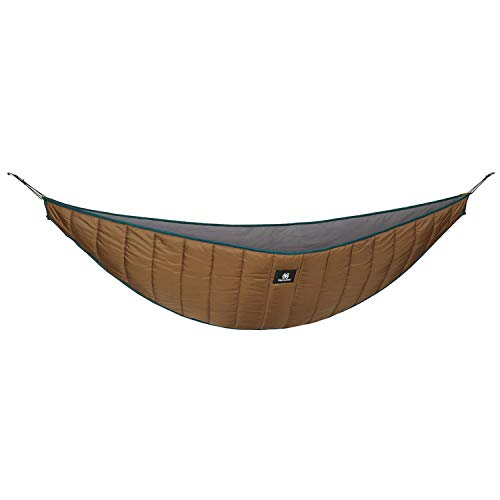
OneTigris Hideout Hammock Underquilt — Best Quick-Setup Full Length
The Hideout’s title leads with the two promises underquilt owners care about most: full length and quick setup. Full length means the insulation runs from shoulders to feet, because the classic partial-length underquilt saves its weight exactly where the sleeper can least afford it — the calves and feet that hang in the hammock’s coldest gathered end. Quick setup means the seal at both ends is achieved in minutes, by a tired camper, in failing light — and a seal achieved quickly is a seal that actually gets checked, adjusted, and achieved well, rather than abandoned to good intentions.
OneTigris frames the Hideout as a thermal, four-season underquilt, and we grade that as the maker’s ambition rather than a laboratory verdict: plan it as a three-season piece with cold-night manners, test it at the edge of your season in the garden, and let your own notes promote it to winter if it earns the promotion. The brand’s value positioning is the other half of its appeal — this is the underquilt for a hanger building a complete system without paying expedition prices for the underside of it.
For couples or households rigging two hammocks, a quick-sealing full-length design also shortens the evening’s work by half, which is a warmth feature in its own right: the sooner both systems are sealed, the sooner everyone is inside them.
There is one more habit this pick rewards: the pre-sleep seal check, done from inside the hammock with a hand run along both ends. A quick-setup system makes that check a ten-second ritual rather than a rebuild, and rituals are what separate warm systems from hopeful ones across a long trip — the seal you verify nightly is the seal that is still there on the coldest night of the year, when verification matters most.
- Coverage: full length, per the listing title
- Setup: quick setup, per the listing title
- Season framing: 4 season, per the listing title
- Positioning: thermal underquilt for camping and travel
- Where to buy: the OneTigris Hideout Hammock Underquilt listing on Amazon — check price on Amazon
Strengths
- Full-length coverage protects calves and feet.
- Quick setup makes a good seal achievable nightly.
- Four-season ambition at a value maker’s positioning.
Trade-offs
- Temperature figure: none printed in the title.
- Four-season claims should be garden-tested first.
- No stated weight for the ultralight spreadsheet.
Best for: hangers wanting full-length coverage that seals without a fight. Not suited for: strict ounce-counters who need every weight printed before purchase.

OneTigris Night Protector Underquilt — Lightest Stated Weight
The Night Protector prints the number this whole guide is organised around: 25oz, stated in its title, for a full-length underquilt with four-season framing. In a category where several rivals print no weight at all, a stated figure is a maker’s promise a buyer can verify on a kitchen scale — and 25oz for full-length coverage is a genuinely light promise, light enough that the underquilt stops being the item a backpacker interrogates and becomes the item they simply pack. OneTigris thus takes two of the six slots in this guide on opposite virtues: the Hideout on setup, the Night Protector on the scale.
The rest of the title supports the backpacking brief — warm and comfortable, full length, aimed at camping, hiking, backpacking, travelling, and even the beach, which last is marketing breadth but harmless. Grade the four-season language as intent, exactly as with its sibling, and let the stated weight carry the review’s verdict: this is the underquilt for the hanger whose pack has a budget and whose spreadsheet has a column for the underside. Paired with a comparably light top quilt, it builds the lightest honest full system this batch’s guides describe.
It is also the natural upgrade path for pad-in-hammock sleepers: the first dedicated underquilt most hangers buy should be the one whose weight cannot be argued with, and 25oz is very close to unarguable.
It also disciplines the rest of the pack by example. A sleeper who has felt a full-length underside at 25oz starts asking the same question of every other object in the bag — what do you weigh, and what do you earn? — and that question, asked consistently, is how ordinary kits become light ones without a single heroic purchase. The Night Protector is a good underquilt and a better teacher.
- Stated weight: 25oz, per the listing title
- Coverage: full length, per the listing title
- Season framing: 4 season, per the listing title
- Maker: OneTigris, hammock and outdoor line
- Where to buy: the OneTigris Night Protector Underquilt listing on Amazon — check price on Amazon
Strengths
- Lightest stated weight in this guide.
- Full length at that weight is a rare pairing.
- Verifiable figure — weigh it yourself on arrival.
Trade-offs
- No stated temperature range in the title.
- Four-season framing still needs a home test.
- Light builds ask for careful handling in camp.
Best for: backpacking hangers building the lightest full system. A poor fit for: campers who plan strictly by printed temperature ranges.

Wise Owl Outfitters Hammock Underquilt — Best Packable All-Rounder
Wise Owl Outfitters built its name on hammocks and the gear around them, and its underquilt reads like a summary of the category’s common sense: insulated, fitted under hammocks, ultralight, water-resistant, and packable — every one of those words from its title. The water resistance deserves emphasis, because the underquilt is the most weather-exposed piece of insulation in the system, hanging below the tarp’s best protection in the path of ground splash, dew, and wind-driven mist. A shell that sheds that moisture defends the loft that the whole night depends on.
No temperature range and no weight are stated, so the review rests on the maker’s specialism and the design’s completeness: this is the all-rounder for a hanger who wants one underquilt from a hammock-first brand and will establish its range the honest way, across a season of garden hangs and shoulder-season trips. Wise Owl’s wider ecosystem — hammocks, straps, and the woobie-style blanket elsewhere in this batch — also suits households standardising on one maker’s geometry, where every piece is designed to hang with the others.
Buy it as the sensible centre of the shelf: not the lightest stated, not the boldest ranged, but the pick whose every stated quality points at the trips most hammock campers actually take.
It is worth adding that all-rounders age gracefully in a kit. When a hanger eventually buys a specialist — a colder-rated winter piece, a lighter summer one — the all-rounder becomes the loaner, the second hammock’s underside, the guest rig’s warmth, and it serves in that second career for years because nothing about it was ever extreme. Versatility is a longevity strategy, and this pick is built on it.
- Maker: Wise Owl Outfitters, hammock specialist
- Shell behaviour: water-resistant, per the listing title
- Framing: ultralight and packable, per the listing title
- Fit: designed to fit under hammocks, per the title
- Where to buy: the Wise Owl Outfitters Hammock Underquilt listing on Amazon — check price on Amazon
Strengths
- Hammock-specialist design and ecosystem fit.
- Water-resistant shell defends exposed loft.
- Packable build suits carried trips of all kinds.
Trade-offs
- No stated range or weight in the title.
- All-round brief is nobody’s extreme specialist.
- Range must be learned across a season of use.
Best for: hangers wanting one packable underquilt from a hammock-first brand. Not the right match for: spreadsheet buyers who require printed figures for every decision.

CROSSHIP Hammock Underquilt — Clearest Stated Range
The CROSSHIP underquilt does something only one other pick here attempts: it prints its range — 41 to 68 degrees, stated in the title, across a 3-to-4-season framing. Read that range as the maker describing a mild-weather specialist, and respect the honesty of it. The warm end says this underquilt will not cook you in summer; the cool end says it owns the shoulder seasons’ milder half and should be layered, supplemented, or left home when the forecast drops through the thirties. A stated range with a modest floor is worth more to a planner than a bold claim with no floor at all, because it tells you which trips to pack it for — the majority of the hanging year, as it happens.
The rest of the title supports the brief: full-length coverage, lightweight and warm, portable, soft and durable, in a Forest Green colourway. Full length at a mild range is a thoughtful pairing — the sleepers this underquilt serves are out in the long evenings of spring and autumn, when a cold calf at midnight is a likelier complaint than a frozen core. For summer-dominant hangers, this may be the only underquilt they ever need, and its stated range lets them know that before buying rather than after a season of guessing.
It is also the easiest pick here to buy for someone else: a stated range is a set of instructions, and a gift that explains its own limits is a gift that gets used correctly.
Mild-range honesty also protects the rest of a system. A hanger who knows their underside is a 41-degree piece plans the whole envelope accordingly — top quilt, clothing, site — instead of discovering the mismatch at altitude. In that sense the CROSSHIP’s printed floor is a planning tool for gear it will never meet, which is more than can be said for the boldest claims elsewhere on this shelf.
- Stated range: 41 to 68 degrees, per the listing title
- Season framing: 3 to 4 seasons, per the listing title
- Coverage: full length, per the listing title
- Colourway named in title: Forest Green
- Where to buy: the CROSSHIP Hammock Underquilt listing on Amazon — check price on Amazon
Strengths
- Printed range makes trip planning straightforward.
- Full-length coverage at a mild-weather brief.
- Honest floor — no cold-weather overclaiming.
Trade-offs
- Stated floor excludes genuinely cold nights.
- No stated weight in the title.
- Specialist range means a second underquilt for winter.
Best for: spring-to-autumn hangers who plan by printed numbers. Poorly suited to: winter campers, whose season begins below this range’s floor.
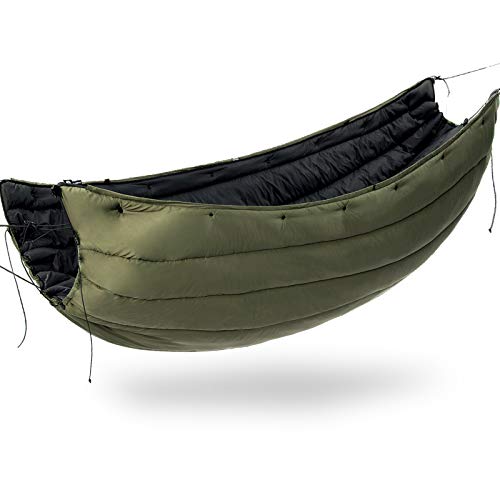
Onewind Hammock Underquilt (Sorona) — Best Cold-End Stated Range
Onewind’s underquilt prints the coldest stated floor in this guide — a range of 35 to 50 degrees — and backs it with the most modern materials list here: Sorona insulation, a 20D recycled nylon shell, full-length coverage at a stated 82 by 52 inches, and a design that serves double hammocks as well as singles. Take the facts in the order a cold sleeper would. The 35-degree floor reaches real shoulder-season cold, the part of the year when hammock camping is finest and least forgiving. The 82-inch length covers a tall diagonal completely. The 52-inch width wraps the wide points of that diagonal, shoulders and hips, where narrower underquilts leave their owners negotiating with the edges.
Sorona is a synthetic insulation with a partly plant-based pedigree, and its presence here matters for the damp reasons this batch keeps returning to: synthetic loft under a hammock, in the weather’s path, that keeps working when the night turns wet. The recycled shell is the other modern note — 20D is a light fabric class, and a hanger counting ounces while counting impact will read that line of the title twice. No weight is stated, which is the one gap in an otherwise complete specification, so the kitchen scale will have the last word for spreadsheet buyers.
For the hanger whose season leans cold and whose conscience leans recycled, this is the most contemporary answer on the shelf — stated range, stated dimensions, stated materials, and a floor that respects October.
The double-hammock capability deserves one more practical note: two sleepers generate more moisture and more movement than one, and an underquilt sized for doubles must hold its seal through both. Width is what buys that stability — the quilt is not stretched to its limits by the wider lie — so couples should read the 52-inch figure as the feature, not as a statistic, and solo hangers should read it as roomy insurance against ever finding the edge.
- Stated range: 35 to 50 degrees, per the listing title
- Insulation: Sorona, per the listing title
- Shell: 20D recycled nylon, per the listing title
- Size: 82 by 52 inches, per the title; suits double hammocks
- Where to buy: the Onewind Hammock Underquilt (Sorona) listing on Amazon — check price on Amazon
Strengths
- Coldest stated floor among the six picks.
- Full stated dimensions suit tall, wide diagonals.
- Recycled shell and modern synthetic insulation.
Trade-offs
- No stated weight despite the complete spec sheet.
- Cold-leaning range may overheat high-summer nights.
- Double-hammock width is surplus for solo minimalists.
Best for: cold-leaning hangers who want stated numbers and modern materials. A weak match for: summer-only campers, who would sleep hot over it in July.

AYAMAYA Hammock Underquilt — Best for Double Hammocks
The AYAMAYA underquilt is the maximalist of the six: sized for single and double hammocks alike, full length, four-season framing, and a title that reaches plainly for winter cold weather. Width is its argument. A double hammock spreads two bodies across a far wider diagonal than any solo rig, and an underquilt sized for that geometry — rather than stretched across it — seals the underside that two sleepers present to the cold. Couples who hang together discover quickly that underside coverage is where shared hammocks fail, and this is the pick designed to answer them.
The winter language should be graded as ambition, in line with this guide’s treatment of every unstated figure: no range is printed, so the four-season brief is a direction, not a destination, and a garden test in real cold is the toll this pick charges before a winter trip. What can be said without speculation is that full-length, double-capable coverage at a four-season brief is the broadest canvas here, and for households whose hammock life includes a partner, a child, or a large dog with opinions, breadth is the specification that decides whether the underquilt gets used or gets replaced.
Solo hangers should read the same breadth as a trade: width you do not need is weight and bulk you carry anyway, and the narrower specialists above exist for you.
Families should also weigh the social geometry: a double hammock with a properly sized underquilt becomes the camp’s favourite seat long before it becomes a bed — two people, one warm sling, the evening’s whole conversation — and gear that serves the social hours gets maintained, aired, and brought along, which is the quiet mechanism by which the AYAMAYA’s breadth keeps justifying itself trip after trip.
- Fit: single and double hammocks, per the listing title
- Coverage: full length, per the listing title
- Season framing: 4 season, winter cold weather, per the title
- Stated warmth: no temperature figure in the title
- Where to buy: the AYAMAYA Hammock Underquilt listing on Amazon — check price on Amazon
Strengths
- Double-hammock sizing serves couples and families.
- Full-length coverage across that width.
- Four-season ambition for year-round households.
Trade-offs
- Unstated range demands a cold home test.
- Width is surplus weight for solo minimalists.
- No stated weight in the title.
Best for: couples and families hanging in wide hammocks. Not suited for: solo ultralight hangers, for whom every extra inch is carried for nobody.
Undersides, Compared
| Underquilt | Stated range | Stated weight or size | Coverage |
|---|---|---|---|
| OneTigris Hideout Hammock Underquilt | None stated; 4-season framing | Not stated | Full length |
| OneTigris Night Protector Underquilt | None stated; 4-season framing | 25oz stated | Full length |
| Wise Owl Outfitters Hammock Underquilt | None stated | Not stated | Under-hammock fit |
| CROSSHIP Hammock Underquilt | 41 to 68 degrees | Not stated | Full length |
| Onewind Hammock Underquilt (Sorona) | 35 to 50 degrees | 82 by 52 inches | Full length |
| AYAMAYA Hammock Underquilt | None stated; 4-season framing | Not stated | Full length, doubles too |
How Does an Underquilt Actually Seal?
By suspension, not by contact. The underquilt hangs from elasticated cords at both ends, snugged so its top edge meets the hammock’s sides with no gap for cold air to pour into, yet loose enough that the loft is never stretched thin. That tension window — sealed but uncompressed — is the entire craft, and it is narrower than beginners expect: a finger’s width of gap at the shoulder end becomes a cold river by 2 a.m., while a cord hauled drum-tight flattens the insulation it was meant to protect. Adjust in small increments, lie in the hammock between adjustments, and check the seal with a hand slid between quilt and fabric at both ends.
The diagonal complicates the seal in one predictable place: the shoulder on the high side of the lie, where the body rides closest to the hammock’s edge. That is where gaps announce themselves first, and where a small repositioning of the underquilt — shifted a few inches toward the head end — earns more warmth than any upgrade. Efficiency thinking of exactly this kind, applied to a whole house, fills our guide to Best Energy-Saving Air Conditioners: seal the envelope first, and the equipment you already own performs a class higher.
Recheck the seal after the first hour, not just at setup. Suspension cords settle, fabric stretches into its night shape, and the seal you made standing beside the hammock is not quite the seal that exists once your weight has been in it — a thirty-second adjustment from inside, early in the night, is worth more than the same adjustment discovered as a cold back at 4 a.m. Build the recheck into the evening ritual, alongside the headlamp check and the water bottle’s placement, and it will never feel like effort at all.
How Do You Vent an Underquilt on Warm Nights?
Open a gap on purpose. On nights at the warm end of an underquilt’s range, loosen one end’s suspension to let a controlled channel of air flow beneath you — the hammock equivalent of a foot out of the bedcovers. The CROSSHIP’s stated range, running to 68 degrees, is a reminder that overheating is a real failure mode at the mild end: a sweating sleeper dampens insulation and sleeps worse than a slightly cool one, so vent early, in small amounts, before the system needs a full reset.
Some hangers slide the underquilt aside entirely for the first hour and pull it under as the night cools, which works beautifully in practiced hands and terribly at 3 a.m. in unpracticed ones. The safer warm-night pattern is the partial gap: warmth reduced, seal recoverable in one tug, and no cold surprise waiting at the hour when the temperature finally drops to meet the forecast.
Venting is also a moisture strategy, not just a temperature one. A sleeper who overheats sweats into the top quilt and chills the whole system by degrees; a sleeper who vents early stays dry, and dry insulation at dawn is warmer insulation at dawn, whatever the thermometer says. Learn your own venting threshold across a few garden nights — the temperature at which your system needs its gap — and you will set it by instinct on trips, the way experienced hangers do, without waking fully to make the adjustment.
Which Underquilt Mistakes Cost the Most Warmth?
Over-tightening the suspension is the first — it feels like diligence and behaves like sabotage, stretching the loft thin across the whole underside. The second is trusting a four-season phrase in a title as though it were a tested figure; this guide grades those claims as ambition precisely because the garden test exists, and skipping the test converts ambition into a cold surprise. Third is the partial-length surprise: hangers who did not check coverage discover the calf gap on the first cold night, in the dark, with no remedy in the pack.
Fourth, storing an underquilt compressed and damp between trips flattens and mildews it in a single off-season. And fifth, ignoring the small hardware — the cords, cleats, and clips that hold the seal — until one fails at dusk; the maintenance habit that prevents it is the same one our guide to Best Range Hood Inserts preaches for kitchen machinery, that the cheapest performance is the inspection you do before the season starts rather than the repair you pay for during it.
How Do You Match an Underquilt to a Top Quilt?
By range first and by ego last. The system’s true floor is set by whichever half is weaker, so a cold-rated top quilt over a mild underquilt is money spent warming the sky. Match the stated figures where they exist — the Onewind underquilt’s 35-degree floor asks for a top quilt comfortable in the same territory — and where one half is unrated, let the rated half set the planning number and grade the unrated half by a garden test at that temperature before trusting the pairing anywhere remote.
Length matching matters quietly too. A full-length underquilt under a short top quilt leaves the feet defended from below and exposed from above, which is better than neither and worse than both; the footbox end of the system deserves the same completeness as the shoulder end. When you assemble pieces from different makers — the normal case — lay the whole system out at home, hang it, lie in it, and run your hands along every seam of the envelope before the first trip grades it for you.
Colour and hardware compatibility are not vanity: a system whose clips, cords, and adjustment points you understand in the dark is a system you will actually adjust in the dark, and adjustment is where matched-on-paper systems are won or lost in practice.
What Does Suspension Hardware Do to Warmth?
Everything, quietly. The cords that hang an underquilt set its distance from the hammock fabric, and that distance is the loft’s living space: too close and the fill is pinched, too far and cold air rents the gap. Quality hardware — smooth cleats, cords that hold their setting, end channels that gather evenly — keeps the distance you set at dusk identical at dawn, through a night of turns and wind. This is why quick-setup designs like the Hideout matter beyond convenience: hardware that adjusts easily gets adjusted correctly, and hardware that fights its owner gets left approximately right, which in this category means wrong.
Inspect the hardware when the underquilt arrives, not when you first hang it outdoors. Run every cord through its full travel, check that the end gathers close symmetrically, and learn which hand does what — because the first real adjustment will happen by headlamp, with cold fingers, and the time to build the muscle memory is the living room.
Carry the tiny spares: a length of cord and a spare clip weigh almost nothing and convert a hardware failure from a ruined night into a five-minute repair. In a category built on hanging by threads, the threads deserve a contingency plan.
How Do You Sleep in a Hammock in the Rain Without Soaking the Underquilt?
The underquilt hangs in the weather’s path, so rain craft starts at the tarp: pitch it wide and low enough that driven rain cannot reach the hammock’s underside, and orient the rig so the tarp’s long axis blocks the prevailing wind rather than funnelling it. Under a well-pitched tarp, the underquilt’s real enemy is not rain but splash and mist — the fine, drifting wet that arrives under every shelter — which is why water-resistant shells like the Wise Owl’s earn their mention in this guide, and why synthetic fills forgive the nights the tarp loses.
Morning discipline completes the defence. If the underquilt took moisture, air it at the first dry hour — over a branch in moving air while breakfast cooks — rather than packing it damp for a day of hiking, which teaches the fill to clump and the shell to smell. On multi-day wet trips, that twenty-minute airing is the difference between a system that degrades gracefully and one that gives up by Thursday.
And keep the packed underquilt in its own waterproof sack inside the pack, separate from wet tarp and rain gear. The most common soaking an underquilt ever receives is not from the sky but from its travelling companions, and it is entirely preventable with one bag and ten seconds of thought at packing time.
How Long Should an Underquilt Last?
Years, if its two enemies are kept from it: compression and damp storage. Loft is a physical structure, and it fatigues where it is crushed — which is why the storage rule in this guide is repeated without embarrassment: loose, dry, and aired, every time, for the whole off-season. A synthetic underquilt stored carelessly loses its spring within a couple of winters; the same underquilt stored lofted will be hanging, plump and ready, half a decade later, and the difference cost its owner nothing but cupboard space and consistency.
Field life is gentler than storage life, hour for hour. Hanging imposes almost no wear; the stresses arrive in packing, washing, and the occasional snag on bark or buckle. Mend small shell tears when you find them — a needle and ten minutes at home against a fill leak discovered by headlamp — and wash only when the season’s evidence demands it, because every wash is a small withdrawal from the loft account.
Judge replacement by performance, not age: when your notes show the same system sleeping colder across two seasons despite honest seals and dry storage, the fill has retired, and the underquilt has earned its replacement. Until then, care is cheaper than shopping, and usually warmer.
How Do You Test an Underquilt Before a Trip Depends on It?
In the garden, on the coldest night you can arrange, with the whole system — top quilt, clothing, tarp — rigged exactly as it will travel. Sleep the full night rather than sampling an hour, because underquilt failures are slow failures: a seal that creeps, a gap that widens as the cords settle, a cold channel that takes until 3 a.m. to announce itself along your back. Morning’s evidence should be specific notes, not impressions — where the cold arrived, which end, which side — because each address has a different and usually free repair, and a note written at dawn is worth a forum of opinions read at noon.
If the test indicts the seal, adjust and retest; if it indicts the range, believe it and re-plan the trip’s layers rather than the laws of physics. The garden test’s real product is not warmth but knowledge: a hanger who knows their underside sleeps to a stated floor, in a stated wind, with a stated gap at the left shoulder, owns a system. Everyone else owns equipment and hope, and hope is not insulation.
Repeat the test whenever one half of the system changes — new top quilt, new hammock, a partner joining — because systems fail at their joints, and every changed piece is a new joint. Ten garden nights across a year will teach you more about your own warmth than any specification in this guide, ours included.
What Should You Pack Around the Underquilt?
Remarkably little, which is the category’s charm. The underquilt replaces the pad for most hangers, so the sleep system’s luggage is two quilts, the hammock, its suspension, and the tarp — a kit whose entire warmth strategy can be explained in one sentence and packed in one bag. Around it, pack for the ends of the body the system serves least automatically: the hat, the sleep socks, the liner gloves, because an underquilt warms the underside of a torso beautifully and does nothing for a bare head in moving air.
Add the repair minimalism this guide keeps recommending — a cord length, a clip, a needle with thread matched to nothing in particular — and a dry bag dedicated to the underquilt alone. That is the whole entourage. The campers who envy hammock packers at the trailhead are usually envying this shortness of list, and it is earned precisely by the underquilt’s single-mindedness: one object, one job, no compromises carried.
How Do You Choose Between Two Underquilts With No Stated Range?
By architecture and by maker, in that order — the method this guide applied to its own unrated picks. Read the coverage first: full length beats partial for any sleeper who camps past September. Read the shell and insulation next, because a water-resistant shell over synthetic loft is a coherent wet-climate answer, whatever its unstated number turns out to be. Then read the maker’s specialism: a hammock-first brand’s unrated underquilt carries the accumulated judgement of a design office that thinks about diagonals all day, and that is worth real money against a generalist’s identical silence.
Then buy the return policy as much as the product: an unrated underquilt is a hypothesis, and the garden test is its experiment, so a listing you can return after an honest home test is worth more than a marginally cheaper one you cannot. Run the test the first cold week after it arrives — not the night before a trip — and let the evidence, rather than the calendar, decide whether it stays.
Finally, write your own figure on it. The night you learn its floor, record the temperature, the wind, and your clothing in the notes this guide keeps urging, and the unrated underquilt becomes a rated one — rated by the only laboratory whose sleeper is you.
Why Do Hangers Convert From Pads and Never Go Back?
Because the underquilt removes a nightly negotiation. A pad inside a hammock must be positioned, repositioned after every exit, and slept on precisely; it bunches under the shoulders, escapes from under the calves, and turns the hammock’s smooth diagonal into a terrain of edges. The underquilt removes the terrain: the sleeper lies on fabric alone, the way the hammock was designed to be lain on, and the insulation minds itself below. Comfort is the advertised benefit, but the deeper one is cognitive — one less system to manage at the tired end of the day, one less failure mode between the camper and sleep.
Warmth follows the same direction. A pad insulates a rectangle; an underquilt insulates a wrap, rising at the sides where the hammock’s fabric curves up around the sleeper, covering the shoulders’ undersides and the hips’ outer edges that a flat pad never reaches. On the diagonal, those curved margins are where the cold lives, and they are exactly what the underquilt was invented to defend.
The conversion is not universal — pad sleeves exist, some hangers genuinely prefer the pad’s firmness, and a pad doubles as ground insurance in a way no underquilt can. But the direction of travel in the hammock world is unmistakable, and it is the reason this guide exists as a category of its own: the underside, properly hung, is where hammock sleep became reliable.
Final Recommendation
Plan by paperwork where paperwork exists: the Onewind Sorona for the coldest stated floor and full stated dimensions, the CROSSHIP for a mild range printed plainly, and the Night Protector for a full-length underquilt at a stated 25oz. Choose the Hideout if sealing speed is your nightly frustration, the Wise Owl if you want a hammock specialist’s all-rounder, and the AYAMAYA if your hammock carries two. Whichever you hang, test it under your own trees before the trip — an underquilt is invisible when it works and unforgettable when it does not, and the campers who sleep warm beneath their hammocks are the ones who made their mistakes at home, in the garden, within reach of a warm house and a second chance.
Buy the underside before you upgrade anything above it. That is the shortest honest advice in hammock camping, and this guide’s six picks are arranged to make it easy to follow at every level of ambition — stated ranges for the planners, stated weights for the carriers, full lengths for everyone, and not one invented figure among them.
Hang it the day it arrives, even if only between two garden posts for an hour, and run your hands along the seal while the light is good. Familiarity bought in daylight is warmth banked for the dark, and no purchase in this category finishes paying for itself until its owner has made that first unhurried acquaintance.
Frequently Asked Questions
Can I use a sleeping pad instead of an underquilt?
You can, and many hangers start there, but a pad inside a hammock shifts, bunches, and insulates only where it lies — while compressing nothing, because it is the insulation. An underquilt wraps the underside continuously and stays put, which is why most pad users eventually convert; the pad remains a fine backup and a good option for hammocks with a dedicated pad sleeve.
What does full length actually protect?
Your calves and feet. A partial underquilt ends around the knees or calves, and the hammock’s gathered foot end is its coldest region — the place where partial coverage is discovered, nightly, at the worst hour. Four of the six picks here state full length in their titles because the category has learned that lesson collectively.
How cold can I go with a 35-to-50-degree underquilt?
Plan around the maker’s floor with margin for your own cold tolerance, your top quilt’s matching range, and the wind. A stated 35-degree floor, like the Onewind’s, is a planning centre for a properly sealed system in layered clothing — not a promise that survives a gapping seal or a summer top quilt above it.
Should a beginner buy a rated or an unrated underquilt?
A rated one, where the budget allows, because a printed range converts the first season’s learning into calibration rather than guesswork: you learn how your body reads a number, and that literacy transfers to every later purchase. An unrated underquilt from a hammock-specialist maker is a perfectly good second choice — but buy it with the garden test already scheduled, and let the test, not the title, tell you what you own.
Do underquilts fit every hammock?
Most fit most gathered-end hammocks, but length and width must be checked against your own rig — especially double hammocks, which need the width the AYAMAYA and Onewind picks are built around. Confirm the variant and dimensions on the listing against your hammock’s measurements before ordering.
Can I use one underquilt across all four seasons?
A wide-range system plus venting covers more of the year than any single figure suggests: seal it fully in the cold months, open a venting gap in the warm ones, and supplement with clothing at the extremes. What one underquilt cannot do is be simultaneously the lightest summer piece and a deep-winter one — the four-season framings in this guide describe versatility across the middle of the year, and hangers who camp at both extremes honestly own, or borrow, two.
How should I store an underquilt between trips?
Loose, dry, and lofted, in a large breathable sack or hung up — never compressed in its stuff sack for the season. Air it after every trip, check the suspension cords while it dries, and it will greet the next trip with the loft you paid for.
Why does my back still get cold spots with an underquilt on?
Usually a local gap rather than a global failure: the quilt has drifted a few inches from where the cold spot sits, or one end’s seal has loosened through the night. Reach out and check both ends’ seals first, then shift the quilt toward the cold address by a hand’s width — targeted adjustments fix most cold spots, and a small sit-pad kept inside the hammock covers the stubborn ones while you learn your system’s habits.
Related Guides
For the top half of the system and the quilts that pair with these undersides, Best Backpacking Sleeping Quilts covers the wider quilt shelf with the same stated-facts discipline this guide applies below the hammock. Start with the underside, match the top to it, and the pair of guides together describe a complete warm night between two trees. Add your own test notes across the first season, and you will own something no listing can sell: a system whose behaviour you know in your own weather, on your own diagonal, at the hours when warmth is decided, in every season you choose to hang through the year ahead, from the first mild night of spring to the last cold snap before the holidays arrive and the deep winter tests begin in earnest for the year that follows behind it, through every trip still to come, in woods near and far, in seasons mild and wild alike, for years of hanging to come after this one ends, wherever the trees allow and the weather permits you to stay out under them all night long, season after season, year after year, trip after trip, hang after hang, night after night, from the first hang of spring to the final hang of the year, and every good night between them, in every corner of the woods you call home, wherever they stand, in any season of the year.



[…] building the other half of the system separately will find the dedicated shelf in our guide to Best Lightweight Hammock Underquilts, where the underside pieces get the same stated-facts […]