What's inside
- Key Takeaways
- Quick Picks
- How Did We Choose These Six Bakers?
- Side-by-Side: The Six Bakers at a Glance
- Why Does a Lid Matter More Than the Pot Itself?
- What Separates a Good Bake From a Great One in the Same Pot?
- How Do You Preheat and Load Without Burning Yourself?
- What Size Baker Fits Your Usual Dough?
- How Should You Care for Enameled Cast Iron?
- What Does a Typical Bake Look Like, Start to Finish?
- How Do Enamelled Bakers Compare With Bare Cast Iron and Ceramic Cloches?
- Which Baking Mistakes Ruin the Most Loaves?
- What Should a First-Time Buyer Budget Beyond the Pot?
- How Do You Adapt Recipes Written for a Different Pot Size?
- Final Recommendation
- When Is a Bread Oven the Wrong Purchase?
- Frequently Asked Questions
- How Long Will One of These Pots Actually Last?
- Related Guides
As an Amazon Associate I earn from qualifying purchases. This post may contain affiliate links at no extra cost to you.
cottageverdict.com is reader-supported. When you buy through links on our site, we may earn an affiliate commission.
Where to buy: Every baker below is sold through its Amazon listing — use the product links in the Quick Picks table and in each review to check price on Amazon before you order, and confirm the colour and size on the listing page itself, because several of these pots come in more than one finish.
If you searched for the best bread ovens expecting a row of countertop appliances with dials and timers, the honest answer will surprise you: in the verified listings for this guide, a bread oven is not a machine at all. It is a heavy, lidded cast-iron baker — a shallow base or deep pot sealed by a domed lid — that lives inside the oven you already own and turns that ordinary cavity into a small, steam-filled chamber. That trapped steam is the whole trick. A lean sourdough dough hitting a preheated iron pot puffs against moist air for the first part of the bake, the crust stays supple long enough for the loaf to spring, and then the lid comes off so the crust can colour and crisp. Once you understand that a bread oven is really a steam chamber you carry in two hands, the six picks below sort themselves quickly: one purpose-built round baker from Le Creuset, four enameled pots shaped or sized in slightly different ways, and one deep six-quart Dutch oven that earns its place by doubling as a stew pot the other six days of the week.
Two cautions before the picks. First, bread machines are a different class entirely — they mix, knead, proof, and bake inside one box — and they appear in this guide only as a contrast, never as a pick, because they do not give you the open crumb and blistered crust that a lidded iron baker is bought for. Second, temperature ceilings matter and are easy to overclaim: only two listings here state a limit, the Armorbear and the MUELLER HOME, and both state oven-safe to 500°F. For the other four, this guide makes no ceiling claim at all, and you should check the listing and the maker’s care notes for the exact pot you buy rather than assuming every enameled pot tolerates the same heat.
Key Takeaways
- A bread oven in this guide means a lidded cast-iron baker used inside a conventional oven, not a countertop appliance and not a bread machine.
- The domed lid is the functional part: it traps the dough’s own steam early in the bake, which is what produces oven spring and a thin, crackling crust.
- Shallow-base designs such as the Armorbear make loading scored dough easier and safer than lowering a loaf into a deep, ripping-hot pot.
- Only the Armorbear and MUELLER HOME listings state a 500°F ceiling in their titles, so treat heat limits as per-pot facts, not class facts.
- Round bakers suit boules; the VORRINGARD is also described by its maker as a loaf pan, which matters if your weekly bake is a sandwich shape.
- Enamelled interiors need gentler handling than bare iron — no metal scouring, no thermal shock from a cold tap onto a hot pot.
Quick Picks
| Baker | Badge | Why it made the cut |
|---|---|---|
| Le Creuset Enameled Cast Iron Bread Oven (9.5 Inch) | Purpose-Built Pick | The only listing here designed from the ground up as a round bread oven, in the 9.5 inch size and Cerise finish. |
| Enameled Cast Iron Bread Oven (6 Qt) | Roomiest Round Baker | A six-quart enameled round with a dome lid that ships with cotton potholders for the hot-lid lift. |
| OLLAKOK Enameled Cast Iron Dutch Oven (5 Qt) | Compact Five-Quart | A five-quart enameled pot in Cyan aimed squarely at sourdough bakers who bake smaller loaves. |
| Armorbear Enameled Cast Iron Bread Oven (9.5 Inch) | Easiest Loading | Shallow base and raised rim form a tight dome fit, and the listing states safe to 500°F with a sling and mitts included. |
| VORRINGARD Enameled Cast Iron Bread Oven (5 Qt) | Loaf-Shape Option | Five quarts in Blue, described as a loaf cast iron bread pan as well as a Dutch oven, so it straddles both shapes. |
| MUELLER HOME Enameled Cast Iron Dutch Oven (6 Qt) | Double-Duty Pot | Six quarts in Thyme Green, stated oven-safe to 500°F and across all cooktops, so it braises as happily as it bakes. |
How Did We Choose These Six Bakers?
We started from verified listings only, and every pick below carries an ASIN confirmed against the maker’s own product title, so the pot you land on is the pot described. Within that verified set we favoured true lidded bakers — a base and a lid that seal well enough to hold steam — over open casserole dishes that happen to be cast iron. Size came next: a baker that cannot take a standard boule made from roughly a kilo of dough is a specialty item, so the six-quart and five-quart pots anchor the list, with the two 9.5 inch round bakers representing the purpose-built end of the class. We also weighed what the listing itself tells you about daily use: whether a sling, mitts, or potholders are included for handling a screaming-hot lid, whether the base is shallow enough to load dough without scraping your knuckles, and whether the maker states a temperature ceiling at all. Colour was never a selection criterion, but it is recorded for each pick because these pots live on open shelves in many kitchens and the finish names — Cerise, Cyan, Blue, Thyme Green, White, Cream White — are how you tell listings apart. Finally, we kept one honest boundary: anything that mixes and bakes automatically was excluded, since a reader shopping this keyword wants the baker’s craft, not an appliance that does the shaping for them. Readers who later move into moist-heat cooking of a different kind often end up browsing Best Home Steam Ovens as well, because the underlying lesson — steam early, dry heat late — travels surprisingly well between the two benches.

Le Creuset Enameled Cast Iron Bread Oven (9.5 Inch) — Purpose-Built Pick
Le Creuset built this piece for one job, and the shape gives it away: a low, wide round base with a domed lid, sized at 9.5 inch and finished in Cerise in the verified listing. Where a general Dutch oven asks you to lower dough down into a deep well, a dedicated bread oven flips the ergonomics — the base is the floor, the lid is the chamber, and your scored boule sits almost at counter height when you load it. That matters at the exact moment your hands are least steady, with a fully proofed loaf balanced on parchment and a pot that has been soaking up heat for the better part of an hour.
The enameled cast iron construction brings the usual Le Creuset trade: superb heat retention and even browning, paired with a surface that wants wooden or silicone tools and a soak rather than a scour. Because the listing title states neither a quart capacity nor a temperature ceiling, this guide claims neither — what we can say is that the 9.5 inch round format is the classic footprint for a medium boule, and that the brand’s bread oven format is widely chosen by bakers who bake one handsome loaf at a time rather than batches. If your household eats a loaf every second day and you want the tool shaped exactly for that rhythm, this is the reference design the other five are measured against.
There is also a rhythm argument for this pot. Because the base is shallow and the lid does the enclosing, the baker behaves almost like a cloche on a stone: you can slide the whole assembly in and out without the deep-pot reach, and the loaf is visible the instant the dome lifts, which makes judging colour in the final minutes far easier. Bakers who proof in a round banneton will find the transfer geometry natural, since the basket, the parchment, and the base all share the same circular footprint. The Cerise finish listed here is the deep red the brand is known for, and it will show flour dust and bake marks honestly — a working pot looks worked-on, and most owners come to like that record. Treat it as the specialist instrument of the group: it does the fewest other jobs, and it does its one job with the least friction.
- Format: round bread oven, 9.5 inch, Cerise finish as listed
- Construction: enameled cast iron base with domed lid
- Capacity and ceiling: not stated in the listing title — verify on the listing
- Where to buy: the Le Creuset Enameled Cast Iron Bread Oven (9.5 Inch) listing on Amazon — check price on Amazon
Strengths
- Purpose-built geometry loads dough more safely than a deep pot.
- Enameled iron holds a long, steady preheat for strong oven spring.
- The domed lid gives tall loaves headroom to expand upward.
Trade-offs
- One-loaf format does not suit bakers running back-to-back batches.
- Enamel asks for gentler tools and no sudden cold-water shock.
- No stated capacity in the title, so size-check against your dough weight.
Best for: the committed sourdough baker who wants the classic round baker shape. Not suited for: anyone who regularly bakes two loaves at once or prefers a pot that also fries on the stovetop daily.
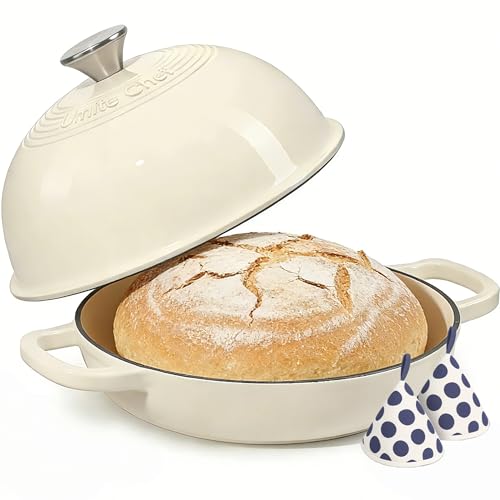
Enameled Cast Iron Bread Oven (6 Qt) — Roomiest Round Baker
Six quarts is the generous end of the home bread class, and this enameled round baker — listed in Cream White with a dome lid and cotton potholders in the box — uses that volume the way a big family kitchen needs. A high-hydration dough that spreads as much as it rises gets lateral room here, and the same pot swallows a double batch of dinner rolls or a large country loaf for a weekend gathering without the dough kissing the lid. The included cotton potholders sound like a small thing until you are lifting a dome lid off a pot at full bread-baking heat with whatever happens to be near the oven; purpose-made hand protection in the box means the first bake does not start with a scramble.
The flip side of six quarts is heft and storage. A pot this size occupies a full oven rack position and a serious slice of cupboard, and moving it in and out at temperature is a two-handed, forearms-committed job. Bakers working in small flats with compact ovens should measure their cavity before falling for the capacity. For everyone else, this is the pick that removes the most common bread-oven regret — buying a size too small — in a single decision, and its round enameled form still behaves exactly like the smaller bakers when you drop back to an everyday loaf.
One more practical note on the big round baker: thermal mass cuts both ways. Six quarts of iron takes longer to reach full preheat than the five-quart pots, so plan the oven time accordingly and let the pot ride through a full heating cycle rather than trusting the oven’s ready beep, which reports air temperature, not iron temperature. In return, that mass barely notices the cold dough landing in it, so the steam burst at loading is strong and the temperature recovery after the lid lift is quick. Bakers who run a levain-heavy schedule, with a loaf proofing while another bakes, will appreciate that steadiness across back-to-back bakes more than any single feature on the spec list.
- Format: round enameled cast iron bread oven, 6 Qt, Cream White as listed
- Lid: dome lid, with cotton potholders included per the listing title
- Capacity and ceiling: 6 Qt stated; temperature ceiling not stated in the title
- Where to buy: the Enameled Cast Iron Bread Oven (6 Qt) listing on Amazon — check price on Amazon
Strengths
- Largest capacity here suits big loaves and roll batches.
- Included potholders solve the hot-lid lift from day one.
- Round dome profile keeps steam behaviour identical to smaller bakers.
Trade-offs
- Heaviest style of pot to move at full temperature.
- Demands real cupboard space between bakes.
- Compact ovens may not clear the dome comfortably.
Best for: households baking large loaves or feeding a crowd weekly. A poor fit for: small kitchens where the pot would live on the stovetop permanently for lack of storage.

OLLAKOK Enameled Cast Iron Dutch Oven (5 Qt) — Compact Five-Quart
The OLLAKOK listing speaks directly to sourdough bakers: an enameled cast iron Dutch oven pot with lid, five quarts, in Cyan, described as a bread oven for sourdough bread baking. Five quarts is the thoughtful middle of this class — large enough for the standard loaf most home recipes are written around, small enough that the pot preheats a touch faster and handles more easily than the six-quart pair. For a two-person household that bakes twice a week and eats modest slices, this is the size that stops feeling like equipment and starts feeling like a habit.
Because the OLLAKOK is framed as a Dutch oven first, it also moonlights credibly: soups, small braises, and stovetop-to-oven casseroles all sit within its remit, which softens the purchase for bakers who cannot justify a single-purpose pot. The Cyan finish is distinctive on a shelf, for better or worse — it will be the most colourful object in most kitchens. As with the Le Creuset, the title states no temperature ceiling, so this guide states none; follow the listing’s own care guidance for maximum heat, and let the pot cool gradually rather than rinsing it hot.
The OLLAKOK also suits bakers who are still calibrating their dough size. When you are learning, loaves come out uneven — one week a tight, well-shaped boule, the next a slack dough that wants to spread — and a five-quart pot is forgiving of both, close enough to support a slack loaf yet roomy enough not to cap a vigorous one. Its Dutch oven depth gives a second forgiveness: if a bake runs pale, the same pot can go back into the oven uncovered for a final colour pass without transferring the loaf to another vessel. That kind of flexibility is worth real money to a baker in the first year of the hobby, before they know whether they are a boule baker, a loaf baker, or both.
- Format: enameled cast iron Dutch oven with lid, 5 qt, Cyan as listed
- Positioning: listed for bread baking and sourdough specifically
- Capacity and ceiling: 5 qt stated; temperature ceiling not stated in the title
- Where to buy: the OLLAKOK Enameled Cast Iron Dutch Oven (5 Qt) listing on Amazon — check price on Amazon
Strengths
- Five-quart size matches most standard home loaf recipes.
- Dutch oven form doubles for soups and small braises.
- Lighter handling than the six-quart options at temperature.
Trade-offs
- Very large or high-hydration loaves may feel close to the lid.
- The bright Cyan finish will not blend into every kitchen.
- Deep-pot loading is less forgiving than a shallow bread base.
Best for: smaller households baking standard loaves a couple of times a week. Not the right match for: bakers whose signature loaf is a big, wet, free-spreading dough.

Armorbear Enameled Cast Iron Bread Oven (9.5 Inch) — Easiest Loading
Armorbear’s listing is the most mechanically specific of the six, and the details all point at the hardest moment of the bake. The base is shallow, the rim is raised, and the maker says that rim forms a tight dome-to-base fit — which is precisely the seal that keeps steam in during the covered phase. A shallow base changes the loading ritual completely: instead of lowering dough into a deep pot and risking a deflated loaf or a burned wrist, you set the dough down almost as if onto a tray, then drop the dome over it. The listing also states safe to 500°F, one of only two explicit ceilings in this guide, and notes that a bread sling and mitts are included, so the transfer tools arrive with the pot.
At 9.5 inch in White, the Armorbear matches the Le Creuset’s footprint while attacking the problem from the value-and-accessories side. The shallow base does give up a little versatility — it is a baker first, and nobody is simmering a stew in a tray — but that focus is the point. Bakers who have scorched a forearm on a deep pot wall, or who bake with a sling every time, will recognise this design as the answer to their specific scar tissue. If loading anxiety is what keeps your starter in the fridge, this is the pick that removes the excuse.
Think carefully about the sling, because it changes technique. With a sling, the dough never free-falls: you lower it in a controlled descent, centre it with a small adjustment, and lift the finished loaf out by the same straps without tipping the pot. Bakers with wrist or grip limitations often find that this single accessory decides whether hot iron baking is comfortable at all, and here it arrives in the box rather than as a separate hunt. The tight dome fit deserves one caution, though: a seal that holds steam in also means you should open the dome away from your face in the final phase, since the stored steam leaves all at once when the lid breaks free.
- Format: 9.5-Inch enameled cast iron sourdough bread oven, dome lid, White as listed
- Base: shallow base with raised rim for a tight dome-to-base fit
- Stated ceiling: safe to 500°F per the listing title
- Included: bread sling and mitts per the listing title
- Where to buy: the Armorbear Enameled Cast Iron Bread Oven (9.5 Inch) listing on Amazon — check price on Amazon
Strengths
- Shallow base makes loading scored dough calm and controlled.
- Stated 500°F ceiling removes guesswork about maximum heat.
- Sling and mitts included for the full transfer routine.
Trade-offs
- Shallow base limits non-bread uses compared with deep pots.
- Single-loaf footprint, like the other 9.5 inch baker.
- White enamel shows bake patina more readily over time.
Best for: bakers who load with a sling and dread deep-pot transfers. Poorly suited to: cooks wanting one pot that must also handle deep braises.

VORRINGARD Enameled Cast Iron Bread Oven (5 Qt) — Loaf-Shape Option
Most of this guide is round, because most artisan home baking is round — but a large share of real households actually eat their bread sliced from a loaf, and the VORRINGARD is the one listing that speaks to both worlds. It is an enameled cast iron sourdough bread oven and Dutch oven, five quarts in Blue, and the maker also describes it as a loaf cast iron bread pan for homemade bread baking, even naming meatloaf among its uses. That breadth signals a pot whose owners bake sandwich loaves and shaped breads as often as boules, and who want the steam-sealed lid benefit applied to a more everyday crumb.
Five quarts keeps it in the manageable middle alongside the OLLAKOK, though the two pots have different personalities: the OLLAKOK leans into the sourdough boule ritual, while the VORRINGARD reads as the pragmatic family baker that also roasts and braises through the week. The title states no temperature ceiling, so none is claimed here. If your starter mostly becomes toast, sandwiches, and the occasional celebration boule, this is the honest match — a lidded iron baker that does not demand you reorganise your baking identity around it.
There is a storage argument quietly working in this pot’s favour. A loaf-oriented baker tends to live alongside loaf pans, and a household that already stores rectangular bakeware will find this pot’s footprint and habits familiar rather than precious. The enamelled interior also suits enriched doughs — the milk-and-butter sandwich loaves that scorch bare iron more readily — because the smooth surface releases sticky, sugary crusts with less persuasion. If your weekly bake includes a soft sandwich loaf for lunches and a crusty loaf for the weekend table, the VORRINGARD is the only pick here whose maker explicitly blesses both shapes, and that dual blessing is its whole case.
- Format: enameled cast iron bread oven and Dutch oven, 5QT, Blue as listed
- Also described by the maker as a loaf cast iron bread pan
- Capacity and ceiling: 5QT stated; temperature ceiling not stated in the title
- Where to buy: the VORRINGARD Enameled Cast Iron Bread Oven (5 Qt) listing on Amazon — check price on Amazon
Strengths
- Loaf-pan framing suits sandwich-bread households.
- Five-quart Dutch oven form stays useful beyond baking days.
- Lidded steam baking still applies to shaped loaves.
Trade-offs
- Less specialised for the classic round boule than the 9.5 inch bakers.
- No stated heat ceiling in the listing title.
- Jack-of-all-trades shape may satisfy purists less.
Best for: families whose bread is mostly sliced loaves for the week. A weak match for: boule specialists chasing the most dramatic crust geometry.

MUELLER HOME Enameled Cast Iron Dutch Oven (6 Qt) — Double-Duty Pot
The MUELLER HOME is the generalist of the six, and its listing says so plainly: a six quart enameled cast iron Dutch oven, heavy-duty, for sourdough bread baking, oven-safe to 500°F, across all cooktops, with casserole dishes among its named uses, in Thyme Green. That across-all-cooktops line is what separates it from the dedicated bakers — this is the pot that starts a braise on the burner, finishes it in the oven, and then, on Saturday, preheats empty and receives a boule. For a kitchen that can only justify one heavy pot, the MUELLER’s argument is that it never has a day off.
The stated 500°F ceiling, shared only with the Armorbear in this guide, gives bread bakers a clear working limit to plan preheats around. Six quarts matches the largest round baker here, so big loaves fit; the deep Dutch oven form does mean the familiar careful lowering-in of dough, ideally on parchment or a sling. Weight is the honest cost — heavy-duty is in the title for a reason — but for cooks who braise as often as they bake, no other pick spreads its cost across so many meals.
Consider the week this pot actually lives. On Monday it holds a bean soup started on the burner; on Wednesday it braises something low and slow; on Saturday morning it preheats empty and takes a boule. That rotation matters for enamel care, too, because a pot in constant gentle use rarely suffers the long damp storage that troubles occasional equipment. The all-cooktops statement in the title also future-proofs it against a stove change — households moving between gas, electric, and induction over the pot’s long life do not have to re-shop the baker when the range changes. Among the six, this is the purchase you justify to a sceptical partner with the most straight face, because it is visibly dinner equipment first and a baking indulgence second.
- Format: 6 Quart enameled cast iron Dutch oven, heavy-duty, Thyme Green as listed
- Stated ceiling: oven-safe to 500°F per the listing title
- Cooktops: across all cooktops per the listing title
- Where to buy: the MUELLER HOME Enameled Cast Iron Dutch Oven (6 Qt) listing on Amazon — check price on Amazon
Strengths
- True double duty across baking, braising, and casseroles.
- Stated 500°F ceiling and all-cooktop compatibility widen its use.
- Six-quart capacity handles the largest loaves in this guide.
Trade-offs
- Heavy-duty build is the most demanding to lift at temperature.
- Deep-pot loading needs parchment or a sling for safety.
- Generalist shape is less elegant for boule-only bakers.
Best for: one-pot kitchens that braise through the week and bake on weekends. Not suited for: anyone with lifting limitations who would struggle with a full six-quart iron pot.
Side-by-Side: The Six Bakers at a Glance
| Baker | Form | Stated size | Ceiling stated? |
|---|---|---|---|
| Le Creuset Bread Oven | Round bread oven, dome lid | 9.5 inch | Not in title |
| Enameled Bread Oven (6 Qt) | Round baker, dome lid | 6 Qt | Not in title |
| OLLAKOK Dutch Oven | Dutch oven with lid | 5 qt | Not in title |
| Armorbear Bread Oven | Shallow base, dome lid | 9.5 inch | Yes — 500°F |
| VORRINGARD Bread Oven | Dutch oven / loaf pan | 5QT | Not in title |
| MUELLER HOME Dutch Oven | Dutch oven, all cooktops | 6 Quart | Yes — 500°F |
Why Does a Lid Matter More Than the Pot Itself?
Steam is the ingredient you cannot add from a jug. In a bare oven, the moisture escaping your dough vanishes into a large cavity and the crust sets within minutes, locking the loaf at whatever volume it had reached. Under a close-fitting iron lid, that same moisture stays in a small pocket around the loaf, keeping the surface supple while the interior gases expand — that delay is oven spring, and it is also why the crust that finally browns, once the lid comes off for the second half, ends up thinner and more shattering than an uncovered bake. This is also why fit matters: the Armorbear’s raised-rim seal is not marketing garnish, it is the mechanism. When you shop, judge lids by how they seat, bases by how safely you can load them, and treat everything else — colour, handles, knobs — as secondary. Interestingly, the same steam-first logic explains why winter bakers proofing dough in cold kitchens sometimes read about entirely different gear, such as Best Cold-Weather Backpacking Quilts, where trapped warmth is likewise the whole design problem, solved with loft instead of iron.
What Separates a Good Bake From a Great One in the Same Pot?
Two bakers can own the identical pot and produce different bread, because the pot is only the stage. The first variable is the dough itself: a well-developed, properly proofed loaf springs in any of these six, while an under-proofed loaf stays dense no matter how good the steam seal is. The second variable is scoring — a single confident slash gives the expanding loaf a planned weak point, so it blooms upward instead of bursting at a random seam. The third is patience in the uncovered phase, where colour is flavour: a loaf pulled pale tastes underbaked even when the interior is done, and the deep browning that enamelled iron encourages is where much of the crust’s character lives. The fourth is record-keeping, humble as it sounds: bakers who note dough weight, pot, and timing for each bake converge on their pot’s sweet spot within a month, while bakers who improvise repeat the same near-miss all winter. None of the six picks can do these things for you, and that is precisely the appeal of the class — the tool is honest, and the skill is yours.
Steam management inside the pot deserves one more word, because it explains small differences between the picks. A tight-sealing dome keeps the early environment humid longest, which favours thin, glossy crusts. A looser-fitting deep pot vents a little steam and gives a slightly thicker, more rustic crust. Neither is wrong; they are dialects. Bakers chasing the shattering, blistered style tend to prefer the purpose-built domed bakers, while bakers who like a hearty chew are often happiest with the deep Dutch ovens. Reading the picks above with that dialect in mind — seal and shape first, brand second — is the fastest route to the right choice.
How Do You Preheat and Load Without Burning Yourself?
Put the empty baker, lid on, into the cold oven and let both climb together to your recipe’s temperature; iron that heats gradually also holds heat evenly, and a pot that goes in cold will not be shocked. While it heats, rest your shaped dough on parchment or in a sling — this is your loading vehicle, not an afterthought. When the oven reaches temperature, work in a set order: mitts on, lid off and onto a heatproof surface, dough lowered or set down by the parchment edges, lid back on, door closed. The shallow-base bakers shorten the dangerous reach; with deep pots, keep the parchment sling long enough that your knuckles never enter the pot. Uncover for the final stretch so the crust colours, and let the finished loaf cool on a rack before slicing, because the crumb is still setting as steam redistributes inside it.
What Size Baker Fits Your Usual Dough?
Match the pot to the dough you actually make, not the loaf you photographed once. Most home sourdough recipes built on five hundred grams of flour rise happily in a five-quart pot or a 9.5 inch round baker. Recipes built on a kilo or more of flour, and doughs wet enough to spread sideways, want the six-quart options. A pot that is too large is not harmless, either: a small dough in a vast chamber spreads flatter, because the walls that would have nudged it upward are too far away. If you bake two sizes regularly, the five-quart class is the compromise most households land on, and the comparison table above is the quickest way to see which of your finalists states its size in quarts versus inches.
How Should You Care for Enameled Cast Iron?
Enamel is glass fused to iron, and it asks for three courtesies. First, avoid thermal shock: let a hot pot cool before washing, and never run cold water into a pot fresh from the oven. Second, protect the surface: wooden and silicone utensils, a soak and a soft sponge rather than metal scouring pads, and parchment between the dough and the base if you want to limit baked-on flour shadows. Third, store it dry with the lid seated as the maker intends, and do not be alarmed by gradual interior darkening — a working bread pot develops a patina of honest use, especially in the pale finishes. None of the six picks needs seasoning, which is precisely why enamelled bakers suit bakers who want the iron’s heat without the bare-iron maintenance ritual.
What Does a Typical Bake Look Like, Start to Finish?
Walk through a Saturday bake and the equipment choices stop being abstract. The starter was fed the night before. In the morning the dough is mixed, rested, folded a few times while the kitchen wakes up, then shaped and set into a floured basket for its final proof. About forty-five minutes before bake time, the empty baker goes into the cold oven, lid on, and the oven climbs to full bread heat with the iron inside it. When the dough has proofed — it should look risen and hold a gentle fingerprint — the choreography begins: basket inverted over parchment or a sling, a confident score across the top with a lame or a sharp knife, mitts on, dome lifted and set aside, dough lowered or placed, dome replaced, door shut.
For roughly the first half of the bake, nothing visible happens, and that invisibility is the steam doing its work inside the sealed pot. This is the phase where discipline matters most: no peeking, no adjusting, no opening the door to show a visitor. When the timer calls for the uncovered phase, the lid comes off — tilted away from your face, because the stored steam is real — and the loaf, pale and fully sprung, finally meets dry oven air. Now colour develops quickly, and the baker’s judgement replaces the recipe’s clock: pull the loaf when the crust is the deep mahogany you like, not when a timer insists. The pot, meanwhile, gets a rest on the stovetop to cool at its own pace while the loaf sings on its rack. Every pick in this guide supports exactly this routine; they differ in how safely you load, how much dough fits, and what else the pot does on the days between bakes.
How Do Enamelled Bakers Compare With Bare Cast Iron and Ceramic Cloches?
All six picks here are enamelled cast iron, but a shopper will meet two neighbouring materials and deserves a map. Bare cast iron — the pre-seasoned combo cookers many bakers start with — tolerates metal tools and shrugs off high heat, but it asks for seasoning care, can react with long acidic braises, and rusts if it is put away damp. Enamel trades a little of that ruggedness for a non-reactive, no-seasoning surface that washes cleanly and suits the dual baking-and-braising life most of these pots actually lead; its vulnerabilities are chipping from hard knocks and crazing from thermal shock, both managed by ordinary care rather than expertise. Ceramic and clay cloches sit at the other end: light, excellent for a single loaf shape, but fragile, slower to preheat, and useless on a stovetop. For a first serious baker that must also earn cupboard space as a cooking pot, enamelled iron is the pragmatic centre of the triangle, which is exactly where this verified pool landed. None of that makes the neighbours bad choices; it makes them different commitments, and a baker who knows they will never braise can happily choose the specialist tools instead.
Which Baking Mistakes Ruin the Most Loaves?
- Skipping the preheat. Dough landing in a lukewarm pot steams weakly and spreads; the iron must be fully hot before the loaf goes in.
- Lifting the lid early to peek. Every peek dumps the steam pocket you paid for; trust the timer during the covered phase.
- Loading bare-handed with a short sling. Most bread-oven burns happen at loading, not unloading — lengthen the parchment, wear the mitts.
- Slicing straight from the oven. A loaf cut hot gums its own crumb; the interior needs cooling time to set.
- Assuming every pot shares one heat limit. Only two listings here state 500°F; check your own pot’s stated ceiling instead of borrowing another model’s.
- Storing the pot damp. Enamel over iron still deserves a dry shelf; trapped moisture invites trouble at chips and rims.
What Should a First-Time Buyer Budget Beyond the Pot?
The pot is the headline purchase, but a small supporting cast decides whether the first month of baking is pleasant. Parchment is a consumable you will use every bake unless your baker includes a sling, as the Armorbear does. A proofing basket matched to your loaf shape helps the dough hold its form during the final rise, and a lame or razor for scoring gives cleaner ears than a kitchen knife, though a serrated knife works while you learn. Oven mitts that actually fit your hands — not the decorative pair by the stove — are safety equipment at bread temperatures, and the six-quart round baker’s included cotton potholders acknowledge exactly that. A simple wire rack for cooling is the last piece; loaves cooled on a solid surface steam their own bottoms soggy. None of this needs to arrive before the pot does, but knowing the full kit in advance keeps the first bake from stalling on a missing ten-dollar item.
How Do You Adapt Recipes Written for a Different Pot Size?
Most published sourdough recipes quietly assume a medium Dutch oven, roughly the five-quart class, so bakers with the six-quart pots rarely need to change anything except expectations: the same dough will spread a little wider and bake a little flatter unless the recipe is scaled up, and many bakers simply scale flour by a quarter when they move to the bigger iron. In the other direction, a recipe written for a large pot can overwhelm a five-quart baker, pushing dough against the lid where it sticks and tears the crust; scale down rather than cramming. Timing shifts modestly with mass — bigger iron holds heat longer into the uncovered phase, so watch colour rather than the clock in the final ten minutes. Hydration interacts too: wetter doughs benefit from the closer walls of a smaller pot, which is one more reason the five-quart pair in this guide suits the high-hydration styles many home bakers are currently chasing, while the six-quart pair suits the firmer, larger loaves of a family bake day.
Final Recommendation
If you bake one classic boule at a time and want the tool shaped exactly for it, choose between the Le Creuset for the reference design and the Armorbear for the calmer loading ritual and the stated 500°F ceiling with sling and mitts included. If your loaves are large or your household is big, the six-quart enameled round baker and the MUELLER HOME are the two roomy paths, with the MUELLER pulling ahead whenever the pot must also braise on weeknights. The OLLAKOK is the balanced five-quart for standard recipes, and the VORRINGARD is the honest pick when most of your bread is sliced from a loaf. Whichever you choose, spend your first bake simply learning its lid fit and your loading routine — the pot will repay that patience for years, because a lidded iron baker is one of the few kitchen tools that genuinely improves the bread rather than merely containing it, and the first morning you lift a dome to find a loaf that has sprung tall and blistered under its own steam, you will understand why bakers guard these heavy, humble pots like heirlooms.
When Is a Bread Oven the Wrong Purchase?
Honesty about fit matters more than enthusiasm. If your household’s bread comes mostly from soft sandwich loaves baked in a tin, a lidded iron baker adds drama you may not need — the VORRINGARD narrows that gap, but a plain loaf pan still wins on simplicity. If lifting is difficult, every pick here is heavy iron, and the six-quart pair especially should be test-lifted in imagination at arm’s length, full of dough, at oven height; a baker you dread moving is a baker you will stop using. If your oven is a compact countertop unit, measure its cavity against the dome heights before ordering anything, because several of these pots assume a full-size cavity. And if what you secretly want is to press a button and slice warm bread an hour later, the bread machine class — excluded from the picks for the reasons given earlier — is genuinely your answer, and there is no shame in choosing the tool that matches the life you actually live. The bread oven rewards a particular pleasure: slow mornings, a living starter, and bread with a crust that crackles as it cools. Buy it for that pleasure, or do not buy it at all.
One more group should pause: bakers in rentals with glass-top stoves and strict landlords sometimes worry about heavy iron on the cooktop. For baking alone, the pot only ever sits on an oven rack, which removes most of that concern; the stovetop question only arises for the double-duty pots, and there the MUELLER’s across-all-cooktops statement in its title is the reassurance to look for on the listing before you rely on it. Weight on the rack is the remaining check — standard oven racks carry a Dutch oven comfortably, but a rack that already sags under a roasting pan deserves a second look before it holds six quarts of iron plus dough.
Frequently Asked Questions
Is a bread oven the same thing as a Dutch oven?
They overlap heavily. A dedicated bread oven is a lidded cast-iron baker shaped for loaves — often a shallow base with a domed lid — while a Dutch oven is a deeper general pot that also bakes bread well. Four of the six picks here are framed as Dutch ovens by their makers, and two as purpose-built bread ovens; both styles trap steam the same way.
Why not just buy a bread machine instead?
A bread machine mixes, proofs, and bakes in one box, which is convenient but produces a soft, pale, pan-shaped loaf. A lidded iron baker asks more of you and returns the artisan result — open crumb, deep colour, crackling crust. They solve different problems, which is why machines appear in this guide only as a contrast.
How hot can I preheat these pots?
Only where the listing states it: the Armorbear and the MUELLER HOME both state oven-safe to 500°F. The other four titles state no ceiling, so check the listing for the exact pot you choose and follow its stated guidance rather than assuming the whole class shares one limit.
Do I need parchment or a sling?
You need one of them. Parchment or a sling is how dough travels safely into a preheated pot, especially a deep one. The Armorbear includes a bread sling per its listing, and the six-quart round baker includes cotton potholders; for the other picks, budget for parchment as a running supply.
Can these pots go on the stovetop too?
The MUELLER HOME states across all cooktops in its title, and the Dutch oven forms generally suit stovetop work. The shallow-base bread ovens are bakers first. Always confirm on the listing for the specific pot, and remember that enameled surfaces prefer gradual heat changes wherever they are used. Readers furnishing a whole small kitchen sometimes pair this research with Best Air Conditioners for Condos when a hot oven and a small flat have to coexist through summer.
How Long Will One of These Pots Actually Last?
Cast iron is the closest thing the kitchen has to a permanent material: the iron itself does not wear out, fatigue, or lose its ability to hold heat, and a pot bought this year can plausibly bake for grandchildren. The enamel is the mortal layer, and its lifespan is measured in decades of ordinary care rather than years — chips usually come from impacts, a dropped lid or a knock against a tap, not from baking itself. That longevity changes the buying maths. A pot used twice a week for fifteen years delivers thousands of loaves, so the difference between the cheapest listing and the one that fits your hands, your oven, and your dough size is spread very thin across its working life. It also argues for choosing the size honestly now rather than planning to upgrade later, because later, with iron, tends never to come. Buy the baker that matches the baker you are, and it will still be on the shelf when you have become the baker you wanted to be.
Related Guides
A last practical thought on colour, since four of the six listings are sold in a named finish and finishes sell out unevenly: the finish changes nothing about the bake. Cerise, Cream White, Cyan, White, Blue, and Thyme Green are the same enamelled iron underneath, so if your chosen pot is unavailable in the colour you first wanted, taking the available finish is a cosmetic compromise, not a functional one. Choose size and shape with care, and let colour be the flexible variable.
If your baking is outgrowing a single pot and you are planning a kitchen around bigger bakes, our guide to Best 40-Inch Electric Ranges With a Double Oven looks at the double-oven format that lets a bread baker run a loaf and a roast at different temperatures at the same time.


