What's inside
- Key Takeaways
- Quick Picks
- How We Chose These Picks
- Why Do Condo Rules Change the Cooling Equation So Much?
- Condo Cooling Options Side by Side
- How Do You Plan Cooling for an Open-Plan Condo Without Wasting Money?
- What Habits Keep a Condo Unit Welcome in the Building?
- How Does a Condo’s Floor and Orientation Rewrite the Sizing Rules?
- What Should a Buyer Ask Management Before Ordering Anything?
- Which Condo Cooling Mistakes Draw Complaints and Refunds?
- How Should a Condo Owner Handle the First Heatwave of the Year?
- Final Recommendation
- Frequently Asked Questions
- Related Guides
As an Amazon Associate I earn from qualifying purchases. This post may contain affiliate links at no extra cost to you.
cottageverdict.com is reader-supported. When you buy through links on our site, we may earn an affiliate commission.
Where to buy: each condo-friendly unit below is sold through its own Amazon listing, linked in the Quick Picks table and under every detailed review, where you can check price on Amazon at the point of decision.
Cooling a condo is a negotiation with rules before it is a question of machinery. The best air conditioners for condos are the ones that satisfy three audiences at once: the resident who wants a cool living room, the association whose handbook governs what may appear in a window, and the neighbour on the other side of a shared wall who hears every compressor start. Many buildings prohibit window units outright, or allow them only at the rear, or require a specific sleeve installation. Others permit anything that does not alter the facade. The first step in any condo purchase is therefore a document, not a product page: read the rules, then shop inside them.
That constraint explains the shape of this list. Three of the six picks are portables, which ask nothing of the building’s exterior beyond a discreet window panel for the exhaust hose. Two are window units, included for the many condos whose rules allow them and whose owners want the efficiency of a mounted machine. One is a U-shaped window design that keeps the window largely closed, a profile some associations tolerate where a full box is banned, though only the written rule in your own building can confirm that. Capacity claims below come only from the listings themselves, and portable figures are translated into their DOE or SACC terms wherever the title prints both, because a condo living space is exactly the kind of open, multi-use room where an inflated headline number disappoints fastest.
Open-plan layouts deserve a warning at the outset. A condo’s main room is often a living area, dining area, and kitchen sharing one volume of air, with a hallway bleeding coolness toward the bedrooms. A unit rated by its listing for a stated square footage assumes something closer to a single enclosed room. Condo buyers should treat stated coverage as the size of the zone the unit can genuinely hold, position the machine so its throw covers the seating area first, and accept that the far bedroom is a separate problem. Readers whose buildings do allow full window installations across several rooms will find the room-by-room treatment in Best Air Conditioners for Humid Climates a useful companion once the main space is settled — humidity, not heat, is what makes most coastal condos feel uncooled even at a correct temperature.
Our Top Picks
 BLACK+DECKER Smart Portable Air Conditioner14,000 BTU (Without Heat)17.1 x 28.1 x 13.8 inches68.3 poundsCheck on Amazon
Key Takeaways
- Building rules outrank product research: confirm whether window units are allowed, restricted to certain facades, or banned before choosing a format.
- Portables dominate this list because they change nothing about the building’s exterior; their honest capacity is the SACC or DOE figure, such as 5,000 BTU SACC on the Midea portable and 10,200 BTU SACC on the large BLACK+DECKER.
- Stated coverage in these titles runs from 150 square feet up to 700 square feet, but open-plan condo space should be read as a cooling zone, not a whole-home promise.
- No title in this group publishes a decibel figure, so neighbour-noise discussion stays qualitative; format and placement do the real work.
- The U-shaped Midea keeps the sash mostly closed, which some associations view more kindly than a protruding box — verify against your own handbook regardless.
Quick Picks
| Pick | Badge | Why it earns its place |
|---|---|---|
| Midea 6,000 BTU Window AC (Electronic Control) | Best permitted-window starter | A 6,000 BTU window unit rated by its listing for 250 square feet with cool, fan, and dehumidifier modes under electronic control. |
| Midea 8,500 BTU Portable AC | Best small-condo portable | Its title states 5,000 BTU SACC honestly against the 8,500 ASHRAE headline, with smart app control and a window kit included. |
| BLACK+DECKER 14,000 BTU Smart Portable AC (BPACT14WT) | Best for open-plan main rooms | The strongest portable rating here at 10,200 BTU SACC per its title, with a coverage claim up to 700 square feet and Follow Me sensing. |
| Midea 10,000 BTU U-Shaped Window AC | Best low-profile window design | The U profile closes the sash into the unit and the listing rates it for up to 450 square feet with inverter control. |
| AGTANA 14,000 BTU Portable AC | Best self-evaporating floor unit | A 14,000 BTU floor unit claiming coverage up to 700 square feet, with self-evaporating operation and auto swing for wide rooms. |
| 16,000 BTU Portable AC With WiFi | Best app-led feature set | The largest headline capacity in the group, with WiFi and app control, a dehumidifier mode, sleep mode, and a 24-hour timer. |
How We Chose These Picks
The first filter was permission. Any format that requires cutting a wall, mounting an exterior bracket visible from the street, or altering a facade was excluded, because those are the installations condo documents most reliably forbid. What survives that filter is what appears here: window units that sit in an existing opening, and portables that vent through a removable panel. Within those formats, listings were required to state their capacity in the title, and portables were ranked by their SACC figures where printed rather than by the ASHRAE headline, since the association with reality matters more than the size of the number.
The second filter was the neighbour test, applied qualitatively because no title here publishes a noise figure in decibels. Formats that keep machinery inside the room were weighed against formats that place the compressor outside the glass; installation quality — a tight window seal, a unit seated firmly rather than rattling in its frame — was treated as part of the product choice, because in a condo a badly seated window unit is a noise complaint with a receipt. The third filter was zone realism: coverage claims are quoted from titles, but the reviews below repeatedly translate them into the language of zones within an open plan, which is how condo cooling actually succeeds or fails.
One class of product was excluded on principle. Search results for condo cooling surface a swarm of small ventless gadgets marketed as windowless air conditioners; they contain no refrigeration cycle capable of cooling a room in the sense of the six units here, and naming them in a ranked guide would lend them a credibility their physics has not earned. They are not mentioned again. Everything ranked below genuinely refrigerates air and states its basis for doing so in its own listing.
Why Do Condo Rules Change the Cooling Equation So Much?
A detached house answers to physics; a condo answers to physics plus a board. The practical consequences run deeper than the window question. Many associations regulate condensate, because a window unit dripping onto the facade or the balcony below generates complaints and water damage claims. Many regulate appearance seasonally, requiring units out by a fixed date. Some buildings carry their own electrical limits in older stacks, where a floor’s shared circuit groans when every unit starts its compressor on the first hot evening. None of these constraints appear on a product page, and all of them can veto a purchase after delivery.
The sensible sequence is therefore: handbook first, window measurement second, product third. A portable that vents through a sliding-door panel may be the only legal option in a tower whose windows do not open at all — a common arrangement in newer high-rises with fixed glazing and a small operable vent. A rear-facing bedroom window may accept a unit that the street-facing living room window may not. Owners who map their own unit’s permissions window by window often discover a mixed solution is legal: a window unit where allowed, a portable where not, each sized to its zone. Kitchen ventilation in open plans raises a parallel set of capture questions, and readers planning a renovation alongside cooling will find the dual-motor discussion in Best Range Hoods With Dual Fans relevant to how cooking heat and moisture load the same open volume the air conditioner must then cool.
Renters in condo buildings face a doubled version of the problem: the landlord’s lease and the association’s handbook both speak, and the stricter of the two governs. For them the portables in this list are usually the whole answer, because a panel in a window is removable in minutes at move-out and leaves no trace for either authority to object to. Keeping the window kit’s original box and photographing the window before fitting anything are small habits that protect a deposit.

Midea 6,000 BTU Window AC (Electronic Control) — Best permitted-window starter
Where the handbook allows a window unit, this Midea is the measured place to start. Its listing describes a 6,000 BTU unit with electronic control, rated for 250 square feet, and offering three modes — cool, fan, and dehumidifier — with a remote control included. That mode set maps well onto condo life: cooling for the evening, fan for the mild nights when air movement alone suffices, and a dehumidifier mode for the damp weeks when the room feels clammy at temperatures that do not justify refrigeration. Electronic controls hold a set temperature more precisely than a dial, which matters in a main room that doubles as a home office.
The 250 square foot rating should be read as a zone. In a studio or a one-bedroom condo with an enclosed main room, it can be the whole answer. In an open plan, it is the answer for the seating zone near the unit, with the understanding that a closed bedroom door creates a second climate that this machine will not govern. Installation is the standard window ritual — seat, level with a slight outward tilt, seal the side gaps — with the condo-specific addition of a condensate check: confirm where the drip falls, and whether your building expects a drip pan or a deflector.
As a first unit for a first condo, its virtues are proportion and simplicity. It does not ask the owner to commit to the largest chassis the window could hold, it does not depend on a smart-home ecosystem, and its mode set covers the shoulder seasons when a cool-only unit would already be stored. Owners who later graduate to a larger space will find this size re-deployable to a bedroom, which softens the cost of starting sensibly.
Day-to-day, the electronic control is what owners interact with, and it repays a small learning investment. Setting a schedule around the workday — cooling paused in an empty flat, resumed before the commute home — is where a unit like this earns its keep in a condo, where every cooled hour is an hour nobody may be home to enjoy. The remote covers the couch-distance adjustments. Nothing about the package is exotic, and that is the point: this is the unit for the owner who wants the room right and the machinery forgettable.
- Cooling capacity: 6,000 BTU, rated by the listing for 250 sq ft
- Format: window unit with electronic control and remote
- Modes: cool, fan, and dehumidifier (3-in-1) per the title
- Suggested zone: enclosed main rooms and studios
- Where to buy: the Midea 6,000 BTU Window AC (Electronic Control) listing on Amazon — check price on Amazon
Strengths
- Three modes cover hot, mild, and damp condo evenings without a second appliance.
- Electronic control holds a steadier temperature for a room that is also a workplace.
- Mid-size capacity redeploys easily to a bedroom if the household later upsizes the main room’s cooling.
Trade-offs
- It remains a window unit, so a handbook ban ends the discussion before features begin.
- An open-plan space larger than its zone will expose the 250 square foot rating quickly.
- No inverter is claimed in the title, so expect conventional compressor cycling rather than modulated running.
Best for: condo owners whose rules permit window units and whose main room is a defined, closable space.
Not suited for: buildings that prohibit window installations, or open plans expecting one unit to govern several rooms.

Midea 8,500 BTU Portable AC — Best small-condo portable
Midea’s portable states its case with unusual candour: the title prints 8,500 BTU ASHRAE, then immediately gives the figure that matters, 5,000 BTU SACC, alongside a cooling claim of up to 150 square feet. Read properly, this is a small-zone machine — a condo bedroom, a den, a studio’s sleeping corner — and judged at that scale it is well equipped. Smart app control and a remote are both listed, dehumidifier and fan modes accompany the cooling mode, and a window kit is included, so the box contains the whole installation apart from foam tape and patience.
For condo use, the portable format’s virtues compound. Nothing protrudes from the building. The window panel comes out in minutes for an inspection, a storm, or a move. The unit can serve the living zone by day and the bedroom by night in a small unit where those are the only two zones that matter, provided someone is willing to wheel it and refit the panel — a five-minute ritual that small-condo households routinely accept in exchange for buying one machine instead of two.
The honest SACC figure also disciplines expectations about noise and runtime. A 5,000 BTU SACC portable holding a 150 square foot bedroom will run long, steady cycles on hot nights. That is normal operation for the format, not a defect, and it is precisely the behaviour the DOE rating was designed to predict. Buyers who internalise the smaller number buy this unit contentedly; buyers who shop by the headline number buy it and feel deceived by arithmetic they were actually shown.
Storage is where this portable quietly outclasses window units in a condo context. When the season ends, the panel lifts out, the hose detaches, and the machine rolls into the same closet that holds the vacuum cleaner. There is no exterior hardware to weather the winter, no association deadline for removal to meet, and no second person needed for a lift. For a one-bedroom flat where every closet shelf is contested territory, an appliance that stores vertically in a corner and asks for no installation anniversary is solving the condo problem in full, not just its temperature half.
- Cooling capacity: 8,500 BTU ASHRAE / 5,000 BTU SACC per the title
- Coverage claim: cools up to 150 sq ft per the listing
- Format: portable with window kit included
- Control: smart app and remote per the title
- Where to buy: the Midea 8,500 BTU Portable AC listing on Amazon — check price on Amazon
Strengths
- Both ratings printed in the title let a buyer size a small condo zone without guesswork.
- Included window kit and app control make it the most self-contained starter portable here.
- Dehumidifier mode suits the damp shoulder weeks in smaller units with limited storage for separate appliances.
Trade-offs
- At 5,000 BTU SACC it is a one-small-zone machine; a main living room will outrun it.
- Panel refitting each time the unit changes rooms is the format’s standing tax on flexibility.
- Floor space near the window is genuinely scarce in small condos, and this unit spends it.
Best for: small condos, studios, and condo bedrooms where one modest zone needs cooling without any exterior change.
A poor fit for: open-plan main rooms, where its SACC rating predicts an all-day run that still loses ground by evening.
BLACK+DECKER 14,000 BTU Smart Portable AC (BPACT14WT) — Best for open-plan main rooms
This is the portable for the condo zone that defeats smaller portables. BLACK+DECKER’s title pairs its 14,000 BTU headline with 10,200 BTU SACC and a coverage claim of rooms up to 700 square feet — the strongest honest portable rating in this guide. In an open-plan main room, that SACC figure is the difference between a machine that establishes a cool seating zone and one that merely stirs the air hopefully. The unit is a smart 3-in-1, combining cooling, fan, and dehumidifier modes, and its Follow Me remote senses temperature at the remote’s location, which in practice means at the sofa rather than at the machine standing by the window.
That sensing detail matters disproportionately in condos. The window wall is the hottest wall — sun on glass all afternoon — and a unit regulating to its own casing temperature will undercool the room’s occupants while overcooling the curtain. Follow Me moves the reference point to where people sit. Combined with smart control, the owner can also start the cool-down from the train home, so the main room is ready on arrival rather than an hour after it.
Size is the standing caveat. A portable of this class is a substantial piece of floor furniture with a substantial hose, and in a condo it will live somewhere visible. The bargain it offers is capacity without permission: no window unit application, no facade question, no sleeve. For a renter in a strict building or an owner whose living room windows are fixed glass with a vent panel, that bargain is often the only one available at this capacity, and it is a good one.
Heat-load honesty is the final word on this pick. A west-facing open plan with a cooking island and four dinner guests is a harder room than its floor area suggests, and even 10,200 BTU SACC will hold such a room at a pleasant temperature rather than a cold one on the worst evenings. Owners should want exactly that: pleasant, steady, and achieved without the machine screaming at full effort from noon to midnight. Judged as a zone anchor for real condo life — cooking, gathering, working, resting — this is the portable with the reserves the role demands.
- Cooling capacity: 14,000 BTU headline / 10,200 BTU SACC per the title
- Coverage claim: rooms up to 700 sq ft per the listing
- Format: smart portable, 3-in-1 cool, fan, and dehumidifier
- Control: Follow Me remote sensing plus smart features
- Where to buy: the BLACK+DECKER 14,000 BTU Smart Portable AC (BPACT14WT) listing on Amazon — check price on Amazon
Strengths
- The highest SACC figure among this guide’s portables gives open-plan zones a realistic chance.
- Follow Me sensing corrects the window-wall bias that makes portables feel inaccurate.
- Smart control enables the arrive-to-a-cool-room routine that condo commuters value most.
Trade-offs
- Footprint and hose presence are the most visible of any pick here; small rooms feel it.
- The 700 square foot claim should still be read as a zone claim in open plans with hallways attached.
- Dehumidifier use in very damp buildings needs the condensate arrangement checked rather than assumed.
Best for: open-plan condo main rooms and strict buildings where a high-capacity portable is the only legal route.
Not the right match for: compact studios, where its size crowds the floor and its capacity overshoots the zone.

Midea 10,000 BTU U-Shaped Window AC — Best low-profile window design
The U-shaped Midea answers a specifically condo-flavoured question: what if the building tolerates a window unit but the resident hates what a window unit does to the room? The chassis dips so the sash closes down into it, preserving part of the view, letting the glass stand between the sleeper and the outdoor side of the machine, and presenting a lower profile to the street than a full box. This 10,000 BTU version is rated by its listing for rooms up to 450 square feet, carries inverter control, and works with Alexa and Google Assistant per the title. Midea’s title also claims 37% energy savings; that figure is the manufacturer’s own claim and is reported here as such, not as a measurement.
Inverter control suits the condo main room’s long evening occupancy. Instead of the bang-and-rest cycle of a fixed-speed unit — each restart audible through a quiet building — the inverter modulates, holding the temperature with smaller corrections. For the neighbour consideration, the closed sash is the headline: a window that still closes is a window that still insulates, and the machine’s working side sits outside that barrier.
Permission remains the owner’s homework. A U unit is still a window unit in most handbooks’ language, whatever its profile, and the bracket work must suit the window. Where it is allowed, though, it offers the largest stated coverage of any window pick in this guide and the most considered answer to the two classic condo complaints — the lost window and the cycling noise — in a single design.
Resale and longevity thinking also favour this design in a condo setting. A unit that leaves the window functional and the view intact is a unit the next owner or tenant also wants, and the inverter’s gentler mechanical life — fewer hard starts, longer low-speed running — is the pattern associated with compressors that age slowly. None of that appears in a headline, but condo owners tend to keep appliances longer than house owners precisely because replacing them involves the building. Buying the design that respects the window is, in that light, buying time.
- Cooling capacity: 10,000 BTU, rated by the listing for up to 450 sq ft
- Format: U-shaped window unit with inverter control
- Smart control: Alexa and Google Assistant per the title
- Maker’s claim: 37% energy savings, as stated in the title
- Where to buy: the Midea 10,000 BTU U-Shaped Window AC listing on Amazon — check price on Amazon
Strengths
- The closing sash preserves view, light, and a layer of sound insulation no conventional box offers.
- Inverter running replaces start-stop cycling with steadier, quieter-feeling temperature holding.
- Coverage to 450 square feet per the listing reaches the main room of most one- and two-bedroom condos.
Trade-offs
- Handbook language usually classifies it as a window unit regardless of profile — permission is not automatic.
- Installation is the most involved of the window picks here, with bracket alignment that rewards patience.
- Voice-assistant features assume a household already invested in that ecosystem.
Best for: owners in window-unit buildings who want the main room cooled without surrendering the window.
Poorly suited to: renters, who generally cannot undertake this class of installation, and fixed-glass towers with no operable sash.
AGTANA 14,000 BTU Portable AC — Best self-evaporating floor unit
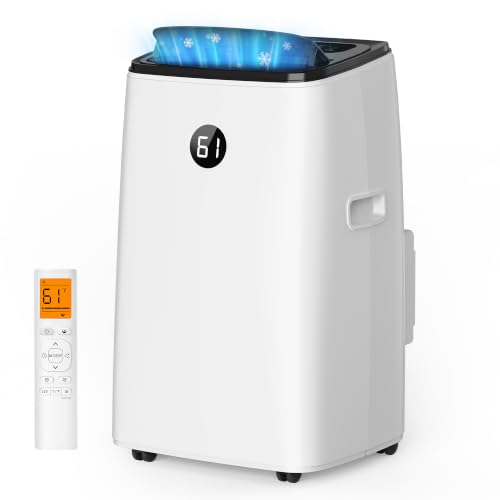
AGTANA’s floor unit enters with a 14,000 BTU rating and a coverage claim of large rooms up to 700 square feet, presented as a 3-in-1 with fan and dehumidifier modes alongside cooling. Two features in its title speak directly to condo realities. The first is self-evaporating operation: condensate is disposed of through the exhaust stream under typical conditions, which reduces the bucket routine that condo owners — often without a convenient floor drain or a utility sink near the living room — find hardest to live with. The second is auto swing, which sweeps the cooled air across a wide room rather than drilling one cold column in front of the machine, a meaningful benefit in the long, combined living-dining spaces typical of condo floor plans.
A remote control is listed, and the unit is floor-standing with the usual window kit arrangement for its exhaust. Its title does not print a SACC figure, so this guide does not invent one: the 14,000 BTU headline should be read with the general portable caution that real-world delivered cooling lands below the laboratory number, and the 700 square foot claim should be read as the maker’s ceiling under favourable conditions rather than as a planning figure for a sun-exposed open plan.
Within those honest bounds, the AGTANA suits the condo owner whose priority is coverage of one big room with minimal water management. Self-evaporation plus swing plus a large headline capacity is a coherent package for a main room that hosts everything from desk work to dinner parties, and the dehumidifier mode covers the muggy weeks when the room needs drying more than chilling.
The remote and swing together define its evening personality. Dinner guests spread along a combined room sit in different thermal pockets — the cook’s corner near the stove, the far end near the glass — and a swinging vane evens those pockets without anyone fetching a fan. In a condo, where a dinner party is also the moment the room’s heat load peaks, that distribution is worth more than another increment of headline capacity. The AGTANA is best understood as a hosting machine: big room, many people, minimal fuss about water, air kept moving across the whole gathering.
- Cooling capacity: 14,000 BTU per the title; no SACC figure stated
- Coverage claim: large rooms up to 700 sq ft per the listing
- Format: floor-standing portable, 3-in-1 with fan and dehumidifier
- Condensate: self-evaporating operation per the title
- Where to buy: the AGTANA 14,000 BTU Portable AC listing on Amazon — check price on Amazon
Strengths
- Self-evaporating design removes the most resented chore of portable ownership in drain-poor condo rooms.
- Auto swing distributes cooling across wide combined rooms better than a fixed vane.
- Large headline capacity and coverage claim target exactly the main-room problem condos present.
Trade-offs
- Without a printed SACC figure, buyers must discount the headline by judgement rather than by data.
- Self-evaporating systems can still need manual draining in sustained high humidity.
- As with all large portables, the hose and window panel are permanent visual residents of the room.
Best for: condo main rooms up to a realistic interpretation of its coverage claim, where water handling must be minimal.
A weak match for: households that want a verified SACC number before spending, or bedrooms where floor space is tight.

16,000 BTU Portable AC With WiFi — Best app-led feature set
The largest headline in this guide belongs to this unbranded 16,000 BTU portable, whose title leads with WiFi and app control and lists a full mode set: cooling, fan, dehumidifier, a sleep mode, and a 24-hour timer, operable by app or remote. No coverage figure and no SACC number appear in the title, and this guide supplies neither — the honest reading is that this is a high-capacity portable whose real delivered cooling, like every portable’s, sits below its headline, and whose suitability must be judged by the owner’s zone rather than by a printed promise.
What the listing does support is a feature-led case. Sleep mode and a 24-hour timer are the two controls condo residents actually program: the timer to pre-cool the unit before arrival, the sleep mode to ease the machine’s effort as the night deepens and the building cools. App control suits the condo pattern of absence — long workdays, travel — where cooling should run for the arrival hour and the pet’s afternoon, not for an empty flat all day. In a building where window units are banned, a connected portable of this capacity is the closest available substitute for a programmable wall system.
The unbranded nature of the listing cuts both ways and deserves plain words. Feature depth at this level is genuinely useful, but buyers should weigh support, documentation, and parts availability with more care than they would for the established names elsewhere in this guide, and should lean on the app ecosystem’s maturity as part of the judgement. For a tech-comfortable owner in a strict building, the trade can be right; for anyone who wants a decade of set-and-forget service, the branded portables above are the steadier bet.
There is a building-politics virtue here too. A connected portable can be run in short, purposeful bursts — an hour before arrival, an hour after departure for the pet — rather than droning through the day, and in a building where management watches overall electrical load during heatwaves, that restraint is both economical and civic. The timer is the feature that makes restraint effortless. Owners who program this class of machine thoughtfully often find their cooled hours drop by half while their comfort stays whole, which is the closest thing to a free upgrade the portable category offers.
- Cooling capacity: 16,000 BTU per the title; no SACC or coverage figure stated
- Format: portable with window exhaust arrangement
- Modes: cool, fan, dehumidifier, sleep mode, 24-hour timer per the title
- Control: WiFi with app control and remote
- Where to buy: the 16,000 BTU Portable AC With WiFi listing on Amazon — check price on Amazon
Strengths
- The richest control set here — app, timer, and sleep mode — matches how condo residents actually schedule cooling.
- The highest headline capacity in the group gives large zones their best portable starting point.
- Dehumidifier mode adds the damp-week capability that open-plan condos frequently need.
Trade-offs
- No SACC figure or coverage claim in the title means capacity planning rests on judgement, not data.
- An unbranded listing invites extra diligence about support and documentation before purchase.
- App dependence is a liability for households that prefer appliances indifferent to networks.
Best for: tech-comfortable condo residents in window-unit-ban buildings who will genuinely use scheduling and app control.
Not suited for: buyers who rank long-term brand support above features, or anyone wanting a verified efficiency rating.
Condo Cooling Options Side by Side
| Model | Format | Rating as titled | Coverage as titled | Condo-relevant trait |
|---|---|---|---|---|
| Midea 6,000 BTU Window AC (Electronic Control) | Window | 6,000 BTU | 250 sq ft | Dehumidifier mode included |
| Midea 8,500 BTU Portable AC | Portable | 8,500 ASHRAE / 5,000 SACC | Up to 150 sq ft | Window kit included |
| BLACK+DECKER 14,000 BTU Smart Portable AC (BPACT14WT) | Portable | 14,000 / 10,200 SACC | Up to 700 sq ft | Follow Me remote sensing |
| Midea 10,000 BTU U-Shaped Window AC | Window, U-shaped | 10,000 BTU | Up to 450 sq ft | Sash closes into the unit |
| AGTANA 14,000 BTU Portable AC | Portable | 14,000 BTU | Up to 700 sq ft | Self-evaporating, auto swing |
| 16,000 BTU Portable AC With WiFi | Portable | 16,000 BTU | Not stated in title | Sleep mode plus 24-hour timer |
How Do You Plan Cooling for an Open-Plan Condo Without Wasting Money?
Begin by naming the zones honestly. In most condos there are two: the main open volume and the bedrooms behind doors. Price and size for the main volume first, because it carries the cooking load, the afternoon sun, and the household’s waking hours. Use the listings’ coverage claims as zone ceilings — 450 square feet for the U-shaped Midea, up to 700 claimed by the two large portables — then discount for reality: high ceilings, a wall of west glass, and an open hallway each erode the zone a unit can hold, and a prudent buyer steps up a class rather than discovering the erosion in July.
Bedrooms behind closed doors are not cooled by a main-room unit in any meaningful sense, and pretending otherwise is the most common condo cooling error. The economical answers are a second, smaller unit for the sleeping zone — the Midea portable’s honest 5,000 BTU SACC is sized almost exactly for this — or a deliberate door-open, fan-assisted arrangement on mild nights. What fails is buying one enormous machine for the main room and expecting its surplus to leak usefully down a hallway; surplus capacity in the wrong room mostly buys noise and cycling, not bedroom comfort. Older cooking equipment adds its own heat burden to open plans, which is why the aging-appliance discussion in Best Halogen Ovens belongs on a renovator’s reading list alongside this guide.
Finish the plan with the building’s calendar. If the association requires window units out by autumn, a portable that stores in a closet beats a window unit that must be manhandled twice a year by one person. If the building’s electrical panel is original and modest, staggering two smaller units can be safer than one large compressor’s starting load. Planning is unglamorous, but a condo punishes improvisation more than a house does, because every improvisation has an audience.
What Habits Keep a Condo Unit Welcome in the Building?
Condensate discipline comes first. Know where your unit’s water goes — out the back of a window unit, into an internal tank or evaporator on a portable — and confirm weekly during the season that it is going there and nowhere else. A drip onto the balcony below is the fastest route to a management letter, and it is always preventable. Second, seat everything firmly. A window unit that buzzes against its frame or a portable whose hose panel rattles in the wind broadcasts into neighbouring units through the structure itself; foam, shims, and a snug panel are neighbourliness in material form.
Guests change the arithmetic of a condo evening, and a thoughtful owner plans for the hosted version of the room, not the empty one. Four extra bodies, an oven that has run for an hour, and candles on the table can together add the heat load of a small extra room. A unit sized exactly to the empty flat will spend the party falling behind; a unit sized with one class of headroom — the step from the small Midea window unit to the U-shaped model, or from the small portable to the large BLACK+DECKER — absorbs the evening without drama. Households that rarely host can ignore this margin. Households whose condo is the family’s gathering place should treat it as part of the base specification.
Third, keep the filter clean, because a condo unit recirculates a small volume of air shared with cooking and pets, and a clogged filter shows up as weak cooling that tempts the owner to run the machine harder and longer — more noise, more condensate, more complaint risk, all from a two-minute rinse. Fourth, respect quiet hours with the controls you have: timers that finish the hard cooling before the building’s quiet period, fan speeds lowered at night, sleep modes engaged. The technology in this list is entirely adequate to be a good neighbour; it only needs an owner who treats the building as part of the specification.
How Does a Condo’s Floor and Orientation Rewrite the Sizing Rules?
Two condos with identical floor plans can need different machines. A top-floor unit absorbs heat through the roof all day, and its ceiling radiates that warmth downward into the evening precisely when the air conditioner should be coasting. A ground-floor unit in the same stack stays comparatively sheltered but collects the building’s damp and the corridor’s cooking smells. South and west glass multiplies afternoon load; a shaded courtyard-facing flat may need a class less than its area suggests. The listings’ coverage figures assume a middle case, so owners at the extremes — penthouse, garden level, glass corner — should adjust a full size in the direction their exposure dictates.
Stack position also governs the portable-versus-window balance. High floors catch more wind, which worries a poorly sealed window panel and can push rain against a window unit’s exterior; low floors catch more street dust, which loads filters faster. Neither fact changes the rankings above, but both change the maintenance rhythm the owner should expect, and a buyer who knows their floor’s personality can read each pick’s trade-offs with the right emphasis.
What Should a Buyer Ask Management Before Ordering Anything?
Four questions cover nearly every condo cooling dispute before it starts. Are window units permitted, and if so on which facades and between which dates? Is there a condensate requirement — a pan, a deflector, a drain route? Are there electrical constraints or a notification requirement for larger appliances? And does the building require any approval for a portable’s window panel, which a few strict associations do regulate as an exterior alteration? Written answers to those four questions convert a risky purchase into a routine one, and they take one email.
Owners planning to sell within a few years should ask a fifth question about what conveys. A permitted, well-installed window unit can be a selling point in a hot market; an unpermitted one is a liability discovered at inspection. Keeping the approval email with the unit’s paperwork is the kind of small diligence that pays for itself at closing.
Which Condo Cooling Mistakes Draw Complaints and Refunds?
The classic mistake is buying first and reading the handbook in the delivery van. Window units have been refused at loading docks by buildings that ban them, and the return shipping on a large appliance is a memorable tuition fee. The second mistake is sizing an open plan by its total floor area and choosing a single unit for the whole flat; the bedrooms stay warm, the main room’s machine runs ragged, and the owner concludes wrongly that the brand failed. The third is ignoring condensate until a neighbour’s ceiling or a facade stain announces it.
Fourth, buyers over-trust headline BTU on portables that print no SACC figure. The two portables in this guide without a stated SACC number may perform honourably, but their headlines deserve a mental discount, and buyers in very hot climates should prefer the models whose makers publish the corrected figure. Fifth, residents forget storage: a condo has no garage, so a seasonal window unit needs a closet plan before it needs a purchase. Each of these mistakes is a planning failure rather than a product failure, which is good news — planning is free.
How Should a Condo Owner Handle the First Heatwave of the Year?
The first hot week is when every weakness announces itself at once: the filter forgotten since September, the window panel stored slightly warped, the circuit that now also feeds a new work-from-home setup. A rehearsal in the first mild week — unit installed, run for an afternoon, condensate path observed, remote batteries replaced — converts the heatwave from an emergency into a non-event. Buildings add their own rhythm: management offices are flooded with cooling questions in the same week, so an owner who needs an approval or an electrician in June queues behind the whole stack. Everything about condo cooling rewards the household that moves a month early.
Heatwaves also test the zone plan honestly. If the main room holds and the bedroom drifts warm by the third consecutive hot night, the building itself is heat-soaked, and the remedy is runtime — starting earlier in the day — rather than a larger machine bought in a panic. Panic purchases in a heatwave are how condos end up with the wrong format at the wrong size under the wrong rules. The picks above were ranked for the considered version of this decision.
Final Recommendation
Let the handbook choose the format
and the zones choose the size. Owners in permissive buildings should start with the U-shaped Midea for a main room up to its stated 450 square feet, or the electronic-control Midea for a smaller enclosed space. Residents of strict buildings should build around portables: the large BLACK+DECKER, judged by its 10,200 BTU SACC, for the open-plan zone; the small Midea portable for a bedroom; the AGTANA where self-evaporating convenience matters; and the WiFi portable where scheduling is the priority. A condo cooled zone by zone, inside its own rules, stays comfortable without ever becoming a topic at the board meeting — and that quiet outcome is the real specification every pick here was chosen against.
Frequently Asked Questions
Can a condo association really ban a window air conditioner?
In many buildings, yes — facade appearance, condensate, and noise are commonly regulated, and some buildings restrict units to rear windows or specific months. The handbook and, if needed, a written answer from management are the authorities. Portables venting through an interior window panel are the usual compliant alternative, which is why they dominate this guide.
Is one large unit better than two smaller ones in a condo?
Usually not, because condo space is zoned by doors. A large unit cools the room it stands in; a bedroom behind a closed door remains its own climate. Two right-sized units — a main-room machine and a small bedroom portable — match how the flat is actually lived in, and each runs in its efficient range instead of one machine straining across a hallway.
How do I keep a portable’s window panel from looking improvised?
Measure the opening, trim the panel to fit rather than forcing the nearest size, foam the perimeter so it neither rattles nor leaks, and route the hose in the shortest gentle path. A well-fitted panel reads as part of the window; a gaping one reads as an apology and leaks cooled air all season.
What does SACC mean for a condo living room in practice?
SACC is the Department of Energy’s adjusted rating for portables, accounting for the heat the machine adds and the air its hose draws in. In practice it is the number that predicts whether the seating zone will actually reach the set temperature. This guide plans around SACC wherever a title prints it — 5,000 on the small Midea, 10,200 on the large BLACK+DECKER.
Should a renter in a condo buy a window unit or a portable?
A portable, in almost every case. It requires no installation permission from either landlord or association, leaves the window unmodified, and moves out with the tenant. The exceptions are long leases in permissive buildings where the landlord agrees in writing — and even then, the U-shaped design’s gentler footprint is the one to propose.
What if my condo windows do not open at all?
Many newer towers use fixed glazing with a small operable vent or a sliding door to a balcony. A portable can often vent through the sliding door with a door panel kit, which is the standard workaround; a window unit has no route at all in that architecture. Confirm the door option before ordering, measure the door’s height for the panel, and treat the balcony door’s sealing as the installation’s main task, since a tall door leaks more air around a panel than a small window does.
Do these units handle the humidity that makes condos feel swampy?
Every pick here lists a dehumidifier mode or function except where noted in its review, and steady right-sized cooling itself removes moisture. A dehumidifier mode is not a standalone dehumidifier, however; a condo with a genuine damp problem — ground floor, coastal, poorly ventilated bathroom — may need dedicated moisture equipment alongside cooling.
Related Guides
Winter behaviour completes the picture for the window picks: a unit left in place through the cold months needs its exterior side covered and its interior gaps sealed, or the window it occupies becomes the flat’s largest source of drafts until spring.
One final condo-specific habit deserves emphasis: photograph the window and the unit’s seating before the season and after any adjustment. If a dispute arises — a claim of facade damage, a question about whether a panel was fitted as approved — dated photographs settle in minutes what memories argue about for weeks. The same photographs make next year’s installation faster, because the shims, foam, and panel orientation are all recorded. In a housing form where permission is part of the product, documentation is part of the installation.
Condo air care extends beyond temperature, since the same enclosed volume holds cooking moisture, dust, and everything the building’s corridors carry in. Readers rounding out a whole-flat approach will find the closest companion reading in Best Air Purifiers for Apartments, where single-space air decisions are weighed with the same respect for small floor plans and shared walls that this guide has applied to cooling from its first paragraph to its last recommendation.


