What's inside
- Key Takeaways
- Quick Picks
- How We Chose These Picks
- Why Does a Room Feel Wet Even When the Air Conditioner Is Running?
- Moisture-First Contenders Compared
- How Should You Run an Air Conditioner Differently in a Humid Climate?
- What Are the Signs That Cooling Alone Will Not Solve a Damp Home?
- How Do Shoulder Seasons Change What You Need From the Machine?
- What Role Does Ventilation Play Alongside All This Cooling?
- Which Humid-Climate Buying Mistakes Keep Rooms Clammy?
- How Should Renters in Damp Regions Choose Without Modifying the Building?
- Final Recommendation
- Frequently Asked Questions
- Related Guides
As an Amazon Associate I earn from qualifying purchases. This post may contain affiliate links at no extra cost to you.
cottageverdict.com is reader-supported. When you buy through links on our site, we may earn an affiliate commission.
Where to buy: every model below is sold through its own Amazon listing, linked from the Quick Picks table and again beneath each full review, where you can check price on Amazon before committing.
In a humid climate, the thermometer is only half the weather. Air at a moderate temperature can still feel oppressive when it is saturated, because the body cools itself by evaporation and damp air refuses to accept more moisture. The best air conditioners for humid climates therefore earn their place on two kinds of work at once: lowering temperature and wringing water out of the room’s air. Every refrigerated air conditioner does the second job as a by-product of the first — water condenses on its cold coil — but the models gathered here were chosen because their listings put moisture handling in the title itself, as a named dehumidifier mode or a built-in dehumidifier function.
One distinction must be made plainly before any ranking, because marketing blurs it and buyers pay for the blur. A dehumidifier mode on an air conditioner is not a standalone dehumidifier. It is a way of running the cooling machine that favours moisture removal — typically slower fan, colder coil behaviour — and it remains tied to the machine’s cooling hardware, its drainage arrangement, and the room it sits in. None of the linked listings in this guide states a daily water-removal figure for its picks, so this guide claims none. A household with a genuinely wet problem — a ground-floor flat that smells of mildew in August, a laundry room that never dries — may need a dedicated dehumidifier appliance in addition to cooling, and no title in this pool should be read as promising otherwise.
The six picks divide into five portables and one window unit. Portables suit humid regions well in one respect: they can be moved to the room that needs drying today. They carry a counterweight in another: a portable’s exhaust arrangements and condensate handling decide how gracefully it copes with weeks of saturated air, and those details are reviewed pick by pick below. Capacity figures come only from the titles — including one honest SACC translation — and the largest rooms in this guide overlap with the territory of Best Air Conditioners for Large Rooms, where raw coverage rather than moisture strategy leads the ranking.
Our Top Picks
 Whynter Portable Air Conditioner Inverter 14000 BTU Smart14,000 BTU16.7 x 19.5 x 32.5 inches77.25 poundsCheck on Amazon
Key Takeaways
- A dehumidifier mode is a way of running an air conditioner, not a standalone dehumidifier appliance; no linked title here states a daily moisture-removal figure, so none is claimed.
- Right-sizing is a humidity decision: a unit that reaches its set temperature too quickly stops before its coil has condensed much water, leaving the room cool and clammy.
- The Shinco prints the honest portable arithmetic — 12,000 BTU headline against 7,500 BTU SACC — and the other portables’ headlines deserve the same mental translation.
- The SereneLife 14,000 BTU model is the only pick whose title states a dual hose system, a configuration that avoids drawing unconditioned air into the room.
- The LG window unit is the sole non-portable here, and its title pairs cooling with a dehumidifier function, a remote, a 24-hour timer, and auto-restart.
Quick Picks
| Pick | Badge | Why it earns its place |
|---|---|---|
| SereneLife 8,000 BTU Portable AC With Dehumidifier | Best compact all-rounder | A dual-motor 3-in-1 rated by its listing for up to 350 square feet, with a stated temperature range and three fan speeds. |
| Whynter ARC-1230WN Inverter Portable AC | Best auto-drain design | An inverter portable whose title specifies a built-in dehumidifier with auto drain, plus Wi-Fi control. |
| LG 8,000 BTU Window AC With Dehumidifier | Best window option for damp rooms | The only window unit here, rated for rooms up to 350 square feet with a dehumidifier function and auto-restart. |
| Shinco 12,000 BTU Portable AC | Best honestly rated portable | Its title states 7,500 BTU SACC beside the 12,000 headline and claims rooms up to 450 square feet. |
| Westinghouse 14,000 BTU AC With Heat | Best big-room coverage with heat | A 14,000 BTU unit claiming 700 square feet, with WiFi, a dehumidifier function, and a heat mode for the damp cold season. |
| SereneLife 14,000 BTU Inverter Portable AC (Dual Hose) | Best dual-hose configuration | An inverter portable whose title names a dual hose system, with Wi-Fi and dehumidifier and fan modes. |
How We Chose These Picks
The entry requirement was moisture language in the title itself. Each pick’s listing names a dehumidifier mode, a dehumidifier function, or a built-in dehumidifier, because a guide for humid climates should rank machines whose makers designed and described them with damp air in mind — not merely any air conditioner, all of which condense some water incidentally. That requirement produced a portable-heavy list, which reflects the market honestly: manufacturers put explicit moisture modes on portables far more often than on window boxes.
Within that pool, drainage arrangements were weighed next, using only what the titles disclose. The Whynter’s auto drain wording, the general self-managing implications of the inverter models, and the absence of drainage claims elsewhere are all reported as titled, without filling gaps by imagination. Capacity was handled with the usual discipline: the Shinco’s SACC figure is quoted wherever its headline appears, and the remaining portables are discussed with the standing caution that their real delivered cooling sits below the printed headline. Hose configuration was treated the same way — the dual hose system is credited only to the SereneLife model whose title states it.
Finally, the guide applied a truth-in-labelling filter to itself. Because no linked title states how much water any of these machines removes in a day, no removal rate appears anywhere below. Because a dehumidifier mode is not a dehumidifier appliance, that sentence is repeated in substance wherever a pick’s moisture mode is praised, so that no reader can skim a single review and walk away with the inflated version of the claim. Humid-climate buying is full of inflated versions; this list declines to add to them.
Why Does a Room Feel Wet Even When the Air Conditioner Is Running?
The sensation has a mechanical explanation. An air conditioner dries air only while its compressor runs and its coil stays cold enough to condense water. When the thermostat is satisfied, the compressor rests, condensation stops, and the moisture already in the room — from cooking, showers, laundry, breathing, and infiltration through every gap — reasserts itself. In a humid climate the infiltration term is large: every door opening admits a slug of saturated outdoor air, and many homes leak that air continuously around windows and through wall penetrations. The room can therefore sit at a correct temperature and a wrong humidity for most of the day.
Oversizing makes this worse in a way that surprises buyers. A large unit satisfies the thermostat in short bursts, spending much of the day idle with a warming coil, while a right-sized unit runs long, unglamorous cycles that condense water steadily. This is why the moderate capacities in this guide are not a compromise. In damp regions, the discipline of matching capacity to the room — the same discipline the large-room guide applies for the opposite reason — is the single most effective humidity strategy available before any special mode is engaged. The dehumidifier modes on these picks then handle the shoulder hours, when the air is wet but not hot enough to justify full cooling. Cooking is a major indoor moisture source in open plans, and the capture principles reviewed in Best Copper Range Hoods — beautiful as that category is — matter here only insofar as venting steam at its source unloads every other appliance in the home.
Regional variation refines the advice without changing it. Gulf and Southeast summers combine peak heat with peak moisture for months, favouring the larger, drainage-serious picks and long daily runtimes. Coastal mid-latitude climates deliver milder heat but relentless damp, favouring the modes and the window unit’s steady hand. Tropical highland homes face cool wet nights where the Westinghouse’s heat-plus-drying combination stops being a curiosity and becomes the point. The six picks were chosen so that each of those regional patterns finds its machine among them, sized by the titles’ own numbers rather than by a national average that fits nowhere in particular.
Furniture and fabrics complete the picture. Bedding, upholstery, rugs, and clothing are moisture reservoirs that absorb damp air at night and release it by day, which is why a room can feel clammy an hour after the unit stops even though no new water entered. Sustained gentle drying — longer runtimes, doors managed deliberately, wet items dried outside the cooled zone — empties those reservoirs gradually. There is no mode button that does it in an afternoon, and any product copy implying otherwise should be read as poetry rather than specification.

SereneLife 8,000 BTU Portable AC With Dehumidifier — Best compact all-rounder
SereneLife’s smaller portable presents itself as a dual-motor 3-in-1: air conditioner, dehumidifier, and fan in one floor unit, rated at 8,000 BTU and claimed by its listing to cool up to 350 square feet. The title is unusually specific about control, giving a temperature range from 64 to 90 degrees Fahrenheit and three fan speeds, with a remote control and a window kit included. For a humid-climate buyer, that fan-speed granularity is practical: the lower speeds are the ones that pair with moisture-focused running, letting the coil stay cold and wet rather than blasting air across it.
The dehumidifier here is a mode of the machine, and this review repeats the guide’s standing clarification because this pick’s name invites the misunderstanding most directly: the mode dries the room by running the refrigeration cycle in a moisture-favouring way, it is not a separate dehumidifier appliance sharing the casing, and the listing states no daily water figure for it. What the mode genuinely offers is shoulder-season usefulness — the weeks when the air is heavy but the temperature alone would not justify cooling, and when a standalone appliance would otherwise need buying, storing, and emptying.
As the compact option in this list, it suits the single damp room problem: the bedroom that never quite dries, the ground-floor study, the nursery-adjacent spare room. Its stated coverage ceiling should be read generously only in mild exposures; a sun-beaten room at the full 350 square feet in a Gulf summer will keep it working at its limit. Within a realistic zone, the combination of named moisture mode, included window kit, and full remote control makes it the most self-contained starting point here.
Placement advice for this class is unglamorous and decisive. Stand it on the room’s driest wall, away from the bathroom door’s steam path, with the hose run short and the window panel foamed at every edge. A portable in a humid climate fights infiltration for a living, and every gap in its own installation is infiltration it invited. Owners who spend the extra twenty minutes on the panel routinely report the machine transformed; the machine, of course, was the same — the room’s leaks were the variable all along.
- Cooling capacity: 8,000 BTU per the title; no SACC figure stated
- Coverage claim: up to 350 sq ft per the listing
- Format: portable, dual motor, 3-in-1 cool, dehumidifier, fan
- Control: temperature range 64–90°F and 3 fan speeds per the title, remote included
- Where to buy: the SereneLife 8,000 BTU Portable AC With Dehumidifier listing on Amazon — check price on Amazon
Strengths
- A named dehumidifier mode plus three fan speeds gives the owner real moisture-running control.
- Window kit and remote are included, so the box contains the complete installation.
- Compact class fits the single damp room that is this guide’s most common problem.
Trade-offs
- No SACC figure is printed, so the 8,000 BTU headline needs the usual portable discount applied by judgement.
- The dehumidifier mode does not convert it into a standalone dehumidifier for a chronically wet space.
- Condensate handling on the wettest weeks should be verified in the documentation rather than assumed.
Best for: one damp room at a time — bedrooms, studies, and ground-floor rooms within a realistic reading of its coverage claim.
Not suited for: whole-flat drying in a severely humid building, where a dedicated dehumidifier appliance belongs alongside cooling.
Whynter ARC-1230WN Inverter Portable AC — Best auto-drain design
Whynter’s ARC-1230WN is the drainage specialist of this list. Its title specifies an inverter portable at 14,000 BTU with smart Wi-Fi, and — the phrase that earns its badge — a built-in dehumidifier with auto drain. In humid-climate service, drainage is destiny: a portable that manages its own condensate can run its moisture mode for days, while one that fills an internal tank and stops will be found idle and blinking on exactly the saturated mornings it was bought for. Auto drain, as titled, is the feature that separates a dehumidifying appliance from a dehumidifying intention.
The inverter compressor supports the same cause from the cooling side. Modulated running keeps the coil cold for longer stretches at part load, which is the physical condition under which condensation happens, rather than the stop-start pattern that lets the coil warm and re-evaporate its collected water back toward the room. The title lists cool, dehumidify, and fan modes explicitly, and describes the unit as cooling and dehumidifying rooms with easy setup — a claim this guide reports as the maker’s framing, consistent with the mode set actually printed.
No SACC figure and no coverage number appear in this title, so neither is supplied here; buyers should apply the standing portable discount to the 14,000 BTU headline and size by zone. What can be said on the evidence is that this is the pick whose moisture engineering is described most completely by its own listing — inverter, dedicated dehumidify mode, auto drain — and for a buyer whose first question is where the water goes, that completeness is the argument.
The ownership rhythm this design enables is worth picturing. During a saturated week, the Whynter can be left in its dehumidify mode through workdays, draining automatically, holding the flat’s moisture down so that evening cooling starts from a dry baseline instead of a swamp. That division of labour — drying by day, cooling by evening — is how humid-climate homes actually become comfortable, and it requires exactly the feature this title leads with. Machines without automatic drainage can imitate the pattern only with an owner at home to empty them, which is to say, for most households, not at all.
- Cooling capacity: 14,000 BTU per the title; no SACC figure stated
- Format: inverter portable with smart Wi-Fi
- Moisture design: built-in dehumidifier with auto drain per the title
- Modes: cool, dehumidify, and fan per the title
- Where to buy: the Whynter ARC-1230WN Inverter Portable AC listing on Amazon — check price on Amazon
Strengths
- Auto drain removes the tank-emptying failure mode that idles lesser portables in wet weeks.
- Inverter running favours the long cold-coil periods under which condensation actually occurs.
- Wi-Fi control lets the owner start drying before arriving home to a saturated flat.
Trade-offs
- The listing states neither SACC nor coverage, so capacity planning leans on conservative judgement.
- Auto drain arrangements still need a suitable route for the water in the specific room.
- Feature depth is wasted on a mild, dry room where a simpler unit would serve.
Best for: persistently damp main rooms where unattended moisture running is the whole point of the purchase.
A poor fit for: anyone who wants a published SACC rating before committing, or small rooms its capacity overshoots.
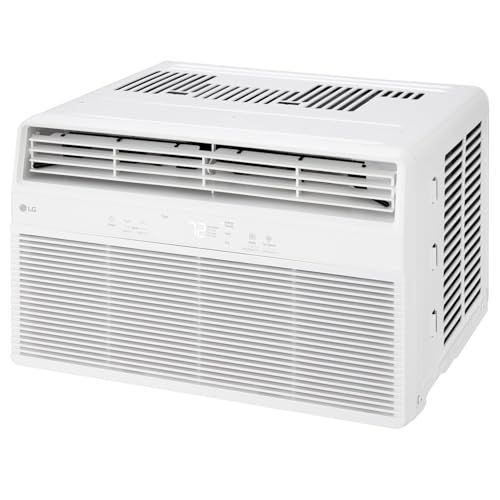
LG 8,000 BTU Window AC With Dehumidifier — Best window option for damp rooms
The lone window unit in this guide earns its place by avoiding the portable compromises altogether. LG’s title describes an 8,000 BTU window air conditioner with a dehumidifier function, running on 115V, with a remote control, a 24-hour timer, and auto-restart, for rooms up to 350 square feet. A window unit’s hot side lives outdoors, so its rated capacity is its working capacity in a way no portable headline is, and its condensate drains outside by design rather than into a tank indoors. For a damp bedroom in a house that permits window units, that architecture is the straightforward answer.
The dehumidifier function here follows the same rule as every moisture mode in this guide: it is a function of the cooling machine, useful for shoulder-season damp and for rooms that feel wet at acceptable temperatures, and it is not a standalone dehumidifier with a rated daily extraction. LG’s title claims no such figure and neither does this review. What the window format adds is runtime confidence — no tank to fill, no hose panel to leak room air — so the function can be left working through a wet week with only the filter asking for attention.
Auto-restart deserves its humid-climate mention. Summer storms in damp regions flicker power constantly, and a unit that resumes its settings after an outage keeps drying through the storm’s aftermath, which is precisely when indoor humidity spikes. Paired with the 24-hour timer for scheduled drying before the household returns, the control set is small but correctly aimed at the climate’s actual behaviour.
There is a quiet maintenance point specific to window units in wet regions. The exterior half of the machine lives in the weather, and its drain path can clog with the algae and debris that humid climates grow enthusiastically. A unit whose condensate backs up will drip in the wrong places and dry the room less effectively, so a seasonal check that water exits where it should is part of owning this format near the coast or the Gulf. It takes minutes, requires no tools beyond a torch and patience, and preserves the one architectural advantage — outdoor drainage — that justified choosing a window unit at all.
- Cooling capacity: 8,000 BTU per the title
- Coverage claim: rooms up to 350 sq ft per the listing
- Format: window unit, 115V
- Controls: remote, 24-hour timer, auto-restart per the title
- Where to buy: the LG 8,000 BTU Window AC With Dehumidifier listing on Amazon — check price on Amazon
Strengths
- Window architecture delivers its rated capacity without a portable derating and drains condensate outside.
- Auto-restart keeps moisture control running through storm-season outages.
- The timer supports scheduled drying of a room before occupants return to it.
Trade-offs
- It needs a suitable window and permission to fill it, which excludes many renters.
- The dehumidifier function remains a mode, not a rated standalone extraction appliance.
- At 8,000 BTU it will short-cycle in a small, mild room, undermining its own drying.
Best for: homeowners with a damp room up to its stated coverage and a window they are free to use.
Not the right match for: rooms far above 350 square feet, or any household barred from window installations.

Shinco 12,000 BTU Portable AC — Best honestly rated portable
Shinco does the thing this guide wishes every portable maker did: its title prints 12,000 BTU and then, in the same breath, 7,500 BTU SACC. That second figure is the planning number, and against it the accompanying claim — rooms up to 450 square feet — reads as the maker’s ceiling rather than a promise for a sunlit room. The unit combines cool, dehumidifier, and fan modes, ships with a remote control, a 24-hour timer, and an installation kit, and is aimed squarely at the mid-size damp room that dominates humid-climate housing.
For moisture work, the honest rating is itself a humidity feature. A buyer who sizes a room against 7,500 BTU SACC gets the long, condensing runtimes that dry air; a buyer who sizes against 12,000 gets short cycles and a clammy room, then blames the dehumidifier mode for a sizing error. Shinco’s title lets the careful buyer be careful. The timer extends the same advantage across the day, letting the machine dry the room during the humid afternoon build-up rather than only reacting in the evening.
The dehumidifier mode carries the standing clarification — a mode of a cooling machine, with no daily extraction figure stated in the title and none claimed here. Judged within those bounds, this is the portable for the buyer who reads specifications closely and wants the specification to reward the reading: both numbers printed, the kit included, the modes named, and a coverage claim that can be planned against without translation.
Consider who this honesty serves best: the buyer comparing across brands on a spreadsheet, who can place the Shinco’s corrected figure beside window units’ working ratings and make an apples-to-apples decision. Much portable marketing depends on that comparison never happening. In a humid climate the cost of the confusion is doubled, because the undersized-feeling machine that results will also under-dry. Shinco’s title is therefore not merely transparent but functional — it is the rare portable listing that lets a careful buyer predict the room’s humidity behaviour, not just its temperature, before the box arrives.
- Cooling capacity: 12,000 BTU headline / 7,500 BTU SACC per the title
- Coverage claim: rooms up to 450 sq ft per the listing
- Format: portable with installation kit included
- Modes: cool, dehumidifier, and fan, with remote and 24-hour timer per the title
- Where to buy: the Shinco 12,000 BTU Portable AC listing on Amazon — check price on Amazon
Strengths
- Published SACC enables correct sizing, which is the foundation of real humidity control.
- The 24-hour timer supports drying schedules matched to the day’s humidity curve.
- Installation kit in the box removes the accessory hunt that delays portable setups.
Trade-offs
- Planned honestly at 7,500 BTU SACC, it is a mid-room machine despite the larger headline.
- Moisture mode remains unrated for daily extraction, as with every pick here.
- Single-room focus means multi-room damp needs multiple placements or a different system.
Best for: spec-reading buyers with a mid-size damp room who want to size by SACC from the start.
Poorly suited to: large open spaces at the top of its coverage claim in severe heat and humidity combined.

Westinghouse 14,000 BTU AC With Heat — Best big-room coverage with heat
Westinghouse’s entry is the generalist of the group: a 14,000 BTU air conditioner with a heat mode, claiming 700 square feet of cooling coverage, with WiFi, a remote, a dehumidifier function, a 3-speed fan, a programmable timer, and a window kit per its title. The window kit in the listing places it in the portable camp for installation purposes, and its headline should be read with the portable caution since no SACC figure is printed. What distinguishes it is seasonal range. Humid climates are not hot all year; many have a damp cold season in which rooms feel raw rather than warm, and a unit that can take the edge off that chill — while its dehumidifier function addresses the accompanying damp — covers the calendar in a way cool-only machines cannot.
The heat mode and the moisture function are natural partners in that season. Cold damp air feels colder than its temperature, and gentle heating with simultaneous drying is the combination that makes a shoulder-season room feel restored rather than merely less cold. The 3-speed fan gives the owner the low gear that both heating and drying prefer, and the programmable timer lets the room be prepared before the household wakes or returns.
Coverage ambition is the point requiring discipline. Seven hundred square feet is the maker’s claim, offered here as titled; a buyer with a genuinely large, genuinely damp main room should treat this model as a candidate whose real test is the first saturated week, with the window kit sealed meticulously, because at the top of any portable’s range the installation quality decides as much as the machine does. Rotisserie cooking, incidentally, adds its own moisture and heat load to open plans — a connection the Best Countertop Rotisserie Ovens guide makes from the kitchen side.
The household this machine fits is easy to recognise. It has one big room that does everything — living, dining, the kids’ homework, the dog’s afternoon — in a region where October can feel as wet as July feels hot. That household does not need the most specialised tool in this guide; it needs the one that never has to be swapped out as the seasons rotate, cooling in the hot wet months and taking the raw edge off the cold wet ones. The Westinghouse’s breadth, which reads as indecision in a specialist ranking, is precisely the virtue that household is shopping for.
- Cooling capacity: 14,000 BTU per the title; no SACC figure stated
- Coverage claim: cools 700 sq ft per the listing
- Format: portable-style unit with window kit per the title
- Extra modes: heat mode and dehumidifier function, 3-speed fan, programmable timer
- Where to buy: the Westinghouse 14,000 BTU AC With Heat listing on Amazon — check price on Amazon
Strengths
- Heat plus dehumidifier covers the damp cold season that cool-only units abandon.
- The largest stated coverage in this guide targets genuinely big damp rooms.
- WiFi and a programmable timer suit the prepare-the-room-ahead pattern of humid climates.
Trade-offs
- No SACC figure is printed, so the big headline deserves a conservative reading.
- Heat from a portable-class unit is supplemental comfort, not a whole-home heating plan.
- The dehumidifier function is a mode without a stated daily extraction rate.
Best for: large rooms in humid regions with a real damp-cold season to cover as well as a hot one.
A weak match for: small rooms, where its capacity and feature set both overshoot the problem.

SereneLife 14,000 BTU Inverter Portable AC (Dual Hose) — Best dual-hose configuration
The second SereneLife in this guide is a different class of machine from its smaller sibling: a 14,000 BTU inverter portable with Wi-Fi whose title names the feature that matters most to portable physics — a dual hose system. A dual hose arrangement draws its intake air from outdoors and exhausts back outdoors, so the machine does not depressurise the room it is cooling. In a humid climate that pressure point is also a moisture point: a depressurised room pulls replacement air through every gap, and in August that replacement air is saturated. The dual hose design attacks the infiltration term directly, which is why it headlines this pick’s case.
The inverter compressor complements the hose arrangement by favouring long, modulated runs — the runtime pattern under which coils condense steadily. The title lists dehumidifier and fan modes alongside cooling, and a window kit is included. The standing clarification applies to its dehumidifier mode as to all others here: a mode of the cooling machine, with no daily extraction figure stated or claimed, best used for shoulder-season damp and for maintaining a dried room rather than rescuing a flooded one.
No SACC figure appears in this title either, so the 14,000 BTU headline is reported with the portable caution, though a dual hose configuration is precisely the design the SACC adjustment penalises least. For the buyer whose room has repeatedly defeated single-hose portables — the room that cools yet never dries, in a house whose doors slam themselves shut from pressure — this is the configuration change most likely to explain and then fix the failure.
Installation patience matters more here than with any other pick, because two hoses must both seat well in the window kit, and a careless fitting leaks away the very advantage the design exists to provide. Budget the extra quarter hour, foam both apertures, and check that neither hose kinks behind furniture. Done properly, the result is the portable that behaves least like a portable — steady pressure, steady drying, no mysterious warm draughts at the door undercuts. Done carelessly, it is an expensive single-hose machine with a spare tube, which is why this review spends its caution on the fitting rather than the features.
- Cooling capacity: 14,000 BTU per the title; no SACC figure stated
- Format: inverter portable with dual hose system per the title
- Modes: dehumidifier and fan modes listed with cooling
- Control: Wi-Fi per the title; window kit included
- Where to buy: the SereneLife 14,000 BTU Inverter Portable AC (Dual Hose) listing on Amazon — check price on Amazon
Strengths
- Dual hose design avoids depressurising the room and pulling saturated air through its gaps.
- Inverter running sustains the cold-coil periods that real dehumidification requires.
- Wi-Fi control supports drying schedules run ahead of the household’s return.
Trade-offs
- Two hoses are bulkier to route and to store than one.
- Without a printed SACC figure, exact capacity planning still rests on judgement.
- The dehumidifier mode remains a mode — no standalone extraction rating is stated.
Best for: humid rooms where earlier portables cooled the air but never dried the room’s feel.
Not suited for: buyers needing the smallest possible footprint, or rooms where a window unit is freely permitted and preferred.
Moisture-First Contenders Compared
| Model | Format | Rating as titled | Coverage as titled | Moisture-relevant trait |
|---|---|---|---|---|
| SereneLife 8,000 BTU Portable AC With Dehumidifier | Portable | 8,000 BTU | Up to 350 sq ft | Dehumidifier mode, 3 fan speeds |
| Whynter ARC-1230WN Inverter Portable AC | Portable, inverter | 14,000 BTU | Not stated in title | Built-in dehumidifier with auto drain |
| LG 8,000 BTU Window AC With Dehumidifier | Window | 8,000 BTU | Up to 350 sq ft | Dehumidifier function, auto-restart |
| Shinco 12,000 BTU Portable AC | Portable | 12,000 / 7,500 SACC | Up to 450 sq ft | Dehumidifier mode, 24-hour timer |
| Westinghouse 14,000 BTU AC With Heat | Portable format | 14,000 BTU | 700 sq ft | Dehumidifier plus heat mode |
| SereneLife 14,000 BTU Inverter Portable AC (Dual Hose) | Portable, inverter | 14,000 BTU | Not stated in title | Dual hose system, dehumidifier mode |
How Should You Run an Air Conditioner Differently in a Humid Climate?
Start earlier than comfort demands. A room allowed to saturate through the afternoon takes hours of runtime to dry, because the machine must empty the moisture stored in bedding, rugs, and upholstery as well as the air. A timer or app schedule that begins gentle cooling and drying before the day’s peak humidity arrives keeps the reservoirs from filling in the first place. This is the humid-climate version of the pre-cooling habit, with the emphasis shifted from temperature to water: the goal is a room whose contents never get wet, not a room rescued after they do.
Manage the doors with intent. A cooled room’s door left open to a humid hallway imports moisture continuously; the same door closed lets the unit govern a finite volume and actually finish drying it. Bathroom doors deserve special discipline — a long shower can undo an hour of drying in the adjacent bedroom if the steam is allowed to wander, so exhaust the bathroom at its source and keep its door shut until the mirror clears. Laundry dried indoors is the other hidden load; where any alternative exists, dry it outside the cooled zone.
Night-time deserves its own tactic. Outdoor humidity often peaks toward dawn even as temperature falls, so a room dried beautifully by midnight can re-saturate by five in the morning if the machine rests. A low, steady overnight setting — or the dehumidifier mode on a timer that covers the pre-dawn hours — defends the room during its most vulnerable window. Sleepers in humid regions consistently report that this pre-dawn defence, more than any daytime heroics, is what makes the bed feel dry when the alarm rings.
Use the dehumidifier mode for the hours it was designed for: the mild, wet mornings and evenings when cooling alone would over-chill the room before drying it. Use full cooling, right-sized and long-running, for the hot wet afternoons. And keep the filter clean with unusual diligence, because humid air carries the mould spores and dust that load a filter fastest, and a starved coil neither cools nor condenses at its rated ability. None of these habits costs anything; together they are worth more than the difference between any two models in this guide.
What Are the Signs That Cooling Alone Will Not Solve a Damp Home?
Some houses announce that their problem is water, not heat. Musty odour that returns within days of cleaning, condensation on the inside of windows in mild weather, mould at the corners of external walls, wooden doors that swell shut every summer, and bedding that feels cool-damp at bedtime in an air-conditioned room — each is a sign that moisture is entering or being generated faster than any comfort-cooling runtime will remove it. In those homes the correct sequence is source first: fix the leak, vent the bathroom, address the ground moisture, and only then size cooling. An air conditioner asked to fight a building defect will run constantly, cost accordingly, and still lose.
This is also where the guide’s central clarification becomes practical rather than pedantic. A household in that situation needs a standalone dehumidifier, an appliance rated by the water it extracts each day, placed where the water is. The six machines above will then do their proper job — comfort — superbly. Confusing the two appliances is the most expensive mistake in this category, because it produces a home that owns the wrong tool in the wrong room while the actual problem continues quietly behind the furniture.
How Do Shoulder Seasons Change What You Need From the Machine?
Humid regions have two discomfort seasons, not one. The obvious season is high summer, when heat and moisture peak together and full cooling does both jobs at once. The treacherous season is the shoulder — spring and autumn weeks when the air is saturated but the temperature is merely mild. In those weeks a cool-only household faces a poor choice between shivering under refrigeration run for drying’s sake, or switching the machine off and letting the house absorb moisture for a month. Every pick in this guide exists partly to dissolve that choice: the dehumidifier modes run the moisture work at gentler thermal cost, and the Westinghouse adds heat for the weeks when the damp arrives cold.
Shoulder-season running also changes the maintenance calendar. Filters load fastest when machines run daily in wet air, and condensate paths grow the most biological clutter in the same months. The owner who cleans at the start of the shoulder season, rather than waiting for summer, gets the drying performance the modes promise. In humid climates, the appliance year effectively starts in the damp spring, and households that internalise that calendar find their machines perpetually ready instead of perpetually catching up.
What Role Does Ventilation Play Alongside All This Cooling?
Cooling recirculates; ventilation replaces. A humid-climate home needs both, in the right places at the right times. Bathrooms and kitchens generate moisture in bursts that no room air conditioner should be asked to absorb — those bursts belong to exhaust fans vented outdoors, run during the shower or the pasta boil and for a while afterward. Bedrooms and living rooms, by contrast, benefit from the sealed, recirculating treatment these six machines provide, because outdoor air on a humid night is a moisture import, not a freshness upgrade.
The mistake is mixing the two philosophies — cracking windows for fresh air while the portable runs, or expecting the air conditioner to clear a steamy bathroom through an open door. Each appliance in this guide performs best in a closed room whose moisture bursts are handled at their sources. Get the ventilation right at the wet rooms, and the cooling machines’ dehumidifier modes shift from fighting the house to merely seasoning its air, which is the workload they were designed for.
Which Humid-Climate Buying Mistakes Keep Rooms Clammy?
The first is oversizing for reassurance. In dry heat, spare capacity is merely wasteful; in humidity it is counterproductive, because short cycles abandon the drying work half done. The second is believing a mode is an appliance — expecting a dehumidifier mode to deliver standalone extraction, then concluding the brand lied when the mode was only ever a mode. The third is neglecting drainage until the machine stops mid-cycle on the wettest night of the year, tank full, room re-saturating.
Fourth, buyers seal nothing. A portable’s window panel fitted loosely leaks the room’s dried air out and the street’s wet air in, and the owner compensates by running the machine harder, which mostly runs the meter harder. Fifth, shoppers ignore the shoulder season entirely, buying for the hottest week and discovering that the long damp spring — when the dehumidifier modes and the Westinghouse’s heat earn their keep — was the season their home actually needed help with. Each mistake is a reading failure before it is a product failure.
How Should Renters in Damp Regions Choose Without Modifying the Building?
Renters face the humid problem with the fewest permitted tools: no window unit in many leases, no ventilation upgrades, no sealing work beyond the reversible kind. The portables in this guide are their realistic arsenal, and the choice among them turns on drainage and hose discipline. A renter who is home daily can manage a simpler machine; a renter who travels for work should weight the Whynter’s auto drain heavily, because a portable that stops when its tank fills is, for an absent household, a machine that does not dry at all. Window panels must be fitted without screws or permanent alteration, which foam and tension accomplish in most openings.
Documentation protects the renter twice over. Photograph the window before fitting the kit, keep the landlord’s written acknowledgement if the lease mentions cooling appliances, and store every panel and hose with the machine so the move-out leaves no orphaned parts behind. Damp regions also make security deposits sensitive to mould claims; a renter who can show the room was actively dried through the season — a machine present, maintained, and run — is in a far stronger position than one arguing from memory in October.
Final Recommendation
Choose by water first and temperature second. For a single damp room, the compact SereneLife covers the common case with its named moisture mode and included kit; for a room that must dry unattended, the Whynter’s auto drain design is the specialist; where a window is available, the LG delivers rated capacity and outdoor drainage without portable compromises; the Shinco rewards the careful sizer with an honest SACC figure; the Westinghouse spans the damp cold season with heat; and the dual hose SereneLife answers the room that cooled but never dried. Buy the machine whose moisture arrangements match your home’s water, and a humid summer becomes a season you manage rather than endure — which, in a climate where the air itself is the problem, is the only verdict that matters.
Frequently Asked Questions
Is a dehumidifier mode as good as a separate dehumidifier?
No, and this guide has been careful to say so throughout. A mode runs the cooling machine in a moisture-favouring way and carries no rated daily extraction; a standalone dehumidifier is built and rated for water removal alone. Modes handle comfort-level damp and shoulder seasons well. Chronic wetness, musty odours, and visible mould call for the dedicated appliance, usually alongside fixing the moisture’s source.
Why does my room feel clammy an hour after the unit switches off?
Because the room’s contents store moisture. Bedding, rugs, upholstery, and clothing absorb damp air while the unit rests and release it afterward, so the air’s humidity rebounds even with no new water entering. Longer, gentler running — right-sized capacity, inverter operation, scheduled pre-drying — empties those reservoirs over days, after which the rebound largely disappears.
Does a dual hose portable really matter in humid weather?
It addresses a real mechanism. A single exhaust hose depressurises the room, and the replacement air that leaks in is outdoor air — in a humid climate, saturated air that the machine must then dry. A dual hose system, as titled on the SereneLife 14,000 BTU model, draws and exhausts outdoors, avoiding that self-inflicted load.
What size should I choose for a damp 300 square foot room?
Start from the listings’ own claims and the honest ratings. The LG window unit and the smaller SereneLife both claim coverage up to 350 square feet; the Shinco, planned at its 7,500 BTU SACC, claims up to 450. In severe exposure, prefer the option whose rating you did not have to discount, and remember that in humidity the next size up can dry worse, not better, if it shortens the cycles.
Can these units prevent mould?
They can make rooms less hospitable to it by holding humidity down through steady running, and that is a genuine contribution. They cannot remediate existing mould, overcome a leak, or substitute for ventilation in a bathroom. Treat persistent mould as a building problem to be found and fixed, with cooling as support rather than as the cure.
Should I run the dehumidifier mode all day while I am out?
It depends on the machine’s drainage. A model with auto drain, like the Whynter in this guide, is designed for unattended moisture running and is the right tool for daytime drying of an empty flat. A model that collects condensate internally may stop when full, so all-day mode running away from home can achieve little beyond the first hours. In both cases a timer that concentrates runtime in the most humid hours is thriftier than an unbroken all-day run.
How often should the filter be cleaned in a humid region?
More often than the manual’s mild-climate rhythm suggests — every few weeks in season is a sensible habit. Humid air loads filters with dust and spores quickly, and a clogged filter reduces both cooling and condensation. It is the cheapest performance available in this entire category.
Related Guides
Keep the condensate path in the maintenance diary alongside the filter, because in this climate the two together decide whether the machine you bought is still the machine you own by the second summer.
A closing observation from the structure of this list itself: five of the six verified picks with explicit moisture design are portables, and that is not an editorial preference but a market fact. Manufacturers build their humidity storytelling into the format that can move to the water. Homeowners with a free window should not let that majority talk them out of the LG’s simpler architecture, and renters should not let the window unit’s elegance talk them into a lease violation. The climate is the same either way; the buildings differ, and the right machine is the one whose moisture arrangements survive contact with both.
Moisture problems rarely stop at the cooled room, and the bathroom is usually the next front in the same campaign. Readers fighting a whole-home damp pattern will find the closest companion reading in Best Air Purifiers for Mold, where the mould side of indoor air is treated with the same insistence on sources before appliances, and where the reader will find the same refusal to let a mode, a filter, or a marketing phrase stand in for the dedicated equipment a genuinely wet home eventually needs.


