What's inside
- Key Takeaways
- Quick Picks
- How We Chose These Picks
- Why Does a Small Home Reward Room-by-Room Cooling So Strongly?
- Small-Home Systems at a Glance
- How Should a Small-Home Owner Sequence a Multi-Room Programme?
- What Does Professional Installation Actually Involve for These Systems?
- How Do These Systems Change a Small Home’s Winter?
- What Should Owners Expect From Maintenance Across the Years?
- Which Small-Home Cooling Mistakes Cost the Most?
- What Does a Small Home Gain in Resale and Daily Life From Fitted Cooling?
- How Should a Buyer Interview Installers for a Job Like This?
- Final Recommendation
- Frequently Asked Questions
- Related Guides
As an Amazon Associate I earn from qualifying purchases. This post may contain affiliate links at no extra cost to you.
cottageverdict.com is reader-supported. When you buy through links on our site, we may earn an affiliate commission.
Where to buy: each ductless system below is sold through its own Amazon listing, linked in the Quick Picks table and under every detailed review, where you can check price on Amazon before arranging installation.
A small home changes the cooling question from “how big a machine” to “how should comfort be distributed”. A cottage, a bungalow, a small ranch — these houses are not one large room but several modest ones, each with its own sun exposure and its own hours of use, and a single heroic appliance in the hallway serves all of them badly. The best air conditioners for small homes, in the verified pool available to this guide, turned out to be ductless mini splits: wall-mounted indoor units paired with an outdoor condenser, installed room by room, each governing its own space. All six picks below are mini splits, and that is not an editorial narrowing — it is what the pool honestly contained for this question, and it happens to be the architecturally correct answer for the housing type.
Two honest boundaries belong at the front. First, a mini split is not a plug-in appliance. It is a refrigerant system: an indoor head on the wall, an outdoor unit on a pad or bracket, lines run between them, and commissioning that belongs to a professional. One listing in this guide states the requirement outright in its title — HVAC tech needed — and this guide treats that phrase as applying in spirit to the whole category, whatever an individual title’s confidence about installation kits. Budget the installer alongside the equipment, or choose a different category of cooling entirely. Second, whole-house central systems are outside this guide’s scope; they are a ducted answer for homes with ducts or the appetite to add them, discussed here only as the alternative a small-home owner should consciously decline or defer.
Efficiency figures need the same discipline as everywhere else in this batch. SEER2 numbers appear below only where a title prints them — 20 SEER2 on two picks, SEER2 18 on another, 19 SEER2 on the largest, and a SEER 22 wording on one — and where a title prints none, as with the Senville that opens the list, none is claimed. Coverage claims likewise come from the titles, running up to 750 square feet for most of the 12,000 BTU class and up to 1,500 square feet for the 24,000 BTU Temprium. Readers comparing running costs across categories will find the efficiency-first ranking in Best Energy-Saving Air Conditioners a natural next read, since a small home cooled room by room is where inverter efficiency compounds most visibly.
Our Top Picks
 COSTWAY 12000BTU Mini Split Air Conditioner& Heater12000BTU, 115V, 20 SEER9 x 44.5 x 13 inches68 poundsCheck on Amazon
 ROVSUN 9000 BTU Wifi Enabled Mini Split Air8.07"D x 31.92"W x 11.49"H7.99 x 31.92 x 11.49 inches70 poundsCheck on Amazon
 GarveeHome SEER 22 12000BTU 115V Mini Split Air31.18 x 23.62 x 28.78 inches87.2 poundsCheck on Amazon
 Temprium 24000 BTU Mini Split Air Conditioner24,000 BTU, 230V, 19 SEER212.28 x 42.87 x 12.91 inches40.8 poundsCheck on Amazon
Key Takeaways
- All six verified picks for small homes are ductless mini splits — the room-by-room answer suits small houses better than one oversized central appliance.
- Professional installation is part of the product: one title states HVAC tech needed outright, and the category as a whole requires refrigerant work no window unit asks for.
- SEER2 figures are quoted only from titles: 20 SEER2 (COSTWAY and ROVSUN), SEER2 18 (Albott), 19 SEER2 (Temprium), and a SEER 22 wording (GarveeHome); the Senville title states none.
- Five picks are 115V-class systems per their titles; the 24,000 BTU Temprium runs on 230V and claims coverage up to 1,500 square feet.
- Every pick is a heat pump as titled, so the same installation heats in winter — a decisive advantage in small homes without ducts.
Quick Picks
| Pick | Badge | Why it earns its place |
|---|---|---|
| Senville LETO (12,000 BTU) | Best established all-rounder | A 12,000 BTU heat pump split with Alexa compatibility and inverter operation, on a 110/120V supply per its title. |
| COSTWAY (12,000 BTU) | Best figured specification | Its title states 20 SEER2, 115V, and coverage claimed at 750 square feet — the most complete planning data in the group. |
| ROVSUN (9,000 BTU) | Best for the single key room | A 9,000 BTU, 20 SEER2 WiFi split with a pre-charged condenser and installation kit per its title, sized for one important room. |
| Albott (12,000 BTU) | Best honesty about installation | A SEER2 18 system with a 750 square foot claim whose title states plainly that an HVAC tech is needed. |
| GarveeHome (SEER 22) | Best stated efficiency figure | Its title leads with a SEER 22 wording, WiFi, and an installation kit, with rooms claimed at 750 square feet. |
| Temprium (24,000 BTU) | Best for the larger small home | A 24,000 BTU, 19 SEER2 heat pump claiming up to 1,500 square feet, on 230V with R32 refrigerant per its title. |
How We Chose These Picks
The pool decided the category. When the verified listings for small-home cooling were assembled, the coherent, specification-complete options were ductless mini splits in the 9,000 to 24,000 BTU range — sizes that map onto small houses room by room or, at the top end, onto a compact open-plan home. Window units and portables exist for small homes too, and the other guides in this batch cover them by room type; but a guide that pretends a small house is just a big room with less floor would mislead. The six splits here were ranked as a programme: start with the main living space, extend to bedrooms as budget allows, and let each room’s unit be sized to that room.
Specification discipline followed the batch rule. SEER2 and coverage appear only as titled; voltage is quoted wherever a title states it, because 115V versus 230V decides whether an existing circuit can serve the outdoor unit; heat pump capability is credited only where the title claims it, which in this pool is everywhere, though the reviews note it pick by pick rather than assuming it silently. Installation language was treated as a feature in itself — the Albott’s explicit HVAC-tech wording is praised not as a warning label but as the most honest sentence in the category.
One scope decision deserves stating. Multi-zone systems — one outdoor unit feeding several indoor heads — are the natural completion of a small-home programme, but the verified pool here consists of single-zone listings, so this guide ranks single-zone systems and discusses the multi-room plan as a sequence of installations. Readers whose homes need four heads on one condenser should treat these reviews as evidence about brands, sizes, and specification honesty, then shop the multi-zone configurations of the same families with an installer’s help.
Why Does a Small Home Reward Room-by-Room Cooling So Strongly?
Small homes are thermally diverse in a way their floor area hides. The kitchen warms at six, the west bedroom bakes at seven, the north nursery barely needs cooling at all, and a single thermostat anywhere in that house is a compromise imposed on every room. A mini split per key room replaces the compromise with governance: each space gets the temperature its occupants want, at the hours they want it, and unoccupied rooms can rest rather than being cooled as a tax on the occupied ones. In a small home, where the total load is modest, that zoning is where the real efficiency lives — more than in any single SEER2 increment.
The heat pump dimension compounds the argument. Small homes without ducts often heat with the most expensive tools in the catalogue: plug-in resistance heaters, ageing wall units, or a single stove heating one room while pipes freeze in another. Every pick in this guide heats as titled, so the installation that solves July also retires the worst of January, room by room, with the same outdoor unit. For a cottage or bungalow, that two-season return is frequently what justifies the installer’s invoice. The fitted, built-in character of the result — a head on the wall rather than an appliance in the window — also suits how small homes are actually furnished, a point the custom cabinetry world understands well, as the fitted-solution thinking in Best Range Hood Inserts shows for the kitchen’s version of the same problem.
There is a discipline the format demands in return: commitment. A window unit can be a experiment; a mini split is a decision about a room for a decade. Placement of the indoor head, the outdoor unit’s position relative to neighbours and bedrooms, and the line-set route through the house all become semi-permanent facts. The sections below treat those decisions with the seriousness they deserve, because in a small home there is no spare wall to move to if the first choice was careless.
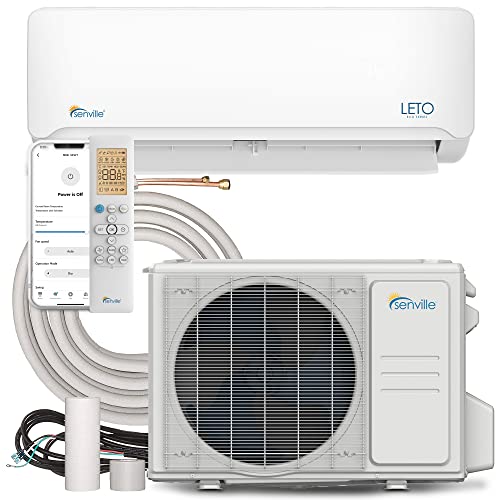
Senville LETO (12,000 BTU) — Best established all-rounder
The Senville LETO opens the list as the category’s reference point: a 12,000 BTU ductless mini split with a heat pump, wall-mounted indoor unit, Alexa compatibility, and energy-efficient inverter operation, running on 110/120V per its title. The listing describes it as a 1-ton system, the classic size for a main living space or a large bedroom in a small home. Notably, the title states no SEER2 figure and no coverage number, so this guide claims neither — the LETO is recommended on its configuration and its longstanding presence in this category, with the understanding that a buyer who needs a printed efficiency figure to plan against has four alternatives below that provide one.
Voice control through Alexa suits the small-home pattern more than gadget appeal suggests. In a house where the living room, kitchen, and dining area share one volume, adjusting the head from the stove or the sofa without hunting a remote is a daily convenience, and scheduling through the same ecosystem lets the one main room be pre-conditioned before the household wakes. The inverter compressor supports the pattern by holding temperature in long, low runs rather than cycling.
As the programme’s first installation, the LETO’s natural home is the room the household lives in — the combined living space of a cottage or the family room of a bungalow. Bedrooms can follow in later seasons with smaller heads from the same family. Buyers should arrange the installer before ordering, confirm the outdoor unit’s placement against local rules and neighbourly distances, and treat the Alexa integration as a bonus on top of a sound refrigerant installation, not as a substitute for one.
There is a maturity argument for beginning a programme here. The LETO family has been the default recommendation in this category long enough that installers know it, parts channels stock for it, and a second head added in three years will match the first in control logic and appearance. A small-home programme is a multi-year project by design, and continuity across its stages is worth real consideration beside any single specification. The household that starts with the reference product rarely regrets the ordinariness of the choice.
- Cooling capacity: 12,000 BTU (1 ton) per the title
- Format: ductless mini split, wall-mounted, heat pump
- Supply: 110/120V per the title
- Control: works with Alexa per the title; inverter operation
- Where to buy: the Senville LETO split listing on Amazon — check price on Amazon
Strengths
- A complete, conventional specification for the main room of a small home.
- Heat pump capability covers the cold season from the same installation.
- Standard-voltage supply simplifies the electrical side of the install.
Trade-offs
- No SEER2 or coverage figure is stated in the title, limiting specification-led comparison.
- Professional installation is required, as with every pick in this guide.
- Single-zone format means additional rooms mean additional systems.
Best for: the main living space of a cottage, bungalow, or small ranch as the first split in a programme.
Not suited for: buyers who need a printed efficiency rating before committing, or anyone expecting a plug-in appliance.
COSTWAY (12,000 BTU) — Best figured specification
COSTWAY’s title is a model of the completeness this guide rewards: a 12,000 BTU mini split air conditioner and heater stating 20 SEER2, a 115V supply, wall-mounted ductless format, coverage up to 750 square feet, and an energy-efficient inverter with heat pump. Every number a small-home buyer needs for planning is present in one sentence. The 750 square foot claim, read as the maker’s ceiling for a favourable space, suits the open main floor of a compact home — or, more conservatively, the large living room that anchors it — and the 20 SEER2 figure gives the running-cost conversation a factual starting point the Senville listing declines to provide.
The inverter-plus-heat-pump combination is the small-home formula in its purest form. Cooling in summer, heating in winter, modulation in both, and a wall head that asks nothing of the windows. In a bungalow whose main floor is one connected volume with bedrooms off it, this unit in the living space plus disciplined door management can carry more of the house than its conservative reading suggests — though this guide’s zoning advice stands: bedrooms that must be right, rather than approximately right, deserve their own smaller systems in time.
COSTWAY’s proposition is ultimately about predictability. A buyer can model this purchase — capacity, efficiency, voltage, coverage — from the title alone, then spend the consultation with the installer on placement and line runs rather than on discovering basic facts. In a category where specification fog is common, that clarity is a genuine product feature, and it is why this pick carries the figured-specification badge.
Consider the bungalow arithmetic this specification enables. A main floor claimed at up to 750 square feet, served by a 20 SEER2 inverter that also heats, converts the home’s largest comfort expense into its most efficient one. The bedrooms, in this first stage, borrow coolth through open doors in the evening and close them at night as the main space’s stored coolness carries them. Many households find that arrangement sufficient for all but the hottest weeks — and discover, a season later, exactly which one bedroom justifies the programme’s second stage. That evidence-led sequence begins with a specification complete enough to trust, which is this pick’s whole case.
- Cooling capacity: 12,000 BTU per the title
- Efficiency: 20 SEER2 as stated in the title
- Coverage claim: cools up to 750 sq ft per the listing
- Supply: 115V per the title; inverter with heat pump
- Where to buy: the COSTWAY split listing on Amazon — check price on Amazon
Strengths
- The most complete title specification in the group enables real planning.
- A 20 SEER2 figure anchors the efficiency comparison honestly.
- Coverage to 750 square feet as claimed suits a compact home’s main floor.
Trade-offs
- The coverage claim should still be read conservatively in subdivided floor plans.
- Professional installation remains part of the true purchase.
- One zone governs one space; the whole-home programme is sequential.
Best for: planners who want capacity, efficiency, and coverage stated before they spend.
A poor fit for: homes needing several rooms conditioned simultaneously from day one.
ROVSUN (9,000 BTU) — Best for the single key room
Not every small-home problem is the main room. Sometimes it is one room that decides whether the house is liveable: the primary bedroom that bakes, the nursery, the home office in the converted porch where someone now earns a living eight hours a day. The ROVSUN is sized for exactly that intervention — 9,000 BTU, WiFi enabled, with an inverter, a stated 20 SEER2, a 115V supply, a pre-charged condenser, and an installation kit, per its title. The smaller capacity is a virtue in a single room: right-sized splits run the long, gentle cycles that hold a bedroom’s temperature and humidity steady through the night.
Two title details speak to the installation reality. A pre-charged condenser simplifies the refrigerant side of the commissioning, and the included installation kit means the line set and ancillaries arrive with the machine rather than as a scavenger hunt. Neither converts the job into a casual weekend project — refrigerant connections and evacuation remain professional territory in this guide’s judgement — but both reduce the installer’s time and the owner’s surprises, which is the honest way to value them.
WiFi control fits the key-room pattern: the office pre-cooled before the workday, the bedroom conditioned before bed, the nursery held steady without entering to adjust anything. As the second or third step in a small-home programme — after the main room is solved — or as the single decisive step for a one-room problem, the ROVSUN is the most precisely aimed pick in this list.
The key-room logic deserves one more emphasis, because it reverses the usual buying instinct. Households tend to spend on the room guests see; comfort, however, is decided in the rooms where life is actually spent — the bedroom’s eight hours, the office’s working day. A 9,000 BTU split in the right bedroom routinely changes a family’s verdict on its house more than a larger system in the living room would. The ROVSUN is the pick that formalises that insight, at a capacity and efficiency that make the intervention feel modest in cost and permanent in effect.
- Cooling capacity: 9,000 BTU per the title
- Efficiency: 20 SEER2 energy saving as stated in the title
- Format: ductless split with pre-charged condenser and installation kit per the title
- Supply and control: 115V, WiFi enabled, inverter, heat pump
- Where to buy: the ROVSUN split listing on Amazon — check price on Amazon
Strengths
- Right-sized capacity for one important room, with a stated 20 SEER2 figure.
- Pre-charged condenser and included kit reduce installation friction.
- WiFi control suits the pre-conditioning routines of offices and bedrooms.
Trade-offs
- Nine thousand BTU will not rescue a main living space of any size.
- No coverage figure is stated in the title, so room matching rests on the capacity class.
- Professional commissioning is still the responsible route despite the kit.
Best for: the one room — bedroom, nursery, office — whose comfort decides the house’s liveability.
Not the right match for: main living areas, where the 12,000 BTU class is the starting point.

Albott (12,000 BTU) — Best honesty about installation
The Albott earns its badge with four words in its title: HVAC tech needed. In a category where listings routinely imply that a refrigerant system is a weekend project, that plain statement is the most consumer-friendly sentence available, and this guide rewards it with a ranking rather than a warning. The machine behind the honesty is fully specified besides: a 12,000 BTU mini split and heater at SEER2 18, on 115V, with inverter operation, self-cleaning, remote and app control, and coverage claimed up to 750 square feet.
Self-cleaning deserves its sentence. An indoor head that helps keep its own coil clean addresses the split system’s one recurring maintenance theme — the indoor unit lives in the room’s air, and a neglected coil in a humid climate grows the musty smell owners then blame on the format. App control alongside the remote covers both the scheduled household and the adjust-from-the-sofa one, and the SEER2 18 figure, while a step below the two 20 SEER2 picks here, is stated plainly enough to be weighed rather than guessed.
Buyers should take the title’s installation wording as the template for the whole purchase: get the tech first. An installer who has seen the house can confirm the head placement, the outdoor unit’s siting, and whether this 12,000 BTU class matches the intended room — and can do so before the equipment arrives. The Albott is the pick for the owner who wants the category’s benefits with its realities stated in the same breath, and there are more such owners than the market’s usual copy assumes. High-throughput households, incidentally, generate their own indoor loads worth planning around, a theme the Best Conveyor Pizza Ovens guide explores from the commercial extreme.
The Albott also models a healthier relationship between buyer and category. A household that reads “HVAC tech needed” and responds by interviewing two installers before ordering will make better placement decisions, get the condensate route right the first time, and hold realistic expectations about commissioning day. That household’s satisfaction with whichever split it buys will be higher than the household that ordered in a click and met reality at delivery. In that sense this listing’s honesty is not merely a virtue in itself — it is a filter that assembles the ownership experience the product deserves.
- Cooling capacity: 12,000 BTU per the title
- Efficiency: SEER2 18 as stated in the title
- Coverage claim: cools up to 750 sq ft per the listing
- Installation: HVAC tech needed, stated in the title; self-cleaning, remote and app control
- Where to buy: the Albott split listing on Amazon — check price on Amazon
Strengths
- The title’s installation honesty sets correct expectations from the first click.
- Self-cleaning addresses the indoor coil’s real maintenance burden.
- Full control set — remote plus app — suits both scheduled and spontaneous households.
Trade-offs
- SEER2 18 trails the 20 SEER2 picks for buyers optimising running costs.
- The stated coverage ceiling needs the usual conservative reading in divided plans.
- It formalises, rather than removes, the installer cost every split carries.
Best for: buyers who want the installation reality in writing and a complete mid-efficiency specification.
Poorly suited to: anyone determined to self-install regardless of guidance.
GarveeHome (SEER 22) — Best stated efficiency figure
GarveeHome leads its title with the efficiency claim: a SEER 22 wording for a 12,000 BTU, 115V mini split with WiFi, described as an energy-efficient ductless inverter heating and cooling system with remote control and an installation kit, for rooms up to 750 square feet. That SEER figure is quoted here exactly as the title words it — the listing says SEER 22 rather than SEER2 22, and this guide preserves the distinction rather than silently upgrading the claim. On its face it is the strongest efficiency statement in the group, and a buyer comparing running costs should weigh it as a maker-stated figure alongside the two explicit SEER2 20 listings.
The rest of the package follows the small-home formula faithfully: inverter modulation, heat as well as cooling, WiFi for scheduling, and an installation kit in the box. In a compact home where the main room’s system will run long hours across both seasons, the efficiency figure — whatever its precise test basis — is aimed at the right variable, because hours are what a primary system accumulates. The 750 square foot claim matches the COSTWAY’s ceiling, giving buyers two figured alternatives at the same coverage with different efficiency wordings to interrogate.
That interrogation is the review’s honest closing note. A careful buyer will ask the seller or installer to confirm the rating basis behind the SEER 22 wording before treating it as superior to a stated SEER2 20, since the two metrics are cousins rather than twins. If the answer satisfies, this is the efficiency-led pick of the six; if it does not, the COSTWAY’s fully explicit title is waiting one review above. Either way, the decision is being made on stated figures, which is the standard this guide exists to enforce.
For the household that tracks its energy use — and small homes with a single main system can actually see one appliance’s fingerprint on the bill — the GarveeHome’s proposition is testable in a way few marketing claims are. Install it, run the main room through a season, and compare against the home’s previous summers with the usual caveats about weather. The WiFi layer supports that experiment with schedules the owner can hold constant. Whether the SEER wording’s basis flatters it or not, a system bought for efficiency and then measured by its owner is the category working exactly as it should.
- Cooling capacity: 12,000 BTU per the title
- Efficiency: SEER 22 as worded in the title (not stated as SEER2)
- Coverage claim: rooms up to 750 sq ft per the listing
- Supply and control: 115V, WiFi, remote control, installation kit included
- Where to buy: the GarveeHome split listing on Amazon — check price on Amazon
Strengths
- The strongest efficiency wording in the group targets the high-hour main room.
- Complete package: inverter, heat, WiFi, and kit all stated in the title.
- Coverage claim matches the class leaders at 750 square feet.
Trade-offs
- The SEER wording differs from the SEER2 basis used by rivals and deserves confirmation.
- Professional installation remains part of the purchase, kit notwithstanding.
- Single-zone scope applies, as with every pick here.
Best for: efficiency-led buyers who will verify the rating basis and then run the system long hours.
A weak match for: shoppers who want every figure on the identical SEER2 basis without asking questions.
Temprium (24,000 BTU) — Best for the larger small home
The Temprium doubles the class: a 24,000 BTU mini split and heat pump at 19 SEER2, claiming coverage up to 1,500 square feet, on a 230V supply, with R32 refrigerant, WiFi smart control, and a complete installation kit, per its title. That specification addresses the top of this guide’s housing brief — the larger small home, the open-plan cottage, the compact house whose main volume is genuinely one big space — where a 12,000 BTU head would run at its ceiling all summer. The 230V requirement mirrors the large-room guide’s lesson: capacity at this level asks for a circuit to match, and the check belongs before the order.
R32 refrigerant is worth its mention as the title’s forward-looking detail; it is the newer refrigerant generation in this category, and an owner installing a system intended to serve a decade should weigh the refrigerant’s future serviceability alongside today’s efficiency figure. The 19 SEER2 rating, stated plainly, sits between the Albott’s 18 and the pair of 20s — respectable at twice their capacity, since efficiency at the 24,000 BTU size is the harder engineering problem.
The Temprium’s risk is the mirror of its virtue: oversizing. In a subdivided 1,100 square foot house, a single 24,000 BTU head in one room does not cool the other rooms — it over-cools its own and leaves the bedrooms to their own devices. This pick belongs in homes whose plan is genuinely open, or as the anchor of a programme whose bedrooms will receive their own smaller heads in due course. Matched to the right architecture, it is the one-system answer the smaller picks cannot be.
Think of the homes where this is not the second stage but the whole answer: the converted barn apartment, the open-plan lake cottage, the compact modern build whose living volume is one tall space. In those architectures the subdivision problem vanishes, and a single 24,000 BTU head with a claimed 1,500 square foot reach is the proportionate tool rather than an indulgence. The Temprium’s WiFi control and complete kit round out a specification that asks only two things of its buyer — an open plan worthy of it, and a 230V circuit ready for it. Homes that meet both conditions will find this the shortest route in the guide from decision to comfort.
- Cooling capacity: 24,000 BTU per the title
- Efficiency: 19 SEER2 as stated in the title
- Coverage claim: up to 1,500 sq ft per the listing
- Supply: 230V per the title; R32 refrigerant, WiFi control, installation kit included
- Where to buy: the Temprium split listing on Amazon — check price on Amazon
Strengths
- Double-class capacity addresses open-plan small homes in a single system.
- A stated 19 SEER2 at this size keeps the efficiency story credible.
- R32 refrigerant and a complete kit look toward a long service life.
Trade-offs
- The 230V supply must exist or be added by an electrician.
- In a divided floor plan its capacity concentrates in one room and overshoots it.
- The largest installation here carries the largest installer involvement.
Best for: open-plan cottages and larger small homes whose main volume is one honest space.
Not suited for: subdivided houses expecting one head to serve many closed rooms.
Small-Home Systems at a Glance
| Model | Capacity as titled | Efficiency as titled | Coverage as titled | Supply as titled |
|---|---|---|---|---|
| Senville LETO 12k | 12,000 BTU | Not stated | Not stated | 110/120V |
| COSTWAY 12k | 12,000 BTU | 20 SEER2 | 750 sq ft (claimed) | 115V |
| ROVSUN 9k | 9,000 BTU | 20 SEER2 | Not stated | 115V |
| Albott 12k | 12,000 BTU | SEER2 18 | 750 sq ft (claimed) | 115V |
| GarveeHome 12k | 12,000 BTU | SEER 22 (as worded) | 750 sq ft (claimed) | 115V |
| Temprium 24k | 24,000 BTU | 19 SEER2 | Up to 1,500 sq ft | 230V |
How Should a Small-Home Owner Sequence a Multi-Room Programme?
Budgeting follows the same sequence. Stage one is the main room’s equipment plus its installation, priced as a single written figure. Stage two, a season later, is the bedroom system, cheaper in every way because the household now knows its installer, its circuit capacity, and its own preferences. Owners who demand a whole-house number on day one usually receive a frightening one and abandon the project; owners who stage it discover the project was affordable all along, merely sequential. The picks in this guide were ordered with that psychology in mind — the programme’s first step is deliberately the easiest to say yes to.
Start with the room that decides the house. In most small homes that is the main living volume, because it carries the household’s waking hours and its cooking load; a 12,000 BTU class system there — four of the six picks sit in that class — transforms the home’s character in one installation. Live with it for a season. The experience teaches the household its own patterns: which bedroom actually suffers, whether the kitchen needs help, how the doors get managed. Those lessons are worth more than any sizing chart when the second installation is planned.
Second comes the sleeping room that suffers most, at the 9,000 BTU scale of the ROVSUN or another 12,000 if the room is large. Third, and only if the evidence demands it, the remaining rooms. Many small homes discover that two well-placed systems plus door discipline carry the whole house, because cooled air in a compact plan is never far from where it is wanted. Sequencing also spreads the installer cost across seasons and lets each installation be judged on its own evidence — the opposite of the whole-house leap that locks every guess in at once.
What Does Professional Installation Actually Involve for These Systems?
The indoor head is mounted high on an exterior-facing wall where possible, so the refrigerant lines and the condensate drain can run a short, gravity-friendly route to the outdoor unit. The outdoor unit sits on a pad or wall bracket with clearance for airflow, positioned with some thought for the neighbours’ windows and the household’s own bedroom — it is a quiet class of machine by design intent, but placement courtesy costs nothing at installation and cannot be retrofitted cheaply. Lines are connected, the system is evacuated and charged or verified against its pre-charge, the electrics are landed on the correct circuit, and the whole installation is commissioned and tested in both modes.
Timing the installation is a lever owners underestimate. Installers are besieged in the first heatwave and available in the shoulder months, when the same work can be scheduled calmly, priced without urgency, and commissioned with time to test both modes properly. A small-home programme planned in autumn — main room installed before winter, its heating value enjoyed immediately, its cooling proven the following summer — extracts value from the equipment in every month of the year. The household that buys in a panic in July pays the panic price for the same hardware and a fraction of the attention.
The owner’s role in that process is decisions, not labour: agreeing head placement before holes exist, confirming the outdoor unit’s site, and understanding the condensate route. Owners who treat the installer’s visit as a consultation rather than a delivery ask better questions and get better placements. The Albott’s title says the quiet part aloud — an HVAC tech is needed — and the households that thrive with these systems are the ones who budgeted for that sentence from the beginning.
How Do These Systems Change a Small Home’s Winter?
Summer sells mini splits, but winter is where small-home owners become evangelists. The typical cottage heating arrangement — a stove or furnace heating the middle of the house while the bedrooms rely on plug-in heaters — is expensive, uneven, and faintly hazardous. A heat pump head in the main room reverses the pattern: efficient warmth delivered where the household lives, at a fraction of resistance heating’s running cost, with the bedrooms borrowing heat through the same door discipline that summer used for coolth. Add the bedroom head in stage two and the plug-in heaters retire entirely.
The shoulder seasons benefit most of all. Small homes overheat and overcool within the same spring week, and a system that can cool on Tuesday and heat on Friday from the same wall head dissolves a whole category of domestic negotiation. Owners consistently report that this flexibility, more than any peak-summer performance, is what they describe to neighbours. When this guide calls the heat pump dimension a dividend, that is the lived experience being summarised.
What Should Owners Expect From Maintenance Across the Years?
A mini split’s indoor head asks for a filter rinse on a calendar rhythm — monthly in heavy use is a sane habit — and an occasional coil inspection, with self-cleaning on the Albott easing exactly that burden. The outdoor unit asks for clearance: vegetation kept back, leaves cleared from its coil in autumn, and its condensate and line set inspected when the seasons turn. None of this requires the installer, but an annual professional check in the system’s early years catches the small refrigerant and drainage issues while they are still small.
The reward for that modest diligence is the category’s defining trait: longevity without drama. A split has no window to reseal, no hose to refit, no seasonal lifting. It simply stays on the wall doing its work, which is why the installation decisions — placement, circuit, condensate — deserve the weight this guide has given them. In a small home, the system becomes part of the house; maintain it like the house, and it will behave like the house, outlasting several generations of the portable appliances it replaced.
Which Small-Home Cooling Mistakes Cost the Most?
The costliest is treating a mini split as an appliance purchase rather than a building project: ordering first, discovering the circuit, the placement, and the installer afterwards, and paying rush prices for all three. The second is oversizing a single head for a divided house — the Temprium’s review states the failure plainly — and concluding that splits do not work when the plan, not the machine, was wrong. The third is ignoring the heating dividend in the comparison, pricing splits against cool-only window units as if January did not exist.
Fourth, buyers compare efficiency figures across different wordings without noticing, treating a SEER claim and a SEER2 claim as the same currency; this guide has flagged the one case in its own list rather than smoothing it over. Fifth, owners neglect the indoor head’s filter and coil in a system with no window to open and no seasonal removal to prompt them — the split runs all year, so its maintenance must be calendar-based rather than season-based. Each mistake is avoidable at the planning stage, which is where this guide has tried to keep the reader.
What Does a Small Home Gain in Resale and Daily Life From Fitted Cooling?
Real-estate language is instructive here. Listings for small homes advertise ductless systems by name, because buyers understand instantly what a wall head promises: the cooling problem is solved, permanently, without ducts the house never had. The same home with a window unit in July photographs reads as a problem deferred. Owners within a few years of selling should weigh that signal honestly — a well-documented installation, with its paperwork and service history kept, is one of the few comfort upgrades a small home can make that purchasers consistently reward rather than discount.
The daily-life dividend is quieter and larger. Fitted cooling removes the seasonal theatre of small-home summers: no units to lift in June, no windows surrendered, no portable hose turning a bedroom corner into an obstacle course, no storage Tetris in October. The house simply has a temperature, set room by room, in both seasons. For households that have lived the appliance version of cooling for years, that absence of theatre is the benefit they describe first — the machines above are, in the end, six different routes to a home that stops negotiating with the weather.
How Should a Buyer Interview Installers for a Job Like This?
Three questions separate a careful installer from a hurried one. Ask where they would place the indoor head and the outdoor unit, and listen for reasoning about line length, condensate fall, and the room’s actual use rather than a gesture at the nearest wall. Ask what the commissioning involves — evacuation, charge verification, a test in both cooling and heating — and treat a vague answer as information. Ask what happens in year two: who services the system, how filters and coils are handled, and what the call-out looks like if the head ever drips. The Albott’s title has already modelled the honesty to look for; the interview is where the buyer verifies it in a person.
Price the whole job in writing before equipment is ordered: equipment, line set, electrical work, pad or bracket, commissioning, and any permit the locality requires. Surprises in split installations are almost never about the machine’s price — they are about the circuit that was not there, the wall that needed opening, the condensate that needed a pump. A written scope converts those from disputes into decisions, and a small home, with its short line runs and simple architecture, should be the easiest housing type in which to achieve that clarity.
Final Recommendation
Plan the house as a programme
and buy the first room properly. The COSTWAY is the planner’s default — every figure stated, 20 SEER2, coverage to 750 square feet as claimed — while the Senville serves buyers content with a proven configuration over a printed rating, the Albott suits those who want installation honesty in writing, and the GarveeHome leads for the efficiency-focused who verify its SEER wording. Add the ROVSUN when one key room needs its own governance, and step up to the Temprium only where the plan is genuinely open and a 230V circuit supports it. A small home cooled room by room, heated by the same machines, stops being a compromise between sizes — it becomes the house that is exactly as comfortable as it is, everywhere it is lived in.
Frequently Asked Questions
Can I install one of these mini splits myself?
This guide’s position follows the most honest title in its own list: an HVAC tech is needed. Refrigerant line work, evacuation, and electrical connection are licensed or specialist territory in most jurisdictions, and a poor installation quietly destroys the efficiency the equipment was bought for. Some listings include kits and pre-charged condensers that reduce the work, but reducing professional work is not the same as eliminating it.
Why are there no window units or portables in this guide?
Because the verified pool for the small-home question consisted of ductless splits, and because the format genuinely suits the housing type: several modest rooms, each wanting its own temperature, in a home where the same machine heating in winter is a major dividend. Window units and portables are covered by room type in the companion guides in this batch for households that prefer them.
What does SEER2 mean, and why do two picks word it differently?
SEER2 is the current federal efficiency metric for this equipment class, measured under the newer test procedure. Most titles here state SEER2 figures directly. One — the GarveeHome — words its claim as SEER 22 without the suffix, and this guide quotes it verbatim and advises confirming its basis with the seller or installer before ranking it against explicit SEER2 figures.
What size circuit do these systems need?
Five of the six titles here state a 115V-class supply — 110/120V on the Senville, 115V on the COSTWAY, ROVSUN, Albott, and GarveeHome — which keeps the electrical work within the range of a normal household circuit addition. The Temprium states 230V, matching its double capacity. In all cases the installer confirms the panel’s capacity and the dedicated circuit the outdoor unit requires; treat any answer that skips the panel inspection as a reason to interview a second installer.
How many of these does a small home actually need?
Often fewer than feared. One 12,000 BTU class system in the main volume transforms the house; a second, smaller system for the worst bedroom completes most programmes. Compact plans share air generously, and a season of living with the first installation is the most reliable way to learn whether a third is needed at all.
Where should the outdoor unit go on a small plot?
On a pad or bracket with clear airflow on all sides, close enough to the indoor head to keep line runs short, and sited with the neighbours’ bedrooms as well as your own in mind. Avoid the wall directly outside a light sleeper’s window and any corner where leaves and snow accumulate. The installer will have preferences born of experience; the owner’s job is to raise the household’s constraints — paths, plantings, the future deck — before the pad is poured, not after.
Will a mini split heat as well as it cools?
Every pick here is titled as a heat pump system, so heating is a designed function rather than an afterthought. In very cold climates an owner should discuss the system’s low-temperature performance with the installer, since heat pump output varies by design and climate; the titles in this pool do not state cold-climate figures, and this guide does not invent them.
Related Guides
The best first installation is the one the household stops noticing within a week, because the room simply holds the temperature it was asked for, in both directions, without theatre.
Keep the installation paperwork — the installer’s scope, the commissioning notes, the warranty registrations — in the house file from day one, because a system documented that carefully is worth more to the next owner, and every service visit in the system’s long life starts from exactly those pages.
One closing caution returns to the guide’s opening honesty: these six systems are equipment plus installation, and comparing their listing prices alone compares only half the purchase. Two households can buy the same model and pay meaningfully different totals because one house offered a short line run and a ready circuit while the other needed electrical work and a condensate pump. The right comparison — the one the installer interview produces — is the installed, commissioned, warrantied system in your rooms. Judge the picks above as the equipment half of that figure, and let local quotes complete it.
A small home’s air is a single system even when its cooling is zoned, and the rooms not yet conditioned still shape the whole. Readers planning the full house will find the closest companion reading in Best Air Purifiers for a 500 Sq Ft Room, where single-space air treatment is sized with the same room-by-room discipline this guide applies to temperature, and where the reader working through a whole small house will find the same insistence on stated figures, honest formats, and equipment matched to the space it actually serves rather than to the space in a brochure.


