What's inside
- Where to Buy a 30-Inch Freestanding Gas Range Without Buying the Wrong Shape
- Key Takeaways
- Quick Picks
- How Did We Sort True Freestanding Ranges From the Lookalikes?
- Thirty Inches, Six Layouts: The Line-Up at a Glance
- How Much Oven Do You Honestly Use in a Week?
- What Should You Check Before the Delivery Truck Is Booked?
- How Do You Keep a Gas Cooktop Looking Cared For?
- Which Burner Layout Suits the Way You Actually Cook?
- What Does Living With a Backguard Control Panel Feel Like?
- How Should You Think About Burner Power Without a Single Number to Trust?
- What Happens to Your Old Range, and Why Does It Matter?
- How Do You Read a Range Listing Like Someone Who Has Been Burned Before?
- Mistakes That Turn a Good Range Purchase Sour
- Final Recommendation
- Frequently Asked Questions
- Related Guides
As an Amazon Associate I earn from qualifying purchases. This post may contain affiliate links at no extra cost to you.
cottageverdict.com is reader-supported. When you buy through links on our site, we may earn an affiliate commission.
Where to Buy a 30-Inch Freestanding Gas Range Without Buying the Wrong Shape
The best 30 freestanding gas ranges all share one honest definition: a self-contained cooker with finished sides, a backsplash panel, four or more gas burners on top and a gas oven underneath, built to slide into a standard 30-inch gap and stand there finished even if one side faces the room. That last clause is where shoppers go wrong. A slide-in model expects cabinetry on both sides to hide its unfinished edges, and a separate cooktop has no oven at all, so neither belongs in this guide even when a search page mixes them in. Every pick below is a true freestanding range with its own oven, sold through Amazon, and every linked name takes you to the listing where you can check price on Amazon and confirm the current configuration before ordering.
Freestanding also describes how the range meets your kitchen in practical ways. Because the sides are finished, the unit can end a run of cabinets or stand beside a doorway without looking like a project awaiting trim. The raised backguard carries the controls on most of these models, which keeps knobs away from small reaching hands at the front edge and gives you a ledge that catches splashes before they reach the wall paint. Depth matters too: a freestanding body usually sits a little proud of the counter line, and the oven handle becomes the furthest point, so measure your walkway with the door open, not just the cabinet gap with a tape held flat.
Gas brings its own checklist. Your home needs a gas line stubbed out behind the range with a shut-off valve you can reach, and the range needs either natural gas orifice sizing or a conversion to liquid propane, which several picks below state plainly in their listings. Ventilation deserves a thought as well, because an open flame under a stockpot produces moisture and combustion by-products that a working hood carries away. None of that is a reason to avoid gas; it is simply the groundwork that separates a smooth delivery day from a cooker sitting in its box while a fitter is booked. Generations of cooks have preferred flame for its instant response — heat that arrives when the knob turns and vanishes the moment it turns back — and a freestanding body remains the simplest, most flexible way to bring that response into an existing kitchen without rebuilding the cabinetry around it.
Key Takeaways
- All six picks are genuine freestanding ranges with ovens — no slide-in models and no oven-less cooktops slipped in to pad the list.
- Oven capacity runs from a 4.0 cu. ft. space-saver cavity to a 6.8 cu. ft. double oven total, so the right choice depends on whether you roast one tray or two at once.
- Burner counts differ more than the shared width suggests: four burners on the simplest pick, five on two models, and six burners on one compact-frame surprise.
- Two picks state liquid propane readiness in the listing itself, which matters for homes beyond the natural gas network.
- Convection appears on the double oven GE and the Cosmo, while the Maytag answers with an air fry mode instead — different tools for different cooking habits.
- Every model here is 30 inches wide, so the real measuring work is depth, door swing, and the gas connection behind the unit.
Quick Picks
| Pick | Badge | Why it earns its place |
|---|---|---|
| Whirlpool 30-Inch 5.0 Cu. Ft. Freestanding Gas Range WFGS5030RS | Best mainstream all-rounder | A 5.0 cu. ft. stainless range with a storage drawer from the brand most local fitters already know by heart. |
| GE 30-Inch Freestanding Gas Range, 4.8 Cu. Ft. | Best unfussy white finish | Sealed burners and a 4.8 cu. ft. oven in a white finish that suits older kitchens avoiding the stainless look. |
| GE 30-Inch Double Oven Gas Range, 6.8 Cu. Ft. JGBS86SPSS | Best double oven | Two cavities totalling 6.8 cu. ft. with convection and five sealed burners for households that cook in parallel. |
| Magnificent Chef 30-Inch Gas Range, Black | Best burner count in the frame | Six burners and cast iron grates over a 4.0 cu. ft. space-saver oven, stated LP/NG ready in the listing. |
| Cosmo Nebula 30-Inch 5-Burner Gas Range COS-305AGC | Best five-burner convection pick | Five burners, fan convection, a wok ring, and a digital display with timer in a stainless Nebula body. |
| Maytag 30-Inch Gas Range with Air Fry, 5.0 Cu. Ft. | Best for air fry households | A 5.0 cu. ft. oven with a dedicated air fry mode for the fries-and-wings crowd who still want gas up top. |
How Did We Sort True Freestanding Ranges From the Lookalikes?
We began by policing the category boundary, because the phrase freestanding gets stretched hard in marketplace listings. A pick had to cook on gas above and below, stand on its own finished sides, and carry its oven inside the same body. That test removed a well-known slide-in profile model and a crowd of built-in cooktops that surface under the same search words. What survived is a set of ranges a delivery crew can level, connect, and leave working the same afternoon.
From there we compared what the listings actually state rather than what the category usually implies. Oven capacity in cubic feet, burner count, grate material, convection or its absence, and fuel flexibility all come straight from the listing titles, and where a title stays silent we describe the pick qualitatively instead of borrowing numbers from a sibling model. Brand breadth counted as well: two household names anchor the list, while smaller labels earned their places with stated features — six burners in a compact oven, a wok ring, an air fry mode — that the big brands do not offer at this width.
Finally, we weighted the guide toward kitchens that cook most nights, not showpiece remodels. If your renovation plans lean electric for the oven instead, our companion guide to the Best 20-Inch Electric Ranges covers the compact end of that world, though at a narrower width than anything here. Within gas, the honest dividing lines are oven size, burner layout, and how much cleaning effort the grates and cavity ask of you each week.

Whirlpool 30-Inch 5.0 Cu. Ft. Freestanding Gas Range WFGS5030RS — Best mainstream all-rounder
The Whirlpool WFGS5030RS is the range a neighbour would recommend without hesitation: a 30-inch stainless body, a 5.0 cu. ft. oven, and a storage drawer underneath for the sheet pans that otherwise colonise a cabinet. Nothing in its listing chases novelty. The appeal is proportion — a full-size cavity that swallows a holiday bird, a cooktop laid out for everyday pans, and a finish that matches the stainless dishwasher and fridge most kitchens already have.
That ordinariness is a genuine asset on delivery day. Whirlpool freestanding ranges are the bread and butter of installers, so the gas connection, levelling, and anti-tip bracket routine is familiar territory, and spare parts travel through a wide service network years down the line. The storage drawer deserves its sentence too: on a 30-inch range the oven earns the space, and the drawer below keeps flat bakeware inside the cooking zone instead of across the room. For a household replacing a tired range like-for-like, this is the lowest-drama route back to full working order.
Day to day, the WFGS5030RS behaves like the appliance equivalent of a reliable colleague. The oven takes the weekly rhythm — tray bakes on Tuesday, a roast on Sunday, a frozen pizza when the day runs long — without any mode or menu standing between you and dinner. Controls on a range like this are deliberately ordinary, which means a visiting grandparent or a teenager cooking alone can work it out in one glance. That legibility is worth real money in a busy house, because an oven nobody can programme confidently is an oven that quietly stops being used for anything beyond reheating.
- Width stated in the listing: 30 inches
- Oven capacity stated in the listing: 5.0 cu. ft.
- Fuel: gas cooktop and gas oven
- Storage: drawer beneath the oven
- Finish stated in the listing: stainless steel
- Where to buy: the Whirlpool 30-Inch 5.0 Cu. Ft. Freestanding Gas Range WFGS5030RS listing on Amazon — check price on Amazon
Strengths
- A full 5.0 cu. ft. cavity handles family roasts and double trays without stepping up to a double oven.
- The under-oven storage drawer keeps sheet pans and cooling racks inside the cooking footprint.
- Mainstream brand backing means installers, parts, and service knowledge are easy to find locally.
Trade-offs
- The listing states no convection, so multi-rack baking relies on rotating trays the old-fashioned way.
- Stainless shows fingerprints around the handle zone and asks for a wipe-down habit.
- It is a like-for-like replacement star, not a feature hunter’s range — no air fry or wok extras are claimed.
Best for: households replacing a worn 30-inch gas range who want capacity, storage, and easy service. Not suited for: cooks who need two oven temperatures at once — the double oven further down this list exists for you.
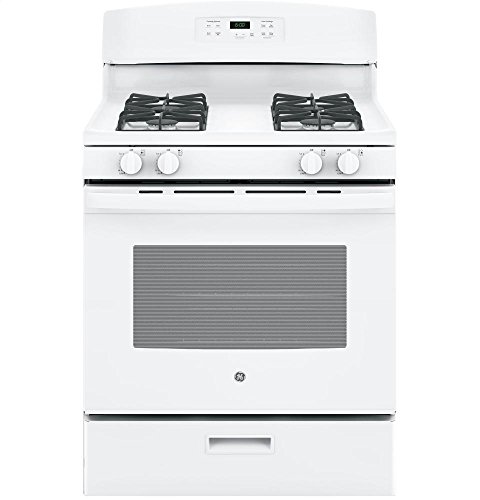
GE 30-Inch Freestanding Gas Range, 4.8 Cu. Ft. — Best unfussy white finish
This GE keeps the brief deliberately plain: a white 30-inch freestanding body, sealed burners, and a 4.8 cu. ft. oven. White appliances have quietly returned to favour in farmhouse and rental kitchens alike, and a white range also hides the pale dusting of flour and hard-water spots that stainless displays so proudly. The 4.8 cu. ft. cavity gives up a little volume to the Whirlpool above, yet it still fits a standard roasting pan with room for a side dish on the rack below.
Sealed burners are the detail that earns this pick its keep. Each burner sits in a contained well, so a boiled-over pot of pasta water pools on the cooktop surface instead of draining down into the burner box where it would bake onto parts you cannot reach. Wiping the top becomes a single-surface job. For landlords fitting out a rental, or anyone equipping a kitchen where the range will be cleaned by many hands over many years, that contained design quietly prevents the slow grime build-up that makes older open-burner ranges smell faintly of every spill they ever met.
There is also a steadiness to a range specified this plainly. No touch panel to fail, no fan motor in the cavity, no software between the knob and the flame — the parts count is low, and most of what can wear out is mechanical and replaceable. In a cottage kitchen or a first home where the appliance budget must stretch across a decade, that simplicity compounds. The white finish plays a part as well: it brightens a small kitchen in a way stainless cannot, and it pairs with the painted cabinetry and pale worktops that dominate cottage-style rooms.
- Width stated in the listing: 30 inches
- Oven capacity stated in the listing: 4.8 cu. ft.
- Burners: sealed burner design stated in the listing
- Fuel: gas cooktop and gas oven
- Finish stated in the listing: white
- Where to buy: the GE 30-Inch Freestanding Gas Range, 4.8 Cu. Ft. listing on Amazon — check price on Amazon
Strengths
- Sealed burners contain spills on the surface, keeping the burner box clean and odour-free.
- The white finish forgives flour dust and water spots far better than stainless steel does.
- A straightforward control layout suits shared kitchens, rentals, and cooks who dislike touch panels.
Trade-offs
- At 4.8 cu. ft. it is the second-smallest oven here, so very large birds need a test fit.
- No convection is stated, so even browning across two racks takes manual rotation.
- White enamel can chip if heavy cast iron lands hard on an edge, showing dark metal beneath.
Best for: white-appliance kitchens, rental properties, and anyone who prizes sealed-burner cleanup. A poor fit for: bakers who regularly run two racks and want fan help with evenness.
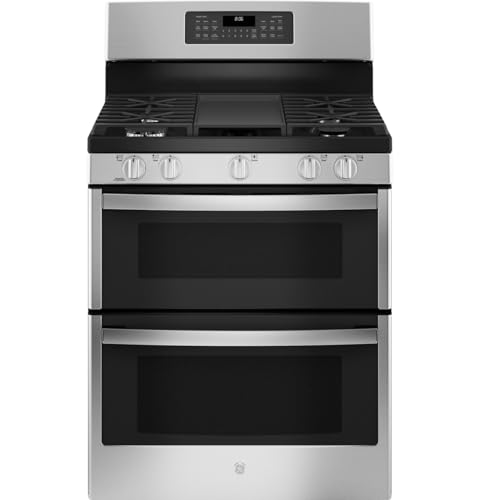
GE 30-Inch Double Oven Gas Range, 6.8 Cu. Ft. JGBS86SPSS — Best double oven
The JGBS86SPSS answers the oldest complaint about a single oven: everything wants a different temperature at the same hour. Its two cavities total 6.8 cu. ft., arranged so a smaller upper oven handles weeknight trays and reheats while the larger lower oven takes the roast. Five sealed burners sit on top, convection works in the oven, and the continuous cast iron grates are stated dishwasher safe — a cleaning concession anyone who has scrubbed a grate in a sink will appreciate.
Think about how a double oven changes a Sunday. Garlic bread crisps above at one heat while a casserole finishes below at another, and neither waits on a cooling cavity. The smaller upper oven also preheats faster and uses less gas for a single tray of biscuits, which over a year of small bakes is the quiet economy of this design. Continuous grates let you slide a heavy pot from a fierce burner to a gentle one without lifting, and because they run edge to edge, a wide griddle can straddle two burners for pancake mornings. Steam clean adds a low-effort freshening cycle between deep cleans.
Holiday cooking is where this design earns its premium most visibly. The turkey rests in the lower oven while the upper cavity handles pies at a different heat, and the five burners above carry gravy, sprouts, potatoes, and a pan of pigs-in-blankets without a queue forming. Hosts who have spent years performing oven Tetris — holding dishes warm in the microwave, resting roasts under foil until they cool — feel the difference in their shoulders by dessert. Even on ordinary weeks, the upper oven becomes the default for anything on a single tray, which quietly shortens preheat waits across dozens of small meals.
- Width stated in the listing: 30 inches
- Total oven capacity stated in the listing: 6.8 cu. ft. across two cavities
- Burners stated in the listing: 5 sealed burners
- Grates: continuous cast iron, stated dishwasher safe
- Oven help stated in the listing: convection and steam clean
- Where to buy: the GE 30-Inch Double Oven Gas Range, 6.8 Cu. Ft. JGBS86SPSS listing on Amazon — check price on Amazon
Strengths
- Two cavities cook at two temperatures simultaneously, ending the holiday scheduling puzzle.
- Dishwasher safe continuous grates turn the worst cleaning chore of gas cooking into a rack load.
- The small upper oven preheats quickly for single trays, saving gas on everyday bakes.
Trade-offs
- The lower oven sits low, so lifting a heavy roast means bending deeper than with a single cavity.
- Two cavities mean two sets of racks and seals to keep clean across the year.
- Neither cavity alone matches a big single oven for one very tall item like a standing rib roast.
Best for: households that entertain, bake while roasting, or cook two courses on different heats nightly. Not the right match for: anyone with limited mobility who would struggle with the low lower oven.

Magnificent Chef 30-Inch Gas Range, Black — Best burner count in the frame
Magnificent Chef plays a different card from the household names: six burners — described in the listing as three ultra-fast and three fast — over a 4.0 cu. ft. space-saver oven, all inside the same 30-inch width and a black finish. Six burners on a standard-width top is a layout usually found a size up, and it changes the geometry of a busy evening: a sauce, a sauté, a kettle, and a simmer can each hold their own ring while two spots stay free for the next act.
The trade is written into the oven. At 4.0 cu. ft. this is the smallest cavity in the guide, deliberately so — the listing calls it a space saver, and the design clearly spends its room on the cooktop rather than the box below. Cast iron grates give the top a sturdy, pot-friendly surface, and the listing states LP/NG readiness, meaning the range is prepared for either natural gas or liquid propane, a flexibility rural buyers often have to chase through conversion kits. Delivery included and a 2-year warranty are also stated in the listing, which softens the risk of choosing a lesser-known badge.
Cooking on six rings changes how a meal comes together. Instead of sequencing — sauce held warm while pasta boils, vegetables waiting their turn — everything moves in parallel, and the cook becomes a conductor rather than a queue manager. The black finish suits the role: it hides the scorch shadows that accumulate around hard-working burners and looks deliberate beside dark worktops. Just keep the pan-size caveat in view. Six rings reward cooks whose batterie is mostly small-to-medium saucepans, lids, and skillets; a household built around one enormous wok or a 32 cm paella pan will find the crowd less charming.
- Width stated in the listing: 30 inches
- Oven capacity stated in the listing: 4.0 cu. ft., described as space saver
- Burners stated in the listing: 3 ultra-fast and 3 fast burners
- Grates stated in the listing: cast iron
- Fuel stated in the listing: LP/NG ready
- Where to buy: the Magnificent Chef 30-Inch Gas Range, Black listing on Amazon — check price on Amazon
Strengths
- Six burners in a 30-inch frame is a layout the big brands reserve for wider ranges.
- Stated LP/NG readiness suits homes on propane without a separate conversion hunt.
- Delivery included and a stated 2-year warranty reduce the unknowns of a smaller brand.
Trade-offs
- The 4.0 cu. ft. oven is the tightest here; measure your largest roasting pan before committing.
- Six burners crowd the top, so very wide pans on adjacent rings will compete for elbow room.
- A newer brand means a thinner local service network than Whirlpool or GE can offer.
Best for: stovetop-first cooks who run several pans at once and bake modestly. Poorly suited to: holiday hosts whose oven, not their cooktop, does the heavy lifting.
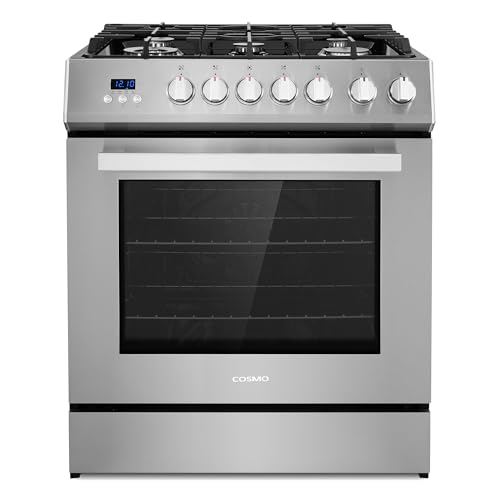
Cosmo Nebula 30-Inch 5-Burner Gas Range COS-305AGC — Best five-burner convection pick
Cosmo’s Nebula COS-305AGC aims at the cook who finds four burners one short and six a crowd. Five burners spread across the top, a 5 cu. ft. convection oven with fan circulation below, cast iron grates, and a digital display with timer — the listing reads like a checklist of the features mainstream ranges make you step up a tier to reach. The included wok ring is a small, telling extra: it cradles a round-bottom wok over the flame properly instead of leaving it to wobble on a flat grate.
Convection is the substantive story. A fan moving hot air around the cavity evens out the hot corners every gas oven has, so a tray of roast potatoes browns at the edges nearest the walls as willingly as the centre. The listing also states liquid propane convertibility, keeping this pick open to propane homes. Stainless steel keeps it visually in step with most modern kitchens, and the digital timer display answers the one gap in knob-only ranges — knowing at a glance how long the oven has left without setting a phone alarm across the room.
The Nebula also suits the cook who is quietly upgrading their ambitions. Fan circulation makes multi-rack baking — two trays of biscuits, a batch of meringues — behave predictably, and the five-burner top with a wok ring covers both the gentle end and the violent end of stovetop cooking in one layout. Cosmo pitches this range at buyers who read listings closely, and the listing rewards the reading: nearly every feature a comparison shopper would ask about is stated outright rather than implied. If your shortlist method is a spreadsheet, this is the pick that fills the most cells from its own title alone.
- Width stated in the listing: 30 inches
- Oven capacity stated in the listing: 5 cu. ft.
- Burners stated in the listing: 5 burners
- Oven help stated in the listing: convection with fan circulation
- Extras stated in the listing: wok ring, digital display with timer, cast iron grates
- Where to buy: the Cosmo Nebula 30-Inch 5-Burner Gas Range COS-305AGC listing on Amazon — check price on Amazon
Strengths
- Fan convection at this width brings even multi-tray browning within a standard budget shape.
- The wok ring supports round-bottom woks properly for high-heat stir-frying.
- Stated LP convertibility keeps propane households in play without aftermarket guesswork.
Trade-offs
- The centre fifth burner narrows the spacing for two very large pans side by side.
- A digital display adds an electronic part to an otherwise mechanical appliance class.
- Cosmo’s service footprint is smaller than the legacy brands if a fault appears years on.
Best for: stir-fry fans and convection bakers who want five burners inside a 30-inch gap. Not suited for: purists who want a range with no electronics anywhere on the panel.

Maytag 30-Inch Gas Range with Air Fry, 5.0 Cu. Ft. — Best for air fry households
The Maytag starts from the same sensible base as the Whirlpool — 30 inches, stainless, a 5.0 cu. ft. oven — and then answers the countertop appliance question. Its listing names an air fry mode alongside bake, which means the wings, fries, and reheated pizza slices that currently justify a separate basket appliance on your counter can move into the oven cavity instead. For a small kitchen, retiring a countertop air fryer frees the exact patch of worktop where dough gets rolled.
Air fry in a full oven works differently from the countertop pod: a high-heat fan-driven mode crisps food spread on a tray, in batches big enough for a family rather than two portions at a time. Sheet-pan dinners gain the same benefit — vegetables at the tray’s edge crisp instead of steaming in their own juices. Maytag’s reputation rests on durability-minded laundry and kitchen machines, and this range keeps that plain, sturdy character: gas burners above for the searing and simmering, a generous oven below, and one modern mode added where it genuinely changes weeknight cooking.
Consider the Friday-night test. Frozen fries for four, a tray of chicken thighs, and a pan of green beans can move through this oven in overlapping waves while the burners above handle a sauce, and nothing needs a second appliance humming on the counter. The air fry mode also revives leftovers with a dignity the microwave cannot manage — yesterday’s roast potatoes come back crisp rather than tired. Maytag buyers tend to keep appliances a long time, and a range that folds two appliances into one footprint suits that keep-it-for-years temperament, provided the household actually uses the crisping mode often enough to justify choosing it over the double oven.
- Width stated in the listing: 30 inches
- Oven capacity stated in the listing: 5.0 cu. ft.
- Modes stated in the listing: air fry and bake
- Fuel: gas cooktop and gas oven
- Finish stated in the listing: stainless steel
- Where to buy: the Maytag 30-Inch Gas Range with Air Fry, 5.0 Cu. Ft. listing on Amazon — check price on Amazon
Strengths
- The air fry mode can retire a countertop appliance and free precious worktop space.
- Full-size air frying handles family batches instead of two-portion basket loads.
- A 5.0 cu. ft. cavity matches the largest single ovens in this guide.
Trade-offs
- Air frying a whole tray splatters more of the oven than a small basket contains.
- No double cavity, so two-temperature cooking still needs sequencing.
- The listing is brief, so confirm burner layout details on the product page before you order.
Best for: families who air fry weekly and want that habit inside a full-size gas oven. A poor fit for: cooks who never crisp anything and would rather spend on a double oven.
Thirty Inches, Six Layouts: The Line-Up at a Glance
| Model | Oven space | Burners up top | Signature extra |
|---|---|---|---|
| Whirlpool 30-Inch 5.0 Cu. Ft. Freestanding Gas Range WFGS5030RS | 5.0 cu. ft. single | Standard four-burner class layout | Storage drawer below |
| GE 30-Inch Freestanding Gas Range, 4.8 Cu. Ft. | 4.8 cu. ft. single | Sealed burners | White finish |
| GE 30-Inch Double Oven Gas Range, 6.8 Cu. Ft. JGBS86SPSS | 6.8 cu. ft. across two ovens | 5 sealed burners | Convection and steam clean |
| Magnificent Chef 30-Inch Gas Range, Black | 4.0 cu. ft. single | 6 burners | LP/NG ready as listed |
| Cosmo Nebula 30-Inch 5-Burner Gas Range COS-305AGC | 5 cu. ft. single | 5 burners | Wok ring and timer display |
| Maytag 30-Inch Gas Range with Air Fry, 5.0 Cu. Ft. | 5.0 cu. ft. single | Standard four-burner class layout | Air fry mode |
How Much Oven Do You Honestly Use in a Week?
Capacity numbers only matter against your own pans. A 5.0 cu. ft. cavity takes a large turkey, a full sheet pan, or two racks of cookies with air between them. Drop to 4.0 cu. ft. and the turkey still fits in most cases, but the second rack crowds and tall items like a lidded Dutch oven on a rack below a tray stop being possible. The honest exercise is to measure the three vessels you bake in most — roaster, casserole, biggest tray — and compare their footprints with the cavity you are considering, remembering that stated capacity counts every corner, including space the racks cannot use.
The double oven reframes the question entirely. Its 6.8 cu. ft. total is not one vast box but two useful ones, and households that cook a main and a side most nights often use that split more fully than a single deep cavity they heat entirely for one tray. Conversely, if your signature dish is a single enormous bake — a whole suckling pig is beyond any of these, but a very large goose is not — the undivided 5.0 cu. ft. models keep the full height available. Neither answer is wrong; they are answers to different kitchens.
While you are thinking about the cold side of the kitchen, remember that range swaps often travel with fridge swaps in a remodel, and our guide to the Best Affordable Side-by-Side Refrigerators covers the value end of that pairing. Back at the range, also weigh rack positions and broiler placement, because a broiler inside the oven cavity behaves differently from an old drawer broiler when you are finishing gratins at close quarters.
What Should You Check Before the Delivery Truck Is Booked?
Start behind the range, not in front of it. Confirm the gas stub-out position and that a shut-off valve sits within reach of the opening, because installers will not connect to a line they cannot isolate. If your home runs on propane, confirm the pick is stated convertible or ready for LP and ask who performs the orifice swap — some sellers include it, others leave it to your fitter. Photograph the existing connection with your phone; a fitter can tell from one picture whether an adapter will be needed on the day.
Then walk the route the range will travel. A 30-inch range passes a standard doorway, but tight hallway turns, stair rails, and a raised threshold can each add a wrinkle, and the unit should stay upright so its grates and racks do not shift. Measure the final opening at counter height and at the floor, since older cabinetry is not always square, and check the floor for level: gas flames burn visibly lopsided on a tilted cooktop, with oil pooling to one side of every pan until the feet are adjusted.
Finally, plan the anti-tip bracket. Every freestanding range ships with one, and it must be fixed to the floor or wall so the unit cannot tip if a child or a heavy leaning load presses the open door. It takes minutes to install and is the single safety step most often skipped in home swaps. Ask the delivery crew to fit it, or fit it yourself before the first boil, not after.
How Do You Keep a Gas Cooktop Looking Cared For?
Gas cooktops reward small, frequent cleaning over heroic monthly sessions. Lift the grates once a week and wipe the surface beneath while it is still bare; crumbs and boil-over sugars that sit through another week of burners firing carbonise into specks that need soaking rather than wiping. Cast iron grates — several picks here use them — want drying after any wash, because a grate left wet in a humid kitchen can bloom with surface rust at the contact points. The GE double oven’s dishwasher safe grates remove even that chore.
Burner caps and heads lift off on most designs, and a monthly soak in warm soapy water keeps the ports clear so flames burn blue and even. If one burner starts clicking without lighting or burns with a lazy yellow edge, a clogged port or a damp igniter is the usual cause, and both are cleaning matters before they are repair matters. Keep the igniter ceramic dry after wiping the top; a wet igniter is the classic reason a freshly cleaned cooktop refuses to light for an hour.
Oven care splits by model. Steam clean, stated on the GE double oven, loosens light soil with water vapour for a wipe-out finish and suits monthly freshening. Heavier roasting soil still needs a proper clean cycle or manual work regardless of brand. Wipe the door seal rather than scrubbing it, keep foil off the oven floor — it traps heat and can fuse to enamel — and your cavity will stay honest for years.
Which Burner Layout Suits the Way You Actually Cook?
Count your typical pans, not your ambitions. A household whose biggest night is pasta, sauce, and a vegetable pan uses three burners and values wide spacing between them for big pots. Four burners with generous gaps — the Whirlpool and Maytag pattern — serve that kitchen better than a crowded six-ring top where a 28 cm skillet overhangs its neighbours. The six-burner Magnificent Chef flips the priority: many modest pans at once, tapas-style cooking, or a canning kettle plus preserving pans during harvest season.
Five burners, as on the Cosmo and the GE double oven, usually place the fifth in the centre, where an oval fish kettle or a long griddle can sit across it. Centre burners earn their place if you own that cookware; without it, the fifth ring mostly steals elbow room from the back pair. Grate design matters alongside count — continuous grates let you slide rather than lift, which your wrists will thank you for when a full Dutch oven needs to move off the boil.
Simmer behaviour deserves a mention too. Gas shines at the low end: a small ring turned down holds a custard at a bare shiver without the on-off cycling of older electric elements. When you read listings, look for how the burners are described — ultra-fast and fast rings on the Magnificent Chef signal top-end intent, while the gentlest simmer usually lives on the smallest rear ring of any layout here. Match the layout to the pans you own today, and the range will feel designed rather than merely new. Readers furnishing a whole work zone rather than one appliance may also enjoy our guide to the Best Computer Chairs for Posture and Comfort, since a kitchen remodel so often ends with a desk nook attached.
What Does Living With a Backguard Control Panel Feel Like?
Most freestanding ranges in this guide put their controls on the raised backguard, and that placement shapes daily habits more than first-time buyers expect. Knobs and oven controls sit above and behind the burners, so a sleeve brushing a front knob cannot nudge a flame, and small children reaching up meet the oven handle long before any control. The height also keeps the controls out of the splash zone of a frying pan, which is why backguard panels on older ranges so often outlive the cooktops beneath them.
The costs are ergonomic rather than functional. You reach over or between pots to adjust the oven, and a tall stockpot on a back burner can crowd the panel behind it. Steam from a front pan rises straight across the controls you are trying to read. None of this is a defect — it is the freestanding format’s long-settled compromise, traded for finished sides and placement freedom — but cooks migrating from a front-control slide-in should expect a week of reaching to the wrong place before the new geography becomes muscle memory.
There is one more backguard dividend: the panel acts as a low backsplash, catching the fine mist that frying sends backward and sparing the wall paint a slow yellowing. In a cottage kitchen with painted walls rather than tile, that ledge quietly protects the room’s finish, and it gives resting spoons and lid edges a heat-safe landing strip that front-control designs cannot offer.
How Should You Think About Burner Power Without a Single Number to Trust?
Listings describe burners in words as often as figures — ultra-fast, fast, power — and those words are relative to each maker’s own range rather than to a shared scale. Treat them as a map of intent: the ring a brand calls its fastest is where they expect your stockpot to live, and the smallest ring, usually at the back, is where sauces should hold a simmer. When a title does state a figure, it is the total or the headline burner, and it tells you about ambition rather than about the simmer end where most weeknight cooking actually happens.
A practical test once the range is installed tells you more than any brochure. Time a litre of water to boiling on the biggest ring, then see how low the smallest ring will hold a pan of milk without it catching. Those two numbers — your numbers, in your kitchen, with your pans — define the range’s real working range. Every pick in this guide passed our listing-level screen for sensible layout; the in-home test is how you confirm the individual unit behaves as its design intends.
Pan material mediates everything. Thin aluminium spreads flame heat unevenly and scorches at the ring’s edge, while heavy cast iron and clad stainless even out the pulses and make a modest burner feel stronger. Before blaming a new range for a sauce that catches, try the same sauce in your heaviest pan. More cooks have fixed a ‘weak burner’ with a better pan than with a service call, and a freestanding gas range rewards good cookware more honestly than any other cooker type.
What Happens to Your Old Range, and Why Does It Matter?
A range swap includes an exit as well as an entrance. The outgoing unit must be disconnected from the gas line by someone qualified, capped safely, and removed — and the order of operations matters, because the new range cannot be connected to a line that still feeds the old one. Many delivery services will haul the old appliance away if that is arranged when you order; arranging it afterwards, with a cold range standing in the middle of the kitchen, is how swaps turn into week-long obstacles. Decide the old unit’s fate — haul-away, resale, or a move to a garage or rental — before the delivery window is confirmed.
There is a small economy in the old range worth knowing about. A working used range has genuine value to landlords, cabin owners, and first-home buyers, and listing it locally before removal day often finds it a second life at no cost to you beyond a photograph and an honest description. A non-working unit still holds scrap and parts value through appliance recyclers. Either route beats paying for disposal by default, and both keep a large steel appliance out of landfill for a while longer.
While the opening stands empty, take the once-a-decade opportunity it offers. Clean the wall and floor behind the range properly, check the gas valve’s condition, confirm the anti-tip bracket position for the new unit, and photograph the connection for your records. The space behind a range is the least-visited square metre in most kitchens; the swap is your one easy chance to inspect it, and the new range will sit more happily — level, sealed, and correctly bracketed — for the attention.
How Do You Read a Range Listing Like Someone Who Has Been Burned Before?
Start with the words the listing chooses to state, and notice the ones it avoids. A listing that prints its oven capacity, burner count, and fuel readiness in the title — as several here do — is telling you the maker expects those numbers to sell the range. A listing that stays vague about capacity while praising style is asking you to buy the photograph. Neither is automatically dishonest, but the burden of checking shifts: with a brief listing, open the full product page, find the specification block, and confirm the cavity size and fuel type in writing before the order, not from the delivery note.
Check the variant discipline too. Ranges often sell in several finishes and fuel configurations under one product family, and the listing you land on may default to a different variant from the one in the headline. Confirm the finish, the fuel, and the model number in the order summary itself. Model numbers — WFGS5030RS, JGBS86SPSS, COS-305AGC — are the only identifiers that cannot drift between colour options, so match the number, not the picture, at checkout.
Finally, read the delivery terms as part of the product. A range is a two-person lift with a gas connection at the end of it; listings differ on whether delivery means the kerb, the kitchen, or a full connection by a qualified fitter. The Magnificent Chef states delivery included, which is worth weighing against a cheaper headline elsewhere that leaves freight and fitting to you. The true comparison is always the installed, working range — everything before that moment is a partial price wearing a complete one’s clothes.
Mistakes That Turn a Good Range Purchase Sour
The classic error is ordering a slide-in model for a freestanding gap, then discovering unfinished sides facing the room and no backguard where the wall needed protection. This guide exists to prevent exactly that, but the same confusion strikes in reverse when a freestanding range is pushed into a slide-in’s fitted slot and its backguard collides with a low window sill or a tiled ledge. Measure the wall behind as carefully as the gap itself.
Second comes ignoring the fuel you actually have. A natural gas range connected to propane without conversion burns wrong — sooty, weak, and unsafe — and the fix belongs to a qualified fitter, never to experimentation. Third, skipping the anti-tip bracket because the range feels heavy is a genuine hazard; weight does not stop a tip once a load levers on an open door. Fourth, forgetting ventilation: a powerful set of burners in a small sealed kitchen will steam the paint and set off alarms until a working extraction path exists.
Last, buyers often choose by burner count alone and discover their two favourite pans cannot sit side by side. Take your widest skillet and your stockpot to the decision: sketch the cooktop circles at full scale on paper if you must. Ten minutes with a tape and a pencil prevents years of juggling pans between rings.
Final Recommendation
For most households the Whirlpool WFGS5030RS is the calm centre of this list: full-size oven, storage drawer, stainless finish, and a service network that makes ownership uneventful. Choose the GE double oven when your cooking genuinely runs two temperatures at once, the Magnificent Chef when the cooktop is your stage and the oven a supporting act, the Cosmo when convection and a wok ring speak to your weeknight habits, the white GE when sealed burners and an easy-clean finish lead your list, and the Maytag when air frying has earned a permanent place in your routine. Measure the gap, confirm the fuel, book the bracket — then let the blue flame do what it has always done best, which is respond the instant you turn the knob.
One last word on timing. Ranges are among the longest-lived appliances in the house, and the model you choose will host a decade of birthdays, sick-day soups, and ordinary Tuesdays. That horizon argues for choosing the layout your cooking needs rather than the badge your neighbours recognise, and for treating stated listing facts — capacity, burner count, fuel readiness — as the evidence, since those are the details you will live with long after the delivery packaging is forgotten. Pick the range whose compromises you mind least, and it will feel less like an appliance and more like part of the household.
Frequently Asked Questions
What makes a range freestanding rather than slide-in?
A freestanding range has finished sides and its own backguard, so it can stand anywhere along a wall, including at the end of a cabinet run. A slide-in has unfinished sides and no backguard because cabinetry and a backsplash are expected to complete it. The two are not interchangeable in the same opening without cosmetic and sometimes control-placement compromises.
Can these gas ranges run on propane?
Some state it directly: the Magnificent Chef is listed as LP/NG ready, and the Cosmo Nebula is listed as liquid propane convertible. Others would need a conversion kit and a qualified fitter. Never connect a natural gas configuration to a propane supply without the correct orifices — the flame behaviour and safety margins depend on them.
How do I know whether 4.0 cu. ft. is enough oven?
Measure your largest roasting pan and your tallest lidded pot. If both fit with a rack position to spare, 4.0 cu. ft. will handle everyday cooking, and it only pinches when a very large bird plus sides must share one cavity. Households that regularly cook for a crowd should look at the 5.0 cu. ft. models or the double oven instead.
Are cast iron grates hard to maintain?
They ask for two habits: dry them after washing so contact points do not rust, and avoid thermal shock from cold water on a hot grate. In exchange they give a stable, flat surface that heavy pots cannot rock on. The GE double oven removes even that effort by stating its continuous grates are dishwasher safe.
Accessories deserve one honest paragraph. A spare set of burner caps, a second oven rack, and a properly fitting griddle are the three extras most owners actually use; everything else — novelty knob sets, decorative splash guards, imported trim kits — tends to live in a drawer. Buy the rack when you buy the range if two-rack baking is your habit, because matching a rack to a cavity years later, after a model revision, can turn into a surprising scavenger hunt. Keep the griddle question tied to the burner layout you chose: a long griddle only earns its storage space on a top with a centre burner or continuous grates to support it evenly.
Do I need a range hood with a gas range?
A working extraction path is strongly advisable. Gas burners produce water vapour and combustion by-products along with cooking steam and grease, and a hood that vents outside clears all of it. Recirculating hoods help with grease and odour but do not remove moisture, so vented is better where the building allows it.
What should I do on delivery day?
Check the range for transit damage before signing, confirm the gas connection and shut-off are ready, have the anti-tip bracket fitted, and test every burner plus the oven igniter while the crew is still there. Keep the manual and model number photographed on your phone; you will want them the first time you order a part or book a service visit.
Related Guides
Still weighing the wider kitchen picture? Our guide to the Best Gas Dryers With Moisture Sensors covers the laundry room’s gas appliance with the same attention to fuel and fit. Between the range guides in this series — compact electric, dual fuel at two widths, six-burner layouts, and off-grid propane — you can match nearly any kitchen’s fuel supply and cooking style to a shortlist before you spend anything.


