What's inside
- Key Takeaways
- Quick Picks
- How We Chose These Picks
- What Separates a Reach-In From a Big Home Upright?
- Capacity, Doors and Controls at a Glance
- How Do You Size a Commercial Freezer for a Real Menu?
- What Does a Sensible Temperature Routine Look Like?
- Which Buying Mistakes Cost Commercial Kitchens Most?
- Installation and Commissioning: The First Forty-Eight Hours
- Zoning in Practice: How Working Kitchens Organise a Reach-In
- Maintenance Calendar: Keeping a Reach-In Honest for Years
- When a Business Outgrows Its First Commercial Freezer
- Energy, Heat and the Room Around the Cabinet
- Final Recommendation
- Frequently Asked Questions
- Related Guides
As an Amazon Associate I earn from qualifying purchases. This post may contain affiliate links at no extra cost to you.
**cottageverdict.com is reader-supported. When you buy through links on our site, we may earn an affiliate commission.**
Where to buy: each model below is linked to its Amazon listing from the Quick Picks table and from its review heading, where you can check price on Amazon, confirm the current door configuration and shelving count, and review delivery options for freight-sized equipment before committing.
A domestic upright freezer and a commercial reach-in only look like relatives. The best commercial upright freezers are built for a working day that never resembles yours: doors opened scores of times per shift, trays slid in hot-adjacent, health inspections that ask questions a home kitchen never hears, and a compressor expected to recover temperature quickly after every opening. This guide compares six verified reach-in models from 12 to 69 cubic feet, spanning the single-door cabinet a small café can justify through to a three-door, 85-inch-wide unit for a serious restaurant kitchen. Certification language is quoted only where a listing states it, temperature ranges only where a listing prints them, and duty features such as locks and self-closing behaviour are discussed at the level the listings support — because in commercial buying, an assumed specification can become a failed inspection.
Who needs this class rather than a large home upright? Cafés, bakeries, bars, small restaurants, school and workplace kitchens, caterers holding stock between events, and food retailers who need frozen display-adjacent storage that staff can work from all day. The dividing line is not really size; a 12 cubic foot commercial reach-in is smaller than some home uprights. The line is design intent: shelving built for trays and tubs, doors built for constant use, temperature control built to be checked and logged, and certification where the listing claims it, for premises where an inspector may ask.
Key Takeaways
- The six linked models span 12 to 69 cubic feet, all of them reach-in uprights rather than domestic cabinets with commercial-sounding names.
- Certification is claimed only where the listing states it: the KOOLOTS 12 carries ETL and NSF wording plus DOE certification, the Arctic Air is described as NSF certified, and the 27-inch unit and the VEVOR are described as ETL certified.
- Temperature ranges appear only where listings print them — the Coolake states -13°F to -5°F, while the BODEGACOOLER, the 27-inch model and the VEVOR each state their own bands.
- Shelving counts scale with size, from three adjustable epoxy shelves on the Arctic Air to twelve adjustable shelves on the three-door VEVOR.
- Two models state frost-free or auto-defrost operation in different words — the Coolake says frost-free; the 27-inch model and the VEVOR say auto defrost — and the guide keeps each listing’s own phrasing.
- Freight reality matters: the largest cabinet here is 85 inches wide, so delivery route, door widths and floor load belong in the buying decision from the start.
Quick Picks
| Pick | Badge | Why it is here |
|---|---|---|
| Coolake 49 Cu Ft Commercial Freezer | Two-door prep-kitchen anchor | Forty-nine cubic feet, eight adjustable shelves and a stated frost-free system in a 54-inch stainless cabinet. |
| BODEGACOOLER 23 Cu Ft Reach-In Freezer | Single-door all-rounder | A 23 cubic foot stainless single-door reach-in aimed at restaurants, cafés and bars. |
| KOOLOTS 12 Cu Ft Commercial Freezer | Certified compact | The smallest cabinet here, with ETL and NSF wording, a door lock and DOE certification in its listing. |
| Arctic Air AWF25 Reach-In Freezer | Established workhorse | Twenty-five cubic feet, NSF certification as listed, and a bottom-mounted compressor with three epoxy shelves. |
| 27-Inch Commercial Freezer (23.6 Cu Ft) | Digital-control choice | ETL certified as listed, with auto defrost, fan cooling and digital temperature control in a 27-inch footprint. |
| VEVOR 69 Cu Ft Commercial Reach-In Freezer | Maximum capacity | Sixty-nine cubic feet across three doors with twelve adjustable shelves for high-volume kitchens. |
How We Chose These Picks
The first filter was honesty of category: every linked model had to be a genuine reach-in commercial upright, designed and described for business premises. Large domestic uprights wearing commercial adjectives were excluded, because a home cabinet in a working kitchen fails in predictable ways — door seals, shelving and recovery speed are simply not specified for shift-long abuse. Each surviving model was then read closely for the facts its listing actually states: capacity, width, shelving, temperature band where printed, defrost wording where given, and certification wording where claimed.
Size coverage was deliberate. Commercial buyers do not shop one size: a gelato shop needs a compact certified cabinet, a pub kitchen needs a mid-size single door, and a banqueting operation needs a wall of storage. The six models therefore ladder from 12 cubic feet to 69, with two distinct models around the popular 23 to 25 cubic foot mark so buyers in that band can compare a stainless digital-control design against an established white workhorse. Where two models overlap, the reviews below draw the contrast the listings support rather than inventing differences.
The last filter was evidential discipline. In commercial equipment, buyers repeat listing claims to landlords, partners and inspectors, so this guide repeats only what it can point to. If a listing does not state a temperature range, the review does not estimate one. If a listing does not claim a certification, the review does not imply one. Readers comparing these cabinets against small domestic units — for example the compact freezers gathered in our guide to Best Freezers for Breast Milk Storage, where dedicated small cabinets serve a very different, home-based purpose — will feel the difference in philosophy immediately: commercial reach-ins are specified like equipment, not appliances.
What Separates a Reach-In From a Big Home Upright?
Begin with the door’s working day. A home freezer door opens perhaps a dozen times on a busy day; a reach-in in a lunch service opens that many times before the first tickets are fired. Commercial cabinets are therefore designed around recovery: after each opening, the refrigeration system must pull the interior back to holding temperature briskly, because the food inside is inventory and, in many cases, subject to storage rules the business must demonstrate. Shelving tells the same story — adjustable shelves spaced for trays, tubs and boxes, in counts that scale with the cabinet, rather than door bins shaped for domestic packets.
Temperature control is the second separator. Several listings here print a working band — the Coolake’s stated -13°F to -5°F is a holding band for frozen stock, while the wider bands printed for the BODEGACOOLER, the 27-inch model and the VEVOR reflect cabinets whose controls span refrigerated-adjacent lows to deep holding temperatures as listed. The point for a buyer is not the numbers alone but the logging habit they enable: commercial kitchens check and record freezer temperatures as routine, and a cabinet with a clear digital control, like the 27-inch model states, makes that routine easier to keep honestly.
Certification is the third separator, and the one most often faked by implication. Listings here claim different things: ETL and NSF wording with DOE certification on the KOOLOTS, NSF certification on the Arctic Air, ETL certification on the 27-inch model and the VEVOR. The Coolake and BODEGACOOLER listings provided do not make certification claims, so this guide makes none for them — a buyer whose premises require a specific mark should verify the current certification status of any model directly before purchase, because marks, listings and production runs change. That caution is not a criticism of the uncertified-in-this-listing models; many excellent cabinets serve premises where no particular mark is demanded. It is simply the difference between buying equipment and buying a story.
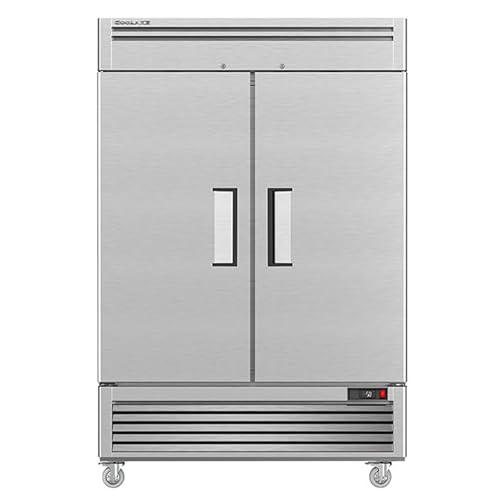
Coolake 49 Cu Ft Commercial Freezer — Two-door prep-kitchen anchor
The Coolake is the point in this guide where a freezer stops being an appliance and becomes kitchen infrastructure. Its listing describes a 54-inch-wide stainless cabinet of 49 cubic feet with eight adjustable shelves, a stated operating band of -13°F to -5°F, and frost-free operation, addressed to school and restaurant prep kitchens. Forty-nine cubic feet organised over eight shelves is a serious mise en place store: proteins on one level, pastry and bread on another, ice cream and frozen desserts held where the pastry section can reach them without crossing the kitchen.
The stated temperature band is worth reading carefully because it is a holding band, not a blast-chilling promise: this cabinet keeps frozen stock properly frozen through a working day of openings. Frost-free operation matters disproportionately in commercial use, where a manual-defrost cabinet must be emptied and taken offline — an operational event a busy kitchen schedules reluctantly and postpones dangerously. A frost-free reach-in simply keeps working, week after week, while staff attention stays on food rather than ice management. The stainless construction suits the prep-kitchen environment the listing names, where surfaces are wiped down constantly and equipment is expected to look clean at a glance during inspections.
Plan the Coolake’s arrival like a contractor, not a shopper. A 54-inch-wide commercial cabinet arrives as freight, needs a route through the building with no tight turns it cannot make, and needs floor space reserved before delivery day rather than negotiated with existing equipment afterwards. Check your doorway heights, your corridor corners and the exact footprint against the listing’s dimensions on the product page, and arrange for the packaging to leave with the delivery crew if they offer it. Kitchens that rehearse the installation enjoy the cabinet from day one; kitchens that improvise spend the first week working around a stainless obstacle in the wrong place.
- Capacity as listed: 49 cu ft
- Width as listed: 54 inches
- Shelving as listed: 8 adjustable shelves
- Temperature band as listed: -13°F to -5°F
- Defrost as listed: frost-free
- Construction as listed: stainless steel, industrial reach-in
- Settings named in listing: school and restaurant prep kitchens
- Where to buy: the Coolake 49 Cu Ft listing on Amazon — check price on Amazon
Strengths
- Large two-door capacity with eight adjustable shelves suits a full prep operation.
- Frost-free operation removes defrost downtime from the kitchen calendar.
- A clearly stated, narrow holding band suits disciplined frozen-stock storage.
Trade-offs
- The listing provided makes no ETL or NSF claim, so premises requiring a specific mark must verify status directly.
- Its 54-inch width and freight delivery demand a planned installation route.
- Capacity this large is wasted on a small café, which will cool empty air at commercial scale.
Best for: restaurants and institutional prep kitchens needing a frost-free, two-door frozen store at the centre of production.
Not suited for: small premises without the floor space, door clearance or stock volume to justify 49 cubic feet.

BODEGACOOLER 23 Cu Ft Reach-In Freezer — Single-door all-rounder
Twenty-three cubic feet behind a single stainless door is the classic footprint of the independent restaurant kitchen, and the BODEGACOOLER is pitched squarely at it. The listing describes a stainless steel single-door reach-in with a stated band of -10℉ to 10℉, addressed to restaurants, cafés, bars and garages, and to frozen food, ice cream and meat storage. That breadth of intended settings is honest to the size: this is the cabinet a business buys when frozen storage must be professional but the kitchen cannot surrender a wall to it.
The single-door format has operational virtues that two-door cabinets cannot copy. One door means one seal to maintain, one swing to plan around the pass, and a full-width interior that accepts wide trays without a centre mullion negotiating with every load. For a bar programme holding ice cream, frozen garnishes and batch cocktails’ components, or a café holding pastry and breakfast proteins, the format is simply right-sized. The stated temperature band spans from deep holding into a range that gives the operator flexibility across products, set and checked as the kitchen’s own food-safety routine requires.
Buyers should note what this listing does not do: it does not claim a certification mark in the wording provided, and it does not enumerate a shelf count. Neither omission makes it a lesser cabinet, but both make the product page worth a careful read — confirm the shelving configuration and, if your premises or insurer ask for a particular certification, verify the model’s current status with the seller before ordering. In a category where rivals sometimes imply more than they state, a listing that states its size, material, door count and temperature band plainly is a reasonable foundation for a working purchase.
- Capacity as listed: 23 cu ft
- Doors as listed: single solid door
- Temperature band as listed: -10℉ to 10℉
- Construction as listed: stainless steel
- Settings named in listing: restaurant, cafe, bar, garage
- Storage named in listing: frozen food, ice cream, meat
- Where to buy: the BODEGACOOLER 23 Cu Ft listing on Amazon — check price on Amazon
Strengths
- Classic single-door footprint fits kitchens that cannot spare a double-door wall.
- Stainless construction and a plainly stated temperature band suit daily commercial work.
- Size serves cafés and bars as comfortably as full restaurant kitchens.
Trade-offs
- No certification is claimed in the listing provided; verify directly if your premises require one.
- Shelving details are not enumerated in the listing wording, so confirm configuration before ordering.
- A single door this size has a wide swing that tight kitchen layouts must plan around.
Best for: independent restaurants, cafés and bars needing a professional single-door frozen store.
A poor fit for: high-volume operations whose stock turns over faster than 23 cubic feet can buffer.
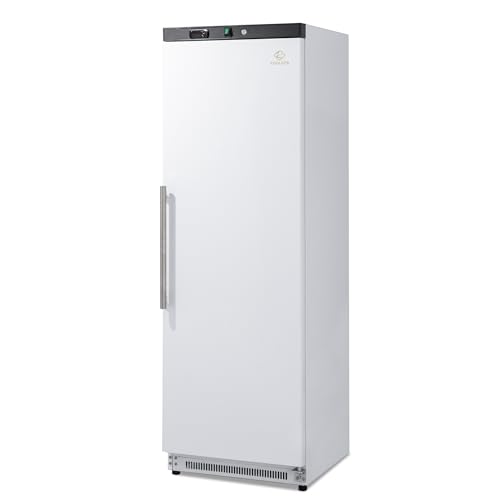
KOOLOTS 12 Cu Ft Commercial Freezer — Certified compact
Small premises face a certification paradox: the inspection regime does not shrink with the kitchen, but the floor space does. The KOOLOTS answers with the most credentialled listing in this guide at the smallest size: 12 cubic feet in a 24-inch-wide white solid single-door cabinet, with ETL and NSF wording in its title, a door lock, an energy-efficient description and DOE certification, addressed to restaurants, garages, stores and homes. For a bakery corner, a food truck’s base kitchen, a convenience store’s back room or a café that freezes its own pastry, those stated credentials do real work — they are the difference between showing an inspector a documented commercial cabinet and explaining a domestic one.
The lock deserves its own sentence, because at this scale it is often the deciding feature. A lockable freezer protects high-value stock — premium ice cream, frozen seafood, prepared retail items — in shared or semi-public spaces where a home cabinet would simply trust everyone who walks past. Combined with the compact footprint, the KOOLOTS becomes the natural satellite freezer: the cabinet by the till, in the stockroom or beside the prep bench, holding the items that need both cold and custody. Its white finish suits back-of-house and retail-support spaces where stainless is not required for the room’s look.
Temper your expectations on volume honestly. Twelve cubic feet is a working buffer, not a warehouse: it holds a delivery cycle for a small operation, not a month of stock. Businesses that buy it as their only freezer and then grow will feel the ceiling within a season — which is an argument for planning the second cabinet’s position now, not against this one. As listed, with its certification wording and lock, it is the most completely specified small commercial freezer in this roundup.
- Capacity as listed: 12 cu ft
- Width as listed: 24 inches
- Certification wording as listed: ETL, NSF; DOE certified
- Door as listed: white solid single door, with lock
- Efficiency as listed: energy-efficient
- Settings named in listing: restaurants, garages, stores, homes
- Where to buy: the KOOLOTS 12 Cu Ft listing on Amazon — check price on Amazon
Strengths
- The fullest certification wording in this guide, stated at the smallest footprint.
- A locking door protects valuable stock in shared or public-adjacent spaces.
- Compact 24-inch width fits corners and stockrooms larger cabinets cannot enter.
Trade-offs
- Twelve cubic feet is a buffer, not bulk storage, for any growing operation.
- The listing provided states no temperature band, so confirm operating range on the product page.
- White finish shows back-of-house wear more visibly than stainless in heavy kitchens.
Best for: small restaurants, stores and cafés that need documented commercial credentials in a compact, lockable cabinet.
Not the right match for: operations whose weekly frozen deliveries already exceed a small buffer cabinet.
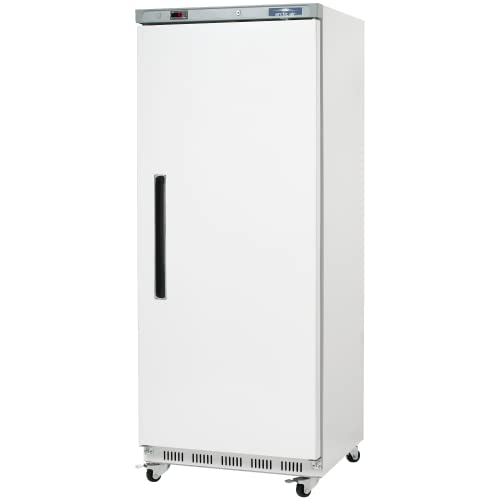
Arctic Air AWF25 Reach-In Freezer — Established workhorse
The Arctic Air AWF25 represents the traditional end of this category: a 25 cubic foot solid-door reach-in on 115V power, described as NSF certified for restaurants, with a bottom-mounted 3/4 HP compressor, three adjustable epoxy shelves and a white finish. Bottom mounting is a deliberate, old-school virtue — the compressor sits low where kitchen air is coolest, and the cabinet’s storage rides higher, so staff load and retrieve at comfortable heights rather than stooping to the floor for the bottom shelf. Epoxy-coated shelving is likewise a working-kitchen choice, resisting the corrosion that raw wire suffers in humid, frequently cleaned environments.
Three shelves in 25 cubic feet means tall, generous levels rather than many shallow ones — a configuration that suits operations storing large tubs, boxed proteins and tray stacks rather than hundreds of small items. Kitchens that need finer subdivision can add their own tubs and bins per level, which many prep teams prefer anyway because a bin can be carried to the bench while a shelf cannot. The 115V specification matters practically: it speaks the language of ordinary commercial circuits, simplifying placement in older buildings where heavier electrical work would delay an opening.
The listing provided does not print a temperature band, so this guide does not assign one; commercial buyers should confirm the operating range and control details on the product page and set their logging routine accordingly. What the listing does state — NSF certification, compressor size and placement, shelving material and count — is the vocabulary of a cabinet designed by people who expect it to be specified, inspected and worked hard. For a restaurant that wants a known-format workhorse rather than the newest control panel, that is a persuasive profile.
- Capacity as listed: 25 cubic feet
- Power as listed: 115V
- Certification as listed: NSF certified
- Compressor as listed: bottom-mounted, 3/4 HP
- Shelving as listed: three adjustable epoxy shelves
- Finish as listed: white
- Where to buy: the Arctic Air AWF25 listing on Amazon — check price on Amazon
Strengths
- NSF certification stated plainly for restaurant use.
- Bottom-mounted compressor keeps storage at working height and draws cooler low air.
- Epoxy shelves and tall levels suit tubs, boxes and tray stacks.
Trade-offs
- Three shelves is coarse subdivision for small-item storage without added bins.
- No temperature band is printed in the listing provided; confirm before relying on one.
- White finish and traditional styling prioritise back-of-house duty over front-of-house looks.
Best for: restaurants wanting a proven-format, certified reach-in with generous shelf levels for bulk containers.
Poorly suited to: businesses needing many shallow, finely divided shelves for small packaged goods.
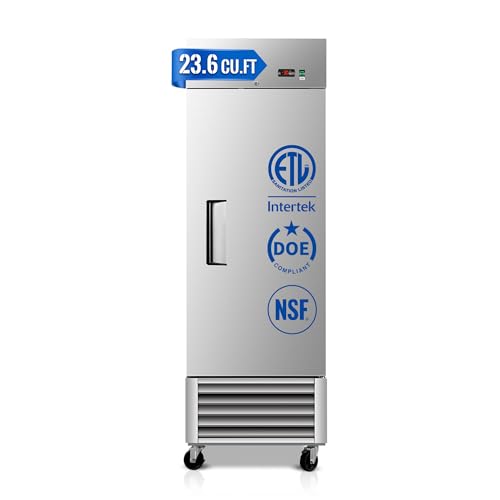
27-Inch Commercial Freezer (23.6 Cu Ft) — Digital-control choice
This 27-inch-wide stainless reach-in packs the most modern control description in the guide into a footprint barely wider than a home upright: 23.6 cubic feet, ETL certification as listed, auto defrost, fan cooling and digital temperature control spanning a stated -10°F to 10°F, addressed to restaurants, bars and shops. Fan cooling is the feature to understand: rather than letting cold settle where it falls, a fan circulates air through the cabinet, which evens out the difference between the top shelf and the bottom — the quiet enemy of consistent storage in tall cabinets. For a kitchen logging temperatures, evenness is not a luxury; it is what makes a single recorded reading meaningful.
Digital control pairs with that evenness. A digital controller invites a precise set point and makes the daily check a glance rather than a guess, and auto defrost removes the offline hours that manual cabinets demand. In a 27-inch footprint, that combination reads as the thinking small kitchen’s choice: nearly the BODEGACOOLER’s capacity class, with a more instrumented approach to holding it. Bars with frozen programmes, cafés holding ice cream at a serving-friendly discipline, and restaurants with one freezer that must simply be right every morning are the natural buyers.
As with every model here, verify the specifics that your premises depend on — the listing states ETL certification, and buyers whose local rules require a particular mark should confirm current status on the product page. The stainless construction suits both back-of-house work and the increasingly common open-kitchen format, where equipment is visible to guests and must look the part. In a guide of honest listings, this one is the technologist’s pick: not the largest, not the most credentialled on paper, but the most deliberately controlled.
- Capacity as listed: 23.6 cu ft
- Width as listed: 27 inches
- Certification as listed: ETL certified
- Temperature control as listed: digital, -10°F to 10°F
- Cooling as listed: fan cooling
- Defrost as listed: auto defrost
- Construction as listed: stainless steel reach-in
- Where to buy: the 27-Inch Commercial Freezer listing on Amazon — check price on Amazon
Strengths
- Fan cooling and digital control deliver the most even, checkable holding in this size class.
- Auto defrost keeps the cabinet in service without scheduled emptying.
- ETL certification is stated, and stainless suits open kitchens as well as back rooms.
Trade-offs
- Digital controls are one more system to learn for teams used to a simple dial.
- At 23.6 cu ft it will not absorb a banqueting operation’s peak stock.
- Fan-cooled cabinets ask for disciplined loading so air paths stay open.
Best for: cafés, bars and restaurants that log temperatures and want even, digitally controlled holding in a slim footprint.
A weak match for: buyers who want maximum cubic footage per cabinet position above all else.
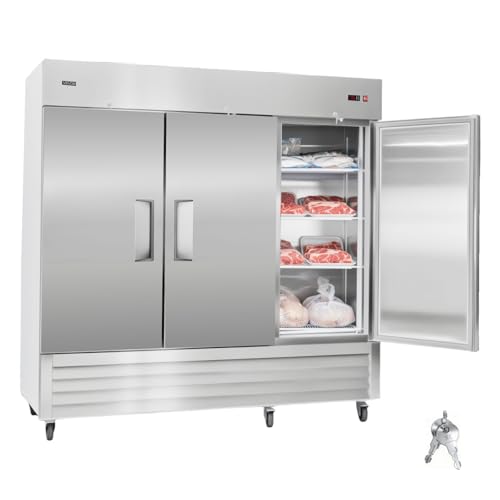
VEVOR 69 Cu Ft Commercial Reach-In Freezer — Maximum capacity
The VEVOR closes the ladder at the top: 69 cubic feet behind three doors in an 85-inch-wide stainless cabinet, with auto-defrost, twelve adjustable shelves, a stated band of -11 to 14℉ and ETL certification as listed, built for restaurant kitchens. Three doors change how a big cabinet works. Instead of one vast interior exposed at every opening, staff open the section they need — proteins, pastry, or the day’s prep — while the other sections stay sealed and cold. Across a long service, that sectional discipline is worth real temperature stability, and it lets three team members work the freezer simultaneously without queuing at a single door.
Twelve adjustable shelves across three sections gives a kitchen a genuine zoning system: dedicate a section per department and the freezer becomes a map of the menu. The stated temperature band is the widest printed in this guide, running from deep holding up through temperatures that give operators flexibility across product types, set per the kitchen’s own procedures. Auto-defrost at this scale is close to non-negotiable — manually defrosting 69 cubic feet means rehousing a small warehouse of food — so its presence in the listing is one of the model’s most important practical facts.
Respect the logistics. An 85-inch-wide cabinet is a building decision: measure the delivery route as you would for a piano, confirm the floor where it will stand, and plan its position as the anchor of the kitchen’s cold-storage wall rather than an appliance that can be shuffled later. The operations that justify it — high-cover restaurants, caterers, institutions — will feel its value every service. Smaller kitchens should read its specification as a description of their future, and buy the 23 to 25 cubic foot class for their present.
- Capacity as listed: 69 cu ft
- Width as listed: 85 inches
- Doors as listed: 3 doors
- Shelving as listed: 12 adjustable shelves
- Temperature band as listed: -11 to 14℉
- Defrost as listed: auto-defrost
- Certification as listed: ETL certified
- Construction as listed: stainless steel
- Where to buy: the VEVOR 69 Cu Ft listing on Amazon — check price on Amazon
Strengths
- Three-door sectional access keeps unopened sections sealed through busy services.
- Twelve shelves across 69 cubic feet support true departmental zoning.
- Auto-defrost and ETL certification are both stated at the largest scale in this guide.
Trade-offs
- An 85-inch cabinet demands a freight plan, a measured route and a permanent position.
- Far more capacity than a small operation can fill, and empty volume still costs to cool.
- Its stated band tops out higher than the Coolake’s holding band, so set points need deliberate management per product.
Best for: high-volume restaurant kitchens and caterers needing zoned, three-door frozen storage at full commercial scale.
Weakest fit: any premises where the delivery route or floor plan cannot accept an 85-inch-wide cabinet.
Capacity, Doors and Controls at a Glance
| Model | Capacity | Doors | Stated band or control note | Certification in listing |
|---|---|---|---|---|
| Coolake | 49 cu ft | Solid-door upright (54 in wide) | -13°F to -5°F, frost-free | None stated in listing provided |
| BODEGACOOLER | 23 cu ft | Single door | -10℉ to 10℉ | None stated in listing provided |
| KOOLOTS | 12 cu ft | Single door, with lock | No band stated | ETL, NSF, DOE certified |
| Arctic Air AWF25 | 25 cu ft | Solid door | No band stated; bottom-mounted compressor | NSF certified |
| 27-Inch Commercial Freezer | 23.6 cu ft | Reach-in, 27 in wide | Digital control, -10°F to 10°F, fan cooling | ETL certified |
| VEVOR | 69 cu ft | 3 doors | -11 to 14℉, auto-defrost | ETL certified |
How Do You Size a Commercial Freezer for a Real Menu?
Start from deliveries, not from floor space. Count how much frozen stock arrives in your largest weekly delivery, add the buffer you need for a missed or delayed delivery, and then add the working stock that lives permanently in the freezer — sauces, pastry, bread, ice cream. That total, honestly estimated, is your minimum. Then apply the commercial reality that a freezer packed to the last corner cools unevenly and slows its staff down: the cabinet you buy should hold your peak load at roughly three-quarters full, with air able to move and hands able to reach. A café whose peak is modest will land near the KOOLOTS or the single-door 23 cubic foot class; a restaurant doing its own butchery and pastry will land at the Coolake or beyond.
Door count follows team size. One cook working alone is well served by a single wide door. A brigade working a service needs sectional access, because every shared door is a queue and a temperature leak. That is why the ladder in this guide moves from single doors at 12 to 25 cubic feet to the VEVOR’s three doors at 69: the doors are not a styling choice but a workflow one. Kitchens planning a broader refit should think about how the freezer’s rhythm interacts with the rest of the line — the same planning mindset our guide to Best French Door Wall Ovens applies to oven access in a fitted kitchen, where door geometry decides whether two cooks can work side by side or merely take turns.
Finally, size the room, not just the cabinet. A reach-in needs clearance for its door swing, working room in front for a trolley or a person carrying a tray, and ventilation space the manufacturer specifies. It also needs a floor that can take the loaded weight and a power supply appropriate to the model — the Arctic Air’s stated 115V is the friendly case; always confirm the electrical requirements of the exact model on its product page before the electrician’s visit becomes a second visit.
One more sizing factor hides in the menu itself: packaging format. A kitchen buying whole primals and bulk tubs consumes cubic feet in large, indivisible lumps and needs the tall, coarse shelving of a cabinet like the Arctic Air. A kitchen buying portioned, boxed and bagged product consumes the same volume in small units and benefits from more, finer shelves. Read your last delivery note as a sizing document — the shape of what arrives predicts the shape of the cabinet that will hold it gracefully, and a mismatch between packaging and shelving wastes more space than any difference between rival models’ headline capacities.
What Does a Sensible Temperature Routine Look Like?
Commercial frozen storage runs on routine rather than technology. Set the cabinet to the holding temperature your products and local rules require, within the band the listing states for your model, and then check it on a schedule — typically at opening and closing — recording the reading where your food-safety system keeps its logs. The models here support that routine differently: the 27-inch unit’s digital control makes the reading unambiguous, the Coolake’s narrow stated band suits a single disciplined set point, and the wider-band cabinets give flexibility that must be matched by a clear house rule about where the dial or controller actually sits.
Loading discipline protects the routine. Hot food does not belong in a reach-in freezer; cool it properly first through your kitchen’s normal process, because a freezer asked to do a chiller’s job will warm everything around the load while it struggles. Leave space between items for air to circulate, especially in fan-cooled cabinets whose evenness depends on open air paths. Keep the door openings purposeful during service — know what you are fetching before you open — and brief every new team member that the freezer door is not a thinking perch. These habits sound mundane, and they are exactly the habits that separate kitchens whose freezers hold temperature beautifully from kitchens blaming their equipment.
Defrost and cleaning belong on the calendar, not in a crisis. Frost-free and auto-defrost models — the Coolake, the 27-inch unit and the VEVOR as listed — reduce the burden, but seals, drains and interiors still need scheduled attention. Wipe seals weekly, check that doors close fully without persuasion, and clear any ice that begins at corners before it becomes a landscape. A cabinet treated this way holds its temperature with less effort, which staff feel as reliability long before they could name the cause.
Which Buying Mistakes Cost Commercial Kitchens Most?
The expensive mistake is buying a domestic upright for commercial duty because the capacity looked similar. It will not be specified, certified or shelved for service work, and when it fails — usually mid-season, fully loaded — the replacement conversation happens under duress. The second mistake is the mirror image: buying far beyond your volume, so a three-door cabinet cools air for years while its purchase cost sits idle. The ladder in this guide exists so neither error is necessary; there is a defensible size at every step from 12 to 69 cubic feet.
Third, buyers repeat certification claims they never verified. If your premises, landlord or insurer require a particular mark, confirm the exact model’s current status yourself rather than inheriting a salesperson’s summary — this guide has been careful to claim only what each listing states, and your purchase file deserves the same care. Fourth, kitchens forget the unglamorous specifications that decide daily happiness: shelf count and material, door swing against the pass, and whether the controls can be read at a glance. Our colleagues’ guide to Best Top-Control Dishwashers makes a parallel point for dish rooms — control placement and readability shape a working day far more than brochure features do. Fifth, nobody measures the delivery route until the cabinet is on the pavement. Measure it while you are still comparison shopping, and let the answer eliminate the models your building cannot accept.
Installation and Commissioning: The First Forty-Eight Hours
A commercial freezer’s life is set in its first two days more than in its first two years. Position comes first: the cabinet stands level, with the ventilation clearance its maker specifies, away from the direct heat of the cooking line where possible — a reach-in parked beside a range spends its life fighting the room. Confirm the power supply matches the model’s stated requirements before the cabinet is pushed into its final position, because discovering an electrical mismatch with 49 cubic feet of stainless already wedged into place turns a small job into a dismantling exercise. Older buildings deserve particular care; the Arctic Air’s stated 115V is straightforward, but every model’s exact requirements should be confirmed from its product page and manual, not assumed from its size.
Commissioning is a patience exercise. Let the empty cabinet run down to its set holding temperature and sit there, stable, before the first box of stock crosses the seal. Load in stages rather than in one heroic transfer, giving the refrigeration system time to recover between stages, and arrange the load as you intend to live with it — zoning by department or by product family from the first day, because reorganising a full commercial freezer later is a half-day project nobody schedules willingly. Record the first day’s temperature readings at your planned check times; those numbers become the baseline your routine compares against, and a cabinet that starts life logged is a cabinet whose later drift gets noticed early.
Brief the team before the first service, not after the first mistake. Show everyone where each product family lives, agree the rule that doors are opened with a purpose and closed without slamming, and put the temperature log where the person who opens up will actually see it. Fifteen minutes of briefing protects the investment better than any extended warranty, because most commercial freezer suffering is not mechanical failure but accumulated small abuse — doors left ajar on a latch, vents blocked by a thoughtless tray stack, seals nicked by careless crate edges. The cabinet you commission carefully is the cabinet still holding temperature serenely in year five.
Zoning in Practice: How Working Kitchens Organise a Reach-In
Ask an experienced kitchen porter where anything lives in the freezer and you will hear a map, not a list. That map is zoning, and it is the difference between a cabinet that speeds service up and one that slows it down. The commonest scheme divides by department: proteins in one zone, pastry and bread in another, vegetables and prepared sauces in a third, ice cream and desserts in the zone nearest the pass. In a single-door cabinet the zones become shelf levels; in the Coolake’s two-door format they become sides; in the VEVOR’s three doors they become whole sections with their own climates of use — the door opened forty times a service and the door opened twice.
Within each zone, the working rule is first in, first out, enforced physically rather than by memory. New stock goes behind or beneath the old, labels face outward, and anything without a label and a date is treated as a question to be answered the same day. This sounds like generic kitchen discipline, and it is — but the freezer is where it pays most visibly, because frozen stock hides its age. A reach-in’s clear shelving and front access make rotation genuinely easy compared with a chest freezer’s archaeology, which is one of the under-sold reasons commercial kitchens standardised on the format in the first place.
Seasonal operations zone dynamically. A caterer’s freezer in wedding season holds plated components and desserts in strict event order; the same cabinet in winter holds stocks, sauces and slow-moving staples. The adjustable shelving stated across this guide’s models — three epoxy levels on the Arctic Air, eight on the Coolake, twelve on the VEVOR — exists precisely for these re-maps. Plan a shelf-height review whenever the menu changes substantially, and the cabinet will keep fitting the food instead of the food contorting to fit the cabinet.
Maintenance Calendar: Keeping a Reach-In Honest for Years
Weekly, the work is seals and surfaces. Wipe door seals with a damp cloth and inspect them for nicks and splits, because a seal is the cheapest component in the cabinet and the one whose failure taxes everything else. Check that every door closes fully under its own weight or latch without a hip-check, and clear the floor in front of the cabinet so doors swing freely and staff stop kicking them. Wipe the interior front edges where hands and crates make contact; in a food business, the freezer’s visible cleanliness is part of how inspectors form their first impression of the whole kitchen.
Monthly, look deeper. Vacuum or brush dust from accessible vents and grilles as the manufacturer’s guidance allows, because a commercial kitchen’s air carries flour and grease that settle exactly where cooling air needs to move. Review the temperature log as a trend rather than a ritual: a cabinet whose readings creep slowly upward over a month is telling you something weeks before it becomes an emergency. Check shelving for damage and corrosion, especially at the points where crates slide, and re-level the cabinet if it has been knocked out of true by a floor scrubber or a delivery collision.
Seasonally, do the full audit. Empty one section at a time, clean the interior properly, evict stock that has outstayed its welcome, and re-map the zoning against the coming menu. Frost-free and auto-defrost models still benefit from this rhythm; automatic systems manage ice, not organisation. Keep a simple record of any engineer visits and parts replaced with the cabinet’s paperwork. Businesses that run this calendar rarely meet the classic commercial freezer catastrophe — the Monday-morning discovery of a warm cabinet and a weekend’s stock lost — because their cabinet’s small problems were found while they were still small.
When a Business Outgrows Its First Commercial Freezer
Growth announces itself in the freezer before it shows in the accounts. The signs are consistent: deliveries that cannot be put away without a game of Tetris, staff holding doors open while they hunt, a buffer that vanishes by Thursday, and a creeping reliance on a domestic chest in the corner that nobody wanted to buy. When two of those signs persist for a full season, the business has outgrown its cabinet, and the honest options are a larger reach-in or a second, specialised one — not another season of improvisation with stock stacked against the vents.
The second-cabinet route deserves more respect than it gets. Keeping a 23 cubic foot workhorse at the line and adding a compact certified cabinet like the KOOLOTS for high-value or retail stock often beats replacing everything with one giant unit, because it separates workflows: the busy door and the custody door, the daily stock and the reserve. It also builds resilience — one cabinet’s bad week is an inconvenience rather than a closure. Businesses planning this route should standardise shelving heights and container sizes across both cabinets so stock moves between them without repacking.
The larger-cabinet route suits businesses whose growth is in volume per service rather than in product range: more covers, bigger batches, whole-animal buying. There, the step from a single door to the Coolake’s 49 cubic feet or the VEVOR’s three-door 69 is a workflow upgrade as much as a capacity one. Whichever route you take, buy for the business two seasons ahead, not the business at its most frantic peak — a cabinet bought for the single busiest week of the year spends fifty-one weeks cooling spare air, while a cabinet bought for steady growth, with a modest overflow plan for peaks, earns its place every single day.
Energy, Heat and the Room Around the Cabinet
A commercial freezer is also a heater: every unit of cold it makes inside is paid for with warmth rejected into the kitchen. In a small room, a large cabinet can raise the ambient temperature enough to make itself work harder, a feedback loop that placement breaks. Give the cabinet the maker’s clearances, keep it out of the range line’s direct plume, and let the room’s ventilation do its job. Kitchens that site freezers thoughtfully — in the cooler back corridor rather than the firing line’s elbow — feel the difference in both the cabinet’s steadiness and the staff’s comfort during service.
Efficiency claims deserve the same discipline as certification claims. The KOOLOTS listing describes its model as energy-efficient and DOE certified; the other listings provided do not make efficiency claims, so this guide does not grade them. What any operator can control is loading and habit: a three-quarters-full cabinet holds temperature through openings better than a near-empty one, doors opened with a purpose leak less cold than doors opened for browsing, and a seal wiped weekly keeps the cold where it belongs. Those habits, applied to any model in this guide, will do more for a real electricity bill than any single specification printed on a listing.
Final Recommendation
Match the cabinet to the operation you actually run. Small premises that need documented credentials should start with the KOOLOTS 12, whose listing pairs ETL and NSF wording with a lock at a corner-friendly size. The independent restaurant mainstream is served by the 23 to 25 cubic foot trio: the BODEGACOOLER for straightforward stainless single-door duty, the Arctic Air for a certified workhorse with tall epoxy-shelved levels, and the 27-inch model for digitally controlled, fan-cooled evenness. Step up to the Coolake 49 when prep volume demands a frost-free two-door store, and to the VEVOR 69 only when three-door zoning matches a brigade’s real workflow. Buy the size your largest delivery justifies, verify any certification your premises require, and the freezer will repay you the way good equipment always does — by being forgotten, service after service, because it simply holds its temperature and lets the kitchen cook.
Frequently Asked Questions
What makes a freezer commercial rather than just large?
Design intent and specification. A commercial reach-in is built for constant door openings, tray-and-tub shelving, checkable temperature control and, where the listing claims it, certification for business premises. A large domestic upright may match the capacity while being specified for a dozen openings a day in a home. In a working kitchen, that difference decides reliability, inspection outcomes and how long the cabinet survives.
Do I need NSF or ETL certification for my business?
That depends on your local rules, your landlord and your insurer, and it is a question to settle before you buy rather than after an inspection. In this guide, the KOOLOTS states ETL and NSF wording plus DOE certification, the Arctic Air states NSF certification, and the 27-inch model and VEVOR state ETL certification. The Coolake and BODEGACOOLER listings provided state no mark, so verify any model’s current status directly if a mark is required for your premises.
How much capacity does a small café actually need?
Estimate your largest delivery, add a missed-delivery buffer and your permanent working stock, then choose a cabinet that holds that total at about three-quarters full. For many cafés that arithmetic lands between 12 and 24 cubic feet, which is why this guide includes the compact KOOLOTS and two single-door models in the 23 cubic foot class. Growing into a second cabinet later is cheaper than cooling an oversized one for years.
Is fan cooling worth choosing over a simpler cabinet?
Fan cooling, stated on the 27-inch model here, circulates air so the top and bottom of a tall cabinet hold closer to the same temperature. That evenness makes temperature logging more meaningful and storage more predictable. It rewards disciplined loading — air paths must stay open — so kitchens that pack cabinets solid may not feel the full benefit. For operations that log readings daily, it is a genuinely useful feature rather than a brochure extra.
Can these freezers go in a garage or stockroom instead of the kitchen?
Some listings name garages among their settings, including the BODEGACOOLER and the KOOLOTS. Placement outside the kitchen still needs a level floor, suitable power, ventilation clearance and protection from weather and dust. Remember that stock stored far from the line gets fetched less efficiently, so many businesses use a stockroom cabinet as the bulk store and a compact in-kitchen unit as the working buffer.
How long should a commercial reach-in last in daily service?
Longevity depends more on environment and routine than on any figure a listing could print, and no model in this guide states a lifespan, so none is promised here. What experience teaches is that cabinets kept level, sealed, ventilated and logged tend to serve for many years, while identical cabinets parked against a heat source with nicked seals age in a fraction of the time. Buy the specification you need, commission it carefully, and run the maintenance calendar in this guide — that combination, not a brand badge, is what longevity is made of.
What should I check on delivery day?
Inspect the cabinet before signing: door alignment and seal contact all round, shelving count against the listing, controls powering on, and no transit damage to corners or the door face. Confirm the model and configuration match what you ordered, photograph any damage immediately, and position the cabinet with its required clearances before loading. Let it reach holding temperature empty before the first stock goes in.
Related Guides
Businesses speccing a whole cold wall often pair a reach-in freezer with fresh storage, and our guide to Best 4-Door Refrigerators covers the refrigerated counterpart in the same multi-door spirit. Read together, the two guides will help you balance frozen and chilled capacity across the same kitchen footprint.


