What's inside
- Where to Buy a Four-Door Fridge, and Why the Fourth Door Earns Its Keep
- Key Takeaways
- Quick Picks
- How Did We Choose These Six Four-Door Refrigerators?
- Side-by-Side Comparison: Six Four-Door Cabinets at a Glance
- What Does Counter Depth Really Cost You in Storage?
- How Should You Measure an Alcove for a Four-Door Refrigerator?
- Which Ice Arrangement Suits Your Household Best?
- How Do You Organise Four Doors So the System Survives Real Life?
- Lower Doors or a Lower Drawer — Which Four-Door Layout Works Harder?
- How Do You Keep Four Sets of Door Seals Doing Their Job?
- How Should a Four-Door Refrigerator Be Levelled and Settled In?
- How Do You Load a Four-Door Fridge for a Party Weekend?
- What Mistakes Do Four-Door Buyers Most Often Make?
- Final Recommendation
- Frequently Asked Questions
- Related Guides
As an Amazon Associate I earn from qualifying purchases. This post may contain affiliate links at no extra cost to you.
cottageverdict.com is reader-supported. When you buy through links on our site, we may earn an affiliate commission.
Where to Buy a Four-Door Fridge, and Why the Fourth Door Earns Its Keep
The best 4-door refrigerators solve a problem that ordinary French-door models quietly create: every time you open both wide doors to fetch a single yogurt, the whole chilled cabinet breathes out and warms up. Splitting the cabinet into four doors — two up top for fresh food, and two below, whether drawers or doors — means the small errands of a kitchen day only ever expose a quarter of the cold at a time. This guide compares six machines that take that idea seriously, from a cavernous GE Profile flagship down to a black Upstreman that suits a first proper kitchen.
Every model below is sold through Amazon, and each linked name in this guide leads to that product’s own listing, where you can check price on Amazon and read the full specification sheet before committing. Nothing here carries a printed price, deliberately: refrigerator pricing swings with seasons and promotions, while the things that actually decide satisfaction — capacity, depth, door layout, ice arrangements — stay fixed. Judge the machines on those fixed things, then let the listing’s current figure meet your budget or fail to.
One honest warning before the picks themselves. Four-door cabinets reward households that cook in zones: a drawer for deli and drinks, a drawer for produce, doors that keep the everyday grab items at eye level. If your kitchen life is one giant weekly shop dumped wherever it lands, the divisions will feel like fuss rather than help for the first month. Most owners report the zoning becomes habit quickly, but it is a habit, and this guide will keep pointing at which layout asks the least reorganising of you.
Key Takeaways
- Four doors cut cold-air loss on small trips, because a snack run opens one small compartment instead of the entire fresh-food cabinet.
- Counter-depth models trade raw litres for a flush fit; the Bosch and Hamilton Beach below sit shallower than the full-depth GE Profile.
- Only the Frigidaire Gallery in this set advertises an external ice and water dispenser, so through-door ice is a deciding feature, not a given.
- Capacities here span 14.9 to 28.7 cubic feet, a range wide enough that measuring your alcove matters more than brand loyalty.
- A convertible temperature drawer, offered by the Frigidaire, is the four-door layout’s party trick: freezer space that becomes fresh space when a holiday shop demands it.
- Smaller four-door models from KoolMore and Upstreman bring the layout to 33-inch-class and budget-conscious kitchens that flagship lines ignore.
Quick Picks
| Pick | Badge | Why it stands out |
|---|---|---|
| GE Profile 28.7 Cu. Ft. 4-Door French Door Refrigerator PGE29BYTFS | Biggest Cabinet | Its dual-dispense autofill pitcher and 28.7 cubic feet make it the entertainer of the group. |
| Bosch 800 Series 4-Door French Door Refrigerator B36CL80SNS | Counter-Depth Poise | A smart, counter-depth 36-inch cabinet with bar handles for kitchens that prize a built-in look. |
| Frigidaire Gallery 21.5 Cu. Ft. 4-Door French Door Refrigerator GRMC2273CD | Through-Door Ice and Water | The only pick here with an external dispenser, plus a convertible drawer and smudge-proof black stainless finish. |
| KoolMore 17.9 Cu. Ft. 4-Door French Door Refrigerator, Stainless | Narrow-Kitchen Fit | A 33-inch-wide four-door at 17.9 cubic feet, with a simple manual twist ice maker. |
| Upstreman 14.9 Cu. Ft. 4-Door French Door Refrigerator FC149 | Compact Four-Door | The smallest cabinet in the set still keeps the four-door split, finished in black. |
| Hamilton Beach 17.7 Cu. Ft. French Door Refrigerator HBF1770 | Freezer-Drawer Simplicity | French doors over a pull-out freezer drawer, counter depth, without dispenser plumbing to maintain. |
How Did We Choose These Six Four-Door Refrigerators?
We started from listings whose own titles confirm the four-door French-door format, then filtered for variety of circumstance rather than variety of badge. A guide that lines up six near-identical 36-inch flagships helps nobody; a guide that spans 14.9 to 28.7 cubic feet, counter-depth and standard-depth, dispenser and no-dispenser, helps almost every reader locate their own kitchen somewhere along the line. Every specification quoted in the spec boxes below comes from the manufacturer’s own listing title for that model — nothing has been borrowed from a sibling model or a reviewer’s memory.
We also weighed how each machine asks to be lived with. Ice is a good example: the Frigidaire puts it through the door, the GE Profile puts a dual-dispense autofill pitcher inside, and the KoolMore keeps a manual twist tray in the freezer. None of those is the correct answer in the abstract. The correct answer depends on whether your household burns through ice at parties, drinks infused water all day, or barely touches the stuff. The detailed sections argue each case on its own terms. Readers comparing formats rather than models may also enjoy our companion guide to Best Affordable Side-by-Side Refrigerators, which shows what the older two-door split does with similar money and space.
We also paid attention to what each listing does not claim. When a title names no dispenser, no ice maker and no smart feature, this guide reports the silence rather than filling it with assumptions carried over from a brand’s dearer models. That discipline matters most at the affordable end of the four-door market, where a familiar badge can smuggle in expectations the specific model never promised. Every pick below is therefore described strictly on the evidence of its own listing title, supplemented only by general guidance about the format that applies to any refrigerator of this layout.
Finally, we considered who delivers the best version of the four-door idea at each size. A compact four-door is not simply a flagship shrunk; its compartments must still accept a pizza box, a casserole dish and a week’s salad without contortion. The picks that follow earned their places because their stated capacities and formats make sense at their scale, not because a brand needed representing in the list.

GE Profile 28.7 Cu. Ft. 4-Door French Door Refrigerator PGE29BYTFS — Biggest Cabinet
At 28.7 cubic feet, the GE Profile PGE29BYTFS is the refrigerator in this guide that a large household grows into rather than out of. The four-door arrangement divides that volume so the fresh-food section up top handles daily traffic while the lower compartments swallow bulk buys, party platters and the slow-moving reserves that otherwise colonise the back of a single big drawer. Families who shop weekly at warehouse clubs will feel the difference immediately: there is a door behind which the overflow lives, out of the sightline of the weekday cook.
The feature GE chose to headline is the dual-dispense autofill pitcher, and it deserves the headline. A pitcher that refills itself inside the fridge removes the two classic annoyances of door dispensers — the drips on the floor and the lukewarm first glass — while still giving you cold, filtered water on demand for the table. For households that entertain, a full pitcher carried to the dining room beats a queue of guests at a dispenser paddle. It also frees the door exterior of the dispenser recess, which keeps the stainless front clean-lined.
Living with the big GE means respecting its footprint. This is a full-size, full-depth cabinet, and it will stand proud of standard counters in a way the counter-depth picks below will not. Measure the route from kerb to kitchen as carefully as the alcove itself; a 28.7-cubic-foot cabinet that cannot make the turn at the hallway has helped nobody. Given the room, though, its organisation rewards the cook who preps in stages, because marinating trays, resting dough and tomorrow’s lunches can each claim a zone.
Think about the weekly rhythm this cabinet creates. The big shop lands on Saturday and disappears into assigned compartments; by Wednesday, the fresh section still looks composed rather than excavated, because the reserves live behind their own doors and the daily items never had to be dug out from under them. Meal-prep households gain a subtler benefit: cooked components for the week can occupy one lower compartment entirely, leaving the upper cabinet for raw ingredients, which is a tidier and safer separation than most single-cabinet fridges can offer without a pile of lidded boxes doing the work.
There is a hosting dividend too. A 28.7-cubic-foot four-door swallows the drinks, the platter, the marinating joint and the desserts simultaneously, and the autofill pitcher means the water supply renews itself between courses without anyone standing at a dispenser. If your house is the one that absorbs family gatherings by default, this is the pick in the guide built for that role, and its stainless front will take the traffic without showing every touch.
One more consideration separates this GE from the counter-depth field: door storage depth. A full-depth cabinet’s doors can carry gallon jugs and tall bottles without stealing shelf space, which changes how the fresh section organises itself. Households that keep several milks, juices and sauces on rotation will feel that generosity daily, and it is a benefit no specification headline captures — you only notice it when you come back to a shallow-doored fridge and start playing shelf chess again.
- Capacity, from the listing title: 28.7 cu. ft.
- Format, from the listing title: 4-door French door
- Water feature, from the listing title: dual-dispense autofill pitcher
- Finish, from the listing title: stainless steel
- Model, from the listing title: PGE29BYTFS
- Where to buy: the GE Profile 28.7 Cu. Ft. 4-Door French Door Refrigerator PGE29BYTFS listing on Amazon — check price on Amazon
Strengths
- The largest capacity in this guide by a wide margin, suited to warehouse-club households.
- Autofill pitcher delivers cold water without a through-door dispenser recess.
- Four-door zoning keeps bulk storage separate from the daily fresh-food traffic.
Trade-offs
- Full-depth cabinet will project past standard counter runs.
- No through-door ice dispenser for households that want cubes on demand at the front.
- Its size demands careful delivery-route measuring before ordering.
Best for: large families and keen entertainers with a generous alcove who want maximum organised volume. Not suited for: compact kitchens, or buyers who insist on a flush counter-depth silhouette.

Bosch 800 Series 4-Door French Door Refrigerator B36CL80SNS — Counter-Depth Poise
The Bosch 800 Series B36CL80SNS is the design-led pick: a 36-inch, counter-depth, four-door cabinet with bar handles and a total capacity of 20.5 cubic feet. Counter depth is the whole point. By keeping the box shallow and wide, Bosch delivers the integrated, almost built-in stance that renovated kitchens are drawn around, without the built-in price structure or the cabinetmaker’s involvement. In a galley or an open-plan space where the fridge front is always on view, that restraint reads as calm.
Inside, the four-door split does the same zoning work as the GE’s, in a smaller envelope. Twenty and a half cubic feet is honest family capacity — a weekly shop for four fits without Tetris — but it is not bulk storage, and the guide will not pretend otherwise. What the Bosch returns for that concession is walkway clearance and light: a shallower cabinet steals less floor and shadows less of the room. Smart connectivity is named in its listing title, which suits households that like temperature alerts pushed to a phone when a door has been left ajar by a distracted teenager.
The bar handles deserve a sentence of their own, because handles are the part of a refrigerator you touch ten thousand times. A bar you can hook with a wrist while your hands are full of shopping is a small ergonomic kindness repeated daily. Buyers planning a full premium refit will appreciate how a counter-depth cabinet like this one changes the arithmetic of a renovation: no custom cabinetry, no reinforced floor for a built-in column, yet the finished wall of appliances reads as intentional architecture rather than a row of boxes.
Daily use in a counter-depth four-door has a particular pleasure — everything presents itself. Because the shelves are shallow, the jar you want is never behind two other jars, and the leftovers audit takes seconds. Households that waste food mostly by forgetting it will find this format quietly economical, whatever the purchase tier. The Bosch’s 20.5 cubic feet, honestly used, can outperform a deeper cabinet’s neglected corners by a surprising margin over a year of real cooking.
It is also the pick here most at ease in a quiet house. Premium counter-depth models are bought as much for their manners — soft door action, composed presence, an absence of visual noise — as for their capacity figures. If your kitchen opens onto the room where you read, work and take calls, a refrigerator that behaves like furniture rather than machinery earns its place in ways a spec sheet cannot argue.
- Capacity, from the listing title: 20.5 cu. ft. total
- Width class, from the listing title: 36 inch
- Format, from the listing title: smart freestanding counter-depth 4-door French door
- Handles, from the listing title: bar handle
- Finish, from the listing title: stainless steel
- Where to buy: the Bosch 800 Series 4-Door French Door Refrigerator B36CL80SNS listing on Amazon — check price on Amazon
Strengths
- Counter-depth stance gives a near built-in look in a freestanding cabinet.
- Smart features named in the listing suit households that want door-ajar alerts.
- Bar handles are easy to open with full hands or a hooked wrist.
Trade-offs
- Capacity trails the full-depth picks by several cubic feet.
- No dispenser or pitcher feature is named in its listing title.
- Premium positioning within this line-up, in qualitative terms.
Best for: design-conscious renovators who want the four-door layout without visual bulk. A poor fit for: bulk-buying households that need every cubic foot a standard-depth cabinet offers.
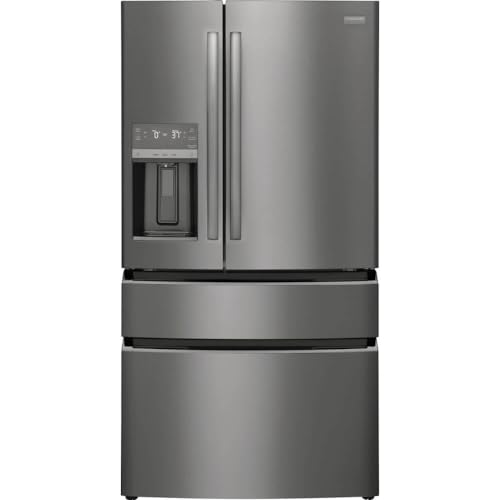
Frigidaire Gallery 21.5 Cu. Ft. 4-Door French Door Refrigerator GRMC2273CD — Through-Door Ice and Water
The Frigidaire Gallery GRMC2273CD is the only refrigerator in this six that puts an external ice and water dispenser in the door, and for many households that single fact ends the debate. If your family’s day runs on glasses of ice water fetched without opening the cabinet — children, athletes, anyone in a hot climate — a through-door dispenser is not a luxury but the main interface of the appliance. Frigidaire wraps it in smudge-proof black stainless steel, a finish that shrugs off the fingerprints a dispenser-centric fridge inevitably collects.
Its second headline is the convertible temperature drawer. A drawer that can swing between freezer and fresh duty is the four-door format’s most practical invention: set it cold for the December baking marathon, set it fresh for the summer barbecue shop. At 21.5 cubic feet in a 36-inch, counter-depth frame, the Gallery sits in the sweet middle of this guide — big enough for a family, shallow enough for a fitted look, flexible enough for the two weeks a year when your shopping changes character entirely.
The counter-depth qualification matters here as it did for the Bosch: you are trading a few cubic feet of depth for a cleaner line. The difference is that Frigidaire spends some of the reclaimed convenience budget on the dispenser, which needs a water line run to the alcove. Renters and owners of older kitchens without a plumbed point nearby should cost that plumbing honestly before falling for the black stainless front.
The convertible drawer also changes how this fridge handles the awkward categories. Cheese and charcuterie for a party, a tray of proofing dough, a dozen eggs too many — each can claim the drawer at fresh temperatures one week, while the next week it freezes the glut of a garden harvest. Owners of fixed-layout fridges solve these problems with a second appliance; the Gallery solves them with a setting. That flexibility is why this model, rather than a larger fixed cabinet, may suit keen cooks whose needs swing with the seasons.
Black stainless deserves a practical note alongside the aesthetic one. On a dispenser-led fridge, the area around the paddles collects drips, splashes and small hands. A smudge-proof finish lowers the daily wiping burden in exactly the zone where the burden concentrates. If your household includes children who serve themselves, that finish will earn its place every single day.
Budget the dispenser’s ongoing care into the decision as well. Through-door systems ask for periodic filter changes and an occasional clean of the recess where drips dry. None of this is onerous, and the listing’s owner community will have the rhythm documented, but a household that wants a fit-and-forget appliance should weigh it against the pitcher and tray alternatives before choosing the Gallery for its front panel alone.
- Capacity, from the listing title: 21.5 cu. ft.
- Width, from the listing title: 36 inches
- Dispenser, from the listing title: external ice and water
- Drawer, from the listing title: convertible temperature drawer
- Finish, from the listing title: smudge-proof black stainless steel, counter-depth
- Where to buy: the Frigidaire Gallery 21.5 Cu. Ft. 4-Door French Door Refrigerator GRMC2273CD listing on Amazon — check price on Amazon
Strengths
- External ice and water dispenser, unique in this line-up.
- Convertible drawer flexes between freezer and fresh storage by season.
- Smudge-proof finish suits a high-touch, dispenser-led household.
Trade-offs
- Dispenser requires a water line at the alcove.
- Counter-depth format gives back some capacity versus full-depth rivals.
- Black stainless finish narrows your matching options for future appliances.
Best for: ice-water households that want through-door convenience plus seasonal drawer flexibility. Not the right match for: kitchens without easy water-line access, or buyers wedded to a bright stainless suite.

KoolMore 17.9 Cu. Ft. 4-Door French Door Refrigerator, Stainless — Narrow-Kitchen Fit
KoolMore’s 17.9-cubic-foot four-door is built around a number most flagship lines ignore: 33 inches of width. Plenty of real kitchens — older houses, narrow galleys, apartments with a fridge nook framed decades ago — cannot accept a 36-inch cabinet at all. This model keeps the French-door-over-two-lower-doors layout inside that narrower frame, with digital temperature control and automatic defrost doing the modern basics quietly in the background.
Ice here is a manual twist ice maker in the freezer. Read that as honesty rather than deprivation: no water line, no dispenser mechanics, nothing to leak, and a tray you twist when you remember and ignore when you do not. Households migrating from a basic top-freezer will find the ritual familiar, while gaining the eye-level fresh section and the split-door efficiency that made them want a four-door in the first place.
Seventeen point nine cubic feet in a 33-inch frame will not swallow a warehouse-club habit, and the guide says so plainly. What it swallows is a normal weekly shop for two to four people, organised across four doors so the milk run does not chill-exchange the whole cabinet. For the kitchen whose constraint is width rather than appetite, this is the pick that respects the constraint instead of arguing with it.
There is a second, quieter audience for a 33-inch four-door: owners of older homes where the kitchen was planned around a smaller fridge and the walls have opinions. Widening an alcove can mean moving plumbing, rewiring a socket or losing a cabinet. A machine that delivers the modern layout inside the existing opening avoids the entire renovation conversation. The KoolMore’s stainless finish helps it sit comfortably beside standard appliances while it does so.
Automatic defrost, named in the listing, is worth underlining for buyers upgrading from an older compact. Manual-defrost freezers demand an annual empty-and-chip ritual that busy households postpone until the ice wins. Here, the freezer maintains itself, and the digital temperature control gives a clearer read on conditions than a numbered dial whose meaning nobody remembers. Small mercies, but a refrigerator is a decade-long relationship built from small mercies.
For renters with a landlord-owned alcove, the KoolMore has one more virtue: it asks nothing of the building. No water line to install, no opening to widen, no finish that clashes violently with whatever range is already there. When the tenancy ends, the machine leaves with you and the kitchen returns to its original state, which is more than can be said for most four-door upgrades.
- Capacity, from the listing title: 17.9 cu. ft.
- Width, from the listing title: 33-inch
- Ice, from the listing title: manual twist ice maker
- Controls and defrost, from the listing title: digital temperature control, automatic defrost
- Finish, from the listing title: stainless steel
- Where to buy: the KoolMore 17.9 Cu. Ft. 4-Door French Door Refrigerator listing on Amazon — check price on Amazon
Strengths
- Fits 33-inch alcoves that exclude most four-door models.
- No water line needed, thanks to the manual twist ice maker.
- Digital temperature control and automatic defrost cover the modern essentials.
Trade-offs
- Manual ice means planning ahead for parties.
- Capacity is modest for large or bulk-shopping households.
- No dispenser or convertible drawer features are named in the listing.
Best for: narrower kitchens that refuse to give up the four-door layout. Poorly suited to: high-volume ice users and families who shop in bulk.

Upstreman 14.9 Cu. Ft. 4-Door French Door Refrigerator FC149 — Compact Four-Door
The Upstreman FC149 is the smallest refrigerator in this guide at 14.9 cubic feet, and its existence is the point: the four-door idea, scaled down to a counter-depth cabinet for small households, first flats and kitchens where a full-size fridge would dominate the room. It wears black rather than stainless, which in a compact kitchen often works better — a dark, quiet front recedes where a big bright one shouts.
Fourteen point nine cubic feet demands a shopping rhythm to match. This is a fridge for households that shop little and often, eat fresh, and keep a short bench of frozen reserves rather than a season’s worth. Couples and singles who cook most nights will find the four-door zoning genuinely pleasant at this scale: the small compartments match small quantities, and nothing gets lost at the back because there barely is a back.
Be clear-eyed about guests and holidays. A 14.9-cubic-foot cabinet hosting a family Christmas will need help — a cool box, a neighbour’s shelf, a garage overflow if your climate allows. The FC149’s bargain is everyday rightness for one or two people, bought at the price of occasional improvisation. For the right household that is a bargain worth taking, and the black counter-depth format will look sharper doing it than a shrunken white top-freezer ever would.
Consider the FC149 as a first serious refrigerator for a household forming its habits now. Couples setting up a first owned flat often inherit or buy the cheapest white box available, then organise their shopping around its failures for years. Starting instead with a compact four-door teaches the zoning habit early, at a scale where mistakes are small. When the household eventually grows into a bigger kitchen, the habits transfer; the machine itself can retire to a utility room or let as a perfectly respectable second fridge.
The counter-depth format also suits the FC149’s likely homes physically. Small kitchens are usually circulation-tight, and a cabinet that sits closer to the wall leaves the cook a wider working corridor. In a studio or open-plan flat, the black front reads as furniture rather than appliance, which matters when the fridge shares a room with your sofa.
Energy habits at this scale deserve a word. A smaller cabinet opened by a small household cycles gently; there is simply less cold mass to disturb and fewer mouths disturbing it. The FC149’s owners are also the readers most likely to shop at markets and cook from scratch, patterns that suit a compact fridge’s quick turnover. Buy it for the life you actually live, and its modest cubic footage stops reading as a compromise.
- Capacity, from the listing title: 14.9 cu. ft.
- Format, from the listing title: 4-door French door, counter depth, full size fridge
- Finish, from the listing title: black
- Model, from the listing title: FC149
- Where to buy: the Upstreman 14.9 Cu. Ft. 4-Door French Door Refrigerator FC149 listing on Amazon — check price on Amazon
Strengths
- Brings the four-door layout to genuinely compact households.
- Counter-depth stance keeps small kitchens feeling open.
- Black finish offers an alternative to the stainless default.
Trade-offs
- Smallest capacity here; bulk shopping will overflow it.
- No ice or water feature is named in its listing title.
- Holiday hosting will need an overflow plan.
Best for: singles, couples and small flats that shop fresh and often. Not suited for: families, batch cookers and anyone whose freezer holds a season of anything.
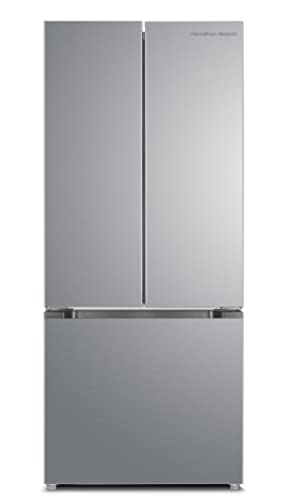
Hamilton Beach 17.7 Cu. Ft. French Door Refrigerator HBF1770 — Freezer-Drawer Simplicity
The Hamilton Beach HBF1770 takes a slightly different route through the four-door idea: French doors up top, and below them a freezer drawer rather than a pair of lower doors. A drawer changes the freezer’s ergonomics completely. Instead of kneeling to peer into a dark lower cabinet, you pull the whole frozen inventory toward you and survey it from above, which is how drawers spoil you everywhere else in a kitchen.
At 17.7 cubic feet and counter depth, the HBF1770 is sized for couples and small families in fitted kitchens. Its listing names no dispenser and no ice feature, and the guide treats that plainness as a feature in itself: there is very little on this machine to go wrong, no water line to plumb, no dispenser recess stealing door storage. Households burned by a previous fridge’s complicated ice system often come looking for exactly this kind of mechanical modesty.
The stainless, full-size presentation keeps it visually at home beside mainstream ranges and dishwashers. Pair it in a small fitted kitchen with seating chosen for long, comfortable suppers — our guide to Best Computer Chairs for Posture and Comfort is about desks, but the comfort principles travel — and the room starts to feel designed rather than accumulated. More practically: measure your swing clearance, because French doors plus a deep drawer pull need honest floor space in front of the alcove.
The drawer format also reframes frozen storage for anyone with limited mobility. Bending double to excavate the bottom of a chest-style lower freezer is a genuine barrier for some cooks; pulling a drawer to waist height and looking down into it is not. If the household includes an older cook who still runs their own kitchen, that ergonomic difference can decide whether the freezer gets used fully or quietly avoided.
Styling-wise, the HBF1770’s plain stainless front is a team player. It does not demand that the rest of the kitchen match a proprietary black or a panel system, and it will look current beside appliances bought years apart. In a guide full of feature-led machines, this one makes the case that the right refrigerator can simply be the one that opens well, chills reliably and asks nothing of you in return.
Practical buyers should also note what a freezer drawer does to frozen organisation: it favours stacking in labelled bags and boxes over standing items upright. If your freezer holds mostly flat-packed portions, soups and leftovers, the drawer is the natural home for them. If it holds tall tubs and upright joints, the lower-door picks above will serve you better, and no amount of drawer enthusiasm should talk you out of your own habits.
- Capacity, from the listing title: 17.7 cu. ft.
- Format, from the listing title: French door, counter depth, freezer drawer
- Size class, from the listing title: full size
- Finish, from the listing title: stainless steel
- Model, from the listing title: HBF1770
- Where to buy: the Hamilton Beach 17.7 Cu. Ft. French Door Refrigerator HBF1770 listing on Amazon — check price on Amazon
Strengths
- Freezer drawer surveys frozen food from above, with no kneeling.
- No dispenser plumbing or water line to install or maintain.
- Counter-depth fit suits standard fitted kitchens.
Trade-offs
- No ice or water feature is named in the listing title.
- Drawer format holds bulky frozen items less flexibly than open lower doors.
- Capacity sits mid-pack; big households should look at the GE Profile.
Best for: couples and small families who value a simple, drawer-based freezer. A poor fit for: through-door ice devotees and bulk freezers.
Side-by-Side Comparison: Six Four-Door Cabinets at a Glance
| Model | Capacity | Depth style | Ice and water story |
|---|---|---|---|
| GE Profile PGE29BYTFS | 28.7 cu. ft. | Full depth | Dual-dispense autofill pitcher |
| Bosch 800 Series B36CL80SNS | 20.5 cu. ft. | Counter depth | None named in listing |
| Frigidaire Gallery GRMC2273CD | 21.5 cu. ft. | Counter depth | External ice and water dispenser |
| KoolMore 17.9 | 17.9 cu. ft. | 33-inch width | Manual twist ice maker |
| Upstreman FC149 | 14.9 cu. ft. | Counter depth | None named in listing |
| Hamilton Beach HBF1770 | 17.7 cu. ft. | Counter depth | None named in listing |
What Does Counter Depth Really Cost You in Storage?
Compare the GE Profile’s 28.7 cubic feet with the counter-depth machines clustered between 14.9 and 21.5, and the depth tax looks dramatic — until you remember that depth is the least usable dimension in a refrigerator. Food at the back of a deep shelf is food on its way to being forgotten. Counter-depth cabinets put everything within an arm’s natural reach and let you see the whole inventory in one glance, which quietly reduces waste. The honest question is not how many cubic feet you surrender, but how many of the deep cabinet’s cubic feet you were actually using well.
There is also the room itself to consider. A counter-depth fridge aligns with the cabinet run, widens the working aisle and stops the appliance from becoming the room’s largest piece of furniture. In open-plan homes where the kitchen is also the living space, that alignment is worth real money in daily pleasure. Choose full depth when your household size truly demands the volume; choose counter depth when the room’s flow matters as much as the shopping list.
How Should You Measure an Alcove for a Four-Door Refrigerator?
Measure the alcove three times: width between the framing or cabinet sides, height under any over-fridge cabinet, and depth from wall to counter front. Then measure the doors again with the doors open in your mind — French doors need lateral clearance to swing past adjacent walls and island corners, and drawers need a straight run of open floor equal to their full extension plus your own standing room. A four-door cabinet that fits the hole but cannot open against your island is a sculpture, not an appliance.
Then walk the delivery route with the tape still in hand. Front door, hallway turns, stairwell corners, the kitchen doorway itself. Compare every pinch point against the cabinet’s largest dimension, remembering that delivery crews can remove fridge doors but cannot remove your door frames. Write the numbers down and check them against the dimensions on the listing page for the exact model you choose; manufacturers publish them, and five minutes with a tape now is cheaper than a refused delivery later.
Which Ice Arrangement Suits Your Household Best?
This guide contains the three honest answers. Through-door dispensing, on the Frigidaire Gallery, serves high-frequency ice-and-water households and costs you a water line plus some door storage. The GE Profile’s autofill pitcher serves table-centred households: cold water in volume, carried where it is needed, with no dispenser recess in the door. Manual twist trays, on the KoolMore, serve everyone else — low ice use, no plumbing, nothing to service — at the cost of planning for parties.
A useful test: count how many times a day someone in your house wants ice or chilled water. In single figures, the tray or the pitcher will never annoy you. In the dozens, with children refilling sports bottles at the door, the dispenser stops being a gadget and becomes infrastructure. Match the machine to the count, not to the showroom’s sense of theatre.
How Do You Organise Four Doors So the System Survives Real Life?
Give each compartment a job and write the jobs down for the first month. A workable pattern: left upper door shelves for condiments and jars, right upper for drinks and daily dairy, main fresh cabinet for ingredients, one lower compartment for frozen reserves, the other for overflow fresh, deli or the week’s planned cooking. The specific pattern matters less than its existence; an unassigned drawer becomes a junk drawer at refrigerator temperatures within a fortnight.
Review the assignment after a month of real cooking and move one thing. Every household discovers a misfit — the tall bottles that only fit one shelf, the cheese that keeps migrating. Four-door cabinets reward this small iteration because each compartment is a separate negotiation. Readers furnishing the rest of a period-feeling kitchen around a new fridge may enjoy Best Mid-Century Modern Chairs for Comfort for the dining corner; the organising principle, everything in its assigned place, is the same.
Lower Doors or a Lower Drawer — Which Four-Door Layout Works Harder?
Five of the six picks here divide the bottom half into doors; the Hamilton Beach divides it into a drawer, and the difference shapes daily life more than any other choice in this guide. Lower doors behave like a pantry: tall frozen items stand upright, categories can be split left and right — meat on one side, vegetables on the other — and each side can be opened without exposing the other. For households that freeze in distinct categories and cook from the freezer several nights a week, that separation keeps the inventory legible.
A drawer behaves like a chest you survey from above. Everything is visible at once, which suits households that freeze opportunistically — leftovers, bread, the reduced-price finds — and retrieve by rummaging rather than by category. Drawers also tend to seal with a satisfying compression when pushed home, and they cannot be left swinging ajar by a hip bump in passing. Neither layout is objectively better; the question is whether your freezer life is filed or piled. File households should buy doors, pile households should buy the drawer, and both should be honest about which one they are.
There is a middle behaviour worth copying whichever you choose: keep a written inventory taped inside a kitchen cabinet door. Four compartments hide food more efficiently than one big box, in every sense. A list that takes ten seconds to update when something goes in or out will save the duplicate purchases and the archaeological discoveries that otherwise accumulate in any divided freezer by its second year.
How Do You Keep Four Sets of Door Seals Doing Their Job?
A four-door refrigerator has roughly twice the gasket length of a two-door, and gaskets are where refrigerators quietly succeed or fail. A seal that no longer meets the cabinet lets moist kitchen air seep in continuously; the machine answers with frost, longer compressor runs and food that ages faster near the leak. The maintenance is unglamorous and quick: wipe each gasket monthly with warm water and a cloth, working into the folds where crumbs and sticky spills collect, then dry them so the rubber stays supple.
Test the seals twice a year with a banknote or a sheet of paper. Close each door on the paper and pull; a healthy seal grips noticeably along its whole length. Where the paper slides out freely, first clean that stretch again — dried spills cause more false failures than worn rubber — then check whether the cabinet is still level, because a twisted stance can hold one corner off its seal. Persistent gaps on a machine in warranty are a service call, not a personality trait to live with.
Keep the door bins honest, too. Overloaded door storage is the commonest cause of doors that no longer close flush: a tall bottle leaning in its bin can hold a French door a few millimetres off its seal all night. If a door needs a push rather than a swing to close, redistribute the bins before blaming the machine.
How Should a Four-Door Refrigerator Be Levelled and Settled In?
Installation day decides more than most buyers realise. The cabinet must sit level side to side and very slightly tilted back, so the four doors swing gently closed under their own weight rather than drifting open. Adjust the front feet with a spirit level on the cabinet top, then test each door: released from a hand’s width, it should sigh shut and seal. A door that bounces or hangs ajar will frost its compartment and run its compressor hard for years, all from ten skipped minutes with a wrench.
Leave the clearances the manufacturer specifies around the cabinet. Refrigerators shed heat through their sides or rear, and a four-door wedged tight into joinery will work harder and die younger than the same machine given breathing room. After positioning, let the cabinet stand before switching on if the delivery involved tipping it, then allow a full day for temperatures to stabilise before loading it with a week’s shopping. Load gradually, set the fresh section to a food-safe chill, and check with a fridge thermometer after twenty-four hours rather than trusting the dial’s optimism.
Finally, register the appliance, photograph the rating plate inside the cabinet, and file both with the delivery paperwork. The rating plate carries the model and serial numbers that every future parts order, warranty conversation and recall check will ask for, and it is far easier to photograph on day one than to transcribe while kneeling with a torch in year six.
How Do You Load a Four-Door Fridge for a Party Weekend?
Party weekends are where the format proves itself, so load deliberately. Two days out, move the everyday reserves into one lower compartment and free the other for the event: drinks first, laid in while there is time for them to reach serving temperature, then the platters stacked with parchment between them, then the desserts where small hands cannot reach them during the afternoon. The fresh cabinet keeps only what the cook will touch while preparing, which keeps the door-open time during the busiest cooking hours remarkably short.
On the day itself, the autofill pitcher on the GE or the dispenser on the Frigidaire becomes the drinks station, and the main cabinet can stay shut for long stretches while guests circulate. Afterwards, the zoning pays a second dividend: leftovers consolidate into a single compartment, the reserves return to their usual home, and nothing about Monday’s ordinary cooking has been displaced by Saturday’s abundance. Owners of two-door fridges perform this same dance with cool boxes and apologies; the four-door simply has the rooms for it.
If parties are rare in your house, do not buy for them. Buy for the Tuesday-evening version of your kitchen, and let the rare big weekend borrow a cool box. The picks above span both philosophies — the GE Profile is the party-capable flagship, the Upstreman the Tuesday-evening specialist — and the honest self-assessment of which household you run is worth more than any feature list in this guide.
What Mistakes Do Four-Door Buyers Most Often Make?
The commonest mistake is buying capacity by headline number while ignoring depth, ending with a magnificent cabinet that swallows the walkway. The second is falling for a dispenser without checking for a water line, or paying for one when the household drinks from the tap twice a day. Third comes measuring the alcove but not the journey — the hallway turn that defeats the delivery. Fourth, treating the lower compartments as a dumping ground from day one, which dissolves the format’s entire advantage. Fifth, forgetting door swing against a wall: a French door that opens ninety degrees and no more makes its outermost shelf a cave. Each of these is avoidable with a tape measure, a count of daily ice trips, and ten honest minutes before ordering.
Final Recommendation
Start with your alcove and your ice habits; they narrow this field faster than brand preference ever will. If the room and the household are large, the GE Profile PGE29BYTFS is the complete four-door statement, pitcher and all. If the kitchen’s line matters most, the Bosch brings the poise, and the Frigidaire Gallery adds the only true through-door dispenser plus a convertible drawer for seasonal flex. Narrower and smaller kitchens are properly served rather than tolerated by the KoolMore, the Hamilton Beach and the Upstreman. Choose the cabinet whose compartments match the way your household actually shops, and the fourth door will stop being a novelty within a week — it will simply be how the kitchen works, one small cold room opened at a time.
If you are torn between two finalists, decide by the morning test. Picture the busiest fifteen minutes of your kitchen day — lunches being packed, bottles being filled, yesterday’s leftovers being judged — and walk through it at each machine in your mind. The cabinet in which that quarter hour feels calmer is the right one, whatever the capacity table says. Refrigerators are bought on specifications and lived with in moments; the moments should get the deciding vote.
A last word on timing. Refrigerators are replaced in a hurry more often than any other major appliance, because the old one chooses the moment. If your current machine is ageing audibly — longer runs, warmer spots, a seal beginning to part — shopping from this guide now, at leisure, is worth real money compared with shopping on the day the compressor stops. Measure the alcove this weekend, note the two or three picks that fit your ice habits and your width, and keep the list somewhere findable. When the day comes, you will be executing a decision instead of improvising one, and the four-door cabinet you chose calmly will organise your kitchen for the next decade.
Frequently Asked Questions
Is a four-door refrigerator more efficient than a two-door model?
It can be in daily practice, because small trips open a small compartment and spill less cold air. The machine’s rated consumption depends on its own engineering, so treat the layout as a usage advantage rather than a guaranteed saving, and keep door seals clean so any format performs as designed.
Can a four-door fridge fit a standard 36-inch opening?
Most full-size models here are built for that width class, and the Frigidaire’s listing states 36 inches outright. Always confirm the exact dimensions on the listing for the model you choose, and leave the small clearances the manufacturer specifies for ventilation and door swing.
What is a convertible temperature drawer actually for?
It is a compartment that can run at freezer or fresh-food temperatures as needed. On the Frigidaire Gallery in this guide it lets you add freezer space during heavy baking or preserving weeks, then return the drawer to fresh duty for drinks and produce afterwards.
Do I need a water line for every model in this guide?
No. Only a through-door dispenser, like the Frigidaire Gallery’s, requires plumbing. The GE Profile’s pitcher fills inside the cabinet, the KoolMore uses a manual twist tray, and the remaining picks name no water feature at all in their listings.
How long should a four-door refrigerator last?
A well-kept refrigerator of any layout should give a decade or more of service. Longevity is helped less by brand folklore than by basics: ventilation clearance, clean door seals, level installation and a condenser kept free of dust. The four-door format adds seals to maintain, so wipe them monthly and check for tears when you clean.
Can I reverse the doors on a French-door model?
Generally no — French doors are handed pairs, and the lower doors or drawers are built for their positions. This is why measuring swing direction against your kitchen’s walls and islands before ordering matters so much on this format; the layout you receive is the layout you keep.
Are counter-depth refrigerators too small for families?
Not necessarily. The counter-depth picks here reach 21.5 cubic feet, which feeds a family that shops weekly. What they cannot do is warehouse-club bulk storage; if that is your pattern, the full-depth GE Profile is the honest answer.
Installed with that care — level, clearances honoured, each of its four doors sighing shut on its seal — a four-door cabinet repays the attention immediately, in the small daily ceremony of opening exactly the compartment you need and no other. It is a modest pleasure, repeated a dozen times a day for a decade, and it is the real product being bought in every pick above: not cubic feet, not finishes, but a kitchen that opens one small cold room at a time, exactly as its cook intended.
Related Guides
Four doors are one answer to the cold-storage question; the wider appliance picture matters too. If a coordinated laundry and kitchen refresh is under way, our guide to Best Smart Washers and Dryers covers the utility room’s hardest-working pair with the same spec-from-the-listing discipline used throughout this page.


