What's inside
- Key Takeaways
- Quick Picks
- How Did We Separate Full-Featured Computerized Machines From Entry Ones?
- Computerized Contenders Compared
- What Can a Computerized Machine Do That a Mechanical One Genuinely Cannot?
- How Do You Get the Most From a Deep Stitch Library Without Drowning in It?
- What Mistakes Do Computerized Machine Buyers Make Most Often?
- What Does the Daily Workflow on a Screen-Guided Machine Feel Like?
- Why Do Presser Foot Counts Deserve More Respect Than Stitch Counts?
- When Does Sewing Speed Actually Matter?
- How Should You Think About Owning Electronics for a Decade?
- Which of These Six Suits a Shared Household Machine?
- How Do Computerized Machines Handle the Fabrics Home Sewists Actually Use?
- What Should a First Month With a Computerized Machine Look Like?
- Final Recommendation
- Frequently Asked Questions
- Related Guides
As an Amazon Associate I earn from qualifying purchases. This post may contain affiliate links at no extra cost to you.
cottageverdict.com is reader-supported. When you buy through links on our site, we may earn an affiliate commission.
Where to buy: All six machines below are sold on Amazon, linked from the Quick Picks table and from each detailed review. Computerized models are sold in several bundle configurations, so verify that the feet, table, and case named in a review are part of the configuration on the listing you open, and take current pricing from the “check price on Amazon” line in each spec box.
There is a plainer tier of computerized machine — the entry models that put a small screen on a basic feature set — and then there is the tier this guide covers: the best computerized sewing machines in their full-featured form, where the electronics genuinely change what a home sewist can do. Stitch libraries run from sixty to six hundred. Buttonholes are measured, memorized, and repeated identically down a shirt front. Screens show you the stitch you actually selected, with the foot the machine recommends for it. If you have already met the entry tier and felt its ceiling — or if you simply prefer to buy the capable machine once — these six are the shortlist, ranked by how completely each one uses its computer rather than by whether it has one.
What does the computer actually buy you? Repeatability, first of all: the twentieth buttonhole matches the first because the machine measures the button and remembers the settings. Precision at low speed, because electronic control holds stitch formation steady when a mechanical machine would be lumpy. And information — an LCD that names the stitch, its length and width, and the correct foot removes the guesswork that sends mechanical owners to the manual. None of that makes fabric feed itself or taste unnecessary, and the honest sections below will say where each machine’s electronics end and its mechanics begin.
Key Takeaways
- This guide covers full-featured computerized machines, a clear step above entry-level computerized models with token screens.
- The SINGER Quantum Stylist 9960 carries the deepest library here — 600 stitches, five fonts, and thirteen one-step buttonholes per its listing title.
- The SINGER HD6600C is the power outlier: a heavy-duty computerized machine whose title states 1,100 stitches per minute and sixty percent more power.
- Brother’s three entries split by temperament — streamlined (CS5055), quilting-equipped (CS7000X), and buttonhole-focused (CP2160F).
- The Janome JW8100 competes on completeness: 100 stitches, an extension table, a hard cover, and 22 accessories in the box.
- Where a listing title does not state a number, this guide says so in the spec box instead of importing figures from other models.
Quick Picks
| Machine | Badge | Defining strength |
|---|---|---|
| Brother CS5055 Computerized Sewing Machine | Streamlined Computerized Pick | An LCD-equipped Brother computerized machine without the quilting extras, for sewists who want electronic control in a tidy package. |
| Brother CS7000X Sewing and Quilting Machine | Quilt-Friendly Computerized Pick | Seventy built-in stitches, a wide table, and ten included feet make it the Brother here dressed for quilting work. |
| SINGER Quantum Stylist 9960 Computerized Sewing & Quilting Machine | Deep-Library Pick | Six hundred stitches, five fonts, thirteen presser feet, an extension table, and a hard case — the maximalist option. |
| Janome JW8100 Computerized Sewing Machine | Complete-Kit Computerized Pick | One hundred stitches, seven buttonholes, an extension table, a hard cover, and 22 accessories arrive as one complete setup. |
| SINGER HD6600C Sterling Heavy Duty Computerized Sewing Machine | Heavy-Duty Computerized Pick | Computerized control over a heavy-duty brief: 100 stitches, added power, and a stated 1,100 stitches per minute. |
| Brother CP2160F Computerized Sewing Machine | Buttonhole-Ease Pick | Sixty stitches, advanced needle threading, and seven auto-size buttonholes target the tasks garment sewists repeat most. |
How Did We Separate Full-Featured Computerized Machines From Entry Ones?
The dividing line is whether the electronics govern the sewing or merely decorate it. In this guide’s tier, stitch selection is digital, settings are displayed and adjustable on screen, buttonholes are one-step and sized by the machine, and the stitch library is deep enough to include utility, stretch, decorative, and — on the SINGER 9960 — lettering. Entry computerized machines typically offer a fraction of that: fewer stitches, simpler buttonholes, and a screen that reports rather than assists. Neither tier is dishonest; they serve different buyers. This guide simply refuses to mix them, because a reader shopping for the full-featured tier who lands on an entry model feels the shortfall within a month.
We read listing titles as the contract. A stitch count, a buttonhole count, a speed in stitches per minute, a table or case in the box — if the title states it, we print it and lean on it. If the title is silent, as Brother’s CS5055 title largely is beyond its LCD display, the review says what can honestly be said about the machine’s class and position, and the spec box flags the silence. That discipline matters more in this category than most, because computerized machines invite number inflation: stitch applications, stitch functions, and built-in stitches are three different counts that marketing loves to blur. Here, only the title’s own number appears, labeled as what it is.
Finally, we kept one heavy-duty machine in the list deliberately. Computerized used to imply delicate, and the HD6600C exists to refute that — but note that even it is a home machine with a power claim, not an industrial tool. Readers whose sewing life is upholstery-weight or leather should treat this whole guide as the refined end of home sewing and look at the heavy categories separately; garment and quilt sewists, meanwhile, will find the overlap with Best Home Quilting Sewing Machines instructive, since two of these six machines are dressed for quilting straight from the box.

Brother CS5055 Computerized Sewing Machine — Streamlined Computerized Pick
The CS5055 is the minimalist of this group, and its listing title practices what it preaches: Brother computerized sewing machine, LCD display, full stop. No stitch count is published in the title, no table or case is promised, and that restraint defines the machine’s role. This is the pick for a sewist who wants the core computerized experience — screen-guided stitch selection, consistent electronic speed control, settings you can see — without paying for quilting furniture or a festival of accessories. In a guide full of machines competing on abundance, the CS5055 competes on focus.
What can honestly be said about its sewing? It belongs to Brother’s computerized line, which means the daily experience centers on the LCD: choose a stitch digitally, see its settings, adjust length and width electronically rather than by dial. For garment sewing, mending with precision, and craft work, that workflow is the entire point of the category, and a streamlined model delivers it without the storage burden of extension tables and hard cases. Readers who need verified numbers — a stitch total, a buttonhole count — should treat the manufacturer documentation as the deciding document, because this guide will not invent them, and the absence of a title claim is not evidence of absence in the machine.
The buyer who thrives here already owns, or happily improvises, the supporting cast: a table, a lamp, a growing foot collection bought one project at a time. What they are purchasing is the computerized core at its least encumbered. Everyone else in this guide sells a more complete room of equipment; the CS5055 sells the engine room only, and for a tidy, experienced sewist that is a feature.
- Display stated in the title: LCD display
- Stitch count: no figure appears in its title — verify with the manufacturer documentation before comparing libraries
- Buttonholes: the listing title does not describe them, so confirm style and count in the documentation
- Included table or case: none is claimed in the maker’s title
- Motor speed: no stitches-per-minute figure is stated in the product title
- Where to buy: the Brother CS5055 listing on Amazon — check price on Amazon
Strengths
- The computerized core experience arrives without quilting extras inflating the package.
- An LCD-centered workflow replaces dial guessing with visible, adjustable settings.
- Its streamlined brief suits smaller sewing spaces and tidy storage.
Trade-offs
- The title’s silence on counts means comparison shoppers must verify specifications in documentation.
- Quilters will need to add table support that sibling picks include in the box.
- Sewists who want lettering or a deep decorative library should look at the 9960 instead.
Best for: experienced or tidy sewists who want electronic control without bundled furniture. Not suited for: buyers who need every specification verified from the listing before ordering.
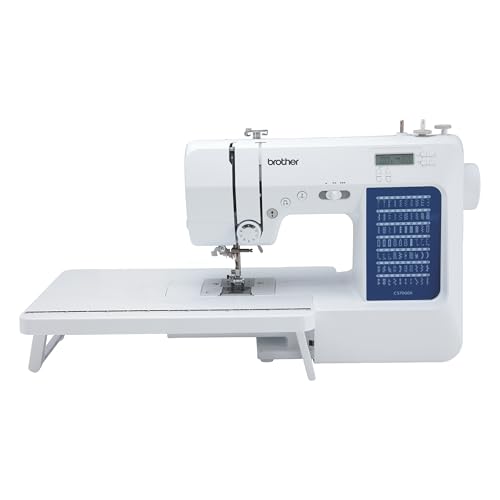
Brother CS7000X Sewing and Quilting Machine — Quilt-Friendly Computerized Pick
Where the CS5055 strips down, the CS7000X dresses up — specifically for the quilt maker’s table. Its listing title states 70 built-in stitches, an LCD display, a wide table, and ten included feet, and calls the machine a sewing and quilting model outright. The wide table is the headline for anyone who has pieced a quilt top on a standard bed: fabric weight stops dragging the work off course, seams stay where you steer them, and the machine’s computerized consistency gets a fair chance to show. Ten feet in the box cover the realistic first year of quilting and garment work without a second order.
Seventy stitches is a well-judged library size for this brief. Piecing needs a perfect straight stitch and a scant-quarter-inch discipline more than it needs novelty; quilting adds a few decorative and appliqué options; garments add stretch and finishing stitches. A 70-stitch menu covers those neighborhoods with room to spare while remaining navigable on the LCD without a printed index card taped to the machine. Brother positions this model at the sewist whose projects alternate between quilts and clothes, and the equipment list supports the claim in a way a bare stitch count never could.
Consider it the balanced buy of the Brother trio: more complete than the CS5055, more quilting-ready than the CP2160F, and less specialized than either extreme. If your sewing room is really a dining table and your projects are measured in quilt blocks and school clothes, the CS7000X’s table-and-feet completeness will be felt in every session.
- Stitches stated in the Amazon listing title: 70 built-in stitches
- Display stated in the stated title: LCD display
- Included feet stated in the model title: 10 included feet
- Table: wide table included, per the listing title
- Buttonhole detail: the listing title does not enumerate buttonholes — check the manufacturer documentation for the count and style
- Where to buy: the Brother CS7000X listing on Amazon — check price on Amazon
Strengths
- The wide table transforms fabric handling for quilt piecing and larger projects.
- Ten included feet remove the usual second purchase for common techniques.
- A 70-stitch library balances garment, quilting, and decorative needs without menu bloat.
Trade-offs
- Buttonhole specifics are not stated in the title, so shirt-makers must verify before committing.
- The table that helps quilting also demands storage space between sessions.
- Lettering and monogramming ambitions belong to the SINGER 9960’s territory.
Best for: quilt-and-garment sewists who want table support and feet included from day one. Not suited for: sewists whose work is exclusively small mending, where its completeness goes unused.

SINGER Quantum Stylist 9960 Computerized Sewing & Quilting Machine — Deep-Library Pick
The Quantum Stylist 9960 is what happens when a manufacturer decides to answer every feature question with yes. Its listing title is the longest in this guide because the machine earns it: 600 stitches, five fonts, thirteen presser feet, thirteen one-step buttonholes, a hard case, an extension table, LED light, and a metal frame, in a computerized sewing and quilting machine. Read that list slowly, because each item retires a common upgrade. The fonts retire the separate lettering question. The thirteen one-step buttonholes retire buttonhole anxiety for every garment weight a home sewist meets. The hard case and extension table retire the storage and support purchases. The metal frame speaks to how the machine will feel in year five.
Six hundred stitches will not all be used — no honest review should pretend otherwise — but depth changes behavior in a subtler way: the stitch you need is present. Decorative edging for a christening gown, a stretch stitch that suits a particular knit, a heirloom-style stitch for a quilt border: libraries this deep turn “the machine cannot do that” into a rare sentence. The five fonts make personalization a native function rather than an embroidery machine’s job, which matters for labels, names on school gear, and quilt signatures. For dressmaking readers, this is the machine in the guide whose buttonhole repertoire and stitch range most directly serve a wardrobe, a point the dressmaking discussion in Best Sewing Machines for Dressmaking develops from the garment side.
The cautions are about appetite rather than quality. A 600-stitch menu rewards a sewist who enjoys exploring settings and punishes one who wants three stitches and silence; the learning curve is real even with a good screen. It is also the guide’s maximalist footprint in spirit — case, table, feet, and all — so small-space buyers should measure their storage honesty before their sewing ambition. For the sewist who wants one computerized machine to be the end of the search, though, the 9960 remains the benchmark this category is judged against.
- Stitches stated in the retailer title: 600 stitches
- Lettering stated in the title: 5 fonts
- Buttonholes stated in its title: 13 one-step buttonholes
- Included feet stated in the maker’s title: 13 presser feet
- Frame, lighting, and extras stated in the product title: metal frame, LED light, extension table, hard case
- Where to buy: the SINGER Quantum Stylist 9960 listing on Amazon — check price on Amazon
Strengths
- The deepest stitch library and buttonhole repertoire in this guide, with lettering included.
- Extension table, hard case, and thirteen feet make it a complete workstation in one purchase.
- A metal frame underwrites the precision the electronics promise.
Trade-offs
- Menu depth means a genuine learning period before the machine feels like home.
- Its complete-kit nature is the largest commitment of space and budget in this list.
- Casual menders will use a small fraction of what they paid for.
Best for: committed garment and quilt sewists who want the search to end with one machine. Not suited for: minimalists, tiny spaces, or anyone whose sewing is a monthly hem.

Janome JW8100 Computerized Sewing Machine — Complete-Kit Computerized Pick
Janome describes the JW8100 as fully-featured, and its listing title itemizes the claim: 100 stitches, seven buttonholes, a hard cover, an extension table, and 22 accessories. The number that deserves attention is not the hundred — respectable, sufficient, unremarkable in this company — but the twenty-two. Accessories are where computerized machines quietly tax their owners after purchase, and a box that arrives with its supporting cast complete lets the first month be about sewing rather than shopping. The hard cover, rather than a soft dust cover or nothing, signals a machine expected to be stored and moved with care, and the extension table repeats the CS7000X’s lesson that fabric support is a stitch-quality feature.
Seven buttonholes is a garment sewist’s working set: the standard sizes and styles that cover shirts, trousers, and jackets without the thirteen-deep repertoire of the 9960. Paired with 100 stitches, the JW8100’s profile is that of a machine specified by someone who sewed real clothes and counted what they actually used. Janome’s reputation in this class rests on stitch formation and feed consistency, and while this guide does not import outside test claims, the specification’s balance — library, buttonholes, table, cover, accessories — is the profile of a machine with no obvious hole in its brief.
Choose the JW8100 when you want the computerized tier’s benefits in their most administratively painless form: one order, everything present, nothing to chase. It cedes the extremes — the 9960’s library, the HD6600C’s power brief — in exchange for having no errands attached, and for many households that trade is the wisest one in this guide.
- Stitches stated in the Amazon listing title: 100 stitches
- Buttonholes stated in the stated title: 7 buttonholes
- Bundled extras stated in the model title: 22 accessories
- Table and cover stated in the retailer title: extension table and hard cover included
- Speed figure: the listing title publishes no stitches-per-minute number, so the manufacturer documentation is the place to verify it
- Where to buy: the Janome JW8100 listing on Amazon — check price on Amazon
Strengths
- Twenty-two accessories make it the most self-sufficient box in this guide.
- A balanced 100-stitch library and seven buttonholes cover garment sewing thoroughly.
- Extension table plus hard cover handle both the sewing and the storing halves of ownership.
Trade-offs
- No lettering is claimed, so personalization projects need another route.
- Power-focused sewists will prefer the heavy-duty brief of the HD6600C.
- Its completeness duplicates accessories that established sewists may already own.
Best for: garment sewists who want a complete computerized setup in a single purchase. Not suited for: buyers chasing the largest stitch library or a heavy-duty motor brief.

SINGER HD6600C Sterling Heavy Duty Computerized Sewing Machine — Heavy-Duty Computerized Pick
The HD6600C exists for the sewist who read the first five reviews and kept asking one question: yes, but what about thick fabric? Its listing title answers in numbers — 100 built-in stitches, sixty percent more power, 1,100 stitches per minute, a one-step buttonhole, an LCD screen, and LED light, in a heavy-duty computerized machine finished in black. The power claim is the soul of the product. Home sewists meet thickness at jeans hems, canvas totes, layered waistbands, and curtain headers, and a computerized machine that can keep stitch formation honest through those stacks — while still offering a screen and a hundred stitches for delicate work — occupies a genuinely useful middle ground.
Hold the claim to its correct scale. Sixty percent more power is a comparison within the maker’s own frame of reference, and heavy duty here means a home machine with a stronger motor brief, not an industrial unit with a servo motor and a table. Upholstery frames and leather goods still belong to heavier categories. But within home sewing, the difference between a machine that slows and skips at a jeans hem and one that walks through it is the difference between finishing projects and avoiding them. The stated 1,100 stitches per minute also marks this as the speed outlier of the guide — valuable for long straight runs like curtains and quilt sashing, provided the operator’s steering keeps up.
The computerized layer matters more on this machine, not less. Power without control chews fabric; the LCD, the stitch menu, and electronic speed management are what let a strong motor sew a blouse on Tuesday after hemming jeans on Monday. If your project list is the most fabric-diverse in your household — denim, canvas, knits, dress fabrics — the HD6600C is the pick that refuses to make you choose between muscle and manners.
- Stitches stated in the title: 100 built-in stitches
- Power claim stated in its title: 60% more power
- Speed stated in the maker’s title: 1,100 stitches per minute
- Buttonhole stated in the product title: 1-step buttonhole
- Display and lighting stated in the Amazon listing title: LCD screen, LED light
- Where to buy: the SINGER HD6600C listing on Amazon — check price on Amazon
Strengths
- The strongest power and speed brief in this guide, aimed at thick home-sewing stacks.
- A full 100-stitch computerized menu means thick-fabric ability costs no delicacy.
- LCD guidance and LED light keep the powerful machine precise at the needle.
Trade-offs
- Heavy duty is a home-sewing claim; industrial upholstery and leather work remain out of scope.
- Its speed ceiling rewards experienced steering and can hurry a beginner’s seams.
- A single stated buttonhole style is narrower than the 9960’s thirteen-deep repertoire.
Best for: sewists whose projects swing between denim-weight stacks and ordinary garments. Not suited for: anyone expecting industrial performance, or beginners who need the gentlest possible pace.

Brother CP2160F Computerized Sewing Machine — Buttonhole-Ease Pick
The CP2160F’s listing title reads like a garment sewist’s diary of small frustrations, each one answered: 60 built-in stitches, an LCD screen, an advanced needle threading system, and seven auto-size buttonholes. Start with the threading. Advanced needle threading is the feature experienced sewists praise most and newcomers understand fastest — the needle eye is the smallest target in sewing, and a system that hits it for you removes a daily friction that quietly discourages short sessions. A machine you can thread in seconds gets used for the ten-minute repair; a machine that fights you gets used on weekends.
Auto-size buttonholes deserve the same respect. The machine measures the button and produces a buttonhole fitted to it, then repeats that size identically — the shirt-front test that separates computerized sewing from mechanical approximation. Seven auto-size styles cover the garment wardrobe’s realistic needs, and sixty stitches supply the utility, stretch, and decorative range a clothes-maker cycles through without the 9960’s expedition-length menu. The CP2160F is, in short, the specialist of this group: not the deepest library, not the strongest motor, but the most precisely aimed at the two operations garment sewists perform constantly — threading needles and making buttonholes.
That aim defines its buyer. If your sewing is clothes — new garments, alterations, repairs that must look shop-bought — the CP2160F’s priorities are your priorities. If your sewing is quilts, the CS7000X’s table matters more; if it is everything at maximum depth, the 9960 waits. Specialization is not limitation when the specialty is your whole hobby.
- Stitches stated in the stated title: 60 built-in stitches
- Needle threading stated in the model title: advanced needle threading system
- Buttonholes stated in the retailer title: 7 auto-size buttonholes
- Display stated in the title: LCD screen
- Included feet and table: the listing title does not enumerate them, so verify the box contents in the manufacturer documentation
- Where to buy: the Brother CP2160F listing on Amazon — check price on Amazon
Strengths
- Advanced needle threading removes the most frequent small frustration in sewing.
- Seven auto-size buttonholes deliver identical, button-fitted results down a garment.
- A focused 60-stitch menu keeps the LCD uncluttered for garment workflows.
Trade-offs
- No table or foot count is stated in the title, so quilting support must be arranged separately.
- Its stitch library is the smallest stated here, which decorative maximalists will feel.
- Thick-stack power is not its brief; the HD6600C owns that argument.
Best for: garment sewists who thread needles and sew buttonholes every single session. Not suited for: quilters needing table support or sewists chasing the deepest decorative menu.
Computerized Contenders Compared
| Machine | Stated stitches | Stated buttonholes | Signature extra |
|---|---|---|---|
| Brother CS5055 Computerized Sewing Machine | Not stated in its title | Not stated in the maker’s title | LCD-guided streamlined package |
| Brother CS7000X Sewing and Quilting Machine | 70 | Not stated in the product title | Wide table, 10 feet |
| SINGER Quantum Stylist 9960 Computerized Sewing & Quilting Machine | 600 | 13 one-step | 5 fonts, hard case, extension table |
| Janome JW8100 Computerized Sewing Machine | 100 | 7 | 22 accessories, hard cover |
| SINGER HD6600C Sterling Heavy Duty Computerized Sewing Machine | 100 | 1-step | Added power and top-end speed |
| Brother CP2160F Computerized Sewing Machine | 60 | 7 auto-size | Advanced needle threading system |
What Can a Computerized Machine Do That a Mechanical One Genuinely Cannot?
Three things, and they are worth separating from the marketing fog. First, it can remember. A mechanical machine’s settings live in dial positions that drift between sessions; a computerized machine recalls the stitch, length, and width you left, and on buttonholes it stores the measured size so a set matches perfectly. Second, it can inform. The screen tells you which foot a stitch wants and warns, on better implementations, when a combination makes no sense — guidance a dial cannot offer. Third, it can regulate. Electronic speed control keeps stitch formation consistent at a crawl, which is where precision work lives: topstitching a collar edge, easing a sleeve cap, sewing a curve on a child’s garment.
There is a fourth, quieter gift: consistency across operators. In a household where two people share one machine, a mechanical model’s results depend on who set the dials and whether they remembered to reset them; a computerized model presents the same stitch, at the same settings, to whoever sits down next. Teachers notice this too — a class of students on screen-guided machines produces comparable work because the machines hold the settings steady while hands vary. For families buying one machine to serve several learners at different levels, that steadiness is worth real money, and it is part of why this tier has become the default recommendation for shared sewing spaces.
What it cannot do is equally clarifying. It cannot feed fabric better than its feed dogs and presser system allow, which is why tables and feet still dominate quilting outcomes. It cannot choose taste — a decorative stitch placed badly is worse than a straight stitch placed well. And it cannot repeal maintenance: lint, needles, and correct bobbins govern computerized machines exactly as they govern mechanical ones. Buyers who understand both columns get a tool that feels close to magical on buttonhole day and honestly mechanical the rest of the month, which is precisely what these six are.
How Do You Get the Most From a Deep Stitch Library Without Drowning in It?
Treat the library as a reference shelf, not a syllabus. In your first month, live in perhaps eight stitches: straight at two lengths, zigzag at two widths, a stretch stitch, an overcasting stitch, the buttonhole, and one decorative stitch you simply like. Make a stitch sampler — a labeled grid on cotton, sewn in a contrasting thread — and keep it in the machine’s cover. The sampler converts a 600-stitch menu from a fog into a map, because you browse fabric, not screen icons, when a project needs something new.
Keep the sampler habit permanently, because libraries keep surprising their owners years in. A stitch you ignored through two years of garment sewing can turn out to be exactly the heirloom edging a christening project wants, and the sampler — updated whenever curiosity strikes — is how you will remember it exists. Some sewists photograph their samplers and keep the images with their patterns; others pin the cloth inside a cupboard door. The medium does not matter. What matters is that the library stays browsable in fabric, where stitches show their true scale and texture, rather than as rows of icons whose differences blur at screen size.
After that, let projects pull stitches out of the library one at a time. A knit dress pulls the stretch stitches. A quilted table runner pulls the decorative edging. Lettering, on the machine that offers fonts, gets pulled by the first school uniform that needs a name. This project-led exploration is how deep libraries justify themselves over years rather than overwhelming in week one — and it is also why the streamlined CS5055 remains a rational purchase: a sewist whose projects never pull beyond the core eight loses nothing at all. Readers whose ambitions drift from stitching into motifs and monograms at scale will eventually look at dedicated embroidery, and the hat-focused corner of that world is surveyed in Best Embroidery Machines for Hats for when the curiosity arrives.
What Mistakes Do Computerized Machine Buyers Make Most Often?
The first is counting stitches as if they were horsepower. Six hundred stitches include variations and decorative patterns that share mechanics; the number signals depth, not strength, and the sewist who needs strength should be reading the HD6600C’s power claim instead. The second mistake is ignoring the buttonhole system while mesmerized by the menu — buttonholes are the computerized feature a garment sewist uses weekly, and their style (auto-size, one-step, counted in the title or not) deserves more scrutiny than any decorative category. The third is forgetting the furniture: a computerized machine on a wobbly table with no fabric support will sew below its ability, which is why the table-included picks in this guide keep earning their keep.
A fifth mistake is buying against a future self who may never arrive — the sewist who will definitely take up heirloom sewing next year, or definitely start a small alterations business. Buy for the projects on your table this season, with one honest step of headroom, and the machine will be used enough to justify itself. Future selves are welcome to upgrade with evidence in hand; present selves saddled with an intimidating maximalist machine tend to sew less, not more, and an underused flagship is the most expensive machine of all per finished seam.
The fourth mistake is treating the screen as the manual. Screens guide selection; they do not teach tension judgment, fabric choice, or why a knit needs a ballpoint needle. New computerized owners sew best when the first month pairs the machine with scrap fabric and low speeds, letting the electronics demonstrate their consistency while hands learn their part. The machine’s memory is excellent, but your hands are the half of the system that still has to be trained, and no LCD in this guide pretends otherwise.
What Does the Daily Workflow on a Screen-Guided Machine Feel Like?
It feels like fewer interruptions. On a mechanical machine, changing from a straight stitch to an overcast stitch is a small ritual of dials and memory: which number, what width did I use last time, is this the right foot? On the machines in this guide, you select the stitch on the screen, the machine presents its standard length and width, suggests the foot, and lets you nudge the values with buttons while watching them change. That sounds like a convenience until you multiply it by a garment’s construction — a shirt might ask for six different stitches in one sitting, and the computerized workflow turns six rituals into six taps. Sewing sessions lengthen not because the machine is faster, but because the friction between steps has been sanded down.
Threading and bobbin routines benefit unevenly, which is why this guide reads titles closely. The CP2160F’s advanced needle threading is a workflow feature of the first rank; a machine without a threading claim asks the same of your eyes as any mechanical model. Similarly, stitch memory matters in proportion to how repetitive your sewing is: a quilter making forty identical blocks wants settings recalled perfectly, while a mender making one repair a month may never notice the feature exists. Judge workflow claims against your own session patterns — frequency, variety, session length — rather than against an abstract feature ranking, and the right pick usually announces itself.
There is also a confidence effect worth naming. Beginners on computerized machines spend less time wondering whether the machine is set up wrong, because the screen states the setup. That certainty redirects attention to the fabric and the seam, where learning actually happens. It is the same reason the entry tier of computerized machines exists at all; this guide’s full-featured tier simply extends the certainty across a much wider range of work, with the tables, feet, and buttonhole systems to match the ambition the screen encourages.
Why Do Presser Foot Counts Deserve More Respect Than Stitch Counts?
Because feet change what the machine can physically do, while stitches mostly change what it can draw. A zipper foot lets the needle sew beside a zipper’s teeth instead of on top of them. A buttonhole foot measures and frames the work that defines garment finishing. A quilting foot, an overcasting foot, a blind-hem foot — each one converts a technique from improvisation into procedure. When the 9960 lists thirteen presser feet and the CS7000X lists ten, those are not garnish numbers; they are thirteen and ten techniques that arrive ready to perform, with no compatibility research and no second order.
The corollary is that a machine with a modest foot count is not crippled — it is unfinished, and the buyer should budget the difference honestly. Feet are model-family specific, so the correct purchases matter, and a sewist who prefers to assemble a collection slowly, project by project, may rationally choose the streamlined CS5055 and spend the savings exactly where their sewing leads. What this guide resists is comparing a bare machine and a thirteen-foot machine as if the difference were packaging. It is capability, delivered early or bought later, and the total cost of ownership only becomes clear when both columns are priced in time as well as money.
When Does Sewing Speed Actually Matter?
Speed matters in long, straight, confident sewing: curtain panels, quilt sashing, duvet covers, the endless hems of household linen. There, a machine that can run at the HD6600C’s stated top speed shortens a chore measurably — provided the fabric is supported, the line is marked, and the operator’s steering has the hours behind it. Speed is a multiplier on skill, in both directions: it multiplies the output of a steady hand and the waviness of an unsteady one, which is why experienced sewists sew fast rarely and beginners should sew fast almost never.
For the rest of sewing — curves, corners, easing, topstitching, buttonholes — the working speed is a fraction of any machine’s ceiling, and the computerized advantage inverts: electronic control’s gift is not pace but consistency at a crawl. A machine that forms perfect stitches at a walking pace lets you sew the difficult twenty centimetres of a project at the speed your eyes can supervise. When comparing these six, therefore, read the single stated speed figure as a specialist credential for the heavy-duty pick, not as a score the others failed to post. Most of your sewing life happens far below every ceiling in this guide, and the machines differ there in guidance and feeding, not in velocity.
How Should You Think About Owning Electronics for a Decade?
A sewing machine is one of the longest-lived appliances in a home, and computerized models add a fair question: will the screen age as gracefully as the steel? The practical answer from this category’s history is reassuring — the electronics in home sewing machines are simple, sealed, and built around stitch control rather than fashionable connectivity, so there is little to become obsolete. What ages machines is mechanical: lint neglected, needles bent into the plate, storage in damp rooms. The metal frame claimed by the 9960 and the hard cases and covers claimed by the 9960 and JW8100 are therefore not cosmetic extras; they are the longevity features, protecting the alignment and cleanliness that decade-scale ownership depends on.
Support your own purchase with three habits. Keep the manual, because the screen’s icons will outlast your memory of the week you learned them. Register nothing, subscribe to nothing — these machines ask for neither — but do keep a note of the exact model name and the foot system it uses, because feet and bobbins are the purchases future-you will make and accuracy there prevents the wrong-part drawer every sewist accumulates. Finally, sew something at least monthly. Machines that run regularly stay limber and familiar; machines stored for a year return as strangers. A computerized machine’s memory is perfect, and regular use is how you build a matching one in your hands.
Which of These Six Suits a Shared Household Machine?
Shared machines live harder lives than personal ones: a parent pieces a quilt on Saturday, a teenager shortens jeans on Sunday, and someone mends a school shirt at dawn on Monday. That rotation rewards the middle of this guide. The JW8100’s completeness means each user finds the foot and accessory they need without a household procurement process, and its hard cover protects the machine during its frequent storage intervals. The CS7000X serves a similar rotation where quilting is the senior partner’s main pursuit. The 9960 can be a glorious shared machine provided the household’s most enthusiastic sewist accepts the role of menu guide for the others — a real role, since a 600-stitch library shared without guidance becomes a machine everyone is slightly afraid of.
What shared use argues against is specialization without communication. The CP2160F’s garment focus delights the household’s clothes-maker and merely serves the quilter; the HD6600C’s power delights the denim hemmers and is wasted on the curtain menders. None of that makes them poor shared machines — it makes the conversation before purchase the important step. List the household’s actual projects for a year, in the proportions they really occur, and buy for the center of that list. Computerized machines reward that honesty more than mechanical ones do, because their strengths are specific and their screens make those strengths easy to use once the right one is home.
How Do Computerized Machines Handle the Fabrics Home Sewists Actually Use?
Quilting cotton is the category’s home turf, and every machine here will piece it beautifully; the differences emerge at the wardrobe’s edges. Knits reward stitch choice — a true stretch stitch or a narrow zigzag with the right needle — and the deeper libraries, the 9960’s above all, simply hold more of those choices in reserve. The computerized advantage with knits is consistency: a stretch stitch formed at an even, regulated pace stretches with the garment instead of popping in wear, and electronic speed control is what makes that even pace available to hands still learning pedal discipline.
Denim and canvas sort the list by motor rather than menu. A single layer passes anywhere; the folded hem stack is the examination, and it is the HD6600C’s stated power brief that sits the exam with confidence. Sheers and silks examine the opposite virtue — delicacy at low speed, a fine needle, a gentle start — and here the screen-guided machines’ ability to hold a slow, exact pace is the feature that matters, whichever badge is on the front. Leather and upholstery-weight work remain outside this guide’s honest scope entirely: no title here claims them, and the feed systems of home computerized machines are not built for those materials’ grip and thickness. Knowing where a category ends is part of buying it well, and these six end, respectably, at the heavy end of ordinary home fabric.
What Should a First Month With a Computerized Machine Look Like?
Week one belongs to the sampler. Sew every stitch family your machine offers onto labeled cotton, at default settings and then at adjusted lengths and widths, and keep the sheet. You are building the reference that turns a menu into a vocabulary, and an hour of sampling saves a year of guessing. Week two is a simple garment or quilt block sewn entirely with core stitches, chosen to teach the machine’s feeding, its buttonhole routine if your project needs one, and the sound it makes when it is happy. Week three introduces one new capability — a decorative edging, a stretch stitch on a knit, an auto-size buttonhole set down a placket — pulled by a project rather than by curiosity alone.
Week four is maintenance and review: brush the bobbin area, fit a fresh needle, and look honestly at which features you touched. That audit predicts your next five years better than any review, including this one. Sewists who discover they live in ten stitches can relax about library envy forever; sewists who bumped against their machine’s limits three times in a month have evidence, not anxiety, to justify their next step. The six machines here span enough range that most first months end in contentment — provided the purchase was matched to the sewing life described honestly at the start, which is the one specification no manufacturer can print for you.
Final Recommendation
Match the machine to the center of your sewing life and the extremes will take care of themselves. Garment sewists who live in buttonholes and needle-threading should take the Brother CP2160F’s focused kindness; those who want the complete wardrobe workstation with the deepest library should take the SINGER Quantum Stylist 9960 and end the search. Quilt-leaning sewists belong with the CS7000X’s wide table, complete-box buyers with the Janome JW8100’s 22 accessories, fabric-diverse households with the HD6600C’s power, and tidy minimalists with the CS5055’s streamlined screen. Whichever you choose, you are buying repeatability — the twentieth seam sewn like the first — and that quiet consistency is what turns a computerized machine from a gadget into the backbone of a sewing room.
Frequently Asked Questions
Is a computerized sewing machine harder to learn than a mechanical one?
For most people it is easier after the first hour. The screen removes the two classic beginner uncertainties — which stitch is selected, and what its settings are — by displaying both. The learning that remains is the same on any machine: threading, bobbin handling, steering, and fabric judgment. Deep-menu models like the 9960 ask for more exploration time, but exploration is optional in a way that dial-guessing on a mechanical machine is not.
How many stitches will I realistically use?
Most home sewists live in eight to fifteen stitches across a year: straight, zigzag, stretch, overcast, blind hem, buttonhole, and a few decorative favorites. Larger libraries pay off in specific moments — lettering for labels, a specialty stitch for heirloom work — rather than daily. That is why this guide weighs buttonhole systems, tables, and threading as heavily as counts: those are the features with weekly consequences.
Can a computerized machine sew denim and canvas?
Within home-sewing limits, yes — and one pick here is briefed for exactly that. The HD6600C’s stated added power and heavy-duty positioning make it the guide’s choice for jeans hems and canvas stacks, used with a suitable needle and a sensible pace. What no machine in this guide claims is industrial capacity; upholstery frames, leather goods, and production runs belong to heavier equipment categories.
What does an auto-size buttonhole actually do?
You place your button in the buttonhole foot’s measuring holder, and the machine sews a buttonhole fitted to that button — then repeats the identical size for every button on the garment. It removes the measuring, marking, and four-step choreography of mechanical buttonholes, and it is why garment sewists rank buttonhole systems so highly: a shirt front with eight identical buttonholes is the computerized difference you can see from across the room.
Do computerized machines need special maintenance?
The mechanical half needs the same care as any machine: lint removal around the bobbin area, fresh needles, correct bobbins, and storage away from dust and damp. The electronic half adds only common sense — surge protection is a kind habit for any screen-bearing appliance, and the machine should be switched off before threading mishaps are cleared by hand. Follow the manual’s oiling guidance for your specific model rather than a general rule, since designs differ.
Should I choose the machine with the most stitches or the most feet?
Feet, for most households. Stitches beyond the core families wait for a project to summon them, and some never get summoned at all, while feet determine whether techniques you already want — zippers, buttonholes, quilting, overcasting — can be done properly this month. That is why the comparison in this guide lists feet and tables beside stitch counts: a thirteen-foot machine with a deep library, like the 9960, wins both columns, but a ten-foot quilting package will serve a piecing household better than a bare machine with twice the menu. Count what changes your sewing this season first, and let the library be the tiebreaker.
Is it worth paying for lettering on a sewing machine?
It is worth it if names and labels are a recurring need in your house — school uniforms, camp clothes, quilt signatures, handmade gifts — because built-in fonts turn a twenty-minute embroidery detour into a two-minute stitch selection. The 9960 is the only pick here whose title claims fonts, five of them, so lettering shoppers have a short decision. If personalization is an occasional whim rather than a routine, skip the feature without regret and put the difference toward the table or feet your weekly sewing will actually touch.
Related Guides
One closing thought for readers torn between two picks on this page: the tiebreaker that ages best is the machine whose daily workflow you can picture without flinching — threading it in your kitchen’s evening light, changing its foot with cold hands, finding its buttonhole routine at the end of a long garment. Specifications win comparisons; workflows win years. All six machines here will sew well. The one that fits your hands, your table, and your patience is the one that will still be sewing when the novelty of the screen has long since become ordinary, dependable routine.
A computerized machine with a quilting table soon turns its owner toward batting, layering, and the sandwich that makes a quilt a quilt. When that day comes, the choices that decide warmth and drape are compared in Best Batting for Bed Quilts, a sensible next read for new quilters.


