What's inside
- Where to Buy a Wine Refrigerator in the 125-Bottle Class Without Counting Cans by Mistake
- Key Takeaways
- Quick Picks
- How Did We Count Bottles Without Ever Trusting a Photograph?
- How Can You Tell a Bottle Count From a Can Count in Two Seconds?
- What Do Zones Actually Do for a Collection Like Yours?
- Where Should a Cabinet of This Size Live?
- How Should You Arrange Bottles Inside a Cabinet of This Size?
- What Temperatures Should Each Zone Actually Hold?
- How Do You Keep a Large Wine Cabinet Running Quietly for Years?
- Which Pick Fits Which Collector? Four Honest Portraits
- Common Mistakes When Buying by the Number
- A Year in the Life of a 125-Class Cabinet
- How Do You Move a Full-Size Wine Cabinet Without Regretting It?
- What Does It Cost to Run a Cabinet in This Class, in Habits Rather Than Numbers?
- Final Recommendation
- How Does a Wine Cabinet Differ From the Refrigerator Already in Your Kitchen?
- What Should You Check in the First Month of Ownership?
- Frequently Asked Questions
- Related Guides
As an Amazon Associate I earn from qualifying purchases. This post may contain affiliate links at no extra cost to you.
cottageverdict.com is reader-supported. When you buy through links on our site, we may earn an affiliate commission.
Where to Buy a Wine Refrigerator in the 125-Bottle Class Without Counting Cans by Mistake
The best 125-bottle wine refrigerators sit at the point where a collection stops being a hobby shelf and becomes a small cellar, and this guide treats the number in its headline the way a careful buyer should: as a claim to be read bottle by bottle in each listing’s own title. The verified picks below state 124, 120, 120, and 100 bottles, with one deliberate 200-bottle step-up for collectors who have already outgrown the class. Every count in this article comes from a title, never from a photograph of shelving and never from a retailer’s rounding.
One warning belongs at the top, because it catches real shoppers: this category is plagued by can counts wearing bottle clothing. A listing in the same searches advertises 125 cans — cans, not bottles — and a hurried reader can order a beverage cooler while believing they have bought a wine cellar. Cans are shorter, narrower, and stack differently; a can capacity tells you almost nothing about how many wine bottles a unit will hold. Each review below therefore repeats its pick’s bottle count exactly as titled, and the verification section teaches the two-second check that separates the two numbers forever.
Shape matters alongside count. This class divides into wide freestanding cabinets, 30-inch multi-door designs that share a wall with the kitchen’s other statement appliances — the same built-in thinking that drives our guide to Best 36-Inch Column Refrigerators — and one slim 24-inch tower whose 200-bottle claim shows how much vertical shelving can hold. Zones divide it further: single-zone simplicity for cellars of similar wines, dual and triple zones for households serving whites chilled and reds merely cool from the same cabinet.
Key Takeaways
- Every bottle count in this guide comes from a listing title: 124, 120, 120, 100, and a 200-bottle step-up beyond the class.
- Can counts are not bottle counts; a 125-can listing found in these searches is a beverage cooler and is not a pick here.
- Zones are the second decision after capacity: single, dual, and triple-zone designs all appear among the picks.
- Two picks are 30-inch multi-door cabinets, one is a wide freestanding Whynter, one a built-in Whynter, and one a 24-inch tower.
- Bottle counts assume standard bottles; large-format and wide Burgundy bottles reduce every cabinet’s real capacity.
- The exact-125 specialist class is covered in its own section without a link, because the verified pool’s honest counts cluster just under the number.
Quick Picks
| Wine refrigerator | Our badge | The short case for it |
|---|---|---|
| Whynter 124 Bottle Wine Refrigerator FWC-1201BB | Closest to the class number | A 124-bottle freestanding cabinet with digital control, a UV-protected glass door, a lock, and a charcoal filter. |
| VEVOR 30in Wine Fridge 120 Bottle | Best multi-zone entertainer | A 30-inch, 120-bottle, triple-zone cabinet that also states a 234-can capacity for the beverage side of a home bar. |
| BODEGA 30 Inch Dual Zone Wine and Beverage Refrigerator | Best wine-and-beverage split | A 30-inch dual-zone design with double stainless drawers, holding 120 bottles and 234 cans as titled. |
| Whynter Built-in Wine Refrigerator 100 Bottle BWR-1002SD | Best built-in under the number | A 100-bottle built-in Whynter with digital control, a UV-protected door, and quiet compressor cooling. |
| 200 Bottle Dual Zone Wine Fridge 24 Inch | Best step-up beyond the class | A 200-bottle dual-zone tower in a 24-inch width, for collections that have already passed this guide’s number. |
| The specialist exact-125 cellar class | The number in its purest form | Specialist cellar cabinets that state exactly 125 bottles, covered as a class because the verified pool clusters at 120 and 124. |
How Did We Count Bottles Without Ever Trusting a Photograph?
We counted from titles, and only from titles. A wine refrigerator’s shelving photographs beautifully and lies fluently — bottles in pictures are often slim, shelves are spaced for the camera, and a cabinet that photographs like a library may shelve like a cupboard. So each pick’s capacity in this guide is the number its own listing prints, and where a title prints two numbers, as the VEVOR and BODEGA titles print both bottle and can counts, we kept the two numbers in their separate columns and never let them touch.
We also screened for the category’s impostors. Beverage coolers with wine-adjacent styling, can-led listings whose bottle count never appears, and compact countertop units borrowing cellar language were all set aside. What survived is a tight class: five linked cabinets whose titles state their bottle counts plainly, plus one class section for the specialist exact-125 cabinets that the pool does not verify but honest shopping should know exist.
Ranking within the five followed the questions collectors actually ask. How close is the count to the class number? How many zones, and do they suit a mixed collection? Freestanding, built-in, or either? And what do the stated details — a lock, a charcoal filter, UV-protected glass — say about whether the maker designs for wine or merely for cold drinks? The reviews answer in that order, pick by pick.

Whynter 124 Bottle Wine Refrigerator FWC-1201BB — Closest to the class number
One bottle short of the headline, and the honest champion of it: the Whynter FWC-1201BB states 124 bottles in its title and builds the rest of its case from details that read like a cellar keeper’s checklist. Digital temperature control, a UV-protected glass door, a lock, and a charcoal filter all appear in the title itself, which tells you the maker expects wine people — who worry about light, vibration, odour, and curious hands — to be reading closely.
As a large freestanding cabinet in black, it asks for floor space rather than cabinetry surgery, which suits collectors whose cellar lives in a dining room, a study, or the cool end of a cottage kitchen. The charcoal filter is the detail casual buyers skip and serious ones circle: cellars exchange air, and a filter keeps the room’s smells — paint, garlic, a wood stove’s breath — out of the corks’ long conversation with the wine. The lock, similarly, is not about distrust; it is about a household where a good bottle should require a decision, not an impulse.
- Bottle capacity as titled: 124 bottles
- Format: large freestanding cabinet, black finish, model FWC-1201BB
- Controls and door: digital temperature control, UV-protected glass door
- Cellar details named: lock and charcoal filter
- Where to buy: the Whynter 124 Bottle Wine Refrigerator FWC-1201BB listing on Amazon — check price on Amazon
Strengths
- The closest verified count to this guide’s class number, stated plainly in the title.
- A charcoal filter and a lock show a maker designing for wine, not just for cold storage.
- Freestanding placement avoids cabinetry work and lets the cellar move rooms as collections grow.
Trade-offs
- A single stated temperature story suits uniform cellaring better than mixed serving temperatures.
- Its freestanding footprint needs genuine floor space, not a spare corner.
- Large-format bottles will eat into the 124 count faster than standard shapes do.
Best for: collectors building a true cellar in a room with floor space to spare. Not suited for: kitchens needing the unit to disappear into a cabinet run.

VEVOR 30in Wine Fridge 120 Bottle — Best multi-zone entertainer
The VEVOR is this guide’s entertainer: a 30-inch cabinet stating 120 bottles and 234 cans, arranged as a four-door, triple-zone design for a home bar that serves wine and everything else. Read its title as two honest numbers side by side — the bottle count places it in this class, and the can count describes a different shelf for a different drink — and you have the model of how dual-purpose listings should be written and read.
Triple-zone cooling across a stated range of 37 to 64 degrees Fahrenheit lets one cabinet hold sparkling wine at serving chill, whites a step warmer, and reds at cellar cool simultaneously, which is the actual pattern of a household that entertains. Built-in or freestanding installation, a lock, a glass door, and LED lighting complete a specification aimed at a bar wall rather than a cellar corner. Homes planning that bar wall often plan laundry and guest spaces in the same project, and the pairing logic resembles our guide to Best Compact Washers and Dryer Pairs — two duties, one footprint, each number read on its own terms.
- Bottle capacity as titled: 120 bottles; can capacity stated separately at 234 cans
- Zones: triple-zone compressor cooling across a stated 37–64°F range
- Format: 30-inch, four-door, built-in or freestanding, with lock
- Door and lighting: glass door with LED light, as titled
- Where to buy: the VEVOR 30in Wine Fridge 120 Bottle listing on Amazon — check price on Amazon
Strengths
- Three zones match the real serving pattern of a mixed collection and a busy bar.
- Bottle and can counts are both stated, letting buyers plan wine and beverage storage separately.
- Built-in or freestanding flexibility suits both bar walls and open floor plans.
Trade-offs
- A four-door entertainer is a piece of furniture; small rooms will feel its presence.
- Collectors wanting one silent cellar temperature may find three zones more machinery than needed.
- The can capacity tempts buyers to misread the headline number — read the bottle figure first.
Best for: home-bar households serving wine and beverages from one cabinet. A poor fit for: purist cellars holding one style of wine at one temperature.
BODEGA 30 Inch Dual Zone Wine and Beverage Refrigerator — Best wine-and-beverage split
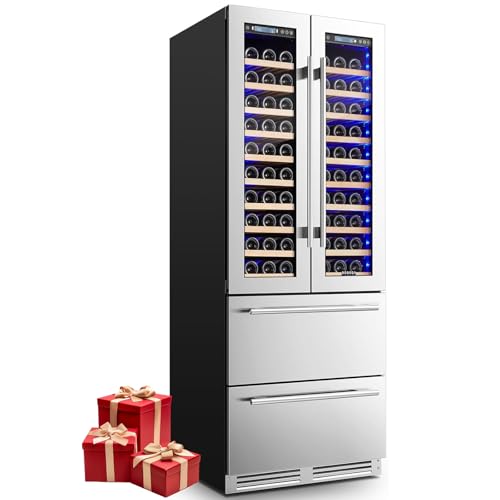
BODEGA’s 30-inch design states its dual identity in its name — wine and beverage — and its title keeps the accounts separate: 120 bottles, 234 cans, dual zones, and a pair of stainless steel drawers that give the beverage side a home of its own. Those drawers are the design’s signature, pulling cans and small bottles out of the wine shelves’ way and into a space shaped for them, which is how a shared cabinet avoids becoming a compromise in both directions.
Quiet compressor cooling and automatic defrost, both named in the title, suit a unit that will live within earshot of conversation — in a dining room, a snug, or the reading end of a cottage where the chairs in Best Kids’ Reading Chairs host the younger audience while the adults’ bottles rest nearby. Built-in or freestanding installation keeps the placement options open, and the dual zones let the wine side hold its temperature while the beverage side runs colder for cans.
- Bottle capacity as titled: 120 bottles, with 234 cans stated for the beverage side
- Zones: dual zone, wine and beverage, as titled
- Format: 30-inch, built-in or freestanding, with double stainless steel drawers
- Running details named: quiet compressor and automatic defrost
- Where to buy: the BODEGA 30 Inch Dual Zone Wine and Beverage Refrigerator listing on Amazon — check price on Amazon
Strengths
- Dedicated drawers keep beverages from colonising the wine shelves.
- Dual zones let wine rest at cellar temperature while cans run properly cold.
- Quiet running and automatic defrost suit living spaces rather than cellars.
Trade-offs
- Two zones rather than the VEVOR’s three, so serving temperatures group more coarsely.
- A shared cabinet means a shared failure point for both collections at once.
- Drawer space is beverage-shaped; oversized wine bottles gain nothing from it.
Best for: households whose fridge door currently overflows with both wine and cans. Not the right match for: collectors who want every cubic inch devoted to bottles.

Whynter Built-in Wine Refrigerator 100 Bottle BWR-1002SD — Best built-in under the number
The second Whynter in this guide plays a different role: a built-in cabinet stating 100 bottles, for the kitchen being designed rather than the room being furnished. Built-in installation means the unit vents and fits as part of a cabinet run, disappearing into the kitchen’s architecture while holding a collection that would fill a small cellar. Its title pairs that format with digital temperature control, a UV-protected glass door, and quiet compressor cooling — the cellar virtues translated into a fitted appliance.
One hundred bottles is this guide’s floor, and it deserves a defence rather than an apology. Many collections plateau near that number for years: a case habit, a few favourites in depth, and a shelf of occasion bottles. A built-in 100-bottle cabinet serves that plateau elegantly and leaves the kitchen’s floor space to the room’s other ambitions. Collectors should simply be honest about trajectory — a collection doubling yearly will outgrow any cabinet in this guide, and the step-up pick below exists for exactly that confession.
- Bottle capacity as titled: 100 bottles, large capacity built-in class
- Format: built-in installation, model BWR-1002SD
- Controls and door: digital temperature control, UV-protected glass door
- Cooling as titled: quiet compressor cooling
- Where to buy: the Whynter Built-in Wine Refrigerator 100 Bottle BWR-1002SD listing on Amazon — check price on Amazon
Strengths
- Built-in format integrates the cellar into a designed kitchen run.
- UV-protected glass and digital control carry the essential cellar protections.
- Quiet compressor cooling suits kitchens that double as living space.
Trade-offs
- The smallest count here; fast-growing collections will feel the ceiling.
- Built-in installation rewards planning and punishes impulse placement.
- No lock or charcoal filter is named in the title, unlike its freestanding sibling.
Best for: designed kitchens holding a steady, curated collection. Poorly suited to: collectors whose case purchases arrive faster than they drink.

200 Bottle Dual Zone Wine Fridge 24 Inch — Best step-up beyond the class
Every honest guide needs its step-up labelled as one, and here it is: a 200-bottle dual-zone tower in a 24-inch width, included not because it belongs to the 125 class but because it towers over it — literally, since its capacity comes from height. The title promises an upgraded compressor, low-noise operation, and intelligent temperature control in a black freestanding-or-built-in body, and the dual zones let a serious collection separate its drinking shelf from its keeping shelf.
Who should step up? The collector whose 120-bottle cabinet already forces monthly triage, the couple cellaring a wedding vintage across decades, and the household that buys by the case when a favourite vintage appears. For them, this guide’s class number is a milestone already passed, and buying the larger tower now is cheaper than buying two cabinets in sequence. Everyone else should read this pick as a signpost: capacity is easy to overbuy, a tower dominates a room, and a half-empty cellar is a sadder sight than a full one.
- Bottle capacity as titled: 200 bottles — a step-up beyond this guide’s class
- Zones: dual zone, in a 24-inch-wide tower format
- Format: freestanding or built-in, black finish
- Running details named: upgraded compressor, low-noise operation, intelligent temperature control
- Where to buy: the 200 Bottle Dual Zone Wine Fridge 24 Inch listing on Amazon — check price on Amazon
Strengths
- Capacity that ends the triage conversation for growing collections.
- Dual zones separate drinking stock from long keeping in one tower.
- A 24-inch width achieves its count through height, sparing floor width.
Trade-offs
- It exceeds this guide’s class by half again; most collections will not fill it.
- A tall tower is a dominant object in a room’s sightlines.
- Top shelves test the reach of shorter collectors when the cabinet is full.
Best for: case buyers and long keepers who have outgrown the class number. Weakest fit: a first cellar still discovering its own size.
The Specialist Exact-125 Cellar Class — The number in its purest form
Somewhere in the specialist cellar market, cabinets state exactly 125 bottles, and this section exists to describe that class honestly: as a class, without a link, because the verified pool behind this guide clusters at 124, 120, and 100 instead. Specialist makers — the cellar outfitters whose catalogues serve restaurants and serious collectors — build to the number with shelving spaced for standard Bordeaux shapes and capacities audited against a stated bottle geometry.
Why does the pool cluster just under? Because capacity is a shelving decision, and mainstream makers optimise for price points and standard cabinet widths, landing where the shelves land. The difference between 120 and 125 bottles is five bottles — one shelf’s spacing, one dinner party’s worth — and no collection in history has failed for want of those five. Hunt the exact number if the number itself delights you, through specialist dealers who will state their bottle geometry in writing; otherwise, let the verified counts in this guide do their honest work.
- Capacity as classed: exactly 125 bottles, stated by specialist makers with a bottle geometry
- Format: cellar cabinets from specialist outfitters rather than mainstream listings
- Verification to demand: the bottle shape the count assumes, stated in writing
- Reality check: five bottles separate this class from the verified 120-bottle picks
- Where to buy: this class is covered without a marketplace link in this guide, because no verified listing in our pool states exactly 125 bottles — pursue it through specialist cellar dealers
Strengths
- An exact count from a maker who states the bottle shape behind it.
- Specialist shelving often handles mixed formats with more grace than mainstream racks.
- Dealer relationships bring delivery, placement, and service into one conversation.
Trade-offs
- Specialist channels mean specialist timelines and pricing structures.
- The gain over a verified 124 or 120 is smaller than the search effort it demands.
- Counts still assume a bottle geometry your collection may not match.
Best for: collectors for whom the exact number is part of the pleasure. Not suited for: anyone who needs a cellar installed before the next case arrives.
There is a social dimension to a cabinet of this size that brochures never mention: it changes how a household buys wine. A case discount stops being a storage problem and becomes an invitation; a favourite producer’s new release can be bought in depth rather than in singles; gifts of wine find a proper home instead of a cupboard above the fridge. The collection becomes a small institution with its own customs — the good shelf nobody raids casually, the drinking shelf everybody understands — and those customs, more than the machinery, are what guests remember about a house that keeps wine well.
How Can You Tell a Bottle Count From a Can Count in Two Seconds?
Read the noun, not the number. Listings in this category print large numerals — 120, 124, 200, 234 — and the eye grabs the figure while the brain skips the word attached to it. Train the opposite habit: find the word bottle or can first, then read its number. The VEVOR and BODEGA titles in this guide print both, honestly separated; the impostor pattern prints a big can number where a bottle number should be and lets the shopper’s assumption do the rest. A beverage cooler sized for 125 cans is a fine appliance and a terrible wine cellar, because cans and bottles differ in height, diameter, and the shelving both demand.
The second check is geometry. A bottle count implies shelving spaced for bottles lying down; a can count implies upright storage on flat shelves. Photographs help here, read sceptically: wine shelving shows cradles, rails, or scalloped racks, while beverage shelving shows flat planes. When a listing’s words and photographs disagree, believe neither and ask the seller — or choose one of the picks above, whose titles settle the question in print.
What Do Zones Actually Do for a Collection Like Yours?
A zone is a separately controlled temperature region, and its value depends entirely on whether your collection lives at one temperature or several. A cellar of reds being kept for future drinking wants one cool, steady temperature and nothing else; zones add cost and machinery to a job that simplicity does better. A household serving from its cabinet weekly wants the opposite: sparkling and whites at serving chill, reds cool but not cold, and the daily drinker somewhere convenient — which is precisely the pattern the triple-zone VEVOR and dual-zone BODEGA and tower are built around.
Be honest about which household you are, because the two designs age differently in your affections. The keeper who buys zones will fiddle with them for a month and then set everything to cellar temperature forever. The server who buys a single zone will chill bottles in the kitchen fridge in batches and quietly resent the choreography. Neither mistake is expensive in money compared with the cabinet itself, but both are expensive in the small daily friction that decides whether an appliance feels like a servant or a supervisor.
Noise belongs in the placement conversation too, especially for the cabinets that will live where people sit. A compressor’s hum that is nothing in a utility room becomes a presence in a reading corner or a dining room at midnight, which is why two picks in this guide carry quiet-running language in their titles and why the rest deserve a first-week listen in the room they will actually occupy. Judge the sound at night, in the furnished room, with the household quiet — the conditions under which the cabinet will spend its life — rather than in a showroom’s daytime bustle, where almost anything sounds discreet.
Where Should a Cabinet of This Size Live?
Wine wants what cellars have always offered: cool, dark, still, and steady. A cabinet supplies the cool and the steady itself, but the room still contributes the rest. Keep any of these picks out of direct sun, away from the heat cycles of a range or a sunny window, and off floors that tremble with every footstep — vibration is the quiet enemy of ageing wine, and a cabinet on a solid floor in a calm room starts its life ahead. The UV-protected doors named on both Whynter picks forgive a brighter room somewhat, but forgiveness is not immunity.
Then plan for the cabinet’s own needs: clearance for its door swing, a socket that is not shared with a kettle’s ambitions, and a delivery route measured like any large appliance’s. Freestanding models need breathing room the maker specifies; built-ins need their vents unblocked by enthusiastic skirting. A cabinet placed with its manual’s clearances honoured will hold its temperature with less effort, less noise, and a longer compressor life — the unglamorous arithmetic underneath every promise a title makes.
How Should You Arrange Bottles Inside a Cabinet of This Size?
A cabinet in this class holds enough wine that arrangement stops being tidiness and becomes retrieval. The keeper’s shelf and the drinker’s shelf should live apart — in the dual-zone tower, by zone; in single-zone cabinets, by height, with the long keepers low where temperatures run steadiest and the weekly bottles at the door’s easy reach. Bottles you must move other bottles to reach are bottles you will forget, and forgotten bottles surface years later as either treasure or vinegar, with the odds set by how honestly the cabinet held its temperature meanwhile.
Group by drinking window rather than by colour or country. This year’s bottles, next year’s bottles, and the long sleepers form a more useful map than a geography lesson, because the question a cellar answers nightly is not where a wine is from but when it should be opened. Leave deliberate gaps in the drinking shelves so new arrivals have somewhere to land without a full reshuffle; a cabinet packed to its printed count has no slack for the case that arrives after a good tasting, and slack, in a cellar, is a feature.
Labels deserve one practical habit: a simple notebook or phone list, shelf by shelf, beats any memory after the fiftieth bottle. Note what went in and when it should come out. The list takes an evening to start and saves the small tragedy of the bottle opened a decade early or the pair discovered a decade late. Serious collectors in the exact-125 specialist class keep such lists as a matter of course; a 120-bottle household deserves the same courtesy from itself.
What Temperatures Should Each Zone Actually Hold?
Cellaring and serving are different jobs wearing similar numbers. For keeping, a single steady cool temperature serves every wine in the cabinet, and steadiness matters more than the precise figure — a cabinet that holds its setting through a summer heatwave is worth more than one that promises a fashionable number and wanders. The Whynter picks’ digital controls matter here: a set temperature you can read and trust beats a dial’s vague geography every day of a wine’s long rest.
For serving, the zones in the VEVOR and BODEGA earn their complexity. Sparkling wines and crisp whites want the cold end of a cabinet’s range — the VEVOR’s title states a span beginning at 37 degrees Fahrenheit — while reds want to rest cool and then warm slightly in the glass rather than arriving at the table cold. A dual-zone household typically keeps one zone at serving chill for whites and sparkling and the other at cellar cool for reds, pulling reds out a little ahead of the meal. The exact figures belong to your palate; the structure — one cold zone, one cool zone — belongs to the physics of how wine drinks best.
What zones cannot do is rescue a cabinet placed in a hot room. A compressor fighting a sun-baked wall will hold its zones unevenly and audibly, which is why the placement section of this guide precedes this one in importance even though it follows it in glamour. Temperature discipline is a partnership between the machine’s zones and the room’s mercy, and the collector who arranges both gets the cellar the titles promised.
How Do You Keep a Large Wine Cabinet Running Quietly for Years?
Begin with level and clearance. A cabinet standing level vibrates less, seals better, and lets its door close with the soft certainty that keeps cold in and noise down; the clearances its manual specifies are not decoration but the compressor’s breathing room. Vacuum the vents and any exposed coils on the schedule the manual suggests, because dust is insulation in exactly the place a refrigerator can least afford it, and a dusty cabinet runs longer, louder, and warmer than its twin.
Mind the door seal the way you would a cellar door’s. Wipe it clean, check its grip with a strip of paper at several points, and replace it when it stops gripping — a tired seal makes the compressor pay for the room’s warmth all night. Keep the cabinet reasonably full, since bottles themselves are thermal mass that steadies temperature through door openings, but never packed against the interior vents, which need their airflow the way shelves need their spacing.
Finally, give the cabinet a rest-day audit once a year: temperatures checked against a simple thermometer rather than the display’s word, the charcoal filter — where fitted, as on the freestanding Whynter — renewed on its maker’s schedule, and the collection list reconciled against the shelves. An hour a year is a trivial rent for a machine guarding a decade of drinking, and the audit has a way of ending with a bottle opened in celebration, which is the correct way for cellar maintenance to end.
Which Pick Fits Which Collector? Four Honest Portraits
The first collector is the cellar builder: a dining-room wall, a growing case habit, and wines bought to keep. The freestanding Whynter 124 is her cabinet — the closest count to the class, a lock for the good shelves, a charcoal filter for the long conversation between cork and air. She will fill it in three years and start a waiting list, and she should know the tower exists for the day the waiting list wins.
The second is the entertainer, whose bar wall serves a crowd with varied thirsts. The VEVOR’s three zones and stated can capacity describe his evenings precisely: sparkling cold, whites chilled, reds cool, and cans for the guests who never touch wine, all behind four doors that make the wall look designed rather than stored. The third portrait is the mixed household, where the BODEGA’s drawers end the nightly negotiation between bottles and cans by giving each its own architecture — a small domestic peace treaty in stainless steel.
The fourth is the kitchen designer, fitting a cellar into a remodelled run where floor-standing furniture would break the lines. The built-in Whynter at 100 bottles is her answer, sized to a curated collection and finished to disappear. And behind all four stands the step-up collector, the one whose portrait is a full cabinet and a case on the floor — for whom this guide’s last linked pick, the 200-bottle tower, is not an extravagance but the correction of an earlier underestimation.
Common Mistakes When Buying by the Number
The headline mistake is the can-for-bottle swap described above, and it is common enough that this guide has now warned against it three times, deliberately. The second mistake is assuming the count fits your bottles: capacities assume a standard shape, and collections rich in wide Burgundy bottles, tall Riesling bottles, or half bottles will find every cabinet’s real number different from its printed one — usually lower for the wide shapes, sometimes higher for halves. The third mistake is buying the step-up first, filling a fifth of a tower, and watching a large appliance hum at a small collection for years.
Fourth, shoppers forget the room: a cabinet placed against a hot wall or in a sun patch will work harder, sound louder, and age faster than its specification promised. Fifth, zones get bought for collections that do not need them and skipped by households that serve weekly. Each mistake is a question asked too late — which is why this guide keeps returning to the same advice: read the noun, know your bottles, and buy for the collection you have plus the one you can honestly foresee.
A Year in the Life of a 125-Class Cabinet
January finds the cabinet at its fullest and its wisest: the holiday cases have landed, the long keepers are logged, and the drinking shelves carry the winter’s reds. This is the month the collection list earns its keep, because a cabinet filled in the festive rush without notes becomes a cabinet of mysteries by spring. February and March are drinking months, drawing the shelves down in the pleasant direction, and the cabinet’s steadiness matters most now — every door opening in a warm room is a small negotiation the compressor must win back.
Spring brings the first buying trips and the first test of the household’s real-capacity arithmetic. A case that fits the plan slides in; a case that does not starts the honest conversation about whether the collection is growing toward the tower. Summer is the cabinet’s examination season: heat tests seals, zones, and placement decisions all at once, and a cabinet that holds its temperatures through August without complaint or chorus has proven itself in the only trial that counts. This is also when the entertainer’s cabinet — the VEVOR at a bar wall, the BODEGA beside the terrace doors — does its public work, serving at temperatures the kitchen fridge could never hold for six different bottles at once.
Autumn is cellaring season, when the year’s releases arrive and the keeper shelves fill with intention. The households that audited in the quiet months now shelve calmly, knowing which shapes fit which racks and which bottles the year will actually drink. And December closes the circle with the cabinet as the household’s quiet treasury — the place from which the year’s best evenings are drawn, one deliberate bottle at a time. A cabinet bought by the habits this guide teaches does not merely survive that year; it organises it.
How Do You Move a Full-Size Wine Cabinet Without Regretting It?
Empty it first — all of it, however tedious the boxing feels — because bottles are both the cabinet’s treasure and its worst moving weight, shifting against shelving with every tilt. Let the cabinet stand unplugged and upright for a settling period before and after the move, as its manual directs, since compressor oils and refrigerants prefer patience to haste. Measure the route with the same seriousness as a range’s: door widths, stair turns, and the swing needed at the destination, remembering that a 30-inch multi-door cabinet turns like furniture, not like a box.
At the new site, level the cabinet before loading a single bottle, confirm the socket’s circuit is not shared with a hungry appliance, and let temperatures stabilise empty before the collection returns. Shelve the long keepers first, low and undisturbed, and the drinking stock last. A move conducted this way is an evening’s work and a non-event in the wine’s long life; a move improvised around a full cabinet is how collections acquire their saddest stories, told ever after in the past tense.
What Does It Cost to Run a Cabinet in This Class, in Habits Rather Than Numbers?
The honest answer avoids invented figures and talks about behaviour instead, because a wine cabinet’s running cost is mostly a story of placement and discipline. A cabinet in a cool room, level, with clean vents and a sound seal, sips; the same cabinet against a hot wall, dusty and leaning, gulps. The compressor’s workload is set less by the badge on the door than by the mercy of the room around it, which is why this guide keeps returning to placement with the persistence of a cellar keeper sweeping the same floor.
Door discipline compounds quietly. Every opening exchanges the cabinet’s cooled air for the room’s warm air, and a household that browses its cellar with the door ajar — reading labels like a bookshelf — pays for the browsing in compressor hours. Browse the list instead; that is what the list is for. Keep the door openings short, purposeful, and rare, and the cabinet will hold its temperatures with the ease that makes for quiet evenings and long machine life.
The consumables deserve a line in the household budget of attention: a charcoal filter renewed on schedule where one is fitted, a door seal replaced when its grip fades, and a thermometer kept honest. None of these is a significant expense; all of them are the difference between a cabinet that ages like a cellar and one that ages like a fridge. Wine people understand delayed rewards by definition — the cabinet simply asks for the same patience in miniature, a few small acts of care now against a decade of bottles kept true.
Final Recommendation
Start with the Whynter 124 if your aim is the class itself: the closest verified count, a freestanding cabinet, and cellar details — a lock, a charcoal filter, a UV-protected door — that show a maker thinking about wine. Choose the VEVOR when the cabinet must entertain in three zones, the BODEGA when beverages need their own drawers, and the built-in Whynter when a designed kitchen is the setting. Step up to the 200-bottle tower only when your collection’s growth has already made the decision for you. And whatever you choose, read the noun before the number — a cellar bought by that habit will hold exactly what you think it holds, which is the whole pleasure of owning one.
How Does a Wine Cabinet Differ From the Refrigerator Already in Your Kitchen?
The kitchen refrigerator is built for food: colder than wine prefers, dry enough to parch corks over long keeping, opened twenty times a day, and shared with onions and leftovers whose smells a cork will slowly admit. A wine cabinet answers each of those facts in turn — a warmer, steadier temperature, humidity friendlier to corks, a door opened with intent, and, on the freestanding Whynter, a charcoal filter standing guard over the air. That is why a serious collection graduates from the kitchen fridge even before it outgrows it: the fridge was never storing the wine so much as chilling it in passing.
The graduation is also about vibration and light, the two enemies a kitchen supplies generously. Compressors in food refrigerators cycle hard and often, counters transmit footsteps and blender shakes, and kitchen lighting is built to be bright. Wine cabinets are engineered quieter and darker by intention, with UV-protected glass on the picks that state it, because their makers know the bottles inside may rest for years rather than days. A bottle kept a month forgives almost anything; a bottle kept a decade forgives nothing it can detect.
None of this makes the kitchen fridge useless to a wine household. It remains the right place for tonight’s white to reach its final chill and for an opened bottle’s short second life. The cabinet is for the unopened future — the cellar in appliance form — and households that assign the two machines their separate jobs find both doing them better. Confusing the jobs is how good bottles end up cooked by kindness, chilled to numbness beside the cheese.
What Should You Check in the First Month of Ownership?
Check the temperature with a thermometer you trust, in more than one zone and on more than one shelf, because a display reports what the cabinet believes and a thermometer reports what the wine experiences. Note the sound the compressor makes in the room’s quiet hours; a cabinet destined for a living space should settle into the background of an evening, and a unit that drones in week one will not grow quieter in year two. Watch the door seal’s behaviour after the cabinet fills, since a full cabinet’s weight and a busy household’s habits both test it early.
Then check your own arithmetic. Count the bottles you actually shelved against the count you planned, shape by shape, and write down the cabinet’s real capacity for your collection — the number every future case purchase should consult. Households that learn their real number in month one buy wine calmly thereafter; households that never learn it discover the number on the doorstep, case in arms, performing shelf triage in front of guests.
Finally, register the appliance, file the manual with the collection list, and note the filter and seal dates where you will see them again. A wine cabinet is a decade-long relationship with a quiet machine, and the households that start it with small paperwork habits are the ones still praising their cellar when the first long-kept bottles come out, sound and singing, years from now.
Frequently Asked Questions
Why does no pick state exactly 125 bottles?
Because the verified pool’s honest counts land at 124, 120, and 100, with a 200-bottle step-up above the class. Specialist makers do build to exactly 125, and that class is covered in its own section — without a link, because we link only to listings whose titles we have verified.
What is the difference between a 125-can and a 125-bottle rating?
Everything that matters. Cans are shorter and narrower than wine bottles and store upright on flat shelves, while bottles lie on spaced shelving. A can rating describes a beverage cooler; a bottle rating describes a wine cabinet. Always read the noun attached to the number before comparing capacities.
How many zones do I need?
Keepers cellaring one style at one temperature need one zone. Households serving mixed wines weekly benefit from two, and entertainers holding sparkling, white, and red at serving temperatures simultaneously are the triple-zone audience. Match the machinery to the pattern you actually live.
Will my wide Burgundy bottles fit the stated counts?
Not at the stated numbers. Capacities assume a standard bottle shape, and wide or tall bottles consume more shelf space per bottle. Expect a real-world reduction, arrange mixed shelves thoughtfully, and treat the printed count as the cabinet’s capacity for standard shapes.
Should the cabinet sit on a shared circuit?
Prefer a circuit that is not already serving a kettle, a microwave, or a heater, because a wine cabinet’s compressor deserves steady supply and a tripped breaker discovered a day late is a cellar incident. If the chosen room offers only shared sockets, note which appliances share them and keep the heavy, cycling ones on a different outlet where the wiring allows.
What is the right first case to buy for a new cabinet?
Buy the wine you already know you drink, in the shapes your cabinet shelves best, rather than a trophy case chosen to impress the furniture. A new cellar earns its keep by serving the household’s real table, and the first case sets the arrangement habits — drinking shelf, keeping shelf, occasion shelf — that the rest of the collection will follow. Prestige can arrive later, bottle by bottle, once the cabinet has taught you its true capacity and your own true pace.
How should I handle a power cut with a full cabinet?
Keep the door closed and let the bottles’ own thermal mass do its work; a full, unopened cabinet holds its temperature far longer than an empty one. Once power returns, let the cabinet settle before opening it to check, and resist the urge to audit every shelf in the warm hour. Wine tolerates a gentle, brief warming far better than repeated temperature swings, so calm is a cellar virtue in an outage as much as in a heatwave.
Can I store opened bottles in the cabinet?
Briefly, yes, though the kitchen refrigerator usually serves an opened bottle’s remaining days better, since the priority shifts from long keeping to short chilling. If the cabinet is the only cool space, stand the opened bottle upright in a door-side spot where it will not be jostled, and drink it within the window its style allows. The cellar’s real job remains the unopened future.
Does a lock on a wine cabinet really matter?
For households with children, guests, or house-sitters, a lock — named in the titles of the freestanding Whynter and the VEVOR — converts a good bottle from an impulse into a decision. It also protects the collection during parties, when an open cabinet invites well-meaning guests to choose by label art. Collectors keeping valuable vintages treat the lock as cellar hygiene rather than suspicion.
What does a charcoal filter do in a wine cabinet?
It cleans the air the cabinet exchanges with the room, keeping household odours — cooking, paint, cleaning products, a wood stove — from slowly reaching the wine through its cork. The freestanding Whynter names one in its title. Filters are consumables: renew them on the maker’s schedule or the protection quietly expires.
Freestanding or built-in: which suits a cottage kitchen?
Freestanding cabinets place anywhere with floor space and move when the room changes, which suits evolving cottages. Built-ins reward a planned kitchen with a seamless run. Two picks here offer either installation, which keeps the decision about the room rather than the appliance.
One closing habit ties every section of this guide together: photograph your cabinet’s shelves on the day the collection is first arranged, and again each time the arrangement changes. The photographs become a map you can consult with the door closed, a record of what the long keepers are and where they sleep, and a quiet deterrent to the impulse purchase that has nowhere honest to go. Collectors with far larger cellars keep exactly such records; a household at this class’s friendlier scale deserves the same calm order, and the calm, in the end, is what the cabinet was bought to protect.
Related Guides
Keep the cabinet’s paperwork with the collection list — manual, model number, filter dates, and the photograph of the rating plate — in the same folder or drawer, because every future question about service, parts, or capacity begins with those few pages. A cellar is a long project disguised as an appliance, and the households that file its beginnings are the ones still running it smoothly when the first long-kept vintage finally comes out.
Cabinets of every kind reward the same title-reading discipline, and readers planning a fitted kitchen wall should continue with Best 4-Door Refrigerators, where capacity claims and door formats get the same careful counting.


