What's inside
- Where to Buy a Refrigerator for a Hot Garage, and the One Distinction That Decides Everything
- Key Takeaways
- Quick Picks
- How Did We Divide These Six Into Two Honest Groups?
- Two Groups, One Table: What Each Title Actually Claims
- How Hot Does Your Garage Actually Get?
- Where Should a Garage Refrigerator Stand?
- How Should You Load a Garage Fridge Through a Heatwave?
- What Does a Garage Refrigerator Cost You in Effort Over a Year?
- How Do You Verify an Ambient Rating Like an Auditor?
- What About Power Cuts, Dust and the Garage’s Other Hazards?
- How Does a Garage Fridge Change the Way a Household Uses Its Garage?
- How Do You Choose Between Group One’s Four?
- What Mistakes Do Garage Refrigerator Buyers Most Often Make?
- Final Recommendation
- Frequently Asked Questions
- Related Guides
As an Amazon Associate I earn from qualifying purchases. This post may contain affiliate links at no extra cost to you.
cottageverdict.com is reader-supported. When you buy through links on our site, we may earn an affiliate commission.
Where to Buy a Refrigerator for a Hot Garage, and the One Distinction That Decides Everything
The best refrigerators for a hot garage are separated from ordinary refrigerators by a single specification: the ambient temperature range the machine is designed to work in. A kitchen fridge assumes a kitchen’s climate. A garage in summer is a different planet — uninsulated, sun-loaded, capable of holding heat long after the street outside has cooled — and a refrigerator placed there must reject its heat into air that is already hot, hour after hour, without losing its grip on food-safe temperatures inside. This guide is organised around that reality, and around an honesty distinction in the listings themselves.
Four of the six picks state their garage credentials in their own listing titles: the Frigidaire 7.5 and the KoolMore 7 and the Midea 7.1 carry the words garage ready outright, and the ICEVIVAL 7 declares itself ideal for garage storage. The remaining two — the BLACK+DECKER 11 and the Hamilton Beach 6.8 — are upright convertibles whose titles say nothing about garages at all. They are included because their format tempts garage buyers, and this guide treats them as what they are: candidates that must be verified, model by model, against the ambient temperature rating published on their product pages before they spend a single summer outside the house. Confusing those two groups is how garage fridges die in July; this article exists so that yours does not.
Every linked pick is sold through Amazon, and each linked name leads to its listing, where you can check price on Amazon and — for the two convertibles especially — read the manufacturer’s stated operating range in full. No prices are printed here, and no ambient figure is quoted that a listing title did not state; where a number must be verified, the guide says so in plain words rather than borrowing one from a sibling model.
Key Takeaways
- Group one states it in the title: Frigidaire 7.5, KoolMore 7 and Midea 7.1 say garage ready; ICEVIVAL 7 says ideal for garage.
- Group two does not: the BLACK+DECKER 11 and Hamilton Beach 6.8 convertibles require you to verify the ambient rating on the product page first.
- Ambient rating — the outside temperature range a fridge is designed for — is the specification that decides survival in a hot garage.
- Most picks here are compact or upright convertibles around 7 cubic feet, sized for overflow, drinks and workshop duty rather than a family’s main storage.
- Placement inside the garage matters: out of direct sun, off the hottest wall, with ventilation clearance, any of these machines works less hard.
- Manual defrost appears in the KoolMore’s title — in garage duty that is a maintenance rhythm to accept knowingly, not a surprise.
Quick Picks
| Pick | Badge | Why it stands out |
|---|---|---|
| Frigidaire 7.5 Cu. Ft. Refrigerator, Garage Ready | Garage Ready, Two-Door | A two-door apartment-format fridge whose title closes with the words garage ready. |
| KoolMore 7 Cu. Ft. Garage-Ready Convertible Upright | Garage-Ready Convertible | A stainless upright that converts between freezer and refrigerator, garage ready, manual defrost. |
| Midea 7.1 Cu. Ft. Upright Convertible, Garage Ready | Garage Ready, Glass Shelves | A black convertible upright with four adjustable glass shelves and an ADA design note in its title. |
| ICEVIVAL 7 Cu. Ft. Upright Convertible Freezer/Refrigerator | Ideal for Garage, per Title | A convertible upright whose title names garage, apartment and kitchen storage, with a reversible door. |
| BLACK+DECKER 11 Cu. Ft. Convertible Freezer/Refrigerator BUC1100XB | Largest Convertible — Verify Ambient Rating | An 11-cubic-foot frost-free convertible; its title makes no garage claim, so verification comes first. |
| Hamilton Beach 6.8 Cu. Ft. Upright Convertible HBFRF6892 | Compact Convertible — Verify Ambient Rating | A 6.8-cubic-foot white convertible upright; again, no garage claim in the title, so check the rating. |
How Did We Divide These Six Into Two Honest Groups?
By reading the titles as legal documents. Group one’s titles make the garage claim themselves — garage ready, three times over, and ideal for garage in the fourth — so those picks carry the claim in their spec boxes, attributed to the listing exactly as printed. Group two’s titles make no such claim; they describe convertible uprights with glass shelves, reversible doors and, in the BLACK+DECKER’s case, an ENERGY STAR note and frost-free operation. All of that may make them excellent machines, and their size and format are genuinely tempting for garage overflow — but temptation is not a rating, and this guide will not promote them into group one on a hunch.
The practical consequence is a two-speed shopping method. For group one, your verification is confirmatory: open the product page, read the stated ambient range, and check it against your garage’s real summer temperatures. For group two, your verification is decisive: the purchase stands or falls on the ambient figure you find, and if the figure is absent or narrower than your garage’s heat, the correct decision is to walk back to group one. Readers who followed the same evidence discipline through our companion guides — where widths and origins were handled exactly this way — will recognise the method; here it is applied to the specification that decides whether a machine survives August.

Frigidaire 7.5 Cu. Ft. Refrigerator, Garage Ready — Garage Ready, Two-Door
The Frigidaire 7.5 is the most conventional refrigerator in this guide and, for many garages, the most suitable: a two-door apartment-size machine with a freezer, adjustable spill-proof shelves and crisper bins, finished in platinum silver, whose listing title ends with the two words this entire article revolves around — garage ready. That placement in the title matters. It is the manufacturer putting the ambient claim in the headline, where it can be quoted, compared and held to account, rather than in a footnote.
The two-door format earns its place in garage duty for a practical reason: it behaves like a small version of the kitchen fridge, so every member of the household already knows how to use it. Fresh overflow and drinks in the main cabinet, ice and frozen reserves in the freezer above, crisper bins for the garden’s glut when it arrives faster than the kitchen can absorb it. Spill-proof shelves, named in the title, are worth more in a garage than in a kitchen — a leaking container out there is discovered later and cleaned less willingly, and a shelf that contains the spill contains the problem.
At 7.5 cubic feet this is an overflow and drinks machine, not a second family’s worth of storage, and it should be bought as such. Its natural household already owns a kitchen fridge and needs the garage to absorb the party drinks, the bulk-buy split, the workshop lunches and the holiday overspill. For that brief, a garage-ready two-door from a mainstream maker, with the claim printed in its own title, is the lowest-risk purchase in this guide.
Placement still matters, even for a rated machine. Give it the garage’s coolest honest position — out of the sun’s path through the door or window, off the wall that bakes all afternoon, with its ventilation clearances intact — and the rating becomes a margin of safety rather than a daily limit being tested. Garage-ready describes a machine designed for the environment, not a machine indifferent to how it is treated within it.
There is a household pattern this Frigidaire serves better than any convertible here: the multi-driver family garage, where teenagers fetch drinks, a parent loads the party shop, and somebody’s workshop lunch lives permanently on the second shelf. A two-door with a separate freezer absorbs that chaos without a mode to mismanage — nobody can accidentally set it to the wrong role, because it has both roles, always, in fixed places. In shared spaces, the absence of settings is a safety feature, and the Frigidaire is the only pick in group one that offers it.
- Capacity, from the listing title: 7.5 cu. ft.
- Format, from the listing title: 2-door apartment size, with freezer
- Garage claim, from the listing title: garage ready
- Shelving and storage, from the listing title: adjustable spill-proof shelves, crisper bins
- Finish, from the listing title: platinum silver
- Where to buy: the Frigidaire 7.5 Cu. Ft. Refrigerator, Garage Ready listing on Amazon — check price on Amazon
Strengths
- Garage-ready claim printed in the listing title itself.
- Familiar two-door format the whole household can use.
- Spill-proof shelves suit out-of-sight storage.
Trade-offs
- Compact capacity limits it to overflow and drinks duty.
- Confirm the exact ambient range on the product page for your climate.
- Top-freezer layout is less flexible than the convertibles here.
Best for: households wanting a straightforward, title-verified garage fridge for overflow. Not suited for: buyers needing all-freezer or all-fridge conversion.

KoolMore 7 Cu. Ft. Garage-Ready Convertible Upright — Garage-Ready Convertible
The KoolMore 7 is group one’s flexible entry: an upright that converts between freezer and refrigerator duty, garage ready by its title, in stainless steel — and manual defrost, also by its title, which this guide will discuss as plainly as the title states it. Convertibility in a garage has a particular seasonal logic. Summer wants a drinks and overflow fridge; autumn’s harvest and hunting households want a freezer; a convertible follows the year instead of forcing the household to own two machines or to misuse one.
Manual defrost is the honest counterweight, and in garage service it cuts both ways. A manual-defrost freezer holds temperature with stoic simplicity and has fewer systems to trouble in a harsh environment; it also asks for a scheduled defrost, which in a garage means planning a morning, a cool box for the contents, and a towel. Households that will actually perform that ritual twice a year can choose the KoolMore with open eyes. Households that know they will not should look at the frost-free claims elsewhere in this guide and be honest about which machine their future selves will maintain.
The stainless finish suits the garages that are really workshops — the ones with benches, tools and a chair by the door — where an appliance is part of the room’s equipment rather than an exile from the kitchen. Seven cubic feet upright stores like a pantry: visible, filed, reachable in one survey, which in freezer mode cures the chest freezer’s forgotten depths as effectively out here as it does indoors.
As with every group-one pick, confirm the stated ambient range on the product page against your garage’s worst week, not its average one. Garage ratings are earned at the extremes; a machine verified against your hottest plausible afternoon is a machine you can load with the holiday shop in a heatwave and forget, which is the entire point of buying the rating in the first place.
Schedule the defrost with the seasons and it stops being a chore and becomes a rhythm: late spring, before the heat, when the cabinet can be emptied into cool boxes on a mild morning and returned to service clean for the summer’s drinks duty. Owners who anchor the task to a season keep it; owners who leave it to memory discover it in August, at the worst possible moment, with the ice at its thickest. The KoolMore rewards the first kind of household completely.
- Capacity, from the listing title: 7 cu. ft.
- Format, from the listing title: convertible upright freezer/refrigerator
- Garage claim, from the listing title: garage ready
- Defrost, from the listing title: manual defrost
- Finish, from the listing title: stainless steel
- Where to buy: the KoolMore 7 Cu. Ft. Garage-Ready Convertible Upright listing on Amazon — check price on Amazon
Strengths
- Garage-ready convertible follows the household’s seasons.
- Upright format keeps frozen contents visible and filed.
- Stainless finish suits workshop-style garages.
Trade-offs
- Manual defrost requires a planned maintenance ritual.
- One role at a time: the whole cabinet converts.
- Confirm the ambient range on the product page before you commit.
Best for: seasonal households wanting one garage machine that can be fridge or freezer. A poor fit for: owners who will never schedule a manual defrost.
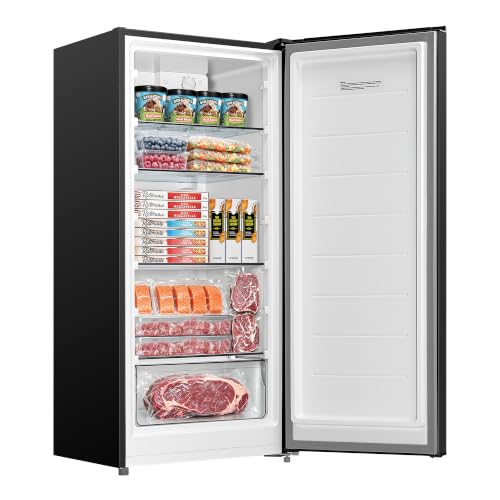
Midea 7.1 Cu. Ft. Upright Convertible, Garage Ready — Garage Ready, Glass Shelves
Midea’s 7.1-cubic-foot convertible upright states its garage readiness in its title and adds the interior details a thoughtful buyer wants: four adjustable glass shelves, a black finish, and an ADA design note among its stated attributes. In a convertible, adjustable glass shelving is not decoration — it is the mechanism by which the cabinet changes roles gracefully. Fridge mode wants shelves spaced for bottles and dishes; freezer mode wants them spaced for stacked flat packs and tubs; a cabinet whose shelves move in minutes converts in fact rather than in brochure.
The glass itself matters in garage duty. Wire shelving lets small items tip and lets spills travel; glass contains, wipes and presents. In a space visited with workshop hands and loaded by torchlight during a power cut, a cabinet whose contents sit visibly on clean glass is a cabinet whose inventory stays honest. The black finish, meanwhile, is the pragmatic garage choice — it absorbs the visual evidence of a working space far more forgivingly than white or bright stainless.
Midea’s scale as a maker supports the purchase the way it did in this batch’s side-by-side guide: a model identity inside a large, documented range, with the product page carrying the full ambient specification this guide instructs you to read. The ADA design note in the title signals attention to reach and usability, which in an upright — where every shelf is at standing height — is a coherent part of the design story rather than a stray badge.
Choose the Midea when your garage machine will convert often and be loaded by several different people: the shelving system is the most explicitly described in group one, and the household that reconfigures its cold storage with the seasons will feel that description working for them every time the cabinet changes roles.
One more garage-specific virtue belongs to glass shelving generally, and the Midea states it most completely: in a space where a spilled bait tub, a leaking marinade or a cracked bottle is a when rather than an if, a shelf that contains and wipes is the difference between a five-minute clean and a cabinet that smells of the incident until autumn. Outbuildings forgive nothing that is allowed to soak in; the Midea’s interior is specified as if its maker understood garages personally.
- Capacity, from the listing title: 7.1 cu. ft.
- Format, from the listing title: upright freezer, fridge-freezer convertible
- Garage claim, from the listing title: garage ready
- Shelving, from the listing title: 4 adjustable glass shelves
- Design note and finish, from the listing title: ADA design, black
- Where to buy: the Midea 7.1 Cu. Ft. Upright Convertible, Garage Ready listing on Amazon — check price on Amazon
Strengths
- Garage-ready claim in the title, with adjustable glass shelving.
- Black finish forgives a working garage’s marks.
- Convertible format serves both overflow and freezing seasons.
Trade-offs
- Compact capacity; a drinks and overflow machine, not a main fridge.
- Verify the exact ambient range on the product page.
- Glass shelves need care when loading heavy workshop provisions.
Best for: households that will convert roles with the seasons and value shelving flexibility. Not the right match for: bulk freezers needing double-digit capacity.
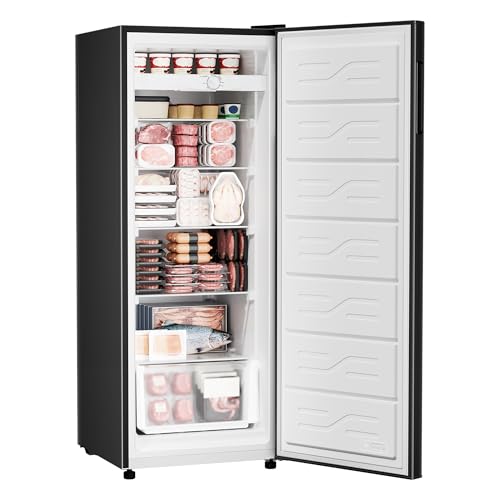
ICEVIVAL 7 Cu. Ft. Upright Convertible Freezer/Refrigerator — Ideal for Garage, per Title
The ICEVIVAL 7 completes group one with slightly different wording that this guide quotes precisely: its title describes a convertible freezer and refrigerator with a reversible door, ideal for garage, apartment and kitchen storage. Ideal for garage is a maker’s positioning statement rather than the technical phrase garage ready, and the distinction is worth the sentence it costs: treat the ICEVIVAL as a group-one candidate whose product page must still be read for the stated ambient range, exactly as you would confirm the range behind the words garage ready on its three companions.
That small discipline aside, the proposition is attractive. A 7-cubic-foot convertible upright with a reversible door solves the garage’s two classic placement problems at once: the role problem, by converting between fridge and freezer, and the handedness problem, by letting the door open away from the car, the bench or the bikes. Garages are the least standardised rooms in any house, and a machine that adapts its swing to the space is a machine that fits more of them without a fight.
The brand is a compact-appliance specialist rather than a mainstream giant, which this guide notes as context rather than verdict: the product page carries the full specification, and the buyer’s verification there — ambient range above all — is the same for a specialist’s machine as for a household name’s. Read it, compare it against your garage’s hottest week, and let that comparison, not the badge, decide.
For the household whose garage doubles as the party store, the gym’s annex and the workshop, the ICEVIVAL’s versatility is well aimed. It is the pick for the buyer who has read this guide’s method, accepts the extra minute of verification its wording requires, and wants a convertible that was positioned for the garage from the start.
The reversible door deserves a final emphasis, because garages defeat more appliances with their geometry than with their climate. Cars shift, benches migrate, bikes multiply; a door that can be re-hung when the room’s arrangement changes gives the ICEVIVAL a second life in the same space without a replacement purchase. In the least standardised room of the house, adaptability is longevity, and this pick builds it into the hinge.
- Capacity, from the listing title: 7 cu. ft.
- Format, from the listing title: upright convertible freezer/refrigerator
- Garage wording, from the listing title: ideal for garage, apartment and kitchen storage
- Door, from the listing title: reversible door
- Ambient range: read the stated figure on the product page, as with all picks here
- Where to buy: the ICEVIVAL 7 Cu. Ft. Upright Convertible Freezer/Refrigerator listing on Amazon — check price on Amazon
Strengths
- Positioned for garage use in its own title.
- Reversible door adapts to any garage’s layout.
- Convertible format covers fridge and freezer seasons.
Trade-offs
- Title wording is positional; the ambient range must be confirmed on the product page.
- Specialist brand with a smaller service footprint.
- Capacity is compact, as throughout this class.
Best for: adaptable garages needing a convertible with a reversible door. Poorly suited to: buyers who want the technical garage-ready phrase and rating confirmed in the headline alone.

BLACK+DECKER 11 Cu. Ft. Convertible Freezer/Refrigerator BUC1100XB — Largest Convertible, Verify Ambient Rating
Group two begins with the machine garage buyers will be most tempted by, and this guide’s treatment of it is the article in miniature. The BLACK+DECKER BUC1100XB is an 11-cubic-foot upright convertible — the largest cabinet in this guide — with glass shelves, a reversible door, frost-free operation and an ENERGY STAR note, all stated in its title. What its title does not state, anywhere, is a garage claim or an ambient range. It may well be rated for garage conditions; many convertibles are. But may is not a specification, and no household should learn the answer from a failed compressor in August.
So the instruction for this pick is procedural and absolute: open the product page, find the manufacturer’s stated operating or ambient temperature range for the BUC1100XB exactly, and compare it with your garage’s realistic maximum. If the range covers your heat with margin, you have found the guide’s biggest convertible and can buy it on its considerable merits — capacity, frost-free convenience, the upright’s visibility, a household name’s ecosystem. If the range is absent, or stops short of your summer, the disciplined answer is group one, and this guide will not soften that answer.
Why include a pick that might fail its own audition? Because buyers will meet this machine in every search for garage storage — its size and format are exactly what the searcher hopes for — and a guide that omitted it would leave them to assume the garage claim it never made. Presented with its evidence labelled, the BUC1100XB becomes either an excellent verified purchase or a clean elimination. Both are services; the only disservice would have been silence or invention.
Frost-free operation, stated in the title, deserves its weight in the comparison once the ambient question is settled: in an outbuilding, a frost-free convertible removes the defrosting ritual that the KoolMore asks its owners to schedule, and for a garage at a second property — visited monthly, loaded seasonally — that removal may be the deciding practical virtue. Verify first, then let that virtue argue.
Capacity deserves its own honest paragraph in this pick. Eleven cubic feet is the difference between a drinks cabinet and a genuine second cold store: a whole preserving session, a side of meat broken down and frozen, the drinks for a serious party with the food overflow beside them. Households whose garage ambitions are that large should not be talked down into group one’s 7-cubic-foot class if the BUC1100XB’s rating verifies — they should be talked into the verification, which takes minutes, and then into the machine their household actually needs.
- Capacity, from the listing title: 11 cu. ft.
- Format, from the listing title: convertible freezer/refrigerator, upright
- Features, from the listing title: glass shelves, reversible door, frost free, ENERGY STAR rated (as printed in the title)
- Garage claim: NONE in the listing title — verify the ambient temperature rating on the product page before any garage placement
- Finish, from the listing title: black
- Where to buy: the BLACK+DECKER 11 Cu. Ft. Convertible Freezer/Refrigerator BUC1100XB listing on Amazon — check price on Amazon
Strengths
- Largest capacity in this guide, in convertible upright form.
- Frost-free operation removes defrost scheduling.
- Glass shelves and a reversible door ease placement and loading.
Trade-offs
- No garage claim in the title; ambient verification is mandatory.
- If its rating falls short of your garage’s heat, it is an indoor machine.
- Single-role conversion, like all convertibles here.
Best for: buyers needing maximum convertible capacity who will verify the ambient rating first. Not suited for: anyone tempted to skip the verification — choose a group-one pick instead.

Hamilton Beach 6.8 Cu. Ft. Upright Convertible HBFRF6892 — Compact Convertible, Verify Ambient Rating
The Hamilton Beach HBFRF6892 closes the guide under the same rule as its group-two companion. Its title describes a 6.8-cubic-foot upright convertible fridge/freezer in white, with a reversible door, removable glass shelves and adjustable controls — a tidy, complete specification for an indoor convertible — and it makes no garage claim of any kind. Everything said about the BLACK+DECKER’s verification applies here with equal force: the ambient rating on the product page is the document that decides whether this machine may live in your garage, and no inference from its format can substitute for it.
On its indoor merits, the HBFRF6892 is a well-judged small convertible. Removable glass shelves make both cleaning and re-roling practical; adjustable controls let the household tune the cabinet to its load and setting; the white finish suits the utility rooms and spare spaces where compact convertibles usually serve. At 6.8 cubic feet it is the smallest cabinet in this guide, sized for drinks, overflow and a modest frozen reserve rather than for a preserving season.
Its garage candidacy, if the rating verifies, would suit the mildest version of the brief: the attached garage that runs warm rather than fierce, the shaded outbuilding, the workshop where a few drinks and the bait freezer share one cabinet. If the rating does not verify, the same machine remains a perfectly good indoor pick — and the household loses nothing by having asked, which is the quiet moral of group two’s entire existence in this guide.
Hamilton Beach’s mainstream presence supports the machine’s documentation and parts story, and its model identity — HBFRF6892, printed twice in its own title as if to make the verification easy — is the string to search when you go looking for that ambient figure. Use it exactly; model families share names loosely and specifications strictly.
There is also a dignity in this pick’s position that deserves naming: it is the guide’s control case. Its presence, clearly labelled, is what makes group one’s claims meaningful — a reader can see exactly what a garage claim looks like by seeing a complete, attractive specification that lacks one. Guides that blur that boundary sell more machines and serve fewer households. This one keeps the boundary bright, and the little Hamilton Beach, honestly labelled, is where the brightness is easiest to see.
- Capacity, from the listing title: 6.8 cu. ft.
- Format, from the listing title: upright convertible fridge/freezer
- Features, from the listing title: reversible door, removable glass shelves, adjustable controls
- Garage claim: NONE in the listing title — verify the ambient temperature rating on the product page before any garage placement
- Finish, from the listing title: white
- Where to buy: the Hamilton Beach 6.8 Cu. Ft. Upright Convertible HBFRF6892 listing on Amazon — check price on Amazon
Strengths
- Compact convertible with removable glass shelves.
- Reversible door suits awkward utility spaces.
- Mainstream brand documentation and parts ecosystem.
Trade-offs
- No garage claim in the title; verification decides its garage fate.
- Smallest capacity in this guide.
- White finish shows a working garage’s marks.
Best for: mild-garage or indoor overflow duty, after ambient verification. A poor fit for: fierce-heat garages unless the product page’s rating explicitly covers them.
Two Groups, One Table: What Each Title Actually Claims
| Pick | Group | Title’s garage wording | Capacity |
|---|---|---|---|
| Frigidaire 7.5 | Stated | Garage ready | 7.5 cu. ft. |
| KoolMore 7 | Stated | Garage ready | 7 cu. ft. |
| Midea 7.1 | Stated | Garage ready | 7.1 cu. ft. |
| ICEVIVAL 7 | Stated | Ideal for garage | 7 cu. ft. |
| BLACK+DECKER BUC1100XB | Verify | None — check ambient rating | 11 cu. ft. |
| Hamilton Beach HBFRF6892 | Verify | None — check ambient rating | 6.8 cu. ft. |
How Hot Does Your Garage Actually Get?
Measure before you shop, because memory flatters. Garages surprise their owners: a space that feels merely warm at noon can hold fierce heat at four in the afternoon, and a metal door in full sun radiates like a radiator all evening. An inexpensive maximum-minimum thermometer, left in the intended fridge position for a week of summer, gives you the number that matters — the peak, not the impression. Compare that peak, with a margin for the exceptional heatwave, against the ambient range on the product page of any pick in this guide.
Note the cold end too, if your climate has one. Garages in continental regions swing both ways across a year, and a machine’s stated range has a lower bound as well as an upper one. The refrigerator that survives your August must also be rated for your January if it is to live out there permanently; the product page’s range answers both questions in the same line, which is why this guide sends you to it for every pick, group one included.
Where Should a Garage Refrigerator Stand?
On the coolest wall, out of the sun’s daily path, with its manufacturer’s clearances open to the room. Avoid the spot beside the water heater or the wall shared with a sun-baked exterior if a better position exists, and never box the machine into a joinery alcove that traps its rejected heat around it — a garage fridge sheds more heat than a kitchen one precisely because its environment is hotter, and it needs somewhere for that heat to go. The household that works at a bench all day understands airflow instinctively; the same thinking that shapes our guide to Best Comfortable Heavy-Duty Office Chairs — position, clearance, the body’s real environment — applies to a machine’s comfort too.
Level the cabinet on the garage floor, which is rarely as flat as a kitchen’s, and recheck the level after the first loaded week. Doors that seal under their own weight are the whole defence against the garage’s warm, dusty air; a cabinet leaning on a sloping slab will breathe that air all summer through a gasket held open by gravity. A spirit level and ten minutes are the cheapest insurance in this entire guide.
How Should You Load a Garage Fridge Through a Heatwave?
Load it before the heat, not during it. A cabinet filled with already-cold goods rides out a hot afternoon on its thermal mass; a cabinet filled with warm shopping at the peak of the day must fight the weather and the load simultaneously. Keep the door discipline strict in hot weeks — decide before opening, fetch in one trip — and resist using the garage machine as the party’s open bar during the hottest hours, or accept that its temperature will wander while the door stands open to the celebration.
Freeze water bottles in the freezer section or in a convertible’s freezer mode ahead of a forecast heatwave. They are ballast, drinks and insurance in one: a power cut in a storm-prone hot region is the garage fridge’s worst hour, and a cabinet ballasted with ice holds its temperature through outages that would spoil an airy, half-empty one. The households that garden and preserve — whose produce moves between garage, kitchen and table all summer, much like the harvest suppers arranged around the seating in our guide to Best Floor Chairs for Bedrooms‘ outdoor cousins — learn this ballast habit in their first season and never give it up.
What Does a Garage Refrigerator Cost You in Effort Over a Year?
More than a kitchen machine, and planning for that is part of buying honestly. Coils out there gather dust, insects and workshop debris faster than any indoor cabinet’s; put a quarterly coil clean and gasket wipe on the calendar with the same seriousness as the car’s service. The KoolMore’s manual defrost adds its scheduled morning. Door seals age faster in heat and dust, so the paper-grip test described across this batch of guides earns a third annual performance in a garage.
Against that effort, set the return: a kitchen freed from overflow, drinks at the point of thirst, a freezer that follows the seasons, and a workshop that becomes the house’s most popular room on summer evenings. Households that run a garage fridge well describe it as the hardest-working cheap space they own — the same alchemy that a good range performs for a kitchen, a subject our guide to Best 30 Freestanding Gas Ranges explores indoors. The effort is real, modest and scheduled; the return is daily.
How Do You Verify an Ambient Rating Like an Auditor?
Follow the chain in order and accept no substitutes. First, the product page for the exact model — not the range, not a sibling — where the manufacturer publishes the operating temperature range. Second, the model’s own manual or specification sheet, which states the range with its conditions. Third, the seller’s written confirmation if any doubt remains. What does not count: a reviewer’s aside, a marketplace answer from another buyer, a similar model’s figure, or the phrase garage ready quoted from a different machine in the same brand’s line. Each model carries its own rating the way each model in our origin guide carried its own rating plate.
Write the figure down beside your garage’s measured peak, with both dates. That scrap of paper is the purchase’s foundation document, and it belongs in the appliance file with the rating-plate photograph you will take on delivery day. Years later, when the machine is blamed for a hot week’s failure or praised for surviving one, the file will say whether the installation was ever within specification — the only verdict that matters, delivered in advance.
What About Power Cuts, Dust and the Garage’s Other Hazards?
A garage fridge lives a harder life than any indoor appliance, and a paragraph of hazard planning belongs in its purchase. Power cuts in hot weather are the acute risk: keep the cabinet reasonably full, ballast it with frozen water bottles as this guide advised, and leave the door shut during an outage — a closed, full cabinet holds safe temperatures for hours that an opened, empty one surrenders in minutes. Dust is the chronic risk, answered by the quarterly coil clean. Moisture and pests are the ambient risks, answered by placement off the floor’s dampest corner and by gaskets kept clean enough to seal completely.
None of this is a reason to keep refrigeration out of the garage. It is a reason to install it like equipment rather than furniture: rated, placed, levelled, ballasted and maintained on a schedule. Households that treat the machine that way get the decade of service the rating promises; households that treat it as a kitchen fridge on holiday get the other outcome, and usually blame the machine in their review of it.
How Does a Garage Fridge Change the Way a Household Uses Its Garage?
Something unexpected happens in the first summer: the garage becomes a room. A rated refrigerator anchors the space the way a range anchors a kitchen — drinks appear, a chair migrates out, the workshop’s lunch stops travelling through the house, and the party’s centre of gravity shifts toward the open door and the evening air. Households consistently report that the garage fridge, bought for overflow, ends up reorganising their summer social life around the coolest square metre of the property.
That transformation raises the stakes of buying correctly. A machine that fails in its first heatwave does not merely spoil food; it strands a room the household had begun to live in. The verification discipline in this guide — measured peak, stated range, honest groups — is what stands between the transformation and the disappointment, and it costs an evening with a thermometer and ten minutes on a product page. Few household upgrades offer a better exchange rate than that.
How Do You Choose Between Group One’s Four?
With the rating verified, the choice among the stated group is an ordinary one about duty. Simultaneous fresh and frozen storage points to the Frigidaire alone. Conversion points to the other three, and among them the defrost question divides the field: the KoolMore asks for a scheduled manual defrost and offers stainless simplicity in exchange, while the Midea’s adjustable glass shelving suits households that will reconfigure the cabinet often, and the ICEVIVAL’s reversible door solves the garages whose geometry defeats fixed-handed machines. None of these is a consolation prize; each is the correct answer to a different garage’s actual life.
Budget tier, in this guide’s qualitative language, runs from the specialist value of the ICEVIVAL through the mainstream Frigidaire and Midea to the workshop-finished KoolMore — but let the duty decide before the tier does. A garage machine is bought once and sweated for a decade; the wrong format at the right tier is a longer regret than the right format at the neighbouring one. Measure the peak, verify the range, choose the duty, and the tier will take care of itself.
What Mistakes Do Garage Refrigerator Buyers Most Often Make?
The fatal one is assuming any fridge is garage-capable because it is sturdy, cheap or spare — the assumption group two exists to correct, in writing, before it costs a compressor. Second is verifying against the average temperature instead of the peak. Third is placing the machine in the sun’s path or sealed into joinery, then blaming the rating. Fourth is forgetting the cold bound of the range in swing climates. Fifth is neglecting the unglamorous maintenance — coils, gaskets, level — that hot, dusty service demands more of than kitchen service ever will. Every one of these mistakes is a decision made once and paid for all summer; the guide you are reading exists so that yours are made correctly.
Final Recommendation
Start in group one unless your needs argue otherwise. The Frigidaire 7.5 is the straightforward garage-ready overflow fridge; the KoolMore and Midea convertibles follow the seasons for households that will manage a manual defrost or prize adjustable glass shelving; the ICEVIVAL adds a reversible door for awkward garages, with its product-page range to be read as carefully as any. Graduate to group two only with the product page open: if the BLACK+DECKER’s 11 cubic feet or the Hamilton Beach’s compact footprint verifies against your measured peak temperature, they are excellent buys — and if it does not, you have lost nothing but a fantasy. A hot garage is an honest environment that punishes assumptions and rewards specifications; buy the specification, place it well, and your garage fridge will still be holding its temperature on the hottest evening of its tenth summer.
Let the last word go to the thermometer. Every confident sentence in this guide descends from one unglamorous act: somebody measured the room before buying the machine. Do that, and the rest of the decisions — group, format, defrost, finish — arrange themselves in an order that feels almost easy. Skip it, and even the right machine becomes a wager. The garage will be hot either way; whether your refrigerator minds is a question you get to answer in advance, on paper, for the price of a week’s patience.
A final word on sequencing for the household planning this purchase in spring: buy and verify before the heat arrives. The thermometer week, the product-page reading and the placement work are all pleasanter in mild weather, and a machine installed, levelled and loaded calmly in May is a machine whose August behaviour is a known quantity. The households queuing for garage fridges during the first heatwave are competing for stock and delivery slots at the exact moment their old assumptions have just failed them. Be earlier than them, and let this guide’s method — two groups, one specification, no assumptions — carry you into summer with the coldest room in the house already running.
Frequently Asked Questions
What does garage ready actually mean?
It is the manufacturer’s claim that the machine is designed to operate across a wider ambient temperature range than a standard kitchen refrigerator. The claim’s substance is the stated range itself, published on the product page — read the figure and compare it with your garage’s measured peak rather than relying on the phrase alone.
Can I put my old kitchen fridge in the garage instead?
Only if its own documentation rates it for your garage’s temperature range, which most indoor models are not designed for. An unrated machine in a hot garage will run constantly, struggle to hold food-safe temperatures at the peak, and wear out early. That is precisely the failure this guide’s two groups are organised to prevent.
Why are the BLACK+DECKER and Hamilton Beach in this guide if they make no garage claim?
Because their convertible format and sizes are exactly what garage shoppers search for, and omitting them would leave buyers to assume a claim the titles never made. Included with their evidence labelled, they can be verified into excellent garage purchases — or eliminated cleanly before money changes hands.
Is a convertible or a two-door better for a garage?
It depends on the duty. Households needing simultaneous fresh and frozen overflow should take the Frigidaire’s two-door. Households whose needs swing seasonally — drinks fridge in summer, freezer in autumn — are better served by a convertible, provided its defrost type matches the maintenance they will actually perform.
Does a garage fridge need a dedicated electrical circuit?
That depends on the machine’s stated electrical requirements and what else shares the garage’s circuits — a workshop’s tools and a refrigerator’s compressor starting at the same moment is the classic nuisance trip. Read the product page’s electrical specification for the exact model, and if the garage’s wiring is elderly or heavily shared, an electrician’s opinion is cheap insurance bought before the installation, not after the first tripped breaker during a heatwave.
What if my garage is attached and only moderately hot?
Then your measured peak may sit comfortably inside ranges that a detached, sun-baked garage would exceed — which widens your field legitimately, including group two if their ratings verify against your number. The method does not change; only its answer does. Mild garages are where verified convertibles like the BLACK+DECKER and Hamilton Beach most plausibly earn their place, and the thermometer, not optimism, is what certifies a garage as mild.
Should I insulate the garage instead of buying a rated fridge?
The two measures cooperate rather than compete. Insulation and shading lower the peak every machine must survive, and a rated refrigerator guarantees the cabinet was designed for the environment that remains. Households planning to keep a fridge in the garage for a decade often do both — the building work once, the rated machine once — and then stop thinking about the problem entirely.
Can a convertible freeze properly in a hot garage?
In freezer mode, a convertible works harder in heat than in any other role, because the gap between its cabinet and the garage air is at its widest. That is exactly why the ambient rating matters most for freezer duty: verify the range with freezer mode in mind, keep the cabinet ballasted and out of the sun, and the rated machines in group one will do the work they were specified for.
How do I find my garage’s real peak temperature?
Leave a maximum-minimum thermometer at the fridge’s intended position through a week of hot weather and read its recorded maximum. Use that figure, plus a margin for exceptional heat, as the number every candidate’s stated ambient range must cover.
Keep the appliance file habit for this machine above all, because garage equipment is the most likely in the house to be questioned later — by an insurer after a loss, by a buyer of the house, by your own memory in five years. The file holds the measured peak, the verified range, the rating-plate photograph and the maintenance dates. Four artefacts, one folder, and every future conversation about the hardest-working appliance on the property starts from evidence instead of recollection.
And when the first heatwave arrives and the garage door rolls up on a cabinet holding its temperature without drama — drinks cold, ice firm, the workshop lunch safe — remember that the moment was decided weeks earlier, by a thermometer, a product page and a refusal to assume. That is the whole craft this batch of guides teaches, in kitchens, in narrow alcoves, in questions of origin, and out here in the heat: read what is printed, verify what is not, and buy only what survives both.
One more placement scenario deserves a sentence, because it arrives in almost every household eventually: the garage fridge inherited by a new role when the kitchen is renovated and the old indoor machine is demoted outward. Resist the demotion unless the old machine’s own rating covers the garage — age has not widened its ambient range, and sentiment is not a specification. The renovated kitchen’s cast-off belongs in the classifieds or with a relative whose need is indoor; the garage deserves a machine chosen for the garage, from group one, or verified into it from group two.
And if the household’s garage is destined to become a workshop, a studio or a small business’s premises in the coming years, buy the refrigerator for the room it will become: rated, convertible where the future is uncertain, documented from day one. The machines in this guide were chosen to survive both the climate and the plan changing around them — which, in the end, is the most garage-like quality any of them could have.
Summer will grade the work, as it grades everything placed in its path. A machine chosen by measurement, verified against its maker’s own figures and installed like equipment tends to receive the grade its owners hoped for — silently, in cold drinks and firm ice, on the evenings when the whole street is wilting. That silence is the sound of a specification doing its job.
Related Guides
Heat management is a whole-home discipline, and the laundry room has its own version of it. Our live guide to Best Energy-Efficient Electric Clothes Dryers examines machines chosen for how they handle heat and energy together — a fitting companion read once the garage is sorted.


