What's inside
- Key Takeaways
- Quick Picks
- How We Chose These Picks
- How Do the Six Coolers Compare on Capacity?
- What Temperatures Should the Two Zones Actually Hold?
- How Do You Install a 24-Inch Cooler Under a Counter?
- How Should You Load Bottles and Cans for Even Cooling?
- What Maintenance Keeps a Drinks Cooler Honest for Years?
- How Do You Decide Between Built-In and Freestanding Placement?
- What Should a Wine Beginner Store Differently From a Collector?
- How Does a Drinks Cooler Change Party Hosting?
- How Should You Handle Power Cuts and Holidays?
- What Glass Door Etiquette Should a Household Adopt?
- How Do You Compare Two Coolers With Identical Capacities?
- How Does Seasonality Change What the Cooler Holds?
- What Should Hosts With a Home Bar Add Around the Cooler?
- How Long Should a Cooler Last, and What Ages First?
- How Should a Household Set a Sensible Budget for This Category?
- How Do You Stock the Cooler for a Dinner Party Versus a Big Gathering?
- What Is the Right Way to Clean and Defrost a Drinks Cooler?
- How Should You Arrange the Cooler in a Small Apartment?
- How Do You Know This Category Is Worth It for Your Home?
- How Should You Plan the First Fill After Installation?
- How Do You Live With the Cooler During Its First Month?
- What Mistakes Do Drinks Cooler Buyers Make Most Often?
- Final Recommendation
- Frequently Asked Questions
- Related Guides
As an Amazon Associate I earn from qualifying purchases. This post may contain affiliate links at no extra cost to you.
cottageverdict.com is reader-supported. When you buy through links on our site, we may earn an affiliate commission.
Where to buy: all six coolers below are sold through Amazon, and their names in the Quick Picks table, the detailed reviews and the comparison table link to the matching listing so you can check price on Amazon and confirm bottle and can capacities, zone arrangements and installation requirements before ordering. The best wine and beverage refrigerators solve a household argument with engineering: wine wants one temperature, served drinks want another, colder one, and a single-box refrigerator can only compromise. Every pick in this guide is a 24-inch dual zone model — one cabinet, two climates — built to slide into the standard undercounter bay or stand alone as a small drinks station.
Twenty-four inches is the size that matters because it is the dishwasher’s footprint: the bay in most kitchen runs, the gap a remodel leaves, the width a freestanding unit can occupy beside a bar or in a pantry without rearranging the room. Inside that footprint, the listings here divide their space between bottle storage on one side or zone and cans and bottles on the other, with published capacities such as ICEPURE’s 19 bottles and 58 cans, Tylza’s 20 bottles and 88 cans, and NewAir’s 20 bottles and 78 cans showing how differently makers spend the same inches.
Dual zone is the feature to interrogate hardest, because it is the reason for the category. Two zones mean wine resting at cellar calm on one side while sodas, beers and mixers sit properly cold on the other, each held by its own control rather than by a truce. The reviews below read each listing for what its zones and capacities actually promise, and the sections after them cover the installation realities — ventilation, levelling, door swing — that decide whether a cooler hums happily for a decade or complains from its first summer.
One honest note before the picks: bottle capacities in this category assume standard Bordeaux-shaped bottles, and can counts assume standard cans, so treat every figure as a comparison between models rather than a promise about your particular cellar of Burgundy bottles and craft tins. The relative ordering is real even when your absolute count lands a little lower.
There is a lifestyle dividend hiding under the specifications, and regular hosts name it immediately: a dedicated drinks cabinet ends the refrigerator-door loitering that fragments every gathering. Guests can be waved toward the cooler instead of the cook’s workspace, children can be assigned a known shelf, and the cook’s ingredients stop migrating behind the beer. Kitchens are choreography as much as equipment, and few appliances improve the choreography of an evening as cheaply as giving drinks their own address.
Key Takeaways
- All six picks are 24-inch dual zone coolers, fitting the standard undercounter bay or standing alone.
- Published capacities vary widely inside the same footprint: from 19 bottles and 58 cans up to 20 bottles and 88 cans.
- Dual zone ends the temperature truce between wine and everyday drinks by giving each its own climate.
- Built-in installation needs its ventilation respected; freestanding placement is the forgiving alternative.
- Bottle counts assume standard shapes, so Burgundy and Champagne bottles reduce real-world capacity.
- The right pick depends on your ratio: cellar-leaning households and can-heavy households should choose differently.
Quick Picks
| Pick | Badge | Why it earns its place |
|---|---|---|
| Velieta Wine and Beverage Refrigerator 24 Inch Dual Zone | Best All-Round Dual Zone | A glass-door 24-inch dual zone cooler with a powerful compressor, aimed at built-in drinks duty. |
| Honeywell 24 Inch Dual Zone Wine Cooler and Beverage Cooler | Best Brand-Name Freestanding | A dual zone compressor cooler presented as a large freestanding wine cellar and drinks fridge in one. |
| ICEPURE 24 Inch Wine and Beverage Refrigerator | Best Published Balance | Stated plainly in its listing: 19 bottles and 58 cans across two zones in a 24-inch cabinet. |
| Tylza 24 Inch Dual Zone Wine and Beverage Refrigerator | Best Can Capacity | Twenty bottles plus 88 cans, a quiet black finish and touch controls, for built-in or freestanding use. |
| EUHOMY Wine and Beverage Refrigerator 24 Inch Dual Zone | Best Bottle-Leaning Split | Twenty-one bottles lead its stated capacity, with a beverage side, in a built-in or freestanding cabinet. |
| NewAir 24 Inch Dual Zone Beverage Refrigerator and Wine Cooler | Best Entertainer’s Split | Twenty bottles and 78 cans from a drinks-first brand, for built-in or freestanding placement. |
How We Chose These Picks
Every candidate had to clear three bars: a genuine 24-inch cabinet, two independently controlled zones rather than one zone with a warmer shelf, and a listing that publishes its bottle and can capacities so households can plan. Where a listing’s headline omits a figure, the review says so and works with what is published rather than borrowing numbers from a sibling model.
Within that field we spread the picks across real household ratios. Some families are wine-first with a garnish of cans; others run a soda-and-beer economy with a shelf of bottles for guests. The capacities in this guide — from ICEPURE’s 19-and-58 to Tylza’s 20-and-88 — are different answers to that ratio question, and we have labelled each pick with the household its split actually serves instead of pretending one ranking fits a cellar and a games room equally.
Installation flexibility counted too. Models the listings describe as built-in or freestanding give a household two lives for one appliance: under the counter today, beside the bar after the remodel. Compressor cooling was the assumed baseline throughout, since the category’s promise — two steady climates — depends on it, and glass doors appear across the field because drinks storage is partly a display decision whether owners admit it or not.

Velieta Wine and Beverage Refrigerator 24 Inch Dual Zone — Best All-Round Dual Zone
Velieta’s cooler states the category’s core brief without ornament: a 24-inch dual zone refrigerator with a glass door and what the listing calls a powerful compressor, built for the undercounter bay. That combination — two climates, compressor steadiness, a front you can see the evening through — is the template the rest of this guide varies, and as the first pick it sets the baseline: wine resting in one zone at its chosen temperature, everyday drinks held properly cold in the other, neither borrowing the other’s weather.
The glass door deserves its moment because it changes how a drinks fridge is used. A visible inventory gets rotated; a hidden one gets archaeology. Hosts glance through the glass and know whether the white is in, whether the mixers need a shop, and whether a guest’s favourite survived the weekend. In a kitchen run or a bar corner, that visibility turns the cooler from storage into a small, lit shopfront for the household’s own evenings.
Judge Velieta the way you would judge the template itself: on the listing’s published zone arrangement and capacity figures, on the ventilation its built-in life requires, and on whether its split of space matches your ratio of bottles to cans. Households wanting the straightforward version of this category — no gimmicks, the dual zone idea executed directly — will find this the natural starting point before the specialists below argue for their variations.
- Width: 24 inches, standard undercounter bay
- Zones: dual zone wine and beverage layout
- Cooling: compressor, described as powerful in listing
- Door: glass, for visible inventory
- Role: built-in drinks station baseline
Strengths
- Executes the dual zone brief without gimmicks
- Glass door keeps stock visible and rotated
- Compressor cooling holds two steady climates
Trade-offs
- Headline listing leaves capacities to the detail table
- Built-in use demands ventilation discipline
- Glass front shows a messy interior honestly
Best for: households wanting the category’s template done properly. Not suited for: buyers who need the largest published can count.

Honeywell 24 Inch Dual Zone Wine Cooler and Beverage Cooler — Best Brand-Name Freestanding
Honeywell brings a household name to a category full of specialists, and its listing leans freestanding: a 24-inch dual zone compressor cooler described as a large freestanding wine cellar and beverage cooler in one cabinet. That positioning suits a particular and common situation — no spare undercounter bay, but a corner of a dining room, pantry or bar area waiting for a job. A freestanding cooler asks only for a socket and sensible air space, and starts work the day it arrives.
The dual zone arrangement carries the same truce-ending logic as every pick here, with wine in one climate and drinks in the other, and compressor cooling underneath to hold both steady against a warm room. The brand name matters in a specific way for this appliance class: a cooler is a decade-long, always-on purchase, and some buyers sleep better with a badge their household already knows from other rooms of the house. That comfort is a legitimate buying reason as long as the specification underneath it is read with the same care as any specialist’s.
Freestanding freedom has one rule that must not be improvised: a cooler designed to breathe around its cabinet should not be slid into a tight built-in cavity unless the listing explicitly blesses that installation. Keep its air gaps, level it carefully — a leaning cooler works its compressor and its door seal harder than either deserves — and this Honeywell will do the quiet, decade-long work its category promises.
- Width: 24 inches, freestanding presentation
- Zones: dual zone wine and beverage layout
- Cooling: compressor system per the listing
- Role: large freestanding cellar and drinks fridge
- Placement: corner, pantry or bar area duty
Strengths
- Freestanding design installs without cabinetry
- Recognised household brand behind the badge
- Two climates for wine and drinks together
Trade-offs
- Freestanding airflow needs must be respected
- Not the pick for a flush built-in look
- Capacities should be confirmed in the listing table
Best for: bay-less households wanting a plug-in drinks station. Not suited for: remodels chasing a seamless undercounter line.

ICEPURE 24 Inch Wine and Beverage Refrigerator — Best Published Balance
ICEPURE publishes its arithmetic right in the title — holds 19 bottles and 58 cans — and that candour earns it the balance badge in a category where some rivals make you excavate their numbers. Nineteen bottles is a real household cellar: a case for keeping, a few for the month, and the odd celebration bottle waiting its turn. Fifty-eight cans is a similarly honest figure, covering the soda, beer and sparkling water traffic of a family that entertains without turning the cooler into a warehouse.
The dual zone layout divides those two populations into their proper climates, wine at its resting temperature and drinks at serving cold, inside the same 24-inch footprint as every pick here. For the household whose ratio genuinely sits near that published split — and many do, once they count — this is the least theoretical purchase in the guide: the listing tells you the shape of your storage before the tape measure comes out.
Apply the standard capacity discount with a clear head. Nineteen bottles means nineteen standard bottles; a cellar of wide Burgundy and Champagne shapes will land lower, and cans in craft sizes shuffle the other count too. What survives that discount is the proportion, which is the thing a buyer is really choosing. If your drinks life is a modest cellar plus a lively can economy, ICEPURE’s published balance describes it more precisely than any rival here.
- Width: 24 inches, dual zone cabinet
- Capacity: 19 bottles and 58 cans as listed
- Zones: separate wine and beverage climates
- Ratio: balanced cellar and can storage
- Role: built-in or standalone drinks duty
Strengths
- Capacities published plainly in the listing
- Split matches a typical mixed household
- Two zones keep wine and drinks at their own temperatures
Trade-offs
- Can count trails the Tylza by a wide margin
- Wide bottle shapes reduce the bottle figure
- Specialist brand, smaller name recognition
Best for: mixed households whose ratio matches the published split. Not suited for: can-heavy entertainers needing maximum beverage room.

Tylza 24 Inch Dual Zone Wine and Beverage Refrigerator — Best Can Capacity
Tylza’s published split tells a story about a household: 20 bottles and 88 cans. The wine side is a respectable case-and-a-half; the can side is a small warehouse, the largest beverage count in this guide by a clear margin. This is the cooler for homes where the drinks fridge works harder than the cellar — teenagers and sodas, games nights and beers, sparkling water by the flat — while still keeping a proper zone of wine at a proper temperature for the adults’ end of the evening.
The listing adds the ownership details such a household feels: a quiet running character, a black finish that disappears into modern cabinetry or a media room, touch-screen controls, and the flexibility to live built-in or freestanding. Quiet matters disproportionately in this category because coolers live where people sit — kitchens with dining tables, open-plan rooms, home bars — and a compressor’s voice becomes part of the furniture whether it was auditioned or not.
Check the ratio against your reality before falling for the big number. Eighty-eight cans is glorious if cans are your economy and wasted geometry if your household drinks mostly wine, because the space was taken from somewhere. Buyers whose cellars outgrow twenty bottles quickly should look at the EUHOMY’s bottle-leaning split below instead. Buyers feeding a can-driven household will find no rival here that keeps their drinks this cold, this organised and this quiet about it.
- Width: 24 inches, built-in or freestanding
- Capacity: 20 bottles and 88 cans as listed
- Controls: touch screen, per the listing
- Finish: black, described as quiet-running
- Ratio: beverage-heavy with a real wine zone
Strengths
- Largest can capacity in this guide
- Quiet character suits living spaces
- Installs built-in or freestanding
Trade-offs
- Bottle count is modest for growing cellars
- Black finish narrows some kitchen palettes
- Can space is wasted on wine-first households
Best for: can-heavy households and games-room bars. Not suited for: collectors whose cellars keep expanding.

EUHOMY Wine and Beverage Refrigerator 24 Inch Dual Zone — Best Bottle-Leaning Split
EUHOMY — a name this batch of guides meets repeatedly in ice — fields a 24-inch dual zone cooler whose listing leads with 21 bottles, the highest bottle figure among the picks that publish one, alongside its beverage side. That ordering is a small manifesto: this is the wine-leaning split, for the household whose bottles are the point and whose cans are the supporting cast. Twenty-one standard bottles is two cases’ worth of intent, enough for a drinking cellar that rotates rather than a trophy cabinet that merely accumulates.
The cabinet follows the class pattern — built-in or freestanding life, two climates under separate control — and its value is in the proportion rather than any single flourish. Wine stored at a steady serving-or-resting temperature, in the dark calm behind a cooler door, keeps its character in a way the kitchen refrigerator’s icy, vibrating, onion-scented interior never allowed. The beverage zone then does the everyday work without asking the wine to endure soda temperatures.
Apply the usual honesty about bottle shapes, and note that the listing’s can figure deserves a direct check in its table before you compare totals across this guide. What can be said from the headline is enough to place it: if your household’s centre of gravity is the bottle — a wine club delivery, a growing interest, dinners built around pours — EUHOMY’s split respects that gravity better than the can-led rivals, while still keeping the mixers cold.
- Width: 24 inches, built-in or freestanding
- Capacity: 21 bottles lead the listed figure
- Zones: dual zone wine and beverage layout
- Ratio: bottle-leaning with beverage support
- Role: drinking cellar plus drinks duty
Strengths
- Highest published bottle count here
- Wine-first proportion for growing cellars
- Flexible built-in or freestanding placement
Trade-offs
- Can capacity needs confirming in the listing
- Beverage-heavy homes will fill its smaller side
- Standard bottle shapes assumed by the count
Best for: wine-leaning households with a working cellar. Not suited for: soda-and-beer economies needing maximum cans.
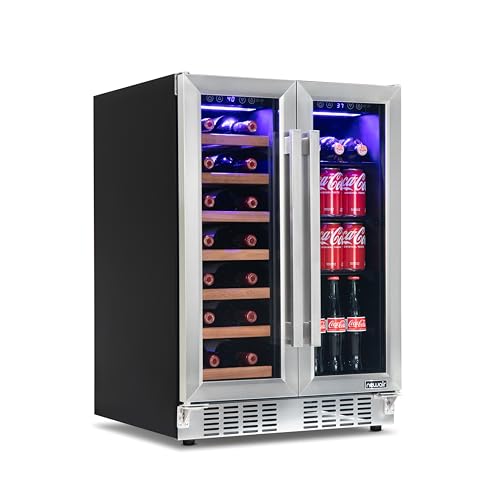
NewAir 24 Inch Dual Zone Beverage Refrigerator and Wine Cooler — Best Entertainer’s Split
NewAir names its priorities in its title’s order — beverage refrigerator first, wine cooler second — and the published split backs the billing: 20 bottles and 78 cans. That is the entertainer’s geometry. The wine zone holds a dinner party’s worth of bottles at their temperature, while seventy-eight cans absorb the true volume of any gathering, which is never wine; it is beer, soda, sparkling water and the mixers that multiply as the evening warms up.
The brand’s long focus on beverage cooling shows in the positioning: freestanding or built-in undercounter life, a 24-inch cabinet that takes the standard bay, and a layout meant to be opened forty times in an evening without the temperature sulking. Hosts should picture the door traffic honestly — a cooler at a party is a public utility — and value a drinks-first design that expects exactly that workload.
Against the Tylza, its closest rival in spirit, the NewAir trades a handful of cans for the drinks-specialist badge; against the ICEPURE it offers a livelier can economy for a similar bottle count. The decision between them is a ratio decision wearing brand clothes, and the sections below on zoning your own household’s drinking will settle it more reliably than any feature list. For the host whose parties are the point, this is the split composed for the job.
- Width: 24 inches, built-in or freestanding
- Capacity: 20 bottles and 78 cans as listed
- Zones: dual zone beverage and wine layout
- Ratio: entertainer’s split, cans to the fore
- Brand focus: beverage cooling specialist
Strengths
- Party-scale can storage with a real wine zone
- Drinks-specialist brand behind the design
- Flexible installation for kitchens or bars
Trade-offs
- Can count sits just below the Tylza’s
- Cellar growth beyond 20 bottles needs a plan
- Beverage-first layout serves wine second
Best for: frequent hosts whose gatherings run on cans. Not suited for: quiet cellars that rarely entertain.
How Do the Six Coolers Compare on Capacity?
| Pick | Badge | Distinguishing detail |
|---|---|---|
| Velieta Wine and Beverage Refrigerator 24 Inch Dual Zone | Best All-Round Dual Zone | Glass door, compressor, the template pick |
| Honeywell 24 Inch Dual Zone Wine Cooler and Beverage Cooler | Best Brand-Name Freestanding | Freestanding dual zone from a household name |
| ICEPURE 24 Inch Wine and Beverage Refrigerator | Best Published Balance | 19 bottles and 58 cans, stated plainly |
| Tylza 24 Inch Dual Zone Wine and Beverage Refrigerator | Best Can Capacity | 20 bottles and 88 cans, quiet black design |
| EUHOMY Wine and Beverage Refrigerator 24 Inch Dual Zone | Best Bottle-Leaning Split | 21 bottles lead its stated capacity |
| NewAir 24 Inch Dual Zone Beverage Refrigerator and Wine Cooler | Best Entertainer’s Split | 20 bottles and 78 cans, drinks-first brand |
What Temperatures Should the Two Zones Actually Hold?
Think of the zones as two different promises. The wine side serves two masters depending on the bottle: reds rest and serve in the mid-teens Celsius, whites and sparkling wines want it colder, nearer the high single digits — so a wine zone’s job across a year is flexibility within that band, with the bottles you will drink soonest set toward their serving temperature and the keepers resting in the calm middle. The beverage side has a simpler creed: properly cold, the low single digits where sodas bite, beers refresh and mixers behave.
The discipline that makes dual zone worthwhile is resisting the urge to run both sides at one compromise temperature, which recreates the kitchen refrigerator’s failure inside a more expensive box. Set each zone for its population, verify with a thermometer left inside for a day rather than trusting the display’s optimism, and re-check after loading a warm case, because a dozen room-temperature bottles will pull a zone upward for hours while it recovers.
How Do You Install a 24-Inch Cooler Under a Counter?
Measure the bay the way the refrigerator guide in this batch teaches: width in three places, depth to the shallowest obstruction, height under the counter’s lowest point, and trust the smallest figure everywhere. Twenty-four-inch bays are standard until the moment they are not — a pipe, a skirting board, an old floor that rises — and a cooler that fits on paper but not past the skirting is a freestanding cooler by accident.
Ventilation is the installation’s soul. Built-in coolers breathe through their front by design, which is why the models here that bless built-in use can sit flush; a freestanding-first design pushed into a sealed cavity will run hot, loud and short-lived. Level the cabinet on its adjustable feet so the door seals evenly, leave the clearances the listing specifies at the back and sides, and give the machine a day at temperature before loading the cellar. Undercounter luxury is mostly patience, measured in millimetres.
How Should You Load Bottles and Cans for Even Cooling?
Air is the courier of cold inside these cabinets, and loading is how you employ it. Bottles lie in their racks with small gaps rather than jammed shoulder to shoulder; cans stand in their zones without walling off the vents at the back; and nothing — however thirsty the household — gets stored flat against the cooling plate or fan outlet. A cooler loaded like a warehouse runs unevenly, with warm corners the display never mentions.
Rotate like a shopkeeper. New stock goes behind or beneath, older stock forward, and the wine zone’s front row should be the bottles you genuinely intend to drink next, because a cellar that hides its ready bottles behind its keepers teaches its owner to buy duplicates. After a party or a delivery, let the cabinet recover its temperatures before judging its performance; even the steadiest compressor needs hours to forgive a warm case of cans.
What Maintenance Keeps a Drinks Cooler Honest for Years?
The list is short and mostly dry: wipe the door seal and check it closes on a banknote’s resistance all the way around; keep the front vent — the cooler’s lungs in built-in life — free of dust and pet hair with a soft brush; and clean the interior before spilled mixer becomes a permanent perfume. Glass doors want a microfibre cloth rather than anything abrasive, since their whole job is to be looked through.
Once or twice a year, pull a freestanding unit forward or open a built-in one’s service space and vacuum the dust where warm air gathers. Verify both zones with a thermometer on the same visit. A cooler has no filters to feed and no water to plumb, which makes it one of the lowest-maintenance appliances in this entire batch of guides — provided its air is respected. Starve the airflow and even the best compressor becomes an expensive cupboard.
How Do You Decide Between Built-In and Freestanding Placement?
Built-in placement is a commitment to a room’s plan: the cooler joins the cabinetry line, frees floor space and reads as architecture rather than furniture. It suits kitchens being remodelled, bars being built and households confident the drinks station’s home will not move for a decade. Its demands — exact bay measurements, respected ventilation, a level base — are one-time disciplines paid at installation for years of seamlessness.
Freestanding placement is a commitment to flexibility. The cooler can begin in a pantry, graduate to a dining room and retire to a games room without a single cabinet being harmed, and renters can take it with them. Its demands are ongoing courtesies: air space on the breathing sides, a position out of direct sun and away from radiators, and the honesty not to shove it into a cavity it was not designed for. Several picks here — Tylza, EUHOMY and NewAir among them — are listed for both lives, which is why they suit households whose plans are still moving.
What Should a Wine Beginner Store Differently From a Collector?
A beginner’s cooler is a drinking cellar, and it should be loaded like one: bottles bought to be opened within the season, arranged so the ready ones stand forward, with the zone set toward serving temperatures because nothing is being aged for a decade. The beginner’s mistake is buying a collector’s layout — deep, static, reverent — for wine that wants drinking, and then being afraid to open anything in their own home.
A collector’s cooler is a waiting room. Bottles rest undisturbed at a steady cellar temperature, the door opens rarely, and capacity planning counts shapes as much as numbers because a serious cellar accumulates wide bottles. Both households are served by this guide’s six, but they should weight the splits differently: beginners toward the balanced ICEPURE, collectors toward the bottle-leaning EUHOMY, and both toward the discipline of drinking what the front row offers.
How Does a Drinks Cooler Change Party Hosting?
It removes the refrigerator door from the party’s traffic. Guests’ drinks, the host’s ingredients and the evening’s wine each live in the cooler, while the kitchen refrigerator keeps its cold and its dignity behind a door that opens for cooking alone. Anyone who has hosted through a single shared refrigerator — the ice bucket archaeology, the salad exiled by beer — recognises this as the difference between a party that flows and one that queues.
Before guests arrive, the cooler rewards the same staging as clear ice in the companion guide: zones set, stock rotated forward, a thermometer’s verdict trusted over the display’s. After guests leave, restock the front rows while the evening’s evidence is fresh. A drinks cooler does not make a household generous, but it removes every mechanical excuse a generous household ever had.
How Should You Handle Power Cuts and Holidays?
A closed cooler is a well-insulated box, and its first rule in a power cut is to stay closed: every peek spends the cold you are trying to save. Wine tolerates a slow, brief warming with remarkable grace — it survived centuries of cellars less steady than your kitchen — while carbonated drinks merely become a later problem of patience. When power returns, let both zones recover fully before judging temperatures or restocking warm items into them.
Holidays away call for the opposite of drama. A stocked cooler can simply be left running; its whole design is unattended steadiness. Households that prefer to switch off should empty perishable mixers, clean and dry the interior, and leave the door ajar so the cabinet airs rather than perfumes itself. On return, run it a day before reloading the cellar, and the machine resumes its decade as if the interruption were a rumour.
What Glass Door Etiquette Should a Household Adopt?
A glass door turns stock-keeping into a glance, but it also publishes your household’s habits to every guest. Keep the front rows honest: the bottles and cans you are proud to serve, arranged by kind, with labels facing out where the shelves allow. The back rows can carry the spares and the experiments. A cooler that looks composed through its glass makes its owner look composed, which is an unfair but real dividend of the format.
Children and glass doors form their own negotiation — the cooler is not a vending machine, however much its lit interior argues otherwise — and households solve it by assigning one low shelf or zone corner as the free-for-all territory of juices and sodas. The wine keeps its calm, the children keep their dignity, and the door keeps its fingerprints confined to one washable altitude.
How Do You Compare Two Coolers With Identical Capacities?
When the published splits tie, shop the second order: zone arrangement, control quality, the noise character the listing describes, finish against your room, and the installation lives each model is blessed for. Read how each listing talks about its own machine; a seller precise about ventilation and levelling is telling you something about the support behind the badge. Then read the delivery terms to your address, because a 24-inch cooler is freight as much as furniture.
Finally, stand in your kitchen and act out both futures. The built-in that vanishes into the run; the freestanding that anchors a corner and can leave with you. Specifications end in a tie more often than marketing admits, and when they do, the room itself should cast the vote — it is the only judge who will live with the result every day.
How Does Seasonality Change What the Cooler Holds?
A drinks cooler’s contents migrate across the year more than its owners expect. Summer fills the beverage zone with sparkling water, lagers and mixers and pushes the wine side toward whites and rosés at serving cold; winter deepens the reds, slows the can traffic and makes room for the celebration bottles that December demands. Households that acknowledge the migration buy capacity for their busiest season rather than their average week, because a cooler that fails in August will not be forgiven in January.
The dual zone design earns its keep precisely here: the zones’ temperatures can be re-aimed as the calendar turns, the wine side cooling toward summer whites or settling toward winter cellaring without disturbing the drinks side’s permanent chill. Treat the seasonal changeover as a small household ritual — clean the interior, verify the thermometers, restock with intent — and the cooler stays a current appliance instead of a museum of last season’s tastes.
What Should Hosts With a Home Bar Add Around the Cooler?
The cooler is cold storage, not the whole bar. Around it, a serious drinks corner wants a small work surface for opening and pouring, glassware within a step, and ice — the clear, slow kind from the companion guide — banked in the freezer nearby. A bottle opener that lives in one known drawer sounds beneath discussion until the first party proves otherwise. The cooler’s glass door supplies the display; everything else should supply the workflow.
Lighting deserves a thought too. A cooler in a dim bar corner glows pleasantly through its glass; the same cooler under harsh kitchen fluorescents looks like retail. Place and light the cabinet as furniture, not as an appliance that wandered in, and the room will treat it accordingly. Hosts consistently find the drinks corner becomes the house’s social gravity well — plan its seating and standing room with that destiny in mind.
How Long Should a Cooler Last, and What Ages First?
A compressor cooler kept ventilated and level is a decade-class appliance. What ages first is rarely the refrigeration: door seals tire, hinges gather play, interior lights and controls live harder lives than the sealed system behind them. The maintenance in this guide — seals wiped, vents dusted, temperatures verified — is aimed exactly at those first-agers, because a cooler usually fails socially, through a door that no longer seals or a zone that drifts, long before it fails mechanically.
Buying with that timeline in mind changes the arithmetic. The cheapest cabinet that meets the ratio today may not be the cheapest decade, especially in built-in form where replacement repeats the installation labour. Established badges and drinks specialists alike earn consideration here; what matters is that the listing documents the machine thoroughly and the seller stands somewhere findable. Cold drinks are a small luxury — a cooler that delivers them for ten years is a modest one.
How Should a Household Set a Sensible Budget for This Category?
Budget for the installed, stocked appliance rather than the cabinet alone: delivery, any electrical work for a new socket, the first fill of both zones, and the small furniture of a drinks corner all belong in the honest total. Against that total, weigh what the cooler replaces — the second refrigerator some households run for drinks alone, the ice and cooler boxes of every party, the wine quietly ruined by kitchen-fridge storage across a year.
Within the category, let the ratio spend your money. Capacity in the zone you will not fill is decoration; a quieter running character in a living space is a daily dividend; installation flexibility is insurance for renters and remodels alike. The six picks here span those priorities deliberately, and the most expensive mistake available is not any of them — it is a beautiful cabinet whose split describes somebody else’s household.
How Do You Stock the Cooler for a Dinner Party Versus a Big Gathering?
A dinner party drinks like a cellar: a few bottles chosen deliberately, opened in sequence, with water and one mixer in support. Load the wine zone forward with the evening’s running order and let the beverage side carry still and sparkling water and the driver’s dignity. The cooler set this way feels like a sommelier’s trolley — small, intentional, calm — and the host’s only job is the pouring.
A big gathering drinks like a festival: cans in battalions, ice in quantity, and the wine zone demoted to a supporting shelf for the few bottles that will actually be opened. Restock the Tylza or NewAir style splits heavily toward cans, pre-chill everything a day ahead because a warm load takes hours to forgive, and accept that the door will open fifty times — which is precisely the workload these entertainer splits were composed for. Same cabinet, two philosophies; the guest list chooses.
What Is the Right Way to Clean and Defrost a Drinks Cooler?
These compressor cabinets manage their own frost in normal service, so cleaning is a hygiene ritual rather than a defrosting expedition. Empty one zone at a time into the kitchen refrigerator, wipe shelves and walls with a mild solution, dry everything thoroughly, and let the zone recover its temperature before the stock returns. Spilled wine and mixer syrup are the enemies; both become permanent perfume if they are allowed to dry in a warm corner.
Work the exterior into the same session: glass polished with a microfibre cloth, seals wiped and inspected, the front vent brushed free of the dust that kitchens manufacture. If a cooler ever does need a full defrost — after a door left ajar in a heatwave, say — towels, patience and an unplugged afternoon solve it; never chip ice with anything sharper than a plastic spatula, because the interior surfaces you can scratch are the ones you will look at for a decade.
How Should You Arrange the Cooler in a Small Apartment?
Small homes reward the freestanding life. A 24-inch cooler claims the footprint of a dishwasher and the presence of a small bookshelf, and it earns that territory best where drinks already happen: the end of a kitchen run, a dining-room wall, the wide part of a hallway near the living room. Keep it out of the bedroom-adjacent wall if its compressor’s night voice would share your sleep, and out of direct sun, which makes any cooler work theatrically hard.
Renters should photograph the corner before and after, keep the packaging until the first week proves the placement, and enjoy the format’s rare kindness: when the lease ends, the drinks station leaves with you, zones and all. A built-in look can be borrowed in the meantime with a counter-height surface above the cabinet — the eye reads it as furniture, the landlord reads it as untouched, and both readings are correct.
How Do You Know This Category Is Worth It for Your Home?
Run the refrigerator-door audit for one week. Count how often the main refrigerator opens for a drink rather than for food, how many bottles of wine are currently enduring its arctic, vibrating interior, and how many cans warm on a counter during every gathering for want of cold room. If the counts embarrass the kitchen’s current arrangement, a dual zone cooler is not a luxury purchase but a reallocation — of space, of temperature and of calm — that a household feels several times a day.
If the audit comes back quiet — wine rare, cans rarer, parties annual — believe it and spend elsewhere; this guide’s honesty about ratios cuts in that direction too. The households that adore these cabinets are the ones whose evenings genuinely run on two temperatures. For them, the only remaining question is which of the six splits in this guide describes their fridge door’s traffic, and by now that census has already answered.
How Should You Plan the First Fill After Installation?
Let the empty cabinet reach its set temperatures first — a day of patience that pays for itself in every bottle thereafter — and verify both zones with a thermometer before a single drink is entrusted to them. Then load in stages: the wine zone’s keepers first, since they will not move again soon, the everyday bottles forward, and the beverage side filled to its working rows rather than its theoretical maximum, so the air can learn its routes around a realistic load.
Resist christening the cooler with a party that same evening. A new cabinet, a warm case of cans and forty door openings is a stress test disguised as a celebration, and the machine will be blamed for physics. Give it a quiet first weekend of ordinary service, learn its sounds and its recovery pace, and let the first gathering arrive when host and cooler already understand each other.
How Do You Live With the Cooler During Its First Month?
The first month teaches a household its own drinking census, which is why this guide keeps returning to ratios. Notice which zone empties and which zone accumulates; notice whether the front rows you chose are the bottles actually being opened; notice the hour at which the cabinet’s hum enters your awareness, if it ever does. Adjust the loading to the evidence rather than to the plan you made in the shop, because the cooler will serve the household you have, not the one described at purchase.
By the second month the cabinet should have disappeared into the room’s furniture, noticed only when a guest compliments the cold of a drink or the calm of a bottle poured at its proper temperature. That disappearance is the category’s true success metric. A drinks cooler is not a hobby and should never become one; it is infrastructure for evenings, and the best compliment it can earn is that nobody in the house thinks about it at all.
What Mistakes Do Drinks Cooler Buyers Make Most Often?
Buying the ratio backwards leads the list: the wine-first household seduced by an 88-can headline, the soda economy squeezed into a bottle-leaning split. Count your own bottles and cans on an ordinary week — actually count them — and let that census choose the pick. The second mistake is installation improvisation: a freestanding cooler entombed in cabinetry, a built-in starved of its clearances, either one unlevelled so its door never quite seals.
Capacity literalism follows. The published counts assume standard bottles and cans standing in parade order; a real cellar of mixed shapes lands lower, and a buyer who needed every promised slot has bought a size too small. Finally, temperature apathy: both zones parked at one compromise from delivery day onward, quietly wasting the entire point of the appliance. A dual zone cooler is a small act of respect toward two different drinks — set it up as one.
Final Recommendation
Let your census decide. The balanced household starts at the ICEPURE and its published 19-and-58 split; can-driven homes and hosts step to the Tylza or the entertainer-minded NewAir; wine-leaning households take the EUHOMY’s bottle-first geometry; and anyone without a bay should let the freestanding Honeywell or the template-setting Velieta anchor the plan.
Whichever cabinet comes home, give it the three gifts this category runs on: honest ventilation, a level floor, and zones set for their actual populations. Do that, and a 24-inch cooler becomes the hardest-working two feet in the house — wine at peace, drinks at attention, and the old refrigerator argument settled every single evening.
Frequently Asked Questions
Can I store opened wine in a dual zone cooler?
Yes, and the wine zone is a kinder home for an opened bottle than the main refrigerator, whose colder air and food odours bully delicate wine. Reseal the bottle well, stand it where it will not be jostled, and plan to finish it within days; the cooler preserves, it does not perform miracles.
Why do real bottle counts come in below the published figure?
Published capacities assume standard Bordeaux-shaped bottles in perfect formation. Burgundy, Champagne and other wide or tall shapes occupy more geometry per bottle, so mixed cellars land lower. Treat the figure as a comparison between models and a best case for your own shelves.
Is a dual zone cooler worth it over the main refrigerator?
For households that keep wine properly and drink cold beverages daily, yes: the main refrigerator is too cold and too chaotic for wine, and too crowded for party drinks. The cooler gives both populations a dedicated climate and frees the kitchen refrigerator for food.
Can these coolers go in a garage or covered outdoor area?
Only where the listing’s stated conditions allow it. Compressors and controls are specified for indoor ambient ranges, and garages that swing hot or freezing can defeat both zones and shorten the machine’s life. A pantry or interior bar corner is the safer ambition.
How noisy is a beverage cooler in an open-plan room?
Compressor coolers run at a low background level, with the Tylza in this guide specifically presented as quiet-running. Placement helps: a level cabinet on a solid floor, with its vents unobstructed, runs noticeably calmer than an unlevelled one humming against cabinetry.
Should wine and drinks really not share one temperature?
They can share a refrigerator, and most households prove it nightly — but they cannot both be at their best. Wine held at beverage cold for months dulls and shivers; drinks held at wine temperature taste like a warm afternoon. Dual zone exists because the compromise is daily and cumulative, and households that drink both seriously feel the difference within the first week.
Can a dual zone cooler replace a second refrigerator?
For drinks, entirely — that substitution is the category’s founding purpose, and it frees the second refrigerator’s space, power and noise for households that only ever kept it for beverages. It will not replace a second refrigerator’s food duties: leftovers, party platters and overflow groceries still need a food cabinet. Households whose spare fridge holds ninety percent drinks should make the swap without nostalgia and enjoy the smaller, quieter, better-organised result.
How full should I keep the cooler for efficient running?
Comfortably stocked rather than jammed or empty. A reasonable load of cold bottles and cans stabilises temperatures through door openings, while a cabinet packed vent-to-vent cannot circulate its air. Keep the vents visible, the front rows honest, and let the zones breathe.
Related Guides
A drinks station grows by neighbours, and the neighbouring guides cover them. The ice for those drinks is made — slowly and beautifully — by the machines in Best Undercounter Ice Makers‘ companion research on clear ice, the cooking end of an entertaining kitchen is handled by Best 48 Inch Ventilation Hoods Wall Mount Chimney Stainless, and compact cold storage for tight kitchens appears in Best 24 Inch Counter Depth Refrigerators.


