What's inside
- Key Takeaways
- Quick Picks
- How We Chose These Picks
- The Best 30 Cu Ft Refrigerators, Reviewed One by One
- How Do the Six Compare Side by Side?
- How Do You Measure for a Refrigerator This Big?
- French Door, Four-Door or Side-by-Side: Which Layout Feeds Your Household?
- How Should You Organise Nearly Thirty Cubic Feet?
- What Does the First Week With a Giant Fridge Teach You?
- How Do You Keep a Large Refrigerator Running Efficiently?
- How Much Food Does Thirty Cubic Feet Actually Hold?
- What Happens to Your Kitchen Layout When the Fridge Gets This Big?
- How Do Door Alarms and Alerts Earn Their Keep?
- Should You Plumb In a Water Line?
- How Do You Handle a Holiday Week in a Cabinet This Size?
- What Should You Check Before the Delivery Truck Arrives?
- How Does a Big Fridge Change Your Food Waste?
- What Noise Should You Expect From a Cabinet This Size?
- How Do Finishes Survive Family Life?
- When Is the Smaller End of This Class the Smarter Buy?
- How Should You Think About the Freezer Half of the Bargain?
- What Role Does Lighting Play Inside a Very Large Cabinet?
- How Do You Childproof and Grandparent-Proof a Giant Fridge?
- What Is the True Cost of Owning the Class Leader?
- How Should Renters and Landlords Read This Class?
- What Separates a Good Big Fridge From a Great One After Five Years?
- How Do You Move House With a Refrigerator This Size?
- What Should a Second Fridge Household Do Differently?
- How Does Climate Affect a Large Refrigerator?
- Which of These Six Suits a Cottage-Style Kitchen Best?
- How Do You Read a Capacity Figure Like an Engineer?
- What Warranty and Service Questions Should You Ask?
- How Should You Stock the Cabinet on the Day It Arrives?
- What Are the Most Common Mistakes When Buying a 30 Cu Ft Refrigerator?
- Final Recommendation
- Frequently Asked Questions
- Related Guides
As an Amazon Associate I earn from qualifying purchases. This post may contain affiliate links at no extra cost to you.
cottageverdict.com is reader-supported. When you buy through links on our site, we may earn an affiliate commission.
There is a size of refrigerator that stops being an appliance and becomes a household system, and the best 30 cu ft refrigerators live right at that line. Before the picks, one piece of plain dealing: the six models in this guide actually span 27.6 to 30 cubic feet. Only the Samsung reaches the full thirty; the others step down through 29.3, 29, 28.9 and 28.7 to 27.6, and we name each model’s true capacity wherever it appears, because a family shopping this class deserves the real ladder, not a rounded one.
Where to buy: each model below is sold through Amazon, and the pick names in the Quick Picks table and the detailed reviews link to the listing so you can check price on Amazon, confirm the finish and dispenser configuration, and read the delivery terms. Refrigerators in this class are freight-sized purchases; the delivery route through your home matters as much as anything in the specification.
Why shop at the top of the capacity range at all? Because the households that need it — big families, batch cooks, holiday hosts, anyone whose weekly shop fills a trolley and a half — pay for undersizing every single week in overflow bags, garage overflow fridges and food forgotten at the back of a cramped shelf. A 27.6-to-30 cu ft cabinet ends that weekly negotiation. The six below split into French door and side-by-side layouts, three-door and four-door arrangements, and one useful lesson: at this size, layout decides daily happiness far more than the last cubic foot does.
Key Takeaways
- The real range in this guide is 27.6 to 30 cu ft — only the Samsung Bespoke is a full 30, and every pick is labelled with its true capacity.
- Four of the six are French door models; the Kenmore is the lone side-by-side, and two GE Profile models split the fresh-food section into four doors.
- All six are full-width, roughly 36-inch-class cabinets, so the opening width is a given — depth and door swing are the measurements that bite.
- AutoFill water pitchers appear on the Samsung and both GE Profile picks, a gentler alternative to through-door dispensing.
- At this size, delivery access — doorways, halls, turns — fails more purchases than any feature comparison.
- Buy layout first and capacity second: a 27.6 cu ft four-door you organise well beats a 30 cu ft cabinet you excavate.
Quick Picks
| Pick | Badge | Why it earns its place |
|---|---|---|
| Samsung 30 Cu Ft Bespoke 3-Door French Door Refrigerator | Best True 30 Cu Ft Pick | The only full-thirty in the guide, with an AutoFill pitcher and the clean Bespoke panel look for design-led kitchens. |
| Midea 29.3 Cu Ft French Door Smart Refrigerator MRF29D6AST | Best Near-30 Value Layout | Gives up less than a cubic foot to the leader while keeping the wide French door fresh-food deck big households actually use. |
| Sharp 28.9 Cu Ft French Door Refrigerator SJF2955KS | Best Cooling-Feature Pick | Standard-depth 36-inch body with through-door ice and water plus boost modes aimed at big-shop recovery days. |
| GE Profile 28.7 Cu Ft 4-Door French Door Refrigerator | Best Four-Door Organisation | Splits the cabinet into four doors with a dual-dispense AutoFill pitcher, so zones stay cold and categories stay separate. |
| Kenmore 29 Cu Ft 36 Inch Side-by-Side Refrigerator | Best Side-by-Side in Class | The vertical-split alternative at a true 29 cu ft, with a space-saving dispenser and fast-chill features for freezer-heavy households. |
| GE Profile 27.6 Cu Ft 4-Door French Door Refrigerator PVD28BYNFS | Best Compact End of Class | The smallest here at 27.6 cu ft, but a full four-door GE Profile layout in fingerprint-resistant stainless for slightly tighter kitchens. |
How We Chose These Picks
We set the floor at 27.5 cubic feet and then refused to round anybody up. Each model’s capacity in this guide is the figure its own listing states, printed in its spec box and comparison row exactly as given — 30, 29.3, 29, 28.9, 28.7, 27.6. Readers comparing across guides will find other sites calling this whole ladder “30 cu ft”; we would rather show the steps. The differences are real but modest, roughly a shopping bag of food per step, which is why the rest of our judging leaned on layout.
Layout judging meant asking how each cabinet divides its space: French doors over a freezer drawer, four doors with a convertible or divided fresh section, or the side-by-side’s full-height split. We looked for through-door or pitcher water, ice arrangements that do not eat a whole shelf, and finishes that survive family life. We also weighed the brands’ service footprints in the US, because a refrigerator this size is a ten-to-fifteen-year relationship, and the household that buys one is usually feeding enough people that a week without it is a genuine crisis.
The Best 30 Cu Ft Refrigerators, Reviewed One by One

Samsung 30 Cu Ft Bespoke 3-Door French Door Refrigerator — Best True 30 Cu Ft Pick
The headline is accurate for once: this Samsung Bespoke is a genuine 30 cubic feet, the largest cabinet in the guide, arranged as three doors — French doors above, a deep freezer drawer below. The Bespoke design language matters in real kitchens; the flat, panel-ready styling lets a very large refrigerator sit quietly in a room instead of dominating it, which is no small thing when the appliance is the size of a wardrobe.
The AutoFill water pitcher is the feature owners tend to mention first after a month. It lives inside the door, fills itself, and can infuse water with fruit — a small daily pleasure that replaces the through-door dispenser and keeps the front of the cabinet clean-lined. Inside, the full width of the fresh-food deck takes party platters and sheet trays without the rotate-and-pray manoeuvre smaller fridges demand. Families who host will feel the 30 cu ft most at exactly those moments.
Think about the freezer drawer honestly, though. A single deep drawer swallows turkeys and batch-cooked trays beautifully, but small items migrate to the bottom unless you add your own bins and discipline. Households that freeze many small, distinct things may organise better in the side-by-side below. For the big-shop, big-gathering household this guide is aimed at, the Samsung’s combination of true capacity and calm design is the one to beat.
- Total capacity: 30 cu ft — the full class figure
- Layout: 3-door French door with freezer drawer
- Water: AutoFill pitcher, infuser-ready
- Finish: stainless steel, Bespoke styling
- Model reference: RF30BB6200QLAA per the listing
Strengths
- True 30 cu ft — no rounding, the largest here
- AutoFill pitcher keeps water ready without a plumbed door dispenser
- Full-width fresh deck swallows platters and trays whole
Trade-offs
- Deep freezer drawer needs owner-supplied bins to stay organised
- Very large cabinet: delivery route and door swing need careful checks
- Design-led Bespoke styling will not suit every traditional kitchen
Best for: large families and frequent hosts who want the genuine class maximum in a calm, modern package. Not suited for: households that freeze many small items and hate drawer rummaging.
For current pricing and configuration details on the Samsung 30 Cu Ft Bespoke, check price on Amazon and confirm the delivery service offered for your address.

Midea 29.3 Cu Ft French Door Smart Refrigerator MRF29D6AST — Best Near-30 Value Layout
Midea’s entry gives up just 0.7 cu ft to the Samsung and keeps everything else about the big French door formula: a wide fresh-food level at waist height, a freezer drawer beneath, and smart connectivity for temperature checks and alerts. For many households this is the pragmatic centre of the class — close enough to thirty that the difference never once appears in daily life, in a package that typically asks less of the budget, though you should confirm the current figure on the listing rather than take our word for it.
The smart features deserve a measured word. A door-ajar alert is genuinely useful in a house with children, and remote temperature visibility is reassuring after a power cut. What smart cannot do is organise the cabinet for you; at 29.3 cu ft the Midea still rewards households that assign shelves to categories and defend the system. Given that discipline, its wide deck handles the weekly shop of a large family with room left for the unexpected cake.
Consider this model the class’s sensible default: if the Samsung’s design premium does not move you and the four-door layouts feel like doors for doors’ sake, the Midea’s honest near-thirty capacity and straightforward layout make a complete case on their own.
- Total capacity: 29.3 cu ft
- Layout: French door with freezer drawer
- Connectivity: smart refrigerator features per the listing
- Finish: stainless
- Model: MRF29D6AST
Strengths
- Within a shopping bag of the class leader’s capacity
- Smart alerts suit busy family households
- Classic wide French door deck for big weekly shops
Trade-offs
- Not a true 30 cu ft, despite sitting in this class
- Smart features need a home network to earn their keep
- Freezer drawer organisation is, again, the owner’s homework
Best for: big families who want near-maximum capacity and useful alerts without paying for design theatre. Not suited for: buyers determined to own the literal 30 cu ft figure.
For current pricing and the smart-feature list on the Midea MRF29D6AST, check price on Amazon before you compare it against the Samsung.

Sharp 28.9 Cu Ft French Door Refrigerator SJF2955KS — Best Cooling-Feature Pick
Sharp builds its case on the days a big refrigerator earns its money. The SJF2955KS is a standard-depth, 36-inch French door model at 28.9 cu ft with through-door ice and water, an advanced cooling system, and Chill-Boost and Freezer-Boost modes — the features you want on the evening a hot car delivers a hundred pounds of groceries to a warm kitchen. Boost modes pull temperatures down fast after loading, which is precisely when food safety is won or lost.
Standard depth is the other half of its appeal. Counter-depth cabinets look sleek but surrender interior volume; this Sharp keeps the full depth and the capacity that comes with it, at the cost of standing prouder of the counter line. In a large kitchen that trade is painless, and the through-door dispenser keeps the household’s water traffic out of the fresh-food compartment entirely — every glass of water no longer warms the salad drawer.
At 28.9 it sits mid-ladder, closer to the top than the bottom, and for households that prioritise ice, water and fast recovery over the final cubic foot, it is arguably the most complete working refrigerator in the six.
- Total capacity: 28.9 cu ft
- Width: 36 inches, standard depth
- Layout: French door
- Dispenser: through-door ice and water
- Cooling extras: Chill-Boost and Freezer-Boost modes
Strengths
- Boost modes recover temperature quickly after big shops
- Through-door ice and water keeps the cabinet closed more of the day
- Standard depth preserves real interior volume
Trade-offs
- Standard depth stands forward of the counter line
- Mid-ladder capacity at 28.9, not the class maximum
- Dispenser plumbing adds a water line to the installation checklist
Best for: households that load groceries in bulk and drink iced water all day. Not suited for: kitchens where a flush, counter-depth line is the priority.
For current pricing and dispenser details on the Sharp SJF2955KS, check price on Amazon and check your water-line access at the same time.

GE Profile 28.7 Cu Ft 4-Door French Door Refrigerator — Best Four-Door Organisation
Four doors sound like a gimmick until a household lives with them. This GE Profile, at 28.7 cu ft, divides the cabinet so that the sections you open most are the smallest — a quick grab of milk no longer airs the entire fresh-food volume. The dual-dispense AutoFill pitcher serves filtered water from the door area without opening the main compartment wide, continuing the same theme: cold air is money, and this design spends less of it.
The four-door split also enforces a natural taxonomy. Households tend to settle into using the divided zones for distinct families of food — dairy and deli in one, produce and leftovers in another — and find that food stops disappearing into a single cavernous shelf. At family scale, that visibility is worth real money: less forgotten food is less wasted food, week after week.
It is not the largest cabinet here, and freezer devotees should study how the four-door arrangement divides the frozen space before committing. But as an organisation machine for a busy kitchen, the GE Profile makes the most coherent argument in the guide that how a refrigerator is divided matters more than the last cubic foot.
- Total capacity: 28.7 cu ft
- Layout: 4-door French door
- Water: dual-dispense AutoFill pitcher
- Finish: stainless steel
- Model reference: PGE29BYTFS per the listing
Strengths
- Four doors reduce cold-air loss on quick grabs
- Zoned layout keeps food categories visible and separate
- AutoFill pitcher is a proven household-pleaser
Trade-offs
- Divided sections fit fewer oversized single items per zone
- More doors and seals to keep clean and aligned
- Capacity sits below the class’s top step
Best for: organised families who open the fridge constantly and hate food waste. Not suited for: cooks who regularly store very wide trays in one undivided space.
For current pricing and zone dimensions on this GE Profile four-door, check price on Amazon and picture your own categories in its sections.

Kenmore 29 Cu Ft 36 Inch Side-by-Side Refrigerator — Best Side-by-Side in Class
Every class needs its dissenting layout, and the Kenmore is this one’s: a full 29 cu ft arranged side by side, fresh on one vertical half, frozen on the other, in a 36-inch fingerprint-resistant stainless cabinet. The side-by-side’s virtues are unfashionable but real — frozen food at eye level, narrow door swings for tight kitchens, and a freezer that organises small items on shelves instead of burying them in a drawer.
The details suit the format. A space-saving ice and water dispenser keeps the freezer’s usable width intact, Accela Chill and Accela Freeze provide the fast pull-down that big shops need, and adjustable glass shelving lets the tall fresh side take stockpots and party drinks. Households migrating from an older side-by-side will find the Kenmore speaks their language fluently at a capacity their old machine never reached.
The format’s known limit is width per side: a frozen pizza box or a wide tray can be an argument. If your cooking rarely involves wide frozen items, that limit may never once appear, and the Kenmore’s 29 honest cubic feet make it the second-largest cabinet in this guide.
- Total capacity: 29 cu ft
- Width: 36 inches
- Layout: side-by-side
- Dispenser: space-saving ice and water in the door
- Extras: Accela Chill, Accela Freeze, adjustable glass shelves, fingerprint-resistant finish
Strengths
- Second-largest capacity here, in the freezer-friendly layout
- Eye-level frozen storage on real shelves, not a drawer dig
- Narrow door swings suit galley kitchens
Trade-offs
- Each vertical half is too narrow for the widest trays and boxes
- Fresh-food deck is narrower than any French door rival here
- Heavy freezer users must watch ice-maker space claims closely
Best for: side-by-side loyalists and freezer-organised households wanting near-30 capacity. Not suited for: cooks whose life involves wide sheet trays and party platters weekly.
For current pricing and interior dimensions on the Kenmore 29 cu ft side-by-side, check price on Amazon and measure your widest regular tray first.
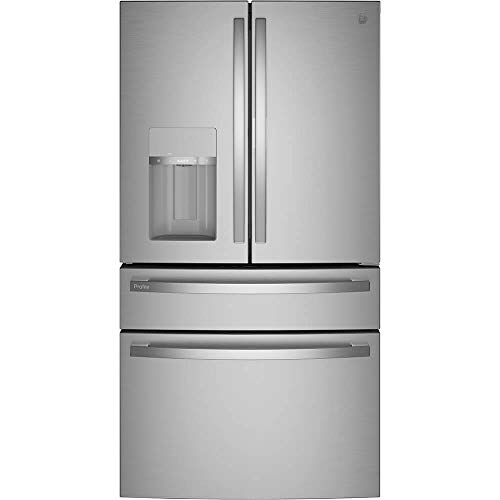
GE Profile 27.6 Cu Ft 4-Door French Door Refrigerator PVD28BYNFS — Best Compact End of Class
The PVD28BYNFS is the bottom step of the ladder at 27.6 cu ft, and we include it deliberately: it is where this class shades into ordinary large refrigerators, and some kitchens honestly live there. What it keeps from its 28.7 cu ft sibling above is the four-door GE Profile architecture — divided fresh storage, careful water service, fingerprint-resistant stainless — in a cabinet that asks slightly less of the room.
That slightly-less matters in real floor plans. A kitchen that cannot quite swallow the deepest or widest of the class leaders may still fit this model, and the household loses about a bag of groceries of volume against the Samsung while gaining the four-door organisation that makes large fridges liveable. Read its capacity plainly, though: 27.6 is not thirty, and a family already bursting a 25 cu ft machine should probably climb the ladder rather than camp on its first rung.
For the right household — four people, organised habits, a kitchen at the smaller end of large — this is the class’s quality-over-quantity answer, and a better buy than a cavernous cabinet whose back corners become a food museum.
- Total capacity: 27.6 cu ft — the smallest in this guide
- Width: 36 inches
- Layout: 4-door French door
- Finish: fingerprint-resistant stainless steel
- Model: PVD28BYNFS
Strengths
- Full four-door GE Profile layout at the class’s entry step
- Fingerprint-resistant finish suits family traffic
- Slightly easier fit for kitchens near the class’s size limit
Trade-offs
- 2.4 cu ft below the Samsung — a real difference for big shops
- Four-door division limits single-item width per zone
- Fast-growing families may outgrow it sooner than expected
Best for: organised mid-size families who value layout over the last cubic feet. Not suited for: households already overflowing a large fridge and shopping purely for volume.
For current pricing and full dimensions on the GE Profile PVD28BYNFS, check price on Amazon and compare its footprint against your opening.
How Do the Six Compare Side by Side?
| Pick | True capacity | Layout | Water service | Standout trait |
|---|---|---|---|---|
| Samsung Bespoke 3-Door | 30 cu ft | French door, freezer drawer | AutoFill pitcher | Class maximum, panel-calm design |
| Midea MRF29D6AST | 29.3 cu ft | French door, freezer drawer | Smart-connected model | Near-30 capacity, family alerts |
| Sharp SJF2955KS | 28.9 cu ft | French door, standard depth | Through-door ice and water | Boost cooling modes |
| GE Profile 4-Door | 28.7 cu ft | Four-door French door | Dual-dispense AutoFill pitcher | Zoned organisation |
| Kenmore Side-by-Side | 29 cu ft | Side-by-side | Space-saving door dispenser | Eye-level freezer shelves |
| GE Profile PVD28BYNFS | 27.6 cu ft | Four-door French door | Door water service | Class layout, smallest footprint demand |
The ladder in one view: capacity descends 30, 29.3, 29, 28.9, 28.7, 27.6, while layouts divide into drawer-freezer French doors, two four-door organisers and one vertical side-by-side. Choose your layout family first, then take the largest capacity within it that your kitchen and delivery route allow.
How Do You Measure for a Refrigerator This Big?
Measure the opening three ways: width at its narrowest point, height under any cabinet or soffit, and depth from wall to the counter’s front edge. Then measure the journey — front door, hallway turns, stairwell corners — because a 36-inch-class cabinet that fits the kitchen but not the corridor is a sculpture in your driveway. Note where the water line and socket sit; both should be reachable without the cabinet hard against the wall.
Leave breathing room in your numbers. Manufacturers publish required clearances for ventilation and door swing, and French doors need their full arc plus handle depth to open past ninety degrees so drawers and bins can slide out. A cabinet wedged to the millimetre is a cabinet whose doors kiss the wall every day of its life.
French Door, Four-Door or Side-by-Side: Which Layout Feeds Your Household?
French doors put the food you use hourly at waist height in one wide space, which is why they dominate this class; their freezer drawers reward bulk and punish small-item sprawl. Four-door models tax that width slightly to buy zoning and smaller door openings — the right trade for organised households and snack-heavy children. The side-by-side keeps frozen food visible on shelves and narrows the door swing, at the price of width in both compartments.
Run the tray test before deciding. Find the widest thing you refrigerate monthly — a roasting pan, a pizza box, a party platter — and check it against each layout’s clear width. Layouts are philosophies, but trays are facts, and facts should win.
How Should You Organise Nearly Thirty Cubic Feet?
Assign every shelf a category and label the crispers, however unfashionable that sounds. In a cabinet this size, the enemy is not space but forgetting: food drifts to the back, duplicates accumulate, and the weekly shop buys a third jar of something already owned twice. A shallow-front rule helps — nothing hides behind anything else on the main shelves, and tall items live together so sight lines stay clear.
Keep a running list on the door of what the freezer holds, dated. Drawer and side-by-side freezers alike reward the list and punish its absence. The households that love these big machines a year later are, without exception, the ones that treated organisation as part of the purchase.
What Does the First Week With a Giant Fridge Teach You?
It teaches you where your household actually reaches. The door bins you filled with condiments will be wrong by Thursday; the shelf you gave to drinks will overflow while the deli zone echoes. Reorganise once, deliberately, at the end of week one, moving the daily traffic to the front and the patient food to the back. Check temperatures with a simple thermometer in both compartments after the first big shop, when the cabinet has real work to do.
Also watch the doors. Big French doors carry big gaskets, and a door closed on a protruding handle or a tall bottle leaks cold all night. Teach the household the push-until-it-clicks habit early, or enable the door alarm if your model offers one, and the machine will hold its temperatures with far less effort.
How Do You Keep a Large Refrigerator Running Efficiently?
Full but not packed is the efficient state: food mass holds temperature, while gaps around the vents let air circulate. Keep the condenser area dusted, the gaskets wiped, and the temperature at ordinary food-safe settings rather than arctic ones — every extra degree of cold is paid for daily. Through-door dispensers and AutoFill pitchers both help efficiency quietly, by giving the household water without opening the main doors twenty times a day.
Once a season, audit the contents ruthlessly. A 30 cu ft cabinet can hide a fortune in expired jars, and every forgotten item removed is space, energy and money returned. Big fridges reward big housekeeping habits; they merely tolerate the rest.
How Much Food Does Thirty Cubic Feet Actually Hold?
Translate the number into shopping. A cabinet at the top of this class swallows two full trolley loads without stacking anxiety: the weekly shop for a family of six, plus the bulk-buy run, plus the leftovers architecture of a household that cooks once and eats three times. The freezer side of that equation matters just as much — a whole lamb’s worth of butcher boxes, a season of garden produce, or the batch cook’s month of ready meals, all in one address.
The households that underuse these machines are the ones who shop daily and cook small; for them a 27.6 like the GE Profile PVD is already generous, and the Samsung’s full thirty is a echoing cave. Match the cabinet to the shopping rhythm you actually keep, not the one a bulk warehouse tempts you into twice a year.
What Happens to Your Kitchen Layout When the Fridge Gets This Big?
A 36-inch-wide, full-depth refrigerator is a piece of furniture the room must be planned around. It claims a wall, dictates where the bin can stand, and sets the swing geometry for every nearby door and drawer. In return it can anchor a kitchen: the Bespoke’s calm frontage in particular reads as cabinetry, letting the largest appliance in the house become the quietest-looking one.
Plan the triangle honestly. A huge fridge at the far end of a long kitchen adds steps to every meal’s making; placed near the main counter run, it shortens the working day noticeably. If a remodel accompanies the purchase, mock the footprint with tape and live with the outline for a week before committing — cardboard has saved more kitchens than any designer.
How Do Door Alarms and Alerts Earn Their Keep?
In a small fridge, a door left ajar is a nuisance. In a thirty-cubic-foot cabinet feeding six people, it is a grocery bill quietly warming. Door-ajar alerts — the kind the Midea’s smart system can send to a phone — pay for themselves the first time a child leaves the French door resting on a milk bottle at bedtime. The same logic applies to temperature alerts after power cuts, which tell you whether the food is safe before you have served it.
None of this requires a smart home or an app habit. A simple audible alarm on the cabinet does most of the work; connectivity merely extends its voice to wherever you happen to be. Judge the feature by your household’s chaos level, which you know better than any reviewer.
Should You Plumb In a Water Line?
Through-door dispensers like the Sharp’s and Kenmore’s need a water line, and the installation ranges from trivial — a line already waiting behind the old fridge — to a plumber’s visit in older houses. AutoFill pitcher models sidestep the question: the Samsung and GE Profiles fill their pitchers from the cabinet’s internal supply arrangement, which still needs water access, so read each listing’s requirements rather than assuming pitcher means plumbing-free.
Either way, budget a filter habit. Dispenser and pitcher systems both rely on filters that want changing on schedule; neglected filters are the commonest reason great water features become slow, strange-tasting disappointments. Put the change date on the family calendar the day the refrigerator arrives.
How Do You Handle a Holiday Week in a Cabinet This Size?
The holidays are the class’s home fixture: the turkey resting, the ham waiting, three desserts in rotation and a door that opens forty times a day. Prepare the cabinet like a theatre before a run — clear the expired, move the everyday to one side, and give the event food a dedicated shelf with nothing stacked on top of it. Boost modes, where fitted, earn their applause on the day the warm groceries for the feast arrive.
After the event, resist the slow slide back into chaos. Leftovers get dated containers and a deadline; the freezer list gets updated while the washing-up is still happening. The households that dread January fridge archaeology are the ones who skipped the twenty minutes of December discipline.
What Should You Check Before the Delivery Truck Arrives?
Confirm the route in writing with the seller: doorway widths, the stair turn, the door that may need to come off its hinges. Clear the path of rugs, shoes and optimism. Know where the old refrigerator is going — garage, buyer, or haul-away — before the new one is in the hall, because two giant cabinets and a delivery crew fill a kitchen completely.
Have the water line and socket accessible, the floor protected, and a cooler with ice ready for the food in transit between machines. Once the new cabinet is level and running, give it several hours to reach temperature before loading it fully; a giant box of warm air takes time to become a refrigerator, and patience on day one protects the week’s shopping.
How Does a Big Fridge Change Your Food Waste?
Visibility is the whole story. In an over-full small fridge, food dies unseen at the back. In a well-run large one, everything has a shelf, a zone and a sight line, and the cook can inventory the fresh food in one glance — the four-door GE Profiles are built around exactly this advantage. Waste falls not because the cabinet is bigger but because it is legible.
The reverse happens in an unorganised large fridge, which simply hides more waste at greater expense. The machine provides the shelves; the household must still provide the system. Buy the size, then immediately buy the containers, labels and list habit that make the size pay.
What Noise Should You Expect From a Cabinet This Size?
Large compressors are not loud, but they move more air and their fans have a presence in a silent house at night. Kitchen placement forgives this entirely; open-plan living asks a little more care. Check that the cabinet stands level and clear of neighbouring units, since vibration transmitted into cabinetry is the usual culprit behind a refrigerator that seems noisier than its specification.
Ice makers add their own percussion — cubes dropping into an empty bin at 3 a.m. carry further than expected. Households sensitive to night noise often switch the ice maker off in the evening or choose pitcher models and a countertop ice arrangement. None of this is a defect; it is the acoustics of a hardworking machine, planned for rather than discovered.
How Do Finishes Survive Family Life?
Fingerprint-resistant stainless, like the Kenmore and the smaller GE Profile wear, is not a marketing garnish in a house with children — it is the difference between a cabinet that looks clean and one that documents every snack. Standard stainless cleans up beautifully but asks for the effort weekly. Bespoke-style panels take a third path, disguising the appliance as furniture and shrugging off the daily evidence.
Whichever finish you choose, establish the cleaning rule early: a soft cloth, warm water, nothing abrasive, and a wipe of the handles more often than pride suggests. Handles are the most-touched surface in the kitchen and the first place a big refrigerator starts to look tired.
When Is the Smaller End of This Class the Smarter Buy?
When the kitchen is large but the household is not, when the shopping is weekly but modest, and when the delivery route argues against the deepest cabinets — the 27.6 cu ft GE Profile is the honest answer, and pretending otherwise wastes money and floor. It is also the smarter buy for cooks who value the four-door system above raw volume, since organisation routinely saves more food than capacity stores.
The class ladder exists so each household can stop at its own rung. Read the true capacities, run the tray test, walk the delivery route with a tape measure, and the right rung usually identifies itself without any salesmanship at all.
How Should You Think About the Freezer Half of the Bargain?
Capacity figures are totals, and households live in the split. A family that batch-cooks and buys meat in bulk is really shopping for freezer volume and should interrogate each model’s frozen share and its shape — drawer depth on the French door models, shelf width on the Kenmore. A family that freezes little more than ice cream and peas can happily let the fresh side dominate and should weigh the fresh deck’s width and shelving first.
Ask the question with your last month in mind: count the frozen items you own today and the fresh items that crowd your current shelves. The layout that relieves the actual crowding is the right one, even if a different layout photographs better. Refrigerators are bought in showrooms but judged in February, at the back of the freezer, by torchlight.
What Role Does Lighting Play Inside a Very Large Cabinet?
Interior lighting sounds like a footnote until you are searching a thirty-cubic-foot cabinet at midnight. Bright, well-placed LED lighting — the kind modern large models use to wash the whole fresh deck — turns the visibility argument of this class into reality: nothing can hide in a corner that is properly lit. It also changes behaviour; a cabinet you can see into gets closed sooner, wasting less cold.
Judge lighting in person where you can, and by shelf layout where you cannot. Glass shelves pass light downward; solid shelves hoard it. In the freezer, a small light is the difference between reading labels and excavating by feel, and it is worth more over ten years than several headline features we could name.
How Do You Childproof and Grandparent-Proof a Giant Fridge?
Big French doors are easy for small hands to open and heavy for small arms to close, which is how door alarms earn their place in family kitchens. For grandparents, the calculus runs the other way: waist-height fresh food in a French door layout spares backs and knees, while a low freezer drawer full of heavy frozen goods may need organising so the daily items sit in the top tray, not the bottom of the drawer.
Side-by-side models quietly shine for older households, putting both fresh and frozen food between knee and shoulder height. When a refrigerator serves three generations, as these large ones often do, that ergonomic argument can outweigh every other feature in this guide.
What Is the True Cost of Owning the Class Leader?
Beyond the purchase figure — which you will confirm on the listing, since we publish no static prices — ownership costs arrive as filters, electricity and the occasional service visit across a long life. Large cabinets use more energy than small ones in absolute terms but often less per cubic foot, and their running cost is usually dwarfed by the value of the food inside them at any given moment.
The expensive failures are organisational, not mechanical: the forgotten bulk buy, the duplicated shop, the holiday overflow bought because nobody could see what was already owned. A big refrigerator with a system is an economy; a big refrigerator without one is a warehouse with rent. Price the containers, labels and thermometer into the purchase and the machine’s economics turn in your favour.
How Should Renters and Landlords Read This Class?
Most rental kitchens will not accept a 36-inch-class cabinet, and tenants should measure before falling for any model here. Landlords furnishing larger family homes, though, should note that capacity is a genuine amenity families screen for, and a reliable near-30 model like the Midea answers it without exotic parts or service needs. Whatever the tenure, the delivery-route rules apply twice over in older rental stock with narrow stairs.
For tenants between homes, the honest advice is to wait: this class rewards permanence. The cabinet is sized to a kitchen, plumbed to a wall and levelled to a floor, and moving it annually is nobody’s idea of value.
What Separates a Good Big Fridge From a Great One After Five Years?
Not the features list — the seals, the hinges and the household’s habits. Great survivors stand level, their gaskets meet cleanly all round, their coils breathe dust-free air, and their interiors still follow the system set in the first month. Their owners can name the temperature in both compartments without looking, because a cheap thermometer lives inside and gets read.
Every model in this guide can be a five-year success under that regime, from the Samsung flagship to the Kenmore dissenter. The machine provides capacity and cooling; greatness is a maintenance habit wearing an appliance as its uniform.
How Do You Move House With a Refrigerator This Size?
Plan it like the major furniture it is. Empty it completely the day before, let the freezer defrost with towels standing guard, and secure or remove the shelves and bins — a loose glass shelf in transit is a tragedy in two acts. Professional movers will want the doors taped or strapped and the cabinet kept upright; if it must travel tilted, it needs hours standing in its new home before switching on, so the compressor oil finds its way back.
At the new kitchen, the measuring ritual repeats in full: opening, route, water, socket, level. The households that damage big refrigerators rarely damage them in use; they damage them on stairs, in doorways and in the impatient first hour after a move. Slow is smooth, and smooth is how a fifteen-year appliance survives being relocated at year six.
What Should a Second Fridge Household Do Differently?
Many families reaching for thirty cubic feet already run a garage or basement overflow unit, and the new cabinet should change that system’s job, not merely enlarge it. Let the kitchen machine own everything fresh and this-week; demote the overflow to drinks, preserves and the deep freezer archive. Two refrigerators with distinct jobs waste less food than one giant and one junk drawer with a compressor.
Resist the opposite temptation — cancelling the overflow before the new cabinet proves itself. Live a month with the big fridge’s real organisation, then decide what the second machine still earns. Capacity problems are sometimes layout problems in disguise, and a month of evidence beats a showroom hunch.
How Does Climate Affect a Large Refrigerator?
A cabinet in a cool northern kitchen cruises; the same cabinet in a hot, humid southern kitchen works against the room all summer, and its door gaskets meet warm moist air at every opening. None of the six here is a garage appliance — kitchens only, within ordinary indoor temperatures. Households in hot climates should be extra strict about placement away from ovens and sunny walls, and extra faithful about coil cleaning, because dust plus heat is the combination that ages compressors early.
Humidity writes its signature on the door bins and gasket folds, where a weekly wipe prevents the mildew that otherwise takes hold unnoticed. Big fridges in warm climates are not a problem to solve; they are a routine to keep, and the routine is measured in minutes per month.
Which of These Six Suits a Cottage-Style Kitchen Best?
Our readers often ask the aesthetic question last and feel it longest, so it deserves a straight answer. The Samsung Bespoke’s flat, furniture-like frontage sits most gently in a cottage or farmhouse room, reading as a tall cabinet rather than a machine. The Kenmore’s fingerprint-resistant stainless is the practical traditionalist’s choice, shrugging off the evidence of a working kitchen. The GE Profiles split the difference — modern, but with a warmth to their detailing that suits painted cabinetry.
Whichever you choose, give the giant its visual breathing room: a plant or a bread crock crowding its flank makes the whole wall feel negotiated. Large refrigerators look best when the kitchen admits they are large and arranges itself accordingly.
How Do You Read a Capacity Figure Like an Engineer?
Total capacity counts every cubic inch the manufacturer can claim, including door bins and odd corners no casserole will ever occupy. Usable capacity — the shelves as you will actually load them — is always less, and it differs between layouts with identical totals. That is the deeper reason this guide prints the ladder honestly and then argues about layout for pages: the 27.6 cu ft four-door, organised into zones you fully use, can out-store a 29 cu ft cabinet whose back shelf is a no-go zone of forgotten jars.
When you compare listings, look for shelf dimensions and freezer split figures alongside the headline total. A photograph of the interior with the doors wide is worth a paragraph of marketing, and your own widest tray, measured at home, is worth more than either.
What Warranty and Service Questions Should You Ask?
Refrigerators this size are serviced in your kitchen, not carried to a workshop, so the questions are practical: who is the authorised service network in your area, what does the sealed-system coverage include, and how are parts handled for your model a decade from now. The brands in this guide all maintain US service operations, but coverage density varies by region, and a rural household should confirm its nearest agent before choosing between two otherwise-equal finalists.
Keep the paperwork, register the purchase, and photograph the model plate inside the cabinet on day one. When a service call comes — in year nine, over something small — the household with the plate photo and the receipt solves it in one call instead of three.
How Should You Stock the Cabinet on the Day It Arrives?
Load it in waves, not in one heroic transfer. Chilled food first, in the zones you planned, with the vents left visibly clear; frozen food next, packed flat and dated; door bins last, once you can see what the household reaches for hourly. Leave a thermometer in each compartment for the first forty-eight hours and glance at it whenever you pass — the readings teach you the cabinet’s personality, where its cold corners and gentle spots live.
Then write the freezer list, photograph the fresh shelves for your phone, and declare the system open. A refrigerator stocked thoughtfully on day one tends to stay thoughtful, because the first arrangement becomes the habit every later shop follows without thinking.
What Are the Most Common Mistakes When Buying a 30 Cu Ft Refrigerator?
The headline mistake is trusting the class name over the spec sheet — as this guide’s ladder shows, “30 cu ft” models may hold 27.6. Next comes measuring the kitchen opening and forgetting the delivery route. Third is choosing a layout by showroom looks rather than by the tray test and your household’s freezer habits.
Fourth: ignoring the water question until installation day, when a dispenser model meets a kitchen with no reachable water line. Fifth: filling the new cabinet by transferring everything from the old one without an audit, instantly recreating the old chaos at larger scale. Each mistake is cheap to avoid in the week before purchase and expensive in the month after.
Final Recommendation
If your household truly needs the class maximum, the Samsung 30 Cu Ft Bespoke 3-Door French Door Refrigerator is the honest headline act — a real thirty cubic feet with a pitcher system families end up loving. Organisation-first households should look hard at the GE Profile 28.7 Cu Ft 4-Door French Door Refrigerator, whose divided layout wastes less food than a bigger box might. And freezer-led households owe the Kenmore 29 Cu Ft 36 Inch Side-by-Side Refrigerator a fair hearing before defaulting to French doors. Pick the layout your cooking actually uses, take the largest true capacity that fits your space, and the right refrigerator will quietly organise your kitchen’s whole week around itself.
Frequently Asked Questions
Is a 27.6 cu ft model really part of the 30 cu ft class?
Retailers group them together, which is why we show the ladder openly: 27.6 is the entry step, about a shopping bag smaller than a true 30. For many kitchens the difference never shows; for maximum-volume households it might, so buy with the real figure in mind.
Do French door freezers hold a large turkey?
Generally yes — a deep freezer drawer is one of the format’s strengths, swallowing a whole bird or a stack of batch-cooking trays. Check the drawer’s internal dimensions on the listing against the largest item you freeze each year.
How much clearance do these refrigerators need?
Follow the specific model’s published clearances for the sides, top, back and door swing; they vary by design. As a rule, plan for ventilation space plus enough door arc for interior drawers to slide fully out.
Are AutoFill pitchers better than door dispensers?
They solve the same need differently. A pitcher keeps the cabinet front clean and serves a full jug at the table; a through-door dispenser gives glass-by-glass ice and water without opening anything. Households with heavy ice use usually prefer the dispenser, as on the Sharp and Kenmore here.
Will a refrigerator this size fit through my front door?
Many homes need the refrigerator’s doors removed for delivery, which crews do routinely — but narrow halls, tight turns and low stairwells still defeat some routes. Measure the whole journey and tell the seller about any tight point before the truck is loaded.
How long should a refrigerator in this class last?
A well-kept large refrigerator commonly serves well beyond a decade. Clean coils, healthy gaskets and sane temperatures are the whole secret; big cabinets are not fragile, they are merely expensive to neglect.
Related Guides
Capacity is only one axis of the refrigerator decision. For cold storage that travels, see Best 12v Portable Refrigerators; for the next size step down, Best 25 Cu Ft Refrigerators covers the class below this one; and if width rather than volume is your constraint, Best 33 Inch Wide French Door Refrigerators narrows the field to slimmer cabinets.


