What's inside
- Key Takeaways
- Quick Picks
- How Did We Judge Ease of Use Without a Stopwatch and a Laboratory?
- Six Friendly Machines, Side by Side
- What Does a Beginner’s First Month Actually Demand From a Machine?
- How Can You Make Any Beginner Machine Feel Easier Tonight?
- Which Beginner Mistakes Have Nothing to Do With Talent?
- Which Fabrics Should a Beginner Sew First, and Which Should Wait?
- How Do You Learn Alongside a Child or a Parent Without Anyone Crying?
- What Does Looking After an Easy Machine Look Like Month to Month?
- How Should You Choose Between These Six Without Overthinking It?
- Which Accessories Are Worth Adding Once the First Month Goes Well?
- What Should You Do When an Easy Machine Suddenly Sews Badly?
- Final Recommendation
- Frequently Asked Questions
- Related Guides
As an Amazon Associate I earn from qualifying purchases. This post may contain affiliate links at no extra cost to you.
cottageverdict.com is reader-supported. When you buy through links on our site, we may earn an affiliate commission.
Where to buy: Each machine in this guide links to its Amazon listing from the Quick Picks table and from its detailed review. Beginner machines are frequently sold in slightly different bundles, so check that the feet, kit pieces, or table mentioned in a review match the configuration on the listing in front of you, and rely on the “check price on Amazon” line in every spec box for current pricing.
The best easy to use sewing machines are not the machines with the fewest features. They are the machines that forgive you. They forgive the threading you got slightly wrong, the speed you did not mean to choose, the seam you steered a few millimetres off course at midnight. Ease of use lives in specific, testable places: a bobbin diagram printed where you can see it while your hands are busy, knobs large enough to turn without pinching, a low speed that is genuinely low, a light that actually reaches the needle, and instructions that assume you have never done this before because, statistically, you have not. This guide ranks six machines by how kindly they treat a beginner’s first month, not by how impressive their stitch menus look in a photograph.
That kindness matters commercially as well as emotionally. The sewing world loses most of its beginners in the first three projects, and the usual cause is not lack of talent — it is a machine that made threading feel like an exam and speed control feel like a trap. Every pick below was chosen to lower a specific barrier: one leans on diagrams and tutorial videos, one enlarges its controls for older hands and tired eyes, and the minis strip the experience down to a handful of decisions. Readers who already know they want push-button stitch selection and screens should browse Best Computerized Sewing Machines alongside this guide, because easy and computerized overlap more than the marketing suggests.
Key Takeaways
- Ease of use is measurable: visible threading guidance, honest low speeds, readable controls, and light at the needle beat long stitch lists.
- The Janome Arctic Crystal pairs an interior metal frame with a bobbin diagram and tutorial videos, making it the most supported start in this group.
- Large knobs and a clear low/high speed choice make the Easy Threading model the natural pick for seniors and anyone with stiff hands.
- The minis here trade capability for calm — fewer decisions, pedal control where offered, and kits that remove shopping from week one.
- Reverse stitching, offered by one mini in this guide, is the beginner feature most worth insisting on because it locks seams without extra steps.
- No machine in this guide requires tools, apps, or a dealer visit to complete a first project.
Quick Picks
| Machine | Badge | What makes it gentle |
|---|---|---|
| Janome Arctic Crystal Easy-to-Use Sewing Machine | Guided Start Pick | A bobbin diagram, tutorial videos, and a metal interior frame support beginners through garments, patchwork, and light quilting. |
| Easy Threading Sewing Machine for Beginners & Seniors | Big-Control Comfort Pick | Large knobs, a work light, and a plain low/high speed choice remove the squinting and fumbling from everyday sewing. |
| Victool Mini Sewing Machine (16 Stitches) | Friendly Mini Pick | Sixteen stitches, an intuitive threading path, and easy setup shrink the distance between unboxing and a first mended seam. |
| Portable Mini Electric Sewing Machine with 57-Piece Kit | Complete-Box Beginner Pick | A 57-piece kit, two speeds, a foot pedal, and an extension table mean nothing else needs buying before the first craft session. |
| Portable Sewing Machine for Beginners (12 Stitches, Two-Speed) | Reverse-Stitch Mini Pick | Reverse stitching, an LED light, two-speed control, and a 32-color thread kit cover the beginner checklist in one small box. |
| Portable Tabletop Beginner Mini Sewing Machine | Household Spare Pick | Compact, giftable, and aimed squarely at quick repairs and alterations for beginners, kids, and adults sharing one machine. |
How Did We Judge Ease of Use Without a Stopwatch and a Laboratory?
We broke the beginner experience into the five moments where new sewists actually quit: threading the machine, winding and inserting the bobbin, choosing a stitch, controlling speed through the first seam, and recovering from the first tangle. A machine scored well when its listing title or design addressed one of those moments directly — a printed bobbin diagram, a threading path described as intuitive, a low speed you select rather than feather, a light at the work area. Features that merely decorate a specification table, like a large stitch count on a mini, earned no ease points at all.
We also weighted who the beginner is. A confident twelve-year-old, a returning sewist whose last machine had a hand crank’s grandchild, and a seventy-year-old with arthritic thumbs are all beginners, but they stumble at different fences. That is why this guide keeps a full-size guided machine, a big-knob comfort machine, and four minis in the same list: ease is not one property, and the friendliest machine for one pair of hands can be the fiddliest for another. Where a listing title stayed silent about a detail — stitch numbers on the comfort model, for instance — the spec boxes record the silence rather than borrowing a figure from a cousin product.
One boundary deserves stating early. Easy to use does not mean heavy-duty, and none of these machines should be bought to sew upholstery projects; the thick-fabric end of sewing lives in guides such as Best Sewing Machines for Upholstery. What these six promise is a calm route into ordinary sewing — garments from light fabric, patchwork, mending, crafts — and that promise is worth more to a beginner than any amount of unused power.

Janome Arctic Crystal Easy-to-Use Sewing Machine — Guided Start Pick
Janome’s Arctic Crystal is the machine in this guide that most clearly understands where beginners bleed time. Its listing title names an interior metal frame, a bobbin diagram, tutorial videos, and a design brief aimed at garments, patchwork, and light quilting. Start with the bobbin diagram, because it sounds like nothing and solves everything: the bobbin is the part new sewists insert backwards, seat wrongly, and blame for every loop and tangle of their first month. A diagram at the machine turns a manual-diving expedition into a glance. Tutorial videos do the same work for threading and first seams — pausable, rewatchable, and available at the exact moment of confusion rather than in a booklet’s index.
The interior metal frame is the grown-up detail hiding inside a beginner brief. Frames decide how a machine ages: a machine that flexes and rattles when new will only get looser, while a rigid interior keeps the needle bar, feed, and presser assembly in alignment through years of being carried between rooms and stored in cupboards. For a beginner, alignment is not an abstract virtue — it is the difference between a machine that sews straight when you steer straight and one that drifts and teaches you bad habits. The stated project range is equally honest. Garments, patchwork, and light quilting are exactly what a capable starter machine should claim, and the absence of heavy-duty language is a sign of a maker describing a tool truthfully.
Who thrives on this machine? The beginner who intends to stay. If your plan is a wardrobe of simple garments, a patchwork throw by winter, and mending in between, the Arctic Crystal’s support materials flatten the learning curve while its frame refuses to become the ceiling. It is the least disposable purchase in this guide, and for many households that is the real definition of easy: you learn one machine, thoroughly, instead of relearning a cheaper one every year.
- Frame stated in the title: interior metal frame
- Guidance stated in its title: bobbin diagram and tutorial videos
- Named project range in the maker’s title: garments, patchwork, light quilting
- Stitch count: the listing title publishes no number, so consult the manufacturer documentation if a specific stitch matters to you
- Buttonhole style: not described in the product title — another detail to confirm in the documentation rather than assume
- Where to buy: the Janome Arctic Crystal listing on Amazon — check price on Amazon
Strengths
- Guidance is built into the ownership experience through the diagram and videos, not left to willpower.
- A metal interior frame promises steadier sewing now and better manners as the machine ages.
- The stated project range is broad enough to grow with a beginner for several years.
Trade-offs
- Its stitch count is unstated in the title, so stitch-menu shoppers must do one verification step.
- Full-size manners mean full-size storage; it will not vanish into a drawer like the minis.
- Beginners who only ever mend may be paying for headroom they never visit.
Best for: committed beginners who want one supported, durable machine for garments and patchwork. Not suited for: drawer-storage households or anyone whose sewing begins and ends with emergency hems.

Easy Threading Sewing Machine for Beginners & Seniors — Big-Control Comfort Pick
Most beginner machines are easy for the manufacturer’s idea of a beginner: young eyes, nimble fingers, good light. This one was briefed differently. Its listing title leads with easy threading for beginners and seniors, large knobs, and a light, then adds clear controls, a low/high speed choice, and a work light, naming home sewing, repairs, alterations, and sleeves among its jobs. Every one of those phrases is an accessibility feature wearing work clothes. Large knobs can be turned by hands that find small dials painful. A genuine low speed, selected rather than coaxed from a pedal, lets a cautious sewist finish a seam without the machine ever sprinting. A work light aimed at the needle is the difference between threading in one attempt and threading in six.
The sleeve mention is worth pausing on, because sleeve and cuff work is where older sewists most often surrender garments to a tailor. A machine that names sleeves in its brief is claiming the shaped, narrow jobs are within reach — alterations rather than only flat mending. Combined with easy threading, that makes this pick the natural recommendation for a grandparent returning to sewing after decades, or for any adult whose hands or eyesight have made a standard mini feel like it was designed by enemies. Ease, for this reader, is not about learning quickly; it is about not being excluded by the controls.
Set expectations correctly and it will not disappoint. This is a home sewing and repair machine, described in its title without stitch-count fanfare, and its virtues are ergonomic rather than expansive. Buy it for the person who will sew monthly for pleasure and necessity, in good light they control, at a speed they choose. That reader does not need a stitch library. They need a machine that says yes the first time they sit down.
- Threading described in the Amazon listing title as: easy threading, aimed at beginners and seniors
- Controls stated in the stated title: large knobs, clear controls
- Speed settings stated in the model title: low and high
- Lighting stated in the retailer title: work light included
- Named jobs in the title: home sewing, repairs, alterations, sleeves, DIY projects
- Where to buy: the Easy Threading Sewing Machine for Beginners & Seniors listing on Amazon — check price on Amazon
Strengths
- Control sizing and clarity serve older hands and eyes better than any rival here.
- A selectable low speed removes pedal anxiety for cautious or returning sewists.
- The work light targets the needle area where threading and starting seams happen.
Trade-offs
- The title states no stitch count, so decorative ambitions should be verified in the documentation first.
- Its comfort brief centers on home sewing and repairs, not on craft-fair production or heavy fabrics.
- Households wanting a tiny footprint will find the minis below easier to store.
Best for: seniors, returning sewists, and anyone whose hands or eyesight demand bigger, clearer controls. Not suited for: stitch-count shoppers or sewists planning thick, layered projects.

Victool Mini Sewing Machine (16 Stitches) — Friendly Mini Pick
The Victool mini sells calm in a small pink box. Its listing title promises 16 stitches, portability, an intuitive threading path, easy setup, and a workload of quick mending, simple cotton crafts, and creative DIY projects. Intuitive threading is the phrase to underline. On a mini, the thread path is often a guessing game of tiny guides; a path designed to be followed without a diagram is a genuine ease feature, and pairing it with easy setup means the machine respects the reality of mini ownership — it will be set up and put away hundreds of times, so every setup has to be painless or the machine stops being used.
Sixteen stitches is a sensible ceiling for this class: enough to offer a few decorative options for crafts without turning stitch selection into homework. The stated work — mending and simple cotton crafts — matches the machine’s physics. Cotton craft fabric feeds kindly, mending is short-seam work, and both forgive a mini’s lighter feeding in a way that long garment seams do not. As a gift, the Victool is well judged: pink styling, a creative-projects brief, and nothing about its operation that requires a mechanically confident adult standing by. As a household’s only machine, it is the mending-and-crafts answer, not the garment answer, and this guide will keep that boundary bright.
- Stitches stated in its title: 16
- Threading described in the maker’s title as: intuitive threading path
- Setup described in the product title as: easy setup
- Named jobs in the Amazon listing title: quick mending, simple cotton crafts, creative DIY projects
- Pedal and speed detail: the listing title does not spell these out, so the manufacturer documentation is the source to check before ordering
- Where to buy: the Victool Mini Sewing Machine (16 Stitches) listing on Amazon — check price on Amazon
Strengths
- Threading and setup were designed as the product, which is exactly right for a mini.
- Sixteen stitches give craft projects variety without overwhelming a new owner.
- Its brief is honest: mending and cotton crafts are jobs it can genuinely finish well.
Trade-offs
- Mini feeding and clearance keep it away from layered, bulky, or slippery fabrics.
- Control details beyond threading are not stated in the title and need a documentation check.
- Serious garment sewing will outgrow it within a few projects.
Best for: crafters, gift buyers, and mending households that prize painless setup. Not suited for: anyone planning to sew clothing as a regular hobby.

Portable Mini Electric Sewing Machine with 57-Piece Kit — Complete-Box Beginner Pick
Beginners quit for logistical reasons more often than anyone admits: the machine arrives, the first project needs pins, spare needles, a seam ripper, and three other small things nobody owns, and the hobby pauses for a shopping trip that never happens. This mini attacks that failure mode head-on with a 57-piece sewing kit in the box, alongside two speeds, a foot pedal, and an extension table, in a package its title aims at DIY crafts, home sewing, and repairs. The extension table deserves equal billing with the kit. A mini’s small bed lets fabric droop and drag; a table restores a flat, supported surface, and flat support is an ease feature because the machine stops fighting the fabric’s weight on your behalf.
The foot pedal completes the beginner-friendly picture. Pedal control means both hands stay on the work, guiding rather than chasing, and the two-speed choice lets a nervous starter cap the machine’s enthusiasm while learning. Judge the kit pieces as starter grade — they are there to make week one possible, and keen sewists will gradually replace scissors and pins with favorites. But week one is where hobbies live or die, and a box that contains the whole first month is a legitimate design philosophy, not a gimmick. For a parent equipping a teenager, or an adult buying their own first setup in one order, this is the lowest-friction route in the guide.
- Bundled extras stated in the stated title: 57-piece sewing kit
- Speed settings stated in the model title: 2-speed
- Control: foot pedal included, per the listing title
- Extension table: included, per the listing title
- Stitch count: no figure appears in the retailer title — the manufacturer documentation holds the answer if variety matters to you
- Where to buy: the Portable Mini Electric Sewing Machine with 57-Piece Kit listing on Amazon — check price on Amazon
Strengths
- The large kit removes the second-shopping-trip problem that stalls new hobbies.
- An extension table and pedal together give this mini unusually grown-up handling.
- Two speeds let confidence set the pace during the fragile first projects.
Trade-offs
- Kit quality is starter grade; tools will be upgraded one by one as skills grow.
- Its stitch count is unstated in the title, so menu size cannot be compared from the listing alone.
- It remains a mini under the fabric: light layers and short seams are its home ground.
Best for: first-time buyers who want one box to contain the entire start of the hobby. Not suited for: sewists who already own quality tools and would rather spend on the machine alone.

Portable Sewing Machine for Beginners (12 Stitches, Two-Speed) — Reverse-Stitch Mini Pick
Ask experienced sewists which beginner feature they would refuse to surrender and reverse stitching wins quietly. It is how you lock a seam’s ends so the whole line of stitching cannot pull out, and on many minis it is absent, leaving beginners to overlap stitches awkwardly or watch hems unravel in the wash. This portable mini includes it, and its listing title rounds out the beginner brief with 12 built-in stitches, two-speed control, a foot pedal, an LED light, and a 32-color thread kit for home mending. That is a thoughtfully complete checklist: control, visibility, seam security, and the thread to start with, all in a small machine.
The LED light is more than a bullet point at this scale. Minis migrate to wherever space exists — a corner of a bedroom desk, a kitchen table after dinner — and those places are rarely lit for needlework. A light at the needle turns evening mending from squinting to sewing. The 32-color thread kit solves a subtler beginner problem too: matching thread to fabric closely enough that a repair disappears. Mending is this machine’s stated purpose and it is well equipped for it; crafts and simple projects on light fabric follow naturally, while garment construction remains a job for the Arctic Crystal end of this guide.
- Stitches stated in the title: 12 built-in
- Speed settings stated in its title: two-speed control
- Reverse stitching: included, per the listing title
- Lighting stated in the maker’s title: LED light
- Bundled extras: 32-color thread kit
- Where to buy: the Portable Sewing Machine for Beginners (12 Stitches, Two-Speed) listing on Amazon — check price on Amazon
Strengths
- Reverse stitching locks seams properly, a feature many minis omit entirely.
- LED lighting suits the improvised, after-hours places minis actually get used.
- The color thread kit makes invisible mending possible from the first evening.
Trade-offs
- Twelve stitches are a working set for mending, not a decorative library.
- Its mini build caps fabric weight and layer count like every rival in its tier.
- No extension table is claimed, so larger craft pieces need hand support.
Best for: mending-focused households that want seams finished properly on a small machine. Not suited for: crafters sewing large pieces who need table support for fabric weight.
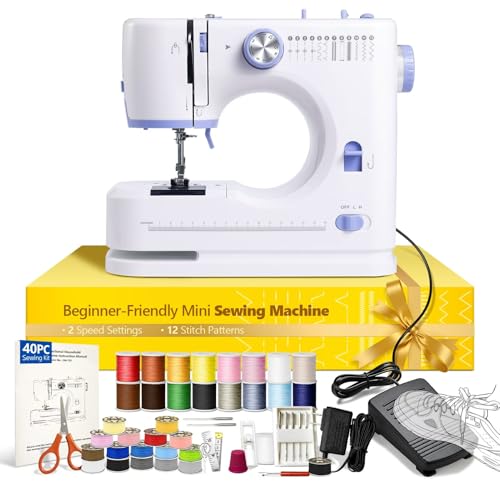
Portable Tabletop Beginner Mini Sewing Machine — Household Spare Pick
The last pick makes no grand claims, and that is its charm. Its listing title describes a portable tabletop beginner mini for home use — compact, easy to use, intended for quick repairs, DIY crafts, and alterations, and giftable for beginners, kids, and adults. Read that as the specification of a household spare: the machine that lives in a cupboard, comes out for a torn seam or a costume adjustment, and goes away again without ceremony. Households buy this kind of machine the way they buy a spare phone charger — not for joy, but because the day it is needed, nothing else will do.
The kids-and-adults framing deserves a practical note. A compact mini shared between a supervised child learning first seams and an adult doing alterations is a realistic family pattern, and a simple machine serves it better than a feature-laden one nobody wants to re-teach. Keep the shared jobs in the stated lanes — repairs, crafts, alterations on ordinary fabric — and this little tabletop unit will be borrowed, used, and put back for years. Households that find one member sewing weekly should treat that as the signal to promote them to the Arctic Crystal and let this mini return to spare duty, which is succession planning, not failure.
- Form factor stated in the product title: portable tabletop mini, compact
- Named jobs in the Amazon listing title: quick repairs, DIY crafts, alterations
- Audience named in the stated title: beginners, kids, and adults
- Stitch count: the listing title gives no figure, and the manufacturer documentation should be consulted rather than guessing from rival minis
- Speed and pedal detail: likewise unstated in the title — confirm in the documentation if pedal control is essential to you
- Where to buy: the Portable Tabletop Beginner Mini Sewing Machine listing on Amazon — check price on Amazon
Strengths
- Compact tabletop size stores like an appliance and deploys like one too.
- A simple, shared brief suits households where several people mend occasionally.
- Giftable positioning and broad age framing make it an easy household purchase.
Trade-offs
- Key operating details are unstated in the title, so keen comparers must check documentation.
- Its repair-and-craft brief leaves garment sewing to larger machines by design.
- Frequent sewists will find its simplicity becomes a ceiling within months.
Best for: households wanting a shared spare for repairs, crafts, and alterations. Not suited for: a dedicated hobbyist who will sew every week and needs room to grow.
Six Friendly Machines, Side by Side
| Machine | Ease anchor | Stated stitches | Watch out for |
|---|---|---|---|
| Janome Arctic Crystal Easy-to-Use Sewing Machine | Bobbin diagram plus tutorial videos | Not stated in the model title | Needs real storage space |
| Easy Threading Sewing Machine for Beginners & Seniors | Large knobs and selectable low speed | Not stated in the retailer title | Ergonomic brief, not a stitch library |
| Victool Mini Sewing Machine (16 Stitches) | Intuitive threading path, easy setup | 16 | Mending and cotton crafts only |
| Portable Mini Electric Sewing Machine with 57-Piece Kit | 57-piece kit plus extension table | Not stated in the title | Kit tools are starter grade |
| Portable Sewing Machine for Beginners (12 Stitches, Two-Speed) | Reverse stitching and LED light | 12 | No extension table claimed |
| Portable Tabletop Beginner Mini Sewing Machine | Compact shared-household simplicity | Not stated in its title | Details require a documentation check |
What Does a Beginner’s First Month Actually Demand From a Machine?
Week one is threading, winding a bobbin, and sewing wobbly lines on scrap while learning that the machine is not judging you. The features that matter are the diagram at the bobbin, the threading path you can follow without a video paused on your phone — or, in the Arctic Crystal’s case, the video itself — and a low speed that forgives a heavy foot. Week two is the first real object, usually something rectangular and forgiving: a cushion cover, a tote, a hemmed curtain. Now the extension table and pedal control start paying rent, because fabric handling replaces machine handling as the main challenge.
Threading deserves its own sentence in this calendar, because it is the skill every beginner secretly dreads and the one that improves fastest with repetition. Practice it deliberately during week one — thread, unthread, thread again — until your hands know the path the way they know a shoelace. Machines that print guidance on the body or supply videos shorten this apprenticeship, but no feature removes it entirely, and that is fine: a sewist who can rethread calmly in the middle of a project owns their machine in a way that a sewist who fears the thread path never quite does. Confidence in sewing is mostly this, repeated across a dozen small skills.
Week three is where the first tangle, skipped stitch, or broken needle arrives, and it is the week that decides whether sewing becomes a hobby or a story. Machines survive week three when their owners can rethread from scratch, fit a fresh needle, and slow down — which is why this guide keeps rewarding visible guidance and honest low speeds over specification fireworks. By week four the beginner is either altering real clothes, with sleeves and shaped seams entering the picture, or happily settled into mending and crafts. Both endings are successes. The machine’s job was to make sure the ending was chosen by interest, not imposed by frustration. Readers who reach week four hungry for decorative stitching and design work may find the next chapter in Best Computerized Embroidery Machines, where the learning curve restarts at a friendlier altitude than it once did.
How Can You Make Any Beginner Machine Feel Easier Tonight?
Start by slowing everything down one notch below what feels necessary. Beginners steer better at half speed, and every machine in this guide that offers a low setting or a second speed is offering accuracy disguised as caution. Next, sew the first ten centimetres of any seam on a scrap of the same fabric, checking that the stitch looks like a stitch on both sides; two minutes of testing prevents the classic beginner disaster of completing a seam and discovering loops underneath. Keep the manual — or the tutorial videos — open beside the machine for the first month rather than treating consultation as defeat.
Light and posture do quiet work too. Sit so the needle is in front of your sternum rather than off to one side, raise the machine on a book if the table makes you hunch, and add a lamp before blaming your eyes. Pre-wind two bobbins in your main thread colors so a bobbin change never interrupts a project mid-flow. And adopt the universal reset for any small machine behaving strangely: stop, rethread the top completely, reseat the bobbin, fit a new needle. That sequence, in that order, cures most beginner emergencies without a single tool, and learning it early is worth more than any accessory in any kit in this guide.
Which Beginner Mistakes Have Nothing to Do With Talent?
The most common is sewing over pins at speed, which bends needles and teaches the machine to skip. The second is pulling the fabric through from behind — beginners drag work toward themselves when nervous, fighting the feed dogs and stretching seams wavy; the machine feeds, your hands only steer. The third is choosing a first project with a zipper, a curve, and a deadline, a combination that has ended more hobbies than any machine defect. The fourth is thread hoarding in reverse: using the oldest, cheapest thread in the house for the first project, then blaming the machine for the tangles that thread was always going to cause.
A sixth mistake belongs to gift buyers: purchasing for the sewist you hope someone becomes rather than the one standing in front of you. The teenager who wants to customize thrifted clothes needs a machine that handles real garment fabric and forgives experimentation; the grandparent who mentions mending twice a year needs big knobs and a calm low speed. Both are beginners, and swapping their machines would make both unhappy — one under-equipped, one over-complicated. When in doubt, ask what they sewed, mended, or wished they could mend in the last twelve months, and buy for that answer. The machines in this guide cover the realistic spread of those answers precisely because ease was measured against real households instead of an imaginary average beginner.
A fifth mistake is quieter: never sewing at all because the machine feels too new to risk. Every pick here was built to be started, stopped, rethreaded, and forgiven. Schedule the ugly first project on purpose — a shopping bag from an old sheet is ideal — and give yourself permission for crooked seams. Crooked seams on a finished bag teach more than perfect intentions beside an unopened box, and every machine in this guide will happily sew the bag while you learn where its edges are.
Which Fabrics Should a Beginner Sew First, and Which Should Wait?
Fabric is the hidden difficulty setting of every beginner project, and choosing kindly at the fabric shop matters as much as choosing kindly at the machine shop. Plain woven cotton — the quilting cotton every craft store stocks in cheerful bolts — is the training ground: it stays where you put it, feeds without arguing, shows your stitching honestly, and irons flat so your seams look better than your steering deserves. Old cotton sheets run a close second and cost nothing, which makes them perfect for the deliberate ugly first projects this guide keeps recommending. Light linen and cotton blends behave similarly once you accept a little more fraying at cut edges.
The fabrics that punish beginners share a trait: they move. Jersey and other knits stretch under the presser foot, so a seam sewn at full confidence comes out longer and wavier than the fabric that entered; they need a stretch stitch or gentle zigzag, a lighter foot on the pedal, and ideally a walking pace you would find embarrassing on cotton. Slippery linings and satins slide sideways and pucker. Denim and canvas resist, and on the minis in this guide they are simply out of scope beyond a single layer. Sheers get eaten — drawn down toward the needle plate — unless you start on a scrap leader and hold the thread tails. None of this makes these fabrics forbidden; it makes them month three rather than day three, sequenced after cotton has taught your hands the basics on a fabric that cooperates.
Thread and needle choices ride along with fabric choices, and beginners can keep the system simple. One good all-purpose thread in white, black, and a mid-grey will mend and make most of what a first season asks; match colors more precisely only when a repair needs to vanish. Fit a fresh universal needle for wovens, keep a ballpoint for the day knits arrive, and change the needle whenever a project matters or a strange clicking begins. These are small disciplines, but on easy machines they are the difference between the machine’s kindness showing and the supplies sabotaging it.
How Do You Learn Alongside a Child or a Parent Without Anyone Crying?
Shared learning is where easy machines earn their name socially. The pattern that works, whether the second learner is nine or seventy-nine, is to separate the jobs: the confident person threads and troubleshoots, the learner steers and chooses fabric, and both of you agree that the first projects are allowed to be crooked. A mini with an intuitive threading path, like the Victool, suits a child’s first supervised sessions because setup never becomes a ten-minute adult preamble; the tabletop mini suits a family cupboard for the same reason. A grandparent relearning after decades benefits from the opposite end of the design spectrum — the big-knob machine — because their barrier is not concepts, which they remember, but controls that have shrunk since their last machine.
Safety and supervision need one clear paragraph. Sewing machines are power tools with a friendly reputation: needles move fast, and fingers belong behind the presser foot, never in front of it. Children sew with an adult in the room, at low speed, on simple shapes, with the machine switched off whenever hands approach the needle to reposition fabric. Adults returning to sewing deserve the same respect for the low-speed setting — not as a judgment, but because confidence rebuilt at a calm pace lasts, while a fright in week one can retire a machine for good. Every pick in this guide can be operated gently; use that gentleness deliberately and the machine becomes a place where generations can sit side by side productively, which is a rarer household achievement than any finished cushion cover.
What Does Looking After an Easy Machine Look Like Month to Month?
The kindest machines still need five minutes of care now and then, and beginners should learn the routine while it is still optional rather than after a breakdown teaches it. Lint is the main enemy: cotton projects shed fluff into the bobbin area, and a small brush — often hiding in the accessory kit — clears it in a minute. Do that whenever you change the bobbin and the machine’s stitch quality stays eerily consistent. Keep the machine covered or in its cupboard spot between sessions, because dust plus lint plus time is the recipe for the sluggishness people misdiagnose as old age.
Needles and bobbins are the other half of the routine. A needle is a consumable with a working life measured in projects, not years; swap it at the start of anything you care about and immediately if it strikes a pin. Use the bobbin type your manual specifies and wind bobbins smoothly rather than at full sprint, because a lumpy bobbin feeds thread unevenly no matter how easy the machine is. Finally, store the pedal and cord with the machine, every time, in the same place. Half the “broken machine” stories in beginner households are actually “the pedal is in a different drawer” stories, and easy machines cannot be easy from inside a treasure hunt.
How Should You Choose Between These Six Without Overthinking It?
Answer three questions honestly and the list shortens itself. First: will sewing be a hobby or a utility? Hobby answers point up the guide toward the Arctic Crystal, whose frame and guidance support growth; utility answers point down toward the minis, whose whole virtue is being adequate instantly. Second: whose hands and eyes are involved? If the honest answer includes stiff fingers, reading glasses worn on a chain, or a learner who needs to see exactly what a control does, the big-knob Easy Threading machine jumps the queue regardless of tier snobbery. Third: what else must be bought? If the household owns nothing — no scissors worth the name, no pins, no thread — the kit machines convert one purchase into a working setup, and the 57-piece-kit mini is the most complete version of that idea in this guide.
Notice what is not among the questions: stitch count, color, and which machine a stranger on the internet calls best. Stitch counts on beginner machines mostly measure menu length, and you will live in three stitches for a year. Color matters only insofar as a machine you like looking at gets left out and used — a real effect, but a tiebreaker, not a criterion. And the stranger’s best machine was chosen for the stranger’s hands, projects, and cupboard. Your three answers, honestly given, will land on the right pick here with a reliability no ranking table can match, because ease of use is a relationship between a person and a machine, not a property a machine carries alone.
Which Accessories Are Worth Adding Once the First Month Goes Well?
Resist accessorizing in week one — the kits in this guide exist partly to delay that spending — but a short list earns its place once sewing sticks. A pair of fabric scissors that never touch paper transforms cutting from a wrestling match into a pleasure, and a rotary cutter with a small mat suits the patchwork-leaning beginner. Extra bobbins of the correct type for your model end the mid-project rewind ritual. A seam gauge — a tiny ruler with a sliding marker — makes hems even in a way eyeballing never will, and a magnetic pin dish keeps pins off the floor and out of feet. None of these cost much; together they remove the small frictions that remain after the machine itself has been chosen kindly.
What not to buy yet matters equally. Specialty presser feet beyond what your machine includes can wait until a project demands one by name; a drawer of feet for techniques you have not met is inventory, not equipment. Decorative thread collections can wait for the same reason. The beginner who spends month two sewing rather than shopping will arrive at month three knowing exactly which single accessory their work is asking for, and that purchase — specific, needed, immediately used — is how a sensible sewing kit actually grows.
What Should You Do When an Easy Machine Suddenly Sews Badly?
It will happen, usually mid-project, and the sequence of checks matters more than mechanical knowledge. Stop sewing and take the work out gently; forcing fabric under a jammed needle bends things. First check: is the needle bent, dull, or the wrong type for this fabric? Replace it on suspicion alone — needles are cheap and pride is expensive. Second check: rethread the machine from the very beginning, with the presser foot raised so the thread seats properly in the tension discs; a shocking share of loops and nests are born in a threading that skipped one guide. Third check: remove and reseat the bobbin, confirming its direction against the diagram or manual, and brush out any lint that has gathered around it.
If the stitch still misbehaves, slow down and sew a test line on scrap while changing only one thing at a time: a different thread, a longer stitch, a lighter press on the pedal. Single-variable testing is how beginners build the diagnostic instinct that experienced sewists make look like magic. And keep perspective on the whole event — a machine that tangles on a Tuesday and sews beautifully on Wednesday after a rethread has not failed you; it has taught you the reset ritual that every sewist in history has performed. The easy machines in this guide were chosen partly because their guidance — diagrams, videos, clear controls — makes that ritual short. Short rituals get performed. Long ones get postponed until a small problem becomes a shelved machine, which is the only true beginner failure there is.
Final Recommendation
Choose by the barrier you most need lowered. If guidance is the barrier, the Janome Arctic Crystal’s bobbin diagram, tutorial videos, and metal frame make it the most completely supported start in this guide, and the machine most likely to still be your machine in five years. If the barrier is physical — stiff hands, tired eyes, dim rooms — the Easy Threading model with its large knobs and selectable low speed is the kindest purchase you can make for yourself or a parent. If the barrier is sheer overwhelm, take a mini: the Victool for painless setup, the 57-piece-kit model for a complete first month in one box, the reverse-stitch mini for mending done properly, or the tabletop mini as a household spare. Start with the machine whose help matches your hesitation, and your first finished seam will arrive while the enthusiasm that bought it is still warm.
Frequently Asked Questions
Is a mini sewing machine genuinely easier than a full-size one?
For setup and storage, yes; for sewing itself, only partly. A mini presents fewer decisions and lives where you can reach it, which lowers the barrier to starting. But a guided full-size machine such as the Arctic Crystal, with its bobbin diagram and videos, can be easier to actually learn on, because its feeding and stitch formation are more forgiving once you begin. Choose the mini for occasional mending and crafts, and the guided full-size machine for a hobby you expect to keep.
What should a senior look for first in a sewing machine?
Controls before stitches. Large knobs that turn without pinching, a threading path that does not demand threading a needle by feel, a real low speed, and a light that reaches the needle will decide whether the machine is a pleasure or an ordeal. The Easy Threading pick in this guide was briefed on exactly those points, which is why it leads our thinking for older sewists even without a published stitch count.
Do beginners need a foot pedal, or is a button enough?
A pedal teaches better habits. It frees both hands for guiding fabric and gives speed a physical relationship with your foot that becomes automatic within a few sessions. Button-only control can work for short mending, but the minis in this guide that include pedals — the kit models and the reverse-stitch mini — are noticeably easier to learn steering on, and steering is the beginner skill everything else builds on.
How important is reverse stitching for a first machine?
More important than its low profile suggests. Reverse stitches lock the ends of a seam so it cannot unravel in use or in the wash, and beginners who lack it must improvise with overlapping stitches that look bulky and hold worse. If your shortlist is all minis, the model here with reverse stitching has a real functional edge for mending, where seam ends are the whole job.
Can these machines handle quilting?
Light quilting and patchwork, yes, at the guided end of the guide: the Arctic Crystal names patchwork and light quilting in its brief, and piecing quilt tops from cotton is well within a capable starter machine. Full quilting of thick, layered quilts is a different demand, and beginners who fall for quilting seriously will eventually want a machine chosen for that work specifically. Start with patchwork, learn what you love, and upgrade with evidence rather than speculation.
How long does it take to feel comfortable on a beginner machine?
Most people feel genuinely comfortable somewhere between the third and fifth project — not the third hour, the third finished thing. Comfort arrives as a collection of small automatisms: threading without thinking, reaching for the reverse lever at a seam’s end, hearing a wrong sound and knowing it means the bobbin. Easy machines compress that timeline by removing obstacles rather than by adding talent, which is why guidance features like diagrams and videos show up in this guide’s scores again and again. If your first project wobbles, that is the normal price of admission, and the machines above are built to make sure you pay it once rather than every time you sit down.
Should a beginner buy the machine with the biggest kit?
Only if the household truly owns nothing to sew with. A large kit, like the 57-piece set in this guide, is a logistics solution: it guarantees the first month can happen without extra orders. If you already have scissors, pins, and thread from another craft, the kit’s value drops and a better machine for the same money — the Arctic Crystal, say — becomes the smarter buy. Judge kits by what they save you from shopping for, not by the piece count printed on the box, because forty of the pieces in any kit are the small consumables you would have bought in a single inexpensive bundle anyway.
Related Guides
One last encouragement before you choose: the distance between a non-sewist and a sewist is exactly one finished, imperfect project. Every machine above can carry you across that distance this week, with the fabric you already own and the light you already have, provided you let the first seams be practice rather than evidence. Pick the pick whose help matches your hesitation, thread it the same evening it arrives, and sew something small enough to finish before bed.
Easy machines and simple first projects belong together, and few projects forgive a beginner like a rag quilt, where raw edges are the aesthetic rather than the error. For patterns and finished examples to aim your early seams at, browse Best Animal Rag Quilts once your machine is threaded and your confidence is warming up.


