What's inside
- Key Takeaways
- Quick Picks
- How Did We Judge Dryers That Are All, on Paper, Huge?
- Capacity in Context: What 8.0 Cubic Feet Swallows
- How Much Dryer Does Your Household’s Biggest Load Really Need?
- How Do You Dry Very Large Loads Evenly?
- What Does Owning a Dryer This Size Cost You in Attention?
- What Does Steam Actually Do in a Dryer This Size?
- Which High-Capacity Mistakes Turn a Flagship Into a Liability?
- Final Recommendation
- Frequently Asked Questions
- Related Guides
As an Amazon Associate I earn from qualifying purchases. This post may contain affiliate links at no extra cost to you.
cottageverdict.com is reader-supported. When you buy through links on our site, we may earn an affiliate commission.
Where to buy: all six dryers below are sold on Amazon under their listing names, and in this category the first specification to read is the drum, the second is the fuel, and the third is everything else; check price on Amazon once you know whether your laundry room feeds its dryer with a heavy electric circuit or a gas line, because that fact divides this list in half before any brand preference gets a vote.
The best high-capacity clothes dryers are bought by households whose laundry has a physical scale problem: the king comforter that folds a standard drum in half, the Sunday mountain of towels from a house with three bathrooms, the sports kits of two teenagers arriving home on the same wet evening. A standard dryer asks such households to split loads, and split loads mean the dryer runs all day. A high-capacity drum — in this guide, 7.8 to 8.0 cu. ft. — swallows the load whole, and the arithmetic of the laundry week changes from “how many cycles” to “which afternoon.”
Capacity this size brings its own physics, and the guide will be honest about it. A big drum earns its keep only when loads are actually big; run half-empty, it heats a large cabinet to dry a small pile, and the sensor becomes the most important part of the machine, because a sensor is what keeps a large, mixed load honest — reading the damp core of a towel bundle instead of the dry pillowcase that touched the sensor strip first. It is not a coincidence that sensor drying is named in title after title below: at this drum scale, sensing stops being a convenience and becomes the mechanism that makes the capacity usable. Buyers should also expect a big dryer to change the room it stands in — its door swing, its vent run and its presence are all full-size — and the sizing section below treats that as part of the specification, not as an afterthought.
The six picks divide first by fuel — four electric, two gas — then by character. Two Kenmores mirror each other across the fuel line with the same steam-and-wrinkle pitch. The BLACK+DECKER is the specification-forward electric with a printed cycle count and a professional-installation note. The GE adds a sanitize cycle and smart designation at 7.8 cu. ft. The Smad is the full-size value entry with an unusual dual-voltage claim. And the Midea gas dryer brings sensor drying to the largest gas drum in the set. Measure your laundry room, confirm your fuel, and the list shortens itself.
Key Takeaways
- High capacity here means 7.8–8.0 cu. ft. — drums that take a king comforter or a household’s towel mountain in one load instead of three.
- Fuel divides the list: four electric and two gas picks, and your laundry room’s connections decide which half you are shopping.
- Sensor drying is named in most of these titles because at this scale it is structural — it is what dries the damp core of a huge load instead of its surface.
- Steam appears on three picks (both Kenmores and the BLACK+DECKER) for wrinkle and odour care; the GE answers with steam plus a sanitize cycle.
- Two listings state ENERGY STAR certification (Kenmore electric, BLACK+DECKER); the BLACK+DECKER also states plainly that it requires professional installation.
- Steam refresh, used weekly in big households, is a between-wash category of laundry in its own right — it relaxes wrinkles and lifts odours, and it is not a substitute for washing or for a sanitize cycle.
- A big drum run half-empty wastes its advantage — these machines repay households whose loads are genuinely large and frequent.
- Installation is part of the purchase at this size: 240V electrics and gas connections alike are professional work, and one listing here prints that requirement in its title.
Quick Picks
| Dryer | Badge | Why it earns its place |
|---|---|---|
| Kenmore 8.0 Cu. Ft. Electric Dryer | The certified family flagship | An 8.0 cu. ft. electric drum with Accela Steam, Wrinkle Guard, Smart Sensor Drying and ENERGY STAR certification stated in the title. |
| BLACK+DECKER 8.0 Cu. Ft. Electric Front-Load Dryer with Steam | The specification in full | Twelve cycle selections, an LED display, steam and ENERGY STAR at 240V — with the professional-installation requirement printed, not hidden. |
| GE 7.8 Cu. Ft. Smart Electric Dryer with Steam and Sanitize | The sanitize specialist | A smart 7.8 cu. ft. electric dryer whose title pairs steam with a dedicated Sanitize cycle — the hygiene-led pick of the set. |
| Smad 8.0 Cu. Ft. Full-Size Electric Dryer | The flexible-voltage value entry | A 27-inch full-size 8.0 cu. ft. dryer, stackable, whose title claims 120V/240V flexibility — an unusual electrical story to verify on the page. |
| Midea 8.0 Cu. Ft. Gas Dryer with Sensor Dry | The big gas drum | Sensor Dry in an 8.0 cu. ft. front-load gas dryer — the largest gas capacity in this guide, matched to its maker’s washer line. |
| Kenmore 8.0 Cu. Ft. Gas Dryer | The gas mirror of the flagship | The Kenmore steam-and-sensor formula in gas form: Accela Steam, Wrinkle Guard, Smart Sensor Drying and touch controls at 8.0 cu. ft. |
How Did We Judge Dryers That Are All, on Paper, Huge?
When every drum in the set sits within two-tenths of a cubic foot of the others, capacity stops being the discriminator and the supporting systems decide. We weighted, in order: the drying intelligence (is sensing named, and what else supports even drying of very large loads), the garment-care layer (steam, wrinkle systems, sanitize), the honesty of the listing (figures printed in the title versus left to be discovered), and the installation story each machine tells. A dryer this size is a decade-long fixture installed by professionals; the listing that respects that — as the BLACK+DECKER does by printing its installation requirement — starts ahead.
We also kept the fuel split fair. Gas and electric at this capacity serve different houses, not different quality tiers, and the reviews grade each machine inside its fuel class. Everything specified comes from the listing titles; where a title is terse — the Midea’s, notably, arrives with its capacity phrasing slightly scrambled — the review reports what is clear, flags what is not, and sends you to the page for the rest. Households whose loads are large because the family is large think about capacity in every room, not just the laundry — the same buyers sizing an 8.0 cu. ft. drum are often the ones reading our guide to Best Heavy-Duty Recliner Chairs for a living room that has to fit everyone properly — and the laundry-side version of that arithmetic gets its own sizing section below.

Kenmore 8.0 Cu. Ft. Electric Dryer — The certified family flagship
Kenmore’s electric 8.0 is the most completely credentialled machine in this guide, and its title reads like a checklist written by someone who has answered buyer questions for years: Wrinkle Guard and Accela Steam to reduce wrinkles, static and odours; Smart Sensor Drying; ENERGY STAR Certified. Each element answers a real large-load problem. The sensor answers the damp-core problem. The steam answers the refresh problem — the load of school clothes that needs odours and creases lifted more than it needs washing. The Wrinkle Guard answers the human problem, which is that nobody unloads an 8.0 cu. ft. dryer the moment it stops.
The certification matters at this size more than at any other. A big electric dryer is one of the hungrier appliances in a home, and an ENERGY STAR model is the difference between capacity bought once and capacity paid for monthly. Kenmore printing the certification in the title — rather than leaving it to a badge hunt on the page — is the kind of listing honesty this guide rewards wherever it appears. The drum itself is front-load and white, the standard flagship form, and the feature set is pitched at the family whose laundry is a logistics operation: many people, much bedding, no patience for split loads.
There is a load-composition point specific to this drum size that owners learn in the first month: an 8.0 drum makes it tempting to merge what should be two sorted loads into one grand load, because it fits. It fits physically and dries unevenly, for the reasons the technique section covers — and the sensor, reading the load’s average, will call the cycle done with the towel core still cool. The discipline that makes these machines sing is to use the capacity for depth within a fabric class — all the towels, all the bedding, all the denim — rather than for breadth across classes. Used that way, the flagship’s promise is real: fewer, better loads.
There is a load-composition point specific to this drum size that owners learn in the first month: an 8.0 drum makes it tempting to merge what should be two sorted loads into one grand load, because it fits. It fits physically and dries unevenly, for the reasons the technique section covers — and the sensor, reading the load’s average, will call the cycle done with the towel core still cool. The discipline that makes these machines sing is to use the capacity for depth within a fabric class — all the towels, all the bedding, all the denim — rather than for breadth across classes. Used that way, the flagship’s promise is real: fewer, better loads.
What the title does not give is a cycle count or a control description, and on a machine of this tier those details — how the cycles are organised, whether the panel will make sense to every member of the household — deserve a read on the product page. The specification that is present, though, is the one that decides most purchases at this size: certified efficiency, sensing, steam and wrinkle care in the largest electric class. Households replacing a merely adequate 7.2 with a true 8.0 will feel the difference in the bedding load first: the comforter that used to be folded into the drum now tumbles, and tumbling is drying.
- Drum: 8.0 cu. ft., front-load electric dryer, white
- Certification stated in the title: ENERGY STAR Certified
- Drying method as named in the title: Smart Sensor Drying
- Garment care named in the title: Wrinkle Guard and Accela Steam, for wrinkles, static and odours
- Cycle count: not stated in the listing title
- Where to buy: the Kenmore 8.0 Cu. Ft. Electric Dryer listing on Amazon — check price on Amazon
Strengths
- The full flagship set — sensor, steam, wrinkle guard — with certification printed in the title.
- Steam refresh suits the school-and-work wardrobe rhythm of a large household.
- A true 8.0 drum ends the split-the-comforter era.
Trade-offs
- Cycle and control details live on the product page, not in the title.
- Electric running at this capacity rewards the certification — and punishes half-empty loads.
- The feature set is family-scale; a couple would be buying capacity they rarely fill.
Best for: large families who want the certified, fully-featured electric flagship. A poor fit for: small households, whose loads would rattle in an 8.0 drum and waste its running costs.

BLACK+DECKER 8.0 Cu. Ft. Electric Front-Load Dryer with Steam — The specification in full
BLACK+DECKER’s 8.0 cu. ft. entry (model BFLD80ME) is the listing for buyers who read specifications the way other people read reviews: LED display, 12 cycle selections, ENERGY STAR, 240V, requires professional installation — all printed in the title. That last phrase is the most trustworthy words in this guide. A full-size 240V dryer is a professional installation in any honest telling, and a brand that prints the requirement in its headline is a brand whose other numbers deserve to be taken seriously.
The installation sentence in that title deserves one more moment, because buyers sometimes read “requires professional installation” as a warning about this model specifically. It is the opposite: it is a disclosure about the category. Every 240V full-size dryer should be professionally installed — circuit verified, connections made to code, venting confirmed — and the models that do not print the requirement are not exempt from it, merely quieter. Budget the installation for whichever machine in this guide you choose, and treat the BLACK+DECKER’s candour as the standard the others should be held to at quote time.
Twelve cycles at this capacity is a considered number: enough to give towels, bedding, delicates and heavy cottons their own programmes, few enough that the panel stays legible to the whole household. Steam is present for the refresh-and-relax work that big households use constantly. The 240V line confirms this is a conventional full-power electric dryer — no compact compromises, no dual-voltage story — and the LED display keeps the interface in the present decade without handing the machine to an app.
Set against the Kenmore electric, the choice is one of emphasis: the Kenmore leads with its sensor-and-steam care story and its certification; the BLACK+DECKER leads with enumeration — cycles counted, voltage stated, installation declared — and shares the certification. A buyer who wants the machine’s paperwork in order before the first conversation will start here. What neither title offers is a wrinkle-guard style end-of-cycle program by name on this model, so households that reliably forget loads should confirm the page’s cycle list before deciding between the two.
- Drum: 8.0 cu. ft., electric front-load dryer with steam
- Model: BFLD80ME, per the listing title
- Cycles: 12 cycle selections, LED display, per the listing title
- Electrical: 240V; professional installation required — both stated in the title
- Certification stated in the title: ENERGY STAR
- Where to buy: the BLACK+DECKER 8.0 Cu. Ft. Electric Front-Load Dryer with Steam listing on Amazon — check price on Amazon
Strengths
- The most completely specified title in the guide — cycles, voltage, certification, installation.
- Steam plus twelve cycles covers the large household’s real rotation.
- Professional installation stated up front sets honest expectations.
Trade-offs
- No sensor system is named in the title, though a machine of this tier should be checked on the page for it.
- 240V professional installation is a scheduled cost, not a delivery-day surprise to improvise around.
- No wrinkle-care program is named for load-forgetting households.
Best for: specification-first buyers who want the paperwork straight and the cycles counted. A poor fit for: anyone hoping to self-install a full-size electric dryer, or who needs an end-of-cycle wrinkle program confirmed in the headline.

GE 7.8 Cu. Ft. Smart Electric Dryer with Steam and Sanitize — The sanitize specialist
GE’s entry is the smallest drum in this guide by a whisker — 7.8 cu. ft. — and the only one whose title leads with a hygiene programme: a Sanitize cycle, paired with steam, in a smart front-load electric dryer (model GFD65ESSVWW). The sanitize pitch is aimed at a specific and real set of loads: the household with a new baby, the home that fosters animals, the bedding of someone recovering from illness, the gym towels that have earned suspicion. A dedicated high-heat sanitize cycle is the dryer’s answer to loads where “dry” is not the only requirement.
The smart designation places this machine in the connected class, and at this capacity the honest case for connectivity is scheduling and notification: a dryer that runs very large loads benefits from telling the household when a cycle ends, because an 8 cu. ft.-class load left sitting is a lot of laundry to re-tumble. Steam covers the refresh work. What the title does not name is a sensor system or a certification — GE’s line certainly documents both in its materials, but this review grades the listing in front of us, and the listing’s story is sanitize plus steam plus smart.
Sanitize cycles have a usage discipline of their own that the manual will state and this guide will echo: they are high-heat programmes meant for the loads that tolerate and need them — cotton bedding, towels, cloth nappies, workwear — and not for the delicates drawer. Used on their intended loads, a sanitize programme is the difference between laundry that is clean and laundry that is finished. Households that run one weekly know exactly which loads those are; households shopping on the strength of the word should name their sanitize loads before paying for the feature, because a programme without a load is a badge, and this guide has tried throughout to sell no badges.
Two-tenths of a cubic foot is the other talking point, and it deserves deflating: in real loads, 7.8 versus 8.0 is the difference of a hand towel, not a comforter class. Buyers should choose between this GE and the 8.0 machines on their programmes and their laundry room, not on the decimal. If sanitize is a weekly need in your house, this is the pick the guide was organised to surface; if it is a yearly need, the other machines’ strengths will serve you better.
- Drum: 7.8 cu. ft., smart front-load electric dryer, white
- Model: GFD65ESSVWW, per the listing title
- Programmes named in the title: Steam and Sanitize cycle
- Sensor system: not named in the listing title — verify on the product page
- Certification: not stated in the listing title
- Where to buy: the GE 7.8 Cu. Ft. Smart Electric Dryer with Steam and Sanitize listing on Amazon — check price on Amazon
Strengths
- The only dedicated Sanitize cycle in the set, for hygiene-critical loads.
- Steam plus smart notification suits very large, long loads.
- The 7.8 drum is functionally the 8.0 class in every load that matters.
Trade-offs
- Sensor and certification claims must be confirmed on the product page.
- Connectivity is a layer some large households neither need nor want.
- Sanitize is a specialist programme — wasted emphasis if your loads never need it.
Best for: households with babies, animals, illness recovery or serious gym laundry in the weekly rotation. A poor fit for: buyers who want their flagship’s efficiency certification printed in the headline.
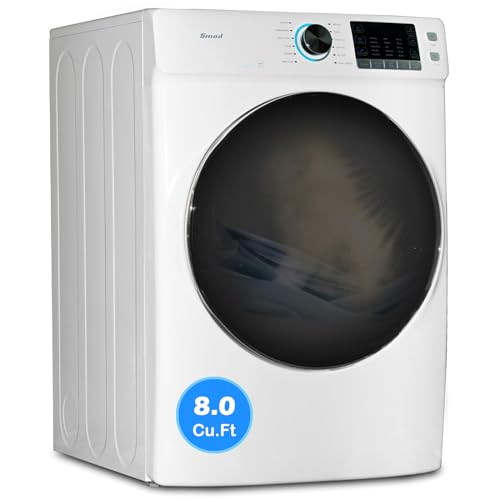
Smad 8.0 Cu. Ft. Full-Size Electric Dryer — The flexible-voltage value entry
Smad is the least familiar badge in this guide and its title makes the boldest electrical claim: an 8.0 cu. ft., 27-inch full-size electric dryer, stackable, rated “120V 240V.” That dual-voltage phrasing is unusual enough that this review’s main service is to tell you to verify it carefully on the product page and in the manual — because if a full-size dryer genuinely offers flexible voltage arrangements, it solves real installation problems in older homes, and if the phrasing means something narrower (a convertible connection, a regional variant), you need to know before the electrician arrives, not after.
Read on its confirmed merits, the Smad is a full-size value entry: a true 8.0 cu. ft. drum in the standard 27-inch width, front-load, stackable for laundry closets that go vertical, and pitched by its title at apartments, homes, RVs and laundry spaces generally. The RV mention alongside a 27-inch full-size cabinet is optimistic marketing — few RVs host a full-size dryer — and should be read as enthusiasm rather than specification. The home and apartment case needs no such discount: this is the pick for a buyer who wants the big drum’s capacity at the value end of the tier and is willing to do the verification homework a less-documented listing requires.
There is a buyer this machine serves particularly well, and naming them clarifies the pick: the landlord or property manager furnishing a rental’s laundry room, and the family building a second laundry station in a basement or garage apartment. For those buyers, capacity per purchase is the metric, brand theatre is a cost, and a stackable full-size drum at the value tier is the rational specification — provided the verification homework is done once, carefully, at purchase. The homework is the price of the tier; this guide’s position is simply that the price should be paid knowingly.
That homework list is short and specific: the electrical arrangement, the cycle list, the sensor question (the title names none), and the venting specification. A buyer who confirms those four on the page owns the same information the flagship listings print in their titles, and may well conclude the Smad’s drum-for-tier exchange is the right one for a rental property, a second laundry room, or a first big-dryer purchase on a disciplined budget. A buyer who cannot confirm them should walk up the list to the enumerated machines.
- Drum: 8.0 cu. ft., 27-inch full-size front-load electric dryer
- Form: stackable, per the listing title
- Electrical claim in the title: 120V 240V — verify the exact arrangement on the product page and in the manual before ordering
- Sensor system: not named in the listing title
- Cycle count: not given in the listing title
- Where to buy: the Smad 8.0 Cu. Ft. Full-Size Electric Dryer listing on Amazon — check price on Amazon
Strengths
- A true full-size 8.0 drum at the value end of the capacity class.
- Stackable form suits vertical laundry closets.
- The dual-voltage claim, if it verifies as hoped, eases difficult installations.
Trade-offs
- The listing requires more buyer verification than any other pick here.
- No sensor, cycle or certification information appears in the title.
- The title’s RV suggestion overreaches for a 27-inch full-size machine.
Best for: value-led buyers and second laundry rooms, willing to verify four facts on the page. A poor fit for: buyers who want the flagship paperwork printed in the headline, or genuine RV installations.

Midea 8.0 Cu. Ft. Gas Dryer with Sensor Dry — The big gas drum
Gas households shopping at this capacity have exactly two doors in this guide, and Midea’s is the one with Sensor Dry in the headline. The machine — model MLG45N1AWW — is an 8.0 cu. ft. front-load gas dryer described as the matching partner to Midea’s washer line, and the matching point is worth taking seriously at this size: a dryer bought to stand beside a specific washer inherits its dimensions, its door swing logic and its control language, and a matched pair at 8.0 cu. ft. is a laundry room that looks and behaves like one decision.
The title’s phrasing arrives slightly scrambled in the listing — the capacity appears twice in different positions — but the substance is clear: 8.0 cu. ft., gas, front load, Sensor Dry, white. Sensor drying on a gas drum this size carries the same structural argument as on the electrics: big gas loads are exactly the loads where timed drying wastes fuel on the dry shell while the core stays damp. Gas heat arrives fast, and a sensor is what keeps that speed honest, ending the cycle at dryness rather than at enthusiasm.
Matched pairs have one more practical dividend: a single delivery, a single installation visit, and a single set of connection positions planned once. In a guide that keeps returning to installation as the hidden half of every dryer purchase, a pair designed to be installed together is a real economy — of money, of scheduling, and of the household’s patience.
Everything else about this pick must be read on its page — cycles, wrinkle care, venting figures — and the gas installation rules from the wider catalogue apply in full: licensed connection, proper venting, clearances respected. What can be said from the listing is that this is the largest gas drum in the guide with sensing confirmed in its own headline, from a maker whose value-tier completeness has been a theme across these laundry guides. For a gas household that wants capacity and sensing without moving to the Kenmore’s steam story, this is the straightforward door.
- Drum: 8.0 cu. ft., front-load gas dryer, white
- Model: MLG45N1AWW, per the listing title
- Drying method named in the title: Sensor Dry
- Pairing note in the title: front-load matching (to the maker’s washer line)
- Cycle count and wrinkle programs: not stated in the listing title
- Where to buy: the Midea 8.0 Cu. Ft. Gas Dryer with Sensor Dry listing on Amazon — check price on Amazon
Strengths
- The largest gas capacity here with Sensor Dry confirmed in the title.
- A matched-pair design story for Midea washer owners.
- Gas running suits the frequent, heavy drying this capacity invites.
Trade-offs
- The title is the tersest of the gas pair — most details live on the page.
- No steam or wrinkle program is named for refresh-heavy households.
- Gas installation remains licensed, vented work, as with any gas dryer.
Best for: gas households, especially Midea washer owners, wanting maximum drum with sensing. A poor fit for: buyers who want a steam refresh programme named in the headline — that is the Kenmore below.
Kenmore 8.0 Cu. Ft. Gas Dryer — The gas mirror of the flagship
Kenmore built this guide’s bookends: the same 8.0 cu. ft. formula, the same Wrinkle Guard and Accela Steam pitch — wrinkles, static and odours — the same Smart Sensor Drying, here in a gas dryer with touch controls where the electric’s title led with its certification. The mirroring is genuinely useful to a shopper, because it isolates the fuel decision: if your laundry room has gas, this is the Kenmore flagship translated, feature for feature, and the comparison against the electric version becomes a question about your house rather than about the machines.
Steam in a gas dryer deserves its sentence, because households sometimes assume steam belongs to the electric flagships. It does not: the steam system is a water-side feature, independent of how the drum is heated, and its work — relaxing wrinkles, lifting odours from clothes that need refreshing rather than washing — is identical here. Combined with gas heat’s fast arrival and the sensor’s judgement, the package is the most complete gas specification in this guide, and the touch controls keep the panel in the wipe-clean modern pattern.
One question this machine raises for the whole guide is worth answering directly: does a gas flagship need its electric twin’s certification to be efficient in practice? Gas dryers are judged on different paperwork, and in daily use the running story of a gas drum this size — fast heat, sensored cycles, large loads dried once — is frugal in the way households actually experience: fewer cycles, less time, less reheating of loads that a smaller drum would have split. The certification’s absence from the title is a paperwork fact, not a performance verdict.
The title does not print a certification or a cycle count, and gas dryers carry the standing installation paragraph: licensed gas connection, vented run within the machine’s rating, clearances as the manual specifies. None of that distinguishes this machine from its gas sibling; what distinguishes it is completeness. A gas household that wants the flagship experience without translating between brands’ vocabularies will find this the shortest path: same badges, same programmes, different fuel.
- Drum: 8.0 cu. ft., front-load gas dryer, white
- Drying method as named in the title: Smart Sensor Drying
- Garment care named in the title: Wrinkle Guard and Accela Steam, for wrinkles, static and odours
- Controls: touch controls, per the listing title
- Certification: not stated in the listing title
- Where to buy: the Kenmore 8.0 Cu. Ft. Gas Dryer listing on Amazon — check price on Amazon
Strengths
- The flagship Kenmore formula — sensor, steam, wrinkle guard — in gas form.
- Steam refresh serves large households’ between-wash wardrobe needs.
- Touch controls keep a feature-rich panel simple to live with.
Trade-offs
- No certification is printed in the title, unlike its electric mirror.
- Gas installation is professional work with a vent run to plan.
- Cycle enumeration waits for the product page.
Best for: gas households wanting the complete flagship feature set without changing brands. A poor fit for: electric homes, obviously — and for gas buyers who want the specification enumerated in the headline.
Capacity in Context: What 8.0 Cubic Feet Swallows
| Dryer | Fuel & drum | Headline systems | Deciding detail |
|---|---|---|---|
| Kenmore 8.0 Electric | Electric, 8.0 cu. ft. | Smart Sensor, Accela Steam, Wrinkle Guard, ENERGY STAR | Certification printed in the title |
| BLACK+DECKER 8.0 Electric | Electric 240V, 8.0 cu. ft. | Steam, 12 cycles, LED display, ENERGY STAR | Professional installation declared up front |
| GE 7.8 Smart Electric | Electric, 7.8 cu. ft. | Steam, Sanitize cycle, smart | The hygiene programme of the set |
| Smad 8.0 Electric | Electric, 8.0 cu. ft., 27-inch | Stackable; dual-voltage claim | Verify the electrical story on the page |
| Midea 8.0 Gas | Gas, 8.0 cu. ft. | Sensor Dry | Matched-pair partner for Midea washers |
| Kenmore 8.0 Gas | Gas, 8.0 cu. ft. | Smart Sensor, Accela Steam, Wrinkle Guard | The flagship formula in gas form |
How Much Dryer Does Your Household’s Biggest Load Really Need?
Do the comforter test first, because it is the load that separates this class from the standard 7.0s. A king comforter in a standard drum dries in folds — the outside roasts, the inside steams itself — and comes out needing a second cycle and a shake. In an 8.0 drum it tumbles as a single moving mass, air reaches its middle, and one sensored cycle finishes it. If your household washes bedding monthly or better, that single load justifies the class. If your bedding goes to a cleaner and your loads are ordinary clothes, a standard drum will serve you as well and run cheaper — capacity is only a virtue when it is used.
Then count the towel economy. Bath towels are the densest common load, and they are where big drums quietly save the most time: a house that generates a dozen bath towels, hand towels and washcloths between laundry days dries them in one high-capacity load instead of two standard ones, every week, forever. Sports households should count kits the same way. The pattern to notice is that high capacity is rarely about one heroic item; it is about the weekly volume of dense, ordinary things, and the households that benefit most are the ones whose laundry problem is throughput. The same fit-the-user arithmetic governs the seating in our Best Reclining Adirondack Chairs guide — specification follows the actual body and the actual habit, not the showroom’s idea of either — and a dryer is no different.
Finally, match the washer. A high-capacity dryer fed by a much smaller washer runs half-empty by design, which wastes its running costs and its point. The natural pairings are the large washers of the same class — drums in the 5 cu. ft. neighbourhood — and households upgrading one machine should plan the pair’s timeline honestly: dryer first is fine, but the capacity dividend arrives when both sides of the laundry room are speaking the same volume.
How Do You Dry Very Large Loads Evenly?
Technique matters more as drums grow, because a big drum invites the two errors that defeat drying: packing and mixing. Packing first — an 8.0 drum should be loaded to a generous but genuinely loose fill, with air space for the load to lift and fall; a load pressed in by optimism dries at its surface and steams at its centre, and no sensor fully rescues it, because the sensor reads what tumbles past it. When in doubt, the shake test decides: if you cannot shake the load apart easily at loading, it is two loads wearing a trench coat.
Mixing is the subtler error. A load that combines bath towels with pillowcases and a fleece dries at three speeds, and the cycle — sensored or timed — must choose a master. Sorted by weight, each load dries evenly and predictably; mixed, the light items over-dry while the towels finish. The steam-equipped machines offer a partial pardon for mixed loads at the refresh stage, and the sanitize cycle on the GE exists for the loads whose mixing is the point — the family wash that must come out hygienic rather than merely dry. But the weekly discipline is sorting, and at this capacity sorting is quick, because each sorted load is big enough to be worth the machine’s time.
Households with a baby run a variation of this discipline that deserves its own note: the loads are small but constant, and they interleave with the household’s big loads rather than replacing them. The workable pattern is a standing small-load rhythm — the day’s baby clothes and cloth items through a short sensored cycle — while the drum’s capacity is spent where it belongs, on the bedding and towels the baby also generates in surprising volume. Families in that season are usually re-equipping the whole house at once, reading this guide in the morning and our roundup of Best Glider Chairs for Babies and Nurseries in the afternoon; the laundry advice that serves them is to let the big drum do big work and resist filling it with handfuls.
Between loads, give the machine its ten seconds: lint filter, every time, without exception — a big drum moves a lot of air, and its filter loads accordingly. Monthly, wipe the sensor strips as the manual directs, because a film-coated sensor under-reads moisture and stretches cycles. The households that keep those two habits find that a high-capacity dryer’s performance in year five resembles its performance in week one, which is the entire investment case for buying at this tier.
One more ownership rhythm belongs in this section: the seasonal deep load. Twice a year, most large households wash everything — the stored blankets before winter, the guest bedding after the holidays, the curtains nobody admits to neglecting. A high-capacity dryer turns that project from a weekend of split loads into a single day’s pipeline, and owners consistently name the seasonal project, not the weekly wash, as the moment the machine justified itself. Plan the purchase before the season if you can; the drum will be waiting, and so will the blankets.
What Does Owning a Dryer This Size Cost You in Attention?
Less than folklore says, provided two systems are respected: the air path and the moisture path. The air path is the vent — a big dryer moves a large volume of hot air, and its vent run must be sized, routed and cleaned with the seriousness that volume deserves; a flagship dryer on a neglected vent performs like a budget dryer and ages like an old one. The moisture path is the sensor’s world: keep the sensor strips clean, keep the filter immaculate, and the machine’s judgement stays calibrated. Neither duty is weekly work beyond the filter; both are the difference between a dryer that holds its performance and one that drifts.
There is also a space cost that deserves naming, because it is paid daily: a full-size pair at this capacity turns a laundry room into a single-purpose room. Households with the space to spare never notice. Households converting a small utility room should walk the room with the machines’ dimensions taped on the floor before ordering — the door must close, the baskets must live somewhere, and a person must be able to stand in front of an open dryer door with a load in their arms. Capacity bought at the price of a room nobody can move in is capacity misspent, and the tape-on-the-floor hour is the cheapest consultation in the whole purchase.
What Does Steam Actually Do in a Dryer This Size?
Steam in a dryer is widely misunderstood as a cleaning claim, so let the record be plain: dryer steam does not wash anything. What it does is relax. A steam programme introduces moisture and heat to a dry or nearly-dry load so fibres loosen — wrinkles release, odours lift, and a garment that needed refreshing rather than laundering comes back to wearable without a wash cycle’s water, time and wear. In a large household, that refresh load is a real category of laundry: the school uniforms on Thursday, the work shirts before a trip, the table linen before guests. Three of the six machines here carry steam in their titles, and in big households it is used more than several of the wash programmes on the matching washer.
Steam also rescues the forgotten load more completely than tumbling alone: a load that sat overnight in the drum can be steam-refreshed into presentability instead of rewashed, which over a year of family laundry is a meaningful saving of water, energy and clothing life. Its limits are equally plain — steam does not remove soil, it does not sanitize (that is the GE’s separate, hotter programme), and it does not forgive a load packed so tightly that the steam cannot circulate. Used for what it is, it is the feature large households miss most when a later machine lacks it.
Which High-Capacity Mistakes Turn a Flagship Into a Liability?
The first is buying capacity for a household that does not generate it — the couple in the condo with an 8.0 drum heating air — because the machine’s costs are sized to its drum while its benefits are sized to its loads. The second is neglecting the installation homework: full-size electric dryers need their proper circuit and, on the BLACK+DECKER’s own printed instruction, professional installation; gas models need licensed connection and a vent run within rating. A flagship installed casually is a liability with a warranty.
The third mistake is skipping the verification step on the terser listings. The Smad’s voltage claim and the Midea’s cycle list are page questions, and a buyer who orders on the title alone has volunteered for surprises. The fourth is forgetting the room: an 8.0-class cabinet with its door swing needs a laundry room measured in three dimensions, including the path from the street. And the fifth is treating sensor care as optional — the filmed sensor and the clogged filter are how big dryers quietly become slow dryers, blamed on age when the cause was housekeeping.
A closing note on timing, because large households often buy a dryer in a crisis — the old one dies mid-winter with a full roster of loads behind it. Crisis buying is exactly when the verification and measurement steps in this guide get skipped, and exactly when they matter most: a flagship delivered to a room it cannot enter, or wired for a circuit the panel cannot supply, converts a two-day problem into a two-week one. The hour with the tape measure and the product page is not a delay in solving the crisis; it is the difference between solving it once and solving it twice.
Final Recommendation
Let fuel speak first, then character. Electric households choosing the complete, certified flagship take the Kenmore 8.0; those who want the specification enumerated take the BLACK+DECKER; those with hygiene-critical loads take the GE and its sanitize cycle; and value-led buyers willing to verify a listing take the Smad. Gas households split between the Midea’s sensor-led simplicity at full capacity and the Kenmore gas model’s complete steam-and-sensor formula. Whichever door you choose, the purchase succeeds the same way: a drum matched to real loads, installed professionally, and kept with two small habits. Buy the capacity your biggest ordinary week actually needs, and an 8.0 cu. ft. dryer stops being an indulgence and becomes the machine that gives a large household its Sundays back.
Frequently Asked Questions
Will an 8.0 cu. ft. dryer fit through my doors and into my laundry room?
Measure both, in that order: the path (doorways, turns, stairs) and the room (cabinet footprint, door swing, vent and connection space behind). Full-size machines in this class are built around the standard 27-inch width — the Smad’s title states it explicitly — but depth with connections and swing is where installations fail. The delivery team’s tape measure is not a substitute for yours, taken before ordering.
Is the difference between 7.8 and 8.0 cu. ft. worth worrying about?
No. In real loads it amounts to a hand towel or two, far below the difference made by load discipline, sorting and sensor care. Choose between the GE at 7.8 and the 8.0 machines on programmes — sanitize, steam, certification, fuel — and on your laundry room, and let the decimal go.
Do I need a special circuit for a dryer this size?
A full-size electric dryer runs on a heavy circuit — the BLACK+DECKER states 240V and professional installation in its title — and your home’s panel and wiring must match the machine’s requirements, confirmed by the installer. The Smad’s dual-voltage phrasing is the exception that proves the rule: verify exactly what it means for the specific unit before assuming it relaxes the requirement. Gas models, by contrast, run their motors and controls on ordinary household current alongside the gas connection.
Why does every big dryer in this guide talk about sensors?
Because scale changes the sensing problem. In a standard drum a timed cycle’s guess is usually close; in an 8.0 drum loaded with towels, the surface of the load and its core can be in different states entirely, and only a sensor reading the clothes themselves ends the cycle at true dryness. Sensing is what makes the capacity usable rather than merely large — which is why it is named in title after title here.
How long do dryers of this class usually serve?
Full-size dryers are among the home’s longer-lived appliances, and the flagship tier’s case rests on exactly that horizon: a decade or more of service over which the installation cost, the capacity dividend and the sensor’s savings all compound. Longevity in practice tracks the unglamorous variables this guide keeps naming — vent condition, filter discipline, sensor care — far more than it tracks the badge on the door.
Gas or electric at this size — which should a large household choose?
Choose the fuel your house already speaks. A laundry room with a gas line and a modest electrical panel points to the gas pair here; a room wired for a full-size electric dryer points the other way. Where both genuinely exist, households that dry constantly tend to favour gas running costs, while households planning an all-electric future should buy for that future. The drying experience at this tier — sensing, steam, capacity — is available on both sides of the line, as the two Kenmores demonstrate.
Can a high-capacity dryer handle delicate loads too?
Yes, with the right cycle and honest loading — a big drum is gentle on a small delicate load in the mechanical sense, since the clothes have room to move without abrasion, though it is an expensive way to dry three blouses. Households often batch delicates into one weekly load for exactly that reason. Check the chosen model’s cycle list on its page for the delicate and low-heat programmes your wardrobe needs.
And when the seasonal project and the weekly rhythm are both counted, most households discover their true load profile is lumpier than they believed — quiet weeks and mountain weeks alternating. A high-capacity drum is, among other things, insurance against the mountain weeks: it absorbs the surge without turning laundry into the household’s second job, and in the quiet weeks its sensor keeps the smaller loads honest. Sized for the surge and disciplined in the lull is the complete operating philosophy of this class.
Can an 8.0 cu. ft. dryer really dry a king-size comforter in one pass?
Capacity is the entry ticket, not the whole story. A king comforter needs room to tumble and unfold; in a 7.0 cu. ft. drum it often stays balled, so the middle finishes damp even when the surface feels dry. The 8.0 cu. ft. models in this guide — the Kenmore and BLACK+DECKER electric units and the Midea and Kenmore gas units — give the load space to open up, and sensor cycles matter as much as volume because they keep the run going until the thickest part of the fill dries instead of stopping on a timer. Load the comforter on its own, pause once midway to shake it out and turn it, and the big drum does the rest; two pillows or a sheet set can ride along only if they still leave the comforter free to move.
Related Guides
Capacity is one answer to a large household’s laundry; the household itself is the other half of the question. For the family-scale view — loads, rhythms and the machines that serve many people at once — continue to Best Dryers for Large Families.


