What's inside
- Where to Buy Clothes Dryers Without Mixing Up Two Different Species of Machine
- Key Takeaways
- Quick Picks
- How Did We Sort Six Dryers Into Two Honest Classes?
- Side by Side: Class, Capacity and Power Across All Six
- How Much Laundry Does Each Class Actually Swallow in a Week?
- What Should You Check About Venting and Power Before Any Dryer Arrives?
- Why Does the Washer’s Spin Matter More Than the Dryer’s Wattage?
- Which Dryer Class Suits Renters, and Which Suits Homeowners?
- How Does Climate Change Which Dryer Belongs in Your Home?
- How Should You Maintain a Dryer So Its Tenth Year Dries Like Its First?
- What Does a Dryer Cost You After the Purchase, in Time and Attention?
- How Do You Decide Between Two Dryers in the Same Class?
- What Mistakes Do Dryer Buyers in This Category Keep Making?
- Final Recommendation
- Frequently Asked Questions
- Related Guides
As an Amazon Associate I earn from qualifying purchases. This post may contain affiliate links at no extra cost to you.
cottageverdict.com is reader-supported. When you buy through links on our site, we may earn an affiliate commission.
Where to Buy Clothes Dryers Without Mixing Up Two Different Species of Machine
The best clothes dryers in a modern home come in two species that happen to share a name. One is the full-size laundry-room machine: a wide cabinet with a seven-cubic-foot drum, a 240-volt appetite and a vent run to the outside wall. The other is the portable: a compact box that plugs into an ordinary outlet, dries a few pounds at a time and earns its keep in apartments, RVs and spare corners. This guide deliberately reviews both — two full-size machines and four portables — and it labels the class of every pick in plain language, because the single most expensive mistake in this category is comparing a portable as though it were a small full-size dryer. It is not. It is a different tool for a different household.
Read the class label before the feature list. A family washing bedding for five needs the drum volume and vented airflow of the full-size pair at the top of this guide. A renter in a studio, a couple in a caravan, a household adding a second dryer beside a basement sink — those readers should start at the portables and judge them against each other, not against machines twice their size. Readers whose homes run on bottled gas rather than a natural-gas line will also want our companion guide to Best Propane Dryers, which explains honestly how gas dryers and LP conversion kits actually work.
Every linked pick below is sold through Amazon, and the linked name on each pick leads to its listing, where you can check price on Amazon and confirm dimensions, voltage and venting against your own space. This guide prints no prices, because the correct dryer is the one whose class, fuel and footprint fit your home; that fit does not change with a promotion. Specifications quoted in the spec boxes come only from each listing’s own title, and where a title is silent — about a cycle, a sensor, a dimension — the review says so instead of decorating the machine with borrowed features.
Key Takeaways
- Two picks are full-size 7.0 cu. ft. electric dryers; four are portable or compact machines, and each review states its class before its features.
- The two full-size Kenmore and BLACK+DECKER models both name sensor drying in their titles; among the portables, only the full-size pair makes that claim.
- Three portables run on ordinary household voltage — 120V appears in the BCED26, Euhomy and MOJOCO listings’ class — while the full-size BLACK+DECKER specifies 240V.
- Stainless steel drums appear in the TABU, BCED26 portable listings, a durability point worth weighing in small machines that work hard.
- Load size is the honest divider: 8.8 lb is the only pound capacity stated in this set, on the BCED26, and it defines portable expectations.
Quick Picks
| Pick | Badge | Why it stands out |
|---|---|---|
| Kenmore 7.0 Front Load Electric Dryer White | Full-Size Sensor Benchmark | A 7.0 cu. ft. electric dryer whose title names Wrinkle Guard, Smart Sensor Drying and touch controls. |
| BLACK+DECKER 7.0 Front Load Dryer BLD67ME | Dial-and-Display Full Size | Seven cubic feet at 240V with an LED display, a dial, and five sensor and manual dry selections. |
| TABU 3.5 Portable Clothes Dryer | Largest Portable in the Set | A 3.5 cu. ft. front-loading portable with four drying modes and a stainless steel drum. |
| BLACK+DECKER 2.65 Portable Dryer BCED26 | Wall-Outlet Portable | 2.65 cu. ft. and 8.8 lb capacity, 1400W on a standard 120V outlet, vented, with a stainless drum. |
| MOJOCO Portable Clothes Dryer 600W | Travel-Weight Mini | A 600W compact dryer with an adjustable timer, pitched at apartments, RVs and travel. |
| Euhomy 3.5 Clothes Dryer 120V | LCD Portable With Exhaust Pipe | 3.5 cu. ft. at 120V and 1500W, four functions, an LCD panel and an exhaust pipe in the box. |
How Did We Sort Six Dryers Into Two Honest Classes?
We began with the listing titles and nothing else. A pick earned its class from the words its own seller chose: front load electric dryer at 7.0 cubic feet reads as full-size; portable clothes dryer at 2.65 or 3.5 cubic feet, especially with a pound capacity or a 120V plug in the title, reads as portable. Where a title named a feature — Smart Sensor Drying on the Kenmore, five sensor and manual selections on the big BLACK+DECKER — the review discusses that feature. Where a title named nothing of the sort, the review does not invent it, which is why the portables below are praised for drums, modes and wattage rather than for sensors their listings never mention.
The second filter was household truth. Each pick had to answer a real laundry situation better than its neighbours: family volume, rental restrictions, travel, a second-dryer corner, a dorm-adjacent first home. Machines that duplicated a neighbour’s answer without adding a distinction were dropped. What survives is a ladder — climb it by class first, then by the details inside the class. Households washing for children in cloth nappies, incidentally, should hold the thought that drying is only half of that particular laundry marathon; the washing half returns later in this guide, where spin and load discipline are discussed.
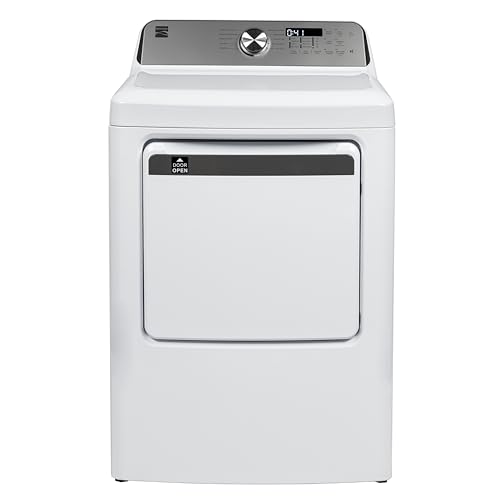
Kenmore 7.0 Front Load Electric Dryer White — Full-Size Sensor Benchmark
Class first, as promised: this Kenmore is a full-size machine, a 7.0-cubic-foot front-load electric dryer in white, built for a proper laundry space with a vent run and a matching washer beside it. Its title is unusually informative for the category. It names Wrinkle Guard, described as reducing wrinkles and static; it names Smart Sensor Drying, which is the machine’s claim to ending cycles when the load is dry rather than when a timer guesses; and it names touch controls, which place the interface on a flat panel rather than behind a rotary dial.
Sensor drying matters most in mixed loads. A drum holding towels beside synthetics defeats any fixed timer: the towels need another ten minutes when the shirts are already dry, and a timer splits the difference by overcooking one and undercooking the other. A sensor system reads the load’s moisture and keeps the cycle honest, which protects elastic, prints and the general dignity of clothes that would otherwise emerge baked. Wrinkle Guard answers the other everyday failure — the load that finishes at noon and sits until six, setting its creases like concrete. A dryer that periodically tumbles after the heat ends keeps that load recoverable.
Seven cubic feet is the mainstream family size, the volume that swallows a full washer load including a week’s towels or a set of bed linen without packing the drum so tightly that air cannot move. Front loading pairs naturally with a front-load washer, stacks where the laundry space is a closet rather than a room, and presents the familiar ergonomics most households already know. Kenmore’s long presence in American laundry rooms also means the model sits in a mature ecosystem of installers, documentation and service familiarity.
Choose this Kenmore if your household dries full washer loads daily and your frustrations are the classic pair: loads dried unevenly by timers, and loads wrinkled by neglect after the buzzer. Its title promises exactly the two systems aimed at those frustrations, which is a more relevant promise than a longer cycle list.
Ownership details reward a closer look. Touch controls on a dryer live a harder life than touch controls on a phone: they meet wet hands, detergent film and the occasional elbow, and a flat panel wipes clean in a way a dial cluster never quite does. The white finish, meanwhile, is the laundry room’s camouflage — it shows lint honestly, forgives the scuffs of baskets dragged past, and matches the majority of washers already installed in American homes, which matters when the pair was bought years apart. Kenmore’s distribution through mainstream channels also means delivery, haul-away and installation conversations tend to be routine rather than exotic, a real consideration for a machine that weighs as much as an adult and must travel through hallways and door frames to reach its working position.
Think, too, about who in the household actually dries. A sensor-led machine lowers the skill floor for everyone: teenagers, guests and the laundry-averse partner all get acceptable results from the default cycle, because the machine rather than the user judges doneness. That quiet redistribution of competence is worth more across a year than any exotic cycle, and it is the deepest reason sensor systems have become the full-size class’s centre of gravity.
- Class: full-size front-load electric dryer
- Capacity, from the listing title: 7.0 cu. ft.
- Drying system, from the listing title: Smart Sensor Drying
- After-cycle care, from the listing title: Wrinkle Guard, to reduce wrinkles and static
- Controls, from the listing title: touch controls
- Where to buy: the Kenmore 7.0 Front Load Electric Dryer listing on Amazon — check price on Amazon
Strengths
- Sensor drying named outright, aimed at mixed loads that defeat timers.
- Wrinkle Guard addresses the finished-load-left-sitting problem directly.
- Full 7.0 cu. ft. drum takes complete family washer loads.
Trade-offs
- Full-size footprint and venting needs exclude most apartments and RVs.
- Touch panels divide households that prefer a physical dial.
- Electric running costs depend entirely on your local tariff.
Best for: families with a dedicated laundry space who want sensor honesty and wrinkle rescue in one mainstream machine. Not suited for: renters, small-space households or anyone without a vent path.

BLACK+DECKER 7.0 Front Load Dryer BLD67ME — Dial-and-Display Full Size
The second full-size pick is also a 7.0-cubic-foot front-load electric dryer, and its title tells a different story about control. The BLD67ME specifies 240V — the heavy circuit a full-size electric dryer expects — and pairs an LED display with a dial control. That pairing is the machine’s personality: the dial gives the satisfying, glove-friendly, turn-and-go selection that many households prefer, while the display reports what the dial chose. Its title also names five sensor and manual dry selections, a phrase worth parsing: sensor selections let the machine judge dryness, manual selections let the human overrule it, and a good dryer offers both because some loads — a single damp hoodie, a rug — lie to sensors.
BLACK+DECKER’s presence in laundry is newer than its presence in workshops, and the brand approaches the category with a toolmaker’s bluntness: capacity, voltage, model number, control type, selection count, all in the title, no poetry. For buyers who comparison-shop on specifications, that bluntness is a gift. The BLD67ME designation also matters practically; a precise model number makes ordering the right vent kit, stacking kit or replacement belt a one-search task years from now.
Against the Kenmore above, the honest distinction is interface and emphasis. The Kenmore leads with wrinkle care and touch controls; this machine leads with its dial, its display and the explicit coexistence of sensor and manual drying. Households with members who distrust touch panels — arthritic hands, wet hands, work gloves — will feel the difference daily. Households that want the dryer to manage wrinkles after the cycle should weigh the Kenmore’s named Wrinkle Guard more heavily.
As a full-size electric, it asks the standard questions before purchase: a 240V dryer circuit, a vent route, and floor space for a 7.0-cubic-foot cabinet. Answer those three and it is a straightforward, specification-forward family dryer.
The manual half of its selection set deserves more respect than it usually gets. Sensor systems judge moisture brilliantly in ordinary mixed loads, but laundry life includes oddities: a single heavy bath mat, a costume that must be warmed rather than dried, a load of nearly dry clothes needing ten warm minutes to release a musty storage smell. Timed, manual drying handles all three without argument. A dryer offering both philosophies — the machine decides, or you decide — covers the full oddity range of a household’s year, and the BLD67ME’s title is one of the few in this category that bothers to say so.
There is also a longevity argument for the dial itself. Rotary controls survive decades of indifferent handling, work through power flickers without menu resets, and can be operated by feel in a dark utility room. Paired with a display that confirms time remaining, the arrangement gives feedback without fragility. Households burned by a previous machine’s failed touch board will read this specification with particular warmth.
- Class: full-size front-load electric dryer
- Capacity, from the listing title: 7.0 cu. ft., model BLD67ME
- Power, from the listing title: 240V
- Selections, from the listing title: 5 sensor and manual dry selections
- Controls, from the listing title: LED display and dial control
- Where to buy: the BLACK+DECKER 7.0 Front Load Dryer BLD67ME listing on Amazon — check price on Amazon
Strengths
- Dial plus display suits hands that dislike touch panels.
- Sensor and manual selections coexist, each covering the other’s blind spots.
- Precise model identity simplifies future parts and accessory orders.
Trade-offs
- No wrinkle-care system is named in its title, unlike the Kenmore.
- 240V installation rules it out for standard-outlet spaces.
- White-only presentation in this listing limits finish matching.
Best for: full-size households that want a physical dial, a clear display and both sensor and manual drying on the record. A poor fit for: anyone shopping for a plug-anywhere portable or a wrinkle-guard feature set.

TABU 3.5 Portable Clothes Dryer — Largest Portable in the Set
Now the class changes, and the numbers must change with it. The TABU is a portable clothes dryer: 3.5 cubic feet, front-loading, described by its title as built for compact spaces in homes, apartments and RVs. Among this guide’s four portables it shares the largest drum figure, and its title adds two specifics worth weighing — four drying modes and a stainless steel drum. Four modes in a portable is a meaningful spread: small machines often offer a timer and a prayer, while a modal machine lets a user separate delicates from denim instead of cooking both at one temperature for one duration.
The stainless drum deserves its sentence. Portable dryers work close to their limits, tumbling near their capacity in small drums where fabric rubs the same surfaces thousands of times. Stainless resists the rust spots and rough patches that eventually snag knits in cheaper drum finishes, and it wipes clean when a forgotten crayon or a leaking pen announces itself. In a machine bought precisely because money and space are tight, drum durability is not a luxury detail; it is the difference between a three-year appliance and a seven-year one.
Judge the TABU as the head of the portable class, not as a shrunken family dryer. It will dry a modest load properly — a few days of clothes for one person, a couple’s light rotation, an RV’s weekly accumulation — and it will do so in spaces where no full-size machine can stand. It will not swallow a family wash day, and a household that tries will spend the afternoon running back-to-back cycles and resenting a machine that was honest about its size from the start.
Its energy-saving operation, named in the title, also fits the portable logic: smaller drums heating smaller loads use less energy per load, provided the user resists overfilling, which forces second cycles and erases the saving entirely.
Placement is where the TABU’s front-loading format earns quiet praise. A front loader can slide under a counter, sit beneath a shelf of folded laundry, or stack its working surface into the room’s vertical economy — all impossible for a top-opening small machine that needs clear air above its lid. In the RV context its title names, that vertical economy is the whole game: every surface must work twice. The four modes also map neatly onto travel laundry reality, where one day produces swimwear and synthetics and the next produces the denim and cotton that a trip accumulates. A modal machine meets both days on their own terms instead of averaging them into mediocrity.
Water discipline matters in this class too. Portable owners often dry in spaces without floor drains or laundry sinks, so a load that arrives well-spun protects floors and patience alike. Pair the TABU with the washer’s highest comfortable spin and its drum size becomes an ally; pair it with dripping loads and even 3.5 cubic feet will feel like a negotiation.
- Class: portable/compact clothes dryer, front-loading
- Capacity, from the listing title: 3.5 cu. ft.
- Modes, from the listing title: 4 drying modes
- Drum, from the listing title: stainless steel drum
- Intended spaces, from the listing title: homes, apartments and RVs
- Where to buy: the TABU 3.5 Portable Clothes Dryer listing on Amazon — check price on Amazon
Strengths
- Largest portable drum figure in this guide, shared with the Euhomy.
- Four modes give small loads real temperature and time choices.
- Stainless drum resists snags and rust in a hard-working small machine.
Trade-offs
- Half the Kenmore’s volume; family wash days become relay races.
- No sensor system is claimed in its listing title.
- Portable venting arrangements still need thought and a window or vent plan.
Best for: apartment and RV households wanting the roomiest portable drum here with a stainless interior. Not the right match for: families expecting full-size throughput from a compact cabinet.
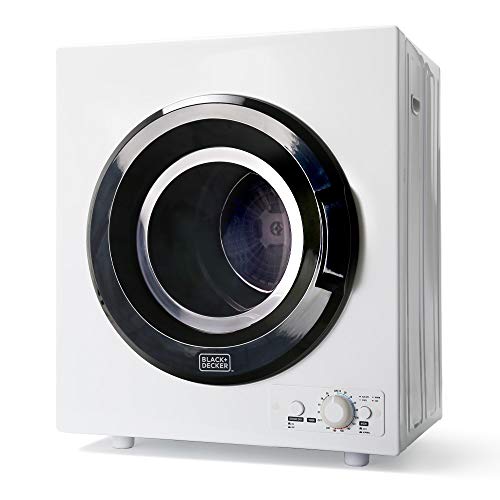
BLACK+DECKER 2.65 Portable Dryer BCED26 — Wall-Outlet Portable
The BCED26 is the portable whose title does the most honest arithmetic in this guide. It states 2.65 cubic feet, then translates that abstraction into 8.8 lb of capacity — the load figure a buyer can actually picture: roughly a small basket of everyday clothes. It states 1400W and 120V, which together announce the machine’s defining convenience: it runs from a standard wall outlet, the listing says so outright, with no electrician and no special circuit. It states vented, and stainless steel drum. Four facts, and a renter can decide from them alone.
That 120V operation shapes everything about ownership. A vented 120V portable can live in a rental where modifications are forbidden, dry in a spare bedroom or a large bathroom, and move house in the back of a car when the lease ends. The trade is time: 1400 watts moves less heat than a 240V element, so loads dry more slowly, and the discipline of smaller, well-spun loads matters. Feed it laundry that the washer has spun thoroughly and it performs cheerfully; feed it dripping, overloaded bundles and it will spend the evening proving thermodynamics.
Within the portable class, the BCED26 sits below the two 3.5-cubic-foot machines in volume and above the MOJOCO in structure — a true tumble dryer with a stainless drum rather than a minimal travel unit. For a single person, a couple with a light rotation, or a household drying baby clothes and gym kit between main washes, that middle position is often the sweet spot: real tumbling, real venting, no installation.
The model number, BCED26, is again worth having verbatim for filters and parts. Portable dryers ask for lint diligence more than any other laundry appliance, and owning the exact designation keeps that diligence simple.
Consider the households this machine quietly serves best. The nurse on rotating shifts whose laundry happens at midnight in a rented flat. The grandparent in a garden apartment who has carried baskets to a shared laundry room for the last time. The new parent in a one-bedroom where the baby’s laundry is daily but tiny. None of them needs seven cubic feet; all of them need drying that happens at home, on an ordinary socket, without negotiation with a landlord. The BCED26’s specification reads as though it were written from their list of constraints, which is the highest compliment a portable can earn.
Its vented design also deserves a plain explanation for first-time portable buyers. Venting carries moisture and lint out of the room through a hose, typically to a window kit. That is more effective than dumping humid air into the living space, and it is why this class of machine, despite its modest wattage, leaves clothes genuinely dry rather than merely warm and less wet.
- Class: portable electric dryer, vented
- Capacity, from the listing title: 2.65 cu. ft., 8.8 lb
- Power, from the listing title: 1400W, 120V, standard wall outlet
- Drum, from the listing title: stainless steel drum
- Model, from the listing title: BCED26
- Where to buy: the BLACK+DECKER 2.65 Portable Dryer BCED26 listing on Amazon — check price on Amazon
Strengths
- Runs on an ordinary outlet; the renter’s installation problem disappears.
- Pound capacity stated plainly, so expectations start honest.
- Stainless drum and true vented tumbling at a genuinely portable size.
Trade-offs
- 8.8 lb loads mean more cycles for couples with heavy laundry habits.
- 120V drying is slower than any 240V machine’s.
- Vented operation still needs a sensible exhaust arrangement indoors.
Best for: renters and single households who need real tumble drying from a normal socket. Poorly suited to: bedding-heavy households or anyone drying for three or more people daily.

MOJOCO Portable Clothes Dryer 600W — Travel-Weight Mini
At the far end of the portable spectrum sits the MOJOCO, and its title is a study in modest, accurate ambition: a 600W compact dryer for apartment and travel, a mini dryer for apartment, RV and travel, with an adjustable timer and hassle-free setup. Note what 600 watts means. This is not a machine for drying a week’s laundry; it is a machine for drying small things promptly — underwear and socks on a trip, a baby’s daily rotation, gym clothes in a dorm-adjacent room, the single shirt needed tomorrow — without a laundromat journey or a radiator draped in damp cotton.
Its title even uses the words small, quiet and fast-drying, and the honest reading of that trio is scale-relative. A tiny load in a tiny drum dries fast because there is barely anything to dry. Quiet follows from a small motor moving a small load. Buyers who understand that bargain tend to love machines like this; buyers who expect it to behave like the TABU above end up writing the angry reviews that warn everyone else. The adjustable timer is the control that matters here — small loads vary enormously, and a timer the user sets by judgement suits a machine whose loads are counted in items rather than pounds.
Consider the MOJOCO as a specialist instrument. In a motorhome crossing states, in a studio where a full portable would crowd the kitchen, in a nursery corner handling a daily trickle of small laundry, it occupies almost no space, asks almost nothing in setup, and solves the specific misery of small damp things with nowhere to go. It is also the natural second dryer for households whose main machine is far away — a basement unit, a shared laundry room — and whose daily reality is a handful of items at a time.
No drum material or capacity figure appears in its title, and this review invents neither. What the title promises is compactness, low wattage, timer control and easy setup, and on those four promises the machine should be judged.
There is a travel ritual this machine understands. Hotel sinks wash the day’s smalls; hotel radiators, where they exist, dry them slowly and unevenly; hotel air conditioning mostly teaches patience. A 600W mini dryer collapses that ritual into an hour of unattended tumbling, and for travellers packing light — the carry-on-only tribe who wash as they go — that collapse is the difference between a five-garment wardrobe that works and one that smells of the road. The same logic serves hospital stays, seasonal work accommodation and any temporary housing where laundry access is shared, distant or priced by the load.
Set expectations by garment, not by load. Shirts, smalls, socks, swimwear, a child’s outfit: these are its native cargo. A pair of jeans is a project; a towel is an imposition. Buyers who sort their expectations as carefully as their laundry will find the little machine almost smug in its competence.
- Class: mini portable dryer for apartment, RV and travel use
- Power, from the listing title: 600W
- Control, from the listing title: adjustable timer
- Setup, from the listing title: hassle-free setup
- Character, from the listing title: small, quiet, fast-drying for small loads
- Where to buy: the MOJOCO Portable Clothes Dryer listing on Amazon — check price on Amazon
Strengths
- Smallest commitment in space, wattage and setup in this guide.
- Timer control suits item-count loads that vary daily.
- Genuinely travel-shaped: RVs, dorms and studios can all house it.
Trade-offs
- 600W confines it to small loads; jeans and towels overwhelm it.
- No capacity or drum specification is offered in its title.
- It supplements a laundry system rather than replacing one.
Best for: travellers, dorm and studio dwellers, and households drying a daily trickle of small items. A weak match for: anyone whose typical load includes bedding, denim or bath towels in quantity.
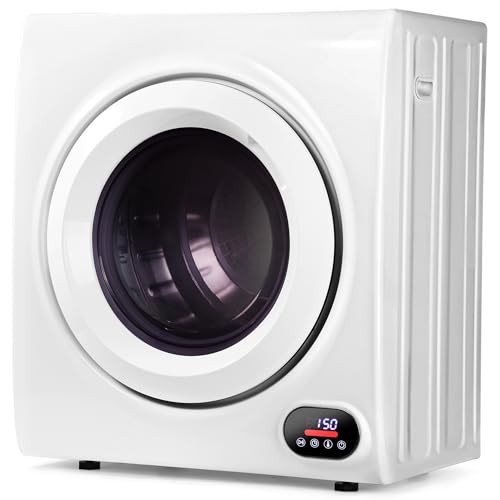
Euhomy 3.5 Clothes Dryer 120V — LCD Portable With Exhaust Pipe
The Euhomy closes the portable class with the most complete small-machine specification in the guide. Its title states 3.5 cubic feet — the joint-largest portable drum here — on 120V power at 1500W, with four functions, an LCD control panel, front loading, and an exhaust pipe included. Read that list slowly, because each item removes a known portable-dryer friction. The 120V plug removes the electrician. The 1500W element, the strongest wattage among these portables, shortens the 120V drying penalty. The LCD panel replaces guesswork knobs with a readable interface. And the included exhaust pipe removes the accessory hunt that delays so many portable installations by a week.
Against the TABU, its same-size rival, the distinctions are interface and equipment. The TABU names a stainless drum and four drying modes; the Euhomy names an LCD panel, four functions and the exhaust pipe, while its title does not specify drum material. A buyer choosing between them is really choosing which certainty matters more: the drum’s long-term surface, or the controls and the ready-to-vent box contents. Neither answer is wrong; they suit different anxieties.
In use, a 3.5-cubic-foot 120V dryer serves apartments, small homes and RVs as a genuine primary dryer for one or two people, provided loads are spun well and not packed. The front-load format stacks and tucks more neatly than top-opening small machines, and the LCD’s presence signals a machine designed to be lived with daily rather than tolerated occasionally. Euhomy’s broader small-appliance catalogue — the brand is a familiar name in compact refrigeration — suggests a support ecosystem accustomed to exactly this size class.
One caution belongs to every 120V dryer and applies here with the strongest element in the class: give it a proper outlet, not a tired power strip, and keep the exhaust path short and straight so the machine’s wattage becomes dry clothes rather than warm room air.
The LCD panel changes the daily relationship with the machine in ways a specification list understates. A readable panel tells the user what the dryer thinks it is doing — which function, how far along, what remains — and that feedback loop teaches good loading habits within a fortnight. Knob-only portables leave their users guessing whether a load needs ten more minutes or thirty; the Euhomy’s display narrows that guesswork, and over a year of small loads the saved re-runs amount to real time and real electricity. Four functions, clearly labelled, beat twelve mysterious ones for the same reason: the machine gets used correctly by everyone in the household, including the person who never reads manuals.
For landlords furnishing small units, the included exhaust pipe is a similarly practical mercy. A portable dryer supplied complete — machine, pipe, standard plug — can be installed by a caretaker in one visit, documented in the tenancy file, and replaced like-for-like years later without a redesign of the unit’s laundry corner.
- Class: portable/compact front-load dryer, 120V
- Capacity, from the listing title: 3.5 cu. ft.
- Power, from the listing title: 1500W, 120V
- Functions and controls, from the listing title: 4 functions, LCD control panel
- In the box, from the listing title: exhaust pipe included
- Where to buy: the Euhomy 3.5 Clothes Dryer listing on Amazon — check price on Amazon
Strengths
- Strongest portable wattage here, easing the usual 120V time penalty.
- Exhaust pipe included, so venting can start the day it arrives.
- LCD panel gives a small machine a grown-up interface.
Trade-offs
- Drum material is not stated in its title, unlike the TABU and BCED26.
- Still a portable: family volumes exceed its honest capacity.
- 1500W on 120V deserves a sound, dedicated-quality outlet.
Best for: apartment households wanting the most fully specified 120V portable in this set. A mismatch for: buyers who rank a named stainless drum above controls and included venting.
Side by Side: Class, Capacity and Power Across All Six
| Dryer | Class | Capacity | Power named in title | Signature point |
|---|---|---|---|---|
| Kenmore 7.0 Front Load Electric Dryer White | Full-size | 7.0 cu. ft. | Electric, full-size circuit | Smart Sensor Drying plus Wrinkle Guard |
| BLACK+DECKER 7.0 Front Load Dryer BLD67ME | Full-size | 7.0 cu. ft. | 240V | Dial and LED display, sensor and manual selections |
| TABU 3.5 Portable Clothes Dryer | Portable | 3.5 cu. ft. | Not stated in title | Stainless drum, four modes |
| BLACK+DECKER 2.65 Portable Dryer BCED26 | Portable | 2.65 cu. ft., 8.8 lb | 1400W, 120V | Standard-outlet vented drying |
| MOJOCO Portable Clothes Dryer 600W | Mini portable | Not stated in title | 600W | Timer control, travel format |
| Euhomy 3.5 Clothes Dryer 120V | Portable | 3.5 cu. ft. | 1500W, 120V | LCD panel, exhaust pipe included |
How Much Laundry Does Each Class Actually Swallow in a Week?
Translate cubic feet into behaviour. A 7.0-cubic-foot drum accepts the output of a standard family washer in one transfer: five days of clothes for two adults, or a full bedding change, or the towel accumulation of a sporty household. Owning that volume means laundry day stays a day — loads move washer to dryer in pairs, and the machines rest between. A 3.5-cubic-foot portable halves that rhythm: the same household washes smaller and oftener, drying becomes a background habit rather than a weekly event, and the household’s clothing rotation quietly shrinks to what the drum can service.
Bedding deserves its own arithmetic, because it is where class promises go to be tested. A duvet cover and two sheets fill a portable drum completely and dry unevenly unless turned halfway; in a 7.0-cubic-foot drum the same set tumbles freely and finishes in one honest cycle. Households that wash bedding weekly — allergy households, households with young children, anyone keeping a guest room in rotation — should let that single recurring load vote heavily in the class decision. Conversely, a household whose bedding goes to a laundry service, or whose climate allows line-drying most of the year, can safely let the portable class’s convenience outvote the drum.
Neither rhythm is superior; they suit different lives. The 2.65-cubic-foot BCED26 and the MOJOCO push the logic further, toward continuous small-load living — the pattern of singles, travellers and small-space couples everywhere, where laundry is a ten-minute daily ritual instead of a Saturday. Choose the class whose rhythm matches the life you actually lead, and remember that the washer feeding the dryer matters just as much: readers speccing a matched front-load pair should continue to our guide to Best Front-Load Washers With Steam for the washing half of that partnership.
What Should You Check About Venting and Power Before Any Dryer Arrives?
Full-size electric dryers want two things your home either has or has not: a 240V dryer circuit and a vent path to the outdoors. Confirm both before ordering, because a beautiful machine in a garage, waiting on an electrician’s diary, dries nothing. Measure the vent route as the crow flies and as the duct bends; every elbow slows airflow, stretches drying times and collects lint. Keep the run short, smooth-walled where possible, and accessible enough that cleaning it stays a chore you actually perform.
Portables relax the power question — the BCED26 and Euhomy plug into ordinary 120V service, and the MOJOCO asks for less power than a kettle — but they do not abolish the moisture question. Vented portables push warm wet air somewhere: out a window with a proper kit, through the included exhaust pipe to a sensible outlet, never into a small closed room that will reward you with condensation and a mildew hobby. Decide where the moisture goes before the machine arrives, and the portable experience becomes the convenience its buyers describe.
Why Does the Washer’s Spin Matter More Than the Dryer’s Wattage?
Every dryer in this guide, from the 600W MOJOCO to the full-size pair, works under the same arithmetic: water the washer leaves behind is water the dryer must evaporate, gram by gram, at heating-element speed. A load spun thoroughly can carry a third less water than a load spun lazily, and that difference dwarfs the gap between neighbouring wattages. Before blaming a portable for a slow afternoon, check the spin setting it was fed; before upgrading a full-size machine for speed, check whether the washer’s fastest spin has ever actually been selected.
Practical corollaries follow. The cloth-nappy household promised a return earlier should pair this spin discipline with our guide to Best Washers for Cloth Diapers, where the washing half of that demanding, hot and heavy routine gets its own honest treatment. Separate loads by fabric weight so thin items are not held hostage by one saturated towel. Shake garments out before loading, because a balled sheet dries as a ball — dry shell, damp core. And clean the lint filter every single load: airflow is a dryer’s true currency, and a furred filter taxes every cycle regardless of class, brand or price.
Which Dryer Class Suits Renters, and Which Suits Homeowners?
Renters live under three constraints: no modifications, no special circuits, and a deposit hostage to the landlord’s opinion of the walls. The portable class was invented under exactly those constraints. A 120V vented machine leaves no trace, moves at lease end, and converts an underused corner into a private laundry. Homeowners face the opposite temptation — unlimited installation freedom spent on the wrong class. A large house with a proper laundry room gains little from a portable’s compromises, just as a studio gains nothing from a full-size machine’s appetite for space and circuitry.
The interesting households sit between: owners of small homes, accessory-dwelling landlords, families adding a second dryer near a mudroom sink. For them the Euhomy and TABU class — real drums, real modes, ordinary power — often beats both extremes, delivering daily competence without construction. Match the machine to the tenure and the floor plan, not to the showroom’s sense of occasion.
How Does Climate Change Which Dryer Belongs in Your Home?
Households in humid climates lean on dryers differently from households in dry ones. Where summer air arrives pre-loaded with moisture, line-drying slows to a mildew gamble and the dryer becomes a year-round necessity rather than a winter convenience — a pattern that argues for the full-size class where space permits, and for the strongest portable wattage where it does not. Where winters are the damp season, the dryer’s busiest months coincide with the heaviest garments: coats, knits and bedding, all slow-drying cargo that rewards drum volume. Arid-climate households, by contrast, may use a dryer mainly for towels, bedding and the softness that tumbling gives fabrics the line leaves stiff — a lighter duty cycle under which a mid-size portable can serve a household that would overwhelm it elsewhere. Let your postcode vote alongside your floor plan.
How Should You Maintain a Dryer So Its Tenth Year Dries Like Its First?
Maintenance in this category is unglamorous and almost entirely about air. The lint filter is the daily discipline: clear it before every load, without exception, because airflow lost to a furred screen lengthens every cycle and heats every garment harder than intended. Monthly, wash the filter under a tap if fabric-softener residue has filmed it — water should pass through the mesh freely; if it beads, the film is costing you drying time on every load. Twice a year, vacuum the vent run and the machine’s lint trap housing, and check the exterior vent flap still opens fully and closes against weather and wildlife.
Portables add two habits of their own. Their smaller drums and filters clog proportionally faster, so the filter discipline matters even more, and their exhaust arrangements — window kits, indoor vent boxes, the Euhomy’s included pipe — deserve a quarterly inspection for kinks, crushing and lint dams. Full-size machines ask for one more: an annual look at the drum’s felt seals and the door gasket area, where trapped lint and small lost items quietly accumulate. None of this requires a technician; all of it requires a calendar note, because dryers fail slowly, through neglect measured in lint, long before they fail suddenly.
The payoff for this modest regime is consistency. A maintained dryer dries the Tuesday load in the same time as the identical load a year earlier, which makes its behaviour predictable — and predictability, in a machine a household uses hundreds of times a year, is the quality owners actually feel.
What Does a Dryer Cost You After the Purchase, in Time and Attention?
The purchase is the smallest part of dryer ownership. The real costs arrive weekly: the minutes spent waiting on a slow load, the electricity inside every cycle, the garments retired early because they were dried hotter and longer than their fibres forgave. Class choice sets most of these costs in advance. A full-size sensor dryer minimises per-garment attention for a busy family — loads go in mixed and come out right — while taxing the household with a dedicated space and circuit. A portable minimises installation and space costs while taxing time: smaller loads, more cycles, a closer eye on venting and filters.
Attention is the currency buyers forget to budget. The MOJOCO asks for a few attentive minutes around tiny loads and gives back total placement freedom. The Kenmore asks for almost no attention at all and gives back nothing in placement freedom — it lives where the vent and circuit say it lives. Neither bargain is better in the abstract. The household that travels, rents or lives small should buy freedom; the household rooted in a family home should buy the disappearance of laundry as a topic. Price those two currencies honestly and the shortlist in this guide usually shortens itself.
How Do You Decide Between Two Dryers in the Same Class?
When two picks share a class and a capacity — the Kenmore against the big BLACK+DECKER, the TABU against the Euhomy — the specification sheet stops helping and the household’s habits must arbitrate. Ask who dries, and how they think. A household of confident dial-turners should not be sentenced to a touch panel for a decade; a household that chronically forgets finished loads should weight wrinkle care above interface nostalgia. Ask what the loads actually contain: sensor systems earn their keep on varied family laundry, while uniform loads — the athlete’s identical kit, the worker’s identical uniforms — dry perfectly well under simpler control.
Ask, finally, about the room. Measure the depth with the door open, the swing against the opposite wall, the distance to the vent outlet, the floor’s level. Two dryers that tie on paper separate instantly in a real laundry space, where one fits the vent run gracefully and the other demands an elbow maze. The machine that suits the room, the hands and the loads — in that order of daily contact — is the right one, and it is rarely decided by the feature list that filled the advertisement.
What Mistakes Do Dryer Buyers in This Category Keep Making?
The first mistake is the one this guide opened with: cross-class comparison. A portable judged against a full-size drum will always look deficient, and a full-size machine judged on portability looks absurd; both verdicts are category errors, not product assessments. The second mistake is ignoring the moisture exit. Every vented dryer is also a humidity pump, and a home that gives that humidity nowhere to go will collect it in windows, walls and wardrobes. The third is overloading small drums. Portables dry by airflow around fabric; a drum packed to the door has no around, and the result — hot outside, damp inside — gets blamed on wattage that was never the problem.
Fourth, buyers forget the circuit conversation until delivery day: the 240V requirement of a full-size electric dryer is not a suggestion the delivery crew can waive. Fifth, they shop by cycle counts instead of by the two or three cycles their laundry actually uses weekly. And sixth, they skip the tape measure. Doorways, stair turns and the laundry closet’s depth have ended more dryer purchases than any specification ever printed.
Final Recommendation
Start with class, and let the class choose your shortlist. Households with a laundry room, a 240V circuit and family volumes should decide between the two full-size machines: the Kenmore for its named sensor drying and Wrinkle Guard, the BLACK+DECKER BLD67ME for its dial-and-display honesty and its blend of sensor and manual selections. Households in apartments, RVs and small homes should decide among the portables: the TABU for drum material and modes, the Euhomy for wattage, controls and the included exhaust pipe, the BCED26 for standard-outlet simplicity with a stated pound capacity, and the MOJOCO for the smallest daily trickle of laundry imaginable.
One last discipline applies to every name on this page: verify the listing’s current specification against your space before ordering, because titles compress and models revise. Measure the doorway the machine must pass, not just the alcove it must fill, and photograph your existing vent outlet and circuit so the delivery conversation starts from evidence rather than optimism.
Whichever class you choose, honour its terms: feed it spun loads, give its moisture an exit, keep its filter clean, and it will repay you in the only currency laundry has — dry clothes, ready when expected. The right dryer was never the biggest one on the page; it is the one whose size, power and habits fit the household that will live with it every week of the year.
Frequently Asked Questions
Can a portable dryer really replace a full-size dryer?
For one or two people with modest laundry, yes — the 3.5-cubic-foot class exists for exactly that life. For families, no: the drum volume turns wash day into an all-day relay. The honest question is not which class is better but which household you are.
Why do the two full-size dryers here both mention sensor drying?
Because at family scale, sensor drying is the feature that pays weekly: mixed loads dry evenly, energy stops when the clothes do, and fabrics avoid the baked finish timers produce. Both titles name it — Smart Sensor Drying on the Kenmore, sensor selections on the BLACK+DECKER.
Do 120V portable dryers take much longer?
They take longer per load than 240V machines, because less power moves less heat. The penalty shrinks dramatically with well-spun, right-sized loads, which is why portable owners who sort and spin properly report a far better experience than those who overload.
What does Wrinkle Guard actually do for me?
On the Kenmore, the title describes it as reducing wrinkles and static. In daily terms, it is aimed at the load that finishes long before you return to it — the machine keeps the clothes from settling into set creases while they wait for you.
Should I match my dryer to my washer’s brand?
Matching matters for stacking kits, pedestal heights and control-panel aesthetics, not for drying performance — a dryer cannot tell which brand washed the load. If you plan to stack, verify the stacking kit against both model numbers; if the machines will stand side by side, buy each on its own merits, as this guide’s mixed-brand line-up assumes.
Which pick should an RV owner look at first?
Start with the class built for the space: the TABU names RVs in its intended spaces, the Euhomy names RV use as well, and the MOJOCO is the travel-format option for very small loads. Confirm your RV’s outlet capacity and venting arrangement before choosing among them.
Related Guides
Readers comparing the portable class in greater depth — sizes, venting styles and apartment installations — should continue to Best Compact Portable Dryers, this guide’s closest companion, which stays entirely inside the small-machine world that four of these six picks inhabit.



[…] is part of the plan. Drying is half of any compact tower’s life, and our general guide to Best Clothes Dryers gives the wider field for households mixing brands […]