What's inside
- Key Takeaways
- Quick Picks
- How Did We Sort Two Technologies and Three Size Classes Into One List?
- Condensing and Heat-Pump, Household and Mini: The Whole Field at a Glance
- Condensing or Heat-Pump: Which Ventless Technology Earns Its Keep?
- Where Does a Ventless Dryer Actually Live?
- How Do You Live Well With a Slower Dryer?
- How Should a Ventless Dryer Be Sized Against Its Washer?
- What Should You Honestly Expect From the Mini Class?
- Which Ventless Buying Mistakes Should You Refuse to Make?
- Final Recommendation
- Frequently Asked Questions
- Related Guides
As an Amazon Associate I earn from qualifying purchases. This post may contain affiliate links at no extra cost to you.
cottageverdict.com is reader-supported. When you buy through links on our site, we may earn an affiliate commission.
Where to buy: the five linked dryers below are sold on Amazon under their listing names; the sixth pick — the premium European heat-pump lines — is covered in prose because no verified listing for those lines sits in this guide’s pool, and they are shopped through appliance dealers. Check price on Amazon for the linked five once you know which of the two ventless technologies, and which size class, your home is actually shopping for.
The best ventless clothes dryers exist for one reason: the duct is impossible. Maybe the laundry closet sits in the middle of a condo with no exterior wall. Maybe the lease forbids penetrations, the HOA forbids new vents, or the building is old enough that its walls are not yours to drill. A vented dryer in any of those homes is not an appliance, it is a negotiation. A ventless dryer ends the negotiation by keeping its moisture inside the machine’s own plumbing — condensing it into water that drains away or collects in a tank — and asking nothing of the building at all.
Ventless is not one technology, and this guide’s first job is to separate the two. A condensing dryer uses a heating element and a condenser: hot air dries the load, then gives up its moisture on a cold surface inside the machine. A heat-pump dryer recycles its heat through a refrigerant loop instead of venting it away, running cooler and using considerably less energy, at the price of still longer cycles and a higher tier of machine. Both are slower than a vented dryer pushing hot air straight outside — that is the honest tax of the category — and both repay it with total placement freedom and, in the heat-pump case, genuinely frugal running.
The six picks divide by size as much as by technology, and the division matters. Three are real household dryers — a 4.0 cu. ft. condensing Kenmore and two heat-pump machines of 4.4 and 4.2 cu. ft. — sized for couples and small families and stackable over compact washers. Two are mini portables, a COSTWAY and a 600W MOJOCO, which belong to the tabletop, dorm and RV world and are reviewed as such: they dry small loads for one person, and pretending otherwise would be a disservice. The sixth, in prose, is the Bosch and Miele heat-pump class — the premium end of ventless, bought through dealers, that sets the standard the others are measured against.
Key Takeaways
- Ventless dryers condense their moisture into a drain or a tank, so they install anywhere with power and water access — no duct, no exterior wall, no permission slip.
- Two technologies share the label: condensing dryers are the simpler, hotter-running design; heat-pump dryers recycle heat, run cooler and sip energy, and take longer still.
- Every ventless dryer is slower than a comparable vented machine; right-sized loads and scheduling are how owners absorb that.
- Three picks here are full household machines (4.0–4.4 cu. ft.); the COSTWAY and MOJOCO are tabletop-class minis for dorms, RVs and single-person smalls — a different tool for a different job.
- Condensing machines need their water path managed — a drain connection or a tank you empty — and their lint and condenser care kept on schedule.
- The Kenmore is the one listing here whose title states ENERGY STAR certification; the heat-pump picks argue efficiency through their technology instead.
- Plumbed condensate is the upgrade worth taking where a model offers it: a dryer that drains itself deletes the tank routine forever.
Quick Picks
| Dryer | Badge | Why it earns its place |
|---|---|---|
| Kenmore 4.0 Cu. Ft. Ventless Condensing Electric Dryer | The condensing household standard | A compact front-load condensing dryer with Smart Sensor Drying, Wrinkle Guard and an ENERGY STAR certification stated right in the title. |
| Midea 4.4 Cu. Ft. Heat Pump Ventless Dryer | The largest heat-pump drum here | Heat-pump efficiency in a 4.4 cu. ft. stackable cabinet — the biggest ventless drum in this guide, pitched on energy and space saving. |
| LG 4.2 Cu. Ft. Ventless Heat Pump Dryer | The 24-inch smart heat-pump | Dual Inverter HeatPump technology in a 24-inch stackable smart dryer — the connected, compact flagship pattern of the ventless world. |
| COSTWAY Portable Ventless Clothes Dryer | The tabletop laundry-room substitute | A portable heated ventless dryer for homes and dorms — a countertop-class machine for small loads where no laundry room exists. |
| MOJOCO 600W Portable Clothes Dryer | The travel-weight mini | A 600W compact dryer with an adjustable timer, aimed at apartments, RVs and travel — the smallest, lightest drying in this guide. |
| Bosch and Miele Heat-Pump Dryer Lines (prose-only) | The premium benchmark | The European heat-pump lines that define the top of this category — dealer-sold, described qualitatively below, with no link because no verified listing for them sits in this pool. |
How Did We Sort Two Technologies and Three Size Classes Into One List?
By refusing to grade them against each other unfairly. A tabletop mini and a 4.4 cu. ft. heat-pump dryer are both “ventless dryers” the way a bicycle and a van are both vehicles; the reviews below judge each machine against its own class’s job. The household machines are assessed on capacity, technology and stacking; the minis on honesty of scale — how much laundry, for how many people, in how small a space. Within the household class, the condensing-versus-heat-pump question gets its own section, because it is the decision buyers actually agonise over.
Everything specified below comes from the listing titles. Ventless listings are prone to vagueness — the COSTWAY title, for instance, states no drum size at all — and where a figure is absent the review says so and tells you what to look for on the page, rather than borrowing a number from a cousin model. Readers whose space problem is the opposite of this guide’s — room to spare and loads to match — will find the big vented drums in Best High-Capacity Clothes Dryers; this guide is for the homes where the vent run, not the drum, was the binding constraint.

Kenmore 4.0 Cu. Ft. Ventless Condensing Electric Dryer — The condensing household standard
Kenmore’s 4.0 cu. ft. condensing dryer is the straightforward centre of this category: a compact front-load machine that dries without a vent, senses its loads, guards their wrinkles, and carries an ENERGY STAR certification that its title actually prints — the only listing in this guide that states the certification outright, which makes it the easiest efficiency claim in the article to verify. Condensing is the older of the two ventless technologies, and its virtues are the plain ones: the mechanism is well understood, the machine runs at familiar dryer temperatures, and its purchase tier sits below the heat-pump class.
The supporting cast is the same modern-basics set that served the gas guide well. Smart Sensor Drying matters doubly on a condensing machine, because condensing cycles are long and an over-run cycle wastes more than time — it bakes clothes that were already dry. Wrinkle Guard’s intermittent tumble rescues the load you started before dinner and remembered at bedtime, a rhythm condensing owners know well, because these machines reward being loaded and left. The 4.0 cu. ft. drum is compact-class: a couple’s weekly laundry passes through it comfortably in a few loads, and it stacks or stands in the 24-inch-class closets this category is bought for.
One more household pattern suits this machine particularly well: the stacked compact pair in a bathroom or kitchen-adjacent closet, where the laundry lives where the clothes do. In those installations the condensing design’s simplicity is a daily virtue — no duct to route through a finished room, no heat-pump premium to justify — and the dryer’s modest drum matches the compact washer beneath it load for load. It is the least theatrical machine in this guide, and for the standard condo installation it may be the most correctly specified.
The ownership duties are the condensing standard. The condensed water needs its path — plumbed to a drain where the installation allows, or collected and emptied — and the condenser and lint path need their scheduled cleaning, because a condensing dryer’s performance fades exactly as its air and water routes clog. None of this is burdensome, but it is real, and buyers graduating from a vented dryer should read the manual’s care pages in week one rather than discovering them in month six, when drying has quietly stretched.
- Drum: 4.0 cu. ft., compact front-load electric dryer, white
- Technology: ventless condensing, per the listing title
- Certification stated in the title: ENERGY STAR Certified
- Drying method named in the title: Smart Sensor Drying
- End-of-cycle care: Wrinkle Guard, to reduce wrinkles and static
- Where to buy: the Kenmore 4.0 Cu. Ft. Ventless Condensing Electric Dryer listing on Amazon — check price on Amazon
Strengths
- The only title here that states ENERGY STAR certification — an efficiency claim you can check.
- Sensor drying protects long condensing cycles from over-running.
- A true household drum size in the compact footprint, not a mini in disguise.
Trade-offs
- Condensing drying is slower and warmer-running than the heat-pump picks.
- Water tank or drain management is a permanent part of the routine.
- At 4.0 cu. ft. it asks couples to run a few more loads than a full-size vented dryer would.
Best for: condo and apartment households wanting the proven ventless pattern with a certified efficiency claim. Not suited for: buyers chasing the lowest possible running energy, who should be reading the heat-pump reviews next.

Midea 4.4 Cu. Ft. Heat Pump Ventless Dryer — The largest heat-pump drum here
Heat-pump drying inverts the usual dryer bargain: instead of making heat, throwing it through the clothes and discarding it, the machine keeps its heat in a loop, drying at lower temperatures for longer. Midea’s entry is the largest ventless drum in this guide at 4.4 cu. ft., stackable, and pitched in its title on exactly the two words the technology earns — energy efficient, space saving. For a household that dries often, the running-cost difference between a heat-pump machine and an element-driven condensing machine is the story of the appliance’s whole life, paid back quietly load by load.
The gentler temperatures deserve emphasis for wardrobe reasons. Heat is what ages elastic, dulls prints and sets shrinkage; a dryer that works cooler is mechanically kinder to the clothes inside it, and owners of heat-pump machines commonly report that delicates and sportswear live their intended lives rather than a shortened version. The trade is time, again, and more of it: heat-pump cycles are the longest in this guide, and the household rhythm that suits them is the scheduled one — loads started before work, before bed, before the school run, finished whenever they finish.
Stacking deserves its own practical note on this machine, because a 4.4 cu. ft. dryer lives most of its life above a compact washer in a closet built for exactly that tower. Use the maker’s stacking kit rather than improvisation, confirm the washer below is the maker’s intended partner class, and leave the water arrangement — tank or drain — accessible in the stacked configuration, since a tank you cannot reach is a tank that will not be emptied. None of this is difficult; all of it is cheaper decided on paper than discovered on a ladder.
The title is otherwise terse: no sensor system is named, no cycle count given, no certification printed. Heat-pump dryers as a class rely on moisture sensing to run their long cycles efficiently, but this review will not put words in the listing’s mouth — the product page carries the control and sensor details, and they should be read there. What the title guarantees is the technology, the capacity, the stacking form and the ventless design, and for the buyer whose decision is “heat pump, biggest drum, sensible badge,” that is the complete sentence.
- Drum: 4.4 cu. ft., front-load, stackable
- Technology: heat pump, ventless, per the listing title
- Pitch stated in the title: energy efficient, space saving
- Sensor system: not named in the listing title — confirm on the product page
- Number of cycles: not stated in the title
- Where to buy: the Midea 4.4 Cu. Ft. Heat Pump Ventless Dryer listing on Amazon — check price on Amazon
Strengths
- The biggest ventless drum in the guide, with heat-pump running economy.
- Cooler drying temperatures are gentler on elastic, prints and sportswear.
- Stackable form suits the compact laundry closets this category serves.
Trade-offs
- Heat-pump cycles are the longest here; impatient households will feel it.
- The title leaves sensor and cycle details to the product page.
- The technology sits in a higher purchase tier than the condensing Kenmore.
Best for: frequent dryers in ventless homes who will harvest the energy savings for years. Not suited for: same-day laundry turnarounds, or buyers who want the full specification printed in the headline.

LG 4.2 Cu. Ft. Ventless Heat Pump Dryer — The 24-inch smart heat-pump
LG’s DLHC1455W is the ventless pattern in its most developed form: a 24-inch, 4.2 cu. ft. stackable dryer whose title names its Dual Inverter HeatPump technology and its smart designation in the same breath. The dual inverter language refers to the machine’s compressor and motor drive — the parts that define a heat-pump dryer’s efficiency and its noise — and in a category where the machine often lives within earshot of a living room, a dryer engineered around its compressor’s manners is not a luxury. Ventless dryers run long; a quiet one is a better neighbour for every one of those hours.
The “smart” in the title is the one place this guide’s ventless list meets connectivity, and it lands differently here than it would on a simple dryer: on a machine whose cycles are measured in hours, being able to check a load’s progress or its completion from another room is a genuine convenience rather than a novelty. The 24-inch width is the standard compact-laundry dimension, pairing with the 24-inch washer class and stacking into closets that a full-size pair could never enter. At 4.2 cu. ft. the drum sits between the Kenmore and the Midea — family-of-three territory for households with a steady laundry rhythm.
The compact class also asks a discipline of its owners that full-size laundry rooms forgive: the closet is small, so everything about the installation is close — the machine’s vents and filters, its water path, its door swing against the closet door. LG’s 24-inch form is designed inside that reality, but the owner still owns the clearances. Measure the closet with the door closed in your mind, not just open, and check the stacked height against the shelf the previous tenant installed. A permanent installation, which is this machine’s destiny, rewards a permanent installation’s care.
As with the Midea, the heat-pump bargain applies in full: cooler, thriftier, slower. LG’s implementation is the one buyers choose when the ventless decision is permanent — a condo they own, a laundry closet with no exterior wall at all — and the machine is expected to serve for the long term. The title does not print a certification or a cycle count; the page and the model’s documentation carry those, and on a purchase of this permanence they deserve the reading.
- Drum: 4.2 cu. ft., 24-inch wide, stackable compact
- Technology: ventless heat pump with Dual Inverter HeatPump technology, per the listing title
- Designation in the title: smart electric dryer, white
- Model: DLHC1455W, per the listing title
- Certification: not stated in the listing title
- Where to buy: the LG 4.2 Cu. Ft. Ventless Heat Pump Dryer listing on Amazon — check price on Amazon
Strengths
- Dual inverter heat-pump engineering targets efficiency and quiet in one design.
- The 24-inch stackable form fits the true compact laundry closet.
- Smart monitoring suits a machine whose cycles run for hours.
Trade-offs
- Heat-pump timing applies — the longest cycles in the household class.
- Connectivity is a layer some buyers in this category actively avoid.
- Specification details beyond the headline technology live on the product page.
Best for: condo owners making a permanent ventless installation who value quiet and monitoring. Not suited for: buyers who want their dryer entirely offline, or who need a dryer this week at the condensing tier.
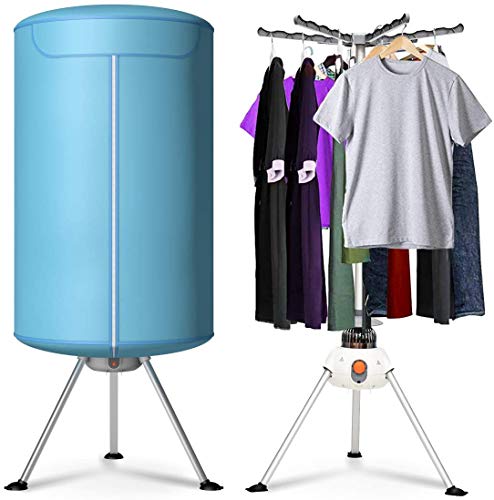
COSTWAY Portable Ventless Clothes Dryer — The tabletop laundry-room substitute
Now the size class changes, and the review changes with it. The COSTWAY is a portable ventless dryer — a heated drying machine for homes and dorms, in the listing’s own words — and its natural habitat is a countertop, a utility shelf or the top of a mini washer in a home with no laundry room at all. Judged as a household dryer it would be absurd; judged as the machine that lets a dorm resident or a studio renter dry their own clothes in their own space, it is a small liberation, and it is reviewed on those terms.
The title calls it a hot drying machine with a heater, which tells you the mechanism honestly: this is the heated-air pattern in miniature, ventless because at this scale the moisture involved is a small load’s worth, released into the room rather than ducted out of it. Expect to dry the loads this class is built for — underwear, gym kit, a few shirts, a towel or two — and expect those loads to take a while, because a portable heater works with a fraction of a full-size dryer’s power. The title states no drum capacity, and that absence is the first thing to check on the product page: in the mini class, capacity in pounds is the difference between a useful appliance and a warm cupboard.
The dorm case deserves a moment of specifics, because it is where this machine will mostly live. A student with a portable dryer and a small washer — or a sink-washing routine — owns their laundry schedule entirely: no quarters, no basement timetable, no stranger’s lint. The loads are the size a student actually generates between classes, and the machine’s patience matters less when it runs during study hours in the same room. What it replaces is not a household dryer but a system of errands, and measured against errands, a warm box that dries your kit while you read is an easy purchase to defend.
Placement is the COSTWAY’s whole argument. It asks for a surface and an outlet, nothing else — no water, no drain, no vent — which makes it the zero-installation member of this guide. For a renter whose alternative is a laundromat or a drying rack over the bathtub, a machine that dries a small load unattended, in the room, is worth its counter space. It is not a family dryer and does not pretend to be one; it is the answer to a specific, common, small-space problem.
- Class: portable ventless dryer for home and dorm use, per the listing title
- Mechanism described in the title: hot drying machine with heater
- Drum capacity: not stated in the listing title — the first figure to verify on the product page
- Installation: countertop-class; no vent, no water connection implied by its portable design
- Load scale: small personal loads; not a family-size machine
- Where to buy: the COSTWAY Portable Ventless Clothes Dryer listing on Amazon — check price on Amazon
Strengths
- Zero-installation drying for rooms with no laundry provision at all.
- Portable form moves with dorm rooms, rentals and seasonal spaces.
- Ventless at a scale where the room can absorb a small load’s moisture.
Trade-offs
- Small loads only — this is a personal dryer, not a household one.
- Drying is slow at portable power levels; plan loads around the day.
- The title’s missing capacity figure must be confirmed before purchase.
Best for: dorm residents, studio renters and anyone whose laundry room is a countertop. Not suited for: couples or families, whose loads would queue behind this machine all weekend.

MOJOCO 600W Portable Clothes Dryer — The travel-weight mini
The MOJOCO prints its defining number in its name: 600W. That wattage is the whole review in miniature. A full-size dryer works with several thousand watts; this compact machine works with six hundred, and everything about it — its load size, its drying time, its intended homes — follows from that figure. The listing aims it at apartments, RVs and travel, and describes a small, quiet, fast-drying machine with an adjustable timer and hassle-free setup. “Fast-drying” at 600W should be read in the mini class’s own terms: fast for a load of smalls, in a machine you can carry.
And carrying is the point. This is the dryer for the RV drawer, the extended-stay suitcase life, the apartment where a COSTWAY-class box is already too much furniture. Its loads are the traveller’s loads — a few garments, underwear, a swimsuit that needs to be dry by morning — and its adjustable timer suits exactly that rhythm: set it, sleep, pack. The title’s “quiet” claim matters in an RV, where the machine may run feet from the bed, and a small heater-fan appliance at this wattage has a plausible claim to it.
The RV case sharpens the same point. Campground laundry is a tax paid in quarters, in walking and in afternoons — and it scales with exactly the small, frequent loads a traveller generates: swimwear, hiking layers, the day’s clothes. A 600W machine that runs off the vehicle’s ordinary power while its owner sleeps converts that tax into a background hum. Its limit is equally clear — the week’s towels still belong to a bigger machine somewhere — but travellers plan around limits for a living, and this one is easy to plan around.
Honesty about scale is the whole service a review can do this machine. It will not dry a family’s towels, it will not make a duvet cover ready by evening, and a buyer who needs those things should be reading the top half of this guide. But for the one-person, small-load, no-space problem — the problem the mini class exists to solve — a 600W dryer that sets up without hassle and stores without complaint is a rational purchase, and the MOJOCO is its clearest statement in this pool.
- Class: portable mini dryer for apartment, RV and travel, per the listing title
- Power: 600W, per the listing title
- Controls named in the title: adjustable timer
- Character claimed in the title: small, quiet, hassle-free setup
- Drum capacity in pounds: not stated in the listing title — verify on the product page before planning loads
- Where to buy: the MOJOCO 600W Portable Clothes Dryer listing on Amazon — check price on Amazon
Strengths
- The most portable dryer in this guide — RV and travel are its stated home ground.
- 600W running suits vehicle and small-space electrical realities.
- An adjustable timer matches the set-it-overnight travel rhythm.
Trade-offs
- 600W means small loads and patient drying, by physics rather than by flaw.
- No capacity figure in the title; the page must confirm the load size.
- Not a substitute for a household dryer in any multi-person home.
Best for: RVers, frequent travellers and single occupants drying small loads in tiny spaces. Not suited for: anyone whose weekly laundry includes bedding, bath sheets or more than one person’s wardrobe.
Bosch and Miele Heat-Pump Dryer Lines — The premium benchmark (prose-only)
Above the household machines in this guide sits the class that defined ventless drying in Europe long before it was common in American laundry rooms: the heat-pump dryers sold under the Bosch and Miele names. These are compact, stackable, dealer-sold machines, typically in the 24-inch class, built around refined heat-pump systems, dense build quality and control designs that assume the machine will serve for many years. When reviewers reach for a ventless benchmark — for dryness evenness, for build, for the quiet confidence of the thing — it is usually one of these they are reaching for.
There is a second, quieter reason these lines anchor the category: service culture. Premium European laundry appliances are sold with an expectation of dealer installation, levelling and instruction, and for a ventless machine — whose performance depends on its water path and its placement more than a vented machine’s does — that guided first day prevents the slow disappointments that unmanaged installations produce. Buyers who value that hand-holding, and the long parts horizon that follows it, are buying something real; buyers who do not should save the difference and take the LG or the Midea with a clear conscience.
No verified listing for these lines sits in this guide’s pool, so there is no link and no model recommendation here; instead, the shopping guidance. You will find these dryers through appliance dealers and the brands’ own retail channels rather than in this guide’s marketplace pool — search each brand’s name with “heat pump dryer” and compare within the current compact line, paying attention to the drain arrangement (many premium ventless machines plumb their condensate away so no tank ever needs emptying) and to the stacking kit for your washer. Expect the premium tier’s terms: a higher purchase commitment than the Midea or LG above, repaid in build, refinement and the longest view of ownership in the category. If your ventless installation is permanent and your standards are set by the best the technology offers, this is the shelf to shop — with a dealer’s advice in the room.
- What they are: premium compact heat-pump dryer lines from Bosch and Miele, sold through appliance dealers
- Form: typically 24-inch class and stackable, matching compact washer installations
- How to shop: search each brand with “heat pump dryer” at appliance retailers; compare the current compact line’s drain arrangement and stacking options
- Ownership note: many premium ventless models can plumb condensate to a drain — confirm per model rather than assuming a tank
- Where to buy: appliance dealers and brand retail channels; no marketplace listing for these lines is part of this guide’s verified pool
Strengths
- The category’s benchmark build and heat-pump refinement.
- Dealer support and installation guidance come with the purchase.
- Designed for the longest ownership horizon in ventless drying.
Trade-offs
- The premium tier asks a premium commitment, by design.
- Buying is a dealer conversation, not a one-click marketplace order.
- Model lines change; each unit’s specification must be read on its own documentation.
Best for: permanent ventless installations where the buyer wants the technology’s best-regarded form. Not suited for: first-apartment budgets, or anyone who wants the dryer delivered by a marketplace courier this week.
Condensing and Heat-Pump, Household and Mini: The Whole Field at a Glance
| Dryer | Technology & size | Signature from its title | Right-sized for |
|---|---|---|---|
| Kenmore 4.0 Cu. Ft. Condensing Dryer | Condensing, 4.0 cu. ft. | ENERGY STAR Certified; Smart Sensor Drying; Wrinkle Guard | Couples in condos and apartments |
| Midea 4.4 Cu. Ft. Heat Pump Dryer | Heat pump, 4.4 cu. ft., stackable | Energy efficient, space saving | Frequent dryers chasing running costs |
| LG 4.2 Cu. Ft. Heat Pump Dryer | Heat pump, 4.2 cu. ft., 24-inch | Dual Inverter HeatPump; smart | Permanent compact installations |
| COSTWAY Portable Dryer | Heated portable, countertop class | Ventless laundry dryer for home and dorms | Dorms and studios, personal loads |
| MOJOCO 600W Portable Dryer | Heated mini, 600W | Adjustable timer; apartment, RV, travel | Travellers and RVers |
| Bosch / Miele heat-pump lines (prose-only) | Heat pump, premium compact class | Dealer-sold benchmark lines | Buyers specifying the top of the category |
Condensing or Heat-Pump: Which Ventless Technology Earns Its Keep?
The decision turns on three household facts: how often you dry, how long you will keep the machine, and how warm your laundry space runs. A condensing dryer is the simpler machine — a heating element, a condenser, familiar temperatures — and for a household drying a few loads a week, its lower purchase tier and brisker cycles are a rational settlement. Its costs are paid in energy per load and in heat: a condensing dryer warms its room noticeably over a long cycle, which in a small condo in summer is a real consideration.
A heat-pump dryer pays more at purchase and collects the difference in running: recycling its heat makes it the thriftiest way to dry a load with electricity, and its cooler operation is gentler on clothes and on the room. The household that dries daily, keeps appliances for a decade, or launders heat-sensitive wardrobes — sportswear, elastics, prints — is the household the technology was designed for. The Midea and LG above, and the Bosch and Miele lines in prose, are all expressions of that same bet at different tiers. Households furnishing compact rooms across the home tend to make this permanence calculation repeatedly — it is the same reasoning that governs a stack of Best Stackable Outdoor Dining Chairs bought for a small terrace: choose the design that fits the constraint once, and the constraint stops taxing you daily.
One more difference is tactile: heat-pump loads often emerge feeling cooler and very slightly humid to an impatient hand, then finish in the first minutes of airing — a known characteristic of low-temperature drying, not a fault. Owners learn their machine’s endpoint within a few loads. What never changes is the shared ventless truth: neither technology will match a vented dryer’s pace, and both are bought with placement freedom as the prize.
Where Does a Ventless Dryer Actually Live?
Walk the typical installations and the category makes physical sense. In the interior condo closet — the canonical case — a stackable heat-pump dryer stands over its washer, plumbed or tanked, in a room with no exterior wall at all; the closet that a vented machine could never serve becomes a complete laundry. In the bathroom installation, common in European-style apartments, the dryer shares the room’s existing drainage, and the tank question often answers itself. In the kitchen-corner arrangement, a compact ventless unit takes the space a dishwasher would, under a counter, in homes where the kitchen is the only room with water on two walls.
The minis live elsewhere: the COSTWAY on a dorm-room shelf or a utility counter, the MOJOCO in an RV cabinet or a spare-room corner in a rental where the landlord’s machines are three floors down. Each of these placements shares the same enabling fact — no duct was consulted. That is the whole technology in one sentence, and it is why the category keeps growing in cities: the housing stock is full of rooms that could hold a dryer if only the dryer would stop asking the building for a hole.
Placement has two disciplines regardless of room. The machine needs its air — ventless dryers exchange heat with the room, and a sealed, tiny, already-warm closet taxes a condensing machine’s efficiency — and it needs its level, because a long, slow tumble on an unlevel floor is a noise complaint with a fuse. Give it air and level, and a ventless dryer disappears into the household’s background, which is where laundry equipment belongs.
How Do You Live Well With a Slower Dryer?
By reorganising the laundry week around rhythm instead of urgency. Ventless households that thrive run smaller loads more often — the drum is never asked to dry a week’s cotton in one heroic pass — and they start loads at the day’s hinges: before work, before bed, before the long errand. A load that finishes “whenever” is only a problem for a household that needed it at a specific hour, and the fix is scheduling, not machinery. Sensor drying, where a model offers it, is the ally here: it ends the cycle at dryness rather than at a guessed time, so an unattended load is neither baked nor left damp in a sealed drum.
The water routine becomes a household habit on the same scale as taking out recycling. If your machine collects condensate in a tank, empty it on a fixed cue — after every load is the habit that never overflows — and if it can be plumbed to a drain, pay that small installation attention once and delete the chore forever; the premium lines described above make a point of offering the plumbed route. Lint care is the other habit: ventless machines route everything through their filters and condensers, and a neglected condenser stretches cycles month by month until the machine seems to have aged years in a season. The manual’s cleaning schedule, kept, is the difference between a dryer that stays slow-and-steady and one that becomes slow-and-slower.
A note on expectations for the first week, because ventless machines are often judged by vented standards in their first three loads and returned by their fourth. Your first load will take longer than you budgeted. Your second will teach you the endpoint — how dry “dry” feels from a cool heat-pump drum, or how a condensing load relaxes in its first minutes of airing. By the third, the household’s rhythm has usually re-formed around the machine, and the question stops being “why is it slow” and becomes “why did we ever rent a home whose laundry depended on a hole in the wall.” Give the category its week before you grade it.
Finally, sort by weight as you would for any dryer, and give bedding its own appointment. A duvet in a 4.0–4.4 cu. ft. ventless drum is a legitimate load; a duvet plus the week’s towels is a small tragedy of uneven drying. The households in the outdoor-living half of this catalogue understand the same principle from the other side — nobody asks a folding lounger to be a sofa, which is why our Best Zero-Gravity Chairs guide grades each design against its own job — and ventless dryers reward exactly that honesty about scale.
How Should a Ventless Dryer Be Sized Against Its Washer?
The pairing rule from the vented world survives intact: the dryer should hold at least what the washer holds, because wet laundry expands. In the compact class this guide inhabits, that usually means a 4.0–4.4 cu. ft. dryer standing over a 2.2–2.7 cu. ft. compact washer — a comfortable ratio that lets a full wash load dry as a single load, which is the arrangement that makes ventless living feel effortless rather than managed. Households pairing a compact dryer with a full-size washer should expect split dry loads as a permanent routine and decide in advance that the trade is worth it, because no setting changes the arithmetic.
There is also a rhythm pairing to consider. A ventless dryer’s long cycle pairs best with a washer that is quicker than it is: while the dryer works through load one, the washer can complete load two and hold it, so the laundry day becomes a pipeline instead of a queue. Households that wash and dry in strict sequence, waiting for each stage, experience the ventless tax at its maximum; households that overlap the stages barely experience it at all. The machine did not change — the choreography did — which is why this guide keeps treating laundry as a system rather than a purchase.
What Should You Honestly Expect From the Mini Class?
The two portables in this guide deserve a section of plain expectations, because the mini class attracts the category’s most mismatched purchases. A portable dryer dries a small load of light garments well. It dries them in the time a small heater needs, which is not the time a full-size dryer needs, and its drum — whatever the product page states its capacity to be — should be loaded at the modest end of that figure for results you will be happy with. Towels are its sternest test and bedding is beyond its brief. Within those lines, a mini is a genuinely useful appliance: it turns a dorm room self-sufficient, makes an RV independent of campground laundry, and gives a studio a private alternative to the shared basement machines.
The buyer’s checklist for the class is short and mostly about the page rather than the machine: confirm the stated capacity in pounds, confirm the power draw against the circuit or vehicle system it will run on, and confirm how the unit handles its moisture — the minis release a small load’s worth into the room, so the room’s ventilation is part of the installation. A buyer who has read those three lines cannot be disappointed by a mini, because the disappointment in this class is always a surprise, and surprises here are always optional.
Which Ventless Buying Mistakes Should You Refuse to Make?
The first is buying a mini and expecting a household dryer. The COSTWAY and MOJOCO in this guide are good machines for their class, and that class is one person with small loads; a family that buys one has purchased a queue. The second is the mirror error: paying heat-pump money for a household that dries twice a month, where the energy savings will never repay the tier difference and the longer cycles are pure cost. The third is ignoring the water question until installation day — discovering that the chosen closet has no drain and the tank routine was never part of the plan.
The fourth mistake is treating “ventless” as a single specification rather than a family of them: condensing and heat-pump machines differ in temperature, timing, care and cost, and a buyer who does not know which technology they own cannot keep it well. And the fifth is skipping the capacity arithmetic — matching a 4.0 cu. ft. dryer to a much larger washer, then blaming the dryer for the split loads that arithmetic always required. Every one of these mistakes is a reading mistake, made before purchase, and every one is avoidable in the ten minutes this guide asks of you.
There is one more placement the category quietly serves: the ageing-in-place home, where laundry on the main floor — in a converted closet or a bathroom corner — replaces a basement laundry room and its stairs. A ventless machine is often the only kind that can move upstairs without renovation, and for that household its slowness is not a tax at all; it is the price of laundry without a staircase, paid gladly. Categories earn their keep in specific lives, and this may be ventless drying’s most honourable one.
Final Recommendation
Choose the technology by your drying frequency and the size by your household, and this category resolves itself. The Kenmore condensing dryer is the sensible centre — certified, sensored, household-sized. The Midea heat-pump takes over when running costs and drum size lead; the LG when the installation is permanent and quiet, monitored operation matters; and above them, the Bosch and Miele lines wait for buyers specifying the benchmark through a dealer. The COSTWAY and MOJOCO are not lesser picks but different ones — personal dryers for rooms and vehicles where the alternative is no dryer at all. A ventless dryer is bought with a tape measure and a lease, not with a wish, and the household that reads its constraints honestly gets the category’s real prize: laundry at home, in a home that was never built for it, working every week without drama.
Frequently Asked Questions
Does a ventless dryer make the room humid?
A properly working ventless dryer keeps its moisture in its own plumbing — condensed into a tank or a drain — rather than venting it into the room. You will feel warmth during a cycle, more from a condensing model than from a heat-pump one, and the mini portables release their small loads’ moisture into the room air, which is why they belong in ventilated spaces. A household machine that leaves a room steamy has a maintenance problem, usually a clogged condenser path.
How much slower is ventless drying, honestly?
Noticeably — plan on cycles that run well beyond a comparable vented dryer’s, with heat-pump machines at the patient end of the range and heavy cotton loads stretching any of them. Owners absorb the difference with scheduling and right-sized loads rather than with settings; there is no fast mode that repeals the physics of condensing moisture instead of exhausting it.
Can a ventless dryer be stacked on a washer?
The household heat-pump picks here are explicitly stackable — the Midea and LG titles both say so — and stacking is the standard compact-laundry arrangement, using the manufacturer’s kit for the pairing. The condensing Kenmore’s stacking arrangements should be confirmed on its product page, and the mini portables, of course, stack on nothing: they sit on counters and shelves by design.
Where does the water go in a ventless dryer?
Into a collection tank you empty, or down a drain if the machine is plumbed for it — model by model. Tank machines make the routine part of laundry day; plumbed machines delete it. Premium lines often emphasise the plumbed option. Before buying, decide which routine your household will actually keep, because an un-emptied tank is the most common reason a ventless dryer stops mid-cycle and sulks.
Can a ventless dryer dry a comforter?
In the household class, a comforter that fits the drum with room to tumble is a legitimate load — the 4.4 cu. ft. Midea is the best suited here — and it should travel alone, on its own appointment, with patience. In the mini class the answer is no, and asking it is how portables get returned: bedding belongs to the household machines or to a laundromat’s big drums, and every dryer in this guide is happier when that boundary is respected.
Do ventless dryers need a special electrical circuit?
The compact ventless class is generally kinder to household wiring than full-size electric dryers, but the honest answer is per-model: read the electrical line on the exact listing and in its manual before ordering, particularly for older buildings and for RV use, where the MOJOCO’s stated 600W is the gentlest draw in this guide. Never assume a sibling model’s circuit requirements carry over.
Is a heat-pump dryer worth it over a condensing one?
If you dry often and keep machines long, the running-cost and fabric-care advantages compound in the heat pump’s favour; if you dry occasionally, the condensing machine’s lower tier and brisker cycles are the better settlement. The Kenmore’s stated ENERGY STAR certification narrows the efficiency gap at the condensing end — which is why this guide treats the choice as a household-finance question rather than a technology contest.
And keep a small notebook habit for the first month — nothing formal, just a note of which loads took longest and which settings you actually used. Ventless ownership converges quickly: most households settle on two cycles and a load size, and the notebook is how you find yours in three weeks instead of three months. After that the machine needs no more of your attention than any other appliance, which was the promise all along.
Related Guides
Ventless drying’s two technologies deserve a deeper look than any roundup can give one of them. For the heat-pump side of the story in full — how the machines work, who they suit, and how they compare — continue to Best Heat-Pump Tumble Dryers.


