What's inside
- Key Takeaways
- Quick Picks
- How Did We Choose These Long-Lasting Dryers?
- What Actually Makes a Dryer Last?
- Why Do Simple Controls Age Better Than Smart Ones?
- Which Long-Lasting Electric Dryers Fit Your Household?
- How Do the Six Picks Compare on Durability Logic?
- How Should You Maintain a Dryer So It Actually Lasts?
- When Is Repairing Smarter Than Replacing?
- Do Dryers Age by the Calendar or by the Cycle?
- How Does the Room Itself Age a Dryer?
- What Do Parts and Service Support Really Look Like Over Time?
- What Should You Ask Before Buying a Dryer You Intend to Keep?
- What Does the First Year of Ownership Predict?
- How Does a Dryer’s Second Life Reward the Durable Choice?
- How Can You Spot a Durable Dryer in a Listing in Five Minutes?
- What Mistakes Shorten a Dryer’s Life Most Reliably?
- Final Recommendation
- Frequently Asked Questions
- Related Guides
As an Amazon Associate I earn from qualifying purchases. This post may contain affiliate links at no extra cost to you.
cottageverdict.com is reader-supported. When you buy through links on our site, we may earn an affiliate commission.
Where to buy: All six dryers below are listed on Amazon, with their controls, drums, and capacities stated in their titles — check price on Amazon once you have decided which philosophy of durability fits your home. Long-lasting is a claim this guide defines carefully, so read the framing before the picks.
The best long-lasting electric dryers are not the machines with the most impressive launches, the longest feature lists, or the brightest launch-day photography; they are the machines whose tenth year looks almost exactly like their first, because nothing inside them was fragile, exotic, sealed against repair, or dependent on a supply chain that lost interest in them halfway through their working lives. They are the machines still drying laundry, unremarkably and without service calls, when their flashier contemporaries have been hauled away. Durability in a dryer is rarely about one heroic component; it is about the accumulation of unglamorous virtues — mechanical simplicity where possible, electronics only where they earn their place, drums that cannot corrode, parts a technician can actually obtain, and controls that a household can operate for a decade without a software update standing between them and dry towels.
This guide will be precise about what it cannot promise. No listing in our pool states a lifespan in years, and we will not invent one; any guide that tells you a dryer will last an exact number of years is selling you a fortune as a fact. What can be judged honestly are the ingredients of longevity: how much complexity a design carries, whether its wear surfaces are durable materials, whether its maker supports parts and service, and whether its failure points are cheap and replaceable rather than sealed and exotic. The six picks below were chosen on those ingredients, and each section names the trade-offs of its particular recipe.
One more piece of framing belongs at the front, because readers arrive with a fair question: can a guide judge longevity without a laboratory and a decade? It can judge the predictors, and predictors are how every experienced technician, dealer, and landlord already buys. They ask what the drum is made of, how much electronics the machine carries, whether the brand stocks parts, and how the design treats its own wear items — and their fleets of machines, living or dead, testify that those questions sort the durable from the fragile better than any launch review. This guide simply writes that professional folk wisdom down, pick by pick, with the evidence tied to each listing’s own words.
The field splits into two philosophies that both deserve respect. At full size, the two Kenmore models argue that a mainstream machine with sensor guidance, mainstream parts channels, and no exotic systems is the durable mainstream choice. In the compact field, four machines argue the older truth that simple is durable: stainless drums and tubs, knob or modest controls, and designs a owner can understand completely. Neither philosophy wins universally. The household that will keep a dryer longest is the one whose machine matches its habits, its room, and its appetite for maintenance — and that matching is what the rest of this guide is for.
Key Takeaways
- Longevity here means simple mechanics, durable drum materials, and replaceable parts — not invented year counts.
- Stainless drums and tubs appear in four of the six picks, removing corrosion as a cause of retirement.
- The two full-size Kenmore picks bet on mainstream serviceability and sensor-guided, gentler operation.
- Knob-controlled compacts minimize the electronics that age fastest in any appliance.
- A dryer lasts longest in a home that keeps its vent clear, its filter clean, and its loads honest.
Quick Picks
| Pick | Badge | Why it earns its place |
|---|---|---|
| Kenmore 7.0 Cu. Ft. Electric Dryer, White | Mainstream Full-Size Bet | Sensor drying and wrinkle protection in a widely serviced 7.0 cubic foot platform with touch controls. |
| Kenmore 8.0 Cu. Ft. Electric Dryer, White | Big-Drum Mainstream Bet | The same durability logic at 8.0 cubic feet, adding steam for the largest households’ varied loads. |
| Auertech 3.6 Cu. Ft. Clothes Dryer with Stainless Steel Drum | Stainless Family Compact | A stainless tub and twelve modes in the largest compact here, built for heavy family rotation. |
| BLACK+DECKER 2.65 Cu. Ft. Portable Dryer | Proven Portable Platform | A stainless drum, standard-outlet operation, and a mature compact design from a mainstream tool-and-appliance name. |
| ROVSUN 2.6 Cu. Ft. Portable Dryer with Stainless Steel Drum | Simplest Controls in the Guide | One knob, a stainless tub, and nothing electronic standing between the user and a dry load. |
| Stopsad 1.6 Cu. Ft. Portable Clothes Dryer, Stainless Steel Tub | Durable Mini | Stainless construction and a gentle 800W appetite in the smallest footprint of the six. |
How Did We Choose These Long-Lasting Dryers?
We scored durability the way a repair technician would, not the way a launch event would. First, wear surfaces: drums and tubs made of stainless steel outrank coated alternatives because corrosion is the failure that cannot be repaired away. Second, complexity budget: every additional system — steam generators, touch ecosystems, app layers — is a future failure candidate, so picks either keep the budget low or justify the spending with mainstream service support. Third, serviceability: mainstream makers with deep parts channels outrank exotic imports whose components vanish from catalogs in five years.
We also refused two easy shortcuts. We did not treat price as a durability proxy, because expensive machines die of their electronics while cheap simple ones hum on, and we did not treat feature count as one either. And we did not print a single lifespan figure, because none of these listings provides one and honesty about that absence is the beginning of trustworthy advice in this category. What the sections below offer instead is a per-machine account of where its years will come from and where its risks live, so you can choose the risk profile your household prefers.
The resulting six are admittedly a mixed shelf: two full-size mainstream machines and four compacts. That mix reflects the verified marketplace honestly. Compact dryers, with their simple mechanics and stainless interiors, make an unusually strong durability argument per dollar, while the full-size Kenmores represent the serviceable mainstream at family scale. Buyers needing a full-size machine with a stainless drum should know that purchase runs through dealer channels — a neighboring guide in this series covers that shelf — while buyers open to compact scale will find this guide’s picks unusually hard to kill.
What Actually Makes a Dryer Last?
Start with the enemies list, because longevity is mostly the art of not dying. Enemy one is corrosion, working on drums and cabinets in humid rooms until a surface fails and takes the machine’s usefulness with it. Enemy two is heat stress on electronics: control boards live beside a machine whose entire job is making heat, and every additional board, sensor array, and display is another citizen of that hostile neighborhood. Enemy three is mechanical wear on the honest moving parts — belts, rollers, bearings, motors — which is unavoidable but mercifully cheap to repair when the parts exist. Enemy four is neglect: lint-choked vents and filters that force every cycle to run hotter and longer than designed, aging everything at double speed.
Against those enemies, the durable design deploys boring weapons. Stainless where moisture lives. Mechanical or minimally electronic controls where heat lives. Mainstream engineering where parts must be found in year nine. Generous simplicity everywhere else. Notice what is absent from the weapons list: novelty. The dryers that serve longest are almost never the first of their kind; they are the refined descendants of designs whose failure modes have been found and engineered out across generations. When this guide praises a pick’s plainness, that is not faint praise — plainness, in this category, is the sound of a machine with very little left to go wrong.
There is a fifth enemy that deserves naming because it hides inside good intentions: the dryer that is simply never allowed to finish its work properly. Loads interrupted and restarted, doors opened mid-cycle out of impatience, damp laundry left sitting in a sealed drum for days — each habit stresses components and breeds the musty, corrosive interior climate that ages a machine from the inside. A dryer is a tool with a rhythm, and households that respect the rhythm — start it, let it finish, unload it, leave the door breathing — find that their machines repay the courtesy in the only currency that matters here, which is uneventful years.
The owner’s half of the bargain deserves equal billing. The same dryer lasts measurably longer in a home that empties its filter every load, keeps its vent run short and clear, resists overloading the drum into a solid rotating mass, and attends to new noises while they are still cheap information. Durability is a partnership between a design that forgives and an owner who maintains, and the picks below were chosen to forgive as much as any machine in their class reasonably can, even in homes where the maintenance is enthusiastic rather than perfect and the laundry room is a basement rather than a showroom.
Why Do Simple Controls Age Better Than Smart Ones?
A mechanical knob is a switch with ambitions no larger than its job, and it can do that job for decades in heat and humidity that slowly murder circuit boards. A touch panel with a processor, by contrast, is a small computer living in a steam room, running software, driving a display, and depending on components whose production runs end long before the dryer’s drum wears out. This is not an argument that smart dryers are bad — their features genuinely serve many households — but it is an accounting truth: every generation of electronics inside an appliance is a clock ticking faster than the machine around it.
The middle path, and the one several picks here walk, is restrained electronics: an LED display and a modest control board governing a fundamentally simple machine. That combination buys legibility and a useful mode menu while keeping the electronic population low enough that a mainstream technician can source and swap the board years later. The full-size Kenmore picks add sensor intelligence to that middle path — and sensors earn their complexity honestly, because ending cycles at real dryness reduces the heat exposure of everything in the machine, clothes and components alike. Complexity that reduces wear is an investment; complexity that merely decorates is a liability, and this guide has tried to fund the first kind and starve the second.
Which Long-Lasting Electric Dryers Fit Your Household?
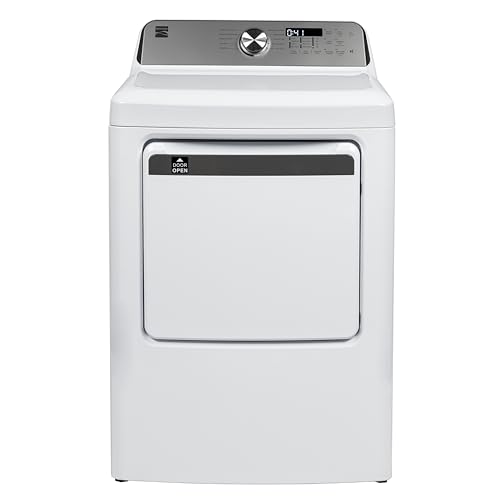
Kenmore 7.0 Cu. Ft. Electric Dryer, White — Mainstream Full-Size Bet
Kenmore’s 7.0 cubic foot electric dryer represents the durability strategy most American households actually live by: buy the mainstream machine, from the mainstream name, with the mainstream parts channel behind it. Its listing names Smart Sensor Drying — the brand’s own wording for load-sensing cycle control — plus Wrinkle Guard and touch controls, in a white front-load cabinet. The longevity argument is systemic rather than exotic. Sensor endings reduce the hours of heat the machine and the clothes endure across years of loads. A widely sold platform means belts, rollers, elements, and boards remain findable long after a niche import’s catalog has moved on.
The size is part of the argument too. Seven cubic feet is the capacity class that generations of family laundry rooms were built around, which means the machine’s dimensions, hookups, and service clearances are the ones every technician already knows. Nothing about owning it will ever require a specialist in the model, and that ordinariness is a durability feature no specification sheet prints. Wrinkle Guard contributes quietly as well: loads that do not need rescue cycles are loads the machine never runs, and the cheapest wear is the wear that never happens.
Its risks are the mainstream risks, stated plainly. Touch controls carry more electronics than a knob, and a full-size machine has full-size moving parts working under full-size loads. Neither risk is unusual, and both are the kind that mainstream service networks exist to answer. For a family that wants one dryer, at family scale, with the deepest possible bench of future help behind it, this Kenmore is the guide’s foundational recommendation.
- Format: full-size front-load electric dryer, white cabinet
- Drum size: 7.0 cu. ft. as stated in the listing
- Working features: Smart Sensor Drying plus Wrinkle Guard, per the title
- Controls: touch controls per the listing title
- Price: check price on Amazon
Strengths
- A mainstream platform with the parts availability longevity depends on.
- Sensor endings cut cumulative heat exposure for machine and clothes.
- Standard full-size format fits every technician’s experience.
Trade-offs
- Touch electronics carry more aging risk than a mechanical dial.
- Full-size scale is wasted on small households’ laundry volume.
- Its drum material is not a headline claim in the listing.
Best for: families wanting a serviceable full-size dryer from a mainstream line.
Not suited for: minimalists seeking the simplest possible control scheme.

Kenmore 8.0 Cu. Ft. Electric Dryer, White — Big-Drum Mainstream Bet
The 8.0 cubic foot Kenmore extends its sibling’s argument to the largest households: Smart Sensor Drying, Wrinkle Guard, and Accela Steam — aimed by the listing at wrinkles, static, and odors — in a white cabinet built to absorb serious weekly volume. The durability logic of capacity is underappreciated. A household that needs eight cubic feet but buys seven runs its dryer more often, in more cycles, with more door swings, more starts, and more wear per garment than the household that bought the honest size. Right-sizing is a longevity decision, because cycles are the currency machines age in.
Steam’s place in a durability guide needs its defense, and it has one. Every garment refreshed by steam instead of a full wash-and-dry round is a cycle the machine never runs and the fabric never suffers; across years, those avoided cycles are real years. The sensor system governs the loads that do run, trimming the padded minutes that timers would have added to each. The result is a big machine designed to be used less per garment than its size suggests — which is precisely how big machines earn long lives.
The trade-offs mirror the 7.0 with additions. Steam hardware is another system with its own future, and the largest cabinet asks the most of its rollers and motor on every load. Households should buy it for genuine volume, not aspiration: a couple running three loads a week will age this machine’s electronics on a calendar while barely touching its mechanical life, the worst of both ledgers. For the big, busy household it was drawn for, it is the guide’s most complete full-size answer.
- Format: full-size front-load electric dryer, white cabinet
- Drum size: 8.0 cu. ft. as stated in the listing
- Working features: Smart Sensor Drying, Wrinkle Guard, and Accela Steam, per the title
- Controls: touch controls per the listing title
- Price: check price on Amazon
Strengths
- Capacity matched to big households reduces total cycles per garment.
- Steam refresh substitutes for full wash-and-dry rounds.
- Mainstream platform keeps future service straightforward.
Trade-offs
- Steam adds a system smaller households may never justify.
- Oversized for modest laundry streams, aging electronics idly.
- Full loads at this scale work the moving parts hardest.
Best for: large households whose volume would over-cycle a smaller machine.
Not suited for: small households buying capacity as a someday aspiration.

Auertech 3.6 Cu. Ft. Clothes Dryer with Stainless Steel Drum — Stainless Family Compact
Auertech’s 3.6 cubic foot machine brings the compact field’s strongest material credential to family duty: a stainless steel tub, stated in its title, in the largest drum of the compact picks here. The durability reasoning is direct. This is the compact most likely to be run like a full-size machine — daily, heavily, by a household — and it is built around the one interior material that treats that workload as a non-event. A coated drum under family rotation is a countdown; a stainless tub under the same rotation is a career.
Twelve drying modes and LED control give the machine a modern surface, and this guide counts that as calculated complexity rather than a contradiction. The modes serve real fabric variety in a family wardrobe, and LED indication is among the simplest electronic features a dryer can carry. The bet Auertech makes is that owners will trade a modest control board for genuine cycle tailoring, while the component that cannot be replaced — the drum — is specified in the material that never needs replacing. That is a coherent longevity philosophy, argued in hardware.
Its ceiling is its class: 3.6 cubic feet serves a family’s stream in sessions, not in single heroic loads, and king bedding remains an outside errand. Electronics, however modest, still outnumber a knob machine’s. But for a small-space household that runs family volume and intends to keep its dryer, this is the compact pick whose material and capacity best match the ambition.
- Interior: stainless steel tub, named in the title
- Size: 3.6 cu. ft. per the title
- Programs: twelve modes with LED control panel
- Built for: busy family homes, in the title’s words
- Price: check price on Amazon
Strengths
- Stainless tub removes corrosion from the retirement equation.
- The largest compact drum here suits real family rotation.
- A deep mode menu tailors treatment across a family wardrobe.
Trade-offs
- Compact ceiling still splits the biggest bedding loads.
- Mode electronics exceed a knob machine’s minimalism.
- Heavy family use will test its class limits daily.
Best for: small-space families who run full-size volumes through a compact.
Not suited for: households needing single-load king bedding capacity.
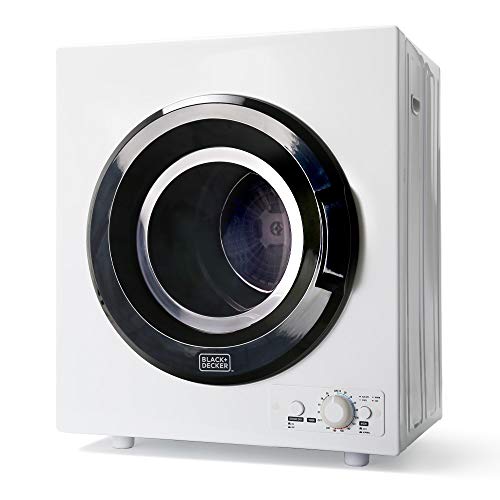
BLACK+DECKER 2.65 Cu. Ft. Portable Dryer — Proven Portable Platform
BLACK+DECKER’s 2.65 cubic foot portable earns its place on two longevity legs: a stainless steel drum, stated in the title, and the maturity of a mainstream compact platform sold in serious numbers by a household name. Volume matters to durability in an unglamorous way — a machine produced at scale accumulates refined tooling, available parts, and a generation of technicians and owners who know its habits. Its specifications are the portable category’s balanced center: an 8.8-pound load rating, 1400W on a standard outlet, vented operation, and controls that ask nothing exotic of anyone.
The stainless drum deserves emphasis in a portable specifically. Portables are stored in closets and garages, carried between rooms, and run in bathrooms — the dampest biography any dryer can have. A drum that cannot rust converts that biography from a corrosion sentence into a mere lifestyle. Combined with the machine’s uncomplicated design, the result is a portable unusually likely to be handed down, resold, or moved to a second home rather than discarded, which is what long-lasting actually looks like in the wild.
Its limits are the portable limits, shared honestly with its siblings in this guide: modest heat, patient cycles, and a drum sized for one or two people’s rhythm. Owners who need more should not stretch this machine past its design; they should step up a class. Owners whose lives fit its footprint get a dryer whose two main longevity risks — drum corrosion and orphaned parts — have both been answered before the box is opened.
- Drum: stainless steel stated in the listing title
- Load size: 2.65 cu. ft. drum with an 8.8 lb rating
- Power: 1400W, 120V, vented, standard wall outlet
- Model reference: BCED26 in the listing title
- Price: check price on Amazon
Strengths
- Stainless drum suits a portable’s damp, mobile life.
- A mainstream maker’s scale supports parts and familiarity.
- Balanced specifications avoid every extreme of its category.
Trade-offs
- Portable capacity excludes family-scale laundry by design.
- Household-outlet power means unhurried cotton cycles.
- Venting still requires a window route or indoor kit.
Best for: singles and couples wanting a portable built to be kept.
Not suited for: households whose weekly volume dwarfs its drum.

ROVSUN 2.6 Cu. Ft. Portable Dryer with Stainless Steel Drum — Simplest Controls in the Guide
If this guide has a purist, it is the ROVSUN: a stainless steel tub, a 2.6 cubic foot drum, 1400W on 110V, and one control knob between the user and dry clothes. Every element of that specification is a longevity argument. The tub cannot rust. The knob cannot crash, update, or lose its display. The machine’s entire electronic population could be described in a sentence, which means its failure census a decade from now will also fit in a sentence. For spaces where the operator rotates — rentals, guest suites, a parent’s apartment — the knob also guarantees the machine will be used correctly by everyone, and correct use is a durability feature.
There is a subtler virtue in its simplicity: diagnosability. When a simple machine misbehaves, the cause lives in a short list — heat, airflow, belt, timer — that any competent technician can walk in an hour. When a complex machine misbehaves, the first appointment is sometimes spent interrogating its electronics before the real fault is even nominated. Owners who value repairability as the core of long-lasting will recognize the ROVSUN as the guide’s most literal answer to its own title.
The surrender is refinement, and it is total. No fabric-specific programs, no countdown, no delayed starts — the machine dries, and that is the whole symphony. Households that choreograph laundry around schedules should look at the Auertech or the Kenmores. Households that want a dryer their grandchildren could operate, built from the material that outlasts its surroundings, have found the purest expression of this guide’s thesis.
- Interior: stainless steel tub, in the title’s wording
- Size: 2.6 cu. ft. drum
- Draw: 1400W at 110V, per the title
- Interface: one control knob, nothing more
- Price: check price on Amazon
Strengths
- The lowest complexity budget of any pick in this guide.
- Stainless tub pairs with the knob for a minimal failure list.
- Simple faults stay cheap and diagnosable for any technician.
Trade-offs
- No programs or scheduling for fabric-specific routines.
- Portable pace and capacity govern its working life.
- Owners wanting feedback displays will find it silent.
Best for: rentals, guest spaces, and simplicity-first owners everywhere.
Not suited for: households that run laundry by app and timetable.

Stopsad 1.6 Cu. Ft. Portable Clothes Dryer, Stainless Steel Tub — Durable Mini
The Stopsad closes the picks by shrinking the durability thesis to its smallest form: 1.6 cubic feet, 800W, five modes, a fast-drying function, and a stainless steel tub where the mini category usually economizes with coatings. Small dryers lead precarious lives — perched in bathrooms, stored in RV cabinets, lent to students — and their drums meet more ambient moisture per load than any full-size machine’s. Stainless in this size class is not a premium flourish; it is the difference between a mini that serves for years of damp corners and one that quietly rusts between semesters.
The gentle 800W appetite contributes its own longevity logic. Less heat stress per cycle, less demand on marginal dorm and RV circuits, and a workload matched to small loads mean the machine rarely operates at anyone’s redline, including its own. Five modes give its owner honest choices for a small wardrobe, and the fast-drying function handles the mini dryer’s most common emergency — one outfit, needed soon — without drama. Everything about the design suggests a machine meant to be kept in service rather than replaced on a cycle.
Its boundary is absolute and should be respected: this is one person’s dryer, or a supplement for delicates and baby clothes beside a larger arrangement. Asking it to carry a family is how good small machines get bad reputations. Within its brief — solo dwellers, dorms, RVs, and the small-load niches of bigger homes — its stainless tub makes it the durable end of tiny, and tiny, kept for years, is a perfectly respectable form of long-lasting.
- Interior: stainless steel tub, per the title
- Size: 1.6 cu. ft. drum
- Draw: 800W, per the title
- Programs: five modes plus a fast-drying function
- Price: check price on Amazon
Strengths
- Stainless construction in the dampest-serving size class.
- A gentle electrical draw spares machine and circuit alike.
- Five modes cover a solo wardrobe’s real range.
Trade-offs
- Capacity is one person’s by deliberate design.
- Low wattage means patient cycles on heavier cotton.
- Large items monopolize the drum one at a time.
Best for: solo dwellers, dorm residents, and RV owners buying for keeps.
Not suited for: anyone expecting it to serve a family’s laundry.
How Do the Six Picks Compare on Durability Logic?
| Pick | Scale | Durability thesis | Main risk |
|---|---|---|---|
| Kenmore 7.0 Cu. Ft. Electric Dryer, White | Full-size | Mainstream parts and service depth | Touch-control electronics |
| Kenmore 8.0 Cu. Ft. Electric Dryer, White | Full-size | Right-sized capacity cuts cycle count | Steam system complexity |
| Auertech 3.6 Cu. Ft. Clothes Dryer with Stainless Steel Drum | Compact | Stainless tub under family workload | Mode electronics, class ceiling |
| BLACK+DECKER 2.65 Cu. Ft. Portable Dryer | Portable | Stainless drum plus platform maturity | Portable capacity limits |
| ROVSUN 2.6 Cu. Ft. Portable Dryer with Stainless Steel Drum | Portable | Minimal complexity, knob control | No programs or scheduling |
| Stopsad 1.6 Cu. Ft. Portable Clothes Dryer, Stainless Steel Tub | Mini | Stainless in the dampest size class | One-person capacity ceiling |
How Should You Maintain a Dryer So It Actually Lasts?
The owner’s ritual is short enough to memorize: filter every load, vent every season, ears open always. The lint filter is the machine’s airway, and a filmed-over screen forces every cycle to run hotter and longer, aging the element, the motor, and the clothes simultaneously. Scrub it with a brush and warm water when water starts beading on it instead of passing through. The vent run is the same story at larger scale — a clear, short, smooth duct is the cheapest lifespan extension in the entire laundry room, and its neglect is the most common way good dryers are murdered slowly by kind owners.
Keep a small notebook or a note on the phone for the machine: installation date, vent cleanings, any part replaced, any sound that came and went. It sounds like overkill for a dryer, and it is the opposite — it is the cheapest diagnostic tool in the house. A technician handed that history can skip half the guessing they would otherwise bill you for, and an owner reading it can see the machine’s life as a story with chapters rather than a series of surprises. Durable machines reward documented care the way gardens reward a planting diary, quietly and over years.
Loading discipline is maintenance too. A drum packed solid strains belts and rollers, tumbles badly, and runs long; a drum loaded loosely to the two-thirds mark treats every moving part gently while drying better. Attend to new sounds the week they appear — a thump, a squeal, a scrape — because the parts that make them are inexpensive at the noise stage and expensive at the failure stage. Longevity is rarely one grand decision; it is the accumulation of these small attentions, paid faithfully by the owner, month after month and year after year, on a machine designed to reward them for as long as they keep paying.
When Is Repairing Smarter Than Replacing?
Repair wins when the fault lives in the cheap census: belts, rollers, thermal fuses, heating elements, and simple switches are the dryer’s consumables, and a machine whose drum and structure are sound deserves their replacement almost regardless of age. This is where the picks’ philosophies pay out — mainstream Kenmore parts flow through every appliance channel, and the simple compacts present faults any technician can diagnose in one visit. A repair quote that frightens you should be weighed against the machine’s remaining virtues, not against the calendar alone.
Replacement wins when the fault is structural: a corroded or damaged drum, a failed main motor on a machine whose other systems are also tired, or electronics whose boards are no longer obtainable at sane prices. The honest technician conversation names which side of that line your machine stands on. Owners who bought with durability logic in the first place — stainless where it matters, simplicity where it counts, mainstream where parts matter — find that the repair side of the line keeps winning for year after year, which is the entire point of this guide.
Do Dryers Age by the Calendar or by the Cycle?
Both clocks run, but they govern different parts. Mechanical wear — belts, rollers, bearings, drum supports — counts cycles, which is why the over-cycled undersized dryer dies young while its twin in a smaller household serves on. Electronic aging counts heat-hours and calendar time together, which is why a barely used smart dryer can still meet its board’s old age in a hot laundry room. Understanding the two clocks changes buying: a high-volume household should spend on mechanical honesty and right-sizing, while a low-volume household should fear complexity more than wear, because its machine will age sitting still.
This is also why the guide’s two philosophies coexist without contradiction. The full-size Kenmores serve households whose dominant clock is cycles, with mainstream parts standing behind every wear item. The simple compacts serve households whose dominant clock is calendar and environment, by carrying almost no electronics for the years to eat and stainless surfaces for the damp to fail against. Ask which clock will govern your laundry room — the pile or the years — and the right half of this guide selects itself.
How Does the Room Itself Age a Dryer?
Laundry rooms are hostile real estate. They are humid by function, linty by physics, and often the least ventilated rooms in the house. A dryer living in a dry, conditioned space with a short vent run inhabits a different world from its identical twin in a sweating basement with a twenty-foot duct — and their service lives will diverge accordingly, whatever the badge says. Buyers cannot always choose the room, but they can choose how the machine meets it: stainless where the damp touches, clearances that let the cabinet breathe, and a vent path that does not ask the blower to fight the house.
Basements deserve a specific word, because they host so many long-lived and so many murdered dryers. The basement virtues are cool air and space; the basement vices are humidity and neglect, since a machine out of sight gets its filter checked on a geological schedule. A basement dryer on a small stand, off the concrete, with its filter ritual kept, can outlive its upstairs cousins. The same machine sitting in a puddle-prone corner with a crushed vent will not see its fifth birthday in health. The room is a co-author of every appliance biography, and this guide’s picks were chosen to give it as little damaging material to work with as possible.
What Do Parts and Service Support Really Look Like Over Time?
Every dryer is immortal on delivery day; the question is what it becomes in year seven, when a roller flattens or an element opens. Mainstream platforms answer that question with depth: parts catalogs that persist, exploded diagrams any technician can pull up, and components shared across enough models that warehouses keep stocking them. This is the unglamorous substance behind the Kenmore picks’ presence here — not nostalgia for a badge, but the arithmetic of a machine whose every wear part has a living supply chain behind it.
Niche and import machines face a thinner future, which owners can mitigate but not erase. Buying from a maker with a real domestic parts operation, keeping the model and serial documentation, and learning the machine’s common wear parts early all extend the practical horizon. The simple compacts in this guide take a different insurance policy: their parts are so generic — belts, thermostats, heating elements of standard design — that the supply chain barely needs to know the brand’s name. Between the mainstream platform and the generic-simple machine, those are the two honest roads to a serviceable old age, and every pick here travels one of them.
What Should You Ask Before Buying a Dryer You Intend to Keep?
Ask what inside it is allowed to wear out and what each of those things costs to replace. A seller who can answer plainly — belt, rollers, element, fuse, all standard, all stocked — is describing a machine designed for a long life in the real world. Ask what the drum is made of, in the maker’s own words, and apply the same title-and-spec-sheet discipline the steel-drum guide in this series teaches. Ask who within driving distance services the brand, because a durable machine with no local hands is a durable machine waiting for a long-distance relationship with a shipping depot.
Finally, ask the question that decides more lifespans than any specification: does this machine fit the household it will actually serve — its volume, its room, its circuits, its patience? Misfit is the silent killer in this category. The undersized dryer is cycled to death, the oversized smart dryer ages its electronics in idleness, the portable asked to do a family’s work is resented into replacement. The picks above span sizes and philosophies precisely so that an honest answer to the fit question exists somewhere in this guide for nearly every laundry room that reads it.
What Does the First Year of Ownership Predict?
A dryer’s first year writes its biography in pencil. Machines that arrive with a rattle, run hot against a strangled vent, or spend their first months overloaded are being aged at double speed before their owners have finished paying attention to them. The shakedown habits matter: run the first loads attended, confirm the vent blows strongly outside, check that the cabinet sits level and quiet, and register whatever paperwork the maker offers while the model numbers are still on your phone’s camera roll. A machine that starts life correctly installed and correctly loaded has already banked years that no later care can buy back.
The first year is also when the household’s true volume reveals itself, and honest owners adjust. If the compact bought for a couple is suddenly serving a baby’s daily small loads, its rhythm changes but its fit survives; if it is serving a multigenerational house that formed after the purchase, the fit has genuinely changed, and planning a right-sized successor early — while the compact can be sold or gifted in health — is better ownership than grinding a misfit into an early grave. Longevity is partly a property of machines and partly a property of households that keep matching them to the life being lived.
How Does a Dryer’s Second Life Reward the Durable Choice?
The most durable machines in this guide are the ones most likely to be handed down, and that second life is part of their value. A simple, stainless portable that outgrows a first apartment becomes a graduate’s gift, a cabin’s laundry solution, a rental’s workhorse — roles where its simplicity and corrosion-proof drum matter even more than they did in its first home. A mainstream full-size machine with a living parts channel sells honestly on the used market, because the buyer inherits the same serviceability the first owner enjoyed. Durability compounds socially in a way feature lists never capture.
There is an environmental sentence in this too, and it needs no embellishment: the greenest dryer is overwhelmingly the one that does not get replaced. Every year a machine serves past its category’s average retirement is a year of manufacturing, shipping, and disposal that never happens. Buyers who choose with the logic in this guide — simple where possible, stainless where it counts, mainstream where parts matter — are making the sustainable choice almost by accident, which is the most reliable kind of sustainable choice there is.
How Can You Spot a Durable Dryer in a Listing in Five Minutes?
Read the title like a technician filling a work order. Note the drum material if it is claimed, and distrust any durability implication that the title itself will not state. Count the systems: each named feature beyond drying is a future service event, so ask of each one whether your household will use it weekly or merely admire it at delivery. Check the controls’ philosophy — knob, restrained panel, or full smart suite — and price the electronics honestly against your horizon. Then look for the maker’s footprint: a household name with a parts operation is a longevity feature that never appears in the feature list, yet decides more tenth years than any cycle name.
Finish the five minutes with the fit audit. Capacity against your washer’s real output, power against your circuit, footprint against your room, and pace against your temperament. A durable machine in the wrong home is a short-lived machine, because misfit gets replaced, and replacement is the one failure mode no engineering can prevent. The six picks in this guide passed exactly this five-minute audit from different directions, which is why a mainstream giant and a one-knob portable can share a durability guide without either of them being a compromise.
What Mistakes Shorten a Dryer’s Life Most Reliably?
Neglecting the vent is the champion, because it taxes every component on every cycle while remaining invisible from the laundry room. Overloading runs second: the heroic stuffed drum feels efficient and is in fact a wear multiplier wearing a virtue costume. Third is ignoring the first strange noise, which converts a belt’s price into a motor’s price with the patience of compound interest. Each of these mistakes is free to avoid, which is why they top the list — the expensive mistakes, by contrast, are mostly made at purchase.
Purchase-stage life-shorteners deserve their own sentence. Buying complexity a household will never use adds failure candidates without adding service. Buying a machine too small for the household’s volume guarantees it will be cycled to death ahead of its design’s schedule. And buying an orphan — a model with no parts channel behind it — means the first modest fault becomes a funeral. The six picks in this guide were chosen to make all three errors difficult to commit, but the buyer still has to meet them halfway.
Final Recommendation
Choose the Kenmore 7.0 if your household is family-sized and your faith rests in mainstream serviceability, or its 8.0 sibling if your volume is honestly larger and steam refresh will genuinely replace wash cycles in your week. Among the compacts, the Auertech is the family-duty stainless choice, the BLACK+DECKER the proven portable platform, the ROVSUN the purist’s knob-and-stainless answer, and the Stopsad the mini that small spaces can keep for years. Then hold up your end of the durability bargain: clean filters, clear vents, honest loads, and prompt attention to new noises. A dryer chosen for simple mechanics and durable materials, kept by an owner with those habits, does not need anyone to promise it a number of years — it will quietly collect them, one unremarkable, perfectly dry load at a time, through moves and seasons and the slow turnover of the wardrobe itself, until the day its replacement is a choice rather than an emergency, which is the finest ending any appliance story can honestly offer a household that planned well.
Frequently Asked Questions
How many years should a good electric dryer last?
This guide deliberately avoids a number, because none of these listings states one and invented figures would be fiction wearing a lab coat. What can be said truthfully is comparative: machines with stainless drums, restrained electronics, mainstream parts support, and owners who maintain vents and filters outlast their opposites by wide margins. Choose the ingredients of longevity and the years take care of themselves.
Are simpler dryers really more durable than smart dryers?
As a population, yes, for a structural reason: electronics age faster than mechanics in a hot, humid appliance, so every additional board and display is another clock ticking. That does not make smart dryers a mistake — their features serve real households — but a buyer whose first priority is service life should count a machine’s complexity as a cost, the way this guide’s knob-controlled picks invite you to.
Does a stainless drum matter for longevity?
It removes the one major component that cannot be economically replaced from the failure list. Drums die by corrosion and coating failure, and either can retire a machine whose motor and controls are healthy. Four of the six picks here carry stainless drums or tubs for exactly that reason; the two full-size Kenmores answer the same concern with mainstream serviceability instead.
What maintenance matters most for a long dryer life?
The lint filter and the vent, without close competition. A clean airway keeps every cycle at its designed temperature and length, sparing the element, motor, and fabrics simultaneously. After those two, loose loading and prompt attention to new noises complete the owner’s whole duty — a few minutes a month in exchange for years of service.
Is it worth repairing an older dryer?
Usually, when the drum and cabinet are sound and the fault is a wear part — belt, roller, element, fuse — because those repairs are modest and the machine’s remaining life is real. Replacement becomes the honest answer when the drum itself fails or parts vanish. Machines bought with the logic in this guide spend far longer on the repairable side of that line.
Should I buy the extended protection plan for a durable dryer?
That depends on which philosophy you bought. A simple machine’s likely faults are cheap wear parts that a plan may barely outrun, while a complex machine’s board failure is exactly the event a plan exists for. Read what the plan covers in parts and labor, who performs the work locally, and whether the drum and motor sit inside or outside its fence. Buy the plan as insurance arithmetic, not as a durability upgrade — no paperwork makes a machine last longer; it only decides who pays when time collects.
Can a portable dryer really be a long-term machine?
Yes, when its life is matched to its design: small loads, honest circuits, storage out of standing damp, and a filter kept clean. The stainless portables in this guide routinely outlive the apartments they first served, precisely because their mechanics are simple and their drums cannot corrode in a closet. What kills portables is not their size but being asked, daily, to do a full-size machine’s job.
Related Guides
Durability thinking spreads naturally across the laundry room and beyond: start the wider tour with Best 110V Hot Tubs for the backyard’s own long-life purchase, return to laundry with Best HE Top-Load Washers when the washer’s turn in the plan arrives, and keep the small-space thread going with Best Portable Washing Machines and Compact Washers. Finally, give a long-lasting dryer something worthy of its years — Best Bath Sheets and Large Towels rounds up the generous towels it will dry, gently and reliably, for a very long time.


