What's inside
- Key Takeaways
- Quick Picks
- How did we choose these HE top-load picks?
- How do the six picks compare side by side?
- What does high-efficiency actually change in a top-load wash?
- How should you load and dose an HE top-loader for clean results?
- Which capacity honestly fits your household’s laundry rhythm?
- What should you check before a washer and dryer pair arrives?
- How does spin speed change the rest of laundry day?
- What maintenance keeps an HE top-loader smelling clean?
- Are smart features on an HE washer worth learning?
- How long should an HE top-loader reasonably serve?
- What does an HE top-loader cost to run, honestly?
- Which fabrics gain most from the HE top-load method?
- What mistakes do buyers of HE top-load washers keep making?
- Final Recommendation
- Frequently Asked Questions
- Related Guides
As an Amazon Associate I earn from qualifying purchases. This post may contain affiliate links at no extra cost to you.
cottageverdict.com is reader-supported. When you buy through links on our site, we may earn an affiliate commission.
Where to buy: every linked machine below sits on Amazon under the exact heading name shown, so open the listing, read its capacity and wash-action lines closely, and check price on Amazon once you have measured your laundry space and hookups.
The best HE top-load washers ask a simple bargain of their owners: accept a tub that fills only partway, tumbles laundry through a shallow pool, and sips water compared with the deep-fill machines of a generation ago, and in return take lower water bills, gentler handling on many fabrics, and spin speeds that leave loads noticeably drier. High-efficiency top-load design is not a marketing garnish on this category. It is the whole engineering brief, and it changes how you load, dose detergent, and judge a finished wash.
That bargain confuses first-time buyers because the tub looks underfilled. A traditional washer drowned clothes; an HE top-loader wets them thoroughly, then uses the weight of the wet load itself, plus a wash plate or a low-profile agitator, to flex fabric against fabric. Cleaning comes from that repeated flexing and from detergent chemistry given time to work, not from sheer water volume. Owners who understand the mechanism stop fighting it, dose low-sudsing detergent properly, and get excellent results. Owners who keep adding water and soap get suds locks, residue, and long rinses.
This guide covers six routes into the category. Five carry verified Amazon listings: a compact 4.0 cubic foot agitator model on a 25-inch footprint, two Samsung washer and dryer pairs at 4.5 and 5.2 cubic feet, a matte black LG pair built around TurboWash, and a 4.4 cubic foot Kenmore with a triple-action agitator. The sixth slot is deliberately prose-only, covering a major maker’s dealer-channel HE top-load range that lacks a clean listing in our verified pool, because pretending otherwise would mean inventing a model number, and this guide does not do that.
One more honesty note before the picks. Three of the five linked options are sold as washer and dryer pairs, which suits households replacing both machines or fitting out a new laundry room, and suits nobody who only needs a washer. Read those reviews as assessments of the washer first, with the paired dryer treated as context, and weigh the standalone KoolMore and Kenmore more heavily if your dryer has years left in it.
Key Takeaways
- High-efficiency top-load cleaning relies on low water, load weight, and fabric flexing, so dosing and loading habits matter more here than raw capacity figures.
- A wash plate and a low-profile agitator solve the same problem differently; neither is automatically gentler or stronger for every household load mix.
- Three picks arrive as washer and dryer pairs, which changes their value completely depending on whether your dryer also needs replacing.
- The 4.0 cubic foot KoolMore fits a 25-inch footprint, a genuinely narrower stance than the full-size machines sharing this page.
- No listing in this set prints an energy rating in its title, so efficiency claims here rest on the HE wash action itself rather than a badge.
- Prose-only coverage of a dealer-channel range appears once, clearly labelled, because no verified listing for it exists in the pool.
Quick Picks
| Pick | Badge | Why it earns its place |
|---|---|---|
| KoolMore 4.0 Cu. Ft. Top Load Washer with Agitator | Narrow-footprint HE agitator pick | A 25-inch-wide, 4.0 cubic foot HE top-loader with a central agitator, sized for laundry closets that reject standard cabinets. |
| Samsung 4.5 Cu. Ft. Top Load HE Washer and Dryer Pair | Mid-size matched pair | A 4.5 cubic foot HE washer bundled with a 7.4 cubic foot electric dryer, for households replacing both machines together. |
| Samsung 5.2 Cu. Ft. Top Load HE Washer and 7.4 Cu. Ft. Dryer Pair | Largest stated washer capacity | The biggest washer in this set at 5.2 cubic feet, again paired with a 7.4 cubic foot electric dryer for one-transaction replacement. |
| LG Top Load Washer and Dryer Pair with TurboWash | Matte black speed-focused pair | A matte black mega-capacity pair built around TurboWash, with steam and sensor drying on the dryer side and Wi-Fi throughout. |
| Kenmore 4.4 Cu. Ft. Top Load Washer with Triple Action Agitator | Standalone scrub-focused pick | A standalone 4.4 cubic foot top-loader whose triple-action agitator, Express Wash, and AccelaWash target genuinely dirty loads. |
| A Major Maker’s Dealer-Channel HE Top-Load Range (Prose-Only) | Prose-only dealer range | A large national brand’s HE top-load line sold mainly through appliance dealers, covered qualitatively because no verified listing exists in the pool. |
How did we choose these HE top-load picks?
Selection started with a hard rule: a machine needed a verified listing whose own title supports calling it high-efficiency, top-loading, or both, and any capacity figure quoted in these reviews comes straight from that title text. Where a title stays silent, for instance on the LG pair’s exact washer capacity, the review says so instead of borrowing a number from a sibling model. That discipline costs some spec-sheet neatness and buys accuracy, which is the right trade for appliances people keep a decade.
Beyond verification, the set was balanced on purpose. Capacity runs from 4.0 to 5.2 cubic feet where stated. Wash action splits between agitator designs and the broader HE approach. Two picks are standalone washers and three are pairs, because real shoppers face both situations. One slot went to a prose-only dealer range so the guide reflects how these machines are actually sold in the United States, where plenty of excellent top-loaders never appear as tidy marketplace listings at all.
Finally, each review was written against the HE bargain described above. Does the machine help an owner dose correctly, load sensibly, and trust a shallow fill? Does its control layout make the efficient cycle the easy default rather than a buried option? A washer that nudges good habits every single day beats a washer with a longer feature list that its owner uses twice a year, and the verdicts below weigh that daily reality heavily.
One further filter deserves naming: nothing in this set was included on the strength of a feature its listing title does not mention, which is why some familiar selling points appear nowhere in these reviews. If a cycle, rating, or dimension matters to your household, its absence from a review means the title stayed silent, and the listing’s own specification section becomes the place to confirm it before money moves.

KoolMore 4.0 Cu. Ft. Top Load Washer with Agitator — Narrow-footprint HE agitator pick
Start with the tape measure, because this KoolMore exists for rooms the other machines on this page cannot enter. Its listing describes a 25-inch width, narrower than the roughly 27-inch stance of a typical full-size top-loader, wrapped around a 4.0 cubic foot tub. That pairing matters in older homes where the laundry lives in a hallway closet, a converted pantry, or a basement corner framed decades ago for smaller appliances. If your doorway, alcove, or hookup wall caps out below standard width, this is the only linked pick here designed around that constraint rather than despite it.
The wash action pairs high-efficiency water use with a central agitator, a combination that reassures buyers who trust a post in the tub but want modern consumption figures. An agitator in an HE tub does not recreate the deep-water scrubbing of an old machine; it works a shallower pool, moving loads through the water rather than drowning them. Expect the familiar HE learning curve on detergent dosing, softened by wash motion that feels closer to what long-time agitator owners already understand. Heavily soiled workwear still benefits from longer cycles rather than extra soap.
Daily life with a 4.0 cubic foot tub means honest load sizing. Family bedding for a queen bed fits as a deliberate single load. A week of one adult’s clothing washes comfortably. Two adults plus children will run more cycles per week than the 5.2 cubic foot Samsung below demands, and that rhythm is the true price of the narrow cabinet. Households that wash little and often will barely notice. Households that save everything for Saturday should measure twice, then look further down this page.
- Capacity printed in the listing title: 4.0 cu. ft.
- Cabinet width in the title: 25 inches
- Wash action named in the title: central agitator
- Efficiency wording in the title: high-efficiency
- Configuration: standalone washer, white finish
Strengths
- Narrow cabinet opens rooms that exclude full-size washers
- Agitator action eases the transition for traditionalists
- Standalone sale suits a washer-only replacement
Trade-offs
- Smallest tub among the linked picks on this page
- More weekly cycles for larger households
- Brand support network is thinner than the legacy makers
Best for: a space-pinned household replacing only a washer, especially agitator loyalists downsizing from an older deep-fill machine.
Not suited for: a big family hoping to clear a weekend laundry mountain in two loads.

Samsung 4.5 Cu. Ft. Top Load HE Washer and Dryer Pair — Mid-size matched pair
Some laundry rooms fail as a system rather than as a single appliance, and this Samsung bundle addresses exactly that moment. The listing pairs a 4.5 cubic foot white top-load washer, described as high-efficiency and smart, with a 7.4 cubic foot electric dryer. Buying the two together guarantees matching heights, matching finishes, and controls designed by one team, which sounds cosmetic until you live with a mismatched pair whose lids, depths, and cycle logic fight each other for a decade. For a planned dual replacement, that coherence has genuine daily value.
The washer itself sits at the sensible middle of the HE top-load market. Four and a half cubic feet swallows a king comforter as a dedicated load, handles a family of three’s weekly clothing without strategic sorting marathons, and still behaves on small midweek washes. As an HE design it follows the low-water pattern this guide keeps returning to: thorough wetting, fabric flexing against the load’s own weight, and a fast spin that hands the dryer a lighter job. Smart connectivity appears in the listing title, so app-based monitoring is part of the package for households that want cycle alerts on a phone.
Judge the bundle economics soberly. If your current dryer runs well, paying for a second dryer to obtain this washer makes little sense, and the standalone picks on this page deserve your attention instead. If both machines are ageing together, the pair simplifies delivery, installation, and warranty conversations into one transaction. Note also that the dryer is electric, so a home plumbed and wired for gas drying should confirm its laundry room setup before falling for the bundle.
- Washer capacity in the title: 4.5 cu. ft.
- Dryer capacity in the title: 7.4 cu. ft., electric
- Efficiency wording in the title: high-efficiency washer
- Connectivity described in the title: smart washer
- Configuration: washer and dryer pair, white
Strengths
- Matched pair ends lid-height and finish mismatches
- Washer size suits three-person households comfortably
- Smart alerts help forgetful laundry starters
Trade-offs
- Bundle forces a dryer purchase on washer-only shoppers
- Electric dryer will not suit gas-only laundry rooms
- Pair pricing hides the washer’s standalone value
Best for: a household whose washer and dryer are both nearing retirement and wants one matched, uncomplicated purchase.
Not suited for: anyone with a healthy dryer or a gas-only hookup arrangement.

Samsung 5.2 Cu. Ft. Top Load HE Washer and 7.4 Cu. Ft. Dryer Pair — Largest stated washer capacity
Capacity is the headline and the headline is real. At 5.2 cubic feet, this Samsung’s washer carries the largest stated tub among the linked picks here, paired once more with a 7.4 cubic foot electric dryer. In practical terms that volume changes laundry from a recurring chore into a twice-weekly event for many families: bulky bedding, a team’s worth of towels, or the accumulated clothing of several children moves through in fewer, fuller loads. Fewer loads is also where an HE design quietly compounds its water advantage, because efficient cycles multiply across a shorter weekly list.
Big tubs punish careless loading, though, and HE big tubs doubly so. A 5.2 cubic foot drum invites the fatal habit of stuffing until the lid resists, which defeats the fabric-flexing action the whole design depends on and leaves the centre of the load merely steamed rather than washed. Load this machine to a loose, domed fill, distribute weight evenly, and its size becomes an asset. Cram it and a smaller washer would honestly clean better. The listing describes the washer as smart, so cycle notifications and remote status are available to households that run laundry from another floor.
As with its 4.5 cubic foot sibling, the pair format is the central decision. Two large appliances arrive together, which delights anyone furnishing a new home or ending a matched pair’s long service, and frustrates anyone whose dryer is mid-life. There is also a physical warning worth stating plainly: confirm the pair’s combined width, your doorway clearances, and your venting route before ordering, because returning one half of a laundry pair is a miserable afternoon. Measured carefully, this is the capacity pick of the page.
- Washer capacity in the title: 5.2 cu. ft.
- Dryer capacity in the title: 7.4 cu. ft., electric
- Efficiency wording in the title: high efficiency
- Connectivity described in the title: smart washer
- Configuration: washer and dryer pair, white
Strengths
- Largest stated tub shortens the weekly load count
- Smart features suit multi-storey laundry routines
- Matched dryer capacity keeps pace with full washer loads
Trade-offs
- Stuffing the big tub undermines HE cleaning action
- Pair format again excludes washer-only buyers
- Combined footprint demands careful doorway measuring
Best for: a larger household replacing both machines, with the discipline to load a big HE tub loosely rather than tightly.
Not suited for: a washer-only shopper, or a home with tight laundry-room access.
LG Top Load Washer and Dryer Pair with TurboWash — Matte black speed-focused pair
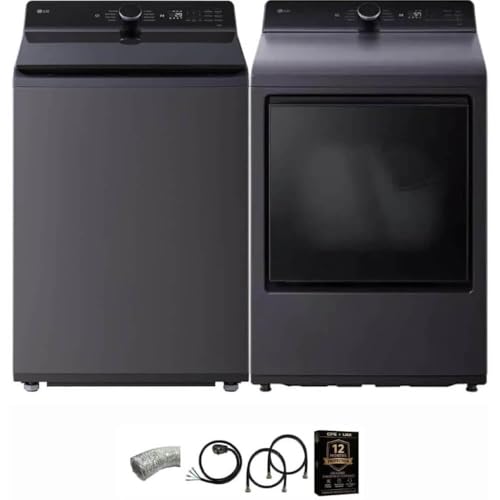
Finish first, because this LG pair is the one pick here that treats the laundry room as a designed space. The listing describes a matte black mega-capacity top-load washer and dryer pair, and matte black appliances change a room’s feel more than any cycle option ever will. Households renovating a visible laundry area, rather than hiding it in a basement, will understand the appeal immediately. Just know that dark finishes advertise lint and detergent splashes more honestly than white enamel does, so the look asks for a quick wipe-down habit in return.
The washer’s named technology is TurboWash, LG’s approach to shortening the wash by working loads more intensively rather than simply soaking them longer, and the listing adds SmartThinQ Wi-Fi connectivity. Speed claims deserve calm reading: a faster thorough cycle helps households that turn laundry around between school, sport, and work, yet no quick cycle rescues an overloaded tub or compensates for detergent overdosing. Notably, the listing title does not print the washer’s exact cubic-foot capacity, calling it mega capacity instead, so this review will not invent a figure; check the listing’s specification section if an exact number drives your decision.
On the dryer side the title lists steam and sensor drying, a pairing aimed at loads that emerge less wrinkled and less over-dried. The bundle also folds in a dryer vent, a power cable, and a twelve-month protection plan according to the listing, which nudges it toward buyers who want a single delivered package with few accessory errands afterwards. As ever on this page, the pair format decides suitability before any feature does. Both machines or neither is the honest framing, and households replacing one appliance should scroll on.
- Capacity wording in the title: mega capacity, no figure printed
- Washer technology named in the title: TurboWash
- Connectivity in the title: SmartThinQ Wi-Fi
- Dryer features in the title: steam dry, sensor dry
- Configuration: washer and dryer pair, matte black
Strengths
- Matte black finish suits visible, renovated laundry spaces
- TurboWash targets households pressed for turnaround time
- Bundle includes vent, cable, and a protection plan per listing
Trade-offs
- Exact washer capacity is not printed in the listing title
- Dark finish shows lint and splashes readily
- Pair-only sale, like the Samsung bundles above
Best for: a style-conscious household replacing both machines and valuing faster everyday cycles over spec-sheet precision.
Not suited for: a buyer who needs a confirmed cubic-foot figure before shortlisting anything.

Kenmore 4.4 Cu. Ft. Top Load Washer with Triple Action Agitator — Standalone scrub-focused pick
Kenmore’s entry makes its argument in the tub. The listing describes a 4.4 cubic foot top-load washer built around a triple-action agitator, language that promises movement in more than one direction rather than a simple back-and-forth swish. For households whose laundry includes ground-in garden soil, workshop grime, or children’s sports kits, that mechanical enthusiasm is the point of the machine. Gentle it may not be, compared with a wash-plate design, but this pick never pretends delicates are its home turf. It is the scrub-first option in a guide otherwise dominated by gentler HE philosophies.
Two speed features share the title with the agitator. Express Wash addresses the small, urgently needed load, the school uniform discovered at bedtime, while AccelaWash is the brand’s broader time-trimming approach for fuller loads. Touch controls complete the listing’s description, giving the machine a flat, wipeable panel instead of a rotary dial. Touch panels divide opinion sharply: they clean easily and look tidy, yet gloved or wet hands sometimes prefer a knob with physical detents. Decide which camp your household occupies before ordering, because you will touch that panel thousands of times.
At 4.4 cubic feet as a standalone washer, this Kenmore occupies the page’s most conventional slot, and that is a compliment. No bundled dryer inflates the transaction, no extreme footprint limits the room, and the capacity covers couples and small families without the stuffing temptation of the largest tubs. Buyers cross-shopping it against the KoolMore should weigh the extra capacity and triple-action scrubbing here against the KoolMore’s narrower cabinet there. Room dimensions, as so often with laundry, may make the decision before preferences get a vote.
- Capacity printed in the listing title: 4.4 cu. ft.
- Wash action named in the title: triple action agitator
- Speed features in the title: Express Wash, AccelaWash
- Controls described in the title: touch controls
- Configuration: standalone washer, white finish
Strengths
- Triple-action agitator suits genuinely grubby loads
- Two named speed options cover small and full loads
- Standalone format keeps the purchase focused
Trade-offs
- Agitator action is the least delicate approach here
- Touch panel will not please committed dial loyalists
- Capacity trails the largest Samsung by a wide margin
Best for: a standalone-washer buyer whose loads skew dirty and who wants mechanical scrubbing with modern speed options.
Not suited for: a delicates-heavy wardrobe that needs the softest wash action available.
A Major Maker’s Dealer-Channel HE Top-Load Range (Prose-Only) — Prose-only dealer range
This slot exists to keep the guide honest about how Americans actually buy top-load washers. A substantial share of high-efficiency models from the largest national brands reaches homes through regional appliance dealers, kitchen-and-laundry showrooms, and builder channels rather than through a tidy marketplace listing. Our verified pool contains no clean listing for such a range, so this pick is prose-only by design: no link, no model number, and no specifications beyond what can be said about the type in general terms. Treat it as a shopping route, not a product.
The route has real advantages worth describing qualitatively. Dealer-sold HE top-load ranges typically span several capacities and both wash-plate and agitator formats under one brand umbrella, letting a showroom visitor compare actions side by side with the same load of towels. Dealers also bundle delivery, levelling, hose replacement, and haul-away into the transaction, services that marketplace purchases arrange separately. For buyers who value a local technician who has seen their exact machine before, that service relationship is the product, and it can be worth a premium tier positioning over the linked picks here.
The costs of the route are equally real. Pricing is quoted rather than listed, comparison takes shoe leather, and delivery slots follow the dealer’s calendar rather than a courier’s. Shoppers who want one of these ranges should bring room measurements, hookup photographs, and a firm detergent-and-loading conversation to the showroom, and should ask which exact configuration, wash plate or agitator, they are being quoted. Then compare the dealer’s all-in figure against the delivered reality of the linked machines above before signing anything.
- Buying route: dealer showrooms quote this range model by model, so no single marketplace listing defines it
- Format described: full-size HE top-load range, qualitative only
- Sales channel described: appliance dealers and showrooms
- No capacity, cycle, or efficiency figure is claimed for this pick
- Positioning described in words only: premium tier, service-led
Strengths
- Showroom comparison of wash actions before committing
- Delivery, levelling, and haul-away usually bundled
- Local service relationship for the machine’s whole life
Trade-offs
- No transparent listed price to compare at home
- Choice depends on regional dealer stock and scheduling
- Nothing here can be verified against a listing title
Best for: a buyer who prizes local service and hands-on comparison over one-click purchasing.
Not suited for: a shopper who wants every claim on this page tied to a checkable listing.
How do the six picks compare side by side?
| Pick | At a glance |
|---|---|
| KoolMore 4.0 Cu. Ft. Top Load Washer with Agitator | 4.0 cu. ft., 25-inch cabinet, agitator, standalone. |
| Samsung 4.5 Cu. Ft. Top Load HE Washer and Dryer Pair | 4.5 cu. ft. washer plus 7.4 cu. ft. electric dryer, pair only. |
| Samsung 5.2 Cu. Ft. Top Load HE Washer and 7.4 Cu. Ft. Dryer Pair | 5.2 cu. ft. washer plus 7.4 cu. ft. electric dryer, pair only. |
| LG Top Load Washer and Dryer Pair with TurboWash | Mega-capacity pair, TurboWash, matte black, capacity unprinted. |
| Kenmore 4.4 Cu. Ft. Top Load Washer with Triple Action Agitator | 4.4 cu. ft., triple-action agitator, standalone. |
| A Major Maker’s Dealer-Channel HE Top-Load Range (Prose-Only) | Prose-only dealer range; no figures claimed. |
What does high-efficiency actually change in a top-load wash?
Everything begins with water volume. A conventional top-loader filled to the brim, using the tub’s depth as its cleaning medium and asking the agitator to stir a small lake. An HE top-loader fills shallowly, wets the load thoroughly, and then relies on motion, time, and detergent chemistry. The practical consequences reach further than the water bill. Loads emerge from the spin drier, which shortens dryer time. Fabrics flex against each other rather than being dragged around a post, which many owners find kinder to prints and knits. And the machine’s sensors spend the cycle managing balance and suds in ways older designs never attempted.
The trade is feedback. In a deep tub you could see cleaning happening; in a shallow HE tub you must trust a process you barely witness, and that trust takes a month of good results to build. Resist the two classic sabotages during that month. Do not add extra water through a bucket or a deep-fill override for every load, because routine overriding converts an efficient machine into an inefficient one with extra steps. Do not compensate with detergent either. HE detergent at the marked dose is formulated for low water; doubling it leaves residue that the limited rinse cannot clear, and the residue then masquerades as a machine fault.
Where front-load machines still hold an edge, honesty requires naming it. A front-loader’s tumbling lifts and drops laundry through water with gravity’s help, typically using even less water and extracting more in the spin. The top-load HE format answers with loading ergonomics, no stooping, mid-cycle additions through the lid on many designs, and no door gasket to wipe. Neither format wins universally. The household that hates bending and loves adding forgotten socks mid-wash has already chosen, and this guide exists to serve that choice well.
How should you load and dose an HE top-loader for clean results?
Loading technique is the cheapest performance upgrade in this entire category. Place items loosely around the tub’s perimeter, alternating large and small pieces, rather than dropping a compressed ball of laundry from the hamper. The goal is a load the wash action can circulate: each garment should be able to travel, flex, and exchange places with its neighbours. Bulky items go in one at a time, balanced by weight around the tub, and a single heavy blanket deserves a cycle of its own rather than a supporting cast of towels that will migrate to one side and trigger balance corrections.
Detergent dosing follows the load and the soil, not habit. Use detergent labelled for high-efficiency machines, measure to the line for your load size, and treat the maximum line as a ceiling reserved for genuinely filthy loads rather than a default. Pods simplify dosing for average loads but remove flexibility for small or lightly soiled ones, where a measured liquid dose can go lower. Hard water complicates the picture, since minerals consume detergent before soil does; households on hard water may need the upper part of the marked range, while soft-water homes often clean beautifully at half the dose they used in their old machine.
Finally, give cycles their time. The efficient programmes on these machines are not slow by accident; extended contact between detergent solution and fabric does work that water volume used to do. Reaching constantly for the fastest option, then judging the category by the results, is like judging a slow cooker by its microwave setting. Keep one quick cycle for genuine emergencies, let the normal and heavy-duty programmes run their full course for weekly laundry, and the shallow tub will stop looking like a compromise and start looking like a method.
Which capacity honestly fits your household’s laundry rhythm?
Manufacturers print capacity in cubic feet, but households experience capacity as loads per week and minutes spent sorting. A 4.0 cubic foot tub serves one or two people elegantly, especially in homes where laundry happens in small, frequent batches that never grow into a weekend backlog. Its limit appears with bedding and with children: a queen duvet becomes a solo performance, and a family’s accumulated week becomes four or five cycles rather than two. None of that is failure. It is arithmetic, and it only disappoints buyers who expected a compact tub to behave like a cavern.
The middle band, roughly 4.4 to 4.5 cubic feet in this guide, is where most couples and three-person households land happily. A king comforter fits as a dedicated load, weekly clothing clears in two or three cycles, and the tub still behaves on a small midweek wash without the cavernous emptiness that tempts owners of the largest machines to postpone laundry until the tub can be filled. Postponement is an underrated cost of oversizing: laundry that waits for a full load is laundry that sits, wrinkles, and eventually becomes an all-day event.
Above five cubic feet, the machine suits households whose laundry genuinely arrives in bulk: several children, multi-generational living, home-based work with uniforms, or a vacation-let turnover rhythm. The discipline required is loading loosely despite the space, and the reward is a weekly load count that can drop by a third. Measure the room before coveting the volume, though. Big top-loaders are deep as well as wide, shorter users should test reach into a comparable tub in a showroom, and a washer you cannot comfortably empty will annoy you every single week of its long life.
What should you check before a washer and dryer pair arrives?
Three of this guide’s picks are pairs, so pair logistics deserve direct treatment. Measure the combined width of both machines plus the gaps your hoses, vent, and power cords require, then measure every doorway and turn between the delivery point and the laundry room. Delivery crews solve many problems, but a staircase turn that defeats a 27-inch cabinet is a fact, not a challenge. Photograph the hookups as they are, including shutoff valves and the dryer’s vent route, and compare them with the incoming pair’s requirements while returns are still painless.
Confirm the dryer’s fuel and venting against your home, not against hope. The Samsung pairs here pair their washers with electric dryers, and the LG bundle lists its vent among the included items; an electric dryer needs the correct high-voltage outlet, and a vented dryer needs a clean, short route outside. Discovering a mismatched outlet after the old machines have been hauled away converts an exciting delivery day into a laundromat week. A short call to an electrician before ordering costs little and settles the question permanently.
Plan the swap sequence too. Wash a final load in the old machine the day before, run the new washer’s empty cleaning cycle first, and keep the old hoses only if they are genuinely recent; new machines deserve new supply hoses as cheap insurance. Level the washer carefully, run a medium load, and stay within earshot for the first spin. Small rocking corrected on day one prevents the walking-washer problems that owners later blame on the machine’s balance system rather than on its feet.
How does spin speed change the rest of laundry day?
The least discussed efficiency in an HE top-loader happens after the wash water drains. A vigorous spin extracts moisture mechanically, which is far cheaper than evaporating it with dryer heat, so loads leave these machines feeling merely damp rather than wet. That difference compounds across a year of laundry: shorter dryer cycles, less heat exposure for elastic and prints, and less humidity pumped into the laundry room. It also explains why an HE washer can post a longer wash time yet still shorten the total journey from hamper to drawer.
Extraction has a behavioural price, though. High-spin loads emerge creased and tightly pressed against the tub wall, and garments left sitting in that state will hold their wrinkles like a grudge. Owners who unload promptly, give each item a sharp shake, and hang or fold immediately see the benefit without the creasing penalty. Owners who start a load before work and empty it at dinner should choose gentler spin settings for everyday clothing and reserve maximum extraction for towels, bedding, and other items that forgive compression gracefully.
Balance management ties into the same story. A modern HE machine will redistribute a lopsided load, sometimes repeatedly, before committing to full spin speed, which is why a single heavy item can stretch a cycle’s final minutes unpredictably. Loading with a rough symmetry of weight, pairing the bath mat with towels rather than washing it alone, keeps the machine decisive. The spin is where these washers earn their keep, and loading habits that respect the spin are rewarded every single cycle.
What maintenance keeps an HE top-loader smelling clean?
Low-water machines concentrate their hygiene demands in a few predictable places. Detergent and softener dispensers hold damp residue between cycles, the tub’s upper rim collects splash deposits the shallow fill never rinses, and any standing moisture in a closed lid environment invites the stale smell owners describe as HE odour. None of this indicates a defective machine. It indicates a machine whose cleaning routine has not yet caught up with its water savings, and the fix is a rhythm rather than a rescue.
Monthly, run the tub-clean programme if the machine offers one, or the hottest, longest empty cycle available, and wipe the dispenser drawer and the lid’s underside while they are still warm. Weekly, leave the lid open after the last load until the tub feels dry to the touch, a habit that costs nothing and prevents more odour than any scented additive. Between those rhythms, measure detergent honestly, because residue from chronic overdosing feeds the very film the cleaning cycle then has to remove.
Water quality writes the final paragraph of maintenance. Hard water leaves mineral scale that roughens surfaces and traps deposits, while very soft water makes overdosing easier because suds appear generous at tiny doses. Households that know their water can tune both detergent and cleaning frequency to it. Households that do not can learn most of what matters from one month of observation: film, suds behaviour, and smell each report a specific cause, and each cause has a specific, inexpensive answer.
Are smart features on an HE washer worth learning?
Connectivity appears in the titles of both Samsung pairs and the LG pair on this page, so the question deserves a direct answer rather than a shrug. The genuinely useful smart features for a top-loader are humble: an alert when a cycle finishes, so damp laundry stops sitting forgotten; a remote glance at remaining time when the laundry room sits two floors away; and diagnostic information that can save a service visit when a drain or balance fault appears. Used for those three jobs, the app earns its place on the phone.
The less useful layer is novelty control for its own sake. Starting a washer remotely only helps a household that loaded it, dosed it, and deliberately deferred the start, which describes planned routines rather than spontaneous ones. Downloading extra cycles matters to the minority who will actually experiment beyond the four programmes every household truly lives on. None of this argues against choosing a smart model, since the connectivity rarely harms anything. It argues for paying for capacity, wash action, and fit first, and treating the app as a pleasant passenger rather than the driver of the decision.
One practical warning belongs here. A connected appliance lives on home Wi-Fi, and laundry rooms sit in basements and utility corners where signals go to die. If your router’s reach into that room is doubtful, test it with a phone before valuing any smart feature, because a washer that cannot hold its connection delivers none of the alerts that justified it. The machines wash identically offline, which is the reassuring part: connectivity is a convenience layer over a mechanical purchase, never the purchase itself.
How long should an HE top-loader reasonably serve?
Buyers reasonably expect a full-size washer to serve for many years, and the honest answer is that longevity in this category is written more by installation and habits than by badge. A machine levelled carefully on a solid floor, fed through sound hoses, loaded within its design, and kept clean will outlast a neglected machine from any brand on this page. Vibration is the slow enemy: a washer that rocks or walks transmits stress to its suspension, its fasteners, and eventually its bearings with every spin, which is why the unglamorous work of levelling on delivery day pays interest for a decade.
Parts and service access form the second half of the story. National brands and dealer-channel ranges hold an advantage here, because their service networks stock common components and their designs are familiar to independent technicians. Smaller brands can still serve well, yet a buyer choosing one should confirm who repairs them locally before the purchase, not during the first breakdown. Ask the question while it is hypothetical and the answer is free.
Finally, match the machine’s ambition to your horizon. A household expecting to move within a few years may rationally choose the simpler, narrower pick and leave it with the house. A household settling for the long term should weight repairability, capacity headroom, and control simplicity more heavily, because the machine bought today will meet future laundry you cannot yet predict, from infants to teenagers to returned adult children, and the best HE top-loader is the one still quietly working when each of those chapters arrives.
What does an HE top-loader cost to run, honestly?
Running costs in this category are dominated by water and by the energy spent heating it, which is precisely the territory where a low-water design earns its keep. A household washing daily will feel the difference in its utility bills across a year far more clearly than a household washing twice a week, so the efficiency premium in any purchase price should be weighed against your real load count rather than a generic promise. Count last month’s loads before shopping and the arithmetic becomes personal instead of theoretical, which is the only arithmetic that should move money.
The second cost hides in the dryer. Because these washers extract so much moisture mechanically, dryer cycles shorten, and the savings there arrive as electricity or gas not burned rather than water not used. Households that line-dry benefit differently: a hard spin leaves laundry closer to dry on the line, shortening the window in which weather can ruin a washing day. Either way, the washer’s spin is an economic feature, and models should be compared with that in mind rather than by wash programmes alone.
Detergent completes the honest ledger. HE machines sip detergent as well as water, and a bottle lasts noticeably longer once dosing discipline sets in, while the overdosing habit quietly taxes its owner twice: once in wasted detergent and again in the extra rinses and cleaning cycles needed to purge the residue. None of these savings will retire anyone early, yet together they mean the efficient machine keeps repaying a modest dividend every week it serves, and that steady dividend, not any single bill, is the true financial character of the category.
Which fabrics gain most from the HE top-load method?
Athletic wear is the quiet winner of low-water washing. Technical synthetics release soil readily, resent heat and agitation abuse, and emerge from a vigorous spin nearly dry, so the HE combination of shallow water, fabric flexing, and strong extraction suits them almost perfectly. Households built around training kits, school sports, and outdoor work will find these loads come back fresher with less wear than a deep, hot, heavily stirred wash ever delivered, especially when detergent stays measured and fabric softener stays away from the moisture-wicking fibres it can coat.
Everyday cottons sit in the comfortable middle. T-shirts, underwear, and bed linen wash predictably in any of the machines on this page, and their results respond more to sorting and dosing than to the choice between an agitator and the broader HE approach. The loads that ask for thought are the extremes at both ends: delicate knits that want the gentlest available cycle and minimal company, and genuinely filthy workwear that wants time, the heaviest programme, and occasionally a pre-treatment at the sink before the machine takes over. A washer chosen for your middle loads and used thoughtfully at the extremes will serve the whole wardrobe without drama.
What mistakes do buyers of HE top-load washers keep making?
Overdosing detergent leads the list, because the instinct that more soap means cleaner clothes survives every technology change. In low water, surplus detergent becomes residue on fabric, a film inside the tub, and eventually an odour blamed on the machine. Measure, then measure slightly less, and let a month of results retrain the instinct.
Treating deep-fill as a default rather than an exception is the second error. A deep-fill option exists for particular loads, such as heavily soiled workwear or bulky items that need full immersion to wet through. Using it universally quietly converts an efficient purchase into a conventional one, at a conventional machine’s running costs, while the owner tells friends the HE savings were exaggerated.
Third, buyers compare pairs and standalone washers as if they were interchangeable line items. A pair’s price includes a dryer you may not need, its installation covers two machines, and its value collapses if one half mismatches your home’s fuel or venting. Compare like with like: washer-only households should rank the standalone picks first and treat pair prices as a different category of decision entirely.
Finally, shoppers skip the reach test. Top-load tubs have grown deeper as capacities climbed, and a machine that fits the room may not fit the user. If the primary laundry-doer cannot comfortably retrieve a wet sock from the tub’s bottom, every load becomes a stretch and a strain. Check depth against the actual human, not the brochure, before any capacity figure seduces you.
Final Recommendation
Ranked for most households, the Kenmore 4.4 is this page’s easiest recommendation: standalone, honestly sized, and built around scrubbing action with modern speed options. The KoolMore wins outright wherever width rules, and the 5.2 cubic foot Samsung pair wins wherever volume rules and both machines need replacing. The LG pair suits renovators who want the room to look deliberate, and the dealer route suits service-first buyers willing to shop in person.
Whichever route you take, commit to the HE method rather than fighting it: loose loads, measured detergent, full cycles. Do that, and the shallow tub that looked like a compromise on delivery day becomes the reason your laundry room uses less water, dries faster, and asks less of your clothes each week, which is precisely the future these machines were built to deliver.
One last word on expectations: judge your new machine after a month of honest use, not after the first load, because both you and the washer are learning a new rhythm together, and the household that gives the method a fair month rarely wishes for its old water-hungry tub back.
Frequently Asked Questions
Do HE top-load washers clean as well as older deep-fill models?
Yes, when loaded loosely and dosed with measured HE detergent, because cleaning comes from fabric flexing, chemistry, and time rather than water depth. Most disappointment traces back to overdosing or cramming, both of which defeat the low-water method the machine depends on.
Can I add a forgotten item after the cycle starts?
Top-load designs generally make mid-cycle additions easier than front-load machines, since opening the lid does not fight a water seal. Pause behaviour varies by model and cycle stage, so check the specific listing and manual, but the format itself is forgiving on this point.
Why does my HE washer take longer than my old machine?
Efficient cycles trade water volume for contact time, letting detergent solution work on fabric longer. The longer wash is usually offset by a faster, more effective spin that shortens dryer time, so judge the pair of machines on total laundry time rather than the wash clock alone.
Should I buy a pair or a standalone washer?
Buy the pair when both machines are ageing together and your home suits the included dryer’s fuel and venting. Buy standalone when your dryer is healthy, because bundle pricing quietly charges you for an appliance you do not need yet.
What detergent belongs in these machines?
Use detergent labelled for high-efficiency machines, measured to the load size and soil level marked on the packaging. Low-sudsing formulation matters more in shallow water, where excess suds cushion the wash action and resist rinsing.
Do HE top-loaders need special plumbing?
No special plumbing is required beyond the standard hot and cold supplies and a drain that any top-loader needs. What matters more is water pressure adequate for the machine’s fill valves and hoses in good condition, since efficient cycles meter water precisely and weak pressure stretches fill times noticeably.
Related Guides
Keep reading across the wider laundry and linen shelf: start with the gentle wash-plate comparison in Best Impeller Top-Load Washers Best Top-Load Washers With Agitators and Water-Level Choice Best Energy-Efficient Electric Clothes Dryers Best 800 GSM Towels.


[…] earlier verified coverage of the high-efficiency end of this same category, Best HE Top-Load Washers, pairs naturally with the hot-wash discussion above and compares the format on efficiency […]