What's inside
- Key Takeaways
- Quick Picks
- How We Chose These Picks
- How Do the Six Compare at a Glance?
- What Does Ventless Actually Mean, and What Does It Not Mean?
- When Is an Indoor Vent Kit an Acceptable Answer?
- How Do You Run a Combo So the Dry Actually Finishes Well?
- What Should a Renter Check Before Any of These Arrives?
- How Much Do These Choices Cost to Live With?
- What Does Each Group Ask of the Room Itself?
- How Do You Compare a Combo’s Price Against a Dryer-Only Machine?
- What Happens to Cycle Times in the Real World?
- How Should You Maintain an Apartment Dryer in a Small Space?
- Which Households Should Skip Ventless Entirely?
- How Do You Decide in One Visit to the Laundry Corner?
- What Does the First Month Teach Owners of Each Group?
- What About Noise, Neighbours, and the Flat Below?
- How Does Season and Climate Bend the Choice?
- Which Mistakes Send Apartment Dryers Back?
- Final Recommendation
- Frequently Asked Questions
- Related Guides
As an Amazon Associate I earn from qualifying purchases. This post may contain affiliate links at no extra cost to you.
cottageverdict.com is reader-supported. When you buy through links on our site, we may earn an affiliate commission.
Where to buy: all six dryers below are sold through Amazon, and the linked names in this guide lead to each model’s listing, where you can check price on Amazon and verify the drying type, dimensions, and venting requirements before ordering. The best affordable apartment dryers for ventless spaces start from a rental reality: the lease forbids cutting a vent hole, the building’s walls are not yours, and the laundry still has to get dry. But this category’s marketing plays loose with the word ventless, so this guide begins by sorting the six picks into the three groups they actually belong to — because buying the wrong group is the one mistake no amount of careful use can undo.
Group one is genuinely ventless: the Kenmore at the top of this list is a condensing dryer that needs no exhaust at all, trapping moisture as water inside the machine. Group two is the ventless combos — the Equator, the Conserv, and the COMFEE’ — single machines that wash and then dry without a vent, condensing their moisture internally. Group three is the honest complication: the BLACK+DECKER and the MOJOCO are portable dryers that are VENTED designs. They are small, affordable, and apartment-friendly in size, but they move moist air out through a hose and need an exhaust path — a window, or an indoor vent kit that captures lint and returns the air to the room. They appear here because apartment shoppers meet them in every search, and you deserve a guide that tells you what they are rather than one that lets the word portable impersonate the word ventless.
With the groups straight, the choice becomes manageable. True ventless machines cost more and dry more slowly; vented portables cost less and dry briskly but ask the room a question. Everything below is written to keep those groups visibly separate, pick by pick.
Key Takeaways
- Only four of the six picks are truly ventless: one condensing dryer and three washer dryer combos.
- The BLACK+DECKER and MOJOCO portables are vented machines that need a window hose or an indoor vent kit — plan the exhaust before ordering.
- Combos trade throughput for a single box and a single plug; the Kenmore is a dryer only and pairs with whatever washer you have.
- Affordable in this category means watching the whole cost: vent kits, stacking or stand space, and your time across longer ventless cycles.
- Condensing and combo drying both return water as liquid — tank or drain hose — never as vapour into the room.
- Small drums reward small, frequent loads regardless of which group you choose.
Quick Picks
| Pick | Badge | Why it earns its place |
|---|---|---|
| Kenmore 4.0 cu ft Ventless Condensing Dryer | True Ventless, Dryer Only | A genuine condensing dryer with sensor cycles — the purest answer to a no-vent lease in this group. |
| Equator 24in Ventless Washer Dryer Combo 1.6 cu ft | Ventless Combo, Built-In Look | A 110V ventless combo with a fast 1400 RPM spin, made to disappear into cabinetry. |
| Conserv 24in Compact Combo Washer Dryer | Convertible Vented or Ventless | Rare flexibility: this combo can dry vented or ventless, with a winterize feature for seasonal homes. |
| COMFEE’ 24in Washer Dryer Combo 2.7 cu ft | Largest Combo Drum | The roomiest combo here, with steam care aimed at the creasing combos are known for. |
| BLACK+DECKER 3.5 cu ft Portable Dryer BCED37 | Portable but Vented — Honest Label | A capable 3.5 cu ft portable that exhausts through a hose; excellent where a window is near, wrong where none is. |
| MOJOCO Portable Clothes Dryer 600W | Tiniest Footprint, Vented | A 600W mini dryer for a few garments at a time; it also vents, so its home is beside a window. |
How We Chose These Picks
Affordability was the first screen, but we defined it the way a renter experiences it: the machine, plus whatever it needs to actually run in a real flat, plus the cost of the compromises it imposes. A cheap dryer that needs a vent kit, a stand, and a window seat is a different purchase from its sticker’s suggestion, and a ventless machine that costs more but installs anywhere may be the cheaper answer to a lease with a no-alterations clause. We also refused to launder terminology: any machine that exhausts air is described as vented in this guide, however portable it is.
The second screen was group coverage. Apartment drying is not one problem but three — the dryer-only problem beside an existing washer, the one-box problem where a combo must do everything, and the minimal problem of a single person with a few loads and a window nearby. The six picks map onto those problems deliberately, two or three honest options per problem, rather than six near-identical machines ranked by decimals.
Finally, we favoured listings that state their method plainly — condensing, ventless combo, vented portable — in their own descriptions. A maker who labels the machine’s physics honestly in the listing is likelier to support it honestly afterward, and in the affordable tier that correlation is worth real money.

Kenmore 4.0 cu ft Ventless Condensing Dryer — True Ventless, Dryer Only
Begin with the only machine in this guide that is a dedicated dryer and genuinely ventless. The Kenmore’s listing describes a 4.0 cu ft ventless condensing electric dryer with smart sensor drying, a Wrinkle Guard programme, and efficiency certification. In an apartment context, each of those phrases does specific work. Condensing means the lease is safe: no hole, no hose out a window, no moist air pushed into the room. The moisture your clothes give up leaves as water in a tank or down a drain line, and the machine can stand in a closet, a bathroom, or a kitchen corner with equal indifference to exterior walls.
The sensor system matters more in a rental than anywhere, because apartment loads are irregular — gym kit on Tuesday, bedding on Sunday, a work wardrobe in between — and timed drying guesses wrong in both directions across that variety. A dryer that reads the load and stops at dryness protects both the clothes and the electricity deposit. Wrinkle Guard then covers the apartment reality that the dryer finishes while life is happening elsewhere in a small home: the load tumbles intermittently instead of setting its creases in a warm heap by the closet door.
Because it is a dryer only, the Kenmore asks you to already own, or separately buy, something to wash in — which for many renters is precisely the situation, the washer having arrived with the flat or survived from a previous home. It stacks where its matching arrangements allow or stands alone, and at 4.0 cu ft it swallows a compact washer’s output whole. For the reader whose problem statement is exactly no vent, no combo, just drying — this is the guide’s cleanest answer, and its price positioning among true ventless machines is why it leads an affordability list.
- Drying method: ventless condensing — no exhaust of any kind
- Capacity: 4.0 cu ft, dryer only
- Controls: smart sensor drying with Wrinkle Guard finishing
- Water handling: condensate tank or drain hose
- Efficiency: certification noted in the maker’s listing
Strengths
- Genuinely ventless, so it satisfies the strictest no-alterations lease.
- Sensor cycles suit the irregular load mix of apartment life.
- Full dryer drum takes a compact washer’s whole output at once.
Trade-offs
- Washing requires a separate machine you must already have or buy.
- Condensing cycles run longer than a vented dryer’s would.
- Returns warmth to the room while it works, like all condensing designs.
Best for: renters with a washer already and a lease that forbids venting outright. Not suited for: anyone needing one purchase to cover washing as well as drying.
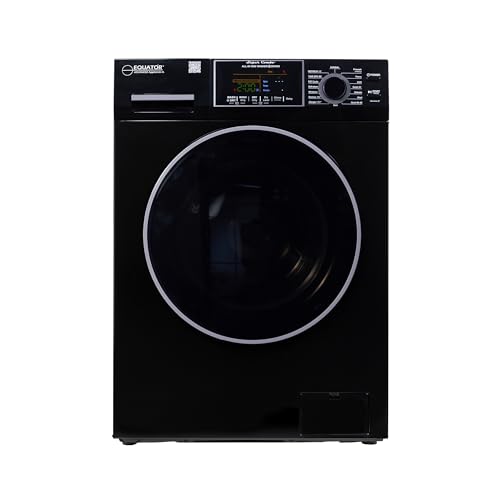
Equator 24in Ventless Washer Dryer Combo 1.6 cu ft — Ventless Combo, Built-In Look
The Equator combo approaches the apartment problem from the opposite end: one 24-inch cabinet, fully built-in in intent, that washes and ventless-dries a 1.6 cu ft load on 110 volts. The listing’s details sketch a considered machine — a 1400 RPM spin, which is brisk for this class and directly shortens every dry cycle by leaving less water in the clothes, and a black finish intended to sit inside cabinetry runs rather than apologize beside them. Equator builds for small-space living as its main trade, and this combo is its apartment flagship in miniature.
That spin speed deserves its emphasis, because in ventless drying the washer half of a combo is secretly the dryer’s best feature. Every extra cup of water the spin extracts is a cup the condenser never has to remove with time and electricity. A 1400 RPM extraction on synthetics and cotton leaves loads noticeably closer to dry than the gentler spins of cheaper combos, and across a year of laundry the saved minutes compound into the machine’s real efficiency story — more than any single cycle’s claims.
The limits are the combo limits, stated once here for all three combo picks: the drum dries best at partial load, the full wash-and-dry programme occupies the machine for hours, and one cabinet means one point of failure. Within them, the Equator is the choice for a fitted kitchen or a built-in laundry wall where the appliance should vanish into the joinery — the flat where the laundry looks designed rather than accommodated. Its 1.6 cu ft capacity suits singles and couples who wash steadily rather than in weekend bulk.
- Drying method: ventless condensing combo — wash and dry in one drum
- Capacity: 1.6 cu ft
- Spin speed: 1400 RPM, strong extraction for the class
- Power: 110V standard household supply
- Format: 24-inch built-in style, black finish
Strengths
- Fast spin shortens every ventless dry that follows it.
- Built-in styling suits fitted kitchens and laundry walls.
- One cabinet, one plug, zero vent — the full rental-safe package.
Trade-offs
- Smallest capacity among the combos here.
- Serial wash-then-dry operation caps daily throughput.
- Black finish shows lint in a laundry setting.
Best for: design-conscious flats wanting laundry that disappears into cabinetry. Not suited for: households washing for more than two people.

Conserv 24in Compact Combo Washer Dryer — Convertible Vented or Ventless
The Conserv combo carries a trick none of its rivals here can match: according to its listing, it can dry either vented or ventless. That convertibility sounds like a brochure flourish until you map it onto real housing trajectories. The renter who cannot vent today moves in two years to a place with a laundry wall that can; the combo bought for the first home keeps serving in the second, switching its drying method instead of being sold. Seasonal homes get the second listed feature — a winterize programme — which prepares the machine to sit safely through a cold, empty season, a detail that matters enormously to cabin and lake-house owners and not at all to anyone else.
The listing also calls the machine quiet, and quiet in a combo earns a premium of its own because combos live close to their people — the studio’s kitchen corner, the one-bedroom’s hall closet. A machine that runs its long evening cycles without colonising the room’s sound is a machine that gets used at the hours that suit the household, which in practice means it gets used properly: full programmes, sensor finishes, no impatient mid-cycle retrievals of half-dry clothes.
As with its combo siblings, drying capacity trails the wash drum and the full programme is a long one; the convertible design does not repeal combo physics. What it repeals is the housing gamble. Of the six picks, this is the one to buy when your address is likely to change before the appliance wears out — students facing moves, professionals on rotations, anyone whose next home is unwritten. Flexibility is its specification, and for the mobile household it outranks a larger drum.
- Drying method: convertible — vented or ventless dry in one combo
- Format: 24-inch compact combo, 110V
- Seasonal feature: winterize programme for homes that sit empty
- Operation: quiet-running design brief
- Finish: black
Strengths
- Survives a house move that changes your venting options.
- Winterize mode suits cabins and seasonal second homes.
- Quiet manners fit studio and one-bedroom living.
Trade-offs
- Convertibility adds complexity a settled household may never use.
- Combo throughput limits apply in full.
- Vented mode still needs an exhaust path arranged when used.
Best for: households expecting a move, and owners of seasonal homes. Not suited for: a settled family wanting maximum loads per day.

COMFEE’ 24in Washer Dryer Combo 2.7 cu ft — Largest Combo Drum
Where the Equator combo argues with spin speed and the Conserv with flexibility, the COMFEE’ argues with room: at 2.7 cu ft it carries the largest drum of the three ventless combos in this guide, and in combo ownership drum room is not a luxury — it is the difference between drying a wash load whole and splitting it into two dry shifts. Its listing adds steam care to the programme set, a feature aimed at the familiar combo complaint that clothes emerge clean yet tired, and positions the machine for dorms and small homes where one appliance must simply handle the week’s laundry without negotiation.
Consider what the extra capacity changes in practice. A couple’s two-day load, a set of bed linen with its towels, a small family’s daily wear — these sit at the edge of a 1.6 cu ft combo’s dignity and inside the COMFEE’s working range. The dry phase still asks for headroom, and disciplined owners will dry at three-quarter loads, but the ceiling lifts enough that ordinary life stops colliding with it. Steam care then plays its part at the end of the cycle, relaxing the creases that long, dense combo dries tend to set, so shirts come out closer to wearable and the iron stays in the cupboard more days than not.
The standing combo cautions apply — serial operation, long full programmes, one cabinet as a single point of failure — and the machine’s overnight-style rhythm is the intended way of life: load in the evening, let the programme run through the quiet hours, unload in the morning. For a small household that can live on that rhythm, this is the combo that asks the fewest compromises per load, and its affordability within the true-ventless group is the reason it anchors this list’s value end.
- Drying method: ventless condensing combo
- Capacity: 2.7 cu ft — largest combo drum here
- Programmes: steam care for crease relief
- Audience: dorms and small homes, per the maker’s positioning
- Format: 24-inch single cabinet, standard outlet
Strengths
- Drum size absorbs ordinary couple-sized loads without splitting.
- Steam care softens the combo category’s creasing habit.
- True ventless operation keeps every lease and wall intact.
Trade-offs
- Full wash-and-dry programmes occupy the machine for hours.
- Drying still prefers partial loads for the best results.
- No separate washer means no overlapping laundry.
Best for: couples and dorm households wanting one ventless box with real capacity. Not suited for: families who need laundry processed in parallel batches.
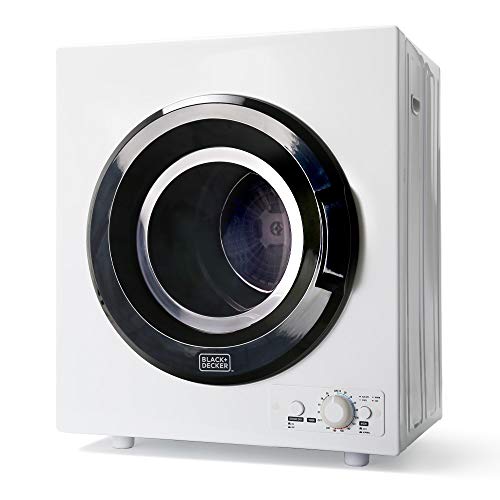
BLACK+DECKER 3.5 cu ft Portable Dryer BCED37 — Portable but Vented — Honest Label
Now the guide keeps its promise and labels the turn in the road. The BLACK+DECKER BCED37’s own listing calls it a vented portable dryer: 3.5 cu ft of stainless drum, 13.2 lb capacity, 1500W on a standard 120V outlet. It is, by the numbers, the most capable dryer drum in this entire guide — larger than the Kenmore’s, larger than any combo’s — and it dries the way vented machines do, briskly, by moving heated air through the load and out. What it is not is ventless. Its moist air leaves through a hose, and that hose needs a destination.
The destinations are two. The straightforward one is a window near the dryer’s station, with the hose fitted to a window kit while the machine runs — the classic portable arrangement, entirely workable in a bedroom or utility corner with a suitable window. The second is an indoor vent kit: a lint-trapping reservoir box that lets the hose discharge into the room, catching lint while the warmed, humidified air joins the household’s. That kit is a legitimate solution in a cool, dry, well-ventilated space and a poor one in a small humid bathroom, and it must be bought and maintained — the reservoir needs water kept in it and lint cleaned out — as part of this dryer’s true cost.
Given a window, though, the BCED37 is a formidable budget answer. It plugs into an ordinary outlet, its drum takes loads the combos would split, its stainless interior treats clothes kindly, and when the lease ends it unplugs and leaves in a car. The household it serves is specific — a renter with a window near the laundry spot and more laundry than money — and for that household it may beat every true-ventless pick here. The household without the window should not be sold it under a ventless banner, which is why this section is written the way it is.
- Drying method: VENTED portable — exhaust hose required, not ventless
- Capacity: 3.5 cu ft, 13.2 lb loads
- Power: 1500W, 120V standard outlet
- Drum: stainless steel
- Exhaust options: window kit or indoor vent kit, arranged separately
Strengths
- Largest, briskest drying in this guide at a portable’s simplicity.
- Runs from an ordinary outlet and moves house in a car boot.
- Full-size loads spare you the combo’s split-and-queue routine.
Trade-offs
- Needs a window or an indoor vent kit — it is not a ventless machine.
- Indoor venting returns warmth and moisture to the room.
- Dryer only: washing still needs a separate solution.
Best for: renters with a window beside the laundry spot and full loads to dry. Not suited for: windowless interior closets or strict no-exhaust leases.

MOJOCO Portable Clothes Dryer 600W — Tiniest Footprint, Vented
The MOJOCO sits at the far end of the size spectrum: a 600W compact dryer for apartments and travel, per its listing, with an adjustable timer and a setup the maker describes as hassle-free. Six hundred watts is a gentle heat budget — a fraction of the BLACK+DECKER’s — and it defines the machine honestly: this is a dryer for a few garments, a uniform, a set of baby clothes, the swim kit after the beach house day. It is also, to keep this guide’s promise, a vented appliance in miniature: its warm moist air needs the same consideration as any exhaust, scaled to its size, which in practice means stationing it near a window or in a room that can accept what it breathes out.
Within that brief, the appeal is obvious. The machine is small enough to live on a counter or in a cupboard, light enough to travel between a dorm and a family home, and cheap to run in the way only a small heater can be. For the single occupant whose laundry is genuinely a few items at a time — the nurse with scrubs on rotation, the athlete with daily kit, the parent of a newborn cycling through small soft loads — a mini dryer sized to the actual problem beats a full machine standing idle and oversized.
What it cannot do is impersonate a household dryer. Family loads would queue for days, heavy cottons and towels test a 600W heater’s patience severely, and anyone buying it as the home’s only dryer for four people has misread the listing’s own words — apartment, travel, mini. Read as what it is, it is a tidy specialist. Read as what it is not, it is a disappointment with a plug, and the distinction is entirely in the reading.
- Drying method: vented mini dryer — give its exhaust a path
- Power: 600W, gentle heat for small loads
- Controls: adjustable timer
- Audience: apartment, RV, and travel use per the listing
- Loads: a few garments at a time, by design
Strengths
- Smallest footprint and simplest setup of the six.
- Gentle wattage suits delicate, small, frequent loads.
- Travels easily between dorm, home, and holiday stays.
Trade-offs
- Not ventless — its exhaust still needs somewhere to go.
- Capacity excludes family-scale laundry entirely.
- Heavy cottons dry slowly on a 600W heat budget.
Best for: singles, travellers, and small-load specialists near a window. Not suited for: serving as a whole household’s only dryer.
How Do the Six Compare at a Glance?
| Model | Group | Size | Exhaust answer |
|---|---|---|---|
| Kenmore 4.0 cu ft Ventless Condensing Dryer | True ventless dryer | 4.0 cu ft | None needed — water to tank or drain |
| Equator 24in Ventless Washer Dryer Combo 1.6 cu ft | Ventless combo | 1.6 cu ft | None needed |
| Conserv 24in Compact Combo Washer Dryer | Combo, convertible | 24-inch class | None in ventless mode; hose in vented mode |
| COMFEE’ 24in Washer Dryer Combo 2.7 cu ft | Ventless combo | 2.7 cu ft | None needed |
| BLACK+DECKER 3.5 cu ft Portable Dryer BCED37 | Vented portable | 3.5 cu ft | Window hose or indoor vent kit |
| MOJOCO Portable Clothes Dryer 600W | Vented mini | Countertop class | Station near a window or ventilated room |
The exhaust column is the whole guide in one glance. Four rows need nothing from the room but power and water; two rows need an air plan. If your lease or your floor plan cannot offer that plan, the first four rows are your list, and the apparent bargains in the last two are bargains for somebody else’s flat.
What Does Ventless Actually Mean, and What Does It Not Mean?
Ventless means the machine completes its work without discharging air anywhere. A condensing dryer cools its internal airflow until the water falls out as liquid; a heat pump variant does the same with refrigeration hardware; a ventless combo applies that drying to a drum that also washes. In every true case the by-products are a tank of water or a drain flow, some warmth in the room, and dry clothes. No hose, no window, no hole, no negotiation.
Ventless does not mean portable, compact, electric, or modern, though the words travel together in listings. A portable dryer with an exhaust hose is a vented dryer that moves house easily. The distinction is not pedantry: it decides whether the machine can work in the windowless closet that motivated your search. When a listing is coy about where the moist air goes, that coyness is your answer — find the sentence about the hose, the vent kit, or the exhaust, and classify the machine by it.
When Is an Indoor Vent Kit an Acceptable Answer?
An indoor vent kit traps lint in a water reservoir and releases the dryer’s air into the room. It is acceptable where the room is large enough, cool enough, and dry enough to absorb warm humid air without consequence — a spacious utility area, a garage-adjacent laundry, a room with an extractor fan or a window that opens after the cycle. It also obliges its owner: the reservoir’s water level maintained, the lint cleaned out on schedule, the kit inspected as the small appliance it is.
It is a poor answer in a small bathroom already fighting mould, in a bedroom closet where humidity settles into clothes, or in a home with respiratory sensitivities to warm lint-adjacent air. In those rooms the true ventless machines are not the expensive option; they are the only option, and their price difference is the cost of the room staying healthy. Choose by the room first and the machine second, always.
How Do You Run a Combo So the Dry Actually Finishes Well?
The governing habit is restraint at the wash stage. A combo’s drum washes its full rating happily, then dries a portion of it well; the owner who loads for the dry, not the wash, gets finished laundry instead of a second shift. Where a big wash is unavoidable, pull out the heavy pieces — towels, denim — and dry them as their own smaller load while the light load finishes. Two considered cycles beat one heroic one on time, energy, and the state of the clothes.
Spin is the second lever: choose the highest spin the fabrics tolerate, because water removed mechanically is water the condenser never spends an hour removing thermally. The third lever is scheduling — combos are marathon appliances, and their natural habitat is the overnight slot or the working day, hours when the machine’s occupation costs nobody anything. Set the load going as you leave or as you sleep, and the combo’s slowness becomes invisible.
What Should a Renter Check Before Any of These Arrives?
Read the lease’s appliance and alterations clauses with the machine’s group in mind. True ventless machines and combos usually need no permission beyond courtesy, since they alter nothing; a vented portable with a window hose is still no alteration, but an indoor vent kit changes the room’s humidity and deserves a landlord conversation in a mould-prone building. Photograph the laundry spot before installation, keep the machine’s feet on a tray or mat where floors are finished, and keep every manual and receipt in one folder for the move-out conversation.
Then check the unglamorous trio: an outlet that can carry the machine without sharing with a heater, a drain or a sink within hose reach for the water side, and a door swing that does not amputate the room. Apartment laundry fails on these details far more often than on drying technology, and every one of them is checkable in ten minutes with a tape measure and a phone torch.
How Much Do These Choices Cost to Live With?
In qualitative terms the running order is steady. The vented portables are the briskest and, per load, unremarkable in energy; their hidden costs are the kit, its upkeep, and the room’s humidity management. The condensing Kenmore spends more electricity per load than a vented machine and returns the difference as room warmth — a cost in summer, a subsidy in winter. The combos spend the most time and modest energy, and their true price is throughput: the household’s laundry occupies one drum for hours, which is free at night and expensive on a Saturday with guests arriving.
Against all of these, price the alternative honestly: the laundromat’s weekly toll in money and hours, or the building’s shared laundry with its queues and its other tenants’ lint filters. For most apartment households, any machine in this guide that matches its group to the room pays for itself in reclaimed evenings long before its motor wears — which is why the category exists, and why choosing the right group matters more than choosing the right brand.
What Does Each Group Ask of the Room Itself?
The true ventless dryer asks for the least and gives the room the most back: it wants air space, a level floor, and a water plan, and it returns warmth. In a bedsit that warmth lands in the living space whether wanted or not, which is why placement beside a hall or bathroom beats placement beside the bed. The condensing Kenmore in a closet off the hall is the classic arrangement — close to the bedrooms producing the laundry, far enough from the sofa to keep its hum conversational rather than theatrical.
The combos ask for plumbing adjacency, because they are washers too: supply, drain, and the vibration manners of a spinning drum join the dryer’s modest needs. A combo in a kitchen run shares the sink’s plumbing elegantly; a combo in a bedroom closet needs the wet wall behind it. Their long programmes also ask the room for time — a combo occupying the only bathroom-adjacent closet will be running, audibly, through many evenings, and the household should choose its corner with the sound in mind.
The vented portables ask for geography: a window within hose reach, or a room that can take the kit’s discharge. That single requirement redraws the flat’s map — the dryer lives where the window is, not where the laundry basket wants it, and the household adapts its carrying routes accordingly. None of these asks is unreasonable. All of them are cheaper to honour at the choosing stage than to renegotiate after delivery.
How Do You Compare a Combo’s Price Against a Dryer-Only Machine?
Compare systems, not stickers. The dryer-only Kenmore presumes a washer exists; if it does not, the honest comparison is Kenmore-plus-washer against a combo alone, and the combo’s single-box price often wins that arithmetic while also winning the footprint. If a washer already exists and works, the comparison inverts: the dryer-only machine is the smaller purchase and the larger drum, and the combo’s premium buys a washing function you would be duplicating.
Then compare the second-order costs. Two machines can be serviced, replaced, and upgraded independently; a combo is retired whole. Two machines overlap their work; a combo queues it. Against that, one machine halves the hookups, the delivery, and the things that can leak. There is no universal winner — there is a household state, washer or no washer, settled or moving, that makes one arithmetic obviously kinder than the other. State your situation in one sentence before shopping and the comparison usually settles itself.
What Happens to Cycle Times in the Real World?
Listings quote cycles the way airlines quote flight times — honestly, under stated conditions that your laundry may not share. A ventless dry of a mixed load in a warm room runs longer than the same load in a cool one, because condensing depends on a temperature difference the room can erode. A combo’s quoted full programme assumes a load sized for drying; load for the wash instead and the dry phase stretches while the drum’s contents steam in their own company. Heavy cotton — the towels, the denim, the hoodie stratum — extends every technology in this guide and shortens none.
The practical response is to stop timing the machine and start scheduling it. Ventless and combo laundry rewards the household that thinks in windows — overnight, the working day, the long Sunday morning — rather than in deadlines. Owners who make that mental switch report the category’s slowness accurately: it exists, and it stops mattering. Owners who need a load dried inside the hour, regularly, should be shopping the vented column of this guide with a window plan, and this guide would rather tell them so than sell them patience they do not have.
How Should You Maintain an Apartment Dryer in a Small Space?
The rituals are the category’s usual ones, compressed by the setting. Filters live behind doors in rooms without utility sinks, so establish where lint gets cleaned and where the tank gets emptied before the first cycle, or the chores will migrate to the kitchen sink by default. A small brush and a dedicated cloth living beside the machine turn filter care into a thirty-second habit instead of a weekly project, and in a small home the difference between a habit and a project is the difference between done and deferred.
Small spaces also concentrate consequences. A slow drip behind a machine in a big laundry room is an annoyance; the same drip in a flat’s closet is a deposit dispute. Check hose connections monthly with a dry hand, keep the floor tray honest, and leave the machine’s door ajar between uses so the drum’s interior dries in rooms whose air is already spoken for. The machines themselves are undemanding; it is the square footage that insists on diligence.
Which Households Should Skip Ventless Entirely?
The honest list is short. Households drying for five or more people on a daily cycle will outrun every drum in this guide and should be solving a full-size laundry problem instead. Households with a genuine one-hour turnaround need — uniforms on rotation, cloth nappies in continuous service — should take the vented route with a proper exhaust if the building allows it, because no condensing technology respects that clock. And households in very humid climates, in rooms without any ventilation, should think carefully even about true ventless machines’ returned warmth, and doubly about indoor vent kits.
Everyone else — the couples, the singles, the small families, the renters under no-alteration leases, the cabin owners, the dorm dwellers — is the category’s natural citizenry. For them the question is never whether apartment drying works, only which of the three groups their rooms describe. Answer that, and the six picks above sort themselves into a decision you can defend to your landlord, your lease, and your laundry basket alike.
How Do You Decide in One Visit to the Laundry Corner?
Stand in the space with three questions. Is there a window the hose could reach without crossing the room? If yes, the vented portables enter the conversation honestly, and their drums and pace may win it. Is there already a washer you intend to keep? If yes, the dryer-only Kenmore is probably your entire decision, and the remaining work is measuring its home. Is the household likely to move within the machine’s early years? If yes, the convertible Conserv insures the purchase against the next floor plan.
If the answers are no window, no washer, no move, the guide’s centre of gravity — the larger COMFEE’ combo or the built-in Equator — is where your shortlist lives, separated by whether you value drum room or extraction speed more. Notice that not one of these questions concerns a brand. Apartment drying is a branch of architecture before it is a branch of retail, and the shoppers who start with the room finish with a machine that fits their life instead of a machine their life must fit around.
What Does the First Month Teach Owners of Each Group?
Condensing owners learn the tank’s rhythm — which loads fill it, which barely touch it — and most convert to the drain hose before the month ends, wondering why they waited. Combo owners learn load sizing in their hands rather than in cubic feet: the weight of laundry that dries beautifully becomes a physical memory, and their wash loads quietly reorganise themselves around it. Both groups learn that the end-of-cycle moment matters — that clothes lifted and hung promptly need almost no ironing, while clothes left sitting re-crease with conviction.
Vented portable owners learn their window kit’s moods: how it seals, how it rattles in a storm, how the hose wants to be routed so it neither kinks nor pools condensate. Kit owners learn the reservoir’s level the way cooks learn a pan. None of this knowledge is onerous, and all of it is the real owner’s manual for the category — the one written by the first month, in the specific flat, with the specific laundry. Expect the apprenticeship, and it feels like mastery arriving; expect perfection on day one, and the same month feels like a complaint.
What About Noise, Neighbours, and the Flat Below?
Apartment drying happens inside shared architecture, and the courteous owner plans for the audience. A dryer on a hard floor above a neighbour’s bedroom broadcasts its drum’s rhythm through the structure; the same machine on a dense mat, levelled properly, in a closet over the building’s own hallway, is a private appliance. Where the machine can stand is a plumbing question; where it should stand, in a multi-unit building, is partly a diplomatic one, and the diplomacy is cheap at the planning stage.
Timing is the other courtesy. Every group in this guide can be scheduled — delay starts and overnight programmes exist precisely so a long ventless cycle can run while the building sleeps lightly or while nobody is home to hear it, depending on which the walls prefer. Learn your building’s quiet hours, keep the spin-heavy washing for sociable times, and the laundry becomes the neighbour nobody has ever thought about, which is the highest praise shared walls offer.
How Does Season and Climate Bend the Choice?
In a cold-climate flat, the condensing machines’ returned warmth is a small heating subsidy and the indoor vent kit’s humidity can even comfort over-dried winter air — the same kit that would be a menace in a Gulf summer. Climate is not a footnote to this category; it is a co-author of every recommendation in it. A guide written in one climate and read in another will mislead politely and completely, which is why this one keeps returning the decision to your rooms rather than to a universal ranking.
Summer in a warm region reverses the sympathies: ventless cycles lengthen as rooms heat, combos ask to run at night, and the window-hosed portable — exhausting its warmth outdoors — suddenly looks like the sophisticated choice rather than the compromise. Households in strongly seasonal places should buy for their worse season, since a dryer that copes with August will forgive January anything, while the reverse is not true. Your climate zone is a specification, as surely as your drum size.
Shoulder seasons flatter every machine in this guide, and delivery-day impressions formed in April should be distrusted accordingly. The appliance you are buying is the one that performs in your hardest month, with your heaviest laundry, in your least ventilated room — judge the six picks against that day, and the choice that survives is the one that will still look wise in year three.
There is one more constituency in this decision that guides rarely mention: the clothes themselves. Ventless and combo drying at moderate temperatures is measurably kinder to elastic, prints, and dark dyes than the fierce heat of an oversized vented dryer, and a wardrobe of modern blended fabrics — gym kit, office knits, children’s clothes with stretch in every seam — ages visibly slower in a gentler drum. Households that replace clothes often may never notice; households that keep garments for years are quietly paid by this category every single week, in waistbands that still grip and blacks that stay black. It is not a reason to choose a group, but it is a dividend every group here pays, and it belongs in an honest accounting of what affordable apartment drying actually returns.
And a closing practical note for the group decision: whatever you choose, keep the packaging until the machine has run a week in your actual rooms. Apartment appliances are returned for fit and fit alone more than for faults — a door swing misjudged, a hose run that crosses a walkway, a hum that lands differently at midnight than at noon. A week of real loads is the only honest trial, and the box in the corner is your insurance that the trial can end in an exchange rather than a regret. After that week, recycle the cardboard with confidence; the machine has been interviewed by the only panel that matters, which is your household, in your flat, with your laundry.
Which Mistakes Send Apartment Dryers Back?
- Believing portable means ventless, and discovering the hose on delivery day in a windowless closet.
- Buying a combo for a family’s throughput, then living with a drum that is always occupied.
- Running an indoor vent kit in a small damp bathroom until the mould files a complaint.
- Loading a combo to its wash rating and expecting the dry phase to cope.
- Skipping the lease check and meeting the landlord’s opinion after the machine is installed.
- Ignoring the water side: no plan for the tank, the drain, or the kit’s reservoir.
Notice that none of these is a defect in any machine above. They are mismatches between a machine’s group and a home’s facts — the exact mismatches this guide was written to prevent.
Final Recommendation
If your lease forbids venting and a washer already lives in your home, the Kenmore 4.0 cu ft Ventless Condensing Dryer is the direct, honest answer. If one box must do everything, choose between the COMFEE’ 24in Washer Dryer Combo 2.7 cu ft for capacity and the Conserv 24in Compact Combo Washer Dryer for flexibility across future homes. And if a window stands beside your laundry spot, the BLACK+DECKER 3.5 cu ft Portable Dryer BCED37 earns its place on merit — as a vented machine, proudly and plainly labelled.
The apartment dryer decision is really a question about your rooms disguised as a question about appliances: answer for the walls, the window, and the lease you actually have, and the right machine is the one still standing when those facts have had their say.
Frequently Asked Questions
Can a ventless dryer go in a closet with no window?
Yes — that is precisely its design brief. Give it air space around the cabinet, a louvred or undercut door so the room’s air can circulate, and a plan for the condensate. The condensing Kenmore and the three combos all work in interior closets where no vented machine could.
Is an indoor vent kit safe to use with a portable dryer?
Used as directed, in a suitable room, yes: keep the reservoir filled to its line, clean the lint it catches, and ventilate the space. It is unsuitable for small damp rooms or anywhere humidity is already a problem. It makes a vented dryer room-compatible; it does not make the dryer ventless.
Why do combos take so long to finish a load?
Because one drum does two jobs sequentially at household-outlet power, and ventless drying is inherently patient. The wash cannot overlap the dry, and the dry itself proceeds at condensing pace. Programmes that run overnight or across the working day hide the duration almost entirely.
Will a portable vented dryer heat up my flat?
With a window hose fitted, most of its heat leaves with the exhaust. With an indoor vent kit, the heat and moisture stay in the room by design — pleasant in a cold utility space, oppressive in a small summer bedroom. The exhaust destination, not the machine, decides the room’s experience.
How large a load can the Kenmore take from my compact washer?
Its 4.0 cu ft drum is deliberately larger than compact washers’ drums, because wet laundry needs tumbling room to dry. A full load from a typical 24-inch washer fits with space to spare; the discipline is the washer’s, and the dryer will rarely be the bottleneck of the pair.
Do I need a drain, or is the tank enough?
The tank is enough, at the price of emptying it on schedule — usually every cycle or two. A drain hose removes the chore permanently where a standpipe or sink is within reach. Most owners start with the tank and convert to the hose within the first month; both paths are normal.
Related Guides
Keep planning with our companion guides: full-size drying on a budget in Best Affordable Gas Dryers, gentle heat for fragile hair in Best Blow Dryers for Damaged Hair, and compact cold storage in Best 5.0 Cu Ft Small Chest Freezers.


