What's inside
- Key Takeaways
- Quick Picks
- How Did We Choose These Compact Portable Dryers?
- What Does Portable Actually Cost You in Performance?
- Where Will a Portable Dryer Actually Live in Your Home?
- Which Compact Portable Dryers Fit Which Small Spaces?
- How Do the Six Portable Dryers Compare?
- How Should You Vent a Portable Dryer Indoors?
- How Do You Get the Best Results From a Small Dryer?
- How Do Portable Dryers Stack Up Against Racks and Heated Rails?
- What Does a Dorm or RV Setup Look Like in Practice?
- How Do You Care for a Portable Dryer So It Lasts?
- How Should Singles, Couples, and Small Families Size Differently?
- How Do Season and Humidity Change Portable Drying?
- What Should You Check on the Day a Portable Dryer Arrives?
- Which Fabrics Love a Portable Dryer, and Which Need Watching?
- What Mistakes Do Portable Dryer Buyers Make?
- Final Recommendation
- Frequently Asked Questions
- Related Guides
As an Amazon Associate I earn from qualifying purchases. This post may contain affiliate links at no extra cost to you.
cottageverdict.com is reader-supported. When you buy through links on our site, we may earn an affiliate commission.
Where to buy: Each machine below is listed on Amazon with its capacity in pounds, its wattage, and its venting style spelled out — check price on Amazon after confirming the dryer suits your outlet and your floor space. Portable dryers reward careful listing-reading, because two machines with identical cubic footage can behave very differently on a dorm circuit.
The best compact portable dryers solve a problem that has nothing to do with laundry technology and everything to do with floor plans. The washer exists — a portable washer by the sink, a shared machine down the hall, a laundromat two streets away — but the drying half of the equation is a balcony railing, a shower rod, or a radiator. A compact dryer that plugs into an ordinary outlet and vents through a window or into a room with a simple kit turns that improvisation into a routine. Clothes come out actually dry, on your schedule, in February, without negotiating with the weather.
Portable is a word worth defining before the picks, because this category is not the same as the fixed compact dryers that live permanently in laundry closets, plumbed and vented and forgotten; these machines earn their name by being movable in the literal sense — light enough to carry, simple enough to set up in minutes, and forgiving enough to work in rooms that were never designed to host an appliance in the first place. The machines here are light enough to move between rooms, small enough to store in a corner or on a counter, and simple enough to run from a standard wall outlet. Most are vented designs that want a window or an indoor venting arrangement; all of them trade the speed and capacity of a full-size dryer for a footprint a studio apartment can forgive. The six picks below span that trade at several sizes, from a genuinely tiny 1.5 cubic foot unit to a pair of 3.5 cubic foot machines that edge toward real household duty.
One more framing note before the details: this guide treats portable dryers as primary appliances for small households, not as novelties. The engineering inside them is ordinary in the best sense — a drum, a heater, a fan, a filter — scaled to a circuit and a footprint that shared housing can absorb. That ordinariness is why they last when they are cared for, why parts and hoses are easy to find, and why the decision between the six below is mostly about fit rather than quality tiers. Buy the fit, and the machine becomes infrastructure; buy against the fit, and even the best-built unit becomes a regret with a power cord.
Expectations are the whole game in this category. A portable dryer will dry a small load of shirts beautifully and a queen duvet not at all. It will take longer than the laundromat’s commercial drum and cost less than the laundromat’s weekly toll in coins and hours. Buyers who understand that exchange — who size the machine to their actual basket and their actual rooms — tend to love these appliances for years. Buyers who expect a full-size dryer in a carry-on body return them within the month, and their reviews tell that story plainly.
Key Takeaways
- Every pick runs from an ordinary household outlet, which is the entire point of the portable category.
- Capacity in pounds is the honest comparison here: the group spans roughly eight to thirteen pounds per load.
- Most of these dryers are vented, so plan a window route or an indoor venting setup before the box arrives.
- Stainless drums and tubs appear across the range and matter for longevity in machines that get moved often.
- The right buyer is a small household, a dorm resident, or an RV traveler — not a family of six.
Quick Picks
| Pick | Badge | Why it earns its place |
|---|---|---|
| BLACK+DECKER 2.65 Cu. Ft. Portable Dryer | The Balanced Starter | An 8.8-pound capacity, a stainless drum, and a standard-outlet plug make it the easiest first portable dryer to live with. |
| BLACK+DECKER 3.5 Cu. Ft. Portable Dryer, 120V | Most Capacity in the Line | Its 13.2-pound rating is the joint-largest here, for households whose portable loads are genuinely household-sized. |
| COSTWAY 1700W Electric Portable Clothes Dryer | Strongest Heater in the Group | The highest wattage on this list shortens cycles for owners whose circuits can feed it comfortably. |
| COSTWAY 1.5 Cu. Ft. Portable Clothes Dryer, 850W | Smallest Footprint | A featherweight electrical draw and five drying modes suit dorms, RVs, and the tightest corners of all. |
| ROVSUN 2.6 Cu. Ft. Portable Dryer with Stainless Steel Drum | Knob-Control Simplicity | A single control knob and a stainless tub keep operation foolproof for shared or guest spaces. |
| Euhomy 2.65 Cu. Ft. Portable Dryer with LCD Panel | Modern Panel Pick | An LCD control panel and four functions bring a more current interface to the same portable footprint. |
How Did We Choose These Compact Portable Dryers?
Portability had to be real, not a marketing adjective. Every pick plugs into a standard household outlet, weighs little enough for one person to reposition without planning the day around it, and occupies a footprint that a small room can absorb. Machines that merely shrank a full-size dryer while keeping its 240V appetite were excluded; they belong to a different guide for a different reader. Within the true portables, we favored stainless drums and tubs, because machines that travel between rooms and seasons collect knocks that cheaper drum finishes forgive less gracefully.
We also spread the selection across the category’s honest range. At one end sits a 1.5 cubic foot, low-wattage machine for a dorm resident drying two uniforms and a towel. At the other, 3.5 cubic foot models take on a couple’s weekly wash in a couple of loads. The middle holds balanced options for the typical apartment dweller whose portable washer produces modest baskets several times a week. A guide that listed six near-identical dryers would be easier to write and useless to read; the differences below are the decision.
Controls earned a look as well. Portable dryers serve grandparents in guest suites, students in first dorms, and travelers in RVs, and those audiences divide sharply between knob people and panel people. This roundup deliberately includes both philosophies, because the best control scheme is the one its owner will use correctly at midnight in an unfamiliar rental. Wattage honesty mattered too: each listing states its draw, and we repeat those figures so you can match the machine to the circuit it will actually meet.
What Does Portable Actually Cost You in Performance?
Physics collects its toll in three currencies: time, load size, and heat. A household outlet delivers a fraction of the energy a 240V dryer circuit provides, so portable machines heat modestly and compensate with patience. A load of cotton shirts that a full-size dryer finishes briskly will take meaningfully longer here, and thick towels longer still. This is not a defect to be engineered around; it is the direct price of plugging into the same outlet as a lamp, and every honest review in this category eventually says so.
Load size is the second currency. Drums between 1.5 and 3.5 cubic feet hold between roughly eight and thirteen pounds of laundry, which translates to a few outfits, a set of towels, or one person’s weekly wash split into sessions. The discipline the category teaches is frequency: small loads, often, dried the same day they are washed. Households that adopt that rhythm stop noticing the capacity ceiling. Households that save a week of laundry for one heroic Sunday will hit the ceiling by the second load and stay annoyed.
Heat is the gentlest currency, and secretly a benefit. Lower temperatures are kinder to elastic, prints, and the synthetic fabrics that dominate modern wardrobes, and portable dryers rarely produce the scorched, board-stiff results an overheated full-size cycle can. Delicate and athletic clothing often comes out of these small machines in better condition than it would from a big drum run carelessly. The portable’s weakness and its virtue are the same number on the dial, which is worth remembering when impatience strikes at minute forty of a towel load on a Sunday evening when the week is already pressing in from every side at once.
Where Will a Portable Dryer Actually Live in Your Home?
The happiest placements share three traits: a flat surface or floor spot near an outlet, a workable vent route, and enough surrounding air that the machine is not stewing in its own warmth while it works through a winter of laundry in a room that was never designed to host an appliance at all. A bathroom corner near a window is the classic arrangement, since the vent hose reaches the opening and the room already tolerates humidity. A bedroom corner works for owners who run the dryer while they are out, because even the quietest portable makes its presence known in a studio at midnight.
Noise belongs in the placement conversation too, because a small dryer on a hollow floor or a thin counter broadcasts itself through the building’s bones. A dense mat under the machine, a solid rather than spindly stand, and a few inches of clearance so the cabinet never kisses the wall all pay for themselves the first time a load runs during a film. Downstairs neighbors, where they exist, will grade your installation by vibration long before they ever see it, and a considerate setup costs almost nothing compared with the goodwill it buys across a year of shared ceilings.
Countertop and tabletop placements suit the smallest machines, especially in RVs and dorms where floor space is the scarcest resource in the building. Owners who go this route should confirm the surface is level and sturdy, and give the drum door swing clearance so loading does not become a wrestling match. Storage is the final placement question: a portable that lives permanently in its working spot gets used daily, while one that must be dragged from a closet for every load slowly becomes an expensive shelf. Choose the spot you will actually keep, then choose the machine that fits it.
Which Compact Portable Dryers Fit Which Small Spaces?
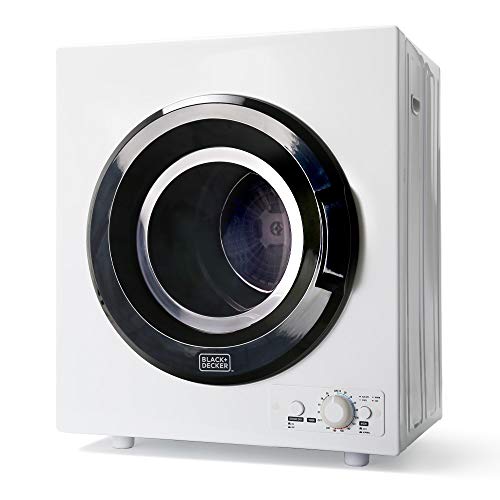
BLACK+DECKER 2.65 Cu. Ft. Portable Dryer — The Balanced Starter
If the portable category has a default recommendation, this is its shape: 2.65 cubic feet, an 8.8-pound load rating, a stainless steel drum, and a vented design that runs from a standard wall outlet at 1400W according to the listing. Nothing about it is extreme, and that is precisely the appeal. It is large enough for a single person’s regular laundry rhythm, small enough for an apartment corner, and ordinary enough in its controls and care that a first-time owner learns it in one load.
The drum size teaches the category’s central habit well. Eight or nine pounds is two or three outfits plus the odd towel, so the machine rewards the wash-small, dry-often pattern that portable living demands. Owners who pair it with a compact washer of similar capacity find the two machines agree about what a load is, and laundry becomes a background task measured in minutes of attention rather than a weekend event. The stainless drum shrugs off the zippers and buttons of everyday loads without the coating wear that cheaper drums show early.
Its compromises are the category’s compromises, worn openly. A week of family laundry would take it many sessions, and heavy cotton blankets are beyond its ambitions entirely. Within its intended world — singles, couples in small flats, a guest suite, a first apartment — it covers the need completely and without drama. Buyers unsure whether portable drying fits their life could do far worse than starting here, because this model is the yardstick the rest of the category is measured against.
- Capacity: 2.65 cu. ft., rated for 8.8 lb loads in the listing
- Power: 1400W, 120V, standard wall outlet, vented
- Drum: stainless steel per the listing title
- Model reference: BCED26 in the listing title
- Price: check price on Amazon
Strengths
- The most balanced size in the group for one or two people’s laundry.
- A stainless drum promises better wear than coated alternatives at this scale.
- Standard-outlet operation keeps installation to a plug and a vent hose.
Trade-offs
- Thick bedding and heavy blankets exceed what its drum and heat can handle.
- Venting still needs a window path or an indoor venting arrangement.
- Capacity that suits a couple will frustrate a growing family quickly.
Best for: singles and couples making their first move from shared laundry to in-unit drying.
Not suited for: households whose weekly wash arrives in family-sized mountains.
BLACK+DECKER 3.5 Cu. Ft. Portable Dryer, 120V — Most Capacity in the Line
The larger BLACK+DECKER stretches the portable idea to its practical limit: 3.5 cubic feet and a 13.2-pound load rating, still on a standard outlet at 1500W, still vented, still with a stainless steel drum. That extra capacity changes the machine’s social role. Instead of a personal appliance for one person’s basket, it can serve a couple’s full weekly wash in two comfortable loads, or a small family’s lighter rotation if the heavy bedding goes elsewhere.
Size cuts both ways in a portable, and this model asks its owner to accept the terms. It is the heaviest and bulkiest machine in this roundup’s family, the one least suited to being carried between rooms on a whim. Most owners will place it once — in a laundry nook, a generous bathroom, a utility corner — and treat it as a semi-permanent resident. Judged as a small fixed dryer that happens to run on a household outlet, it is excellent. Judged as luggage, it is not trying to be.
For renters whose lease forbids real appliance installation but whose laundry volume is genuinely domestic, this is often the sweet spot of the entire category. The drum takes jeans and towels in realistic mixes, the wattage stays within what an ordinary circuit offers, and nothing about the setup requires a landlord’s signature. It is the portable for people whose lives are not portable at all, but whose walls are not theirs to cut into.
- Capacity: 3.5 cu. ft., rated for 13.2 lb loads in the listing
- Power: 1500W, 120V, standard wall outlet, vented
- Drum: stainless steel per the listing title
- Model reference: BCED37 in the listing title
- Price: check price on Amazon
Strengths
- The joint-largest load rating here, enough for a couple’s weekly rhythm.
- Full household-outlet compatibility despite the near-full-size drum.
- A stainless drum at this capacity handles jeans and towels confidently.
Trade-offs
- Its size makes true portability occasional rather than daily.
- Small rooms may struggle to give it both placement and venting.
- Cycle times for full loads still reflect household-outlet power limits.
Best for: renters and couples who need near-household capacity without any installation.
Not suited for: anyone planning to move their dryer from room to room weekly.
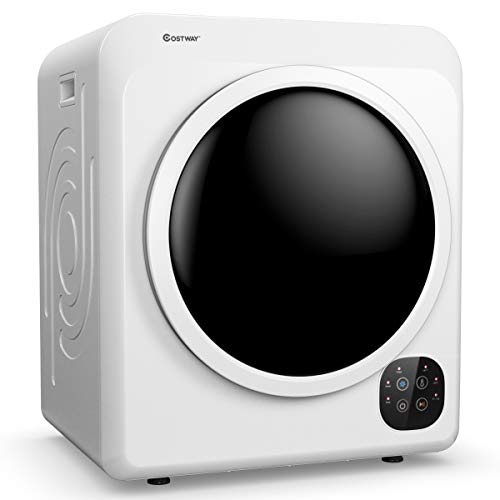
COSTWAY 1700W Electric Portable Clothes Dryer — Strongest Heater in the Group
COSTWAY’s front-load entry leads with its number: 1700W, the highest draw in this roundup, feeding a 13.2-pound capacity machine with a stainless steel tub. Wattage is drying speed in this category more directly than in any other, since every portable is starved for heat by design. Owners with a healthy circuit and a preference for shorter cycles will feel the difference on cotton loads, where this machine closes the gap toward full-size performance more than any rival here.
The listing also notes its control button panel sits on the downside of the machine — a low control layout that suits placement on a raised surface or stand, where the buttons land at a comfortable height and the door swings clear. It is a small ergonomic detail that reveals the design’s intent: this dryer expects to live on something, in a semi-permanent small-laundry arrangement, rather than on the floor of a closet. Plan the stand or counter as part of the purchase and the ergonomics click into place.
The caution is electrical honesty. A 1700W appliance wants a circuit that is not simultaneously feeding a space heater, a hair dryer, and half the kitchen; in older buildings, that means choosing its outlet with a moment’s thought. Owners who give it a reasonably dedicated circuit get the fastest portable drying in this guide. Owners who stack it onto an already burdened line will meet their breaker panel, which is the house’s way of grading the installation.
- Capacity: 13.2 lb loads per the listing title
- Power: 1700W, the highest draw in this roundup
- Drum: stainless steel tub per the listing title
- Layout: front load, control panel on the downside of the cabinet
- Price: check price on Amazon
Strengths
- Top wattage translates into the briskest cycles available in this category.
- A full 13.2-pound capacity matches the largest drums in the group.
- The low control panel suits the stand-mounted setups it is designed for.
Trade-offs
- The electrical draw demands a circuit with genuine headroom.
- Low controls are awkward if the machine ends up sitting on the floor.
- Its pace advantage shrinks on delicate loads that cap temperature anyway.
Best for: owners with a solid circuit who want portable drying at the fastest available pace.
Not suited for: old wiring, shared circuits, or floor-level placements.

COSTWAY 1.5 Cu. Ft. Portable Clothes Dryer, 850W — Smallest Footprint
At the far end of the portability spectrum sits this 1.5 cubic foot COSTWAY: an 850W draw, an eight-pound ceiling, a 17.5-inch inner drum, five drying modes, and a stainless steel drum, all in a vented 120V package aimed squarely at dorms, RVs, and the smallest apartments. Everything about it accepts limits in exchange for fitting where no other dryer in this guide can fit at all — on a counter, in a van, in the corner of a studio that doubles as three other rooms.
The low wattage is a feature in its intended habitats. Dorm circuits and RV electrical systems forgive an 850W appliance far more readily than a 1700W one, and the machine can share its world with a mini fridge and a laptop without drama. Five modes give the owner real choices for a wardrobe of uniforms, gym clothes, and small towels — which is, not coincidentally, exactly the wardrobe of the people this dryer is built for. It dries a student’s week in relaxed daily sessions.
Honesty about scale is essential. Eight pounds is not a family’s laundry; it is one person’s essentials, and a bath sheet counts as a major event in this drum. Buyers who need more should step up within this guide rather than blame the smallest machine for being small. For the solo dweller whose alternative is a laundromat trip in the rain, though, this little dryer can feel less like an appliance and more like a superpower.
- Capacity: 1.5 cu. ft., rated for 8 lb loads in the listing
- Power: 850W, 120V — the gentlest draw in the group
- Drum: stainless steel, 17.5-inch inner drum per the listing
- Modes: five drying modes named in the listing title
- Price: check price on Amazon
Strengths
- The smallest footprint and lightest electrical appetite in this roundup.
- Five modes give a tiny machine real flexibility across fabrics.
- A stainless drum at this size is a durability bonus, not a given.
Trade-offs
- An eight-pound ceiling excludes family laundry by design.
- Low heat means thick cotton items take their time.
- Large single items like bath sheets fill the drum alone.
Best for: dorm residents, RV travelers, and solo dwellers with minimal space and circuits.
Not suited for: couples or families whose loads outsize its drum several times over.

ROVSUN 2.6 Cu. Ft. Portable Dryer with Stainless Steel Drum — Knob-Control Simplicity
ROVSUN’s entry makes its pitch through a single control knob, a stainless steel tub, and a 2.6 cubic foot drum running at 1400W on 110V. In a category drifting toward touch panels and mode menus, the knob is a deliberate philosophy: turn, dry, done. For a dryer destined for a guest house, a rental unit, a parent’s apartment, or any space where the operator changes weekly, that philosophy eliminates the learning curve entirely. Nobody needs a manual to use this machine, and that is a genuine feature.
The specifications around the knob are sensible middle-of-category numbers. The drum matches the balanced BLACK+DECKER’s class, the wattage promises respectable pace for cotton loads, and the stainless tub handles the bumps of a machine that may be repositioned as rooms change purpose. ROVSUN explicitly aims the model at apartments, dorms, and RVs in its listing, and the design reads as if the company believed its own brief: nothing fussy, nothing fragile-looking, nothing that requires an account or an app.
What the knob philosophy surrenders is precision. Owners who like to fine-tune fabric-specific programs or schedule delayed starts will find the interface spartan, and there is no display narrating the cycle’s progress. For the audiences this dryer targets, those absences register as relief rather than lack. It is the machine you buy for a space, not for yourself, and spaces are grateful for appliances that any visitor can operate without instructions taped to the wall.
- Capacity: 2.6 cu. ft. per the listing title
- Power: 1400W, 110V per the listing title
- Drum: stainless steel tub per the listing title
- Controls: single control knob, per the listing title
- Price: check price on Amazon
Strengths
- Knob operation makes the dryer instantly usable by anyone.
- Balanced capacity and wattage cover the typical small-household load.
- Stainless tub construction suits machines that get repositioned.
Trade-offs
- No display or program variety for owners who enjoy fine control.
- Guest-proof simplicity means fewer fabric-specific refinements.
- Its middle positioning is outshone at both extremes of this guide.
Best for: rentals, guest spaces, and anyone who wants drying without a learning curve.
Not suited for: owners who want scheduled starts and detailed cycle feedback.

Euhomy 2.65 Cu. Ft. Portable Dryer with LCD Panel — Modern Panel Pick
Euhomy answers the knob philosophy with its opposite: a 2.65 cubic foot dryer at 1400W and 120V, with a stainless steel drum, four functions, and an LCD control panel that shows the machine’s state at a glance. The audience for this machine is the apartment dweller who lives with their dryer daily and wants information — how far along a cycle is, which function is running — rather than a dial and faith. In a small home where the dryer shares space with life, that visibility helps plan around laundry instead of being ambushed by it.
The four functions cover the practical spread of a small wardrobe: everyday loads, heavier cottons, lighter synthetics, and a gentler treatment for the items that fear heat. Matched with the same drum class as the balanced picks in this guide, the Euhomy handles a single person’s or a couple’s rhythm comfortably, in daily modest loads rather than weekly marathons. Its stainless drum matches the group’s durability standard, which matters for a machine expected to serve for years in tight quarters.
Panel controls bring panel considerations: a display to keep clean, buttons that prefer dry fingers, and electronics that a knob machine simply does not carry. None of that is disqualifying — it is the normal tax of a modern interface, paid gladly by owners who value the information. Buyers choosing between this Euhomy and the ROVSUN are really choosing between two temperaments, and both temperaments are honestly served in this guide.
- Capacity: 2.65 cu. ft. per the listing title
- Power: 1400W, 120V per the listing title
- Drum: stainless steel per the listing title
- Controls: LCD panel with four functions named in the title
- Price: check price on Amazon
Strengths
- The LCD panel makes cycle status visible at a glance.
- Four functions map well onto a small household’s fabric mix.
- It matches the balanced drum class while adding modern controls.
Trade-offs
- Electronics add care considerations a knob machine avoids.
- Its capacity remains a small household’s, whatever the panel suggests.
- Touch controls are less friendly with wet hands mid-laundry.
Best for: apartment dwellers who want modern cycle information in a portable footprint.
A poor fit for: buyers who prefer the set-and-forget simplicity of a single dial.
How Do the Six Portable Dryers Compare?
| Pick | Capacity | Power | Controls |
|---|---|---|---|
| BLACK+DECKER 2.65 Cu. Ft. Portable Dryer | 2.65 cu. ft. / 8.8 lb | 1400W, 120V | Standard cycle controls |
| BLACK+DECKER 3.5 Cu. Ft. Portable Dryer, 120V | 3.5 cu. ft. / 13.2 lb | 1500W, 120V | Standard cycle controls |
| COSTWAY 1700W Electric Portable Clothes Dryer | 13.2 lb | 1700W | Low-mounted button panel |
| COSTWAY 1.5 Cu. Ft. Portable Clothes Dryer, 850W | 1.5 cu. ft. / 8 lb | 850W, 120V | Five drying modes |
| ROVSUN 2.6 Cu. Ft. Portable Dryer with Stainless Steel Drum | 2.6 cu. ft. | 1400W, 110V | Single control knob |
| Euhomy 2.65 Cu. Ft. Portable Dryer with LCD Panel | 2.65 cu. ft. | 1400W, 120V | LCD panel, four functions |
How Should You Vent a Portable Dryer Indoors?
Most portables in this guide are vented machines, and their exhaust has to go somewhere deliberate. The first-choice route is a window: a hose run to the nearest opening, ideally with a window kit that seals the gap so winter stays outside and the warm moist air leaves completely. Keep the hose as short and straight as the room allows, because every bend and sag collects lint and slows the airflow the dryer depends on. A hose draped in loops across a room is both a tripping hazard and a performance tax.
Where no window route exists, indoor venting kits with a water trap or filter box are the common compromise. They catch lint and condense much of the moisture, but they still release warmth and some humidity into the room, so they belong in spaces that can absorb it — a bathroom with an exhaust fan, a utility area — rather than a sealed bedroom closet in January. Whichever route you choose, empty the lint screen after every load and check the hose connection monthly; portable setups get nudged and bumped in ways fixed installations never do.
How Do You Get the Best Results From a Small Dryer?
Load it like you mean it — which, in this category, means modestly. A portable drum filled to loose two-thirds tumbles properly; the same drum stuffed solid turns into a rotating brick whose center stays damp while its surface scorches. Shake each item out as it goes in, because a balled-up shirt from the washer will emerge as a smaller, drier balled-up shirt, and no wattage in this guide can fix geometry. Sorting by weight matters even more than in full-size drying, since a single bath towel among t-shirts will dictate the entire cycle’s length.
Sequence your week around the machine’s temperament. Run the dryer while you are home and awake for the first few loads, learn how its cycles map onto your actual fabrics, and then let it work in the background of ordinary evenings. Delicates and synthetics, which dry fast and hate heat, are the portable’s home turf; reserve patience for the cotton loads. A drying rack beside the machine is not an admission of defeat — it is the classic portable partnership, with the dryer handling ninety percent of the water and the rack finishing the last stubborn waistbands for free.
How Do Portable Dryers Stack Up Against Racks and Heated Rails?
Every small-space dweller has run the free alternative: a folding rack by the window and patience. Racks cost nothing to run and treat delicates beautifully, but they surrender a room’s floor for a day, surrender entirely in humid weather, and leave thick items — jeans, towels, hoodies — in a damp limbo that can turn musty before it turns dry. A portable dryer compresses that whole negotiation into a cycle. The honest comparison is not dryer versus rack; it is dryer for the ninety percent that needs certainty, rack for the overflow and the fragile, which is why so many portable owners keep both without feeling they duplicated anything.
Heated rails and fan-assisted drying closets occupy the middle ground, and they serve single garments well. Where they falter is throughput: a household’s worth of laundry moving through a rail one layer at a time is a hobby, not a system. The portable dryer’s drum, small as it is, still processes a mixed load unattended, and unattended is the operative luxury. Owners upgrading from racks consistently describe the same revelation — not speed, exactly, but the return of their evenings, because laundry stopped being a spatial event staged across the living room.
What Does a Dorm or RV Setup Look Like in Practice?
In a dorm, the winning arrangement is boring on purpose: the dryer lives on a sturdy low stand or a reinforced counter near the room’s best outlet, its vent hose reaches the window with one gentle bend, and a small mat underneath catches the vibration and the occasional drip from a wet load. The 850W class of machine thrives here because dorm circuits are shared, fused conservatively, and shared with a neighbor’s gaming rig. Laundry becomes a study-break rhythm — one small load while reading, another after dinner — which suits both the machine’s capacity and the student’s schedule better than a weekly marathon ever did.
In an RV, placement is a negotiation with motion. The dryer rides secured, not merely situated, because a machine that walks across the floor at highway speed is a hazard wearing an appliance costume. Owners typically run it parked and connected to shore power, vent through a window or a purpose-made port, and treat its capacity as the trip’s laundry metronome: small loads every other day keep the wardrobe rotating without ever staging a laundromat stop. The smallest picks in this guide were clearly drawn with this life in mind, and their owners’ communities swap placement tricks the way other hobbyists swap recipes.
Guest suites and in-law corners form the third classic habitat. There, the dryer’s audience rotates — visiting family, a tenant, an aging parent — and the winning traits are forgiveness and clarity. A knob-controlled machine or a simple panel, a short vent run a housekeeper can check, and a lint screen that empties obviously all matter more than peak wattage. Hosts who think like hoteliers when choosing end up with appliances that guests use correctly without a briefing.
How Do You Care for a Portable Dryer So It Lasts?
Portable dryers live harder lives than fixed ones: they are moved, bumped, stored, and run in rooms that were never plumbed for laundry. Their care routine starts with the lint screen after every single load, without exception, because small drums and household-outlet heat have no airflow margin to spare. A screen allowed to film over turns a modest machine sluggish within weeks, and the owner blames the wattage when the culprit is a gray felt of their own making. Rinse the screen under a tap monthly and brush it gently; the difference is visible in the next load’s finishing time.
The vent hose deserves the same standing attention. Check its connections after any move, keep its run short, and replace it when it kinks or tears rather than taping over damage that will leak lint into the room. Wipe the drum interior occasionally — a damp cloth removes the residue that transfers between loads — and leave the door ajar between sessions so the small cabinet airs out. Machines stored for a season should be stored clean and dry, with the hose detached and the drum empty; a portable put away damp in autumn greets spring with a smell that takes real work to evict.
Finally, respect the feet and the floor. A portable that rocks vibrates itself and its surroundings toward an early old age, so level it on its stand or floor spot and re-check after moves. Keep the area behind it free of the lint dust that gathers wherever warm air escapes, and give its outlet a glance now and then for warmth or discoloration that would suggest a tired connection. None of this is skilled work; it is the small change of appliance ownership, paid regularly so the large bills never arrive.
How Should Singles, Couples, and Small Families Size Differently?
A single person generates a deceptively small laundry stream: a few outfits, gym clothes, towels, and bedding on rotation. Even the 1.5 cubic foot machine can carry that life if loads run every couple of days, and the mid-size picks carry it with room to spare. Singles should buy for their largest regular item — usually a set of sheets or a week’s towels — rather than for their average day, because the average day fits everywhere and the outlier is what sends people to the laundromat.
Couples double the stream but also double the scheduling flexibility, since two people’s loads can interleave across a week. The 2.65 cubic foot class is the honest center for couples, with the 3.5 cubic foot machines earning their size when both partners wear uniforms, train seriously, or simply refuse to do laundry more than twice a week. What couples should not do is buy the smallest unit to save money and then run it four times every Saturday; the savings evaporate in time, which is also a currency.
Small families sit at the category’s edge and should enter it clear-eyed. A portable can absolutely serve as a family’s overflow and delicates machine beside a shared laundry room, and as the sole dryer for a family committed to small, frequent loads — but a family producing a mountain by Friday will find every pick in this guide undersized, and no honest guide should pretend otherwise. For that household, the portable is a bridge or a supplement, and buying it as one produces satisfaction instead of resentment.
How Do Season and Humidity Change Portable Drying?
A portable dryer breathes its room, so the room’s season becomes the dryer’s season. In dry winter air, loads finish willingly and the vented warmth is a small gift to a cold apartment. In a humid August, the same machine works against air already heavy with water, cycles stretch, and a vented-into-the-room setup can leave the space feeling like a greenhouse. Owners in humid climates learn to run the dryer alongside a bathroom fan or a cracked window, to schedule loads for the drier hours of the day, and to forgive the machine a slower August rather than diagnosing it as broken.
Cold-climate owners face the mirror image: a dryer stored in an unheated space starts every load cold-soaked, and its first minutes go to warming its own drum. Bringing the machine indoors the night before laundry day, or simply accepting a longer first cycle, solves what looks like declining performance. These seasonal rhythms are not flaws in any pick in this guide; they are the physics of small machines living in real rooms, and the owners who thrive with portables are the ones who plan around the calendar instead of fighting it.
What Should You Check on the Day a Portable Dryer Arrives?
Unbox it where it will live, and resist the urge to run a victory load before the boring checks are done. Confirm the drum turns freely by hand, the door latches with a clean click, and the lint screen seats fully in its slot — a screen that sits crooked leaks lint into the cabinet from the very first cycle. Read the listing’s stated wattage against the outlet you chose one final time, and plug the machine in directly rather than through whatever power strip was within reach.
Fit the vent hose before the first load, not after, and run an empty or single-towel cycle while you watch the whole arrangement: hose staying attached, window kit sealing, machine standing still instead of touring the floor. Note how warm the room gets and how the sound carries, because those two facts decide whether the placement survives the month. Owners who spend twenty minutes on this shakedown rarely join the chorus of reviewers who discovered their setup’s flaws one damp load at a time.
Which Fabrics Love a Portable Dryer, and Which Need Watching?
Synthetic athletic wear is the portable dryer’s easiest victory. It holds little water, fears high heat, and matches the small machine’s gentle temperament so well that owners of serious gym wardrobes often prefer the portable to the big drum downstairs. Everyday cotton t-shirts and underwear follow close behind, drying evenly in the modest loads these drums were sized for. Baby clothes and cloth diapers, washed in small frequent batches by necessity, also map naturally onto the portable rhythm — many new parents in apartments discover the category through exactly that door.
The watch list is equally clear. Heavy denim, bath towels, and hoodies dry honestly but slowly, and they punish impatience: pulled early, they feel dry at the surface and damp at the seams an hour later. Wool and anything shrink-prone should ride the gentlest setting or skip the drum for the rack, because small dryers still make real heat. Delicate lace and embellished items belong in a mesh bag if they go in at all. None of this is unique to portables — it is laundry physics — but small drums concentrate the consequences, so the sorting habit pays faster here than anywhere else in the laundry world.
What Mistakes Do Portable Dryer Buyers Make?
The champion mistake is sizing by hope: buying the smallest, cheapest unit for a household whose laundry it cannot mathematically hold, then blaming the machine for arithmetic. Weigh a typical load on a bathroom scale before ordering — thirty seconds that prevent the most common return in the category. Second comes ignoring the circuit, particularly with the stronger machines here; a portable dryer sharing a tired circuit with a space heater will introduce you to your breaker panel at the worst moment.
Venting afterthoughts run third. Owners who plan the hose route after the box arrives end up with draped, sagging runs that strangle performance, or with moist air pumped into a room that grows musty by spring. Finally, there is the storage fantasy: the dryer bought for a closet it must be hauled out of for every use. Within a month it is furniture. Measure the working spot, the storage spot, and the load itself before choosing, with a tape and a scale rather than optimism, and the machine you buy will be the machine you use daily.
Final Recommendation
Start with the balanced BLACK+DECKER 2.65 if your household is one or two people and your needs are ordinary; it is the category’s center of gravity for good reason. Step up to the 3.5 cubic foot sibling or the 1700W COSTWAY when your loads are genuinely larger or your patience genuinely thinner, and step down to the little 850W COSTWAY when space and circuits are the binding constraints, as they are in dorms and RVs. Between the ROVSUN and the Euhomy, let temperament decide: a knob for the spaces used by everyone, a panel for the owner who wants to see the cycle think. Whichever machine lands in your home, give it a short vent run, a fair circuit, and loads sized to its drum, and it will repay you in the category’s true currency — laundry finished at home, on your schedule, in any weather, without a single coin, a single shared-machine negotiation, or a single basket hauled through the rain to a building across the parking lot in the middle of a February night.
Frequently Asked Questions
Can a portable dryer really replace a laundromat?
For a small household, yes, with adjusted rhythms: smaller loads, run more often, dried the day they are washed. What it cannot replace is the laundromat’s giant drums for comforters and rugs, so most owners keep a quarterly trip for the oversized items and handle everything else at home. The weekly savings in time and transport usually dwarf that compromise.
Do portable dryers need a special outlet?
No — that is their defining convenience. Every pick in this guide runs from a standard household outlet, at the wattages stated in their listings. The only homework is circuit awareness: give the stronger models a line that is not already carrying other heavy appliances, and never use a lightweight extension cord as a permanent arrangement.
How long does a portable dryer take per load?
Longer than a full-size machine, because household-outlet power limits the heat it can make. Light synthetic loads finish reasonably briskly; heavy cotton loads are the slow ones, and times stretch further if the drum is overfilled or the vent run is long. Owners who sort by weight and load loosely consistently report the best pace.
Can I use a portable dryer in an RV?
The smallest picks here were practically designed for it — the 850W COSTWAY especially, whose gentle draw suits RV electrical systems. Confirm your rig’s circuit capacity, secure the machine against travel movement, and plan its vent route before the trip rather than at the campground. Many RV owners run theirs only on shore power, which is the sensible default.
Will a portable dryer handle jeans and towels?
Yes, in appropriate quantities. A few pairs of jeans or a small set of towels is a normal load for the mid-size picks, though they will take longer than shirts do. The mistake is mixing one heavy towel load’s worth of cotton into a drum already full of lighter items and expecting even results; sort by weight and the machine delivers.
How loud is a portable dryer in a small apartment?
Expect the honest sound of a small appliance at work: a drum turning, a fan moving air, and a hum that carries in a studio more than in a house. Placement decides most of it — a level stand, a mat underneath, and a door between the machine and the bed tame what the specifications cannot. Owners who run loads during waking hours rarely find the noise a lasting issue.
Can I stack or shelf a portable dryer above my washer?
Only with real support: a purpose-built stand or a shelf rated for the machine’s weight plus a wet load, secured so vibration cannot walk it toward the edge. Never balance a dryer on the washer itself unless both makers bless the arrangement. The space saved is genuine, but gravity collects its debts without warning, so the hardware has to be as serious as the intention.
Related Guides
Small-space laundry is a system, so pair this guide with Best Heat-Pump Tumble Dryers when a permanent ventless upgrade tempts you, detour to the bathroom with Best Air Bubble Tubs With LED Lights for the other small-room project on your list, and come back to laundry with Best Compact Clothes Washers for Apartments to match a washer to the dryer you just chose. Then reward the whole setup with Best Bath Towel Sheets — generously sized towels your portable can dry in sensible, sorted batches.


