What's inside
- Key Takeaways
- Quick Picks
- How did we shortlist washers for apartment life?
- How do the six apartment picks compare side by side?
- Should your apartment washer be fixed, portable, or a combo?
- How do you measure an apartment laundry space properly?
- What changes when a washer runs at ordinary household voltage?
- How do you keep compact laundry quiet enough for neighbours?
- What fits, and what does not, in a compact drum?
- How should apartment dwellers handle drying after a compact wash?
- What does it cost to run laundry in a small flat?
- How long do compact machines serve, and what decides it?
- How do combos, sets, and columns differ in daily feel?
- What should you ask before ordering any compact machine?
- How do you build a laundry routine in a home without a laundry room?
- What mistakes do apartment buyers make with compact washers?
- Final Recommendation
- Frequently Asked Questions
- Related Guides
As an Amazon Associate I earn from qualifying purchases. This post may contain affiliate links at no extra cost to you.
cottageverdict.com is reader-supported. When you buy through links on our site, we may earn an affiliate commission.
Where to buy: the machines below are listed on Amazon under the heading names shown, so confirm each listing’s width, voltage, and hookup style against your apartment’s reality first, and check price on Amazon when the measurements agree.
The best compact clothes washers for apartments are chosen by a tape measure before they are chosen by a feature list. Apartment laundry lives in borrowed space: a 24-inch closet, a bathroom corner, the end of a galley kitchen, a nook under a counter that was designed for anything except a washing machine. The machines that thrive there respect three constraints at once, the physical footprint, the building’s plumbing and electrical reality, and the neighbours below whose ceiling is your floor. This guide is organised around those constraints rather than around brochure superlatives.
Two installation families divide the category, and confusing them is the classic apartment mistake. Fixed compact machines, typically 24 inches wide, plumb into proper supplies and drains like small versions of full-size laundry, suiting owners and long leases. Portable machines connect to a sink tap with an adapter, drain into the sink, and wheel or lift away when not washing, suiting renters whose leases forbid permanent changes. Both families appear among the picks, and each review states plainly which world its machine belongs to, because a wonderful machine of the wrong family is a return waiting to happen.
The six linked picks cover the spectrum honestly: a 2.65 cubic foot all-in-one washer-dryer combo from Hamilton Beach running at 120V, a 25-pound fully automatic ROVSUN portable with a drain pump, an Equator 24-inch washer and vented dryer set, a COMFEE’ 24-inch combo with steam care, a stackable 24-inch CONTOURE washer in titanium with a fast 1400 RPM spin, and a tiny 0.9 cubic foot BLACK+DECKER portable that connects to a sink. Between them they answer nearly every apartment configuration a renter or owner can plausibly face.
One promise before the reviews: no pick here will be described as apartment-suitable on vibes. Widths, voltages, and hookup styles quoted below come from the listing titles themselves, and where a title stays silent, the review says so and sends you to the listing’s specification section. In a category where two inches decide everything, precision is not pedantry. It is the entire service a guide can offer.
Key Takeaways
- The 24-inch width class divides fixed apartment laundry from everything larger, so measure the closet before the catalogue.
- Portable sink-connect machines and plumbed compacts are different families; choose the family your lease allows first.
- Two picks are washer-dryer combos, which trade cycle time for a single footprint and no load transfer.
- The CONTOURE spins at 1400 RPM per its title, the fastest extraction figure printed anywhere in this set.
- The smallest pick holds just 0.9 cubic feet, a deliberate one-person scale rather than a shrunken family machine.
- Voltage in these titles is household 120V where printed, one of compact laundry’s genuine freedoms.
Quick Picks
| Pick | Badge | Why it earns its place |
|---|---|---|
| Hamilton Beach 2.65 Cu. Ft. Washer and Dryer Combo | One-box wash and dry | A 2.65 cubic foot front-load combo that washes and dries in one drum at 120V, ending the wet-load transfer entirely. |
| ROVSUN 25 lbs Portable Washing Machine, Full-Automatic | Fully automatic portable | A 25-pound portable that washes and spin-dries automatically with a stainless drum and drain pump, no hand-transferring loads. |
| Equator 24″ Ultra Compact Washer and Vented Dryer Set | Two-box 24-inch set | A matched 24-inch pair, a 1.57 cubic foot washer with a 2.6 cubic foot vented dryer, for plumbed apartment laundry done properly. |
| COMFEE’ 24″ Washer and Dryer Combo with Steam Care | Steam-care 24-inch combo | A 24-inch, 2.7 cubic foot combo with steam care and an overnight dry programme, built for set-and-forget apartment laundry. |
| CONTOURE 24″ Stackable Front-Load Washer, Titanium | Fast-spin stackable washer | A 24-inch stackable washer spinning at 1400 RPM with sixteen cycles and a stainless drum, for pairing with a compact dryer above. |
| BLACK+DECKER 0.9 Cu. Ft. Portable Washer | Sink-connect solo portable | A 0.9 cubic foot, 6.6-pound portable with five cycles and a quick-connect sink adapter included, for one person’s laundry independence. |
How did we shortlist washers for apartment life?
Width came first in the selection, because apartment laundry fails on width more than on any other axis. Picks cluster at the 24-inch class or below it in portable form, matching the closets, alcoves, and under-counter bays that buildings actually provide. Any machine whose listing gave no width signal had to justify itself through an unmistakably compact format, such as the sink-connect portable class, and the reviews flag where a buyer should confirm dimensions on the listing before ordering.
Hookup honesty came second. Each pick was classified by how it truly connects: plumbed supply and drain, sink adapter with drain hose, or a set that pairs a compact washer with its own compact dryer. The Hamilton Beach and COMFEE’ combos were assessed as single-box solutions, the Equator as a two-box set, the ROVSUN and the small BLACK+DECKER as portables with pumps or sink drainage, and the CONTOURE as a fixed stackable washer. A guide that blurred those distinctions would send renters machines their leases forbid, so the distinctions structure every review.
Third, the set was balanced across household sizes. Apartment does not automatically mean single: couples, sharers, and small families in flats all wash seriously, and the 2.65 and 2.7 cubic foot picks exist for them, while the sub-one-cubic-foot portable serves the solo dweller whose alternative is a laundromat’s timetable. Spin performance, cycle counts, and delay features were weighed where titles state them, because in small homes the washer often runs at night, at dawn, or during a neighbour’s working hours, and scheduling flexibility is a real feature there.
Finally, every figure in the reviews traces to a listing title: capacities, the Hamilton Beach’s 800 RPM and 120V, the CONTOURE’s 1400 RPM and sixteen cycles, the BLACK+DECKER’s 6.6-pound rating and included sink adapter. Where a title offers no such anchor, the review speaks qualitatively and points to the listing, a discipline this batch applies everywhere and apartment buyers should demand everywhere else too.

Hamilton Beach 2.65 Cu. Ft. Washer and Dryer Combo — One-box wash and dry
The combo proposition is seductive in a small flat: one machine, one footprint, laundry that goes in dirty and comes out dry without anyone moving it between boxes. This Hamilton Beach unit states the proposition cleanly in its listing: a 2.65 cubic foot all-in-one apartment-size washer and dryer combo, front-loading, with more than twelve wash programmes, an LED display, delay start, an 800 RPM spin, and 120V operation. That voltage matters in apartments, where the laundry corner often offers only an ordinary outlet, and a machine content with household power avoids the electrical negotiations that full-size dryers demand.
Live with the combo rhythm honestly before choosing it. A single drum that washes then dries runs longer total cycles than a two-machine relay, and it can only handle one load’s journey at a time, so the household’s laundry must flow sequentially rather than in parallel. For a single person or a couple washing a few loads weekly, that rhythm feels like automation. For anyone who currently overlaps wash and dry loads on a Saturday, it will feel like a queue, and no feature list will argue the feeling away.
The delay start earns specific praise in apartment life, because it lets a load finish as you wake or as you return, rather than sitting damp through a working day. Twelve-plus programmes cover the wardrobe’s real range without novelty clutter. The 800 RPM spin is modest beside the CONTOURE’s figure below, which means the drying phase carries more of the moisture burden, one more reason the combo suits moderate loads rather than heroic ones.
Choose this machine when floor space is the scarcest resource in the flat and your laundry volume is honestly modest. It converts a single 24-inch-class corner into a complete laundry, asks nothing of a vent, and treats the transfer chore as abolished. Households with heavier throughput should look at the set and stackable picks below, which trade the combo’s elegance for parallel capacity.
- Capacity printed in the listing title: 2.65 cu. ft.
- Format in the title: all-in-one washer and dryer combo
- Programmes in the title: 12+ wash programmes, LED display
- Spin and power in the title: 800 RPM, 120V
- Timing feature in the title: delay start
Strengths
- Single footprint delivers washed and dried laundry
- Household voltage suits ordinary apartment outlets
- Delay start aligns finishing with your schedule
Trade-offs
- Sequential cycles cannot overlap loads
- Modest spin leaves drying phase more work
- Total cycle time stretches beyond two-box relays
Best for: a single dweller or couple whose scarcest resource is floor space, not time.
Not suited for: a high-throughput household that overlaps wash and dry loads.

ROVSUN 25 lbs Portable Washing Machine, Full-Automatic — Fully automatic portable
Portable washing divides into machines that ask for your labour and machines that merely ask for your tap, and this ROVSUN belongs firmly to the second camp. Its listing describes a 25-pound portable washing machine, fully automatic, with a stainless steel drum, a washer and spin-dryer combination, and a drain pump, aimed at homes and apartments. Fully automatic is the load-bearing phrase: fill, wash, rinse, and spin proceed as a programme rather than as a sequence of manual transfers between tubs, which separates this machine from the twin-tub portables that dominate the cheapest end of the category.
The drain pump deserves its own sentence because it decides where the machine can live. A pump lifts waste water to a sink or drain instead of demanding gravity drainage at floor level, which frees the machine from the bathroom-only existence of drain-down portables and lets it work beside a kitchen sink or a utility basin. Combined with the stainless drum, which shrugs off the grit of real clothing better than plastic tubs, the specification reads like a portable designed by someone who has actually used one in a small flat.
Capacity language needs translating for this class. The title rates the machine at 25 pounds rather than in cubic feet, a portable-market convention that describes load weight under the maker’s own assumptions. Treat the figure as a class marker, generously sized for a portable, rather than as a promise to weigh your laundry against. In practice this is a machine for a single person’s week or a couple’s steady rhythm, run in sensible batches, with bedding handled item by item or reserved for a laundromat’s big drum on occasion.
Pick the ROVSUN when you want portable freedom without twin-tub labour: sink-side washing that runs itself, pumps its own drainage, and stores away between sessions. Renters who cannot plumb, sharers whose bathroom hosts the laundry, and anyone upgrading from hand-washing or a manual portable will feel the upgrade in their shoulders within the first week.
- Load rating in the listing title: 25 lbs
- Operation in the title: full-automatic electric laundry machine
- Drum material in the title: stainless steel
- Drainage in the title: drain pump included
- Format: portable washer and spin dryer combo
Strengths
- Automatic programme ends twin-tub hand transfers
- Drain pump frees placement beyond the bathroom
- Stainless drum tolerates gritty real-world loads
Trade-offs
- Pound rating resists direct comparison with cubic feet
- Bedding still exceeds a portable’s honest scope
- Sink access is occupied for each session’s duration
Best for: a renter wanting self-running portable washing with pumped drainage.
Not suited for: a household expecting full-size loads from a portable footprint.

Equator 24″ Ultra Compact Washer and Vented Dryer Set — Two-box 24-inch set
Some apartment laundry corners deserve a real laundry, just a smaller one, and this Equator set is built for exactly that ambition. The listing describes a 24-inch ultra-compact washer of 1.57 cubic feet paired with a vented dryer of 2.6 cubic feet, sold as a set. Two dedicated boxes restore the parallel rhythm combos surrender: the dryer dries while the washer washes, and a multi-load day flows like a full-size laundry day, only at apartment scale. For owners fitting out a permanent small laundry, that rhythm is the argument.
Read the proportions with clear eyes. The washer is the small half of this partnership, at a capacity suited to singles and couples washing frequently in modest batches, while the dryer’s larger volume reflects how much air dried laundry wants around it. The set therefore rewards a little-and-often household and punishes a save-it-all-up one, whose weekend mountain would queue at the washer’s door. Apartment owners with a steady rhythm will find the pairing harmonious; bulk hoarders should look at the 2.7 cubic foot picks sharing this page.
The dryer is vented, per the title, and that single word carries an installation obligation. A vented dryer needs a route for moist air to leave the building, through a wall vent, a window kit, or an existing duct, and an interior room without any of those options is the wrong home for this set however neatly the pair fits it. Confirm the vent path before ordering, the way you would confirm a doorway measurement, because discovering the problem with two machines in the hallway helps nobody.
Choose the Equator when your apartment offers a plumbed, ventable laundry spot and your household wants a genuine two-box routine at 24-inch scale. It is the most conventional laundry on this page, deliberately so, and conventionality, properly sized, is a compliment in a category full of improvisation.
- Washer capacity in the title: 1.57 cu. ft.
- Dryer capacity in the title: 2.6 cu. ft., vented
- Width class in the title: 24-inch ultra compact
- Configuration: washer and dryer sold as a set
- Installation implication: plumbed supplies plus a vent route
Strengths
- Parallel washing and drying restores laundry flow
- Matched pair ends cabinet and control mismatches
- Compact width fits genuine apartment laundry spots
Trade-offs
- Washer capacity suits little-and-often households only
- Vented dryer demands an exhaust route outside
- Two boxes claim more wall than a single combo
Best for: an apartment owner with a plumbed, ventable nook and a steady laundry rhythm.
Not suited for: a renter without venting options or with weekend-bulk habits.

COMFEE’ 24″ Washer and Dryer Combo with Steam Care — Steam-care 24-inch combo
Where the Hamilton Beach combo argues from simplicity, this COMFEE’ machine argues from programmes. Its listing describes a 24-inch washer and dryer combo of 2.7 cubic feet and 26 pounds capacity, front-loading and fully automatic, with steam care and an overnight dry among its named features. Steam care, in the combo context, is a fabric-refreshing and crease-easing tool aimed at the clothes apartment dwellers actually wear, shirts, blouses, workwear, and the overnight programme is the headline for anyone whose laundry must happen while the household sleeps.
Overnight dry deserves a moment’s respect as a piece of domestic design. A combo’s long cycle stops being a flaw when the cycle runs across sleeping hours and the laundry emerges dry at waking, because the machine’s slowness is spent in time nobody was using. Paired with the discipline of loading before bed and unloading at breakfast, the programme converts the combo format’s chief weakness into a scheduling feature. Households with predictable evenings will exploit it weekly; chaotic households will use it twice and forget it exists.
The 2.7 cubic foot drum edges this combo slightly ahead of its Hamilton Beach rival on capacity, and the 24-inch width keeps it inside the standard apartment closet class. Steam features ask for the usual calibration: they ease creases and refresh fabrics, they do not iron, and they do not sanitise a household’s problems away. Judge the machine as a well-programmed single-box laundry with a useful overnight trick, and its value stands on solid ground rather than on steam’s vapour.
Select the COMFEE’ if your flat has one laundry corner, your evenings are predictable, and your wardrobe leans toward garments that appreciate a gentler, steam-assisted finish. It is the combo for planners, and planners are exactly the people who make single-box laundry sing.
- Width and capacity in the title: 24 inches, 2.7 cu. ft.
- Load rating also in the title: 26 lbs
- Named features in the title: steam care, overnight dry
- Operation described in the title: front load, full-automatic
- Positioning in the title: dorm and apartment use, white
Strengths
- Overnight programme turns cycle length into scheduling
- Steam care suits workwear-heavy wardrobes
- Slightly larger drum than the rival combo here
Trade-offs
- Single drum still forbids overlapping loads
- Steam benefits are easing and refreshing, not ironing
- Rewards routine; improvisers underuse its best trick
Best for: a planner in a one-corner flat who will run laundry overnight by design.
Not suited for: a spontaneous household that washes when the hamper overflows.
CONTOURE 24″ Stackable Front-Load Washer, Titanium — Fast-spin stackable washer
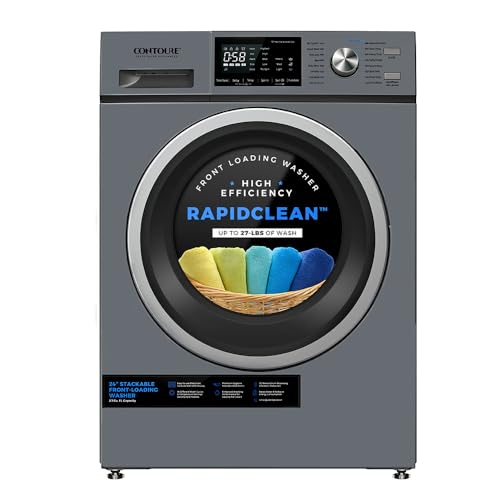
This CONTOURE is the engineer’s pick of the page, and its listing title reads like a specification sheet that wandered into a headline: a 24-inch stackable front-load washer of 2.7 cubic feet, spinning at 1400 RPM, finished in titanium, with sixteen wash cycles, five temperature settings, LED touch controls, a stainless steel drum, high-efficiency operation, and a model number, WH-2700T, tying it to a matching dryer elsewhere in the maker’s line. In a category where titles often hide the numbers, that candour is itself a recommendation, because apartment buyers live and die by numbers.
The 1400 RPM spin is the figure with daily consequences. Extraction at that speed leaves laundry markedly drier than the gentler spins elsewhere in this set, which shortens whatever drying follows, whether that is the matching compact dryer, a heated airer, or a balcony line. For flats where drying space and drying time are the true bottlenecks, and they usually are, a fast-spinning washer attacks the real problem. The trade is creasing and noise discipline: maximum spin is for towels and bedding, while shirts and delicates deserve the gentler settings among those five temperatures and sixteen cycles.
Stackable is the other load-bearing word. This washer is designed to carry its matching dryer above it, converting a 24-inch square of floor into a full laundry column, the most space-efficient serious arrangement apartment laundry offers. Bought alone it remains an excellent compact washer, yet its design intent is the pair, and buyers should cost the column as a whole, including the stacking arrangement the maker specifies, rather than discovering the second half’s price later.
Choose the CONTOURE when your apartment can plumb a fixed machine, your drying bottleneck is real, and a titanium finish suits a laundry corner that lives in view. It is the most technically complete washer in this set, and the review’s only caution is the usual one for its class: confirm the listing’s full dimensions and the matching dryer’s details before the column becomes a commitment.
- Width and capacity in the title: 24 inches, 2.7 cu. ft.
- Spin speed in the title: 1400 RPM
- Cycles and temperatures in the title: 16 cycles, 5 settings
- Controls and drum in the title: LED touch, stainless steel drum
- Model in the title: WH-2700T, high-efficiency, titanium
Strengths
- Fastest spin here attacks the drying bottleneck
- Specification-rich title respects the buyer’s tape measure
- Stacking design builds a full laundry in one footprint
Trade-offs
- Full value arrives with the matching dryer purchase
- Maximum spin creases delicate loads if misused
- Touch controls divide households that prefer dials
Best for: a technically minded apartment owner building a stacked laundry column.
Not suited for: a renter who needs sink-connect portability instead.
BLACK+DECKER 0.9 Cu. Ft. Portable Washer — Sink-connect solo portable
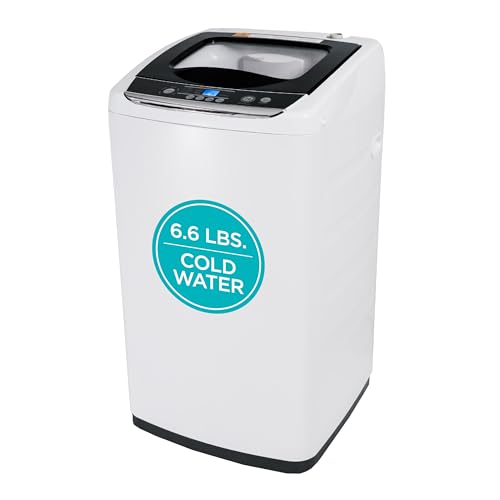
Smallness is this machine’s entire thesis, stated without apology in its listing: a 0.9 cubic foot portable washer with a 6.6-pound capacity, five wash cycles, and a quick-connect sink adapter and drain hose included in the box. It is not a family washer shrunk; it is a one-person appliance designed from the premise that a solo dweller’s laundry is a few shirts, underwear, gym kit, and the occasional towel, and that washing those at home, on your own schedule, beats organising life around a laundromat’s opening hours and someone else’s lint filter.
The included adapter is the detail that makes the thesis work. Sink-connect portables live or die by their fittings, and a machine that ships with its quick-connect adapter and drain hose arrives ready for its first load instead of for a hardware-store expedition. The routine becomes genuinely simple: connect to the tap, drain hose into the sink, wash, disconnect, and store the machine in the corner or cupboard it came from. Five cycles cover the small wardrobe’s real range without pretending to be a full laundry’s vocabulary.
Honesty about scale completes the review. A 6.6-pound load is a few days of one person’s light clothing, not a bedding solution, and sheets, duvets, and bath-sheet habits belong to a laundromat visit or a larger machine. Spin performance in this class leaves clothes damp rather than dry, so plan the airer as part of the system. None of that diminishes the machine; it defines the owner it serves, the solo renter, the dorm-adjacent dweller, the person whose alternative is a bag of laundry carried through the rain.
Buy the little BLACK+DECKER if that description sounds like your life and your lease forbids plumbing adventures. It asks for a sink, an outlet, and thirty honest minutes, and in return it abolishes the laundromat from a single person’s week, which, at this size and positioning, is one of the best trades in the whole category.
- Capacity printed in the listing title: 0.9 cu. ft.
- Load rating in the title: 6.6 lb. capacity
- Cycles in the title: 5 wash cycles
- Included per the title: quick connect sink adapter, drain hose
- Model in the title: BPWM09W, white, portable
Strengths
- Sink adapter included means washing from day one
- Tiny footprint stores in a cupboard between sessions
- Five cycles match a solo wardrobe’s real needs
Trade-offs
- Bedding and bulk exceed its honest capacity
- Spin leaves loads damp, so airer space is required
- One person’s machine, and it knows it
Best for: a solo renter whose lease forbids plumbing and whose loads are small.
Not suited for: couples, families, or anyone washing bedding at home weekly.
How do the six apartment picks compare side by side?
| Pick | At a glance |
|---|---|
| Hamilton Beach 2.65 Cu. Ft. Washer and Dryer Combo | 2.65 cu. ft. combo, 120V, one-box wash and dry. |
| ROVSUN 25 lbs Portable Washing Machine, Full-Automatic | 25 lbs portable, full-automatic, drain pump. |
| Equator 24″ Ultra Compact Washer and Vented Dryer Set | 24″ set, 1.57 washer plus 2.6 vented dryer. |
| COMFEE’ 24″ Washer and Dryer Combo with Steam Care | 24″ combo, 2.7 cu. ft., steam care, overnight dry. |
| CONTOURE 24″ Stackable Front-Load Washer, Titanium | 24″ stackable washer, 2.7 cu. ft., 1400 RPM spin. |
| BLACK+DECKER 0.9 Cu. Ft. Portable Washer | 0.9 cu. ft. portable, sink adapter included. |
Should your apartment washer be fixed, portable, or a combo?
Answer with your lease and your plumbing, not your preferences. A fixed compact, plumbed into supplies and a drain, behaves like a small citizen of the home: always ready, never connected or stored, and usually forbidden to renters whose agreements bar appliance installation. If you own the flat or hold a long, permissive lease with a prepared laundry spot, the fixed route, the Equator set or the CONTOURE column, delivers the calmest laundry life the category offers, and every other option should have to argue against it.
Portables exist for everyone else. A sink-connect machine asks the building for nothing but water pressure and an outlet, leaves no trace when it leaves, and converts any sink into a laundry for the duration of a cycle. The costs are ritual and scale: each session begins with connecting and ends with storing, and capacities stay modest. Renters who accept the ritual gain independence from shared laundry rooms, which many count as the entire point. The ROVSUN softens the ritual with full automation and a drain pump; the little BLACK+DECKER minimises it to a five-minute setup for one person’s loads.
Combos answer a different question: not how the machine connects, but how much floor the whole laundry may claim. One box that washes and dries fits flats where two boxes, however compact, simply have nowhere to stand. The price is time and parallelism, paid on every load. Households that wash little and value the reclaimed floor will pay it gladly. Households that wash much will feel taxed weekly. There is no universal winner among the three families, only a correct diagnosis of your own constraints, made honestly before the catalogue seduces you.
How do you measure an apartment laundry space properly?
Measure three things, in order: the space, the route, and the services. The space means width, depth, and height of the intended spot, with the machine’s door swing or lid arc added, plus the working room your hands need to reach connections behind it. Compact laundry lives in closets designed by optimists, so record the smallest dimension at its smallest point, skirting boards and door frames included, and treat that figure as the law. A 24-inch machine in a 24-inch alcove with a proud door frame is a machine that does not fit.
The route is the path from the building’s entrance to that spot: doorways, hallway turns, stair widths, and the lift’s honest dimensions. Apartment history is full of perfect machines that reached the third floor and no further. Measure the route’s tightest point with the same pessimism as the space itself, and if the two disagree, believe the route. Delivery crews can tilt and pivot, but they cannot negotiate with architecture, and a refused delivery costs more than the tape measure’s ten minutes ever will.
Services close the audit. Find the supplies, the drain, and the outlet; note their distances from the spot; photograph them. For a vented dryer, trace the exhaust’s path outside with your eyes before believing it exists. For a portable, test the sink’s tap shape against the adapter’s needs and confirm the sink can host a drain hose securely. Ten photographs on your phone settle more arguments than any listing’s promises, and they travel to the showroom or the seller’s chat with you.
What changes when a washer runs at ordinary household voltage?
Freedom, mostly. Machines in this set that state 120V operation, the Hamilton Beach combo and the class generally, plug into the outlets apartments actually have, which removes the electrician from the purchase and the landlord’s permission from the conversation in many leases. In older buildings whose laundry provision is an afterthought, that compatibility is often the difference between home laundry and no home laundry, and it deserves to be weighed as heavily as any cycle count.
The physics bill arrives in the drying phase. Household voltage limits the heat a combo or compact dryer can draw, so drying takes longer than in a full-power machine, and thick items ask for patience or for splitting. Washing itself is barely affected, since water and motion do that work, which is why compact washers feel entirely normal while compact drying feels leisurely. Plan the laundry rhythm around the dry, load the combo before bed, favour the fast-spinning washer where drying happens on an airer, and the voltage ceiling fades into the background of a well-run small laundry.
One caution belongs here: an ordinary outlet is not an invitation to share the circuit carelessly. A combo drawing household power for hours deserves a sound socket, ideally not shared with other heavy loads during its run, and older wiring deserves an electrician’s glance if breakers trip. Compact laundry’s electrical modesty is a virtue, and treating the circuit with basic respect keeps it one.
How do you keep compact laundry quiet enough for neighbours?
Apartment laundry is a social act, because your floor is someone’s ceiling and your spin cycle is their evening. Start with installation: a machine levelled carefully on the most solid floor available, ideally not on a hollow section of boards, transmits a fraction of the vibration of a carelessly placed one. Anti-vibration pads under the feet are cheap, unglamorous, and transformative, and they belong under every pick on this page that will live above another household.
Scheduling is the second courtesy. Delay-start features, like the Hamilton Beach’s, exist partly for this: set the noisy spin to land in the building’s waking hours even when the wash begins earlier. Balanced loading matters acoustically too, since a machine redistributing a lopsided load at midnight announces itself through the structure. Load evenly, keep solo heavy items centred, and the spin settles into a brief, civilised hum instead of a wandering thump that travels through joists.
Finally, know your building’s own rules and rhythms. Some leases name laundry hours; some buildings merely have customs, and both deserve respect from a machine that will run for years. The compact category’s modest size helps here, since smaller drums at sensible hours rarely trouble anyone, and the household that pairs a quiet installation with courteous timing will never meet its neighbours through a complaint, which is the best neighbourly outcome laundry can produce.
What fits, and what does not, in a compact drum?
Calibrate by item rather than by hope. Everyday clothing for one or two people is the compact drum’s home load, and it handles that load completely. Single duvets and blankets depend on the machine’s class: the 2.7 cubic foot picks accept a light duvet as a dedicated load, the smaller washer in the Equator set wants thinner items, and the sub-one-cubic-foot portable should never be asked. Sheets travel well everywhere as single sets. Towels, dense and heavy when wet, should fill any compact drum only partway, because their wet weight, not their dry volume, is the machine’s real limit.
Build a two-tier laundry system and the limits stop hurting. Tier one, at home, covers the weekly reality: clothes, underwear, gym kit, sheets, towels in sensible batches. Tier two, a laundromat or a service wash, absorbs the rare giants: the winter duvet, the washable rug, the post-guest bedding mountain. Households that adopt the two tiers stop judging their compact machine by its worst hypothetical load and start enjoying it for the ninety percent of laundry it quietly abolishes.
When an item is borderline, the deciding test is movement. If the item, placed loosely in the drum, still leaves room for the load to shift and circulate, wash it. If it fills the drum by presence alone, it will be wetted rather than washed, and the honest answer is the laundromat. That single judgement, applied calmly, prevents the category’s characteristic disappointment more reliably than any capacity figure printed on a carton.
How should apartment dwellers handle drying after a compact wash?
Drying is the apartment laundry’s true second act, and the picks divide by how they handle it. The combos dry in the drum, slowly and completely hands-off. The Equator’s vented dryer dries like a small conventional machine, given its exhaust route. The washer-only and portable picks hand the problem to you, which means an airer, a balcony, a heated rack, or a bathroom with an extractor fan becomes part of the laundry system and should be planned with the same care as the machine itself.
Spin speed is your leverage over all of it. The CONTOURE’s 1400 RPM extraction is the extreme example: laundry that leaves the drum merely damp dries on an airer in hours rather than a day, which in a small flat is the difference between laundry as background and laundry as furniture. Where spin is gentler, split loads smaller for drying, shake garments out sharply before hanging, and give air a path through the room. A small fan aimed at the airer outperforms a bigger airer in still air, every time.
Humidity is the cost to manage. Drying laundry indoors releases its water into your rooms, so ventilate while drying, favour the room with an extractor, and avoid turning a bedroom into a permanent drying cave. The household that plans its drying as deliberately as its washing discovers that apartment laundry’s reputation for damp misery belongs to improvisation, not to the compact machines themselves.
What does it cost to run laundry in a small flat?
The compact category’s running costs hide a pleasant surprise: small drums use small quantities of everything, water, energy, detergent, per load, and apartment households typically generate loads sized to match. The inefficiency to avoid is the half-empty run, where a full cycle’s overhead is spent on three shirts; the discipline to cultivate is the opposite of the family rule, waiting until a modest load is genuinely ready rather than running the machine on a whim because it is conveniently close.
Combos complicate the ledger in an instructive way. Their drying phase, working at household voltage across a long cycle, spends time more than peak power, and their total energy per load can exceed a separate dryer’s while using a fraction of the floor. Households should price that trade in their own currency: renters paying dearly per square metre will find the combo cheap at any meter reading, while owners with room for a set may prefer the Equator’s more conventional running profile.
Detergent economics follow the dosing rule that governs this whole batch: measure for the drum you own, not the drum in the advertisement. Compact machines concentrate their chemistry in small water volumes, so the marked dose for a small load is genuinely small, and a bottle lasts a disciplined apartment household an impressively long time. Overdosing, by contrast, coats a small machine faster than a large one, which makes the measuring cap the highest-return accessory in compact laundry.
How long do compact machines serve, and what decides it?
Longevity in this class is decided less by badge than by the match between machine and workload. A compact washer asked to serve a family’s volume will age in dog years, while the same machine serving its intended household can run for a very long time. This is why the reviews above keep returning to honest load sizing: the kindest thing an owner can do for a small machine is refuse to make it a big one, splitting loads, respecting wet weight, and sending the giants to the laundromat tier without guilt.
Installation quality writes the second chapter. A portable connected and disconnected carelessly will wear its fittings; a fixed compact left unlevel will wear its suspension; a combo whose filters and seals are never wiped will announce its neglect as odour. None of the care involved is skilled. It is the ordinary attention of wiping, checking, and levelling, applied monthly, and it compounds across years exactly the way neglect does, in the opposite direction.
Parts and support form the closing consideration, and here the mainstream names hold their usual advantage. Before choosing any compact, confirm who services it in your city and whether its wear items, hoses, adapters, filters, are obtainable without drama. A small machine with local support is a long-term appliance; a small machine without it is a disposable one wearing an appliance’s price, and apartment buyers, of all buyers, cannot afford to learn that distinction at the first breakdown.
How do combos, sets, and columns differ in daily feel?
Ownership feel diverges more than specifications suggest. A combo household lives by the drum’s single timeline: laundry is loaded, forgotten, and retrieved dry, which suits people whose days are full and whose loads are few. A set household lives by rhythm and overlap, the practiced choreography of moving one load while the next washes, which suits people who process laundry in deliberate sessions. A stacked column feels like a set folded vertically, with the added pleasure of a single footprint and the added care of loading a dryer at chest height, which shorter and taller households will judge very differently in person.
None of these feelings appears in a specification table, yet each decides satisfaction more reliably than a cycle count. Imagine your own last ten laundry days honestly, who loaded, who forgot, who needed a shirt by morning, and the correct format usually identifies itself. Apartment laundry is intimate infrastructure, used weekly for years, and it should be chosen the way you choose a mattress: by picturing real nights, not by admiring labels in a bright room.
What should you ask before ordering any compact machine?
Ask the listing five questions and require answers in writing. What are the exact external dimensions, including the door’s swing or the lid’s arc? What does installation need, supplies, drain height, vent route, outlet, and does the box include the hoses and adapters to achieve it? What is the honest load guidance for bedding and towels, in the maker’s own words? Who services the machine in your city? And what does return actually involve if the geometry defeats you, since a compact machine that does not fit is only returnable at whatever the policy’s fine print says.
Those five answers, gathered before payment, convert apartment laundry from a gamble into a plan. Sellers of the picks on this page can answer most of them from their own specification sections, and the discipline of asking protects you everywhere else in the category too, where titles grow vaguer and cabinets grow mysteriously wider between the photograph and the doorstep.
How do you build a laundry routine in a home without a laundry room?
Give the machine a fixed home and a fixed timetable, because improvisation is what makes small-space laundry feel chaotic. The machine lives in one corner permanently if it is fixed, or returns to one cupboard if it is portable, and laundry happens on set days that the household can plan around, the way a shared bathroom develops its own quiet constitution. A basket that lives beside the machine, a detergent supply that lives above it, and a drying spot that is always the same airer in the same place convert a scattered chore into a station, and stations are what small homes run on.
Protect the routine from the machine’s own convenience. A washer in the kitchen tempts its owners to run three-shirt loads at midnight, which wastes the cycle’s overhead and the household’s sleep. Batch honestly, run full but kind loads, and let the timetable bend only for genuine emergencies. The flat that treats its compact laundry as a small utility, scheduled and respected, stops noticing the absence of a laundry room entirely, which is the highest compliment the category can earn.
What mistakes do apartment buyers make with compact washers?
Buying by capacity headline without measuring the space, the route, and the door swing is the founding error of this category. Compact laundry is a geometry problem before it is a laundry problem, and the tape measure, applied to the alcove and the hallway with equal pessimism, prevents more returns than any review ever written, including this one.
Choosing the wrong installation family comes second. Renters buy plumbed machines their leases forbid; owners buy portables and then resent the connecting ritual for a decade. Decide the family from your lease and your plumbing first, and let features compete only within the family that your home has already approved.
Third, households ignore the drying half of the system. A washer-only pick without an airer plan, a combo bought by a household that needs parallel loads, a vented dryer with no vent: each is half a laundry wearing a whole laundry’s price. Plan wash and dry as one system, on paper, before either half is ordered.
Finally, buyers overload small drums by translating family habits into compact machines. Wet weight is the limit that matters, towels are heavier than they look, and a compact machine loaded to its honest ceiling will out-clean and out-last the same machine stuffed in optimism. Split the load; the machine is small, but it is not slow, and two kind cycles beat one cruel one.
Final Recommendation
If your flat offers a plumbed corner and a vent path, the Equator set is the calm, conventional choice, while the CONTOURE column is the technical one, built around that remarkable spin. If one box must do everything, the COMFEE’ serves planners who will run it overnight, and the Hamilton Beach serves minimalists who value simplicity at household voltage. If your lease rules your life, the ROVSUN automates portable washing properly, and the little BLACK+DECKER frees a solo dweller from the laundromat for the price of a sink and a cupboard corner.
Measure first, choose the family your home allows, plan the drying as carefully as the washing, and a compact machine stops feeling like a compromise and starts feeling like what it actually is: a laundry sized honestly to the life it serves, humming away in a corner that was never meant to hold one, and holding it beautifully.
Frequently Asked Questions
Can a compact washer handle a queen-size duvet?
A light duvet as a dedicated load suits the larger picks here, the 2.7 cubic foot class, while smaller machines and the portable should leave duvets to a laundromat’s big drum. The test is movement: if the item fills the drum by presence alone, it will be wetted rather than washed.
Do I need a special outlet for these machines?
The picks that state household voltage in their titles use ordinary outlets, which is one of the category’s freedoms. Always confirm the specific listing’s electrical line and give the machine a sound socket, ideally not shared with other heavy loads during a long combo cycle.
Are washer-dryer combos slower than separate machines?
Yes, a single drum washes then dries sequentially, so total cycle time stretches and loads cannot overlap. Programmes like overnight dry convert that slowness into scheduling, which is why combos suit planners and modest volumes rather than high-throughput households.
Will a portable washer annoy my landlord?
Portables connect to a sink without altering plumbing, which is why renters choose them, but leases vary and some restrict appliances or require notification. Read your agreement, keep connections supervised while running, and the arrangement stays as innocent as it is designed to be.
How do I stop a compact washer vibrating across the floor?
Level it carefully, fit anti-vibration pads, load evenly, and avoid maximum spin for lopsided single items. Most wandering machines are installation stories rather than machine faults, and ten patient minutes with the feet on day one prevents the whole genre of complaint.
Is a 24-inch machine big enough for a couple?
For most couples washing steadily through the week, yes: the 2.65 and 2.7 cubic foot class handles clothing, sheets as sets, and towels in batches comfortably. Couples who compress laundry into one weekly mountain should consider the two-tier system and laundromat help for bedding.
Related Guides
Round out the small-home laundry picture and the linen shelf it serves: look next at the finish-led front-loaders in Best Colorful Front-Load Washers Best Compact 120-Volt Electric Dryers Best Steel-Drum Electric Dryers Best Cotton Sheet Sets (Full Size).



[…] the household’s wider wash-day and linen world: begin with the right-sized machines in Best Compact Clothes Washers for Apartments Best Dryers With Wrinkle Guard Best Heat-Pump Tumble Dryers Best Bath Sheets and Large […]